Author Archives: Murderati


A Place of One’s Own

by Toni McGee Causey

If we’ve proven anything at all here this week, it’s that there are as many different ways to write as there are people–and no one way is going to work for everyone. In fact, other than using a computer (mostly), we didn’t have that much other stuff in common, across the group. 

When we first set out to do this, we invited all of you ‘Rati to participate, and I have loved receiving the photos. We’d stressed “work spaces” all week, and I’m really delighted that we had a couple of people game enough to send us their photos of their job’s work space. 

But how to organize them? Finally, they sort of arranged themselves into a sliding scale of “untethered” to “tethered” (more traditional ‘office’). I hope you enjoy these as much as I have.


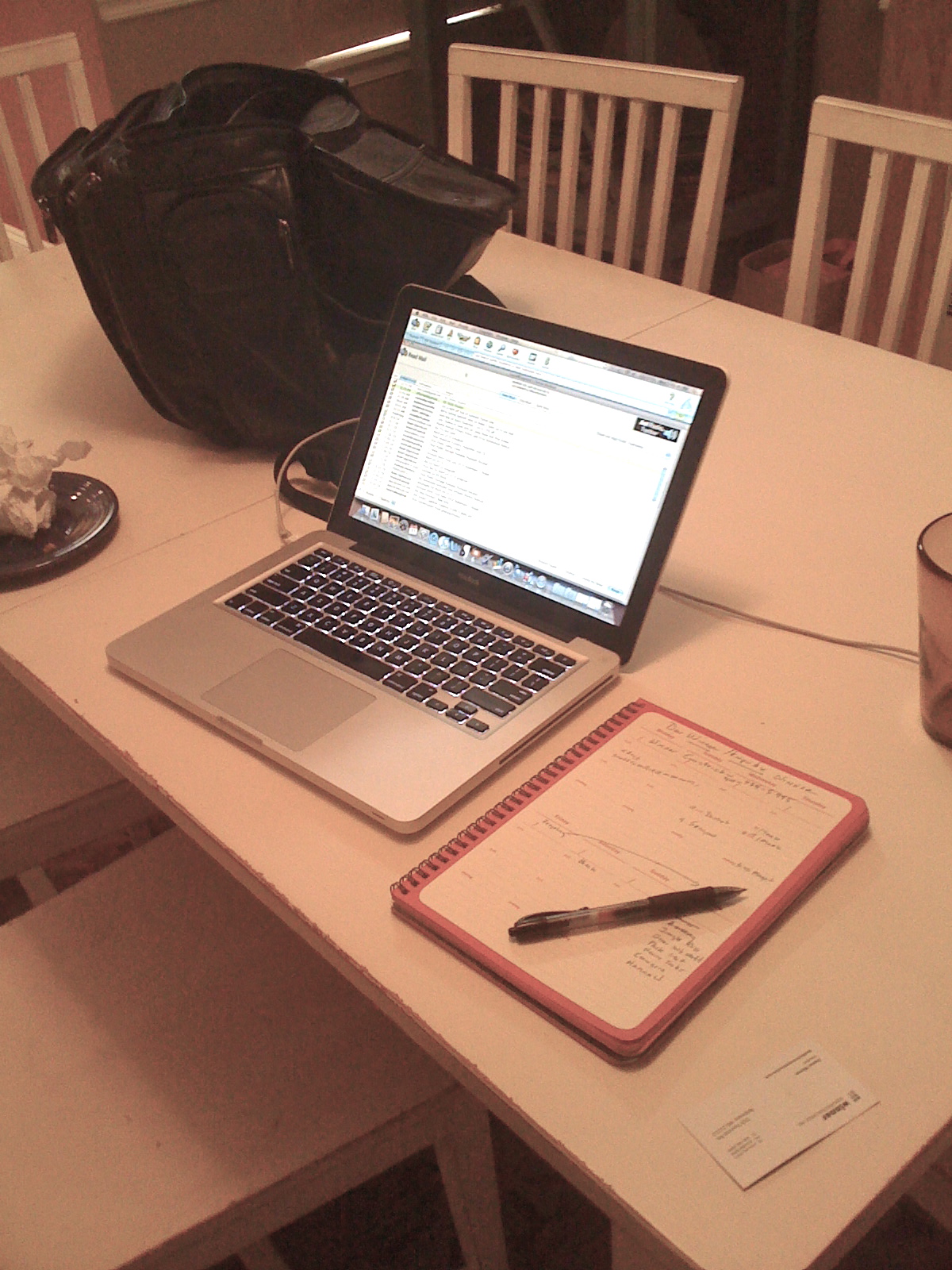
Laura Lippman, author of several novels I know you all know from the fabulous interview Alafair did with her a couple of weeks back. Check out her latest, I’D KNOW YOU ANYWHERE. Laura’s mid-remodel on her home office and has been spending time in many other places – everything from the beach to Starbucks to her kitchen table. Proof that brilliance can occur in any location. Just bring brain.
__________________________________________________

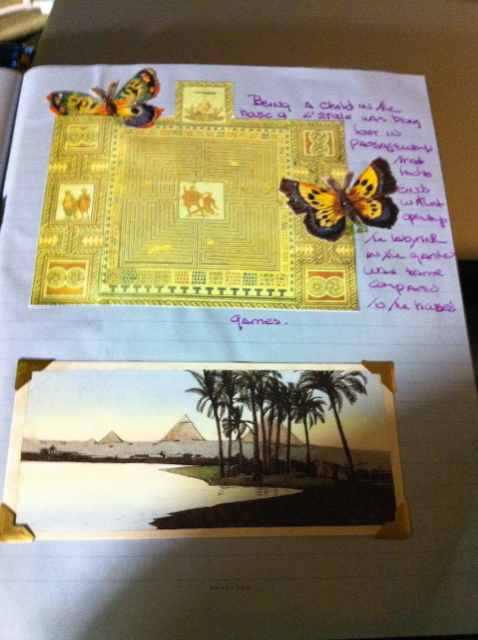
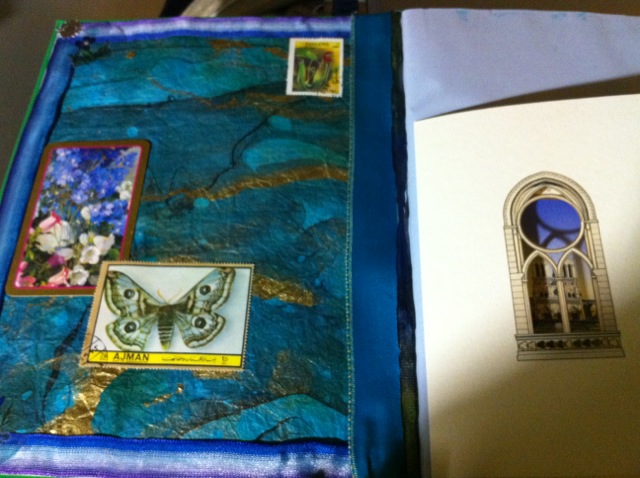
M.J. Rose, author of the acclaimed and inventive wonderful novels, which includes her latest, THE HYPNOTIST. As she explains, “A few too many years of having to write on the run – in cars, planes and hospital rooms – forced me to learn to write wherever I was. My workspace became my laptop and the journal that belonged to my main character. So rather than show you any of the multiple places where I write – my office or living room or the local Starbucks – which are all pretty ordinary – here’s my new main character’s journal. I start a new journal for every new book – or in the case of a series – for the lead character in the series. I write  in the first person from her point of view and create collages of the images and words that define her and her world.  Turn the journal upside down and from the back to the front are research notes not kept on the computer, lists of scenes, calendars, plot charts. While I often yearn to be the kind of writer who has a wonderful office with white boards and has cork walls filled with outlines, I seem to be more productive confined to intimate spaces.”


__________________________________________________

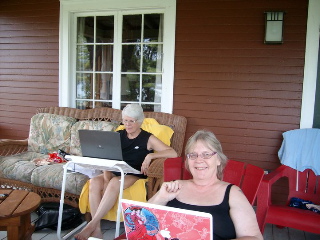
Anne Stuart, aka, Krissie, is one of the most fun authors to be anywhere in the proximity of if you’re ever at an RWA conference. Prolific and fabulous, you’ll want to check out her latest historical romance trilogy, edgy with mystery woven through, starting with RUTHLESS. (Oh, and one of the most captivating websites I’ve seen for an author.) That’s Krissie in the front in the red chair and her friend, Sally, writing in the background.  

__________________________________________________

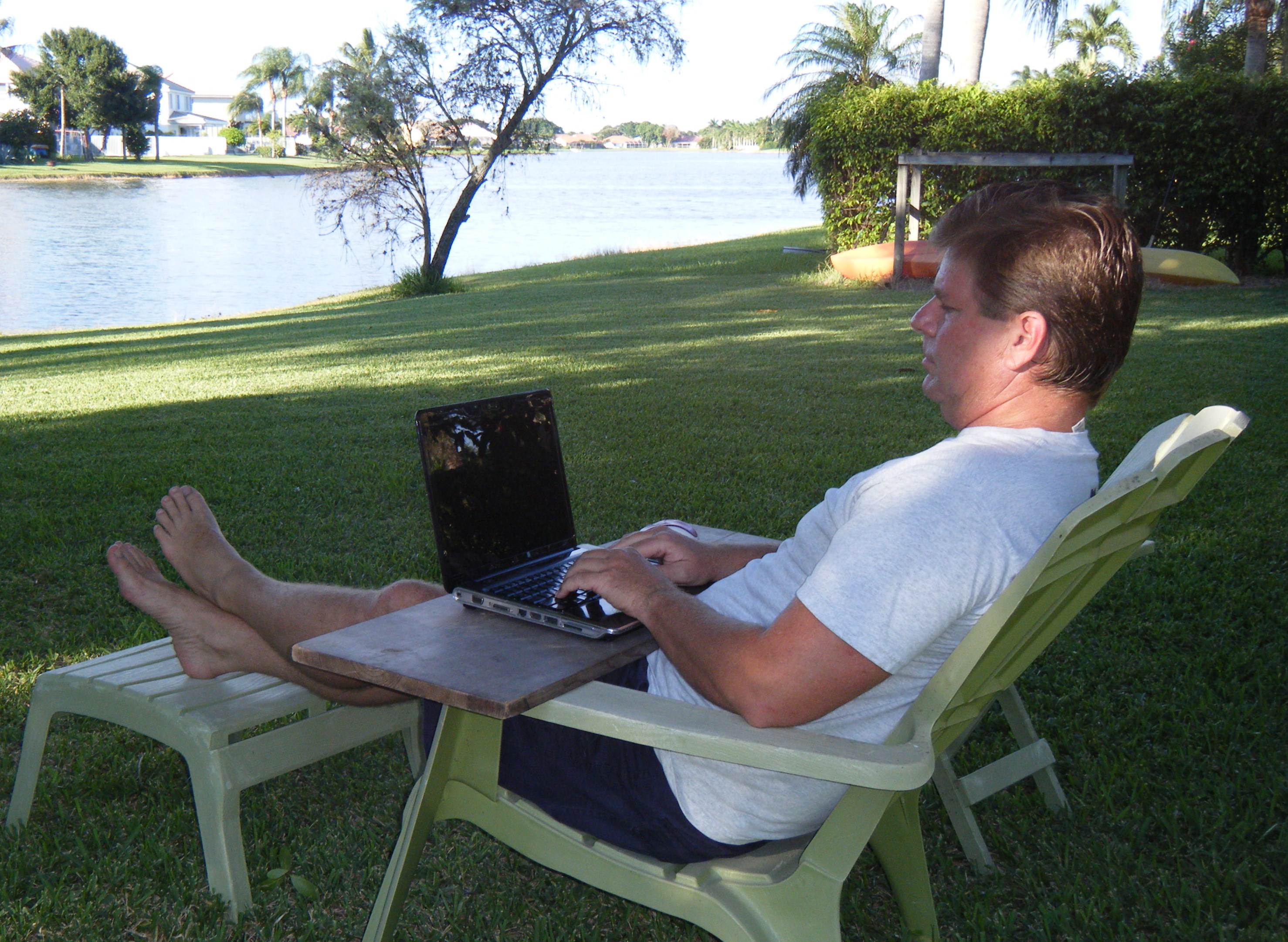
James O. “Jim” Born… and I can’t quite put my finger on it, but it seems like he’s cheating here, somehow. He writes well-loved mysteries, including BURN ZONE. I think we should take a vote in the comments as to whether Jim’s writing or not out there. And then I think he has to invite us all over anyway. 
__________________________________________________

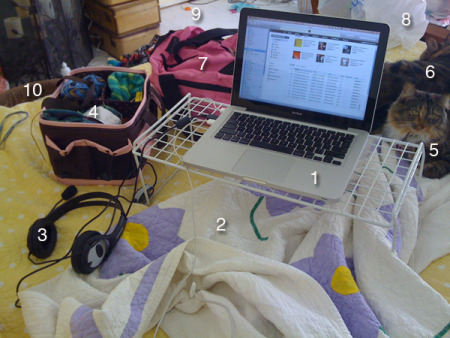
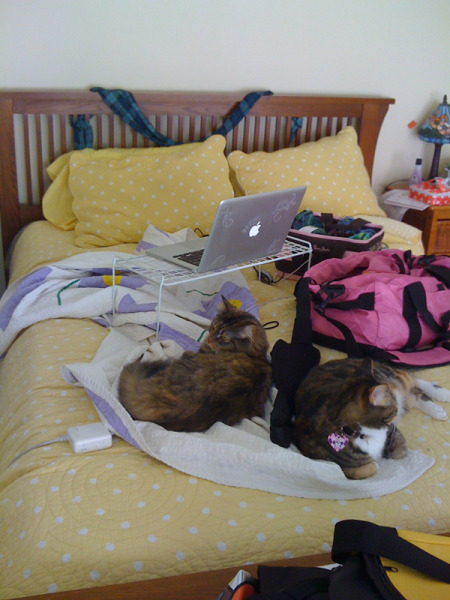
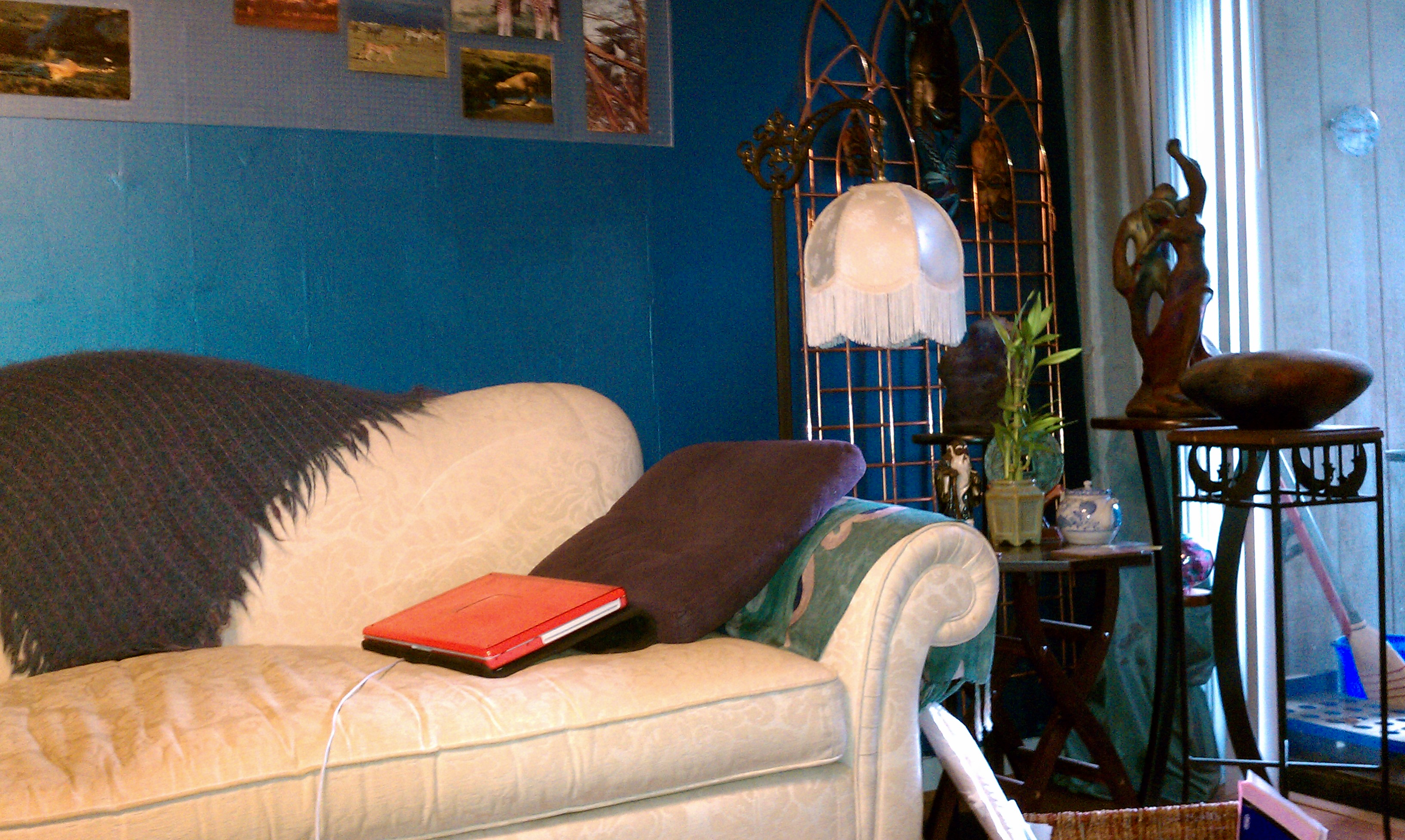
Lucy March, author of fabulous magical romantic fiction. (I can say that, since I was an early beta.) [You may know Lucy as Lani Diane Rich.] I absolutely love that she gave us a “reader’s guide” to her workspace:


  1. My MacBook, otherwise known as The Precious.
  2. Quilt. In case my toes get cold.
  3. Headset, so I can listen to my soundtrack without making others in the vicinity insane because they’ve been forced to endure OKGo’s “Here I Go Again” for the thousandth time. Although, that’s a truly excellent song, so what are they whining about?
  4. Knitting bag. When the writer’s block gets bad, I knit.
  5. Zoey. Cat. Unimpressed.
  6. Daisy. Cat. Unimpressed and sleeping.
  7. Gym bag. To remind me that if I don’t on occasion leave the house, my muscles will atrophy and I will have to hire a Swedish masseuse to carry me around. Which wouldn’t be so bad, if I made that kind of money. But I don’t, so… to the gym.
  8. Shopping bag, full of the stuff I won’t be able to afford anymore if I don’t hit my deadline. Fear isn’t a great motivator, but it’s effective.
  9. That orange blur? That’s the tape measure I’ve been missing for the last three weeks. Thanks, Toni!
  10. Cat bed. Unused. $10.


(Her blog has generated a huge following–such a great community over there. And you’ll see her latest, A LITTLE NIGHT MAGIC coming soon from St. Martin’s Press.)

__________________________________________________


CJ Lyons, who’s not only a terrific author, but is also a physician. It’s not quite right that someone has that much brains, is it? I think, no. Her latest seat-of-the-pants, take-no-prisoner’s medical thriller is CRITICAL CONDITION, out in November. CJ’s visited us here before at Murderati — check out her interview here. I think everyone knows CJ and I have been close friends and beta read each other’s works, but you know you’ve got a good friend when you can email her at some point in the middle of the night and say, “Okay, so I have this body here, and I need to know how to disguise the time of death,” and that’s all you say… and she writes back and tells you how. No questions asked. I’m pretty sure she’d help me hide the body, if she lived closer. You know, if I were a psychopath or something. Which I am not. Yet. (But may be, if Squarespace doesn’t upload these photos faster.)
__________________________________________________

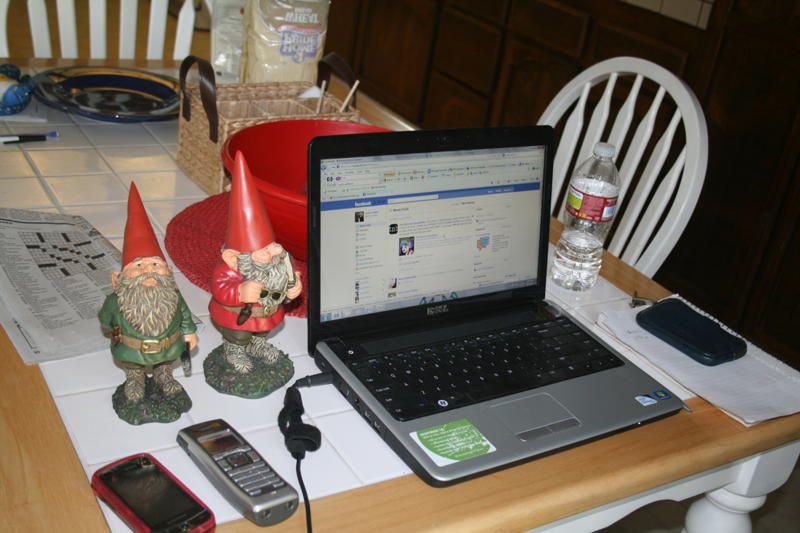
Okay, I have to say, I love the gnomes. And I never thought I’d write that in a sentence. But author / columnist and regular ‘Rati commenter Gayle Carline says:

1. The gnomes, Booker and Hatch. Booker carries a book with him and encourages me to write well. Hatch carries a hatchet and threatens to chop fingers if I don’t finish that f*&#@ing book.

2. Two phones, a cell and the landline, because I’d hate to miss that call from the agent who discovered me on the Internet and wants to introduce my fabulousness to the rest of the world.

3. The LA Times Crossword puzzle. Shut up, it helps me think.

4. The coin purse with my credit card in it, when I have to order stuff to help me. Like software, or books. Or shoes.

5. My little notebook, filled with crap I scribbled while I was waiting at the car wash/doctors office/son’s guitar lesson.
__________________________________________________

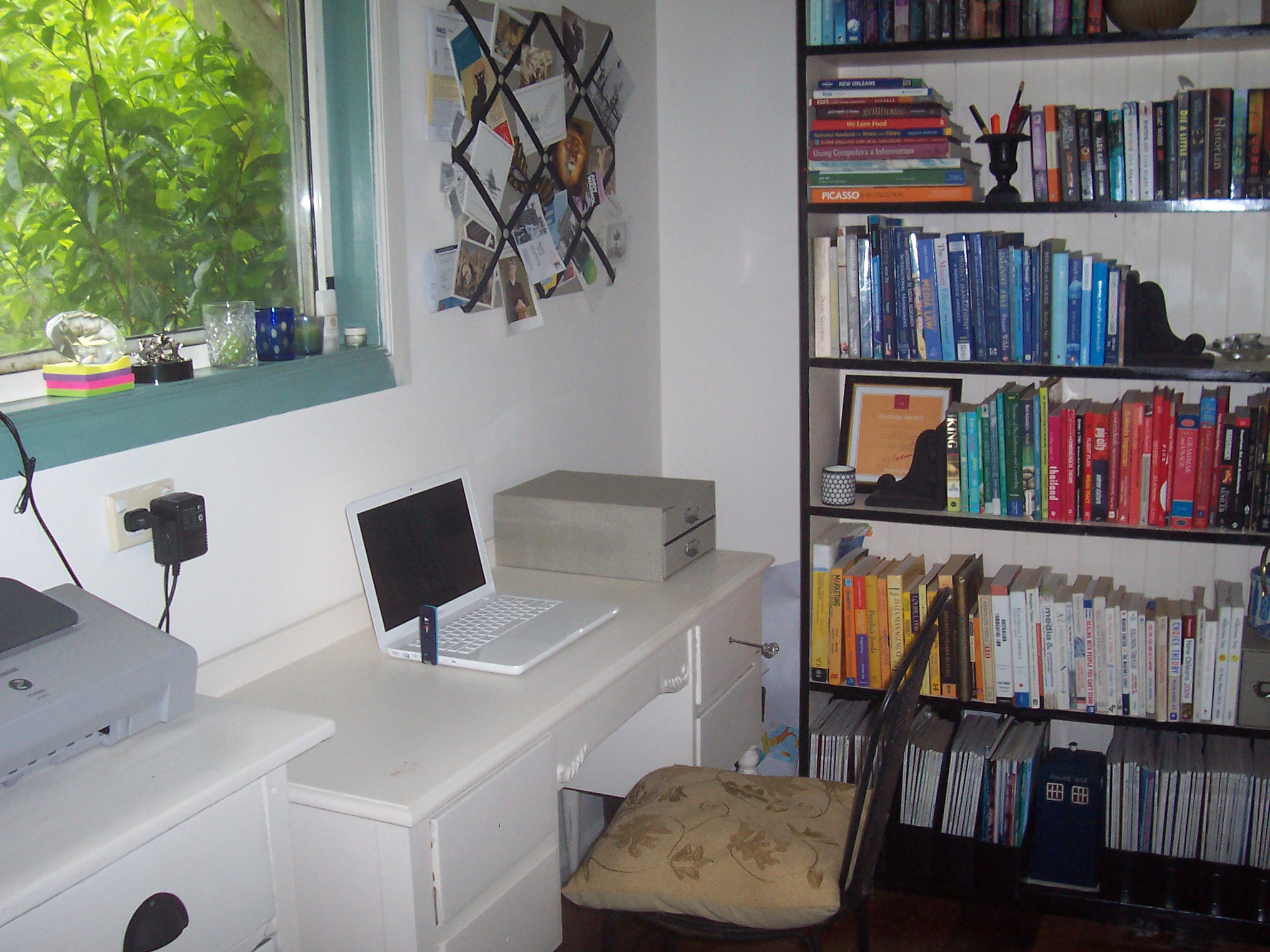
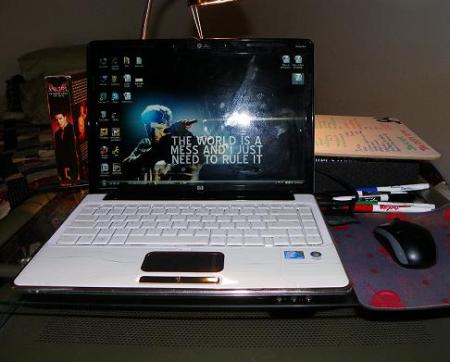
J.M. Kelley (who just had her first sale–JM, tell us about it in the comments and I’ll add the title here)… who is also one of our much loved commenters, says of her space, “My workspace is tiny, to say the least. I have about a six foot area I can call my own. My desk is there to store my computer, or to be used when I don’t end up slumping on the bed in the background to write. When I’m not writing, I’m worshiping Joss Whedon, and as you can tell from the photo, blatantly ignoring the fact that my laptop’s screen is long overdue for a cleaning. I’m a bad, bad writer, and rarely construct any outlines to reference, so that little whiteboard in the picture is my sole source of all info I need to keep continuity. The dry erase penguin does not endorse this behavior. Since I’m a raging insomniac, I do my best writing at night and into the wee hours of the morning. You know it’s a bad night when you see an Australian pop up in your buddy list and they message to ask what the *bleep* you’re doing up so late. Eventually I crash and burn for a couple hours, then I drag myself out of bed again, tired and haggard, to do my daily (fruitless) job searching and resume sending. And then I rush back to the desk when the next plot bunny hops into my head and start the whole process over again.”
__________________________________________________

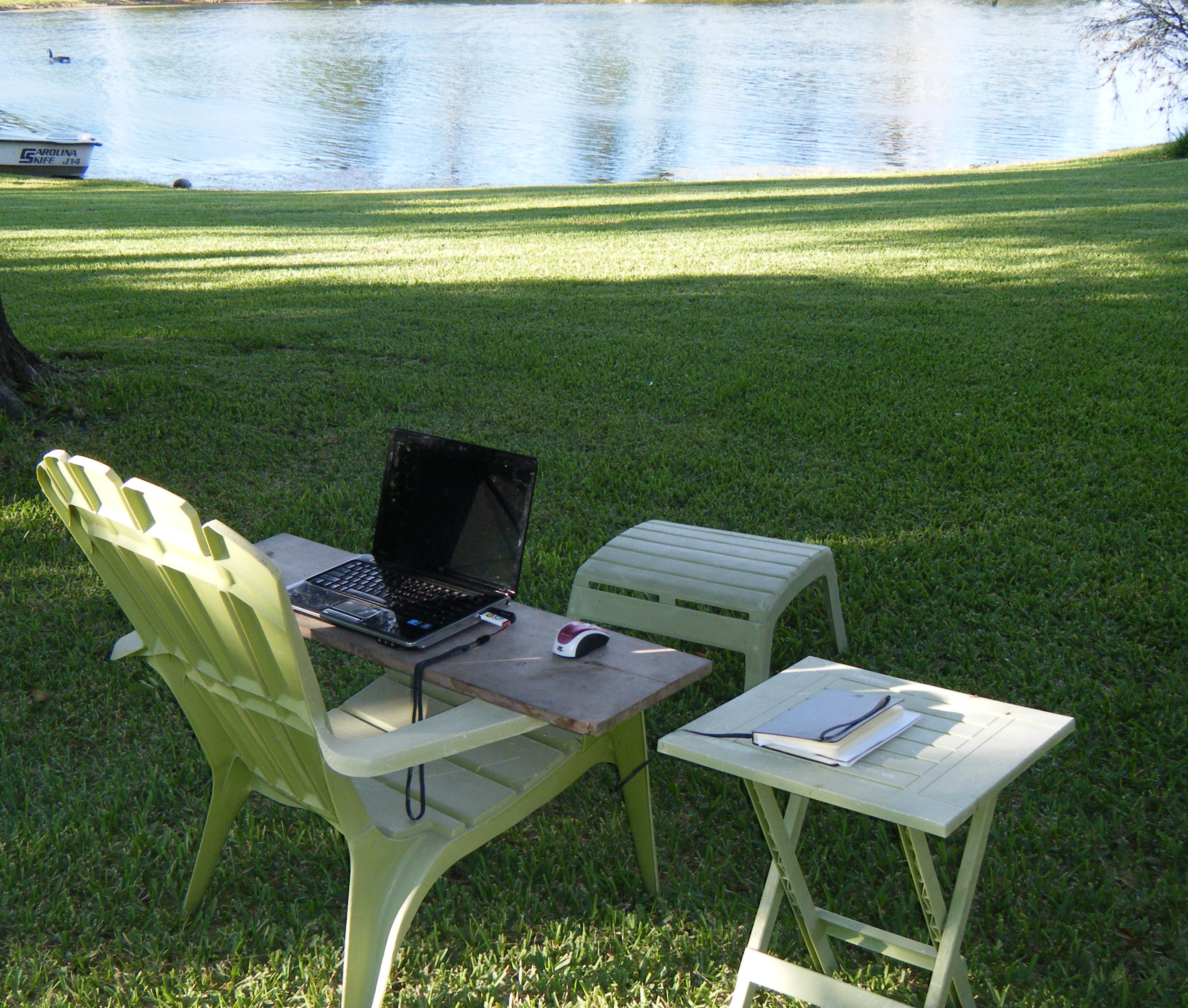
Catherin Shipton, another of the beloved ‘Rati commenters has both an untethered writing location (I love this deck!) and a tethered one, her office, of which she says, “my desk and my office were used a lot throughout my degree. Almost every bit of work produced came from there.  A hideously long project I did at a business incubator was completed there. This place has seen some major sweat hours.

Then my trusty pc died the week after I graduated. So far nothing fiction based has come from the laptop in this space.  I think I might need to get a bit of sage and burn off the old vibes. Or maybe I’m just a bit too in love with being able to switch to places that aren’t quite so tight now I have a laptop.”
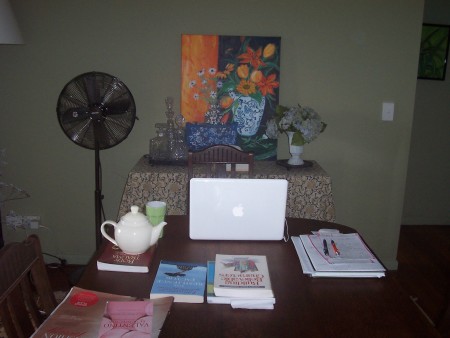
 

(Catherine, I want that fan. Brand name?)


__________________________________________________

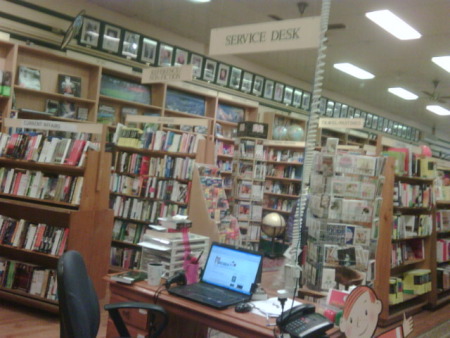
And our wonderful friend, Laura from Victoria, Australia, “run the service desk at Robinsons Bookshop in Frankston.” Have we mentioned how much we love booksellers? Love. Love. LOVE. [Which reminds me… Fran? You should send me something on Seattle Mystery Bookshop to include here. :)… me? pushy? nah.) 
__________________________________________________

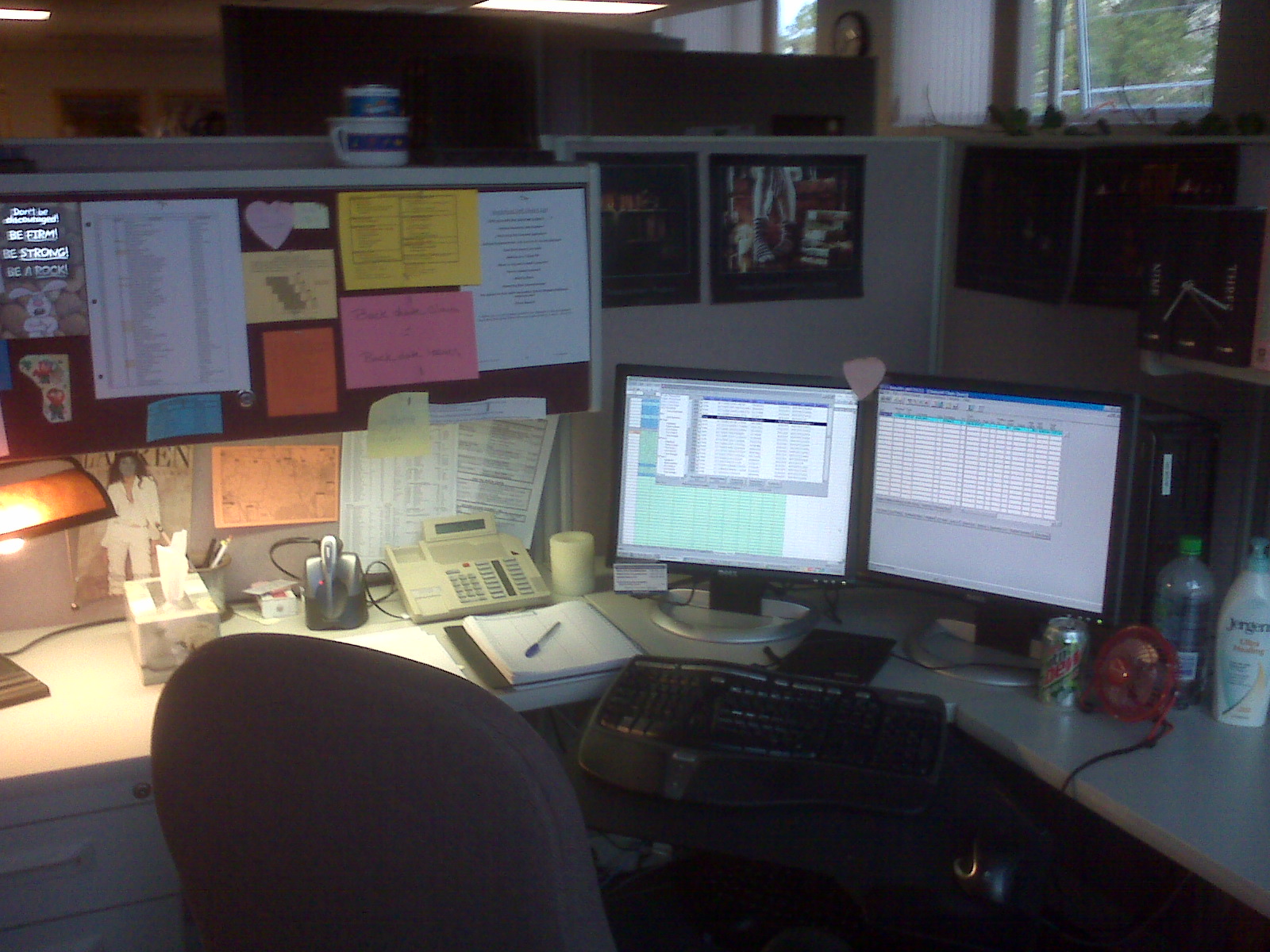
This is from PK the Bookeemonster, who’s another one of our much loved ‘Rati’s. She explains, “This is a photo of my workplace at the job (Dept of Labor – Unemployment Insurance Division).  I’m in a room full of cubicles, set up in three groups of quads. Luckily, right behind me is a wall of windows which looks out onto the neighborhood (yes, little houses) and the Rims. (ah, let’s see, the Rims are a sandstone bluff that runs along the northern border of Billings — picture attached). I’m on the second floor so I like to swing around and see what’s happening in the world outside.  In my cubicle, I try to have “book-ish” things around me: a clock in the shape of three books standing together (to the right), four posters of books in front of me right above the monitors, and I always have my Kindle in between my monitors and if I”m currently reading a book book I place it on the right-hand desk.  In my little clique of co-workers, we’ve named our cubicles and someone made little signs to put up on the outside wall; mine is appropriately “The Library”, as my love of reading is well known.”
 

__________________________________________________

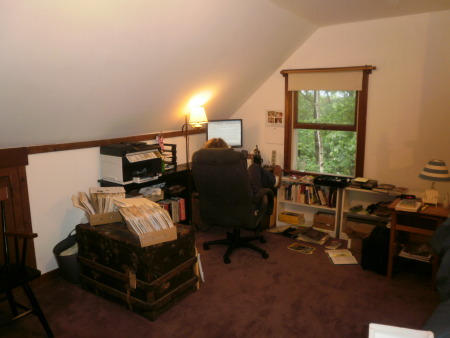
Gayle Lynds, author of taut, razor sharp thrillers such as THE LAST SPYMASTER has her latest out, titled: THE BOOK OF SPIES  Gayle’s in transition herself, so it seemed fitting that her work space sits sort of between the untethered and the tethered, and as she explains, “I’m in the process of moving from California to Maine to be with my fab boyfriend, John.  This has been an adventure in culture shock.  For instance, I’ve given up my red Jaguar for a red pickup truck, planted flowers and veggies, and made moose burgundy.  (What else can one do with moose?)  I’m in Maine now, having brought with me just exactly the research I needed for the book I’m writing.  My cockpit office is on the second floor, a corner of our bedroom, and looks out on beautiful white birch.  It’s tranquil but conducive to work.  I like it a lot.”
__________________________________________________

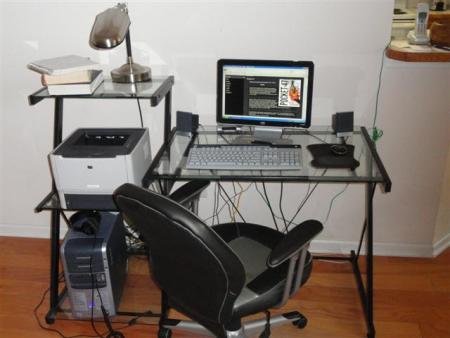
Fellow ‘Rati friend Jude Hardin says of his space, “I’m somewhat of a minimalist, and I like to keep my space clutter-free. I compose all my fiction here, listen to music, blog hop and so forth. I spend a good portion of the day in this chair when I’m not at my “real” job, and I even eat my lunch here most of the time.” I think he’s got such a perfect office that would work for so many people, especially in busy households. I just wish I could be as minimalist. Of course, Jude could be hiding bodies behind those walls. (grin) Jude’s book, POCKET 47 has a fabulous blurb by our own Tess Gerritsen and is coming out in May, 2011.
__________________________________________________

We’re continuing the minimalist theme for a moment here with Spencer Seidel‘s workspace. Spencer, a regular beloved contributor in the comments section says of his place, “As if you can’t tell, I’m a minimalist. The only unique aspect of it is that I have a framed saying on my wall (“Just write the damn book”), which I turn to whenever I start coming up with silly reasons NOT to finish a current draft. I wrote Dead of Wynter right here, which is going to be published next May.” 
[Oh, go check out his blog–the front page has these fabulous photos of huge desks at libraries made from books.]

__________________________________________________
Now this is Karin Slaughter‘s office. It’s bright and cheerful (I love the green) and just doesn’t seem like the office of someone who writes such twisted thrillers about brutal, cold-blooded murder, now, does it? Check out her latest riveting novel, BROKEN

__________________________________________________
And this Karen is one of our favorite ‘Rati commenters, Karen from Ohio, who explains, “Here’s my lovely little Arts & Crafts desk that I rescued from an elderly aunt’s ancient and creaky furniture she left us. It was in very bad shape, but cleaned up well, and makes a graceful addition to my day. It’s right in front of a big picture window overlooking our very private front yard (that’s why there are binoculars on the desk, in case a hawk lands in a tree). As long as it isn’t too cold it’s a great spot.”
I want this room. (sigh)

__________________________________________________
This, as many of you will recognize, is T. Jefferson Parker, beloved by the ‘Rati and cited often on lists of “favorite authors,” especially with such works like IRON RIVER

__________________________________________________
Now, this very zen-like office belongs to Lisa Unger, who writes dark dark thrillers, like her latest one out, titled FRAGILE. I love the lighting, the wall color, and I think that glass treatment on the door is a brilliant solution to bringing light into a room without bringing in unwanted views. I may adapt that here. [Um, because this is all about me.] 


__________________________________________________
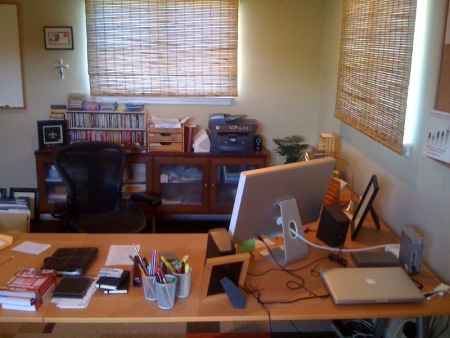
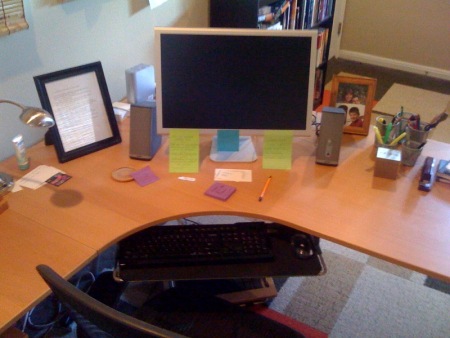
Jeff Abbott, fellow SAINTS fan (and therefore, a perfect human being, thank you), (hey, this is my blog, get’cher own pulpit)… anyway, Jeff’s latest out is TRUST ME. Here’s what he says about his office, “The first one is looking at my desk from the front door of the studio. Desk is a little messy right now, mostly because I have been writing downstairs since wife went back to work (she works at elementary school and goes back earlier than the kids do). I have had to write downstairs watching my sons. My studio is above our garage and only accessible through a outside stairway. Normally my blinds are up but I’ve had them down because they’re so pretty and it’s hot as hell.

Second is looking at my desk. Note to self on purple post it note read “Take pic for Toni”. Since I have been downstairs most of the week that was not a helpful self-reminder. 🙂 I get asked all the time about the carpet: they are tiles, multicolored, so we could create our own flooring pattern. My amazing wife found them, they are often used in design studios, schools, offices.”
__________________________________________________
Jeff (remember, perfect human) is joined by fellow perfect human (read: SAINTS FAN) Erica Spindler — author of BLOOD VINES — in loving those unusual shaped desks. I think I looked at this photo three times before I saw the skull. Here’s Erica’s:
__________________________________________________

If I had had all of the photos included here emailed to me anonymously and someone told me that one of them belonged to our regular and much loved commenter billie, I would have picked this one as hers. And not just because of the horses outside, watching over her, but for the serenity in this image. She says, “pony is saying ‘stop writing about magical ponies and get out here and get this blasted grazing muzzle off me before I starve to death!’ He has to wear one this time of year.” 

__________________________________________________
I love the efficiency of Dudley Forster’s desk here–Dudley’s one of our beloved (yes, I’m using that word frequently, but really, you guys don’t realize how much we appreciate you being here)… regulars. I especially love Dudley’s cat, McDuff. Isn’t that just the perfect name?


__________________________________________________

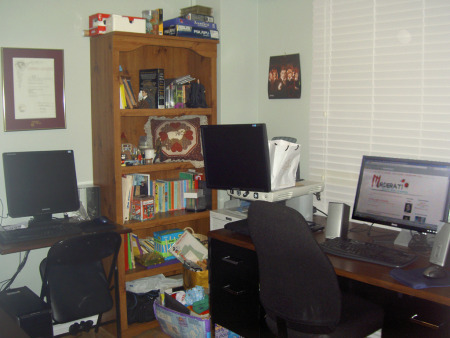
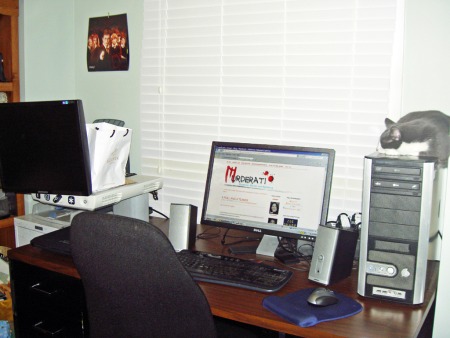
Now this one surprised me, mostly because my eye wandered over to the left and I saw that other box and screen. Regular sweetheart Debbie explains, “My den is 8×8 and I share it with two children, their computer and books, a piano, and the family cats who think that my tower case is theirs.  Pictured is Brontё and yes, there are chocolates in that Godiva bag thanks to hubby!  The machine beside my computer is for enlarging print (I’m blind) but when writing, I mostly depend on adaptive software that produces speech in an amazingly human voice.”

Debbie’s got tenacity and talent–I know we’ll be seeing her books on the shelves one day!


__________________________________________________

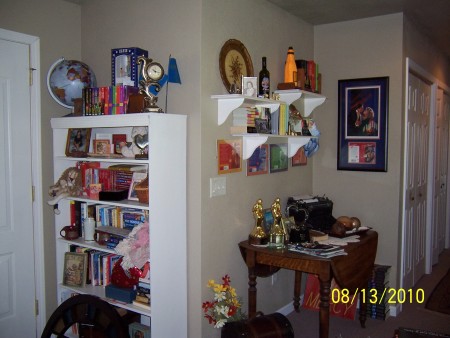
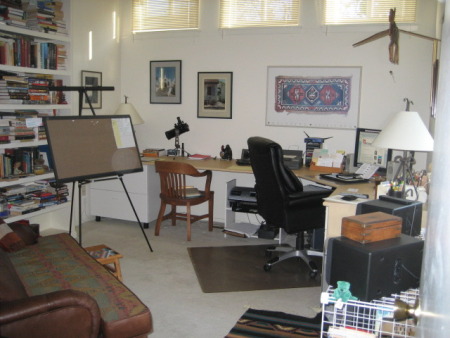
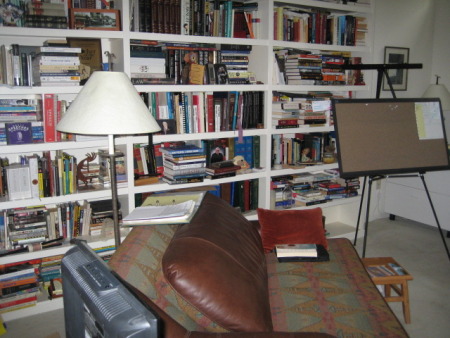
Sandy Toepel, one of our fabulous regular commenters sent these photos, and I love the light and the bookshelves and the neat antiques she’s got around the room. She says, “This is my room of accomplishments and challenges. Once, this was where I corrected tens of thousands of papers and created tens of thousands of lesson plans.  Now, it is where I am attempting composition of a different sort.” And I see that “tens of thousands” in that description and nearly plotz. You know, we don’t really think about all of the extra work our teachers go through during their hours at home in addition to all of the hours in front of those classrooms. Thank God for teachers. I know I couldn’t do it–I don’t have the patience or the temperament or the stamina for that kind of constant interaction with people who can actually talk back. (Unlike my imaginary people. Who can talk back, but can’t throw spitwads, so there’s a plus.)
 

__________________________________________________

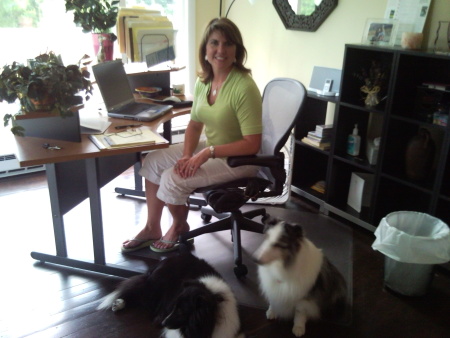
Lisa Gardner is sweet, funny, smart, sharp, and an amazing writer. I’m not sure if it was her great laugh or warm personality, but I had a hard time reconciling myself that this was the same woman who wrote books so scary, blood-tingling that I wanted to read with my hands mostly covering my eyes. Just goes to show you, looks deceive. Check out her latest, LIVE TO TELL.
__________________________________________________

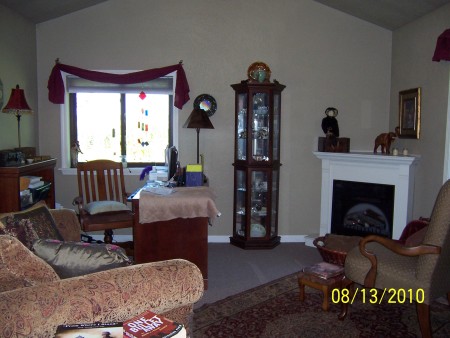
I have to tell this story. I first met Cindy Gerard at my first St. Martin’s Press cocktail party. I was terrified. I knew no one and my agent had had to leave, and I was on my own. Now I’m better in crowds at conferences, but if you’ve never been to an RWA conference, it’s hard to explain the magnitude. And the cocktail parties are usually on Friday nights, so you’ve had a good three days to be completely overwhelmed. Cindy must’ve seen the dear-in-the-headlights look, as she came over, struck up a conversation, and impressed me as one of the nicest and funniest people. I had to confess I didn’t know her books yet, but I took a bookmark and when I got home, I bought one. You know, hoping she’d be a decent writer. 

And I was blown away. Here was someone who was writing terrific sexy action / romance with great characters and witty, smart dialog and I devoured her whole backlist. I’m lucky to count her as a friend today, and she exemplifies the class and pay-it-forward attitude I hope to live up to. 

Go get her latest: RISK NO SECRETS


__________________________________________________

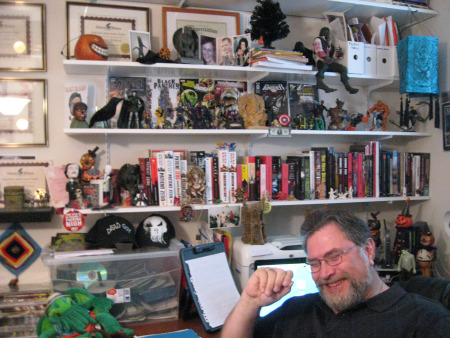
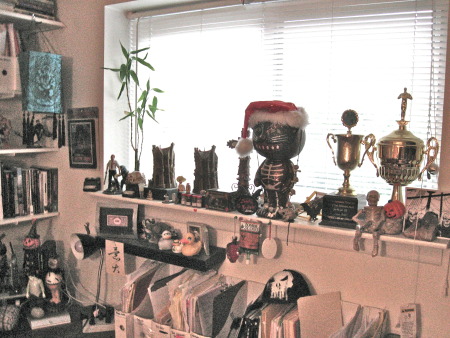
You know, I think Jonathan Maberry wins, hands down, for coolest set of collectibles. How can you not love a guy who has everything from dragons to dinosaurs to demented rubber ducks? You know, really? You want to go read his books, right now, just looking at that office. And his laugh. 😉 So go check out his latest, WANTED: UNDEAD OR ALIVE


__________________________________________________

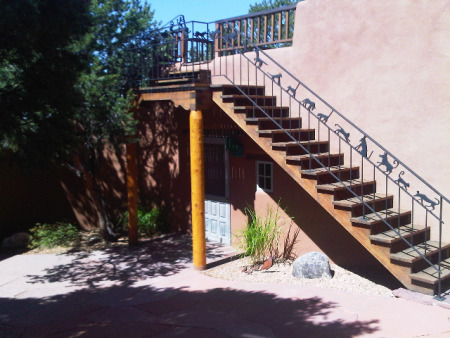
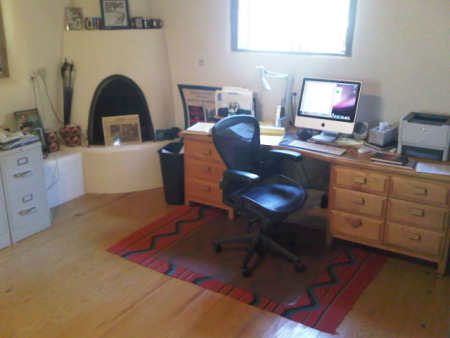
When I first saw these photos of David Morrell‘s office, I thought, “oooh, retreat!” and it has that peaceful vibe to it, doesn’t it? Which just does not explain the mind that can come up with the twisted, hypnotic, heart-stopping thriller stories that he does, but like Lisa Gardner, looks can be deceiving. Check out his latest, THE SHIMMER and I encourage writers to poke around his website (linked to his name above) — it’s got some great perspective on the industry and the changes we’re seeing.
 

__________________________________________________


And finally, last, but not least, is Lee Child‘s beautiful office in New York. Lee’s the author of the famous Jack Reacher novels, and he explains his space thusly: “My office is a separate apartment, in the same building, but 18 floors below where I live, in NYC.  Major productivity tip: a separate desk and computer for the internet.  Major luxury: a separate desk for handwriting and page-proof reading, without a keyboard or monitor to get in the way.” 
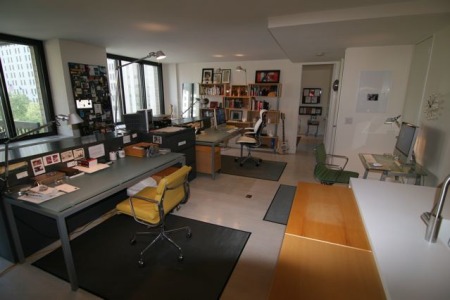
 

When I got a glimpse there to the left of his view, I commented that I didn’t know how he focused. He then sent me this photo, and explained that he focused with “rigorous self-discipline.” 


And what a perfect way to end this round-up. Rigorous self-discipline–no matter where you are, no matter what your workspace is. Dedication to excellence and rigorous self-discipline is what gets us from page one to THE END, one word at a time.


In the Lair

by J.T. Ellison

This is a truly misleading topic for me, because while I have an office, a beautiful, private, somewhat comfy office, I rarely use it to write. I’ve spent the past four years writing on a laptop, which means I’m basically a nomad. I can write anywhere in the house – upstairs, downstairs, in my office, in the bonus room. But 90% of the time I write in the living room. Which is a shame, because I do love this desk (and yes that is a bat dangling from my fan…)

Now we’ve gone and messed things up, because a few weeks ago we bought a new couch. I adore said couch. It’s big enough that both Randy and I can lay on it watch movies or read – it’s a rumpus couch, without a doubt. But we had to move everything around, and sell the end tables, and suddenly, my office away from office was gone. My chair which used to back to the bookshelves now backs to the front door – disconcerting, to say the least. I’ve tried writing on rumpus couch, and that worked, sort of, because of the lovely side table beside it, but I ended up sort of hunched over, and one day last week, I found myself back in my chair. Ahhh…

So I’m in transition. I’m making a concerted effort to actually work in my office – I’ve moved almost all my material up there. My Quo Vadis Equology planner, my 5 year diary (not doing so well with that – shame on me) the old Moleskine with all my notes from last year, my bible – the Levenger Circa notebook that houses my series’ cast lists, current research, notes and other necessities, all stay upstairs now, watched over by one of my blessings, the stone carving that says “DON’T PISS OFF THE FAIRIES” My idea box in there (that red box) and the files that I get into daily.

And my Owl, who watches over me and gives me wisdom…

And my whiteboard, with book stages and due dates, plus other projects. (I’m kind of ready for October, because September’s cat looks a bit psychotic to me.)

My laptop goes on the nifty lapdesk I picked up at Staples last year and immediately got addicted to – it has the laptop, a cushion for my wrist, my Rhodia notepad/mousepad for to dos, and my Clairefontaine notebook for the book I’m working on. (If you can’t tell, I’m addicted to Exaclair products – truly the highest quality materials for writers in the world.) I’ve been trailing this through the house, searching for the right spot to nestle in and work. We’re moving the chair in my office into Randy’s and moving another one into its place, so we’ll see if that’s better.

Why don’t I work at my desk? Well, I think the true answer is I don’t feel very productive there, and I think it’s because my back is to the door. The room we made my office is strangely shaped, with an offset, diagonal door. The door opens to the stairs, and down right out the front door. Anyone vaguely familiar with Feng Shui will recognize that all my creativity leaks straight out of the house through a clear, delineated path. I don’t like the keyboard either; I’ve gotten so used to the Apple keyboard on my laptop with the individual keys (I know, there’s a word for that) and I hate the clacking the joined keys make. I’ve talked about my boxes, which you can see in the picture below – most are stored away now, but the two books I’m working on now are still out.

And here’s the view. Right into my next door neighbor’s pool. Which, let me tell you, is a real treat.

We took steps to make that problem go away last night – we planted a row of Thuja Green Giants along the fence row. They should grow to about 40′ – 60′ and kill that awful view. And I also got to dedicate the very first tree we planted to the memory of our friend David Thompson, which makes me happy, knowing that eventually, when I look out my office window, I’ll see David’s tree instead of the pool.

We’re going to redo everything here before long – put wood down, paint, and I’ll make a decision about the desk. As gorgeous as that furniture is, it takes up a LOT of room space. Space that if I turned the room, faced the opposite wall, had the door to my left instead of at my back, might make me feel more settled. But there is something about working at a desk that feels like, well, work, to me. I don’t know if redecorating will change that.

Which brings us to process. That’s something else that seems to be in flux right now. I’ve been very unsettled for the past year from both personal issues and so much travel that I’ve lost my good habits. Which is B.A.D. For someone like me, to whom schedule and order and planning are paramount, losing my habits is a big freaking deal. I also switched computers, from Windows to Mac, switched writing programs, from Word to Scrivener, back to Word, to Pages, back to Word, and back to Scrivener again. These changes were monumental, and have wrecked my normalcy. The good news is that instead of doing a major tour for THE IMMORTALS, I’m relying on the Internet, so I get to stay home for a few months. This make me very, very happy. I plan to create new habits.

All that said – I still shoot for 1,000 words a day at the beginning of a book, and struggle through the first half for months until one day, almost by magic, the story comes together, and then the last half of the book gets written in a few weeks. I think my one day record is about 8,000 words, and that’s only happened once. But I was so close…strangely enough, that book is called SO CLOSE THE HAND OF DEATH, so I guess if you look at title as an allegory for deadline, it’s right on.

And here’s a random shot – my filing cabinet, so to speak. This is my daily workspace – my Dropbox. And yes, everything is filed (and subfiled, and so on) – I’m not good when it comes to chaos.

Thanks for letting me share my space with you! This has been a fun and illuminating process, and has proven one thing to me – I have severe office envy. And if you want to compare and contrast, here’s a piece I did on the subject two years ago. It’s goes into greater detail on what’s actually ON my desk…

Wine of the Week: Mirabile Nero D’Avola 2007 – Spectacular! Rich, fruity and ridiculously inexpensive. Would I steer you wrong?

My Pit

by Rob the Slob

Photos of our workspace, huh?  Be careful what you wish for.  Just click on the thumbnails to see the full-sized photos.

MAN STYStealing blatantly from my hero, William Goldman (whose book you’ll see prominently displayed), this is what I refer to as my pit.  And, believe me, it really is a pit.  My wife calls it my Man Sty.

I’m not known as Rob the Slob for nothing.

This is where I sit every single day and most of the night.  I must be spending twelve or more hours a day in this chair lately, including weekends.

My ass is sore.

As you can see, I write on an iMac.  I’ve long been a PC guy, but I love my iMac.  On the right is a screen that at the flip of a switch is a secondary Mac display or a Windows 7 monitor.  Depends on my mood.  I’ve got a PC under the desk.  

The thing with all the knobs on the left is my newly acquired Mackie Oynx 1640i firewire mixer.  I write and record music and this helps me do that.

THE LEFT SIDE OF HEAVENThis area is directly to my left as I sit at my desk.  I like the bookshelf there so that I can reach over, grab a book at random and get inspiration from my favorite authors. When I’m low on writing energy, there’s nothing better than reading someone else’s work.

I probably could have cleaned up and made everything pretty, but let’s face it. Most writers are slobs.  We’re right brainers, so what do you expect? I’m looking at some free time late in October and I plan to rip everything out of here and completely redesign this space into something resembling a real office—and recording studio. 

MY BELOVED CHILDRENHere we have an old Fender Bullet Strat that’s worth about ten bucks, which I bought during the Fender CBS years (I worked for CBS at the time as a script typist).  The black one is a Gibson Les Paul, which is on loan from my daughter.  And to the right of that is my new Paul Reed Smith Tremonti, which I absolutely love.

You’ll note the piles of Gold Medal books in the b.g.  My “collection.” Turns out I collect more dust than books.

I’d show you a wider shot of the room, but you’re already disgusted enough.  You do not want to see any more than this.  Trust me.

LOOK AT THE SIZE OF THAT HEAD!This is a reverse shot—and what I look like most of the time I’m writing. Spiffy glasses, eh?

And finally…

MY BRAIN ON DRUGSThis is my real pit.  Where I keep all of my files, all of my notes, all of my ideas… It’s my portable office. I try to carry it with me wherever I go.

Sometimes I forget to bring it.

Hilarity ensues.

————————-

JT’s INSPIRATIONOkay, this shot is for JT, who insisted.  If I got embarrassed easily, I’d be very red-faced right now. Because, let’s face it, I’m really baring my soul here.

a poll and a teaser

by Toni McGee Causey


I would really love it if you all would help resolve a bit of a mystery for a lot of us freaks/writers/authors/scribblers…

Lately, I’ve seen a tremendous amount of discussion on a couple of writers loops I’m on, and elsewhere on various blogs, about how important social media is to a writer’s career. We all pretty much agree that it’s important to have a website (she said, the person who has not updated her own in a long time, yikes)… but there is the assumption / pressure / voodoo guesswork that it’s critical for an author to also be present on Facebook and Twitter and other social media sites.

The assumption is that social media helps authors sell books. And the corollary is that a lack of presence means lost sales (bad author, bad author).

I think these are incorrect assumptions, but I could be wrong.

My theory is that most people who “follow” an author on Facebook or Twitter do so after they’ve already learned about the author–usually by buying their books or visiting them on blogs. I’m not sure that the exposure to the author on Facebook or Twitter actually compels a follower who hadn’t already been interested in buying the author’s books to then do so. 

Does that make sense to you all? 

Now, don’t get me wrong–I enjoy Facebook and Twitter and I think that it’s funt to build a relationship with readers, and I know in my case, many readers have become real friends, so that’s a lot of lagniappe, there. Subsequently, there have been times that these friends have talked about someone else’s books and I’ve gone to check that book out and then I bought it. But I bought it on word-of-mouth, not on the author having posted information. (In each case where this happened, the person had bought and read the book; they had not re-posted anything from the original author.)

I also know that there have been a few times when I’ve seen an author be so… repugnant… on their social media interactions, that I am no longer interested in their books, so the social media thing can definitely backfire.

So I’d like to know if the mandate to “get a FB and Twitter account” to “help sell books” is a fallacy… or if it helps… or if sales are just an occasional side benefit. 

Would you mind telling me which of the following is true for you? Please feel free to pick more than one if you do some of one, some of the other. I’m looking more for overall trends here, so feel free to elaborate.

Now, this is not just aimed at readers, but I really hope you all will come out of lurkdom and post. To make it fun, one lucky commenter will receive a $25 gift certificate to the online bookstore of their choice.


POLL

a) I follow authors on FB/Twitter after I’ve read their books, not before.

b) I follow authors on FB/Twitter after I’ve heard about them from their blogs — this does not mean I have bought or will buy their books.

c) I follow authors on FB/Twitter after someone else has mentioned them / tweeted about them / shared a link, but that’s more out of curiosity, and does not mean I will be buying their books.

d)I follow authors on FB/Twitter, and in some cases (or all cases), have then subsequently bought their books.

e) I follow authors on FB/Twitter after I heard about them from their blogs, and I have then subsequently bought their books.

f) I follow authors on FB/Twitter after someone has mentioned them/tweeted, etc., and I often then buy their books.

g) I follow authors on FB/Twitter and ended up buying something they recommended. (Doesn’t mean I bought that author’s books, though.)

h) What the hell? Who the hell follows authors on FB/Twitter? I don’t “follow” authors online, and I still buy books.

i) WRITE IN YOUR TAKE ON THE USE / ABUSE / FALSE ASSUMPTIONS about Facebook and/or Twitter.


And now, for the teaser part of the post…

For the next two weeks, you will see all of our workspaces and hear about our writing processes. Well, everyone except moi… mine was posted a couple of weeks back here. I think this is a first for us–a concentrated two week look into the same aspect of each of our lives, and how similar–and different–we all are.

On my Sunday, two weeks from now, we have a round-up of photos from a bunch of cool writers friends, and we’re adding more through this week. (Seriously, you will love glimpses into these writer’s workspaces — Lee Child, David Morrell, Laura Lippman, MJ Rose, Anne Stuart, Lani Diane Rich, Karin Slaughter, Lisa Gardner, Cindy Gerard, Erica Spindler, T. Jefferson Parker, CJ Lyons, Jeff Abbott, James Born, Gayle Lynds, Jonathan Maberry… and YOU.)

I want YOU, yes, YOU to send me your photos of your workspaces, because you’re a part of us. So many of you have visited with us every day, and we’d love to include you in our pictorial. YOU DO NOT HAVE TO BE A WRITER. We LOVE READERS. There are a bunch of writer friends who post here for whom I do not have an email address, and yes, I want you on board. All of you. What a cool round-up that would be.

Here’s what you do — take a photo of your workspace. I don’t care if it’s a barn, a desk in a cubicle, an assembly line, a backhoe… take a photo of your workspace and email it to toni [at] tonimcgeecausey [dot] com. Any photo will do, and don’t worry if it’s dark or whatever–I have Lightroom, I can deal with it. Email it and tell me in a sentence or two something about your workspace and what you do there.

C’mon. Join the fun. I’ve got photos right now of everything from a Starbucks to a highrise apartment to a bed. (Yes. A bed. Which is so perfect.) So send me yours, dear ‘Rati. You belong here. 

Now, on to your answers! And thank you.

Fortune-Telling

by JT Ellison

My husband and I just celebrated our 15/18th anniversary. Why the two dates? We married on the 3rd anniversary of our first kiss. Which was one day after we met. We didn’t waste a lot of time falling in love, we sort of did it immediately. Honestly, he could have suggested that we run off to Bora Bora and get married a week later, and I’d have said, “Just hang on a moment, dear, while I grab my favorite bikini.”

As it happens, my sweetly practical husband wanted to wait until we graduated from grad school to get married. A wise, sage man he is – the allure of knowing our lives were already intertwined, that we would work and love together for years to come, was a heady aphrodisiac. Not that I’m competitive or anything, but the desire to impress him drove me to new heights with my schoolwork—not to mention my full time job—and it was a good couple of years.

We were heavy into the political scene at the time—it looked like he was going to be the candidate and I would be the campaign manager. This was a shock to our professors, who thought I’d make a decent candidate myself, until they tried filming me giving a speech and the wheels came off the wagon. Me and Public Speaking were not a marriage made in heaven.

Me and Randy? We are.

So there’s a place we always go to celebrate, and a bartender who’s a friend, and when we all raised out glasses to toast, she said,” Did you ever imagine you’d be where you are today when you got married?”

Which was hysterical, because Randy and I had just had that talk a few hours before.

The short answer is: “No.” The long answer is, “Um, no way.”

Now, Randy runs his own market research firm. That wasn’t a huge surprise, because he’s damn good at public opinion polling, and a natural leader, so I always pushed for him to get out from under the man and run his own shop. He’s been at it for a couple of years now, and it’s a lot of fun. A lot of work, but he loves it.

Me, an international author? Now, that’s a surprise. If you’ve been here from the beginning at Murderati, you’ve been able to track my career from its inception, literally. So you know I’m not kidding when I say this has rather fallen in my lap, and I’m doing my best to manage the ramifications. Two books a year is fun, but stressful, and I’m so committed to making each book better than the last that I sometimes lose the forest for the trees. But things are good, and we’re both doing what we love.

If I’d had any inkling that all this was going to happen, would that change the way I feel about it? Absolutely. I’m a huge fan of letting life unfold, of climbing the mountain, not appearing at the pinnacle. I don’t want to know what’s going to happen tomorrow. We’re at a completely blissful moment in our lives. All is well work wise. We love and respect each other. We have our parents. We have a roof over our heads and money set aside for later and the freedom to travel. We are blessed.

So when I had an opportunity to have a reading done on my future, I balked.

You see, the new book involves the occult. And through the media promotion, I’ve had the great pleasure of meeting a V.I.P.—Very Important Pagan—in the Nashville community. I interviewed a few Wiccans for the book, and did a ridiculous amount of research into their ways, and the ways of the Pagans, the Stregheria, Goths… hell, even Buddhists. Through all of that, I’ve seen many ways of predicting the future, learning the future, and altering the future.

And that, more than anything, frightens me.

I don’t want to know the future. I love that sense of uncertainty that permeates my life. Will the book do well? I don’t know. Could I ask one of my friends to look into the matter and tell me, or give me a spell or a blessing to alter its course? Yes, I could, but I’d never do it. I’m such a firm believer in what happens, happens for a reason, that the idea of actually knowing what’s going to go down freaks me out of a bit. Good, bad or indifferent, my life is unfolding in ways I could never expect. I don’t want to mess with that.

Now, all that said, I do believe in signs. Like the crazy fortune cookie I had once that said “The best advice comes from a child,” just a few days before Lee Child became my ITW mentor. Or the fact that lately, I’ve been besieged by grasshoppers. They land on me when I’m outside, they show up on my deck, I even had one in my cart at Target the other day. If I were a practicing Pagan, I would assume (and be utterly delighted) that I’d been chosen by the Goddess and that she was speaking to me – in this case, the Goddess Aurora, who asked Zeus to grant immortality to her lover, but neglected to ask for youth as well, and since Zeus was a right old bastard with a sick sense of humor, he granted her wish. Her lover, Tithonus, Prince of Troy, was made immortal, but continued to age. She finally turned him into a grasshopper.

The Gods and Goddesses love to send signs. They may appear in person, or as something else. They carry a message, or a blessing, or simply want to check on things. I like that.

Then again, I’m also working on a story about a grasshopper, so the non-believers could say I’m just finding them more often because they’re foremost in my mind…

I think that I prefer the former, for the research I’ve done into Aurora shows her as the Goddess of rebirth. Considering the tattoo on my ankle is two Chinese figures, strength and rebirth (which combines to be the Phoenix Rising) and I’ve reinvented myself to become an author, it’s not such a stretch that she’d be calling to me, now is it?

So my question for you today, folks, is this: If you could see into the future, would you? Do you want to know what’s coming down the pike, or would you rather sit back and let things unfold as they will? Have you ever had a reading done? I know our Pari is handy with the Tarot cards, and our Alex certainly treads through the otherworld with her novels, and I assume, her research. What about you?

Wine of the Week: Sadly, one of the Australian vineyards that we frequent (namely, through a yummy wine called Marquis Philips McLaren Vale Shiraz ) is going out of buisness. They has a lot of wine that needs to be purchased. So here’s a link to the story, in the hopes that a benefactor may be found.

P.S. The wonderful folks at Exaclair, makers of Clairfontaine and Quo Vadis, the notebooks and planners I use (and will talk more about in 2 weeks) did me the honor of a feature in their Writer’s Project. Click here to take a look.

Digging Deep

by Rob the Slob

There’s nothing quite as satisfying as getting an email from your editor telling you that your latest draft is a job well done.  Especially when you knew in your gut that the first draft was quite possibly a disaster.

After doing this for a few years now, I can tell you with great certainty that the difference between the success and failure of a book (from a writerly POV) can often come down to your relationship with your editor.

As some of you may know, I’m with a new publisher (Dutton) and am working with the brilliant young editor (Ben Sevier), who first acquired my debut novel Kiss Her Goodbye over at St. Martin’s years ago, shortly before he left there.

I was mightily bummed when he left SMP, and I tried to tell myself that all would be good—and for the most part it was—but now that I’m working with Ben again, I realize how different things might have been if he’d stuck around.

You see, Ben is an exceptionally good editor.  He has a keen eye for story and character, and a lot of great ideas, but he also has a way of challenging you, helping you to really dig deep until you find your best work.

The book we’re working on right now (I’m in the midst of a polish) has without a doubt been the toughest book I’ve ever had to write—partly because I’m in territory I’ve never fully explored before, but also because Ben has not spared me.  When he thinks I can do better, he pushes for it.

And that, my friends, is what you want in an editor.

After four books, I was at the point where I was starting to have trouble getting excited about writing.  I had no intention of quitting, mind you—and I think those four books are pretty good (although I also think there’s always room for improvement)—but I can’t tell you how nice it was to work with someone who was not only a cheerleader, but wasn’t afraid to give me that slap in the face that I needed to wake me the hell up.

I think it’s important that, no matter what we do for a living, we find a way to shake it up once in a while. Look for ways to challenge ourselves.  Go places with our thinking and our creativity that we’ve never gone before, because there are discoveries to be made.

After turning in a less than perfect first draft of this book and hearing Ben tell me, in the kindest possible way, that I could do better, I have to say that I was spurred on to work harder than I’ve ever worked before.  And I think the results show.

Believe me, when I turned in the revised draft, I was sweating bullets.  Was it as successful as I thought it was?  I spent my entire vacation in Hawaii waiting for that phone to ring or that email that said, “Dude, this is a screaming piece of shit.” (Not that Ben would ever say anything like that. But my imagination tends to run wild when I’m anxious.)

Fortunately, the response was just the opposite, and I was both relieved and overjoyed that all of my back-breaking work had paid off.

And it wouldn’t have happened if I didn’t have a terrific editor.

Every writer should be so lucky.

—-

Today’s discussion:  Do you ever feel as if you’re just going through the motions?  Have you ever had someone really challenge you and found yourself digging deeper and working harder because of it?  If so, tell us about it.

Or if you’ve ever lost an editor in the middle of a deal, how did that work out for you?


summer goodness

by Toni McGee Causey

You know what? I had a grumpy post for today, but really, who wants to read a grumpy post? Besides, it’s difficult to finish a grumpy post when you take a break from it and go off to write and then the writing starts sailing like you own the ocean. I posted earlier this week on Facebook that I’d been listening to a lot of Peter Kater’s Piano CD — if you go to his website, the song titled “Spirit” loads and plays. It starts slow, but about 1:12, the cascade of notes… beautiful. That is how I wish I could play. I put this CD on (God, I love iTunes) and start writing and I feel like this:

Happy. The writing, flowing. (Which is weird in that I’ve never written much to music before this book. I had occasional moments on the third Bobbie Faye book where I listened to music, but mostly a drum cadence when I was writing that insane climax at the LSU / Alabama football game. I’ve been listening to music this entire book, but then almost everything has changed with this book.)

Anyway, I deleted the grumpy post and I decided that today, I’d rather hear from you–what you’re doing, what’s going on that’s good in your life. (C’mon, there are some good things. Please share!)

Here are a few things which have put me in a good mood:

The above mentioned CD. Particularly the songs “Thanksgiving” and “Anthem.”

Books on my TBR pile… I’ve just started one that came out a couple of years ago titled THE LACE READER. I don’t usually like first person present tense, but she captured me from the beginning, so I’m fascinated to see where she’s going with Towney, and especially with the supernatural elements to this mystery. Next up on deck is Chevy Stevens’ debut (hi, Chevy!) titled STILL MISSING. Several people have raved to me about this book (hi Fran!) and I’m always thrilled to read a gut-punching, great first novel. After that is Don Winslow’s SAVAGES, which has also come highly recommended. 

Is there anything better than great books when the heat index outside is around 106? (Um, no.)

This morning (if you’re reading this in the morning), I’ll be having brunch with my parents and husband and granddaughter–we’ll be having omelets, bacon (I think it’s against the law in the south to have brunch without bacon), biscuits, and, just for kicks and giggles, waffles with either blueberries or strawberries (fresh). By afternoon, I will be in a carb coma, so if you hear a loud thunk, that’s me landing on the floor.

So what about you? What are you reading? What’s your favorite summertime food? (Mine is fresh strawberries, followed closely by an ice cold watermelon.) What movies are you watching? (I saw INCEPTION a couple of weeks ago and hope that Alex is going to write about this one–I thought it was brilliant.) Are you looking forward to football season? (That would be a resounding yes over here in SAINTS / TIGER land.) What will you write about in your “what I did over the summer” essay? 


Bleeding on the Page and Other Epiphanies

JT Ellison

As promised, I’m going to talk about the epiphany I had during the Donald Maass lecture at RWA a few weeks ago. And with apologies in advance to Mr. Maass, if I get some of what he said wrong, it’s not because of his teaching – he’s a fantastic teacher, and I’d attend anything he wanted to talk about. Some teachers are like that, they can make you look at a grocery list a new way. No, if I get it wrong it’s because I had my wild epiphany during his lecture, one that affected both the real me and the JT me, and I had to stop and really give it some thought.

Ready?

Let’s go.

Maass’s workshop focused on the turning point of a scene. Now, I hate writing exercises. Really, truly, I rolled my eyes when he said we were going to do one. But I was already so rocked by my first day at RWA that I decided to quit being a snot about it and at least try to play along. So here are my notes.

Donald Maass RWA July 30

The topic is how to make a flat scene come to life. The block quotes are direction from Maass.


What makes a scene transitory and profound? Something changes from the beginning of the scene to the end – what’s the moment of actual change?

Action, words, emotions that identifies the shift.

Think about the Scene’s turning point ten minutes prior:

What’s happening?

Ask the character:

How, Who, What are you right now?

Stop and find out who the character is.

Then go to a moment 10 minutes ahead – ask the same questions:

What is up with you?

How are things?

How has what happened 10 minutes ago changed how you feel?

Do you know you’ve changed?

Do you feel any different?

Is there something you can identify that feels different?

What was the exact moment you knew something had altered in your landscape.

This creates an inner turning point for the scene

TRANSFORMATION

Unfolding journey of the character. Reader’s emotional journey – what does it mean for the character?

What is voice?

Sudden epiphany, a shout from inside my head that actually made me tremble. Our Alex was sitting next to me, she probably felt the earth shift.

VOICE IS YOUR SOUL COMING THROUGH ON THE PAGE

Soul=passion=truth=reality

What is voice? he asks again.

Elusive, we all know that. Sought after, as prized as diamonds. Somewhat like pornography, a little different for everyone, but you know it when you see it. When a story is told is a unique way, when the words sing, the pages turn themselves, and you’re taken to a completely new world, that’s when voice is working.

It’s what we all dream of creating, and how we can look back at our own work a few weeks, months, ever years later and recognize that yes, it’s us, but we don’t remember the exact moment we wrote this. We transcend. We go to another place, into a piece of our brains that not everyone can find, and bleed out onto the page. We tune out the naysayers, the resistance, the blackbirds, and bleed onto the page.

Bleed. Lifesblood. Heartsblood. Soulsblood.

Because what is voice, really? Why is it so elusive? Why do publishing houses pay millions of dollars when they find it?

Voice is simple. It’s your soul. It’s that innermost place, your most private thoughts, fears, joys and loves. It’s the place no one wants to go, consciously at least. But to make a good story great, to make a mediocre character come alive, you have to tap into your soul. You must be honest, and good and true. You must allow your sacrosanct thoughts to leave their writhing nests and spill onto the page.

It’s dangerous, I know. The idea that a stranger could sit down with your book and find a link directly into your greatest shame, or your deepest fear, or your most expectant hope. Your soul is what makes you unique, different from every other creature. Soul is why you can give ten writers the same picture and they’ll all weave you a different tale. Soul is what separates great writers from brilliant ones.

Then I drifted off for a bit, staring at what I wrote, thinking that perhaps, I’ve just cured cancer. Or at least finally, finally figured out how to explain to people why some artists are artists and some people try to be an artist and can’t be.

So I finally tuned back in, and Maass had moved to another exercise. I’m a bit of a convert at this point, so I decide to participate. He asks us to think about a scene we’re working on. I don’t know if y’all recall that I mentioned I’d started my new book a few weeks ago and came to a screeching halt because my opening line came out in first person? Anyway, I’ve finally figured out why that is, and in the construct of Maass’s class, used that opening as my example. Forgive me if this is a bit murky, I’m trying to explain without giving anything away.

The book opens with an email between my main character, Taylor Jackson, and her best friend, Dr. Sam Loughley. For the moment, email is the only way Taylor can truly communicate with the outside world. It’s her lifeline, and she hates that. The email is a reflection of her true self. The words that she and Sam write are much deeper, more meaningful, than she can truly express herself. She’s so good at hiding her emotions, so this incident has forced her to take a trip through her emotions: sorrow, fear, loss, love and remembrance. She can only write about what she’s experiencing at the time, can only write her feelings – obsession, the madness of her words as the emails go out. At the beginning, I can use this to show she’s having doubts about the decision she’s made…

Maass’s voice interrupts my thought process.

When should she throw gasoline on those feelings and light a match?

Voice is more than soul – it’s also intention, and vision. Taylor is afraid, and the readers will see that openly for the first time.

Maass again, his voice a hypnotic lull – and now I’m annoyed with him because he’s interrupting my really cool train of thought, but I stop and listen.

In the world of the story, ask yourself:

What makes me angry?

What are the rest of us not seeing?

What must they understand or see?

What is the question no one is asking?

What’s the puzzle/issue with no solution?

What’s the most dangerous thing?

And now?

Powerless, she’s powerless, and that creates a great conflict.

What pisses you off? What is not right?

Indignation! But does that work for Taylor?

Where is the unexpected grace?

That’s easy, the grounds she’s inhabiting, the setting. The colors, the weather, the animals, the walks, the farm, the garden, the deer – but the comfort is the antagonist as well.

What needs saving? Appreciated? Loved?

Daisies on the grass…Taylor’s peace is an escape from her prison

When can this be expressed the most dramatically?

At this I stop and giggle, pulled from my lull. Why, on page 150, of course, because we’ve hit the mid-point. I rub Alex’s elbow to share my cleverness and we share a knowing laugh. Every Murderati knows what the midpoint is by now…

Who can feel the opposite and challenge?

That’s Sam. Hurt by Taylor.

What about a bad day at the keyboard?

Fear. Self-loathing. Fear. But what exactly is the fear?

Can you experience what they’re experiencing?

And that’s when I’m yanked from my story and into my own head. Fear is what I face every day when I sit down to write. Fear, and I’m not good at allowing myself to experience it. And for this book to work I’m going to have to drop some of MY walls to allow Taylor to experience what she needs to in order for the story to unfold properly.

Cue a moment of sheer, unadulterated REAL fear – will I be able to do that? I don’t like experiencing extreme emotions. I must, must, must not let that stop me.

I have a feeling this book might be cathartic. It better be, or I’ll end up drooling in a corner because I’ve let in all the worry and scary stuff.

We’re done now, and I’m sorry to see the class end. I imagine a week at Donald Maass’s hands would be enlightening. Frightening. And so, so helpful.

Go through the block quotes above. Imagine a scene you’re having trouble with. Hear a soft, gentle voice asking you these questions, and see if you can have an epiphany of your own.

This may be second nature to many of you already, and I know I already do many of the pieces of this exercise unconsciously, but having the ideas presented in this way did result in a new way of thinking for me. I’m going to have to put Donald Maass in my acknowledgments, because he allowed me to see what I had to do to make my story work.

What about you? Am I even close? Or does this all sound nutso? And have you had any good epiphanies, internal or external, lately?

Wine of the Week: Cantina Calpantena Corvina Torre del Falasco 2008 (Super yummy, thick and meaty)

On a very happy side note, ALL THE PRETTY GIRLS releases in the UK today! Click here for more info.

Blank

by Rob Gregory Browne

Stop reading this post right now.

I mean it.

Okay—wait, not yet. Because I have something important to tell you before you do. I want you to learn from my mistake, you see. I want you to understand what I went through one panic-filled day not long ago, in hopes that you won’t ever in your sweet life have to go through it yourselves.

So don’t stop just yet. But when I’m done here, you’d better do exactly what I’ve told you. Because you may not get a second chance.

He’s being cryptic again. I friggin’ hate it when he’s cryptic.

Here’s the story:

It started on a nice summer morning. The air was chilly, but not cold, at least where I live. I sat down to work on my latest manuscript—which I’d made significant progress on—and when I opened the file…

…it was blank.

Wait a minute—did he say blank??

Yes, you read that right.

Completely, utterly blank.

Now, I have no idea how the hell it got that way. It wasn’t as if I’d gotten drunk and erased the entire manuscript before saving it. I can only assume it was a glitch in the software that somehow corrupted the file and wiped away every single word I had spent god knows how long writing.

I didn’t panic, however. Because, hey, I’m not stupid or crazy. I always back up my files. I was using something called Windows Live Sync, which is a great little free program that uses the Internet to sync whatever files you choose to all of your computers.

I have five computers and at least three going at any given time, and they had all been set up with Windows Live Sync—even my Mac. So that’s a good thing, right?

Well, not really.

See, the thing synchronizes your files every time you change them.  So when whatever happened happened, rendering my manuscript blank, the blank copy was synchronized and every single computer had that same corrupted file.

Blank.

But it still wasn’t time to panic.  Because, folks, I really do have a brain, and I also used another backup system called Mozy.  

Mozy backs up any files you choose to their online servers.  It’s a free service up to 2 gigabytes of data, and I highly recommend them.

I set Mozy up to only do backups when I told it to.  And apparently I told it to backup the file right after it got corrupted

So guess what?  The file I restored was… you guess it—

blank.

This is around about the time that tiny little knot in my stomach became a giant fucking lump in my throat. Because, folks, I had just lost a crapload of work.  

Many thousands of words.

Gone.  Completely.  Vanished.  

And I did not, did not, did not—oh my FUCKING GOD—have a back up.

What I had was a blank screen.  A very, very blank screen. And the moment I realized I now had to start writing my book over—completely from scratch—I thought I would cry.

Did I make that clear?  COMPLETELY FROM SCRATCH.

Now I know I’m blaming computer error here.  Because, after all, I had backed up to the cloud and to all of my computers.  I did what I was supposed to do.

But the one thing I hadn’t done that I always do, is email myself a copy.  I don’t know why I didn’t, but I didn’t.  And if I had, I would have had my manuscript back.  Simple as that.

But my manuscript was gone.  Along with all of the great scenes I’d written.  All the the brilliant scenes and pithy dialogue (see, I could think that because I couldn’t read the thing to find out if I was deluding myself).

So now my job was to start at the beginning and see if I could recreate the magic.

A word of advice:  never try to recreate the magic.  Never sit there and try to remember all the witty shit you wrote, because you won’t remember it, or even if you do, it won’t be quite the same, have that same snap. It’ll just lay there on the page looking like the stalest, most awful crap you’ve ever in your life written.

Why?

Because you can’t recreate the magic.  At least I can’t.  Your mileage may vary.

I worked a full eight hours and guess how much I managed to write?

Two paragraphs.  Two really lousy paragraphs.

Needless to say, I was feeling a little depressed.  And I seriously considered just giving up on the book, because…

Why oh why didn’t I email myself a copy?  Why why why????

I got all kinds of sympathy from my friends.  And I appreciated that.  I got people telling me they were horrified when they heard what happened and I’m not surprised.  Because what happened to me is, frankly, every writer’s nightmare.

In addition to writing those two lousy paragraphs, I also spent the day running hard disk restoration software, scouring my hard drives looking for remnants of the erased file.  I was ready to pay a lot of money to purchase that software if it actually found anything.  But it didn’t.  Neither did the other demo I tried.

I had to finally face facts that the file was gone and gone forever.  So back to those two lonely paragraphs I went.

But then, late that night, I thought, why don’t I go back to Mozy and try to restore one more time.  This time I decided not to restore on my desktop.  I went directly to my login on their site to see if I could restore it there. Chances were pretty good that it would be the same blank file, but I figured one last try wouldn’t hurt.

I then learned something about Mozy that I hadn’t realized.  Not only do they back up your files, they don’t overwrite the previous day’s copy.  And there, sitting on their server, was a copy of my manuscript which I had backed up the morning before!

Oh my God.  I couldn’t believe it.  I quickly restored the thing, opened it up and lo and behold, I’d only lost the previous day’s work—seventeen pages.

Seventeen pages!!!!

Any other time I would have been very depressed about losing so many pages, but when I saw that decidedly not blank file, I started jumping for joy.  Literally.

Okay.  So now we get to the lecture part of this post:

Always back up your files.  Don’t rely on your memory to do it, make sure you have an automated system. Make sure you not only back up to another drive, but another computer, a thumb drive, an online server, two or three different online servers.

Because you can never have enough backups.  And to avoid what I went through with all of the back ups I had, make sure you use software that creates a new dated and timed copy every time it runs a task.  You may wind up with hundreds of copies of your manuscript, but believe me, that’s better than none.

Here’s what I now use, all which are FREE:

1. JaBack.  A brilliant piece of software that allows you to create thousands of tasks and run them automatically.  JaBack sends date/timed copies of my manuscript every hour into—

2.  My Dropbox folder (thank you, Toni).  Dropbox regularly backs up all of those copies to its server and shares them with my other computers.  I also use—

3.  Mozy, as mentioned above.  Mozy does its thing a couple times a day.  And—

4.  Since I’m extremely paranoid, I also use SpiderOak, another online service, and—

5.  I still email myself a copy every day.  I created a special macro for my word processor that I simply have to click and it sends my manuscript as an attachment to my google account.  I use gmail because it stores all of those attachments on its server and not on my computer.

I think I’m pretty safe now.  The worst that could happen is that I lose a day’s work again, but it doesn’t seem likely.

Okay.  If you made it this far, it’s time for you to go now and start backing up your data.  Don’t put it off until later.  Do it NOW.  Seriously.

Because the last thing you want to find yourself facing is a blank page.

——-

In today’s comment section (come back after you’ve done your thing):  Tell us all about your data disaster! 

A writer’s workspace (mid-book)

by Toni McGee Causey

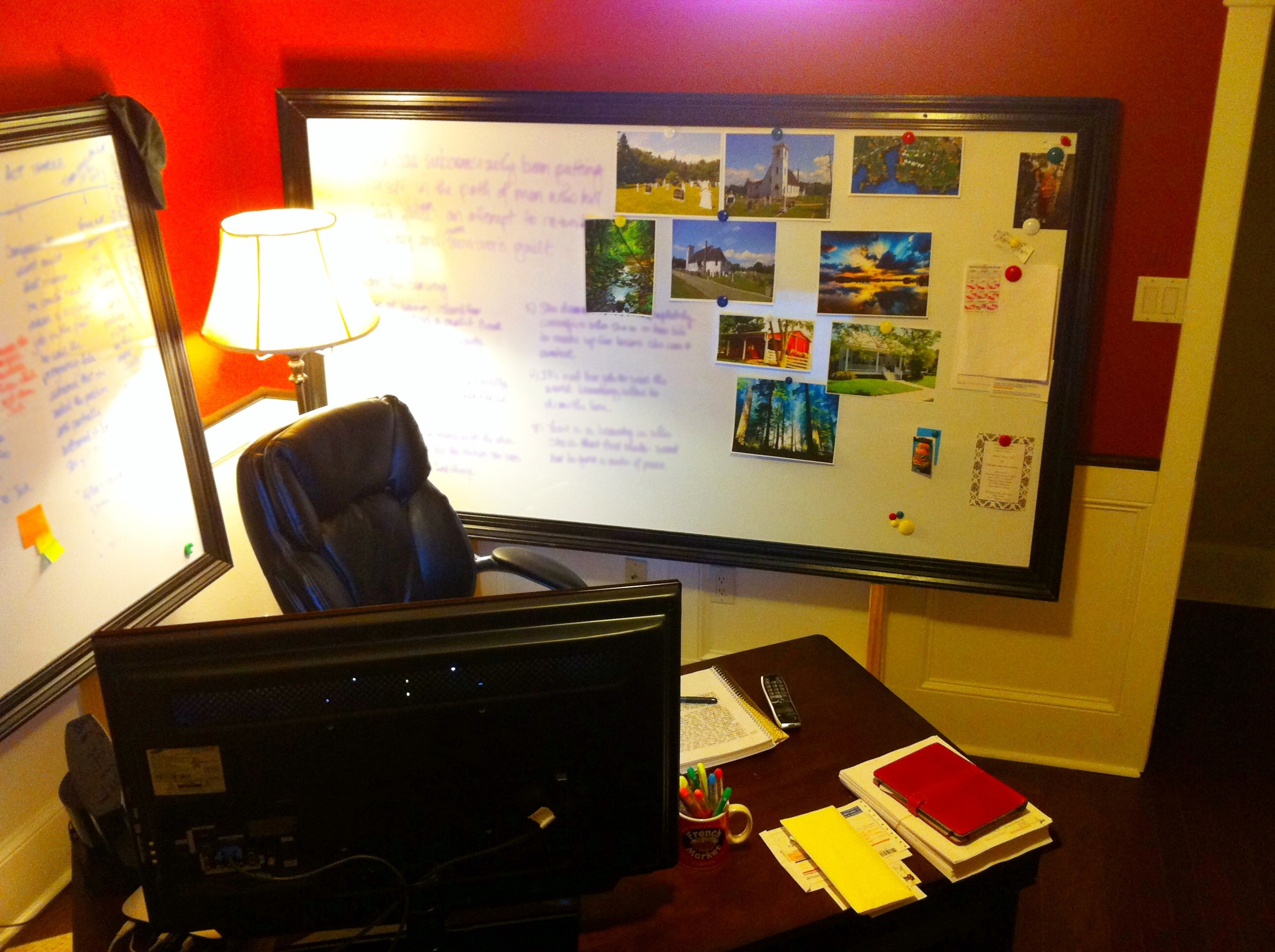
JT has her idea box and her official book box. Alex outlines (I think?). Allison brainstorms as she goes. Rob has a hole in a cave somewhere. (Kidding.) 

I have whiteboards.

 and…

(photos taken with my iPhone because my big digital camera died on me)

I also use Scrivener for Macs — which has many of the same capabilities of these whiteboards + a Word-like software… and I will dump a lot of photos there, images of my characters and such. But when I am working on specific scenes, I like having the photos right there on my board.

 (photos are random, from the internet… not my own)

I like Scrivener for the organizational information-at-my-fingertips convenience. I am actually very lazy about organization–and I’ve paid for that countless times by wasting hours looking for something that I couldn’t remember how I worded (and therefore a simple “find” search wasn’t helpful). Or I’ll forget a character’s last name from the time I mentioned them (which drives me nuts when I can’t find a last name, and then I can’t remember if I actually used it or changed my mind but maybe mentioned them by last-name-only somewhere else). So the organizational ability to just plop a folder under a heading called “characters” on Scrivener, and drop bits of info in there (cut and pasted description, a photo of an actor or anyone I find on the internet who most resembles the character)… and later on, it’s there to remind me of details without me having to search. 

Mostly, though, I use the whiteboards. And lots and lot and lots of Post-It notes.

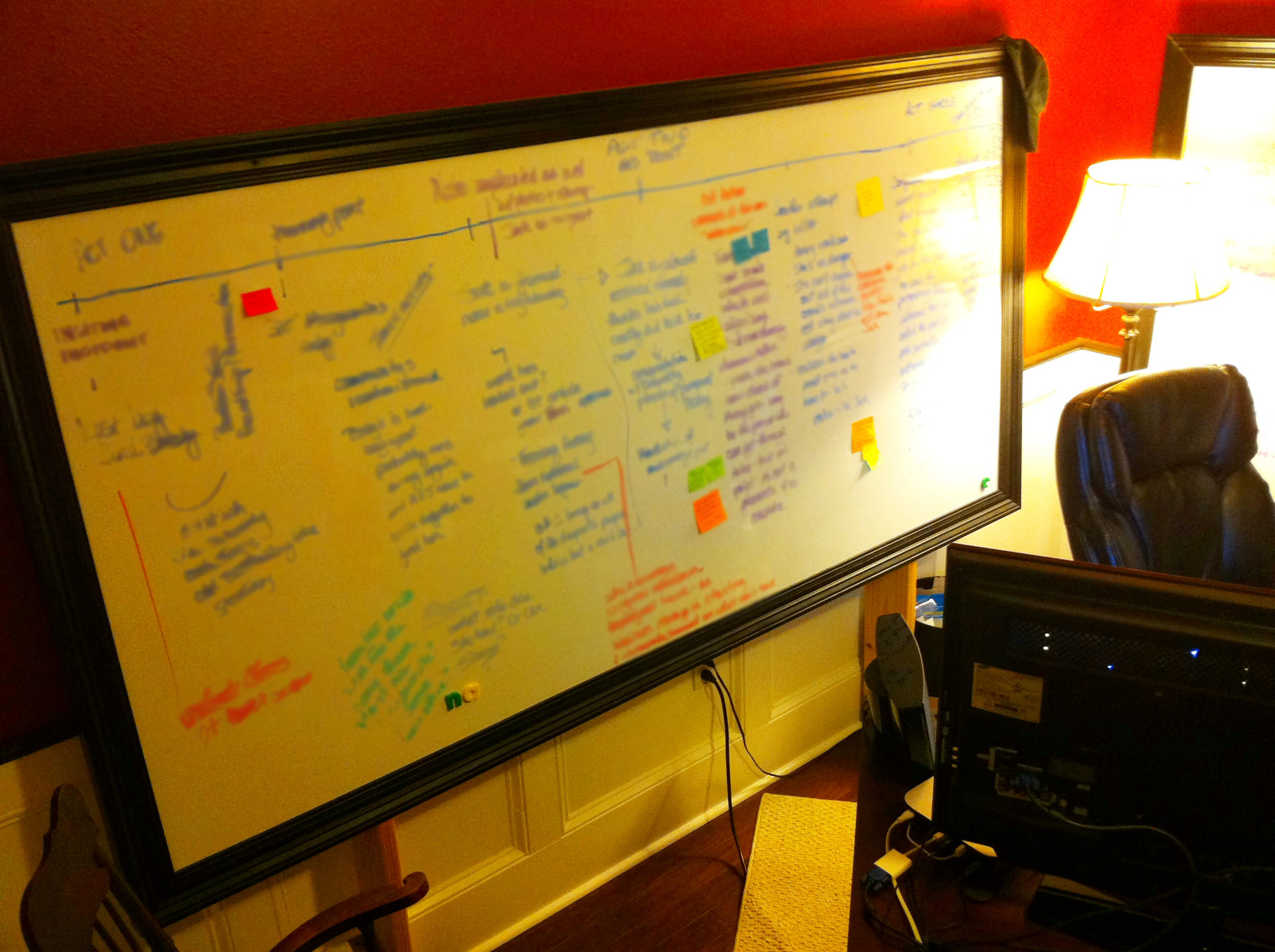
I hate writing a linear outline. I don’t “see” the story like that. I see it playing out horizontally, like a movie. And that might seem like splitting hairs, but I was finally able to structure a story solidly once I allowed myself to write it out horizontally and “hang” the bigger turning points along a timeline, rather than try to write down the page, vertically, in a paragraph-by-paragraph explication.

[So far, I have never had to go back and make any big structural changes–once I get this structure up on the board. When I start blind, without the structure, I end up re-doing the first act too many times to count.]

When I start a project, both of those boards are empty. My husband, Carl, made those for me. [We ordered the magnetic whiteboards online where I found them at a pretty significant savings over Office Depot–especially for these sizes. Carl then framed them and hung them for me.][Yes, he is my hero.] The first thing I’ll do on the board that you see on the second photo is draw that timeline across the time–Act One, Act Two, Act Three lines in place, then turning point lines, climax, resolution. And I start plugging in the major emotional moments / major plot issues. 

Weirdly, I will not write down every scene I “see” in this pass. I don’t need to–if I have a major turning point, I’ll know what I’ll need to do to build up to that turning point. Those things will fluctuate and change, though, so I’m not fond of nailing them down too severely. 

The Post-It notes start showing up at some point around the mid-book process. I’ll start seeing too many things at once and I don’t want to forget the smaller details. I’ll have a note up there about motive, or a twist, just to remember to layer in those clues as I go so that when I get to that scene, it’s ready. As I write, I’ll realize I’ll need to go back and layer something in earlier, or give it more depth because it’s turned out to be more important or useful than the initial throwaway comment indicated back when I wrote it. (I often find I planted things I had no idea I’d planted… I’ll think, ‘Oh, I need to go back and do X’ only to go back and lo, there it was, already there.’ That, my friends, is freaky.)

By the end of the book, I’ll have dozens of Post-Its up there, of things I still need to go back and check. I’ll discard the ones I know I already finished, so it’s not confusing.

[During the edits and then later, the copyedits, I will do more Post-Its. I think the company owes me a thank you for keeping their revenue up.]

You see that notebook on my desk? That’s the second one for this book. It’s a five-subject college ruled thing, nothing fancy, and I’ll brainstorm in there. I will work out motives, or the characters’ traits, backstory, habits, etc., and I almost never go back and refer to anything there because once I write it, I know it. It’s very stream-of-consciousness and hard to follow, but I will often start babbling in there if I have a knotty story problem and usually, the physical process of writing it down helps me brainstorm it out. I don’t know why. I can’t actually write the story in longhand–I freeze up. I’ve been typing too long, having started writing back in the early eighties on an IBM selectric typewriter. 

My office used to be in a front room of the house–a room not-quite-double this sized room, and with floor-to-ceiling bookshelves. I never got anything done. Part of it was the fact that I was too accessible to everyone (kids, employees, husband), and part of it was that the wall space was too visually busy. I don’t have much on the walls in this room, and I like that it’s in the back of the house, where almost no one but my husband will go. I can write in public places when I have to, but it’s difficult because I am naturally nosy and want to eavesdrop on everyone, and then I end up in conversations. Which are great, but then I get nothing done.

[I am just one of those people that complete strangers will tell absolutely everything to. If I’m in a restaurant, people will want to tell me stuff they’ve never told anyone else. Little kids love me. They will be terrified of everyone else in that place, and if I sit down, they are going to try to come over and crawl in my lap. I have had new moms hand me their infant and say, “Can you hold her a sec? I just have to run to the restroom.” or in the grocery story, “Oh, here, I’ll be right back, I have to grab some cereal.” And then I’m standing there, with this kid I’ve never laid eyes on, who, for some reason, thinks this is perfectly okay. At least they don’t cry.]

Anyway, I digress.

I have worked in a very tiny office space made out of a closet. A back porch that we turned into an office. A converted dining room. My “desks” have included everything from a piece of plywood or a lap pillow to an old table to a hand-me-down desk, to, finally, a new desk. I’ve worked with just a typewriter all the way up to my Mac and a big honking monitor. (Yes, I know it’s huge. That wasn’t on purpose. That is just one of those, “Well, fine, if you insist,” moments when they did not have mine fixed, couldn’t fix it, and had to replace it with something bigger. I should get an Oscar for the straight face I had when they asked me if I would mind the bigger monitor.)

I’ve also written while lying in the backseat of a truck, just after having had surgery, while my husband drove us to Colorado–pen and paper and only occasionally, the laptop that was on its last leg.

So I’m curious about your workspace, no matter what you do. What’s on your desk? If you don’t work at a desk, tell me something about what you do and see when you arrive at work? What’s your ideal working environment (whatever you do!). What is the one thing that will derail your efficiency? (Mine is the dog barking next door. There is one of seven which sounds like you are stabbing her, and stabbing her some more and oh, wait, stabbity stabbity stab, and I swear, I think she’s dying and it upsets me. But that’s just how she barks.) (Not too coincidentally, I have begun to write to music all of the time, now.)

Tell me about your workspace!