Author Archives: Murderati


movies

by Toni McGee Causey

I don’t know about you all, but I am flattened by all of the activity from the last few weeks, and what I really want to do is goof off and go watch a good movie. I’m in the middle of creating a new voice for the WIP, which is fairly different from my previous work (this is darker, grittier, different world, no humor), and because of that, I’m interested in how others set up their worlds, hook us, and create their voice. [hmmm. Well, in part. Mostly, I just wanna be a slug in front of a big screen, but let’s pretend I made some sort of profound statement on voice here. I think the triptowhateverturkeystuff has kicked in and I’m knee deep in relatives, and I cried Uncle about a week ago. Thank you.]

Problem is, I just don’t see all that much at the theater that makes me want to bother. I’ve never been, nor will I ever be, interested in the Twilight films, much to the chagrin of several friends of mine who’ve been trying to convince me to give the books and films a try. (One friend even dragged all four books over here and piled them on my desk. Whereupon I made them into handy paperweights ’til she gave up and came and got them back.) I can’t explain why the disinterest. I’ve read plenty of other vampire books I’ve enjoyed. I’ve read plenty of YA. Dunno why the combination feels meh, but it does. (Clearly, I am not the one to go by regarding what will work, though, because holy box office, Batman, that did well. Thank you, young female audiences. Hi, Hollywood, hope you’re taking notes… females can rock the box office.)

The last thing we saw was last weekend: The Blind Side. (Desperation to get out of the house drove us there. It was… okay. Maybe meh tilting toward not bad.) I actually expected more depth to the story, more confrontation with the aspects of Michael Oher’s tragic upbringing, and while that’s shown, there’s a glossing over that frustrated me, as a viewer.

I honestly can’t say I’ve seen anything extraordinary, lately. I’m curious about Precious and it’s probably up next. I’d tried a couple of romantic comedies this summer (The Proposal, which was funny up until the point where it was a complete rip off of While You Were Sleeping, to the point of staging and everthing and that sucked the life out of that ending for me. We also saw The Ugly Truth, which was, indeed, Ugly. If you set aside all taste and moral compass, it had its funny moments. I so want to like Gerard Butler in a film.)

There have been entire months–multiple months at a stretch–where my husband and I will look at the multiplexes and feel completely left out of any thoughts regarding what we’d like. And we’ll go see a huge variety, so you’d think it wouldn’t be that difficult to find something. [Having been a screenwriter for seven years, I grasp how all of this comes about, but still… it’s disappointing to truly want to go to movies, to have the time and money, and repeatedly have nothing worth bothering over.]

There are a couple of movies I’m looking forward to. One is Cameron’s Avatar:

And another one is Rob Marshall’s Nine:

Jim Sherridan’s Brothers looks noteworthy:


But overall… that’s pretty slim pickings. I may have missed something coming out soon, though, so if you have some suggestions, I’d love to hear them. Meanwhile, what’s a great / decent / worth going to film you’ve seen in the theater lately? And I’m all over Netflix and have a few good ones in my queue, but I’d love to see your favorites in a list.


Extra Pulp, Please

by Rob Gregory Browne


I grew up reading popular fiction. One of the first books I ever bought on my own was called The Living Shadow, and was a Bantam reprint of an old pulp novel by Walter Gibson (writing as Maxwell Grant) about The Shadow, a famous character from radio, but quite different in print. The writing in these books is serviceable at best, but I found myself drawn in immediately and hungrily bought every book in the series that was released.

Google.com – Google Products


Around the same time, I discovered the comedy mysteries of Donald Westlake and, later, his Richard Stark books. I was particularly in love with Stark’s Grofield character — who played second banana to Parker — and snatched up as many of the Grofield standalones as I could find.


I also loved reading Mickey Spillane and John MacDonald and many others of the era, most of them courtesy of a guy named Roscoe Fawcett.


Roscoe Fawcett was something of an innovator. Back in the fifties, he noticed how well paperback reprints of hardcover titles were selling, so he came up with an idea: what if he hired writers to create paperback originals? Shoot right past hardcover and take stories straight to the masses at a fraction of the cost, making a small fortune in the process.


Thus, Gold Medal Books was born.


This sounds like a no-brainer today, but Fawcett’s idea was unheard of back then and he pretty much revolutionized the publishing industry. And the writers he hired over the years to write for Gold Medal turned out to be some of the cream of the crop of mystery and thriller writers, including the aforementioned John MacDonald, as well as Westlake, Elmore Leonard, Donald Hamilton and Richard Prather.


Coverbrowser.com

Gold Medal books always had slightly lurid covers. A half-dressed woman with a tough guy hovering over her was fairly standard. But inside, many of those books were short masterpieces of fiction. 


I sometimes think I was born in the wrong era. How wonderful to be able to write these 40 – 50,000 word stories and see the public gobble them up like candy. I doubt if the monetary rewards were great, but I have a feeling these writers made a pretty decent living, many of them writing under multiple pen names. I think the closest thing we have today are the Harlequin Intrigue romances that are also a lot of fun to read. Crime stories with a romantic slant.


(Edit:  Brett so kindly reminded me of Hard Case Crime, which has taken up the tradition and reprinted many of the old Gold Medal greats, as well as taking on new writers.  My apologies to my friends who write for them!)


Recently, I began reading a Gold Medal author that I’ve seen over the years but never got around to reading. A guy by the name of Edward S. Aarons, who wrote forty or so books about a CIA operative named Sam Durrell. Think of Durrell as a more realistic version of James Bond.

Coverbrowser.com


Though few people have heard of him today, Aarons was very popular in his time and I can fully understand why. His books are really well written. He was a meat and potatoes stylist, but it’s some of the best meat and potatoes you’re likely to find.


Because I grew up reading these kinds of books, and still enjoy reading them, I find myself wanting to write them as well. I write popular fiction and make no apologies for that — although some people undoubtedly think I should. I think I mentioned before how a friend of mine wondered when I was going to start writing “serious” books, and I had to wonder, what about my books isn’t serious?


The literary fiction vs. popular fiction debate is a deep, dark hole, but I’ve found a blog post by Michael Blowhard (a very long blog post) from a few years ago that I think sums up my own feelings about the debate. I urge you to take a look at it:


Taking Jackie Collins Seriously


I am amazed by people who look down on popular writing. I’m not quite sure what their reasoning is. The subject matter is too disposable for them? The work isn’t worthy because too many people like to read it? Surely whatever the masses likes has to be mediocre at best.


Coverbrowser.comNo matter. I know what I like to read and I know what I like to write. And those old mass-produced Gold Medal authors — and many who have followed in their footsteps  — have given me untold hours of pleasure. And if I can do the same for someone else, that’s all I ask.


So, again, no apologies. But please don’t ask me when I’m going to start writing serious novels. I’m very serious about what I do already.


Today’s question: Do you have an author you just love that your friends or family might consider a guilty pleasure? Who is he or she?


You Are Here

By Toni McGee Causey

I wonder sometimes. I wonder about this journey we are on, this effort we make to create and breathe life into mere dots of ink. I wonder about the angst of it, the stress and beating of ourselves into smithereens small enough to sieve. How did we get into that mindset?

I’ve thought about this all week, after a few stressful events over the last couple of weeks. To get away from it all, my husband and I visited my oldest son and his wife and the four of us made a trek over to Moab, Utah where there are a couple of impressive national parks I had never heard about.

When you go into the visitor’s center of these parks, there are elaborate displays demonstrating the types of things you’re going to see on your travels through the park, with snippets of educational information that should prove useful. One of the standards in visitor centers of this sort is the big map—or model—of the area, with a star somewhere that indicates the location where you’re standing, with a big “You Are Here” note in bold red, just so you don’t miss it.

And most of the time, we barely reference the “You Are Here” sign. 
                YOU ARE HERE


We glance at it, note it in relation to the map, orienting ourselves for the journey outward, away. It’s simply a starting point, a place that is already boring for the very fact that it’s only the beginning. It’s where you are, not where you are going or where you want to be.

Lives can be like that. And careers. We’re so busy looking outward and onward, away from where we are, that we’re impatient with ourselves to just get over there. To that place. That place that is not here. We’re so focused on the end result, we forget that no end result happens without the journey.

There is always a journey.

On one of the treks in the Canyonlands park, the climb was fairly steep for someone like myself who has been sitting behind a desk for far far too long without enough exercise. For my 27-year-old very physically fit son, it was nothing. He kept saying, “It’s really not much farther, you’re almost there,” all along the way, which was, frankly, kinda annoying, because even as much as I’d like to have believed him, I could see with my own two eyes that there were a lot more steps above me than there were below. About halfway there, I had serious doubts about finishing the stupid climb. It really wasn’t that far, in actuality, but it felt like a zillion miles straight up at an altitude I wasn’t accustomed to, and I was wondering somewhere along the way how I managed to give birth to a drill sergeant who had this crazy notion that I should be up and moving instead of always sitting at my nice happy desk which required exactly 11 steps from my bed. All level steps, I might add. This whole outdoors thing was ridiculous, what with the fresh air and the beautiful scenery and the… hmmmm.

Then we finally got to the last part, a hard slope uphill with no actual steps, you just had to lean into it and use your legs to push on up and then bang, we were on top of the viewpoint where we could see this amazing Upheaval Canyon.
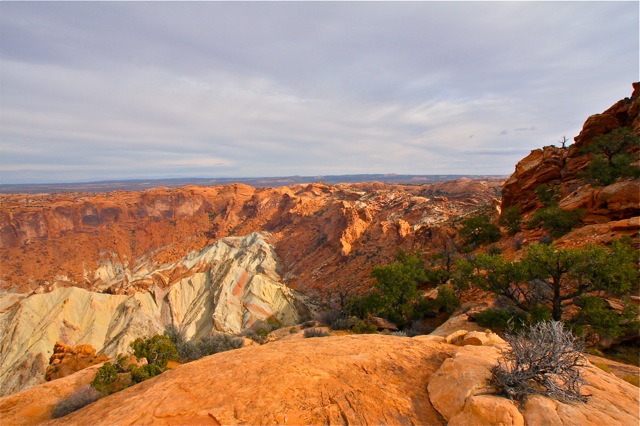
(A shot I took of Upheaval Mountain)

(And the 180 degree view)

The colors were stunning. The vastness of the canyon. The gorgeous sky above. The layers and layers of strata in the canyon that represented the hundreds of thousands (or millions?) of years that this particular canyon formed.

I loved this particular place because the beauty of it lies in the fact that it didn’t form quite like the many canyons around it. There are a couple of theories, but the prevailing one seems to be the idea that an ancient meteor struck the earth there, possibly collapsing a dome of salt. There are details here: http://www.utahtrails.com/UpheavalCan.html, but what struck me was that this thing of beauty was formed by great hardship and change.

I stood on top of that mountain and thought “You Are Here.”

Hardship and change are inevitable on our journeys. We can have a lot of signposts along the way, and educational snippets / suggestions from the best meaning sources, including friends, but nothing is going to substitute for us living and experiencing that journey.

When I looked back at that second view, I realized–that was my view on my way up. Those clouds, that sun, those colors, that world, and I’d barely seen it, because I wanted to be on top of the mountain already. I nearly missed the view, and only realized how far I’d come and how much I’d seen when I looked back and saw the whole picture.

The thing is, I had been mostly looking at my shoes on the way up that mountain, contemplating why on earth this had seemed like a good idea back at the hotel, grousing internally about the effort it was taking just to go see what amounted to a big hole in the ground. I think we do that a lot with our careers and our lives—we are so busy being frustrated with where we are, because we want to be over there, or there, or there. Somewhere not here, not in this particular hard place, because we want to have the end result.

Well, I could’ve looked at photos and had the end result, but it wouldn’t have meant as much. Until you stand there in that moment on the top of that hill that you had to climb, and experienced the vastness of the landscape, witnessed the brilliant hues in the earth, seen forever painted in the sky, you cannot really know the end result.

It’s always going to take work to get from here to there.

A few months ago, if you’d asked me if I’d be standing on top of a mountain, seeing something I’ve never seen, doing something I hadn’t done, I’d have told you no. It wasn’t a part of my plan, a part of what I thought my journey was. But I’d have missed something amazing and life has a way of giving you detours. It’s up to you if you learn from them or not. It’s up to you if you say, “Yes, I am here,” and appreciate where you are. 

On my way back down that hill, I noticed the scenery. Little things I’d taken for granted or hadn’t bothered to experience on the way up, because they were just mere obstacles to my journey to get to the damned top already.

And I thought about that journey up. I had to rest a couple of times, whereas my son could’ve raced up the mountain without breaking a sweat. He has seen this site before and we were experiencing it for the first time. But there are things I’ve seen, hardships I’ve known, that he hasn’t had yet. Things he’s seen and known that I will never fully grasp.

But we both stood at the top, amazed. Speechless with the beauty.
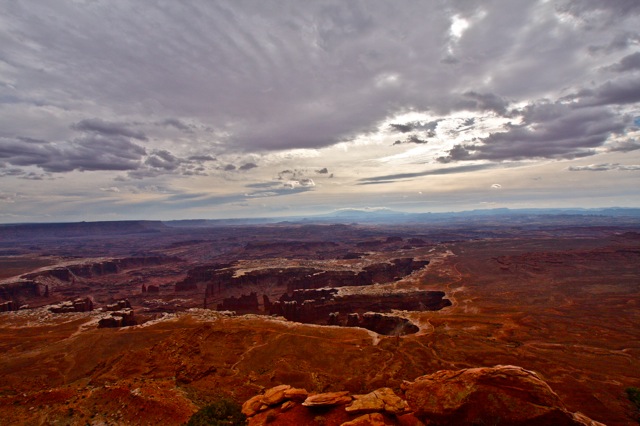
(Another area of Canyonlands… what you cannot grasp from this photo is the vastness of the scale here. From where this shot was taken to the bottom of that canyon you see in the center of the photo is a 2000 ft. difference in elevation. There are canyon walls beyond that, levels upon levels, created hardship by hardship, over eons of time. Beautiful, sublime.)

You can’t compare your journey to someone else’s. Their journey is theirs. Yours is yours. Period. You cannot walk in their shoes. You cannot die their death. They cannot die yours. They may go farther than you, faster than you, but it doesn’t matter. What you can know, and the only thing you can know, is that You Are Here. You don’t know yet what you will be, when you’re done. You might have an inkling of what you’d like to be, where you’d like to be, but you cannot know if that is the best thing for you, when all is said and done. What you can only know is where you are and what your intention is. And all you can do is put one foot in front of the other, in good faith that you will eventually arrive at the right destination for you. Meanwhile, don’t miss the good things that surround you where you are because you’re so busy looking off to the horizon at that far away goal that you may obtain someday.

Embrace where you are, right now. This is part of your journey. You’re not alone. We’re all here, signpost and snippets and educational babble along the way. We cheer each other, sometimes being that annoying supporter who says, “You’re almost there!” when you suspect it’s a lie, but nevertheless, applauding you for trying. But your journey is going to have its own hardships. You’re going to learn your own lessons, and those are good things, both the hardships and the lessons. Because without the hardships, there wouldn’t be anything to compare the beauty to, to recognize the beauty when you see it. To bask in where you’ve gone once you’ve gotten there. 

You Are Here.

Every place you are is the place of your new beginning.

Enjoy.
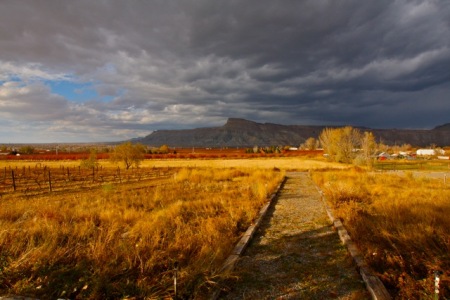
(A shot I took of what seemed to me a most unlikely thing–a vineyard at the base of the mountains in Palisade, CO. A vineyard, in snow country surprised me. But their Reserve Riesling was one of the best I ever tasted. Surprises on the journey.)

So how about you, ‘Rati? What was a surprising turn in your life that brought you to a place you hadn’t expected, which you may never have planned, but for which now you are grateful? OR, if you’d rather, tell me something you appreciate about where you are in life right now.

You break it, You buy it.

JT Ellison

Revisions can be hell.

I’m currently working on a revision of book 5, THE IMMORTALS. When I started, it looked like it was going to be simple. I needed to add a subplot. No big. Move a few chapters around, dump the story in the appropriate spots, read through and voila! Revision done.

Yeah. Not so fast, there, Sparky.

After staring at the computer for three days trying to decide just exactly how I wanted to do this, I realized it wasn’t going to be the snap I first thought. If I wanted to do it right, I needed to do things a little differently.

I write in a very linear fashion. There are a few times when I’ll jot notes toward the end of the manuscript of what the next chapter is about, or throw down some words to describe my climax. But for the most part, I start at the beginning and write sequentially, allowing the story to unfold as I go instead of jumping around from scene to scene.

I had a great opportunity a few months back—I was the media escort for Diana Gabaldon when she came to Nashville. Now that’s not a job I’d ever want again, because I was a stress monkey the whole day, worrying about getting her to the right place on time (you’d think since I live here I wouldn’t be so damn worried, but I was.) One of her talks, she mentioned how she builds a book. I’d heard this before, but I paid special attention this time, to see if it was something I could do.

Diana writes scenes. Separate, living, breathing entities. When she has enough of them, she starts stitching the book together. Sometimes she’ll find that the season is wrong, or the time of day, and rewrite it to match, but for the most part, the way she puts it together sounded absolutely seamless.

Now, I’m a realist. Of course it isn’t seamless. Proper chapter and scene arrangement is vital to the story – you can’t have things out of order, your readers will get confused.

So when I realized I needed to do this subplot, I decided to try it her way.

Surprisingly, it’s sort of working.

But here’s where I got stuck. The subplot revolves around a situation that happed six years earlier. You know what’s coming next. Yep, I have to write in the dreaded of all forms – the flashback.

Stop your groaning.

I’ve never written in flashback before, not extensively like I’m doing now. It’s not the easiest endeavor. Which is fine, I’m always up for a challenge. But I don’t know what the standards are. As the story unfolds, I’m seeing two things: one, it could be a book of its own, and two, I might be better served if I have a second POV. But you’re not allowed a second point of view when you’re flashing back in someone’s head, are you?

I spent a day fretting about this, then finally called New York.

My brilliant editor scoffed slightly and said, “Write it and see if it works. If it doesn’t, you’ve cost yourself nothing.” Which of course is the right answer.

It’s not the easy answer, though. No one wants to spend time exploring when they’re on deadline. I immediately mentally resisted, listing out all the reasons why I shouldn’t try – time being one of the biggest ones. I’m not much for throwing work away—when I write it, it goes in. The idea of writing scenes basically on spec to see if they might work is an anathema to me.

But in the course of all this angst, I suddenly realized what I was really asking. I wasn’t worried so much about the dual POVs in the flashback. I was asking if I could break the rules.

And since when do I ever worry about the rules?????

Happily, when I went to my office, this was the first thing I saw. It’s on my door.


“There are no rules except those you create, page by page.” ~ Stuart Woods


You can imagine the chagrin I felt. Permission? This is writing, damn it. We’re writers. We are the all-powerful creators of universes. We do what we want, when we want. We defy gravity, boundaries, planes of existence. We bring the dead to life. Yes, there are rules, but it’s our job, our mission, to break them. That’s what we do. All successful writers thumb their nose at the rules. Even Stephen King says, “Know the rules so you know when to break them.”

Ah. There’s the rub. We’re allowed to break the rules, but we have to know them first. Okay. Consider this your hall pass.

Here’s the rallying cry. Go forth, and break all the rules. Write something today that’s been eating at you, something that you’re worried about. Something your mind says won’t work. Maybe it won’t. But until you get it on paper, who knows???

When’s the last time YOU broke the rules?

Wine of the Week: 2007 Primaterra Primitivo

PS: Happy Friday the 13th!! Unlike Halloween, good things usually happen in the Ellison household on these days. I hope something good happens for you too!

Take Back That Stapler

by Rob Gregory Browne


Everyone steals.


Oh, don’t try to deny it. You know you’ve done it at one time or another in your life, even if that theft was something as innocuous as the really nice stapler you took from work.


But there are different kinds of theft, aren’t there? Different levels.


Yes, you can say stealing is stealing, but I would certainly never get upset about that stapler — I mean, really, who cares other than the company bean counter or the secretary whose desk you swiped it from?


I mean, we’re not talking someone’s car, right?


But stealing is stealing and it’s quite common in our society.


Kids steal each other’s toys. Teenagers steal music.  Friends steal each other’s spouses. Or maybe borrow them once in awhile. Yet that’s still stealing in a way, isn’t it?


People who are particularly bold may walk into a bank and steal money from an unsuspecting teller. Or step into a Seven Eleven and force the counter man to empty out the cash register.


It happens all the time, and we crime writers make our livings because of it.


We can forgive the minor crimes — the stapler stealing — but the larger thefts, depending on who the victim is, tend to get us a bit riled up. Probably because they scare us. And if we’re the victim, if things are personal, we get very scared indeed.


We feel violated.


When I was in my twenties, my beautiful soon to be wife and I were living in an apartment complex in Santa Barbara, California.


Late one night, out of the blue, a work friend of mine showed up at the apartment, wanting to hang out and have a drink. He even brought the beer.


I was a little surprised to see him, but we sat down, drank the beers as we shot the bull. About twenty minutes passed and my friend abruptly stood up and said he had to go. And he never did explain why he had stopped by in the first place.


The next morning, I went out to my car, only to discover that it had been broken into and my tape deck and a box full of cassette tapes were gone.


And I had to wonder. Had my friend set me up? Could he have been distracting me while a cohort stole my car stereo?


These were, of course, questions that never got answered. Although I suspected him — didn’t want to, but did — I never said a word to him about the incident and we continued to be friends for a couple more years before my wife and I moved back to Honolulu.


But what never went away was that feeling of being violated. And I think that’s how we can measure the severity of theft. By how violated the victim feels.


I was recently violated in a different way.


The theft did not scare me. No tangible item was actually taken from me. But I felt violated nevertheless.


Still do.


Nearly a decade ago, I wrote an article that was published on my website. That article was subsequently published many different places on the web, including here on Murderati and in an international print magazine I used to write a column for.


A couple months ago, I got an email from a reader who thought she had spotted some possible plagiarism of that article. She had read it and had stumbled across an excerpt from a book that was posted on the web and some of the content of that excerpt looked suspiciously familiar.


I investigated and lo and behold, the author of the excerpt had lifted entire passages from my article. Word for word.


With no credit to me. No link to my original article.


There wasn’t a huge amount of theft involved, just a few short passages, as well as a way of describing a writing concept that I feel is original with me, but when you see your own words being credited to someone else — in a published book, no less — that tends to make you feel a bit victimized.


I won’t go into any details. I’ve had exchanges with the author and the publisher and came up with a solution to the problem that I think is fair, and I feel no need to go public with the details.


But for the life of me, I can’t understand how someone can do something like that. I can see inadvertent theft of someone’s work — a lot of ideas are similar, and sometimes we borrow without actually realizing we’re doing it.


But word for word? I just can’t quite get my head around the idea of copying someone else’s work and claiming it as your own. What kind of person does that? It just makes no sense to me.


So I feel victimized. And, yes, I’ll get over it in time, but no matter how much time goes by, I’ll still be shaking my head at the audacity of it all.


If you’re going to take credit for something you didn’t write, for chrissakes, at least don’t be so blatant about it.


Have a little class.


Or stick to staplers.


—————————————


Today’s question: Have you ever had anything stolen from you? If so, how did you feel?

writer chat…

by Toni McGee Causey

This weekend, I’m at the most amazing writer’s retreat with a group of friends; we’re overlooking a gorgeous bay with cerulean blue skies, giant white cranes lazily circling the docks as competent white motorboats slide past in the bay. The weather has been stunning—low 80s, clear, light breezes—and the food has been wonderful. And in spite of all of that beauty, we managed an amazing amount of work done. This is the first time I’ve done this sort of a gathering of writers with a goal of workshopping (brainstorming) and it’s been one of the best weekends, ever.

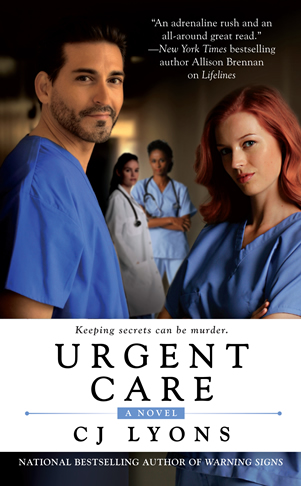
What made it even more of a joy was that the writers I got to spend time with are women I respect and admire, whose writing styles span several genres and who have a great enthusiasm for storytelling at its finest. One of those women happens to also be a friend, CJ Lyons, who has a terrific new book out this week called URGENT CARE 

I asked CJ a few fun questions that I’d like to share with you today, because it’s always a kick to me to ask questions of long-time friends and still be surprised by their answers.

Question: If you were to go to the great Coffee Shop in the sky, which five authors would you love to meet for conversations?

CJ: Hemingway, Dumas, Rilke, E. E. “Doc” Smith, and Shakespeare. 

The reason for those five is that they know how to tell a damned good story and captivate your imagination. Hemingway could use very few words to evoke large emotions. Dumas understood the complexities of people as well as their society. Rilke for his ability to paint with words. Doc Smith for his ability to imagine new worlds and Shakespeare because he understood that it was as important to laugh as to cry.

Question: Who inspired you? 

Ray Bradbury.

He was the first author that I read that understood that adult themes were not out of bounds for kids and didn’t talk down to children. He also introduced me to the idea of words, other than poetry, being able to portray emotion more than just creating action on the page. 

Question: How long have you been writing and how did you know you wanted to write fiction? 

Actually, I guess I’ve been writing fiction all my life, because I’ve been telling stories all my life. I had a hard time telling the difference between reality and not-quite-so-truthful reality, which ended up giving me a lot of time in “time out”… which, of course, meant I had more time to create new stories.

I was an early reader and an early writer. In grade school I created a Civil War saga about a blind orphan girl and her horse—because there always has to be a horse—who rescued other orphans from Confederate marauders. I didn’t write for publication until 2003 when I joined RWA and entered the Golden Heart contest (where I finaled) and I sold that book six months later.

Question: Tell me a little bit about your background which helps to give your current series so much verisimilitude?

My background includes 17 years of practicing pediatrics and pediatric emergency medicine in some of the east coast’s busiest trauma centers. Also, I lived in Pittsburg, where the series is set. But the most important thing is understanding the emotional costs of practicing medicine while working in an urban ER, because the stories are not just about the medicine, they’re about the people and their relationships. The idea for the series was that it wasn’t medicine that saves lives, but people who save lives. 

Question: Your newest book hit the bookstands last Tuesday. Tell me about URGENT CARE.

URGENT CARE is darker and more emotional than the first two books. In it, ER Charge Nurse Nora Halloran must face her greatest fear when the man who attacked her two years ago returned and is now killing his victims.


Question: What is the funniest thing (non-X-rated) that you’ve ever seen in the ER. 

Well, I was amazed to learn just how many men changed their light bulbs while naked and where the light bulb ends up. Note to the wise: wear jeans.

Here’s the summary of URGENT CARE, which I know is a terrific read because I had the great fortune of getting to read this in an earlier draft and was wowed by it:

URGENT CARE (Berkley/Jove, October 2009) by CJ Lyons.  An ER charge nurse must face her deepest fears when the man who sexually assaulted her returns…only now he’s killing his victims.  CJ Lyons’ novels give readers “a powerful and dramatic look into the frenzied world of emergency medicine…Lyons’ characters are dynamic and genuine.”   ~Suspense Magazine

About CJ:

As a pediatric ER doctor, CJ Lyons has lived the life she writes about in her cutting edge suspense novels.  Her debut, LIFELINES (Berkley, March 2008), became a National Bestseller and Publishers Weekly proclaimed it a “breathtakingly fast-paced medical thriller.”  The second in the series, WARNING SIGNS, was released January, 2009 and the third, URGENT CARE, on October 27, 2009.  Contact her at http://www.cjlyons.net

So even though CJ’s story is a very dark tale, I’d love to know what’s the funniest / silliest / craziest thing you (or a relative or friend) managed to do that called for a visit to the ER.

In the Presence of Genius

by JT Ellison

A couple of weeks ago, darling hubby took me to see the symphony. It was a wonderful program—Mozart’s Symphony No. 35 in D major, Ravel’s Rapsodie espagnole, a world premier by Roberto Sierra—but the absolute highlight was Shostakovich’s Concerto No. 2 for Cello and Orchestra. The cellist, a young woman named Elisa Weilerstein, strode on the stage in a purple gown, her flowing brunette locks hanging free around her shoulders. She was stunningly beautiful. She shook the first chair’s hand, nodded her thanks to the audience, arranged herself in front of the Maestro, and dove into the piece. It took no time at all to see we were in the presence of genius.

Weilerstein didn’t play the cello. She became the cello. Her body language, facial expression, the set of her shoulders, all bespoke the story. She plucked the strings with a raw energy, her bow flowing, cutting, ripening the notes, and I literally had to force my mouth closed. The maestro was inspired by her performance, and become more animated himself. The orchestra as a whole came to life, each member hanging on Weilerstein’s every note. 

And we, the audience, were told a story by a genius.

Elisa Weilerstein spoke to me through her music, and in so doing, she garnered a fan for life.

I’ve always likened the symphonic medium to books. There’s a delineated three to four act structure, and the music follows the classic unfolding storylines: Exposition, Rising Action, Climax, Falling Action and Dénouement. The music build and retreats, ebbs and flows, allowing small bits of foreshadowing for the massive climax, the lingering notes closing the piece in a final dénouement. (Rachmaninoff’s Concerto no. 3 lends itself especially well to the crime fiction storyline.) I am particularly drawn to these compositions; it’s always so lovely to see this structure in action.

What is genius though?

Wikipedia defines it thusly:

A genius (plural genii or geniuses) is a person, a body of work, or a singular achievement of surpassing excellence. More than just originality, creativity, or intelligence, genius is associated with achievement of insight which has transformational power. A work of genius fundamentally alters the expectations of its audience. Genius may be generalized, or be particular to a discrete field such as sports, statesmanship, science, or art.

Although difficult to quantify, genius refers to a level of aptitude, capability or achievement which exceeds even that of most other exceptional contemporaries in the same field. The normal distribution suggests that the term might be applied to phenomena ranked in the top .1%, i.e. three standard deviations or greater, among peers. In psychology, the inventor of the first IQ tests, Alfred Binet, applied the term, to the top .1% of those tested. This usage of the term is closely related to the general concept of intelligence. The term may be also applied to someone who is considered gifted in many subjects or in one subject.


“A work of genius fundamentally alters the expectations of its audience.”


In those terms, we’re all genius, to a point. Everything we do affect those around us. We are our own individual purveyors of chaos theory. Every movement, every breath, every blink ultimately alters the course of reality. The Butterfly Effect, as it’s more commonly known. Again from Wikipedia:

The phrase refers to the idea that a butterfly‘s wings might create tiny changes in the atmosphere that may ultimately alter the path of a tornado or delay, accelerate or even prevent the occurrence of a tornado in a certain location. The flapping wing represents a small change in the initial condition of the system, which causes a chain of events leading to large-scale alterations of events. Had the butterfly not flapped its wings, the trajectory of the system might have been vastly different. While the butterfly does not “cause” the tornado in the sense of providing the energy for the tornado, it does “cause” it in the sense that the flap of its wings is an essential part of the initial conditions resulting in a tornado, and without that flap that particular tornado would not have existed.

We writers and readers are daily participants in chaos theory. Writers put words on the page. A year later, a reader holds the finished novel in their hands and reads those words. Their lives can be inextricably altered by the concepts in our work. Our lives have been changed, because we’ve made a psychic connection with the reader. We’ve told a story, and the reader has absorbed the tale.

But there is a step past all of the psychic entertaining we do, a moment in time when even more magic happens. That moment is the book tour, where we meet the readers whose lives we’ve altered.

There have been many roundups of the most recent Bouchercon these past two weeks. I came away with a sense of pure awe. The numbers were staggering – of authors and of fans. There was a moment on Saturday night, at Lee Child’s annual Reacher’s Creatures party, that I realized the collective conscience of the crime fiction world was present and accounted for in a single, stiflingly close room. I was among the geniuses of our genre, of writing, of our finest creativity. Not everyone was there, of course, but if you had a single copy of every novel published by every author in that room, the numbers would wobble the shelves of a mid-sized town library. I made that comment to Mr. Child, who opined that if you added in all the books we’ve read, the numbers would be astronomical.

I know I’m touched each and every day by the genius that permeates out community.

But being a writing genius isn’t enough. Our livelihoods depend on readers. In these changing times, with digital books making a play for large shares of the market, with major wholesalers discounting their titles to openly take a loss, we need readers, fan, more than anytime before.

Mediums change. That’s the nature of our society. Our cultural conscience, though, will remain strong and vibrant, regardless of whether we’re reading electronically, listening, or holding a hardcopy book. Because our collective genius is captured in those words.

I read a fabulous article recently by Nashville-based author Ann Patchett on touring. I know tours aren’t nearly as prevalent as they were, but the article is about more than the physical state of touring, it’s ultimately about the metaphysical connection authors have with readers. Jane Friedman, who developed the modern book tour with Julia Child’s second cooking novel, says to Ann Patchett:

“What hasn’t changed is the connection between the author and the reader. If anything, it’s even stronger. The people who come out to your signings are real…fans.”

And there’s the trick. The folks who come to the conferences, to the readings and signings, are the drivers of the industry. Yes, there are many, many readers who never set foot near an author or conference. But that one fan who puts their hand on your shoulder, who says you’ve touched their heart with your books, can sustain an author for a very long time.

The next time you’re touched by genius, stop for a moment. Appreciate it. Appreciate the phrase that caught your eye, the musical notes that create a melody, the lyrics that speak to your soul, that perfectly shaped fallen leaf. Recognize you’re in the presence of genius, and allow that to spark your own creativity.

Today’s question is self-evident: When was the last time you were touched by genius?

Wine of the Week: Compliments of my parents, who loved the whimsical label – 2007 Michael David Petite Petit

The Lazy Man’s Guide to Blogging

by Rob Gregory Browne

First, be lazy.

That’s not hard for me.  Never has been.

Unfortunately, I haven’t been allowed to be lazy lately.  In fact, I’ve been very, very, very, very busy. (And I don’t think there were enough “verys” there.)

And by busy, I mean I’ve been busy writing.  I’m working on a terrific project and am really putting the nose to the grindstone because a) my deadline is not that far off; and b) I want this to be the best thing I’ve ever written.  So far I think it is.

So you’ll have to forgive me.  I’ve kicked around the idea of quitting the blog business altogether, but since the day job will be gone soon, I’ll have more time to devote to blogging.  Not that this will necessarily make a difference in the quality of my posts — there are only a few blog ideas and it seems that every blog in the universe has recycled most of them again and again — but at least I’ll have time to actually POST.

Which, again unfortunately, I don’t have time to do today.

So what does this mean to you, the Murderati diehard reader?

How the hell would I know?  I’m not you. (Did I mention I’m tired and cranky, too?)

But instead of completely abandoning you, I thought I’d leave you with a couple of videos I did for Murderati back when I was still semi-sane.  Or, at least, pretended to be.

I’ll have a question or two after the jump.

RERUN #1

 So, question:  What song do you sing badly and where do you sing it?

RERUN #2

Old chestnut question:  What’s your favorite book opening?

Okay.  Sorry.  That’s it for me.  But the author of the answer I like best will win a book of mine of your choice:  Hardcover Kiss Her Goodbye (upcoming news on that front) or paperback Whisper in the Dark or Kill Her Again, or… a pre-publication copy of my newest thriller (coming in June), Down Among the Dead Men.

Thanks for playing.

Empty

JT Ellison

There are times when nothing comes.

No words. No ideas. Nothing.

This is one of those times.

After four years of blogging, I’ve simply run out of things to say.

But that’s not a choice I can make. Even when there’s nothing floating around in my brain, no pithy comments, no stellar advice, no embarrassing moments to share, I have to write my blog. It’s a commitment I’ve made to you, the reader, to my blog mates, and ultimately, to myself.

So.

I will force the words onto the page, and hope for the best.

Thankfully, I’m not having this problem with the books. Books are fine. Books are groovy. The ideas are flowing non-stop, and so are the words. I’m at that awkward time of year that I’m writing a new book and editing a forthcoming title, which is always hard. It happens every time I’m just getting my legs under me with a story, boom – I have to all stop and go focus on the one prior. This is good and bad.

For starters, I am writing a series, which means the characters, their foibles and triumphs, all build from book to book. It makes life easy because the world is already built, the characters, for the most part, are the same, and I can simply insert them into a new case. But now that I’m six books in, changes are happening. Characters lives are altered.

One of the tricks I was using is coming back to bite me in the ass – setting each book seasonally instead of annually. As a matter of fact, book five begins within a couple of weeks of book four, and book six starts literally a few days after the end of book five. The fifth book takes place over three days. So that’s a lot of Taylor’s world sandwiched into a very short period of time. How much can a character change in three days?

Well, the obvious answer is as much as I want her to. But I’ve always tried to avoid major changes in her life – she is who she is, and if I’m writing her correctly, her reactions are going to be consistent regardless of circumstance. Consistent, in my mind, is good. But is consistent good for the character, the series, the stories?

I guess I don’t have anything to blog about because I am so involved in the decision making process of these two books that it’s taking all of my mental energy.

And of course, now that I’m forcing myself to type, it seems I have a topic after all.

Remember the old tongue twister: How much wood could a woodchuck chuck if a woodchuck could chuck wood? A woodchuck would chuck as much wood as a woodchuck could if a woodchuck could chuck wood.

That’s kind of where I am with my girl. How much change can she sustain and still stay true to her nature? What kind of change is good, and builds the character? What kind of change is too much to handle? If I want to keep moving her story forward, she’s going to have to change, and change significantly.

Meh. I am starting to understand how shortsighted I was way back when I started writing these books. An iconic character is a noble goal, but no matter what you do, they have to change or the series becomes stagnant.

Let’s use our venerable favorite, Jack Reacher, as an example.

In my mind, Reacher is the ultimate series character. He is iconic in every sense of the word. He is a hero. He is consistent. You know what you’re going to get when you pick up a book by Lee Child.

But Reacher is far from predictable, and therein lies the true majesty of an iconic character. One who can alter subtly instead of “CHANGING” is the goal I had in mind. He even tries to change himself, but always ends up back where he started.

John Connolly’s Charlie Parker is another example I draw from when thinking of excellent series character. Parker does change, appreciably, but that change is a dynamic reaction to his circumstance in the opening book, and the rest of his changing is that subtle altering over the course of the series that Reacher does. Every time Parker tries to change, he ends up ruining things, so it’s easier to stay the same. (I’m simplifying this a wee bit, but remember, I’m struggling for cogent thought today, so bear with me.)

Well. I’ve now given myself a lot to think about.

How about you? How do you feel about series characters, and their evolution over time? Do you like drastic change, or something less appreciable? Any examples you could toss into the mix to help me think this through would be great appreciated!

(I’m at Bouchercon this weekend, so forgive me if I’m a bit lackadaisical. I’ll try to get to everyone over the course of the day.)

Wine of the Week: 2008 Tormaresca Neprica Puglia 

The 24/7 Work week

JT Ellison

I have been the absent-minded professor lately. It’s the worst feeling in the world. I’ve lost the beautiful silver and rope badge holder Randy gave me for my birthday, can’t find my earbuds to my phone (which means no talking in the car, I need to be hands free to handle the new behemoth I’m driving, ie: the foster truck), misplaced the receipt for a very expensive blouse that needs to be returned. I stepped in as a media escort for one of my literary heroes, Diana Gabaldon, and ended up driving the wrong way three times, made wrong turns, nearly ran a red light. And that’s just the past week.

Knowing I was becoming a stress puppy, I signed up for a virtual Zen retreat. I know that’s an oxymoron, but the concept is sound – the retreat consists of emails with podcasts, discussions, guided meditations, just like you were at an actual retreat. One little problem. I’ve been too busy to open the emails and actually participate.

In and of themselves, nothing on this list is world-ending. Add them all up, though, and it’s indicative of a more serious problem.

I. Am. Distracted.

Why am I so distracted? Now, there’s a good question. Stress over the new book, which isn’t exactly writing itself? Stress over trying to keep the marketing and promotion side of the business under control, coiled for the perfect opportunity to strike and get my name in front of millions of people? (Okay, thousands. Hundreds. Ten?) Stress over maintaining some semblance of normalcy while traveling all over the country to attend conferences, trade shows and literary festivals? Stress about personal issues that I have absolutely no control over?

You get the idea. Things are a little crazy around here. Randy’s business has taken off and he has more work than he can handle. I feel the same way. And the response to having more work than you can handle is… you work all the time.

We writers are a rare breed. Every moment of our day is related to our work, even when we have full-time jobs. Every conversation is loaded with possibility, each chance meeting, traffic jam, song on the radio… anything and everything triggers our internal senses. Commit that shaft of light to memory, the look on that woman’s face, the smell of the wet asphalt, the indescribable color of that fallen leaf. It’s no wonder we go on overload sometimes.

I already knew the bane of being self-employed is getting yourself to stop working and actually focus on living life. I didn’t realize that everyone seems to be having this problem until I read this article in the Wall Street Journal, which I found via Karen Doherty on the wonderful Quo Vadis blog.

We are a twenty-four/seven world now. We are immediately accessible not only to our bosses, our friends, and our family, but to strangers as well. Facebook, Twitter, e-mail etc., is our main path of communication. And they don’t close for business at 5 p.m. five days a week. Being self-employed is even worse. Instead of having a set schedule – in the office at 8:30, lunch at 12, home at 5:30 (or 9) – we have to mandate our own time. Some folks are brilliant at this. Some can’t find enough hours in the day.

That’s what being driven is all about. Who can fault that?

But…

The WSJ article was a wake up call for me. I wrote a few weeks back about how social networking is killing our creative spirit. I see now that’s its much more than that. Our inability to turn off, the relax, to let things go for a few hours. That’s what’s killing us. I don’t know about you, but I’m on the computer pretty much from the moment I get up to the time I go to bed. Yes, I turn it off for TV and reading, but it’s still an all-consuming presence.

When’s the last time you took an hour to yourself? No kids, no music, no planner, no computer. No multi-tasking, not even slipping a few minutes of reading in. Just you, living in the moment.

Yeah. Me too.

What’s the solution? Well, the WSJ article’s suggestion of one day a week completely unplugged is a good start. I can do that. With a thorough understanding of what I need to accomplish during the week, altering the allocation of time should be relatively simple. I use a time map anyway, I’ll just shift some things around. Cuts will have to be made, and there’s no question where those will come from – online and the social networks. I’ve actually been pretty good lately, (it all feels so superficial anyway) so that’s not a big loss.

Slowly but surely, I feel like I’ll be able to take my life back from stress and worry. Will I be able to shut my brain off for a whole twenty-four hours? That’s doubtful, but so long as I have a notebook near me, I can write things down as they occur and move on. I won’t be setting a slew of new goals—I agree with this premise on Mnmlist.com that setting too many goals, too stringent goals can mean we’re determining our happiness based on whether or not we achieve those goals—but I am going to try to unplug for a day a week.

We’ll see if that helps.

What about you? Have you already come to the realization that being plugged in 24/7 is bad for you? Or are you still grasping, trying to find the right balance? And are you sick to death of these types of articles? I know time management isn’t exactly mystery oriented – well, it is for me, because how I manage my time is directly proportional to the quality of my writing, but you know what I mean… : )

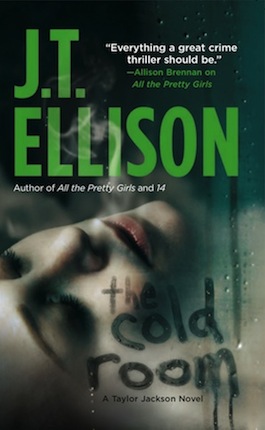
Also, in much more fun news, here’s the brilliant cover for my newest book, THE COLD ROOM (2-23-10)

That means we’ve also redesigned JTEllison.com and everything! Take a peek at the site and let me know what you think!

Wine of the Week: 2005 Cannonau di Sardegna Riserva