Author Archives: Murderati


Never Let Them See You Sweat

by JT Ellison

Ah, nerves.

Many of you know that I nearly came apart early on in my career because I was going to have to do the one thing I was terrified of doing. And when I say terrified, I mean heart-pounding, panic-attack, sweaty-palms, spots-dancing-before-your-eyes, stomach-tied-in-embarrassingly-gurgly-knots, on-the-verge-of-passing-out terrified.

Of course I’m talking about speaking in public.

And I’m not talking about a mild case of nerves, either.

I’ve always had problems with being the center of attention. And no, I will not pay for the keyboard you just spit your coffee onto, because I am dead serious. Having people look to me to be the voice of reason, hell, to be the voice at all, isn’t my cuppa.

“But JT,” you say, “that can’t be true. You have such an outgoing, effervescent personality. I’ve seen you at conferences, laughing in the bar, having a grand old time.” And you’d be right – in my element, with my friends, I’m entirely at ease and not worried of making an ass of myself.

But being in front of a group is much, much different than being a part of a group.

I remember, long, long ago, a semi-drunken night at one of Nashville’s adult establishments where I was crying, quite literally, on Randy’s shoulder in fear. “What if the book sells?” I wailed. “I’ll have to talk to people. I’ll have to get up and speak. I don’t think I can do that.”

“You’ll do what you have to,” my eminently practical husband said, before taking me home and pouring me into the bed.

Imagine the terror I felt when the books did sell. The weeks leading up to my debut were unsettling, to say the least. I was planning a launch party, at which I was going to have to, gulp, speak. I wrote out a speech, figuring I’d just read and pray no one laughed to my face. Before I knew it, there were interviews, and signings set up in 12 states, and I knew I needed to conquer my fears, and fast.

I relayed my worry in an offhand comment to my doctor, and he prescribed medication to help me conquer my fear. And conquer my fear it did. Inderal is a beta-blocker, used for lowering blood pressure. It’s the medication they prescribe for people afraid of flying. It works to even your heartbeat so you don’t get the palpitations and sweaty palms. It nips your fear in the bud. “Take it 30 minutes before you go on,” he told me, “and you’ll be fine.”

And strangely enough, it worked.

But it had its drawbacks. Most of my speaking engagements were an hour long, and I’d noticed, somewhere around the 40 minute mark, a wild sense of unreality, like I was outside of myself looking in. My head would feel sort of floaty, and my heart would pound a few beats more than entirely necessary. Which would make me stumble. Not a perfect scenario.

Ultimately, it wasn’t a doctor who cured me, but a fellow writer. My friend James O. Born saw me popping pills at Southern Festival of Books and asked what the deal was. I told him and he laughed— that hearty guffaw that Jim has—and asked me, “What in the world are you afraid of? Do you think the audience is going to rush the stage, throw you down and gang-rape you?”

“Well, no,” I answered.

“Then what’s the big deal?”

He was right, of course. My next event, I skipped the Inderal. I made it through just fine.

That was two years ago. I’ve fully mastered my nerves now. No medication necessary, a few deep breaths before I go on and I’m fine. I’ve gotten to the point when I’m decent at the speaking part, I think. I still much prefer panels and group signings to speaking solo, but I can manage just fine either way. I just turn on JT, author girl, and become what the audience needs to see. My problems are behind me.

Aren’t they?

Not so fast.

I had an event last week, my last of the summer, in fact. I’m taking a few months off promotion to focus on me, something that’s been sorely lacking since I started this gig. I was really looking forward to this event; it felt like a chapter was closing.

Until I woke up at 4 in the morning with some sort of food poisoning.

Terribly sick.

I couldn’t cancel – this event had been booked for months, a large turnout was expected, a bookstore was coming in to sell the books – I just didn’t have the heart to bail on them. So I sucked down a bottle of Pepto and said a prayer.

To no avail. I got sick before I left the house. I got sick as soon as I got to the venue. I managed to meet my hostesses before I had to bolt to the bathroom again. When they served lunch, I nearly came undone at the table.

And suddenly, the nerves kicked in. Nerves like I hadn’t had in two years. Bordering on panic attack nerves. I honestly didn’t think I was going to be able to pull it off. Try as I may, I couldn’t put on my JT, author girl, suit and go get ‘em, tiger. I was shaky and sweaty and pale and feeling terrible, and I couldn’t for the life of me separate me from JT.

I’ve spoken before of the dual personalities that reside inside my body. The people who know me, know my real name and are a part of my real day-to-day life, aren’t always the same people who know JT and are a part of my book life. I do try to keep the two separate, if only as a buffer for the inevitable bad reviews that happen to that poor JT girl. It’s that same other person who takes over when I have to perform. No true artist can let the world see their tortured soul, the tiny, squawking baby bird inside the glorious Phoenix we must project. You drape yourself in whatever invisible cloth you have designed as your mask, do your thing, and shed it when it’s over.

But that little bit of quiet magic wasn’t working for me last week. I finally had to tell my tablemates that I wasn’t feeling all that hot and had a bad case of the nerves, because I think they were about ready to send out for some sort of elephant tranquilizers. They were very sweet, and understanding, and allowed me some space to gather myself, then smartly got me talking about the books until I finally, finally settled down.

They say never let them see you sweat. And no one outside of my table knew I wasn’t on my game, which helped. When I got up to speak I was okay. Not great, but okay. I gave them my best, but left disappointed that I couldn’t give them the whole show, the full monty. No one who was there had ever seen me speak before, so I’m sure it came across as completely capable. But it wasn’t my most stellar effort.

I’ve only performed sick one other time, at Left Coast Crime in Denver, just after the Great Kidney Stone Attack of 08. I swore that I’d never do it again, because I don’t want to shortchange the readers. There’s a level of expectation involved in public promotion, so much that I understand the desire to be a recluse. I’ve read that Henry Fonda threw up before every performance. I know there are athletes and actors and writers and politicians who do the same. And I applaud every person who tries to overcome their terror and fulfill their purpose. It’s hard, and you should be lauded for your efforts.

For you newbies out there who may be suffering from stage fright, it’s okay. We’ve all been there. The audience is incredibly forgiving. They want to see you succeed. They will be kind. And always remember, no one knows your topic like you do. You are the expert. If you feel yourself faltering, talk about your inspirations and that should get you through the worst of it.

So what about you, ‘Rati? Ever experience performance anxiety? (And that’s for everyone – not just authors have to deal with these issues.)

Wine of the Week: 2006 Cellar No. 8 Merlot

To Boldly Go Where No One Has Gone Before…

by JT Ellison

Space… the Final Frontier. These are the voyages of the starship Enterprise. Its five-year mission: to explore strange new worlds; to seek out new life and new civilizations; to boldly go where no man has gone before.

Cue soundtrack.

I had some dental work done this week. Don’t you spare me a moment’s thought of sympathy, though–it was elective, cost a bajillion dollars and made me feel pretty. And I benefitted, in large ways and in small. Why? I got to spend the better part of an afternoon under the lovely sedative grooves of Nitrous Oxide.

I wrote a post a couple of years ago (click here to read it) about the joys of nitrous. Nitrous and I get along well. It’s a creative booster shot, allowing me to get into a completely different frame of mind. I don’t use drugs, but after an hour with the nitrous, I get a glimmer of understanding about why some people might. Chasing the high, I think they call it, what drives most addicts into their addictions in the first place.

Anyway, because this procedure was going to take a while, they suggested I listen to my iPod.

So I queued up something I knew would take my mind off of things. The soundtrack to Star Trek, by the most brilliant Michael Giacchino. Giacchino does a lot of work with JJ Abrams, most notable the themes for ALIAS, LOST, and of course, STAR TREK.

I’m a huge Trekkie. So I was concerned about the re-energization of the franchise. Sometimes that can fall flat on its face, but Abrams did a masterful job. I can’t say enough good things about this movie – it moved me, made me cheer, captured my imagination, allowed my Dad and I to both indulge in our fascination with all things chaos and quantum, started me down a new avenue of research for a possible future book, and entertained me to the point that I saw it twice in the theater and I’m still hankering to see it again.

Part of the mastery of the movie is the script – so brilliantly rendered by Roberto Orci and Alex Kurtzman that I have to single them out – their interpretation and masterful devices allowed the series to be regenerated into films for the modern era, and for that I salute them. The casting is incredible – I adored Chris Pine and Zachary Quinto, as well as everyone else.

But another aspect of the movie that not a lot of people are talking about is the score by Giacchino. It is so subtle, so powerful, and so perfectly matched to the story that I honestly really didn’t even hear it the first time I saw the movie. Oh, it was there, and there were moments when I heard it, but for the most part, it did its job. Scores aren’t meant to be flashy and in your face. They are a compliment, the eggs that bind the batter so it can be made into a cake, the tray that holds the ice as its being frozen into cubes. In other words, absolutely necessary: the lynchpin of a good movie, the tent pole. Seen but unseen, heard but unheard.

Unless you’ve seen the movie, then downloaded the soundtrack, this may sound silly, but through the music, I can recreate every single moment of that film in my imagination. It’s so successful as a score that it becomes an immediate rewind button. Remarkable. That doesn’t happen to me very often. I’ve had soundtracks that I love, of course (Dances with Wolves, Harry Potter) but rarely am I so moved by the music that I can relive the movie, moment by glorious moment.

Giacchino’s score is wonderful – sweeping, poignant, visceral in spots; playful, sexual and seductive in others. There’s no question which music belongs to the heroes and which belongs to the villain. Nero, the Romulan mining ship captain and driving evil force in the movie, benefits from an especially powerful and ominous theme.

Listening to it under the influence of the nitrous, I wondered if Giacchino was influenced at all by Prokofiev – for some reason, I hear the three horns of the Wolf (from Peter and the Wolf) in the notes to signify Nero’s ship. We all know wolves are bad, bad, bad, and Nero qualifies as a wolf – a threat to the Federation of primary importance. (For those of you who are familiar with this, listen to the Andante molto and tell me what you think.)

Talk about evoking emotions with a classical piece – I can recreate the voice-over to Peter and The Wolf just by listening to the album. The fear, the joy. Ah, Disney at its finest (with the attendant happy ending for Sonia the Duck, too.)

It wouldn’t be the first time a composer has been influenced by an old master – the John William’s distinctive two-note heartbeat JAWS theme is suspiciously similar to the Allegro of Antonín Dvořák’s Symphony #9 in E minor (aka The New World Symphony.) Strangely enough, if you meld the Prokofiev and the Dvořák, it really evokes Nero’s theme in Star Trek. Hmm…

While most of you know my passion for wine, few of you know my undying addiction to classical music. I’ve been using classical for years – to drive me, to tell stories, to layer into my books for effect, as themes for each of my books, to get drunk to, to make love to. I played clarinet for years, with brief forays into flute and saxophone, and shared my first kiss with a trumpet player, so I’m kind of partial to orchestral music. Opera works the same way for me, I adore it. It changes me, alters me, if only for a moment. I’ve always loved the line from PRETTY WOMAN, where Richard Gere explains the obsession with opera:

People’s reactions to opera the first time they see it is very dramatic; they either love it or they hate it. If they love it, they will always love it. If they don’t, they may learn to appreciate it, but it will never become part of their soul.

I couldn’t agree more. I adore the stories told through the music – the emotions it evokes, the fact that just the right note can make or break a piece. It’s what I love about a perfectly pitched scored, like the Star Trek soundtrack. It becomes a part of my soul.

And somehow, I managed to remember this line of thought whilst under the influence of some serious drugs. I must admit, listening to the score under the influence was eye-opening. Mind-expanding, if you will. I felt the music in a completely different way than before. The closest I can remember coming to this was a long time ago, under the manipulative control of Grand Marnier (which is like absinthe to me) and listening to Phantom of the Opera over and over until I was in some sort of wicked trance.

I highly recommend you see the movie, download the score, and have a bit of your favorite non-inhibitor and experience this for yourself. It’s truly something to behold. Kind of like space.

Or maybe I was just stoned out of my gourd.

So how about you, ‘Rati faithful? Favorite movie scores? Favorite operas and classical pieces? And did you like the new Star Trek film?

Wine of the Week: De Toren Fusion V – A South African entry recommended by a dear friend. It’s a bordeaux blend that’s been compared to the finest Chateau Latour wines. Can’t wait to try this one!

(Said dear friend also turned me on to the Kurtzman-Orci interview, so many thanks for both recommendations!)

When Ego Attacks

by JT Ellison

Randy and I went to a concert a couple of Saturdays ago, one I’d been looking forward to for weeks. Months! Billy Joel, with Elton John.

Now, for the record, I adore Billy Joel. Adore the music, the stories, the way he engages the audience. I’ve seen him in concert before, and it was one of the best shows I’ve ever seen. It was at the Cap Center (now US Airways Arena) in Landover, Maryland. I was in high school, which meant a limited allowance, so I could only afford to purchase the cheap seats. Obstructed view. Behind the stage. I was a little bummed, but figured I’d be able to hear, even if I couldn’t see.

Boy, was I surprised. Billy Joel set up his stage with pianos on all four corners, and made a point of playing to every section of the crowd. Even though my seats were “obstructed,” I had a great view, and for a quarter of the concert, Billy sang directly to me. He was funny, self-effacing and charming. The music was outstanding. I went home feeling like I’d been a part of something special, something unique. He’d touched me, without ever having set eyes on me, or knowing I was there. Now that’s power.

Fast forward to current day. We can afford better seats now, though through a timing error we ended up in the nosebleeds. My vertigo and I enjoyed that. Thankfully, the lights went down quickly, and out came Billy and Elton. They played two songs in duet, then Billy exited the stage and Elton took over.

And I mean it when I say Elton took over. The lights. The flash. The pure, unadulterated rock. The individual songs that went on (and on, and on) for fifteen to twenty minutes. And after each song (finally) finished, Elton ran around the stage, banging himself on the chest and inciting the crowd for applause. If I had a microphone near his mind, it would have very clearly screamed LOOK AT ME!!!!!!!!!!!!!!!!!!

Yawn.

We slipped out, took a break, got a drink, walked around, and still he played. Now, don’t get me wrong, there’s a lot of Elton John that I like. But this was a full-on Wembley Stadium show sandwiched into the Sommet Center. And there was this crazy thing that was also supposed to be going on….. Oh, right. Billy Joel.

Elton played for an hour and a half, and after every single song, he paraded around, basking in the adulation. It just felt so forced, so unnecessary. And in contrast, when Billy Joel finally was allowed to take the stage, he started a conversation with the crowd. He apologized to the people with the crappy seats. He told jokes. He talked about his love for, and connection to, Nashville. He took a moment after each song to introduce a band mate. He made it about us, and them, and not about him.

He had the crowd eating out of his hand in two seconds, simply because he seemed to grasp something Elton John didn’t. Billy was there for us. He was playing for us. Elton, sadly, played at us. Elton was a performer, but Billy was an entertainer.

We’ve all met those kinds of people, the ones who ask you how you are, then immediately launch into a recitation of how they are. The people who self-aggrandize, who bang their chests and do everything to get people to notice them. The people who are desperate for any kind of attention, and will do whatever it takes to make sure they’re at the center of it all.

There’s a lesson to be taken away from this. We authors, for better or for worse, are public figures. There are expectations, and challenges, along the way. It’s a heady, heady experience to have people read your work and appreciate it, to gain fans, to entertain strangers. And it’s very easy to fall into the “me” mentality: to think your life, your work, your stories are more important, more entertaining, and more appreciated than anyone else’s at the table. To let your ego take over and run away with your reputation.

I just hope that no one ever comes away from a conference, or a panel, or a signing that I’ve participated in and think that I’ve pulled an Elton John. Give me Billy Joel any day.

And speaking of Mr. Joel, I am most definitely in a New York state of mind. Literally, and figuratively. As you read this, I’m traipsing the streets of Manhattan, one of my favorites cities in the whole world. Lots of events on the plate: meetings galore, signings, and hopefully, a night to ourselves to have a quiet meal and some good wine. I’d like to squeeze in an afternoon at MOMA, a trip up the Empire State Building, and if my ankle holds up, a walk through Central Park. So please don’t hold it against me if I don’t comment in a timely fashion.

Your questions for today –

What’s the best concert you’ve ever seen? Why?

And what’s your favorite city in the whole wide world???

Wine of the Week: Chateau Ross 2005 Big Bitch Red

The Wrath of Grapes

by JT Ellison

Before I start the second installment of the Napa Valley travelogue, I have an announcement to make. Starting next Friday, we are welcoming a new member to Murderati. Stephen Jay Schwartz, a brilliant debut novelist, is going to join me on alternate Fridays. Stephen’s first novel, BOULEVARD, releases in September, and I was proud to offer an endorsement – it’s going to shake the fabric of the crime genre.

After more than three years, the rigors of weekly blogging have taken their toll, and I’m so grateful Stephen has agreed to share the load. He’ll be bringing the newbie’s perspective, and his column is aptly titled “The Newcomer.” You can learn more about Stephen’s world on our About page. Suffice it to say he’s a perfect addition to our merry band of bloggers. I hope you’ll show him all the great kindness that you’ve showed me over the past years.

Now, on to the wine. Here is the link to last week’s In Vino Veritas.

NAPA VALLEY – DAY THREE

Happy Birthday to me… We called this one the unbirthday.

We started with a drive up the 128 to Mumm Napa. What better way to start an unbirthday than with champagne? (And yes, I know this is really sparkling wine, real champagne only comes from the French champagne region.) We took a seat on the Oak Terrace, Mumm’s gorgeous new outdoor tasting deck, settling into the comfy red wicker, and were served our tasting flutes. Though since we were on the Oak Terrace, we were tasting from the Library Collection, and the flutes were full : )

We started with the 2001 Blanc De Blanc. It was a classic brut sparkling wine, crisp and jasminy, with a lemon finish. I moved on to the 2000 DVX Rosé, which was redolent of red apples, and Randy tried the 2005 Pinot Noir. In order to make rosé, you need red grapes as well as white, so the pinots add just the right amount of pink to the glass. But I never knew Mumm’s bottles a pinot out of each season’s growth. That was the second excellent pinot of the trip – smooth and clean with strawberry, peach and tobacco notes.

Me being a complete lightweight, I was a wee bit happy at this point, (nothing like catching a buzz before noon – sheesh) so we had a small plate of crudités that included a divine chocolate covered strawberry and fresh strawberries. Outstanding.

We headed off toward Cakebread then, but accidentally stumbled upon the Rubicon Estate. We’d been planning to hit Rubicon last, but since it appeared on our right, we decided to hit it first. Rubicon is the former Inglenook Estate and is owned by Francis Ford Coppola. You’ve seen me suggest the Coppola wines before, but this is the special place, the vineyard that houses the estate wines. Estate wines are generally older, more established vines that produce less fruit and subsequently, fewer bottles, which means they are more expensive.

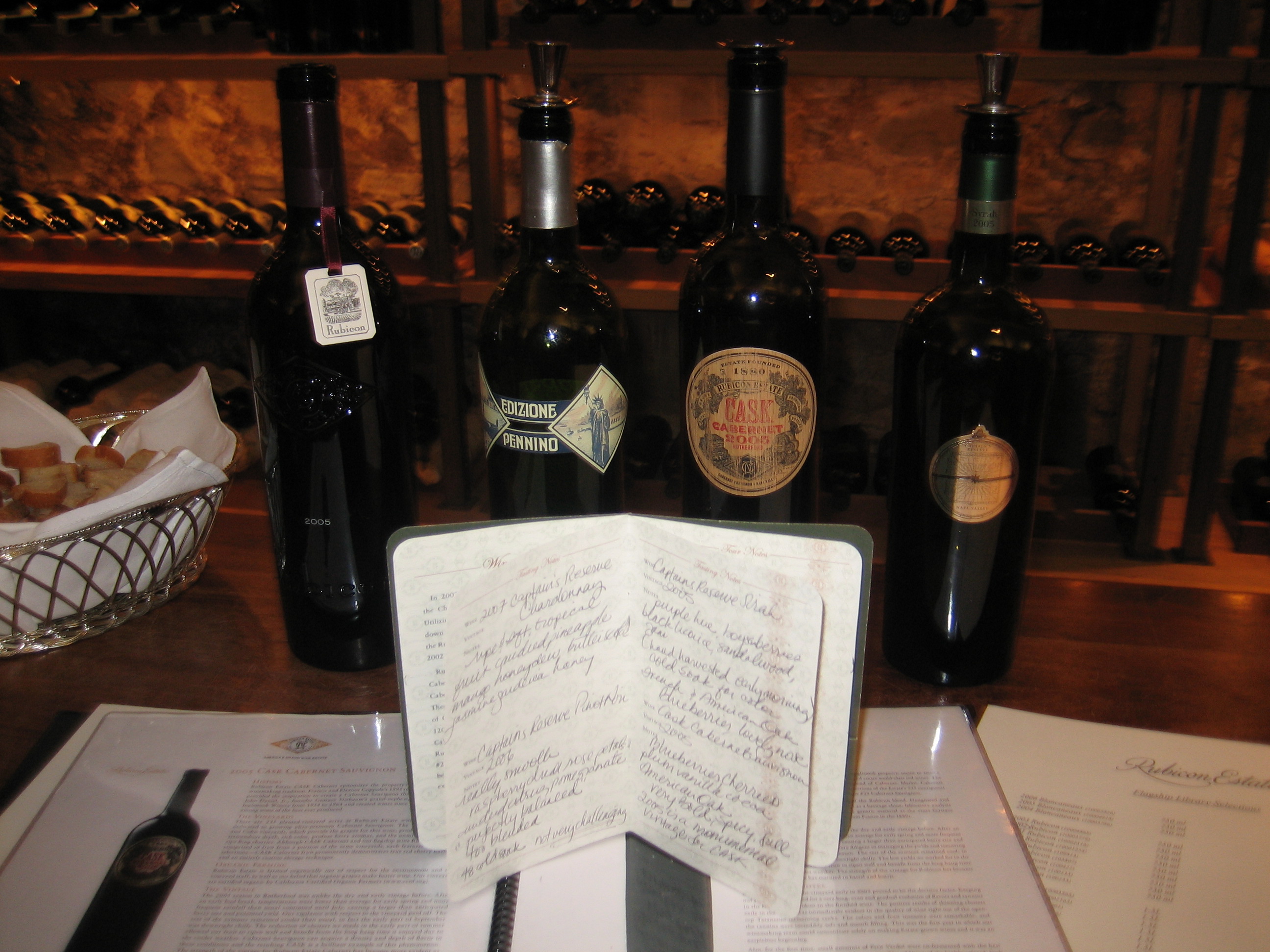
This was by far the most expensive stop, $25 per person for the tasting. They give you a passport, with the history of the estate and fun facts about the vineyard, and plenty of space for tasting notes. And the tasting – oh, my, the tasting.

We started with the 2007 Captain’s Reserve Chardonnay. Though neither of us are big white wine fans, this was very good, tropical and fruity. Then we moved to the 2006 Captain’s Reserve Pinot Noir. That was not what I’d call a very challenging wine. It was good, smooth, actually almost too smooth, and perfectly balanced, and tasted of raspberries and rose petals. The next was the 2005 Captain’s Reserve Shiraz. Now this got our attention. It was deeply purple, with boysenberry, black licorice, blueberries and sandalwood. It had a lovely nose and had fun tidbits – the grapes are only hand-harvested in the early morning hours, then cold-soaked for 48 hours to ensure the rich, ripe color.

Next was the 2005 Cask Cabernet Sauvignon. This was a monumental vintage for the Cask, and the wine was rich with blueberries, cherries, plum, vanilla and cocoa, and was very bold and spicy. Really excellent wine (we bought some to take home!) We tried the 2005 Rubicon too, a heavy cabernet with loads of pepper, raspberry and smoky wood notes. Just fantastic.

The last wine at the Rubicon was an add-on from our server, who was a delight – knowledgeable, pleasant and willing to share some insider secrets. We talked of the Nardi estate in Italy (my family name is Nardi, remember) and that Mr. Coppola had visited their wine-making operation. She suggested we write Mr. Coppola a note, which we did. (The funny thing was, I’m writing a note to one of the greatest filmmakers of all time and all I’m thinking about is how to express my deep gratitude for his endeavors into wine making. Should’ve slipped a card in, but I really didn’t think of it until we left. Oh well.) The wine is a homage to his grandmother’s side of the family and is called Edizione Pennino. We tried the 2006. This is an organically farmed wine, a Zinfandel varietal, soft and full, with white pepper, smoke, blackberries, blueberries and raspberry notes. We took some of this home too, it was lovely. And it was nice to have the opportunity to taste such a special wine, a wine that’s dear to the winemaker’s heart. Made us feel right at home.

And then we went to Cakebread. I know the white fans are drooling right now, but the two whites we tasted, 2007 Sauvignon Blanc and the 2007 Chardonnay, while good, didn’t make a lasting impression. I just don’t have a white wine palate, though I was assured by our tasting tour partners that it was a good wine. The tour itself was a bit uninspired too, with this being more focused on just getting some wine in the glass and into your mouth than any real education. I think the group was a bit too big, and a little unsophisticated, so things were kept on the top layer, so to speak. The 2006 North Coast Rubáiyat was very good, a pinot heavy blend. The 2007 Rubáiyat will be a Merlot blend, which I found interesting. The 2005 Red Hills, Lake County Zinfandel was great, lots of dark chocolate and purple fruits, and the 2005 Napa Valley Cabernet Sauvignon had all the elements of a great cab. It’s typical of the cooler parts of Napa, and was our favorite of the lot.

We had just enough time to hit one more, and let me tell you – choosing which vineyards to go to can be a bit daunting. There are hundreds to choose from. But the wonderful Preiser Key was a Godsend. It breaks the vineyards into appellations, so we could look for vineyards that did our kind of wine. We wanted to taste a California Sangiovesi (the grape that’s used in Chianti,) so we headed to Castello di Amorosa.

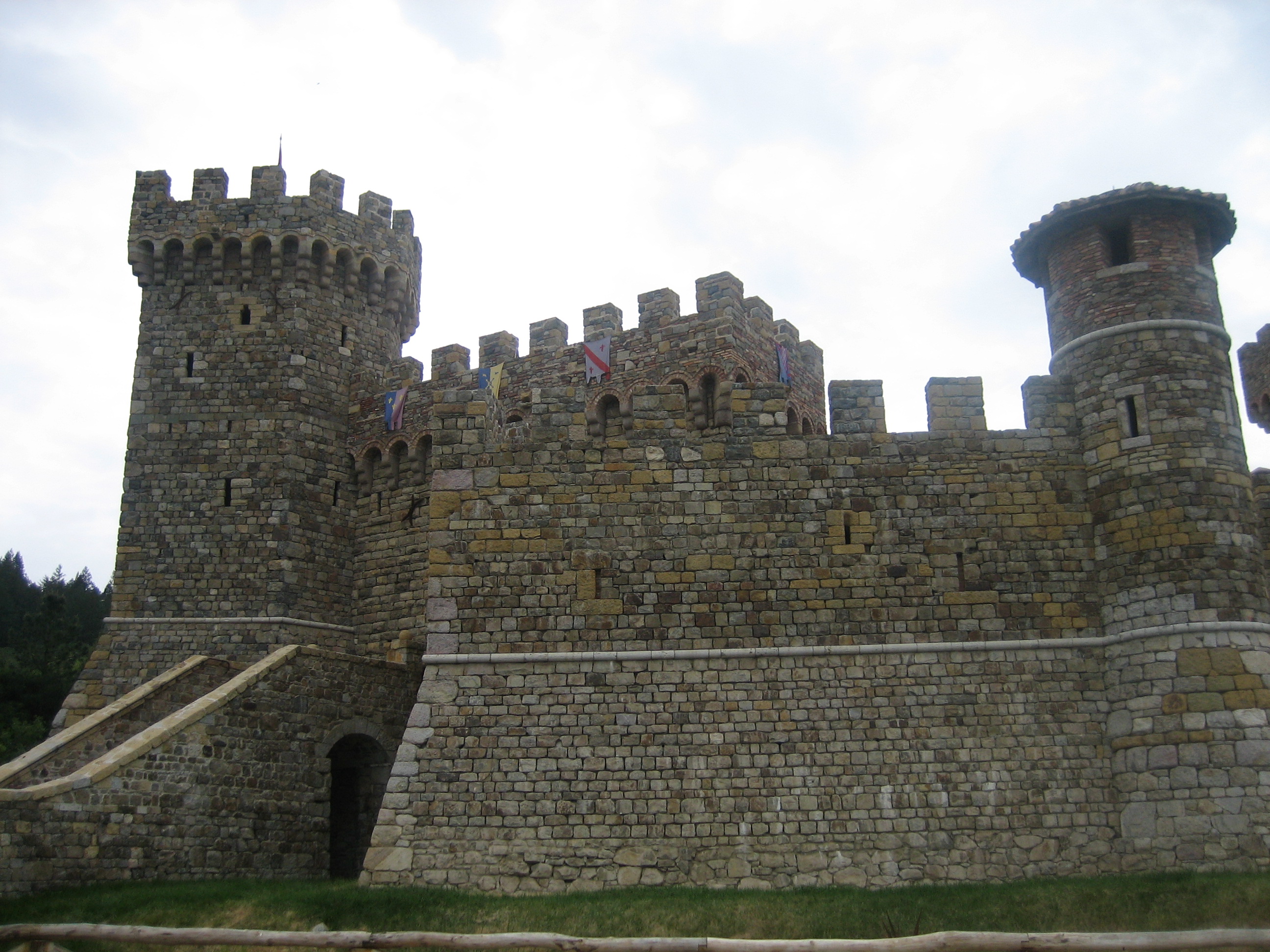
And boy, did we get a fun surprise! What no one mentioned was the name of this vineyard was quite literal – the estate is a castle. A 101,000 square foot medieval castle. Cue enchantment!

We scoured the castle, then went to the tasting. This was one of the estates with a wine club. We wanted to join a couple of clubs, but didn’t want anything that we could buy in stores. Castello di Amorosa is exclusive to their wine club members. Intrigued, we asked for a special tasting that would allow us to determine if this vineyard could be a contender. They didn’t disappoint. The 2005 Diamond Mountain Sangiovese was great – black fruits, supple oak, and vanilla notes. The 2005 Merlot was good too, but needed to breath to let out the spicy, peppery finish. We loved “Il Brigante”, a 2002 Cabernet Merlot blend, cherries, light oak, spices. It’s very dry, which we love. And the name means Little Thief – how can you not love it? The 2004 Cabernet Sauvignon was lovely – rich and fruity, then we moved off the regular tasting list and into the big dogs. “Il Barone”, a reserve cab, was excellent, but what sold us was the 2005 “La Castellana” Reserve. This is a beautiful Super Tuscan wine, absolutely outstanding. We signed up for the club and took bottles of Il Brigante and La Castanella home with us.

And now it was time for the dinner. We had reservations at a restaurant in Napa, so we hurried home, changed and set out for our fine meal. We were sorely disappointed: despite our 8:00 reservation, we weren’t seated until 8:30, and then it took another fifteen minutes for the waitress to take our drink order. It was noisy and crowded, not at all what we were looking for in an intimate birthday celebration. I won’t name the restaurant because I’m sure it’s normally great, they just looked incredibly understaffed, and that never speaks to a good experience.

So we walked. We knew UVA was right around the corner, and we headed there. It was a chilly walk, but well worth it. The meal we had goes down in my top five best meals I’ve ever eaten. It was simple, rustic Italian fare made from fresh, local ingrediants – meatballs smothered in tomato sauce and mozzarella as an appetizer (it was their special, and it was fabulous,) chicken and mushroom carbonara, and a phenomenal tiramisu, accompanied by a bottle of L’Uvvagio Barbera, 2005 and homemade limoncello. They even threw in a candle and wrote Happy Birthday on the plate, and comped the desserts. Classy, and guaranteed that we will recommend them highly. Top it all off with another fire and one of my all time favorite movies, FRENCH KISS, and I call that a successful day.

DAY FOUR

We were at a bit of a loss in the morning. Truth be told, we didn’t want to leave. We needed to head to San Francisco later in the day, the forecast called for rain, and we hadn’t gotten ourselves into the heart of the Sonoma Valley yet. So we decided to Trust in Tara – our theme of the week – and put in an address we knew was on the north end of the Sonoma Valley. That way, we could drive, and anything we stumbled upon was fair game.

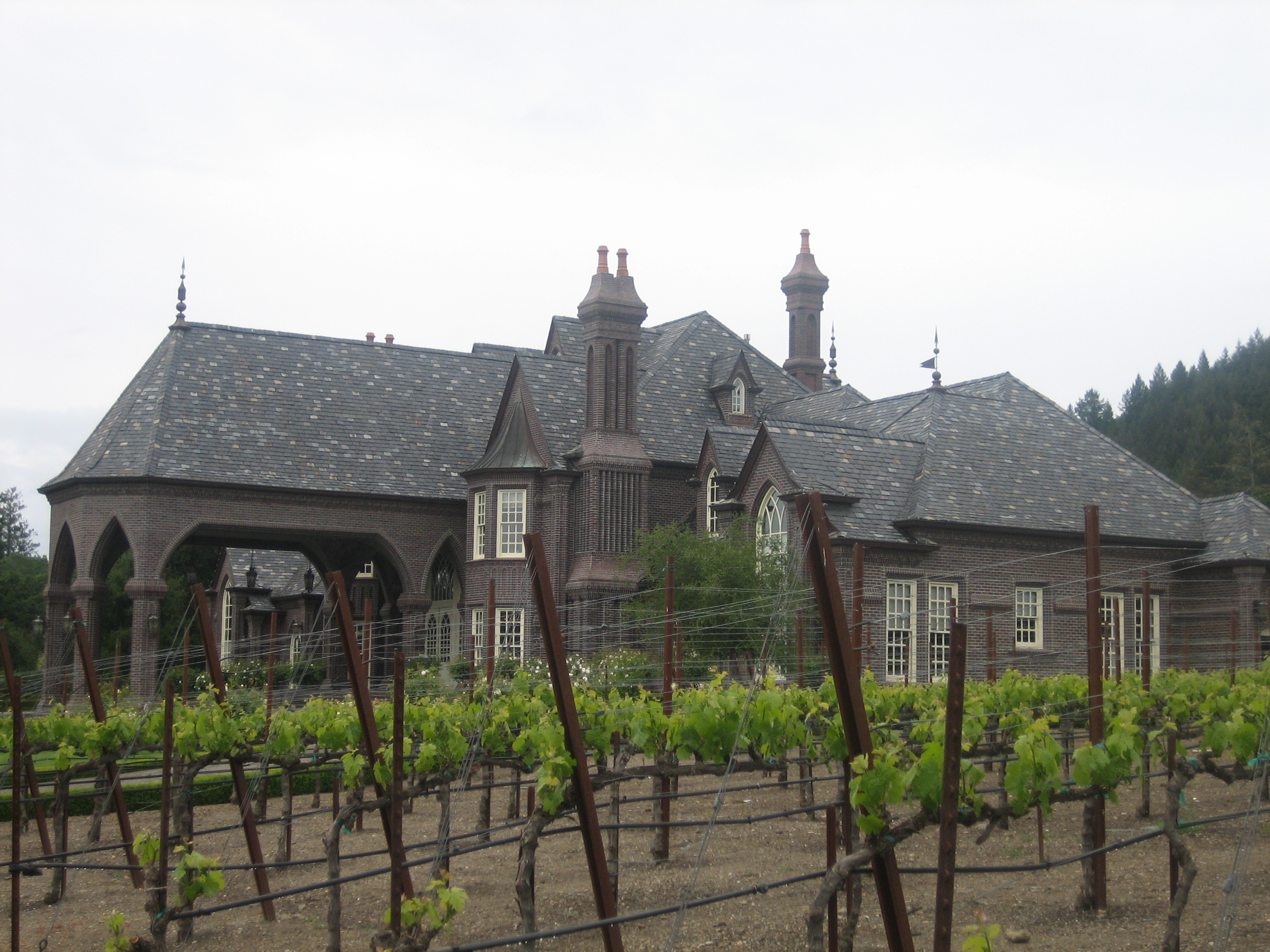
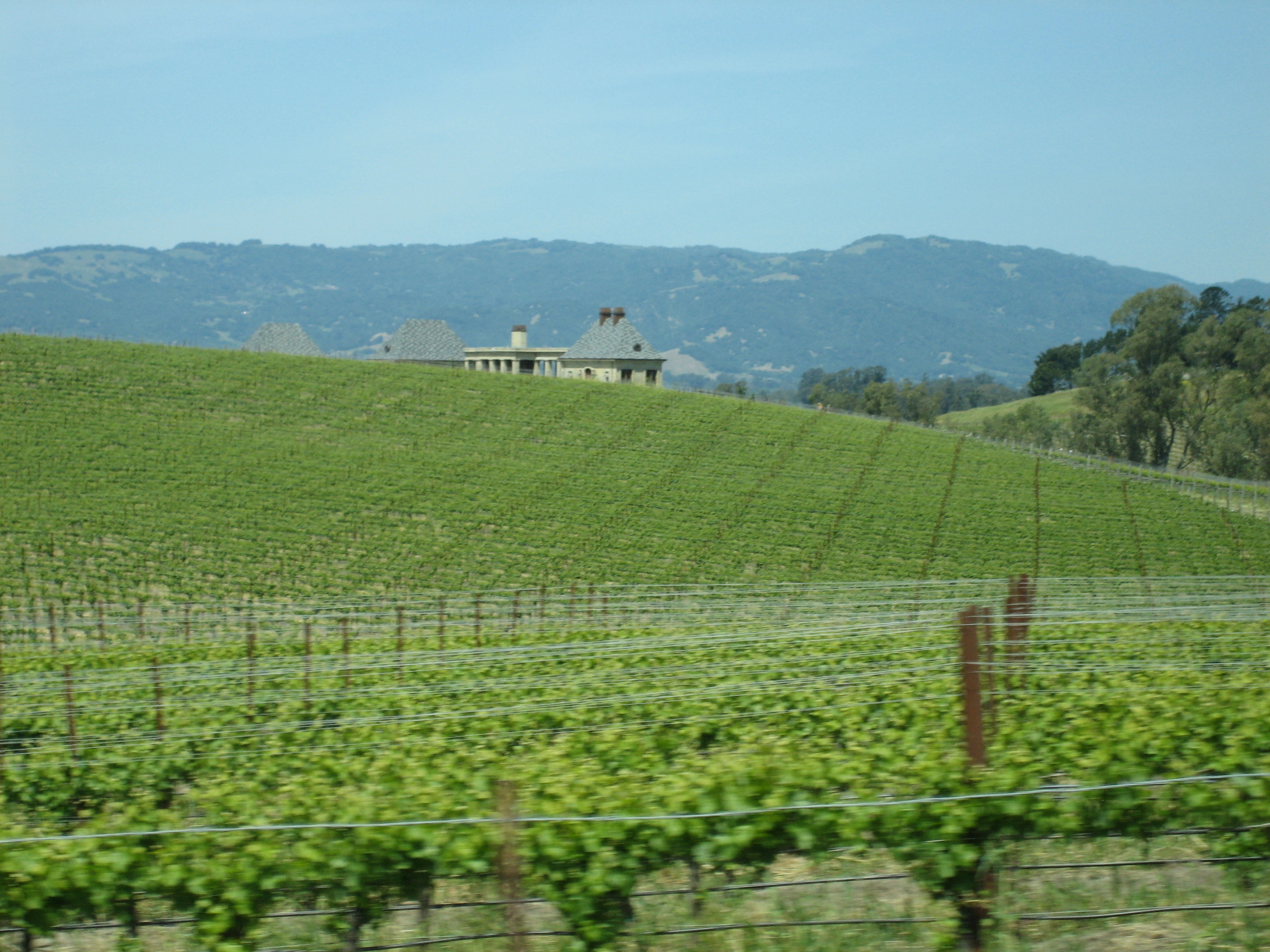
The drive was beautiful, though we got caught in the downtown district of Sonoma, which I thought was much more “city” than Napa. But when we cleared out of that, we were able to drive for about thirty minutes, gazing at the vineyards, feeling the slow seep of time. We spied a huge mansion in the distance, and the closer we got, the more interesting it looked. They had a sign that said Sangiovese in the front, so we stopped. (We really need a bumper sticker that says “I Brake for Sangiovese”.)

The estate was called Ledson. We’d never heard of it, and soon discovered that this was another wine club-only vineyard. Intrigued, we started the tasting. It was so nice to be inside looking out on the rainy day, to see the mist rolling through the valley, to be warm and dry on such a dreary day. We were in the capable hands of Austin Smith, wine consultant extraordinaire, who entertain as well as educated.

We chose an array of reds for our tasting, and got to work. I say work because it is, in a sense. Anyone can go into a tasting and drink wine. It takes some practice to be able to tell one wine from another, to ferret out your individual tastebuds, to be able to tell French oak from American. And trust me, with a little bit of training, anyone can do this. And to the folks in these vineyards, when they get a true oenophile at the bar, it’s like a light goes on inside them. They want to educate. They’ve got the finer details down, and are willing to share. I have to tell you, the most fun of the whole trip was being surrounded by fellow wine junkies.

We started with the 2005 Diamond Ridge Cabernet Sauvignon – lots of rose petals, blackberry and cherry, vanilla, with cranberries, cloves and toasted oak. YUM! Then were tried the 2005 Knights Valley Cabernet Sauvignon. Another excellent wine, with lots of leather, anise and lilac which tasted of chocolate and black berries. The 2005 Mes Trois Amour is the California version of an Australian GSM – that’s a blend of Grenache, Shiraz and Mourvedre grapes – with cocoa and smoke, rich cherry and smoked molasses. The 2007 Russian River Pinot Noir had the characteristic rose petal, strawberries and cherry nose that we’d come to expect from the pinots, but with a surprising caramel and pepper finish.

The 2006 Knights Valley Sangiovese was dry and spicy, and the 2005 Lodi Old Vine Zinfandel was incredibly jammy, with white pepper and plum and a touch of cinnamon. We had some of the 2005 Kinghts Valley Bellisimo, the gold medal winner in the World Wine Championships, that is a 57% Merlot 43% cab blend – luscious, fruity and spicy, and the 2005 Sonoma County Cèpage, which was smoky, leathery, with toasted oak and plums. Truly an excellent wine. The last one we tried was the 2006 California La Montagne, a 75% cabernet 25% sangiovese with raspberry, pepper, rose and lilac notes. It’s a Super Tuscan wine, and absolutely divine. We were sold. We joined the wine club, and Austin comped our tasting, a very nice touch.

And then we ate. Thankfully, there was the great little Café Citti right down the street, and we munched a pizza and cleansed our palates with salad and lots of water.

Declaring our trip a success, we headed into rainy San Francisco. It was too cool to drive the Golden Gate Bridge into town, but the shock of being in a city was a sharp contrast to the lazy, indolent days we’d spent in the country. We decided on the spot that we are definitely country mice, with the exception of New York.

We drove around San Fran and dined in the rain at Capurro’s on the wharf. I had clam chowder and crab cakes, and a lovely glass of 2005 Clos la Chance Zinfandel. Randy was dabbling in the pesto gnocchi again – I just can’t keep that man away from the gnocchi.

We did a minimum amount of strolling, got lost (Tara wasn’t happy with the heavy fog and kept sending us to the wrong street) so we accidentally ended up on Lombard Street. It was dark, but you can still see the crookedness. We did a run through the red light district (when I visited San Fran last, when I was 8, my dad got lost and ended up on that street. Twice. My mom was having kittens.)

Back at the Grand Hyatt, we had a cappuccino and birra in the lounge, then went back to our room. Looking down into Union Square, we saw a group of people, all dressed in black, looking like they were doing a protest. We found out a few minutes later that we were watching anarchists who’d just cracked windows all over the shopping district, causing thousands of dollars in damage. Um, yeah. Way to make a statement, guys – cracking a window at Neiman Marcus while wearing a ski mask is sure to change the world.

DAY FIVE

We had very special plans today. At noon, we were meeting our dear friend Louise and her sweet hubby Bruce for lunch at the Washington Square Bar and Grill. After we packed and managed to get the multiple bottles of wine we bought along the way shipped home, we headed to Washington Square.

Our dear Louise looked lovely, and kindly gifted me with a San Francisco compass, which I desperately needed. We had a brilliant meal (try the fish and chips, they are croquettes and really yummy) and a plain old fashioned cellar merlot. I was actually a bit wined out, if you can believe it.

After a couple of scintillating hours in our dear friends’ company, it was time to go home. We drove across the Bay Bridge into Oakland, and the fairy tale ended. Alas. But out luck held – even though we were an hour late turning the car in, they didn’t charge us an extra day. Southwest was on time, as always, and we got home safe and sound to a very, very happy kitty.

Bottles of wine have been rolling in, with almost daily visits from UPS. Our cellar restocked, now we’re planning our next outing. Italy? Oregon? Wherever we go, we’re sure to find good food, good wine, and make new friends.

More pics of the trip can be found here and here. Thanks for taking the journey with us. A new decade has begun, and I hope it brings great joy and success to us all.

In Vino Veritas

by J.T. Ellison

Ahhh, vino. Anyone who’s been reading this column for more than a few Fridays knows I am a complete and utter wine junkie. An amateur oenophile. A lover of the dark juice, a disciple of Dionysus, a proponent for good wines and vineyards. When we first started Murderati, and I had nothing to say (odd that we’ve come full circle) I thought I’d give a wine tip every week, just as a sort of value-added incentive to read the columns. I’ve given hundreds of wine tips over those three years, so many that I’m considering hiring someone to go through and list them all out for me so I have a record. Because I don’t have a list of all the wines I’ve recommended.

Does that surprise you? I know you know I’m a complete control freak, borderline OCD about so many things, but keeping track of my wine consumption? I’m terrible at it. I’ve started too many notebooks to count – separating them into varietals, countries, years. I put them into lists and then forget to add to it. I’m a bit hopeless, and that’s not the way a real wine connoisseur acts.

Well, I’m not a real connoisseur. I’m just a thriller chick who likes her grape juice.

So when hubby told me he was taking me to the Napa Valley for my birthday, you can imagine how excited I was. We’ve been to Italy a couple of times, strolled through pour favorite vineyard, Tenute Silvio Nardi – learned about tastings and fermentations and the benefits of French oak from our friend Jeorge, the estate manager. We know Francis Ford Coppola has been there, his wine team spent a few weeks learning from the Nardis. (More on that later) And my family name, for those who are interested, is Nardi. Winemaking, apparently, is in my blood.

We touched base with friends we know have travelled in the area for recommendations. We quickly discovered that this can be a pricey trip, because most of the vineyards charge for the tastings, anywhere from $10 a person to $25. That can add up quickly. It was recommended to us that we stay in Sonoma, the less trafficked and less commercial part of the wine country. But Sonoma’s expensive, so we decided to go the economical route of a bed and breakfast in Napa proper, taking advantage of the great travel deals (many, many hotels are doing specials now, three nights for the price of two, that kind of thing.) Turns out that was our smartest move. Napa proper? Not so commercial after all. And the B&B was perfectly located at the mouth of Highway 29 and Highway 128, two of the most beautiful stretches of road in the world. Breakfast in bed daily, a spacious, clean and quiet room with a fireplace and DVD player, a comfy bed and oodles of hot water – it was heaven.

The first day we’d arrived at about 3:00 pm local time after a full day of traveling. We were tired and hungry, and poor hubby had a cold (we were hoping it wasn’t hamthrax, we’d stopped at a local store for a jug of hand sanitizer and there were people in masks.) The B&B manager pulled out a map and a slew of tasting coupons (despite the prices, the coupons were along the lines of two for one tastings, etc.)We decided to forego the tastings in favor of a cheeseburger, which we found at the Napa Valley Grille in Yountville. Napa and Sonoma are made up of a multitude of small contiguous charming towns, with vast tracts of vineyards stretched between them. Most picturesque.

Food served, along with buttery focaccia dipped in rosemary, pepper, garlic and sea salt infused olive oil, we ventured into our first wines. Hubby had a Tangley Oaks Merlot, and I tried the Napa Cellars Merlot. Both were excellent, and we had a first moment of fortune – they’d emptied the very last bottle of Tangley Oaks and didn’t have enough for a full glass, so that one was on the house. Just the right way to get the trip started.

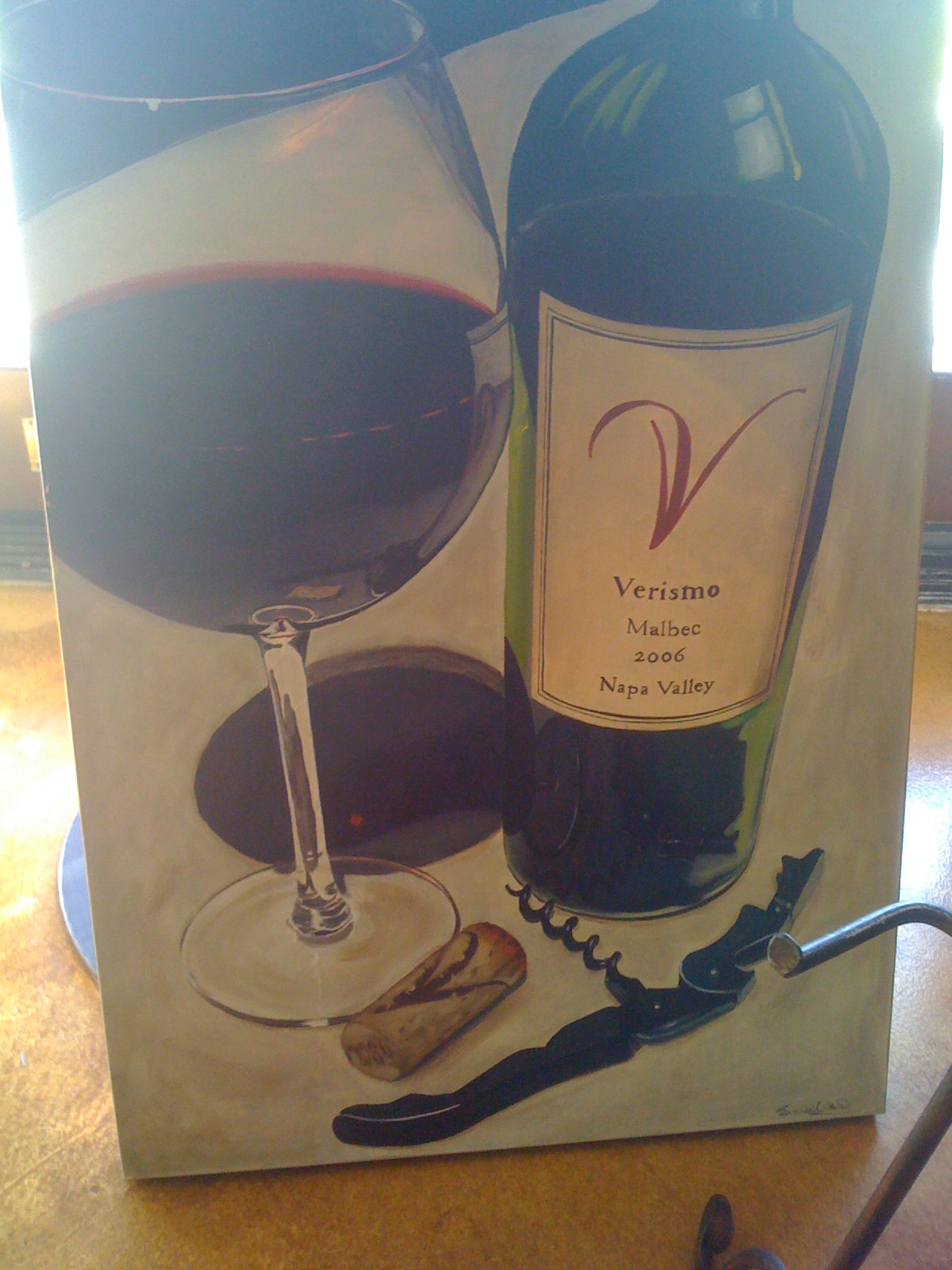
As we left, we noticed a tasting room for Verismo Wines. We stopped in for the heck of it and discovered three excellent wines: Stretta (aged in American Oak), Stella (aged in French Oak), and a surprisingly good Malbec, also aged in French Oak. I’ve never been much for the Malbecs, but this was rich and deep, just great.

Back at the B&B, 5-7 is cocktail hour – with lovely crudités, several wines to taste and some elevator Muzak. We retired early with a bottle of Stretta in our room, lit the fire, doped up the hubster and got a great night’s sleep.

DAY TWO

This was the last day of the decade for me. We wanted to see some redwoods, so we rose late, programmed Tara Stella Gypsy (our Garmin Nuvi, named such because Tara is the Buddhist goddess of navigation, Stella for stars, and Gypsie for… yes, GPS) and off we went. Tara has a plethora of cool features, and we trusted her implicitly to get us around.

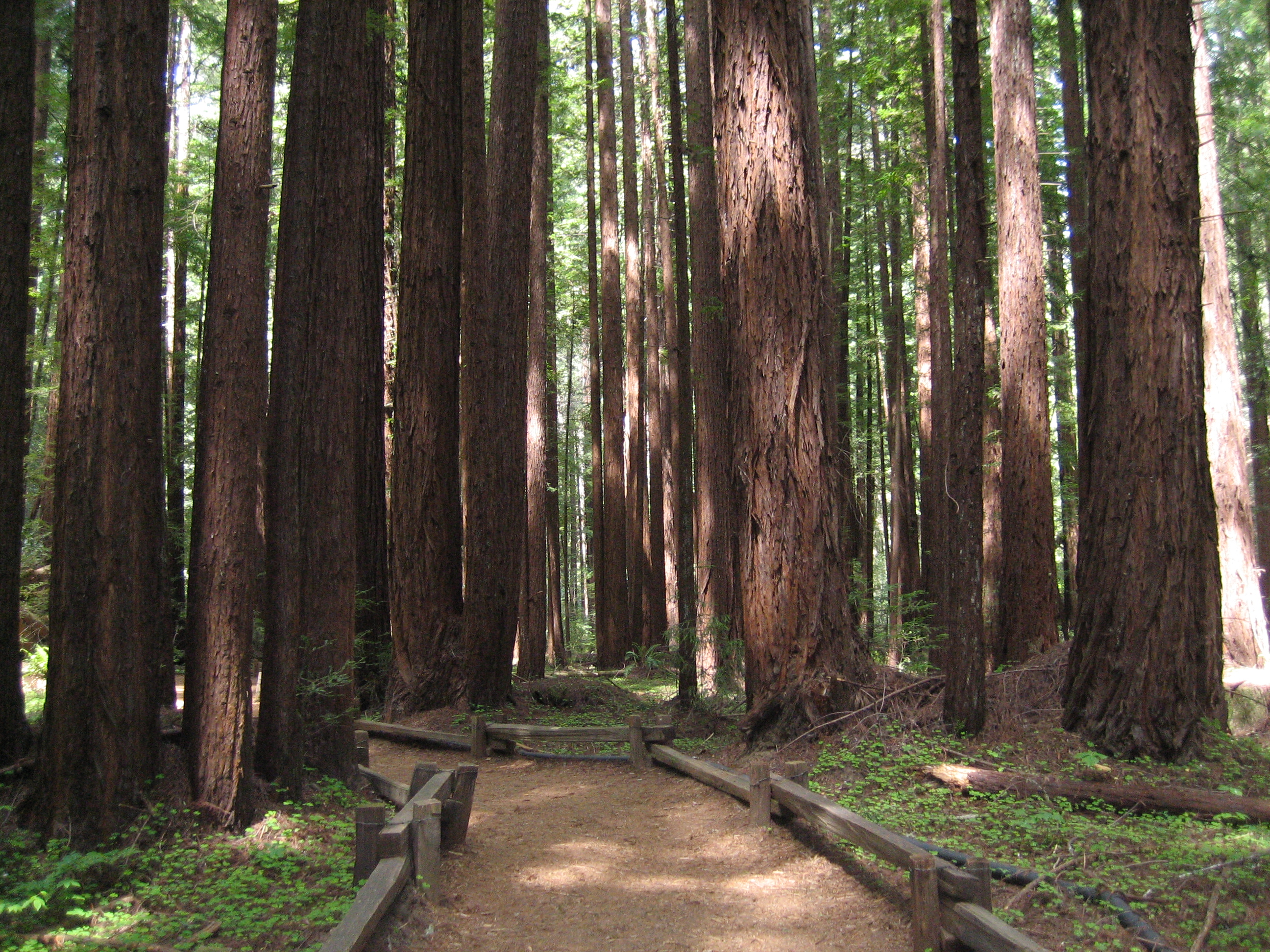
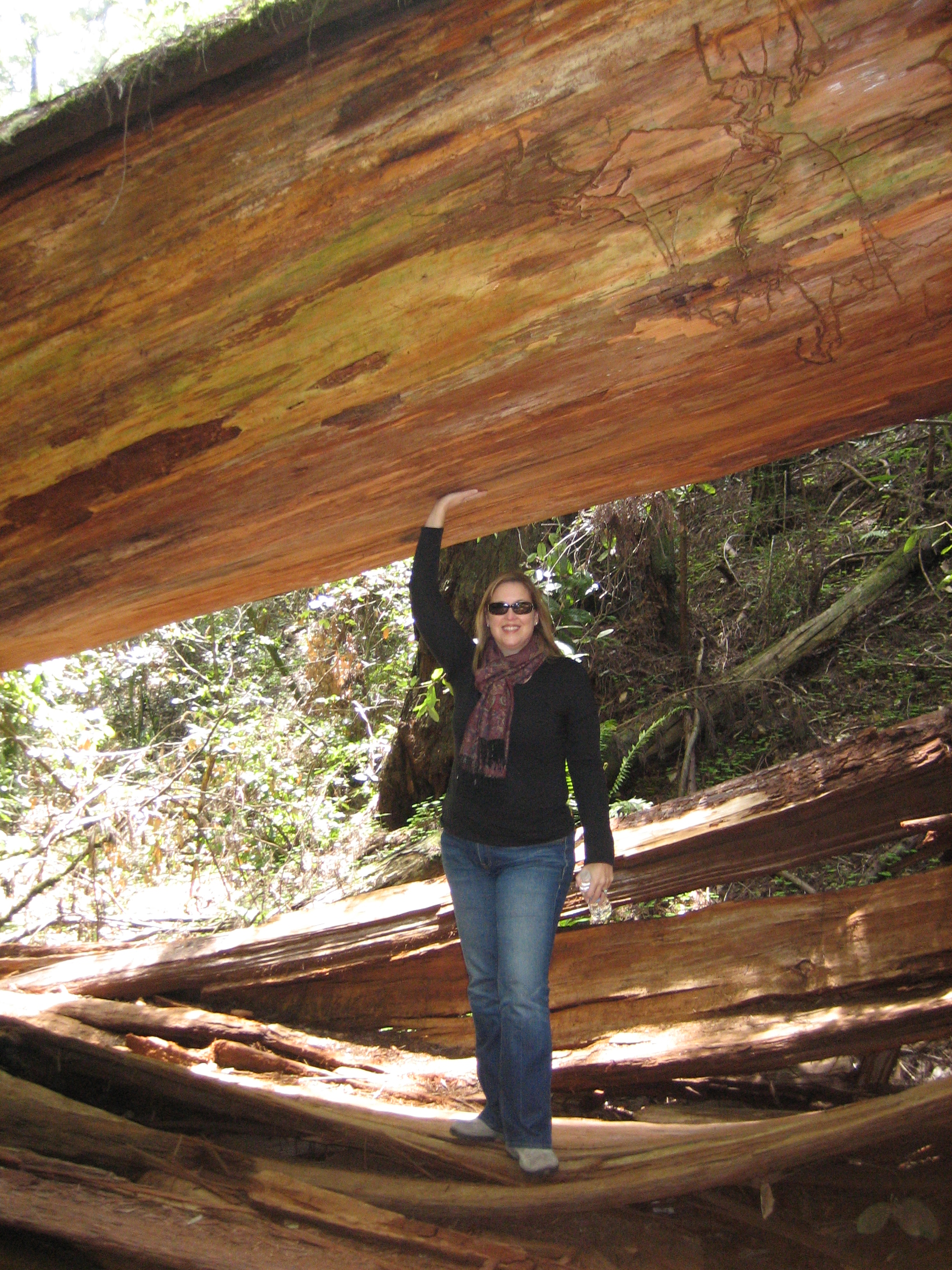
The Armstrong Redwood Forest was about an hour north and west of Napa, and we weren’t disappointed. HUGE trees. HUGE. Towering to the sky, thousands of years old. Having grown up in a forest, it was especially peaceful and perfect. We shared some cocktail peanuts (thanks, Southwest!) and just spent some time being, astounded at the silence in these woods.


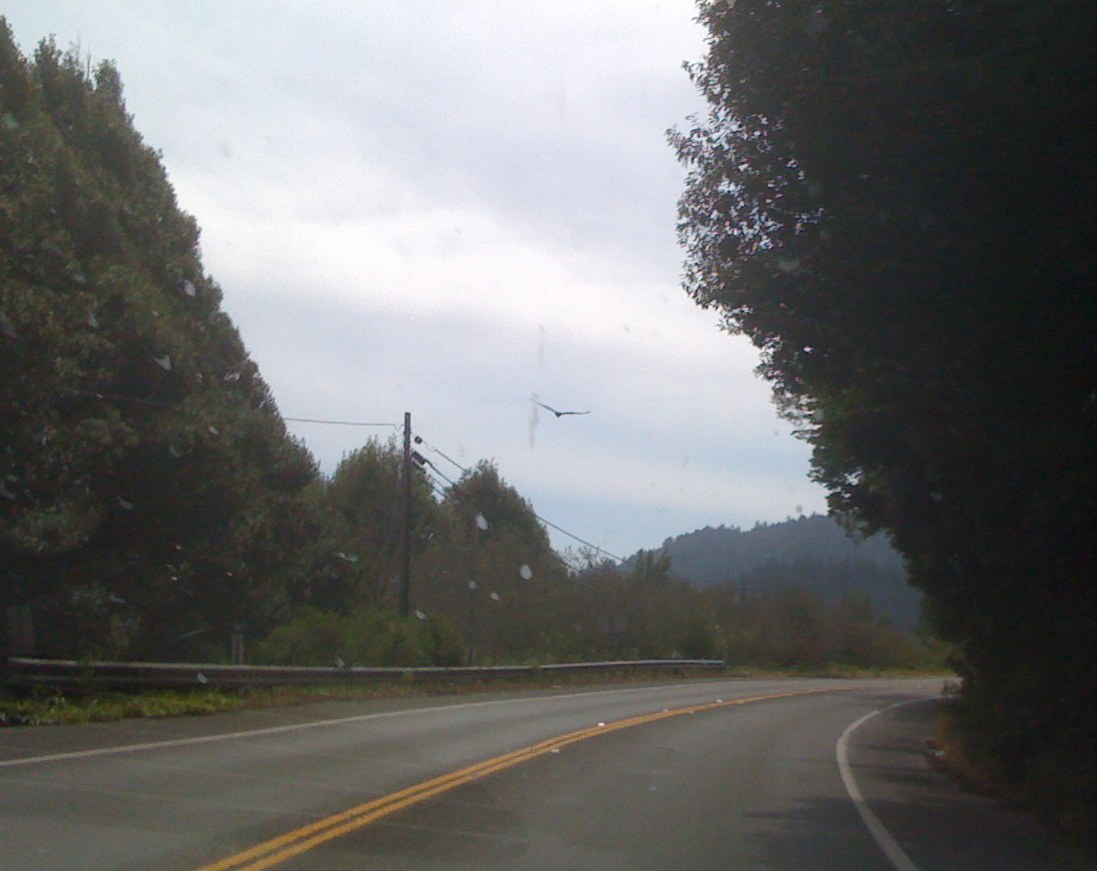
Glancing at the map, we knew we were close to the coast, so we figured what the hell. Tara happily obliged us with a point of interest entry called Goat Rock State Beach. That sounded promising. Driving through the forest, knowing that just around the curve, something glorious awaited us, we were breathless in anticipation. An eagle soared down and got in front of the car as if he were leading us to the rocky cliffs. I couldn’t help myself, I mentally recited some Tennyson.

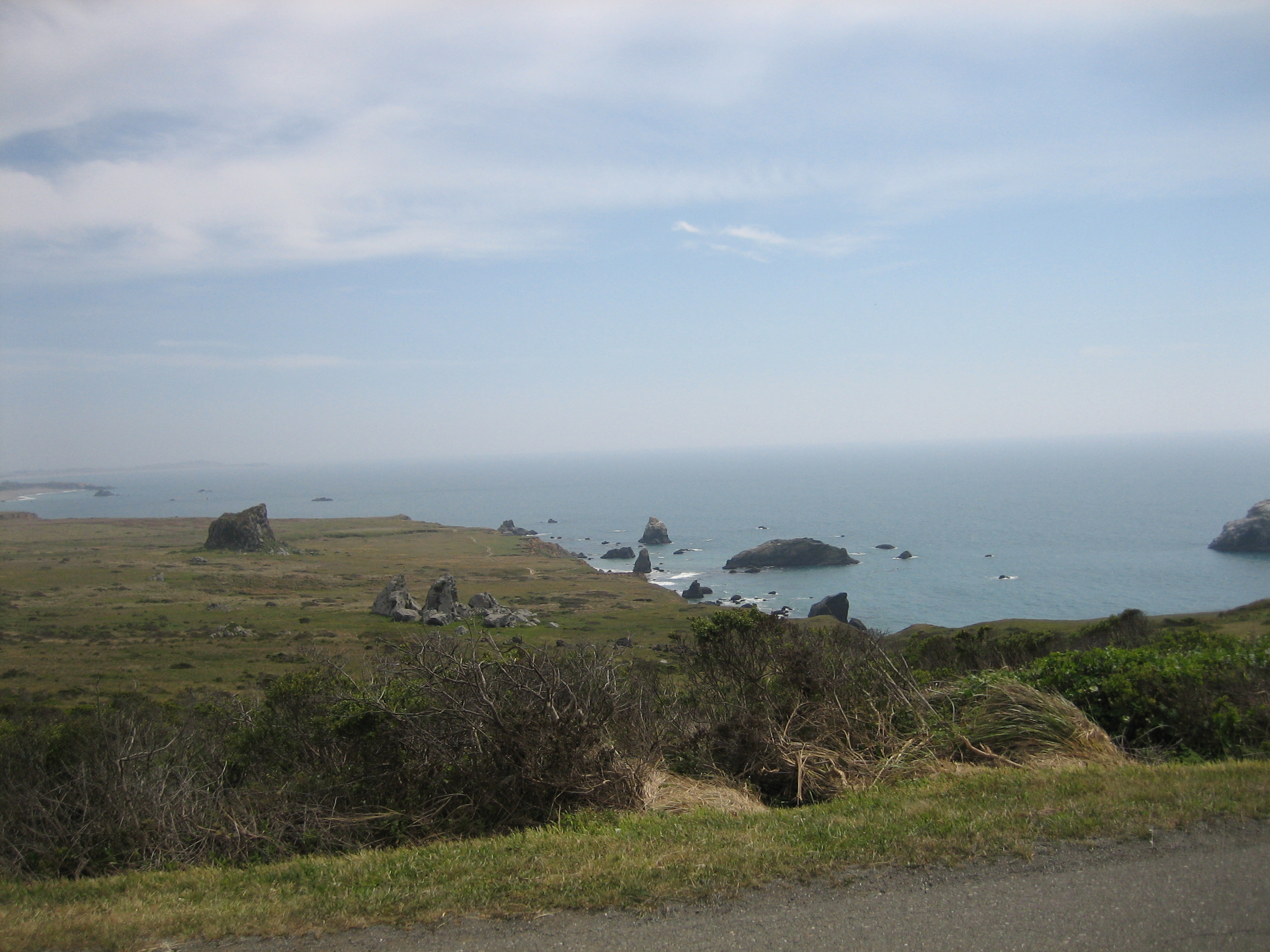
The forest quickly gave way to flatter land, yellows instead of greens, and suddenly, there it was, this gigantic cliff with the Pacific gleaming beneath us.

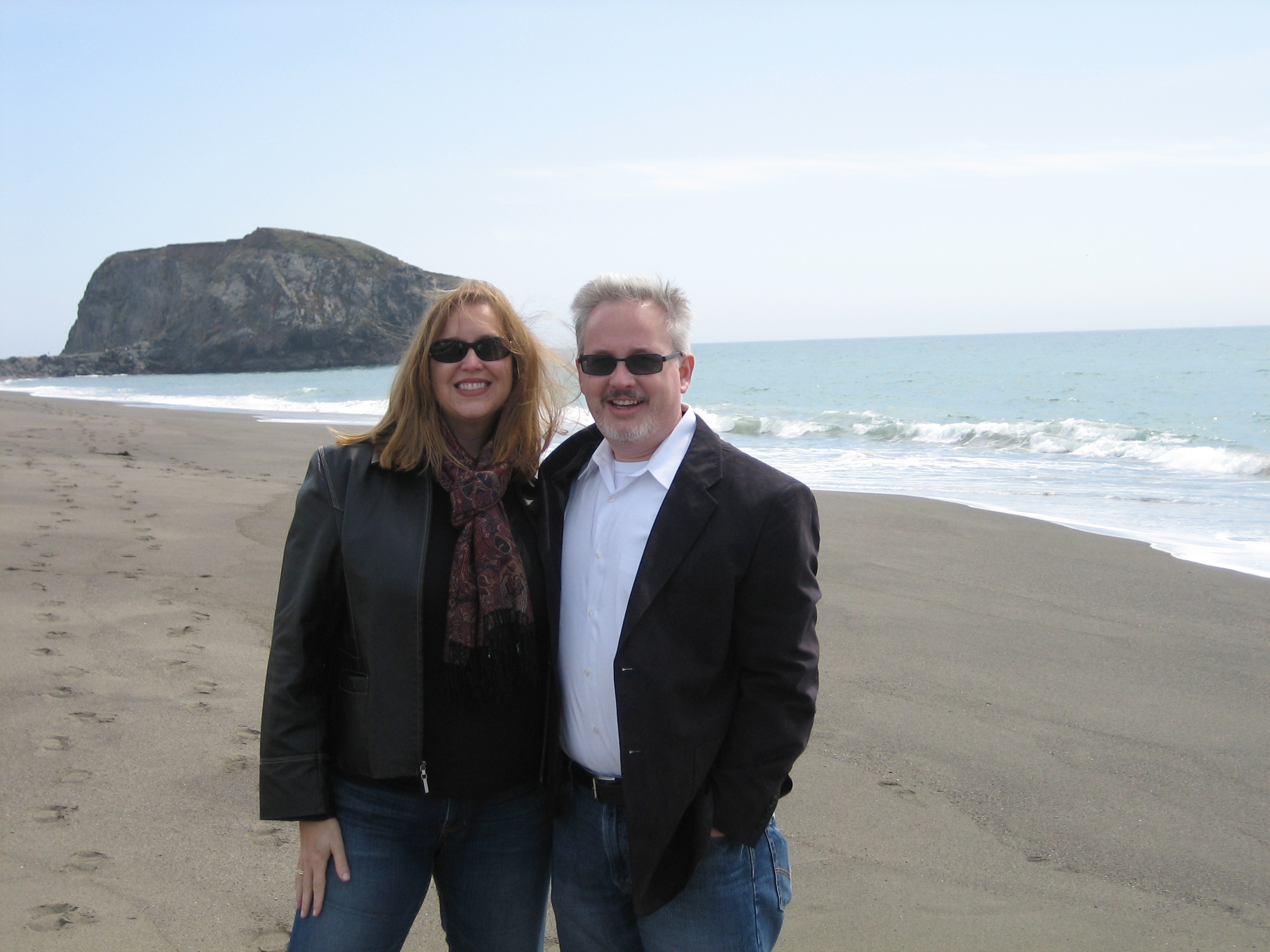
We drove down, taking a million pictures, then parked and walked along the soft sand. Goat Rock is one of the most dangerous beaches in California – the water sneaks up on you and there’s a twenty foot drop shelf right at the water’s edge – we nearly got creamed by a wave trying to dip our fingers in the pacific.

That beach was one of the speechless moments. I don’t have them often, but they burn themselves into my memory banks to stay on forever.

We finally dragged ourselves away and headed to Seghesio Vineyards in Healdsburg. There’s definitely a warming process with some of these wine folks – they assume you know nothing, and treat you a bit disdainfully until you say something in the magic code language of Dionysus (something about oak barrels usually suffices.) Then they open to you and treat you well. That irritated my populist heart a bit, but whatever. There’s also a bit of competition between Sonoma and Napa, with the Sonoma folks looking down their noses at the Napa folks, which I had absolutely no time for. All that aside, we tasted several really good wines at Seghesio: the 2006 Cortina Zinfandel, made in the Dry Creek Valley, 2007 Costeria Pinot Noir, which was a bit too new for me, the 2005 Auradou Zinfandel, also from Dry Creek Valley and the stuff the Old Vine Zin I recommended last week is made of. The 2005 Home Ranch Zinfandel had some Sirah in it, making it fruity, and the 2005 Home Ranch Petit Sirah was excellent, very peppery and laced with black fruit. But the standout was the 2005 Venom. Grown on Rattlesnake Hill, it’s their baby Brunello, and it was rich, spicy and very full-bodied, the kind of wine you want to let breathe for at least thirty minutes, then consume with a superior steak.

The purveyor at Seghesio suggested a fine Italian restaurant in Healdsburg, and since it was past 5:00, we decided to break for food. We ate at a great place right in the Healdsburg Square called Scopa. Scopa is run by a young couple who take their food seriously but keep the atmosphere light and friendly. It was also local vintner’s night, where they have local growers and bottlers wait tables and introduce their wines.

This night, the vineyard was Ceritas. Grown on a rocky slope at the Escarpa Vineyard in the Burgundy tradition, their 2007 Sonoma Coast Pinot Noir was outstanding, probably one of the best Pinots I’ve ever tasted. They only get about 70 cases off the land, and they’ve sunk their life savings into this vineyard, but I bet it will pay off for them in spades. The wine will be available in August, 2009.

The lovely waitress at Scopa suggested we drive the 128 back to Napa. It’s a windy road, but the sun was just getting ready to set and the vineyards were sheathed in the gloaming’s glow – it’s always my favorite time of day, but this was especially gorgeous. The drive took nearly an hour, but it was so worth it.

We rolled into Napa wanting to taste one more wine for the day. We found ourselves at UVA, a lovely Italian restaurant (are you seeing a pattern here???) We had glasses of Monticello Sangiovese and desert – a strawberry tiramisu for me, flourless chocolate for Randy. Throw in a decaf cappuccino and it was time to call it a day. We popped KISS THE GIRLS into the DVD player, lit the fire, and crashed.

Just think. On the last day of my third decade, I was in a forest, on a beach, in a vineyard, ate in two Italian restaurants, drank several gorgeous glasses of wine, watched a movie, had a fire, and did all of the above with the man I love. Every favorite thing in my world. It was one of those perfect, special days that couldn’t be planned if you tried. Sometimes, the road less travelled does pay dividends.

Next Week: DAY THREE, the Rubicon Estate, and how I managed to slip Francis Ford Coppola a note.

There are plenty more photos of the trip here and here.

How Technology is Changing the Face of Literature

by J.T. Ellison

I read this article in the New York Times a few weeks ago. After I finished giggling, I decided I needed to do a piece on this, because it’s the bane of my existence. I hate having to turn to cell phones to relay information, but it’s become a reality that I can’t seem to get around.

I remember our Rob doing a blog post on his old site about how one of his mentors says you never want to have your characters communicating by phone. I’m sure Rob can chime in here with the exact reference, but that advice has stayed with me for the past few years. I take it to heart. You always want your characters to have face to face interactions, especially in a crime novel. I mean really, is Taylor supposed to call a suspect and ask him if he did the crime, all the while judging his reactions by the amount of heavy breathing and stuttering that ensues? No. Of course not.

But technology has made its way into our modern discourse. It’s getting to the point that you must work around the pervasive nature of technology – of cell phones and MacAirs and Eees and instant messaging and texting and twittering and facebooking.

Here’s the reality – cops do use cell phones. I don’t know the rules on usage, whether it’s SOP (standard operating procedure) to do so, but they do. I’ve been there, and witnessed it. They use radios as well, but if they need to reach someone immediately or send a private message, they’ll dial it up. They also have computers in their patrol cars so they can run instant information, be advised of warrants – if you haven’t been in a modern patrol car, you should head down to your local police department and ask for a tour. It like Knight Rider out there.

Simply put, technology, and cell phones in particular, have changed the way we write about crime.

How many people can get kidnapped and put in the trunk of a car anymore? How many get stranded at the side of the road? How many miss their flights and don’t call their friends and spouses so they aren’t waiting at the airport for hours? How many divorce proceeding are based on snooping through cell phone records?

Our cell phones have become an extension of our bodies, a third hand (or second head) that few of us can do without. So the hypothesis is it’s impossible for a modern novel to be considered at all realistic if there aren’t nods to the mod cons. Is this true?

To an extent, yes. But when you’re writing a story, you do need to keep that earlier advice in mind – face to face is always better.

In my upcoming book, I took all of this into account. I wanted to kidnap a girl who was stranded on the side of the road. The scene worked great – she ran out of gas on a semi-deserted stretch of Highway 96; a young, trusting soul who has no reason to believe that the good Samaritan who’s stopped to help is going to betray her. One little problem. What girl in this day and age doesn’t have her cell flipped open to text and call her friends 24/7?

There was a simple solution – the character comes across as a little flighty, but admits she forgot to charge her phone the night before and has no juice. Problem solved, and it actually goes a long way toward describing the character and her ultimate gullibility. She did run out of gas, remember, so she’s not the most responsible type. Forgetting to charge the phone works.

Cell phones can and do get all kinds of mileage in a novel. Phones not on, not charged, fitted with GPS, reworked by Q, satellite phones, encrypted phones. One little problem: We’re teetering on the brink of dating ourselves, because in ten years, the cell phone will be obsolete and everyone reading the book will know immediately that the story was written pre-2012 (or whenever it is that they become obsolete.) And don’t think it won’t happen – look at how far they’ve come in just a few years. Our cells are going to be making us breakfast here before long.

The same issue arose out of 9/11: Every book about New York that was written prior has the twin towers, and all post 9/11 book don’t. The same with movies – I know I still get choked up anytime I see the pre 9/11 skyline. You have to think carefully about when your book is set to make sure these major changes are addressed. And some of us can anticipate the changes before they come, making those books the ultimate cutting edge accessory.

Coda phones became answering machines became voice mail became visual voice mail. Our satellite television has caller ID. Pretty damn soon we’ll have holographic images of people “calling” us that pop up in our living rooms, and then our bedside tables, and then our retinas. Technology moves fast, cutting edge leaps are made every day. For all the books about eco-terrorism now, the nano-tech books are start taking over.

As authors, we’ve always embraced change, adapted to the new and different with relative grace, luddites among us excepted. Many of us are developing the ideas in our novels that will become tomorrow’s technology. Science fiction writers have always been light years ahead with their fanciful ideas (of course, airplanes were a fanciful idea 100 years ago…) Crime fiction is a close second, with all of our spy novels and satellite intercepts and wireless wiretaps.

It’s a brave new world out there.

So what about you? Does it throw you out of the story when you read about a detective making a cell phone call? Do you think there’s a better way? And what’s your prediction for the next wave of technology driven story lines???

Wine of the Week: I hope I’m tromping through their vineyard as you read this: Seghesio Old Vine Zinfandel. I know I’ve recommended it before, but it’s well worth the second mention.

(My apologies for being absent this week. Hubby and I are celebrating my birthday in Sonoma and Napa, California, and I left my laptop at home so I can get a real, live break. We’ve been touring the vineyards, sampling the wines, and I’m hoping to come back with a plethora of new wine suggestions for you. Congrats in advance to all the Edgar winners, and I’ll see you next week with a wine-soaked tourism heavy blog.)

What are Act Breaks, Turning Points, Act Climaxes, Plot Points? (Examples)

by Alexandra Sokoloff

I’m at Romantic Times this weekend, and in between performing in Heather Graham’s Vampire show, and hot tubs with Barry Eisler and Joe Konrath, I’m teaching that Screenwriting Tricks for Authors workshop. One of the things we did was take several movies in a row and identify the Act Climaxes (plot points, turning points, act breaks, curtain scenes, whatever you want to call them) of each, and I thought I’dpost that here todayso we can look at what all happens at those crucial junctures.

First, a quick review of what each Act Climax does:

Remember, in general, the climax of an act is very, very, very often a SETPIECE SCENE – there’s a dazzling, thematic location, an action or suspense sequence, an intricate set, a crowd scene, even a musical number (as in The Wizard of Oz and, more surprisingly, Jaws.).

Also an act climax is often more a climacticsequencethan a single scene, which is why it sometimes feels hard to pinpoint the exact climax. And sometimes it’s just subjective! These are guidelines, not laws. When you do these analyses, the important thing for your own writing is to identify what you feel the climaxes are and why you think those are pivotal scenes.

Now specifically:

AC T ONE CLIMAX

– (30 minutes into a 2 hour movie, 100 pages into a 400 page book. Adjust proportions according to length of book.)

– We have all the information we need to get and have met all the characters we need to know to understand what the story is going to be about.

– The Central Question is set up – and often is set up by the action of the act climax itself.

– Often propels the hero/ine Across the Threshold and Into The Special World. (Look for a location change, a journey begun).

– May start a TICKING CLOCK (this is early, but it can happen here)

MIDPOINT CLIMAX

– (60 minutes into a 2 hour movie, 200 pages into a 400 page book)

– Is a major shift in the dynamics of the story. Something huge will be revealed; something goes disastrously wrong; s omeone close to the hero/ine dies, intensifying her or his commitment.

– Can also be a huge defeat, which requires a recalculation and a new plan of attack.

– Completely changes the game

– Locks the hero/ine into a situation or action

– Is a point of no return.

– Can be a “now it’s personal” loss

– Can be sex at 60 – the lovers finally get together, only to open up a whole new world of problems

– May start a TICKING CLOCK.

– The Midpoint is not necessarily just one scene – it can be a pro gression of scenes and revelations that include a climactic scene, a complete change of location, a major revelation, a major reversal – all or any combination of the above.

ACT TWO CLIMAX

– (90 minutes into a 2 hour film, 300 pages into a 400 page book)

– Often can be a final revelation before the end game: the knowledge of who the opponent really is.

– Often comes immediately after the “All is Lost” or “Long Dark Night of the Soul” scene – or may itself BE the “All is Lost” scene.

– Answers the Central Question

– Propels us into the final battle.

– May start a TICKING CLOCK

ACT THREE CLIMAX

– (near the very end of the story).

– Is the final battle.

– Hero/ine is forced to confront his or her greatest nightmare.

– Takes place in a thematic Location – often a visual and literal representation of the Hero/ine’s Greatest Nightmare

– We see the protagonist’s character change

– We may see the antagonist’s character change (if any)

– We may see ally/allies’ character changes and/or gaining of desire

– There is possibly a huge final reversal or reveal (twist), or even a whole series of payoffs that you’ve been saving (as in BACK TO THE FUTURE and IT’S A WONDERFUL LIFE)

———— ———————————————–

Okay, for examples, I’m starting today with two of my all-time favorite films, JAWS and SILENCE OF THE LAMBS.

Please feel free to argue my points!

And note all times are APPROXIMATE – I’m a Pisces.

JAWS:

ACT ONE CLIMAX:

JAWS is a 2 hour, 4 minute movie and I would say the first act climax is that big crowd scene 30 minutes in when every greedy fisherman on the East Coast is out there on the water trying to hunt the shark down for the bounty. One team catches a tiger shark and everyone celebrates in relief. Hooper says it’s too little to be the killer shark and wants to cut it open to see if there are body parts inside, but the Mayor refuses. We know that this isn’t the right shark, and we see that Sheriff Brody feels that way as well, but he’s to rn – he wants it to be the right shark so this nightmare will be over. But the real, emotional climax of the act is at the very end of the sequence when Mrs. Kitner strides up to Brody and slaps him, saying that if he’d closed the beaches her son would still be alive. This is the accusation – and truth – that compels Brody to take action in the second act. (34 minutes)

It’s a devastating scene – just as devastating as a shark attack, and a crucial turning point in the story, which is why I’d call it the act climax. Brody is going to have to take action himself instead of rely on the city fathers (in fact, the city fathers have just turned into his opponents).

MIPOINT:

The midpoint climax occurs in a highly suspenseful sequence in which the city officials have refused to shut down the beaches, so Sheriff Brody is out there on the beach keeping watch (as if that’s going to prevent a shark attack!), the Coast Guard is patrolling the ocean – and, almost as if it’s aware of the whole plan, the shark swims into an unguarded harbor, where it attacks a man and for a horrifying moment we think that it has also killed Brody’s son (really it’s only frightened him into near paralysis). It’s a huge climax and adrenaline rush. (This is about 60 minutes and 30 seconds in). Brody’s family has been threatened (“Now it’s PERSONAL”). And as he looks out to s ea, we and he realize that no one’s going to do this for him – he’s going to have to go out there on the water, his greatest fear, and hunt this shark down himself.

ACT TWO CLIMAX

As in the first act climax, here Spielberg goes for a CHARACTER sequence, an EMOTIONAL climax rather than an action one. About 83 minutes into the movie, the three men, Brody, Quint and Hooper, who have been at each other’s throats since they got onto the boat, sit inside the boat’s cabin and drink, and Quint and Hooper start comparing scars – classic male bonding, funny, touching, cathartic. In this midst of this the tone changes completely as Quint reveals his back story, which accounts for his shark obsession: he was on a submarine that got hit during WW II, and most of the men were killed by sharks before they could be rescued. It’s a horrific moment, a complete dramatization of what our FEAR is for these men. And then, improbably, the three guys start to sing, “Show me the way to go home.” (I told you – a musical number!) It’s a wonderful, comic, endearing uplifting, exhilarating moment – and in the middle of it we hear pounding – the shark attacking, hammering the boat. And the men scramble into acti
on, to face the long final confrontation of ACT THREE. (92 minutes in).

ACT THREE CLIMAX –

The whole third act of JAWS is the final battle, and it’s relentless, with Qu int wrecking the radio to prevent help coming, the shark battering a hole in the ship so it begins to sink under them, the horrific death of Quint. The climax of course is water-phobic Brody finding his greatest nightmare coming alive around him: he must face the shark on his own on a sinking ship – he’s barely clinging on to the mast – and blowing it up with the oxygen tank. The survival of Hooper is another emotional climax. (2 hrs. 4 minutes).

The interesting thing to note about JAWS is that despite the fact that it’s an action movie (or arguably, action/horror), every climax is really an EMOTIONAL one, involvin g deep character. I’d say that has a lot to do with why this film is such an enduring classic. . It’s also interesting to consider that in an action movie an emotional moment might always stand out more than yet another action scene, simply by virtue of contrast.

————————————————————————————–

SILENCE OF THE LAMBS

ACT ONE CLIMAX

I’d say it’s a two-parter: The lead-in is the climax of Clarice’s second scene in the prison with Lecter. She’s followed his first clue and discovered the head of Lecter’s former patient, Raspai l, in the storage unit. Lecter says he believes Raspail was Buffalo Bill’s first victim. Clarice realizes, “You know who he is, don’t you?” Lecter says he’ll help her catch Bill, but for a price: He wants a view. And he says she’d better hurry – Bill is hunting right now.

And on that line we cut to Catherine Martin, and we see her knocked out and kidnapped by Bill.

So here we have an excruciating SUSPENSE SCENE (Catherine’s kidnapping); a huge REVELATION: Lecter knows Bill’s identity and is willing to help Clarice get him; we have a massive escalation in STAKES: a new victim is kidnapped; there is a TICKING CLOCK that starts: we know Bill holds his victim for three days before he kills them, and the CENTRAL QUESTION has been set up: Will Clarice be able to get Buffalo Bill’s identity out of Lecter before Bill kills Catherine Martin? (34 minutes in).

MIDPOINT:

The midpoint is the famous “Quid Pro Quo” scene between Clarice and Lecter, in which she bargains personal information to get Lecter’s ins ights into the case. This is a stunning, psychological game of cat-and-mouse between the two: there’s no action involved; it’s all in the writing and the acting. Clarice is on a time clock, here, because Catherine Martin has been kidnapped and Clarice knows they have less than three days now before Buffalo Bill kills her. Clarice goes in at first to offer Lecter what she knows he desires most (because he has STATED his desire, clearly and early on) – a transfer to a Federal prison, away from Dr. Chilton and with a view. Clarice has a file with that offer from Senator Martin – she says – but in reality the offer is a total fake. We don’t know this at the time, but it has been cleverly PLANTED that it’s impossible to fool Lecter (Crawford sends Clarice in to the first interview without telling her what the real purpose is so that Lecter won’t be able to read her). But Clarice has learned and grown enough to fool Lecter – and there’s a great payoff when Lecter later acknowledges that fact.

The deal is not enough for Lecter, though – he demands that Clarice do exactly what her boss, Crawford, has warned her never to do: he wants her to swap personal information for clues – a classic deal-with-the-devil game.

After Clarice confesses painful secrets, Lecter gives her the clue she’s been digging for – he tells her to search for Buffalo Bill through the sex reassignment clinics. And as is so often the case, there is a second climax within the midpoint – the film cuts to the killer in his basement, standing over the pit making a terrified Catherine put lotion on her skin… and as she pleads with him, she sees bloody handprints on the walls of the pit and begins to scream… and just as you think things can’t get any worse, Bill pulls out his T–shirt to make breasts and starts to scream with her. It’s a horrifying curtain and drives home the stakes. (about 55 minutes in)

ACT TWO CLIMAX –

The act two climax here is an entire, excruciating action/suspense/horror sequence: Lecter’s escape from the Tennessee prison, which really needs no description! It’s a stunning TWIST in the action. But it’s worth noting that the heroine is completely absent from this climax. The effect on her is profound, though: She was counting on Lecter to help her catch Buffalo Bill. Now that is not going to happen (the Central Question of the story is thus answered: No.) – it’s a complete REVERSAL and huge DEFEAT (all is lost). Clarice is going to have to rise from the ashes of that defeat to find Bill on her own and save Catherine.

The sequence begins about 1 hour and 12 minutes in and ends 10 minutes later, at 1 hr. 22 minutes.

ACT THREE CLIMAX –

… of course is the long and again, excruciating horror/suspense sequence of Clarice in Buffalo Bill0s basement, on her own stalking and being stalked by a psychotic killer while Catherine, the lamb, is screaming in the pit. This is one of the best examples I know of the heroine’s greatest nightmare coming alive around her in the final battle, and it is immensely cathartic that she wins.

Note that the climaxes in SILENCE OF THE LAMBS are very true to the genre, with elements of suspense, action, thriller and horror. Every single climax delivers on the particular promise of the genre – the scares and adrenaline thrills, but also the psychological game playing.

Okay, so any examples for me today? Or any stories you’re having trouble identifying the climaxes of that we can help with?

– Alex

————————————————————-

Previous articles on story structure: (all also linked at right hand side of blog under WRITING ARTICLES).

Story Structure 101 – The Index Card Method

Screenwriting – The Craft

What’s Your Premise?

What is High Concept?

Why the Three Act Structure?

Elements of Act One

Elements of Act Two

Elements of Act Two, Part 2

Elements of Act Three, Part 1

Elements of Act Three, Part 2

What Makes a Great Climax?

Visual Storytelling Part 1

Visual Storytelling Part 2

Creating Suspense

Creating Suspense, Part 2

Fairy Tale Structure and the List

Meta Structure

What Makes a Great Villain?

Villains: The Forces of Antagonism

World Building

by J.T. Ellison

I was at the bank the other day, which is always a trip, because our bank branch is staffed with characters. There’s the comedian chick, the brooding manager, the upbeat and chipper trainee, and the artist. The artist and I get on well, because he’s a writer. He’s done songs, he’s done poems. But lately, he’s been working on a movie script.

You don’t expect to get enlightened at the bank. If anything, that’s about the last place I’d ever go. But the artist dropped a bomb on me, just a simple term that he used to describe what he was responsible for with the script he’s co-writing.

He’s the world builder.

Now I’m sure all you screenwriters just rolled your eyes and said DUH! but I’ve never done any screenwriting, nor worked in Hollywood, and this termed concept of world building was a new one to me.

Of course, I understand that I already have an intrinsic grasp of world building. I do it every time I sit down, open my laptop and create. Each story, each character, each setting, all goes into the world I’m building. I’m the God of my own land, the High Priestess of the Page.

I make the rules.

Oh, heady day!

Science fiction and fantasy writers do a bang up job of world building. Hobbits become heroes, dragons befriend young slayers, vampires turn vegetarian. Trees can speak and witches float around in soap bubbles. Lions rise from the dead and the labyrinth of our subconscious fears are realized. Good and evil have Janus faces, and nothing is as it seems.

In these alternate realities, there are fairy godmothers, guardian angels, and every possible incarnation of death. In Stephanie Meyer’s TWILIGHT series, the books work not because of the vampires, but because of the underlying story – a teenage girl who is uprooted and ends up in a faraway land where normal rules don’t apply. This transportation into a new world allows for a willing suspension of disbelief – that’s the trick. That’s the key.

It’s the driving force behind our culture’s creativity.

If you build it, they will come.

Historical romances sweep us into a land unknown. As a little girl, I remember getting lost in Karleen Koen’s THROUGH A GLASS DARKLY, only to emerge on the other end with a fascination for all things historical. Diana Gabaldon’s OUTLANDER series is completely transcendent. I am there. I am present. I am so entranced that I can see and smell everything the characters do. I’m not reading a book, or a story, I’m plowing through an alternate universe.

J.K. Rowling’s Harry Potter books did that for me also. I still lament that I wasn’t able to attend Hogwarts, with all its bizarre idiosyncrasies and history.

Imagination in the hands of a competent world builder is something to be treasured, read and watched over and over again, striking a resonate chord with all who fall under its spell. It’s just plain bliss.

The mythology behind these grandiose otherworlds are evident. They all have one thing in common: A hero, called to a journey. I’ve been reading Joseph Campbell and Christopher Vogler, (I’ve got a post coming on why I’m mad at Vogler…) and the whole concept of mythos and world building are foremost in my mind as I sit down to write a new Taylor Jackson novel. How am I going to bring Taylor’s world alive for you? What parts of Nashville have I missed in past novels that will give a real flavor to her world? It’s more than character, it’s using setting to define your story. I’ve always said Nashville is a character in my books. I want to show the essence of the city, the piquancy that comprises its hodgepodge cosmopolitan nature.

But I run smack into a brick wall rather quickly. My world? Already built. I’m using real places, real people, real streets and sights and smells. I can’t deviate from what we know this town to be without causing a fervor – and that’s rather limiting.

I started a standalone a few years ago, between my non-published novel and All the Pretty Girls. It’s about a female assassin named Cassiopeia with a chip implanted in her head that can be turned off and on, activating and deactivating her for duty. Sound familiar? Yes, Joss Whedon just released a television show, DOLLHOUSE, with a similar premise. I haven’t watched it because I don’t want to be influenced, because I’m still writing this book. From what I’ve heard, the brain chip is the extent of our similarities, so I’m not worried about finding a market for it once it’s done.

But it’s fun to write, because it expands reality a bit. I’m hoping this book allows me a chance to build a world outside of the careful construct of Nashville. It will take place all over the world, and I have the opportunity to make that world whatever I want it to be. Look at Michael Chabon’s THE YIDDISH POLICEMAN’S UNION. Sitka, Alaska becomes a world unto itself, with its own rules, its own idiosyncrasies. The characters live inside the construct Michael has laid out, and it works because we’re in the hands of a master manipulator, a writer who knows exactly how to twist the world to his own image.

But even the most humble story, if done well, can transport us into another’s life, into their world. We see through the characters eyes, feel their disappointments and frustrations. Whether the setting is as massive as Narnia or as small as a trailer park, if the author has done their job, we can lose ourselves in another world, at least for a time.

So let’s hear it, ‘Rati faithful. Who are you favorite world builders?

Wine of the Week: Sebecka Cabernet Pinotage An absolutely luscious South African wine with the cutest cork (yes, I said cutest cork) It’s cheetah print!

 PS: I have a guest blog up on Criminal Brief today! Come over and show their crew some love too!

Marshall Karp Flips Out

9780312378219

It was a gorgeous day—hot—and a bunch of pals and I had just snagged the very last table-with-an-umbrella outside last summer’s Book Passage Mystery Writers Conference in fashionable Corte Madera, California.

All cotton-mouthed and fading, I threw my book-bag into a chair and did the whole, “hey, anybody want anything from the snack bar?” routine, suddenly hell-bent on getting myself an iced coffee.

IcedCoffee

The line inside was long and slow, so I’m standing there spacing out, trying not to think about how thirsty I am and how many people are between me and my sublime potential beverage, when this tall blue-eyed silvery guy walks up, points a finger at my name-badge and goes, “You!”

A bit startled, I respond, “um. Yeah.”

“Cornelia Read!” he says, still pointing.

Other Blue Meanies

I say “um” again, and he breaks into this huge grin and says, “Marshall Karp,” holding up his own badge, “Our books got published the same month and I’m thinking we need to hang out. Bond. This whole ‘publishing virgins’ thing, right?”

He grins again. I never make it back out to that umbrella table.

My buddies wander inside one by one over the course of the next half hour or so and they don’t leave either. Pretty soon, we’ve taken over the entire damn snack bar—a dozen-plus people trading life stories and cracking up and having the best time anyone’s had since Arlo Guthrie sat down on the Group W bench back in ‘Sixty-whatever. Seriously.

584292941_8984bd8a22-1

By the third hour Marshall is introducing himself to strangers as “the Jewish father Cornelia’s been looking for her whole entire life,” while I just keep toasting him with my ninety-bazillionth iced coffee, and there’s like thirty of us jammed into the place now, dragging more chairs in from outside and totally laughing our asses off to the point of outright choking.

And I swear the same thing happens every time I run into him. The man is the social equivalent of catnip-for-humans-scented electro-magnets or something… like if they shoved a tank-truck-load of nitrous oxide and the entire history of Vaudeville into one half of that teleportation machine in The Fly and got Groucho Marx and Bob Newhart and Gene Wilder to simultaneously push the Big Red Button, I guarantee you’d get a flash of blue lightning and a sudden whiff of ozone and—hey presto—Marshall would saunter out the other end of the thing, cackling magnificently.


Gene-wilder

Plus he writes like he’s on fire. In a good way.

The Rabbit Factory, his first novel, rocked my world, and his second, Bloodthirsty, was a TKO of a sequel. Now he’s released the third novel in his fabulous Lomax and Biggs series, Flipping Out, and it’s so good I may go back to school to become a certified public accountant.


10755834

In honor of that, I want to repost an interview the two of us did for Spinetingler on the first anniversary of our original debut-novel pub dates.

Cornelia: So your professional history was pretty amazing even before you turned to novel writing… You spent years in advertising creating campaigns like “Thank you, Paine Weber,” then you did a successful play and landed in LA writing for TV, not to mention the screenplay with Jason Alexander. How does the whole publishing gig compare to that?

Marshall: I’ve been marketing a product or putting on a show for years, and now suddenly, I AM the product, I AM the show… and I have to tell you, it’s totally weird to be pimping myself.

Pimp Gobleet

When I go to a bookstore, I bring my salad chopper to attract people to the signing table. I’m resigned to the big picture of the business… you show up and try to present yourself. If you like my style or just me and you’ve got $25, maybe you’ll try the book.

Cornelia: What’s the best part?

Marshall: It’s fun to go out there and be with the readers, getting to listen to what they have to say about your work… the stuff I’ve learned from that interaction has been a true education….

When I was in Miami for an MWA conference, I got asked about “the language” in my first book. Now I think we all know that cops in real life tend to say fuck fuck fuck fuck on the job, and you want to be true to that…

Cornelia: Sure, instead of having them yell “Shucky Darn” when somebody pulls a gun or whatever…

Marshall: Exactly… But one woman said to me, “You know, it’s fine in the book, but it’s hard when it’s on the audio in my convertible and I’m driving down Biscayne Blvd. and have to stop at a light.”


2006-Bentley-Azure-Convertible-F-1280x960

I would never have thought of that, if I hadn’t had the opportunity to be out there face-to-face with readers. So in the second book, I ended up taking out 85 F-bombs. Not just for the lady at the stoplight but because when you write and you’re in a hurry, it’s too easy to say “fuck…” sometimes there are better ways to express that emotion.

And cutting out 85 fucks is hard when you’re writing about cops… In Bloodthirsty I went from 115 fucks to 30. It’s hard to get the ring of truth without that language. I made a minor character into a Brit so he could say “bloody” instead. Maybe that’s cheating.

Fuck_yeah

Cornelia: Do you think winding up as a novelist was inevitable, for you?

Marshall: I could always write… I wound up in advertising by accident, literally because when my father made me look for a job after college, I looked at the classifieds I went alphabetically, and I couldn’t do accounting.

I got a job as a direct-mail copywriter at Prentice Hall. A year-and-a-half later I went into Madison Avenue, started doing print ads and television. I got awards and got attention…. But of course the punishment for being a good writer in that business is you get promoted and get put in charge of the writers, so I’m the creative director and supervising instead of writing… same thing as when the head surgeon ends up running the hospital and not operating.

It was good, but I started to miss writing. That’s what drove me to write outside of work in the ad business. The first thing I did was a play, Squabbles. Twenty-five years later, it’s still put on all over the world.

TV people saw that, so I started writing pilots and then movies, which is where I met some of the people I’m killing in Bloodthirsty… met them and worked for them.

Los_Angeles_hollywoodland_sign

I couldn’t spend too much time in Hollywood because my wife and kids were in New York, and I came back and wound up using both skills—my marketing background and my show-biz background—by opening my own Internet ad agency.

This was right when everyone wanted to get into the internet, so I ended up being the gray-haired guy who could go into Chase or Royal Caribbean or drug companies—whoever the big clients were—and all of a sudden it took off, because everybody wanted websites.

I had the long-form skills from the TV business, and I ended up hiring the kids with the blue hair and the nose-rings who the clients were afraid of. The kid with the blue hair can say to the President of Chase, “I can make your logo spin,” and I walk in and ask, “who’s your target audience?”

CamdenBlueHair

That’s what helped me get where I am now… within four years I turned that company into something I could sell, and once I sold it I said, “now I can do what I always wanted to do, which is go to my country house and write a book…”

After my movie got produced, a woman in my town came up to me and said, “I like your movie, when are you going to make another?”

I told her it feels like everyone in Hollywood is twelve years old, and I don’t want to spend the rest of my life pitching American Pie Five, so what I really wanted to do was write a mystery novel. She looks at me and she says, “I’m an editor…” So…

Mildred

One other piece of the puzzle was that I’d worked with James Patterson in advertising. I bounced the idea of The Rabbit Factory off him during a lunch,. He was incredibly encouraging, so I decided try it.

Cornelia: So what drew you to mysteries?

Marshall: That’s what I’ve always wanted to read, so that’s what I wanted to write. It inherently had to be character-based, it couldn’t be about the plot… my play, my movie, they’re always about character.

The character of Mike Lomax came to me years ago: this cop who’d lost his wife and still has to do his job while he’s grieving. He was a three-dimensional character to me long before he was cop… first I made him a MAN.

And then I said, okay, a guy going through this much pain can’t be carrying a book on his own… He needs a counterpoint, and Terry Biggs became the wiseass New York cop’s best friend, who, as they say in the TV biz can “cut the treacle.”

226563494_37eaa7337c

Mike has the heart, but I don’t want people to go oooooooooo for the entire book on his behalf. Terry helps Mike be funny, once they get going. Terry’s the friend I would want if, God forbid, I ever had to go through that kind of pain… a real good guy who knows just the right boundaries.

I think I also wrote enough beer commercials to know what buddies are… I wrote Stroh’s commercials, and sometimes you see a guy screwing his best friend out of a beer…. I don’t believe in buddy-fucking, I believe your buddy’s your buddy. I needed to create someone where there’s that loyalty.

SgtRock-Loyalty

I think I’m quoting William Goldman on this, that “the essence of loyalty is reciprocity.”

Cornelia: I really see that in your writing. In both your books it comes across as the core of what’s happening on the page.

Marshall: My fan mail is always about the relationships, the characters. They want the characters back, they want it to go on….

Cornelia: Character matters. That’s certainly what I want to read about.

Character

Marshall: It’s always about character. I knew I had a good plot, but my focus is always on character… even the minor characters who appear for one scene, I try to give them as much as I can. I try to make them real, or if they’re surreal, as some murderers are, at least to have the ring of truth.

Cornelia: Do you think your other gigs in life have helped inform your writing?

Marshall: Janet Maslin accused me of being a marketing expert when she reviewed The Rabbit Factory for The New York Times, but I’m not trying to sell to you, I’m trying to write it this way because… look, you don’t want to know some guy’s height and weight in a story, you want to get inside his head….

Phrenology_chart


Whenever I wrote a commercial, I didn’t think, “what does the client want to say about his product?” I wanted to be the conscience of the consumer. My job was to understand what the consumer needs and wants.

I don’t market to people when I write a book, I feel what it’s like to be a reader. But I’ve never ever written for the critics. For me, it was always like, “do you want to be avante-garde or do you want to be real?”

Cornelia: Ach, avant-garde. Don’t get me started.

Marshall: I come from real. I spent too many years in New Jersey to have anything avant-garde about me… I’m country.

Postcard

I like to think that I have a basic sincerity, and I think my characters have it too, even the ones with a little guile like Mike Lomax’s father, Big Jim. He’s Big Jim Lomaxstein. He’s me when I’m trying to manipulate my kids.

Cornelia: Now we’ve both got a year of this under our belts. What would you tell someone starting out with writing?

Marshall: Well, as I said in the acknowledgements, it really helps to write a mystery if you know James Patterson. But in every business I’ve been in, I encouraged the younger people to write. It’s all about giving back.

JpSimpsons2

Cornelia: What do you think is the hardest part of breaking into writing?

Marshall: A British reporter sent me an email asking that very question — what I consider to be the biggest obstacles for new writers. I sent him the glowing points from my rejection letters… you know, “Oh, Marshall is so good, but we want to get into forensics and be CSI clones too…”

Just keep writing. You will find a publisher. You will find an audience—even though there are a lot more MBAs acquiring books these days, and it’s a tough business.


Type-writer Girl

When you write your first book, you can’t imagine that this is ever going to be your day job. Everybody’s got to keep going with it to make it.

I watched the DVD of Da Vinci Code a while ago, and there was an interview with Dan Brown on it.

He said that he’d first realized he had something when he went to a bookstore in Washington for a signing, and there were all these people hanging around outside the store. He asked if they’d had a fire or a bomb scare, and was told no, they’re here for you…

Have no expectations, just those from yourself. I was happy having been a writer in various careers all my life, happy to have finished a book. When I got to the end of that first draft, that was, to me, monumental. When I found a publisher, that was just an unbelievable added benefit that turned the personal goal into something I could do—what a lot of writers want to do—which is to share what I’ve written.

Writers don’t get into it for the money. Writers write because that’s what they want to do…

Cornelia: …I heard Robert Crais speak the other day. He said if you want to get into writing for the money, you should go sell BMWs instead.

Marshall: Selling BMWs. Exactly… I was going to say sell cocaine. “Buy enough cocaine, we’ll throw in a BMW!”

Image-of-cocaine

Cornelia: I’d end up buying all of anything you had to sell. Stick with the books… I can almost afford books. Any other business, you’d bankrupt me without even trying.

Marshall: I’m still learning this business, and I find it fascinating, but it’s a process. I find it really interesting that the readers know so much more about the business I’m in now than I do.

When I was in TV, I knew a lot more about how it all worked than the average viewer… The audience doesn’t know what goes on behind the scenes.

Television2

But the fans in this business? The real fans who are at the conventions and signings? They know more than I do. I find that fascinating, and to some degree intimidating… They may not do what I do, but they know more than I do. I’ve been to book events where somebody raises a hand and says, “didn’t Carl Hiaasen do something like that in his fourth book?“

And I say, “I’ve only read two of his books, I don’t know enough! I don’t know as much as you do!”

The readership raises the bar for you. The only thing that’s ever came close to this for me is when I started doing my play.

The first eight weeks we were doing it, I’d come in and sit with the audience, listening to what they said about it. I made changes because of audience feedback that they didn’t know I was hearing.

3d-movie-audience

Cornelia: What’s the best part of it, for you? How does this compare to the other kinds of writing you’ve done over the years?

Marshall: Of my many writing incarnations, this is the final frontier, because I really enjoy the ability to create without a committee. In advertising—TV and movies even more so—it’s about the committee.

These days, the only committee I have is when I get up and think I’m going to write something and the characters want to do it differently… it’s almost like an actress saying, “my character wouldn’t say that!” She’s pissed off. When you’re “the actor” as a writer and that happens, it’s fascinating.

Theda_bara

But the best cool thing is you get to meet a lot of really fascinating, three-dimensional, fun people and you’re way at the top of their list. This is a really fascinating genre, and how great that there’s something this interesting that brings us all together.

I found it really refreshing that the first fan I talked to at LCC was a pediatric cardiologist, and I wanted to say, “You’re saving lives every day, let’s talk about you!”

Cornelia: Speaking of saving lives, I want to know more about the charity you’re involved with, Vitamin Angels…

20070301_vitamin

Marshall: There’s great information at http://www.vitaminangels.org. Working with them started out as my reaction to 9/11.

My daughter was at Ground Zero, and that left me with a visceral understanding that I had to make a difference in the world. There are a great many worthy charities out there, but I had to know I was doing something real. Something that mattered. I didn’t want to just buy tickets to a charity dinner, or bid on something at an auction for a good cause…

When I found out about the Vitamin Angel Alliance, I realized I could use my marketing abilities and my writing skills to raise awareness and money for an organization where you can literally have the accountability that what you’ve done matters–to specific people, specific kids around the world. It’s quantifiable.

Cornelia: Tell me about what they do.

Marshall: They get vitamins and supplements to kids and families around the world. Vitamins can prevent a tremendous amount of suffering. We KNOW this. We KNOW how it works, but there are so many people who don’t have access to basic, essential nutrition.

Five cents’ worth of Vitamin A can keep a child from going blind. Pre-natal vitamin deficiencies kill upwards of 585,000 women and four million newborns every year. When people ask me, “what’s the best thing you’ve written?” I tell them it’s what I’ve written for Vitamin Angels.

***

Now that Marshall’s got three books out, I think we’re going to need a bigger coffee shop for the next time we get together… possibly a circus tent.

MKcropofMKjpg

I guarantee you won’t find a better way to spend an afternoon than in this guy’s company, whether on the page or in real life.

So, ‘Ratis, what makes you flip out? Best answer gets a free copy of Marshall’s latest book (which is AWESOME!)

Neil Nyren on the State of the Industry

Interviewed by J.T. Ellison

For the past two years, we’ve been lucky enough to have publishing guru Neil Nyren join us for an annual glimpse into the inner working of the publishing industry. I was so happy when Neil agreed to come back again, for his third annual State of the Industry interview! Especially now, with publishing in flux, it’s important to get the real skinny on the industry. Links to the past two interviews can be found here (2007) and here (2008). They’re well worth a read.

Neil Nyren is the senior vice president, publisher and editor in chief of G.P. Putnam’s Sons. He’s been involved in the careers of many of today’s leading authors, including Tom Clancy, Clive Cussler, Jack Higgins, W.E.B. Griffin, John Sandford, Dave Barry, Daniel Silva, Ken Follett, Alex Berenson, Randy Wayne White, Carol O’Connell, James O. Born, Patricia Cornwell and Frederick Forsyth. His non-fiction list reads like a who’s who as well: Bob Schieffer, Maureen Dowd, John McEnroe, Linda Ellerbee, Jeff Greenfield, Charles Kuralt, Secretary of State James Baker III, Thomas P.M. Barnett, Sara Nelson, and Generals Fred Franks, Chuck Horner, Carl Stiner, Tony Zinni and Wendy Merrill. And if that’s not enough of an endorsement, he’s just been nominated as Best Editor by Spinetingler Magazine. (You can vote for Neil here.)

I’m always thrilled when Neil comes for a visit, so without further ado, here we go!

 __________________________

The state of the industry is in flux, and we’re all looking for answers. What can you tell us to calm the incipient waves?

Not surprisingly, because of the economy, I’ve gotten asked this a lot the last few months, because everybody’s read all the bad news: layoffs, restructurings, pay freezes, wobbly sales, etc. And, yup, that’s bad. But I point out a few things.

First, it’s bad for everybody right now – we’re in a recession. Much as we like to think we’re the center of the world, God has not struck publishing and passed over everybody else (you can see I have the season on my mind). I’ve also been around long enough to see several cycles come and go – the lean years and the fat years, when we all staff up and buy books like mad.

And it isn’t as if we aren’t buying books now, because we are. We’re being careful, sure (mostly, though some of the buys recently – well, I’m not going to comment), but a publisher’s got to have books. That’s our business. And it’s not all the tried-and-true or big celebrities (though the latter is what tends to get the ink). I’ve just taken a quick look and at Putnam we bought four first novels in March. Other first novels from four different publishers, including us – The Help, Beat the Reaper, The Piano Teacher, Hotel on the Corner of Bitter and Sweet – have made the NYT hardcover list in the first months of this year. That’s pretty encouraging, isn’t it?

All we’re looking for, when it comes to fiction, is a good story. That hasn’t changed, and never will. No matter what happens, the best advice I can give to anybody reading this blog: Just write the best damn book you can.

I know many editors and agents are using Kindles to read submissions. Do you have a Kindle? Outside of the convenience factor, is it the death of the bound book?

Here you start getting into other “in flux” questions, of course. Because we’re not just talking about the Kindle or the Sony Reader, but, all e-reading devices, including smartphones, PDAs, and Dick Tracy’s wrist TV. But I don’t think e-readers are the death of the bound book. It’s still early in the game, and most people aren’t reading e-books yet – Penguin’s income from e-books increased several hundredfold last year from the year before, but that’s still just a teensy-tiny part of our income. However, it is going to keep growing as the apps spread and the physical e-readers improve, and then they’ll simply be one more way to enjoy a book, for those who prefer it (the same way some people like audio books now). But the printed book will always endure. A piece of plastic will never replace the look and feel and smell of paper.

And, no, I don’t have an e-reader, but many of our editors do, not only for books, but, as you say, for submissions. It’s much easier to download a submitted ms and read it that way than to stuff a 500-page ms in your bag. And as I noted on Murderati a while ago, all our sales reps have them, too, so that they’re not afflicted with massive towers of paper teetering around their homes. We have public network folders they can access, and download any ms they want – it gives them a lot more flexibility, and they end up reading more before they sell it than they might have otherwise.

Electronic galleys and catalogs are all the rage – as a cost-saving measure and as an environmental issue. Do you think this is a good trend? Will all publishers move to this model in the near future?

In line with the above, you’ve asked about electronic galleys and catalogues. Harper’s moved to the latter, as have some smaller publishers, and I’m sure there aren’t many publishers who aren’t studying it in some way. I think you’re going to see a lot of it. Printed catalogues are outdated as soon as they roll off the press. Jackets change, publicity and promo details change, plots change, new books are suddenly dropped in – digital catalogues can be constantly refreshed and updated. For me, they just make sense. And they’re short enough so that they’re easy to download for anybody who needs a physical copy.

The future’s a little hazier for electronic galleys, though I think their use will increase. These galleys are meant for reviewers, booksellers, media – a whole host of people – and until all of them have an e-reader, their use is bound to be limited. And even then, a lot of people are likely to want that individual ARC. But – time will tell.

What do you think of the new policy at Thomas Nelson, where they’re making a book, e-book and audio book available for one price? Is this the future of publishing?

I’m not going to comment on Nelson. But here’s one thing I do want to say. There’s a chorus out there that claims publishers should charge next to nothing for e-books, because it cost us next to nothing to produce them. But – and I know I’m going to rile them, but too bad – that’s nonsense. The physical manufacturing of a book is only one small part of a publisher’s costs. It makes no difference if a book is printed or formatted for download, most of the costs are apart from that: the advance (and later royalties), the editing, the copyediting, the proofreading, the design, the marketing, the publicity, all the staff involved in each of those stages. The actual ppb – paper, printing and binding – is not a very big piece. And even when discussing the costs of producing an e-book, there are still plenty involved in formatting for all the different platforms out there, warehousing, and the staff involved in all that.

E-books don’t cost much? Please.

The rate of change in technology is becoming quicker every day. In most cases, readers will get to the next new technology before we do. Can we adapt fast enough and what are publishers doing to adapt to the changes?

Unfortunately, tech is not really my area of expertise, and I am eternally grateful that there are phalanxes of people around here whose responsibility it is to think about it every single day. So I can’t answer this in any intelligible way. I’m fascinated, though, by the bits and pieces I do see: the aforementioned apps for any conceivable device, for instance. The experiments in selling – I’ve just read about one test in some stores to get them more involved in e-book selling. They’re selling cards with a book cover on one side and a code on the other – the customer buys the card, has it activated at the register, and downloads the e-book there or at home. Interesting, right?

Then there are the evolving e-book formats – there’s a new one that allows for two-minute videos, and I’ve just read about a thriller on offer containing “two dozen short videos with actors that augment the book’s main mystery.” It’s called a Vook. I know, not exactly mellifluous, but hey.

Everybody’s Twittering – publishers, authors, bookstores. The bookstore use interests me most, because they’re using it to drive people into signings and events. Publishers are doing a lot with e-cards and videos for accounts – I have a new book for which the author created his own video ad, and we’ve made it available for any account who wants it, and we’re also using it as a paid web advertisement on a number of blogs.

And here’s a cool thing that Penguin UK has done – “We Tell Stories,” a site on which six authors wrote six stories over six weeks, with a mysterious “secret” seventh story involved – it recently won a web award from SXSW. (Editor’s Note: SXSW is South by Southwest, an annual music, movie and technology exposition in Austin, Texas.)

In all industries, businesses are looking for the next great market. Are you looking at opportunities in new emerging markets overseas or among new target audiences within existing markets?

Well, I think the next great market might in fact be e-books, once everything’s sorted out – that some of the customers will be people who aren’t regular readers. We’re also always looking for opportunities in non-book venues – for The Friday Night Knitting Club novel, for instance, we held events in yarn stores. We have whole departments dedicated to special sales and gift sales and college adoptions. Overseas, there are offices – even whole divisions – opening in places like China and India, even Dubai!

In every recession, new businesses and firms rise from the ashes. With all of the layoffs in publishing, what type of business would you suggest they start?

I’ve seen a number of people, not surprisingly, become agents and packagers. I think there’ll be a host of digital opportunities, though – just the other week, I saw an item about a former Doubleday editor and a friend who develops mobile phone games teaming up to launch an imprint for new books to be published on mobile platforms. Another editor left on his own accord to start a recipe website from great chefs and cookbooks authors. I’m sure we’re going to see a lot more of that kind of thing (cellphone novels, incidentally, are all the rage in Japan, so much so that traditional publishers are even taking the most successful and putting them into print!).

What do new authors need to know about how to break in to publishing? Has anything changed?

It depends what kind of publishing they want to break into, I suppose. For traditional publishing, very little has changed. Most (though not all) of us still want agented manuscripts, but editors have been reaching out and finding books through blogs, websites, Twitter (and maybe even cellphones!). Some self-published books have done well and then got picked up by mainstream publishers. And as far as really non-traditional publishing goes, well, we’ve been discussing a little bit of that above. I can’t give much advice on that – I’ve no idea! – but, really, who knows?

Finally, for new authors – and for any authors – here’s something I want to say. I was asked at a conference a few months ago what advice I’d give to writers and – boom or recession, print or e-books, fiction or nonfiction – here’s my best shot:

One, if you’re a writer, write. Write every day. Put your butt in that chair. I don’t care how many pages you turn out, just produce something every day. I know one writer who sometimes speaks at writers’ conferences and begins by asking, “How many here are serious about being writers?” Most, of course, raise their hands. “Then what are you doing here? Go back to your rooms, go back to your homes, go write!”

Two, learn the business. As a writer, you are the CEO of your own business. Nobody will care as much as you do. You should make it your job to learn that business. Don’t assume your publisher knows everything. Do you know what one of the most common answers in publishing is, no matter who asks the question? “I don’t know.” The other is, “It depends.” How many copies will the book sell? I don’t know. Will there be a paperback edition? It depends. Will the NYT review it? Gee, I don’t know. Will you spell my name right on the jacket? It depends.

Learn the business. Observe, listen, question. Be flexible. And don’t get hung up on the trivia that sidetracks so many people. Which leads to:

Three, be happy (I’m indebted to Joe Konrath, on whose site I first saw this advice, and which I’ve adapted a little). Do you know what I’m talking about here? Look, you all know people who think like this. I’ll be happy…when I finish my book. I’ll be happy…when I land an agent. I’ll be happy…when I sell that book. I’ll be happy…when I sell three books…when I make 100K a book…when I hit the NYT bestseller list…when I hit #1 on the NYT bestseller list…when I hit #1 for 5 weeks on the NYT bestseller list…when the movie from my book, starring George Clooney, Angelina Jolie and Meryl Streep makes $400 million at the box office and wins best picture….

These people are never happy. Be happy now. Of course, set goals for yourself, then set new goals, move yourself forward. You may never be at perfect peace with this business. All you can do is try your best, learn from failures, and celebrate successes no matter how small. Be happy now.

And for the fun stuff:

You must have more books than you know what to do with. How do you arrange your books on your book shelves – alphabetical, format, subject???

Hahahaha. Arrange, you say? Come, meet my friends, “helter” and “skelter.” Where shall we begin? With the overstuffed bookshelves? The piles on the floor? The stacks on my bedroom window sill and night table?

Best movie you’ve seen in the past six months?

Impossible task #1, but here are three: Tell No One, Happy Go Lucky, Slumdog Millionaire.

Best book you’ve read?

Impossible task #2, but here are two: The Lost City of Z by David Grann. This is nonfiction, about the explorations deep into the Amazon over the last century-plus to find a supposed lost advanced civilization in the jungle. Many men went, and a lot of them never came out again. Grann, a very good journalist, became fascinated with all this, and during the course of his researches, decided…to try it himself. Understand, he describes himself as a guy who lives on the second floor of his building in Brooklyn and, when given the choice, always takes the elevator. But off he went into the jungle himself, and his adventures are intertwined with that of the historical explorers. Good stuff.

And the second is Charlie Huston’s latest The Mystic Arts of Erasing All Signs of Death. Very dark and funny as hell. There’s no one writing like him.

Thank you so much for joining us today!

Wine of the Week: Here’s a wine tip in Neil’s honor: Chateau de la Negly Coteaux du Lanuedoc. It’s a mature wine, dark and inky, and very rich. Excellent stuff.

__________________________

Neil S. Nyren is senior vice president, publisher and editor in chief of G.P. Putnam’s Sons. He came to Putnam in 1984 from Atheneum, where he was Executive Editor. Before that he held editorial positions at Random House and Arbor House. Someof the author’s he’s edited are Tom Clancy, Clive Cussler, Jack Higgins, W.E.B. Griffin, John Sandford, Dave Barry, Daniel Silva, Ken Follett, Alex Berenson, Randy Wayne White, Carol O’Connell, James O. Born, Patricia Cornwell and Frederick Forsyth; and non-fiction by Bob Schieffer, Maureen Dowd, John McEnroe, Linda Ellerbee, Jeff Greenfield, Charles Kuralt, Secretary of State James Baker III, Thomas P.M. Barnett, Sara Nelson, and Generals Fred Franks, Chuck Horner, Carl Stiner, Tony Zinni and Wendy Merrill.