Author Archives: Murderati Members


Hooptedoodle and The Barbossa Principle

by J.D. Rhoades

When you’re a beginning writer (and for a long long time thereafter) it’s enlightening, and often comforting, to read books and articles on the craft, especially by writers you already admire. And when those nuggets of advice are distilled into nice tidy lists of numbered or bullet-pointed rules, you begin to get a sense that maybe you can actually get a handle on this thing. I for one, still pull out and read Elmore Leonard’s   New York Times essay entitled  “Easy on the Adverbs, Exclamation Points, and Especially Hooptedoodle” at least once a year. After all, who the hell am I to argue with Elmore Leonard, especially when he’s offering advice like “try to leave out the parts that readers tend to skip”?

  I’m also quite fond of Kurt Vonnegut’s “8 Rules for Writing Fiction“, which contains gems such as “Give the reader at least one character he or she can root for,” and “Start as close to the end as possible.”

Most recently, I’ve gotten a kick from Joe Konrath’s cranky and hilarious list “How Not to Write a Story,” a cri de coeur which sprang from  Joe’s experiences wading through the dross of a short story contest he was judging.

But here’s the thing. Once you internalize these rules, you begin to notice more and more writers–good writers, mind you–who break them and get away clean. For instance, both Leonard and Konrath say you should “Never open a story with weather.”  And yet, Orwell’s 1984 opens with just that: It was a bright cold day in April, and the clocks were striking thirteen. Chandler’s short story Red Wind begins with a description of said wind:

There was a desert wind blowing that night. It was one of those hot dry Santa Anas that come down through the mountain passes and curl your hair and make your nerves jump and your skin itch. On nights like that every booze party ends in a fight. Meek little wives feel the edge of the carving knife and study their husbands’ necks. Anything can happen. You can even get a full glass of beer at a cocktail lounge.

Leonard and Konrath warn against starting stories with prologues. Prologues would also seem to violate Vonnegut’s dictum “start as near to the end as possible.” However, two books I’ve read recently which I absolutely loved (Neil Gaiman’s NEVERWHERE and John Connolly’s THE UNQUIET) both have brilliant prologues. So do Lehane’s A DRINK BEFORE THE WAR and Michael Connelly’s ECHO PARK, to name just a couple randomly plucked from my nearby bookshelf.

Vonnegut tells us “Give the reader at least one character he or she can root for.” But Tom Wolfe’s THE BONFIRE OF THE VANITIES is full of characters I found myself wishing heartily would all die in a fire. Even so, I couldn’t put it down.

Konrath warns against the narrator directly addressing the reader, and both Konrath and Leonard warn against lengthy character descriptions, especially at the beginning. But  Twain’s THE ADVENTURES OF HUCKLEBERRY FINN begins and ends with Huck addressing the reader directly:  You don’t know about me without you have read a book by the name of The Adventures of Tom Sawyer; but that ain’t no matter. THE MALTESE FALCON begins with a memorable description of Samuel Spade (who can forget the image of Spade as a “blonde Satan”?) and Megan Abbot’s QUEENPIN begins with the narrator addressing the reader with a lengthy description of the title character, particularly her  legs.

All that said, the “rules” are there for a reason. While some people are prone to chafe at the idea of rules for writing in general,  the fact remains that many works of fiction that flout them do, in fact, suck. They suck with great vigour. Lest we forget, “It was a dark and stormy night” (opening with weather) has become an archetype of the lame opening.

So what are we to do?   Are there no signposts to guide us on our way? Are there rules or aren’t  there?

Over the years, I’ve developed an attitude towards “The Rules” much like that of Captain Barbossa in the movie  PIRATES OF THE CARRIBEAN. You may remember the scene where the plucky Elizabeth Swann tries to talk her way off the pirate ship and back to shore by rule-lawyering the Pirate Code, which she apparently knows only from books. Barbossa just smirks and tells her, “The Code is more what you’d call “guidelines” than actual rules. Welcome aboard the Black Pearl.”

Most of the time, though. the pirates DO follow the Code. Because it makes sense. Except when it doesn’t, and then they don’t. 

So look at it this way. Go ahead and learn the rules as set down by more experienced writers. But when you come across a situation in which you want to break a rule, think once. Then think twice. Then think again. If after three thinks, you still believe  it’s a good idea, then go ahead. It’s your story, after all.

You should still leave out the parts that readers tend to skip, though.

So here’s today’s exercise: tell us a rule you’ve read, either at the linked lists or elsewhere.  Tell us about a work you’ve enjoyed that breaks that rule succesfully and tell us why the story still works. Writers, tell us about a rule you’ve consciously broken and why.

And for more discussion on this subject, check out the quite spirited debate at Steve Mosby’s The Left Room, which was the inspiration for this post.

Blurb Etiquette

By Louise Ure

I recently saw a quote from Dennis Lehane who, when asked why he liked working with beginning writers, said “I’m a Roman Catholic. We believe in sending the elevator back down.” I’m more of a Roaming Catholic, but I agree with him. And some of that “sending the elevator back down” comes in the form of providing blurbs.

Tess Gerritsen was absolutely right in her blog post last week when she said that none of us got here without standing on someone else’s shoulders. Each of us has some other writer up there who pushed the button and sent the elevator back to help us up move up more quickly.

But it’s a big ask of an author to take the time to provide a blurb.

There’s only one writer I know who gleefully admits that he scans the first few pages of the manuscript to get the main character’s name and situation, and then writes the most glowing, over-the-top rave review he can come up with.

The rest of us don’t do it that way. We read the whole thing and try to write something fitting, appropriate and positive. It’s not easy. You want to focus on the novel’s most intriguing elements or style, imagine what the target audience for this novel will relate to, and then express that thought in an articulate, colorful way that will please publisher, author and reader alike.

Some publishers still do the work of putting together a list of potential blurbers and sending out the ARC’s. More often these days, the author herself is asked to compile a potential list and contact those authors. And that can be a daunting task.

So how do you do that?

In my continuing desire to debunk those heretofore unexplained mysteries of the publishing world, here’s my list of do’s and don’ts about how to ask for a blurb.

DO

Start with people you’ve actually met, or whose work you’ve actually read. If you already have a relationship with the author through MWA or ITW, or you’ve met at a conference, or you’ve corresponded with him about how much you love his work, it makes the sale easier.

Do tell the author why his comment is important to you.  Flatter us. Am I one of only three authors you’re contacting? Have you read my work and so identified with my style of writing that you felt compelled to ask? Come on. You’re asking for six hours of our time. Suck up a little.

Do give the author enough time to read the book. We all have more busy/less busy times of year based on our own deadlines, so giving me a book that has to be read within thirty days limits your chances of being taken on. It just might be my busiest time of year. Ideally, you should allow 3-5 months. (I got a request from a young woman recently who asked me to read her book and then said she only had ten days to get the quote in. “Just scan it enough to give me a great blurb!” she suggested. Can you count how many things are wrong in that approach?)

Do give the author a way out. Many authors will not blurb a book at all if they don’t like it. I think that’s fine. After all, it’s our name and reputation on the line. And it doesn’t mean your book is bad (although that’s sometimes the case). It just means it wasn’t to our taste. But please recognize how uncomfortable it would be for an author to have to tell you that. In your request, let her know that “if you can’t get to in within this three month window I’ll understand completely.” That leaves her with a gracious way out.

Do contact more authors than you think you’ll need. Some will inevitably not be able to get to the reading. Some will dislike the book and not want to offer a blurb. I’d suggest a list of six or eight authors should fill most publishers/marketing department needs and still give you the opportunity to focus on the few you really want to feature.

Do follow up once if you haven’t heard from the author when 75% of your time is up.  He might have the wrong contact information for you, or the email might have disappeared into the spam folder. Both have happened to me.

Do send a thank you note afterward. A thank you email is fine, and if you don’t have their email address, just go to the contact page on their website. However, if you mailed them a galley or an ARC, you’ll also have the snail mail address and an old-fashioned, handwritten thank you note is always appreciated. (PS: I’ve sometimes received thank you gifts like chocolate or a bottle of wine afterward but it’s truly not necessary. We’re happy to help aspiring authors even without the graft.)

DON’T

Don’t ask for a blurb until the work is sold to a publisher. This one’s controversial. I’ve seen a disturbing trend recently where new authors and their agents are seeking blurbs earlier and earlier. At first, blurbs were secured when the galleys or ARC’s were available, and they were intended for use on the covers and in promotion when the book came out. But I’ve had more than a dozen requests this year alone from authors who had just retained agents and the agents want the blurbs to help sell to a publisher! I’ve even had debut authors ask for blurbs to include in their query letters to agents. (A better idea: if you know me well enough to ask for a blurb before you get an agent, you’d be better off if I sent that agent a private letter extolling your virtues. Take one step at a time.)

I don’t know if this practice will now move into the mainstream. My hope is that debut authors, as they begin sending out their query letters, will also put together a list of potential commenters and ask, “when this manuscript sells to a publisher, would you be willing to consider offering a blurb?”

Don’t promise how you’ll use it. Sure, the blurb may wind up on the front cover with your title, but don’t promise that. It’s really up to your editor, the marketing department and the cover design artist to make the decision of how best to use the author comment. Later, however, as your final plans are made, it might be thoughtful to write back to your author and tell them how pleased you were to be able to use their quote on your website or in your promotional material … especially if the quote didn’t make it onto the book cover.

Don’t ask for specific language in the blurb. This one should be self-evident. None of the “if you could focus your comments on the emotional depth of my work” etc. Feh.

Don’t ask the author to print out an electronic version of your manuscript unless it’s absolutely necessary. The author may actually offer to receive your manuscript electronically. If at all possible, do not take them up on it. They won’t read the work on screen and you’ve just cost them twenty dollars worth of paper and ink to print it out. Multiple that by the Lee Child-number of inquiries coming in and author blurbs start to look like their own separate cost center.

Don’t send out your manuscript until it’s absolutely perfect.  That draft of the ms before you got around to a final check for typos will not reflect well on you. (My two favorite typos from recent reads were: 1) the woman who said she “was going to have an organism” if he touched her leg one more time, and 2) the man who ordered a “Crap Louis Salad” for lunch.)

See? It’s no different than that ideal query letter you sent to agents:

1. Perfect your work before you send it out

2. Identify the target audience (which authors) you want to contact

3. Tell them why their blurb is the one that’s important to you

4. Don’t feel bad if they turn you down; they weren’t the right person for the job

5. Tell them thank you.

Okay, ‘Rati, how about you? Your chance to crow. What’s the best (or most unusual) blurb you’ve ever received or given? And readers, what’s the blurb that made you pick up that book you’d never heard of before?

PS: Happy Birthday Obama, you Hawaiian-born son of America!

I am a writer

Enter the moment when now becomes yes
when dreams fly free, unbound from gravity and logic.

I sit in this place
in the second, the minute, the hour of possibility.

A woman looks at her lover;
I’ve got the introduction to a story.

A child screams in a store;
I’ve imagined whole chapters: the angry mother, the abusive husband, the lost job.

An old man coughs;
I’ve decided on the poison he imbibed.

All this in an instant.

Then comes the work
the butt in chair, pedal to the metal
BEWARE the cliché
SHUN the formula

WORRY about the industry
the agent
the publisher
the editor
the distributor
the bookseller
the future reader uploading scanned stories, downloading pirated novels on a cellphone/computer/mini-mobile-office.

DAMN my computer! It’s crashed again.
FUCK YOU, reviewer! How dare you take my baby and shred it so?
WHY did she win that award?
WHY did he get that incredible deal?
Options?
Co ops?
Paid Book Tours?
Televisionradiornewspaperswebsitesblogsbooktrailerspostcardsposterspens.

no.

I won’t do it.

NO!

I go outside.

I breathe, let my shoulders relax.

The warm air is velvet in my lungs, smooth and soft and elegant.
Above me the sky is the most amazing blue.
I’ve never seen anything like it.
Do you know . . .
I think this blue isn’t of the Earth.
It’s magic.

Yes.

A magic blue from another world.

Or another time.

Perhaps it’s . . .


Discovering Voice

 By Allison Brennan

On Monday, Pari wrote about honesty in writing. Her post, specifically her question at the end, really stuck with me because I have been thinking about this exact thing lately, but without a name for it:

“What the heck is ‘honesty in writing’ anyway?” she asked.

Honesty in writing is authorial voice. It’s staying true to yourself, writing to discover your voice. We talk about the market a lot, but truly the market is so big that no author should write to the market but instead should write to their voice.

But what in the world is ‘voice’ and how do you find it?

Two days after Thrillerfest officially ended, I had a call from my editor about revisions for ORIGINAL SIN, the first book in my Seven Deadly Sins series. We’d scheduled it ahead of time, because I wanted to jump on revisions quickly. I’d turned in the book without an ending because I honestly didn’t know how it would end. Being the first book in my first series with continuing characters, I’ll admit I was nervous (still am. And no, I still don’t have an ending, but I have two weeks.) I know how to write a climax and finish a story, but how to end a book while keeping interest piqued for the next book?

Fortunately, I planned on revisions, so I sent my editor my first draft. (Caveat: since I edit as I go, my first drafts are pretty clean. I didn’t send her complete crap. Just slightly stinky crap.)

The first thing she said was that when she started reading the manuscript, she was unnerved. It sounded “just like an Allison Brennan novel” but it was paranormal. She went on for several minutes about how odd it was to “hear” me in the story but have something so different than I’ve written for twelve books . . . different yet it was the same.

My editor told me during our first conversation after she bought me, that I had a “commercial voice.” I didn’t know what it meant, and while I won’t say I was insulted . . . I didn’t take it as a compliment at that time. Now, I understand what she meant. At least I think I do—I write in an accessible voice using universal themes. To entertain, not educate.

I rarely talk about voice because you can’t teach it. You can’t tell someone what their voice is or how to write in their voice. “Voice” is one of those ethereal elements in writing that is hard to define. One definition I’ve heard in the past is that voice is the author’s fingerprint on the written page, similar to a singer’s musical voice and a speaker’s talking voice.

Voice is a combination of everything that makes an author unique. Tone, style, and most importantly, the rhythm of the written story. Voice is not genre or theme, though those elements could be part of an author’s voice. When an author is told they have a “strong voice” it generally means that readers love them or hate them. But either way, their voice hits the reader emotionally in both extremes.

I believe it was Lori Foster who said at an RWA workshop several years ago that she hated 3-star reviews. 3-stars meant “blah” or “just okay” or “average.” She’d rather have a bunch of 5-star and 1-star reviews because that meant she hit all the right notes—even if someone hated the book. I tend to agree, because no one wants to be average. No one wants their book to be blah. We may not be writing the Great American Novel, but whatever we DO write, we want our voice to be memorable, so readers will be excited or scared or amused or sad or happy or angry. We want the reader to FEEL SOMETHING, to bring out their emotions, so they become part of the story, not a disinterested third party.  

And that connection is what makes a strong voice. When the writer connects with the reader in such a way that the reader is sucked in, whether the book is commercial or literary, a thriller or a romance, a coming-of-age novel or an epic saga. The words themselves should almost disappear as the reader absorbs the story, becomes part of it, immersed and invested, through the strength of the author’s voice.

I’m of the mind to believe that every voice is unique, like fingerprints. I also believe that most—or all–writers have one, strong voice. Toni and I have discussed this many times and she disagreed with me up until recently (she can share the story if she wants!) My argument is that a writer’s natural voice is, well, natural. It’s how we best tell a story on paper. When we try to write using an unnatural voice—one that doesn’t “feel” right to us—we are then writing for the market or for someone else, fighting our natural rhythm, forcing words and phrases and ultimately the story out onto the paper. It’s stiff, artificial, phony. Dishonest.

One of the biggest hurdles for unpublished writers is a lack of voice. It’s not that they can’t write—they could be technically perfect—but their voice is weak, or it’s not natural to them. Weak voices—and I’ve seen it a lot in contests—tends to be stiff and labored, as if you can actually see the author thinking about what to put on the page. The voice is blah, a 3-star voice, it doesn’t stand out as anything different, even if there’s nothing you can pinpoint as being wrong.

When starting out, some writers mimic their favorite authors, thinking that if Stephen King is successful then they need to write like Stephen King. Since an author’s rhythm is part of voice, to write against your natural rhythm is hard and frustrating. Some new writers also grow scared that their voice is not strong enough, so they pack gimmicks into the story—usually plot devices—to hide a weaker voice.

As most Murderati readers know, I wrote five books before I sold. My first four books I wrote I was still trying to find my voice. I wrote what I thought I should write without letting my natural voice take over. They were all romantic suspense, but I held back, hesitating, and the reader could see the hesitation on the page. I was scared because I didn’t know what I was doing or how to do it, but I was trying to find something–something that I couldn’t articulate at the time.

It was with THE PREY that I let myself go, so-to-speak. I have said I “discovered” my voice writing that book, and that’s as close to an accurate description of what happened as I can get. I literally found my voice in the writing. I let myself write without constraint, without fear of the market, or whether it sounded good, or whether it would sell. I was excited, even when I was stuck. I just knew this was it, this was me. While in writing THE PREY I found my voice, I don’t think I was truly comfortable with it until I wrote my fourth published book, SPEAK NO EVIL. And while every book is harder to write than the last, it’s not the writing itself that is hard. (Which sounds like another blog post on another day!)

You recognize authorial voice just like you recognize a singer on the radio. It’s distinctive, it’s strong, it’s natural. 

When you pick up a book by one of your favorite authors, you read the first page and feel like you’re coming home. It’s comfortable, familiar, and you let the rhythm of their story carry you to the end.

Alex’s post yesterday discussed who we are as part of our voice. She didn’t exactly say that–and maybe she didn’t mean it, I just inferred because I’d already written most of this essay. Voice is more part of us than we realize, which is why when a writer discovers her voice, when the writing—though not easy—becomes natural, comfortable, seemingly effortless—at least on the final draft; we physically yearn to write. We couldn’t not write, because the storytelling is as much a part of us as our verbal voice.

I’d argue that even if you’re switching genres, your voice is unique and moves with you. As in my supernatural thrillers and my romantic suspense novels, I “sound” the same—even though the subject matter is different.

I give a workshop called No Plotters Allowed every year or so. One question I ask people, “If you knew today that you would never sell, would you continue to write?”

I believe that if you answer yes, you’ve found your voice—because it’s so much a part of you, that you could no more stop writing than stop breathing. And once you find your voice, you’re halfway there. You might need to hone it, strengthen it, practice it, but when you find it you know.

Think about one of your favorite authors. What about their voice resonates with you? Would you recognize them in whatever genre they wrote because of their “fingerprint?” Would you follow them wherever they went because you love the way they “sound” in print? 

All the Murderati authors have strong voices–but Toni McGee Causey is truly unique. Perhaps because she’s humorous as well, something that is not only difficult to write but rare in a thriller. I find myself attracted to comedy because it’s something I can not do. I’ve tried. My agent told me I’m not funny. (She denies it, but it’s the God-honest truth.) So I particularly enjoy authors who write with a humorous voice–dark or light.

I flipped open the first Bobbie Faye book, CHARMED AND DANGEROUS, and found this opening for Chapter Seven:

Bobbie Faye had barely turned toward him when Trevor took her gun–so quickly, she hadn’t even known he’d done it until he waved it at her.

“You can decide to shoot me later.”

“Oh, sure, make promises you won’t have to keep after I’ve drowned already,” she said, hugging herself, trying to sustain the snark in order to fake the calm while the water rushed into the truck and crept up her calves. She was calm, damnit. Of course she was calm. She was so one-with-the freaking-calm that after she had drowned, they were going to call her St. Bobbie Faye, Patron Saint of the Calm People. There was a big drawback to that, because calm people don’t really need any help and only the crazies would be haranguing her in the afterlife. Fuck.

Trevor snapped his fingers in front of her face and she lasered a glare at him.

“Am I interrupting something?” he asked, leaning past her, grabbing the flashlight from his glove box.

“I’m a little busy working out my afterlife schedule, thank you very much.”

So last time Murderati regular Billie won books from Toni and me, and to celebrate our dual release month of August (Toni’s WHEN A MAN LOVES A WEAPON comes out this Tuesday, and my CUTTING EDGE came out last Tuesday) I’m giving away more books. Yeah! Free books! So comment about voice–or anything for that matter!–for a chance to win SUDDEN DEATH (by me) and CHARMED AND DANGEROUS (by Toni) both firsts in a trilogy.


Life is a pitch meeting.

by Alexandra Sokoloff

I spoke to a college screenwriting class the other night, and I realized something that I guess I’ve known for a long time, but I’ve never actually put into words.

Life is a constant pitch meeting.

There were about a dozen kids in this class. Okay, not all kids. I talked for about forty-five minutes, my whole story of breaking into the film business and what the job is really like and how it’s different from being an author, all the usual, and the rest of the two-hour class I was just taking questions.

Out of the whole class, only five of the students asked questions, although more did answer when I asked them questions to draw them out. And out of those, only two people actually voluntarily told me what they were working on, in detail. And those were two out of the three who continued to ask questions throughout the class.

Guess which students I remember from the class?

If I were an executive handing out jobs or assignments, guess which ones would get the job?

Not only that, but these two guys caught my attention from the very first moment they walked into the class. They are attention whores. One walked in with a Nerf – Uzi, it looked like, in violent neon colors. At the slightest prompting he pulled that puppy out of his backpack, loaded a clip of Nerf bullets with awesome efficiency, and fired several lethal rounds into the whiteboard at the front of the class. It was a thing of beauty.

The other shuffled in, collapsed into his seat in a posture of abject and total martyrdom, made sure everyone could see the bruise under his eye, and proceeded (again with the most minimal prompting) to tell a woeful tale of being assaulted by his girlfriend over the weekend. She subsequently harassed his roommates and was arrested by the cops.

Now THOSE are entrances. THOSE are characters.

I don’t know if either of those guys can write worth a damn; I don’t know if they’ve got the drive and dedication to do what the job is, but I would give them a chance to show me more, just because they’re standouts – and because in two hours I learned so much more about them and their writing than I did about anyone else in the class. They moved themselves to the top of the theoretical list just by being forthcoming. They put the spotlight on themselves.

Furthermore, the guy with the nerf Uzi draws and writes comic books, and the guy with the out-of-control love life is writing a wacky romantic comedy.

Do we see the pattern here?

They were ILLUSTRATING the kinds of writers they are, in clothing, props, actions, and their entire personal presentations. They were pitching their writing with everything that they did last night. And oh, do film executives love visual aids. Who doesn’t?

At twenty-two or whatever, these guys already have it down.

In screenwriting, because so much of the job is pitching, you have to stand out for simple job survival. Film executives will take six or seven or ten pitch meetings in a day. OF COURSE you have to have a great story to tell, but you equally have to make sure they’re actually awake enough to pay attention.

It’s a lot the same if you’re an author. The more interesting character is going to get more attention from the media (essential for our job survival). You will get more attention from your publisher if they sense you will get extra attention from the media. That’s just reality.

Take a look at successful authors you admire. There’s something beyond their amazing writing, isn’t there? They’re also fascinating people. They have star power in person. You can always find them in a crowded room, and once you spot them, it’s hard to take your eyes off them.  (Have you ever watched Lee Child smoking a cigarette, for example?  Now, tell me that’s not a living advertisment for the Reacher books.)

Now, that is not at all to say that you can’t make a bestselling career as a recluse. It’s happened throughout the ages. Great writing finds a spotlight, even when the author can’t. But I suspect it’s a lot harder to make a career that way, especially these days.

Even though I wasn’t handing out jobs in that class last night, I am a highly connected industry professional who was right in front of them, at their disposal, for two hours. That’s an opportunity that doesn’t get handed to most people every day. There is no reward for being shy in that situation. You need to milk an opportunity like that for all it’s worth.

But the fact is, the Universe is ALWAYS handing us chances to get exactly what we want. It’s a matter of whether or not we’re prepared enough, professionally and emotionally, to TAKE the chances we’re given.

Sometimes we’re just not ready.

Those two guys I’m talking about didn’t know who I was or that I was going to be in class that night. They didn’t put on those little performances for me. They are clearly people who are ALWAYS performing. But the point is, you never know when someone who can help you is going to be watching, or who might take an interest in you and your career simply because you’re interesting.

II you are ready… and that’s a big if – you need to put yourself out there so that people can see who you are. You need to talk passionately and specifically about your work. My friend and literary idol Margaret Maron calls it “sparkling”, and Margaret truly does. You have to sparkle.

I know a lot of us have just been out there at conferences, it’s the season. Think back over your conference experiences. Did you make the most of the HUNDREDS of opportunities that presented themselves to you over the conference weekend?

You aren’t ever going to be on all the time, let’s just be realistic about that! But were you on most of the time? Did you talk passionately and specifically about your newest projects so that editor or agent on the sidelines of the group made a mental note (“Read that author” or “Keep track of that person”).

Did you sparkle?

And if you didn’t, do you maybe not present yourself at full power because somewhere inside you don’t feel ready?

I think that’s an important question for all of us to consider, and regularly. Because when it feels like we’re being held back, it’s usually something inside US that is putting the brakes on.

So those are my questions for the day, and also – who are some examples of authors who sparkle, for you?

Adventures in Newbie Land


By Stephen Jay Schwartz

I’m feeling much better now, after surviving the chaos of my previous blog. I discovered that, yes, if you ignore the strange sound that squeaks from inside your car it will in fact go away.

I took two weeks off from the day job and put fourteen 12-hour work days into my second novel, which is due to my editor mid-August, but will be delivered on September 15, which is, coincidentally, the launch date for BOULEVARD. I’ve come a long way, but I ain’t out of the woods yet.

I managed to write 200 pages in two weeks. This, after having reached page 150 a month ago, then throwing out 85 pages, then spending two weeks hammering out a beat-by-beat treatment from chapter one to the end (with the help of my wonderfully talented story-editor wife Ryen).

I crossed the 300 page mark last night (about 75,000 words) and I’ve got two weeks to write the next hundred pages to finish the book. Then one month for rewrites and a polish before handing it in.

So, what wasn’t doable two weeks ago is doable now. And I’ve got a good lead on turning the home foreclosure mess into a short-sell, so there’s hope there, too.

Meaning, I’m feeling much better, thank you.

And….the BOULEVARD train has left the station…

Reviews are starting to come in. Publisher’s Weekly and Book List so far, and I couldn’t be happier.

In my first blog as Murderati’s Newbie Author, I promised I would share the adventure. Report on the things I’m learning and the experiences I’m having. So here goes.

First and foremost – I recently joined the International Thriller Writers’ Debut Author Program and received their Debut Author’s Survival Guide. This is something I should have read a year ago. Incredible insights and practical advice about what goes on the moment your book sells. If I had read this earlier I would have saved my agent and editor tremendous heartache. Kudos to JT and others at ITW for having made this awesome resource available.  It is something that I will continue to reference for months to come.

I’ve also been getting my tour schedule in order. I’ll be covering all of California as well as my hometown of Albuquerque, Phoenix, Denver, Portland and Las Vegas. The Vegas trip will be fun, since it’s being sponsored by a friend who has guaranteed at least twenty Vegas strippers in attendance. That might not mean much to you…but that’s what I call a friend. Needless to say, my wife will be attending this event.

I’m also excited about the invitation to speak on a panel at the West Hollywood Book Fair. I don’t know if I should feel honored or insulted, actually, considering that the panel is called, “Dark and Twisted: Testing the Limits of Taste and Depravity.” I’m afraid to meet my fellow panelists, unless, of course, I’m the most depraved of the lot.

I’ve also had the opportunity to meet some fantastic authors. Brilliant writers, all of them.

I figured the best way to illustrate what’s going on is to post my current “To-Do List.” It tells more about where my head is than anything I might write in linear form. So here goes:

To Do List

Summer of ‘09

1. Research tattoos

2. Join Mystery Writers of America, per JT Ellison’s e:mail

3. Join Sisters in Crime

4. Schedule time with David (The Novel) for black & white photography

5. Ask Eric or Scott if I should do a book trailer – Blair. L/W 6/24.

6. Schedule lunch with Mike DePasquale, re: Robbery-Homicide Division

7. Be a guest blogger on Naked Authors site per Patty Smiley.

8. Figure out Google Alerts – look at Brett’s e:mail message. What am I doing wrong?

9. Put tour schedule on website.

10. Figure out how to access website and make changes regularly

11. Let everyone know tour dates – drum up a crowd for each signing.

12. Figure out how to do an e:mail blast/save the date thing like Brett did for “Shadow.”

13. Website fix-its: a) Take out quote or attribute it to proper person – Salman Akhtar, not Carl Jung, b) Add new blogs, c) Add proper titles to author blurbs, d) fix links – from one category to the next, e) enlarge navigation buttons so people can read it, f) add book-signing schedule and appearances, g) add reviews when they become available, h) add new covers for hardcover and audio book.

14. Check in w/ Ray Porter re: audio book narration

15. Suzuki – send letter to yet another marketing manager

16. Set up newspaper interviews with Albuquerque Journal

17. Book air flights and pay for tour.

18. Check on train trip and hotels for San Francisco, San Mateo, San Deigo.

19. Get a booktour.com listing or account or whatever.

20. Pay back the $300 to Uncle Jerry & Aunt Annette

21. Practice autograph

22. Review Bouchercon list of events – sign up for things.

23. Check to see if I paid my business license for 2009!!!

24. Days to take off work – Sept. 10, 16, 21-25, Oct. 5-9, Oct. 15, 16, 28, 29, 30.

25. Finish Blog #6

The list, of course, is ever-changing and never-ending. “Get an iPhone quickly before all is lost!” has been accomplished. As well as “Figure out how to make a website.”

Some of the things on my list might sound a little strange. “Research tattoos” being number one. I want something specific to represent this moment in my life. I want a “rite of passage”, marking my transition from unpublished to published. I’m a tattoo virgin, too, so it’s a big deal for me. My wife insists I choose the artist based on the quality of biohazard suit he wears while applying the tattoo, as well as the tidiness of the satellite construction “clean room” from which he works. (I should have added one other item to the list – #26: Daily yoga and meditation to prepare for mother’s reaction when she discovers I’m getting a tattoo). Really, I’m a big boy, it’s not the first nor will it be the last mistake I make in my life. Yes, but this one is permanent, and the Rebbe won’t let you be buried in a Jewish cemetery… 

What’s the Suzuki thing about? Good question. Good story, actually. I’ve been keeping my eyes open for a cool motorcycle for a couple years now. Oiy, he wants a motorcycle now? I’ve never ridden before. About a year ago I pulled up to one of my writing cafes and I saw the perfect bike. A little roadster, all black with shiny, bright chrome. Leather saddlebags. It was the best bike I’d ever seen. I drew closer and read the name on the gas tank, which was also written on the saddlebags. It was a Suzuki Boulevard.

Come on, now. What are the odds? This had to be the universe calling my name. The coincidence propelled me into action. This wasn’t just about finding the perfect motorcycle anymore. It was about finding the perfect cross-promotion marketing opportunity. I quickly found the names of two senior-level marketing execs at Suzuki and wrote to them, giving them the story, suggesting we cross-promote the launch of my novel with their motorcycle. I suggested I could have a banner on my website with a link to their website. I suggested they could sponsor my book tour, that I would ride the new motorcycle they gave me to book signings all across Los Angeles. I suggested they pay for my publicist.

I’ve sent that letter about four times now, to four different marketing executives.

The sound of crickets. Not even a return call to say, “Mr. Schwartz, your request is preposterous.” I should’ve taken the Suzuki item off my list months ago.

And, what, you’re giving me grief about practicing my autograph? You can’t tell me that wasn’t on your Debut Year To-Do List. So far I’ve signed three ARCs, and one was to Brett. The way my handwriting looks, I might as well take a chicken foot and an inkpad to my signings.

Anyway, the journey has begun. I’m getting the biggest kick out of watching my kids explore the world of publication. We’ll be road-tripping California, hitting Sea World and other exciting kid-friendly places along the way. It’s truly an amazing experience. The opportunity of a lifetime.

Let’s do something fun – give us a look at your current “To-Do” List. Just whip it off your computer or type it up and post it. Don’t you dare self-censor!


Rolling with the Punches

~Quickly before my post, just wanted to say if you’re in the San Diego are today, I’ll be speaking and signing at the Mysterious Galaxy Bookstore at 7 p.m. tonight with fellow author Julie Kramer. Mysterious Galaxy is located at 7051 Clairemont Mesa Blvd., Suite 302, San Diego, CA 92111. Hope to see you there.

And since I’m on the road today, I may not be able to reply to comments, so I ask your forgiveness ahead of time. ~


One thing we writers need to be is flexible. This is especially true in our current economy and in the rapidly changing world of publishing.

We all know that the traditional routes to publicity – newspaper reviews, printed ads and the like – are quickly disappearing. Now we all must try to get as many online reviews as possible. Each of these may have a smaller readership than the newspaper reviews, but added together can potentially deliver as many readers as the traditional reviews used to.

Publishers are now starting to catch on to this whole online world, too. And it’s not just the reviews. My own publisher has organized a blog tour for me through the month of August on sites that will, hopefully, expand my fanbase. We’ve seen these blog tours before with such folks as J.A. Konrath and M.J. Rose, and my guess is we’ll be seeing many, many more. In fact, the whole area of marketing is evolving, and I’m sure we will see new oportunities and paths to get our names out there that haven’t even be thought up yet in the near future.

But when I say we need to be flexible, I don’t just mean marketing-wise. A sad fact is that some publishers are cutting mid-list writers, setting us adrift into a void where the future is far from clear. These untethered authors are forced to reinvent themselves or face the reality that our published years are behind us. Maybe this means a switch of genre, but more likely it means writing under a pseudonym for true reinvention. If we wish to continue in the business, we must be willing to take that step, and adapt…to be flexible. 

Even authors who are under contract, with publishers who support them, need to not just sit still as if everything is fine. If we do, it’s like driving a car with our eyes closed. We need to do whatever we can to help our careers by being proactive with our publishers, presenting ideas that will benefit both them and us. We need to also listen to their suggestions, and work together more than ever to build the brand each of us are trying to establish. We also need to recognize opportunities that are presented to us, even if they are scary, and mean we have to take chances. We need to be willing to jump, because we can’t afford to assume everything is going to be fine.

And for those of us who are not yet published, we need to realize that, especially this year, times are tough, and a lot of authors who might have gotten deals in a normal year, have not. But this doesn’t mean it won’t happen. We need to be patient, flexible, and always persistant.

Going forward we all also need to keep flexible with publishing itself. Over the next decade things are going to change. At some point, digital book sales are going to overtake sales of physical books. What is that going to mean to the traditional publishing world? Who knows? But whatever world we find ourselves in doesn’t have to be bad. it will just be different. We have to be ready for it.

And if we are flexible, and roll with the punches, it can also be good world.

Okay writers, where are you in your careers? What do you see the future bringing?

And readers, does the future of books concern you? How do you see yourself reading a book in ten years? Digitally? Or the traditional current method?

Success isn’t a solo accomplishment

I’ve been thinking a lot lately about how much I owe my career to other people.  Yes, it all starts with sitting alone at my desk, spinning a premise into a plot, and a plot into a novel.  That much I have to do all on my own, and it’s a solitary struggle that no one can really help me with.  But once I do my job and the manuscript is completed, I have to stand back and rely on the skills of other people.  If it weren’t for the hard work of editors, publicists, sales reps, cover artists and marketing folks, I would never have hit bestseller lists.  I could fill several weeks’ worth of blogs detailing all the ways publishing professionals have contributed mightily to my success.  But today I want to thank just one group of people, a group to which I belong: authors who blurb.

When I sold my first medical thriller, I was known only as an author of nine paperback romance novels. With HARVEST, my first hardcover, I was breaking into a genre where I was a complete unknown.  The launch of any new hardcover author is a risky proposition, and HARVEST could have bombed like so many other debut novels have.  Out of all the thrillers being published that year, why should booksellers order mine?  Why should readers risk twenty bucks on an unknown?  Why should reviewers even glance at the galley? The publisher loved the book, the marketing people loved it, but how could they convince the rest of the world that HARVEST was worth their time?  In hopes of getting some good advance buzz, they sent out galleys to a number of authors, soliciting blurbs.

And here’s where my first white knight, in the guise of Michael Palmer, came riding to the rescue.  “Nonstop and terrifying,” he wrote.  “Only a riveting storyteller who is also a physician could have written this book.”

A few weeks later, James Patterson chimed in with another slam-bang quote.  In a note to my editor, he said that he didn’t do blurbs anymore, but he was making an exception for mine.

Other terrific quotes soon followed, from Philip Margolin and John Nance.  

I had never met any of these people.  I knew their names of course, but to me they were rock stars, authors I never thought would ever pick up one of my books.  This is what amazed me, that these strangers, people who owed me nothing, would so generously take the time to help out a new author.  And I am absolutely certain that those blurbs were vital to the success of HARVEST.

As my career slowly built, other authors were equally kind: Iris Johansen. Tami Hoag.  Even Stephen King gave me a quote, and his enthusiastic, paragraph-long blurb for GRAVITY was used as the lone back-cover copy on the hardcover.  I didn’t even know they’d been sent the galleys.  I didn’t solicit any of these authors; they received the galleys directly from my editor, so these authors could easily have ignored the requests.  But they didn’t.  And I will always be grateful.

Over the years I, in turn, have been delighted to blurb other debut or emerging authors. I’ve watched those authors, including Lisa Gardner, Kathy Reichs, Harlan Coben, Karin Slaughter, and James Rollins ascend to bestsellers lists around the world.  I get a kick that I “discovered” them before most other readers did.  When I come across a truly compelling book, like C.J. Box’s BLUE HEAVEN or Linwood Barclay’s NO TIME TO SAY GOODBYE, I can’t wait to get to my computer and send off a blurb.

The downside of being generous with blurbs?  You get overwhelmed by galleys.  I have at least a dozen lying around my office or stacked up by my bed, and I wish I could read them all.  I know that I won’t have the time to crack open most of them, and of those I do read, most will fall flat.  Every so often, though, I’ll find one that blows me away, one that I wish I had written.  And I remember how, years ago, Palmer and Patterson stepped in to help launch an unknown writer.

If they did it, so can we all. 


Honesty in writing

When it comes to writing, I think too many of us try to outguess the market, to look into an imaginary retail crystal ball and write to what we think will sell in one, two or three years from now.

That’s why so many bestsellers beget whole cities of stepchildren that don’t share any of the remarkable DNA of their non-biological parents.

All this determining up front what genre our novels are, trying to dissect demographics and reader habits, going onto listservs and designing our works to please readers who like dogs but hate cats, is both useless and self-defeating.

Why?

When creative people spend that much time devising the perfect strategy for success vis a vis other people’s responses, they lose sight of their own unique gifts and voices.

The seed that started this particular vine of thought came from a comment a fellow novelist made about the first few paragraphs I’ve written in a new book. This one isn’t a mystery; it’s just a project I’ve started because I want to write every day and am giving myself permission to explore different styles and ideas.

My friend said, “Pari, I think that’s the most honest piece of fiction you’ve ever written.”

She wasn’t saying this as a condemnation of my other work, but simply out of surprise at the rawness of the emotion in the piece I’d shown her.

Honesty in writing? I was so flattered, I didn’t ask her what she meant.

Last Saturday I was on a panel at a local bookstore with John Maddox Roberts, Jane Lindskold and Pati Nagle. Betsy James was in the audience too. We started talking about writer’s block and a bit about process. I said that I’d felt a change in my writing during the last five months or so since I’d come to terms with not penning more Sasha books for now.

I’ve begun to write what I want to write without worrying so much about where it “fits” into the market. (I’ll deal with that later in the editing or selling process.) And believe me, just because I’m playing with new approaches doesn’t mean I’m forgoing the hallmarks of good fiction for some kind of freeform lark. It’s also not a rejection of the idea of genre or categorization; I’m just not writing to any of those goalposts right now.

As a result, I’m working harder than I ever have, but the quality of the experience is different. I’m getting much more satisfaction from my daily effort. It feels – dare I say it? – more honest, more from the sincere heart than the analytical head.

Will my new fiction sell?
I sure hope so.

What if it doesn’t?
I’ll be very sad . . . but not defeated.

Either way, this slightly new focus is giving me a level of creative freedom that I think will serve me far better in the long run. At the very least, I’m not so damn worried about every publishing hiccup and trend.

The truth is I’m enjoying myself within the struggle of disciplined creation; the journey itself is becoming a lot more interesting.

Today, I have many questions that I’d like to discuss:

1. Writers: Should novelists write to a particular market? Should they follow the conventional wisdom of knowing where their books will go in the bookstores BEFORE they begin?

2. Here’s another bit of conventional wisdom: you should write what you’ve written so that your audience can understand and stay with you. Readers, what do you think of that?

3. Readers: do you know when you’ve found an “honest” writer? Or honesty in the fiction you’ve read? Can you give us any examples?

4. Everyone: Does honesty in writing even matter?

5. Everyone: What the heck is “honesty in writing,” anyway?


Secondary and Tertiary Characters

ByToni McGee Causey

If we think about a visual representation of what our secondary and tertiary characters would look like in a physical representation of their uses and benefits in a story, it might look something like this:

This is the interior structure of a bridge, and every one of those supports is necessary:

But if you look closely at those supports, they work by being at cross angles—cross purposes. They are not all the same—some are even curving in the background in ways that seems counterintuitive to supporting the whole. Each one of these supports has more than one face: the solid side portion, the face with the sun hitting it. Darker, lighter, bent, straight, rusted in spots, repainted in others.

The main characters—and important secondary characters—form the foundation of the story:

Doesn’t this (admittedly craptastic snapshot) strike you as a three-act story? It has entrances and exits, it suspends disbelief by suspending us over water, allowing us to travel from here to there. But without the world of those minor characters holding the framework together, the whole thing wouldn’t work.

But this is, perhaps, where the metaphor breaks down most for a lot of writers. It’s a little too simple to think of story structure like a bridge and the minor characters as support of that story because we’re then thinking of those characters purely as a matter of how they must function within the story to make the final outcome work. Writers have a tendency to work exceptionally hard on the main characters and then slot in the minor characters, utilizing (whether consciously or unconsciously) archetypes: the underdog, the nerdy sidekick, the tough guy sidekick, the “girl,” the mentor, etc.

If you look at that first image, it’s black and white, all sharp contrasts, but each support is essentially interchangeable with the next one. There is no flavor there, no color, no uniqueness, and therefore, for as many supporting players as there are here, there is not a single one of them memorable. And if your main characters are supporting a world and a story full of unmemorable characters, then the conflict and the sense of being immersed in a fascinating world will be lost.

We can use cooking—or music as metaphors. Change an ingredient in a recipe and the outcome generally changes. Change the amount, even, and you’ll end up with an entirely different flavor. Same thing with music—add in that odd woodwind instrument that I always hear in Celtic music but never quite identify and you’ll have a vastly different effect than a trumpet.

So how do you go about creating memorable secondary and tertiary characters?

I’ve heard the old adage that each character is starring in his or her own story, and that’s true, and it’s useful to remember. They have their own goals and their own needs. But for the purposes of a novel, you cannot always show what they think their own story is in that moment that they have on stage, so that sort of advice can sound great but end up not all that practical to apply.

So what can we show?

1. Personality.

This isn’t just a “trait” or a schtick. It drives me a little bit bonkers to read a story where the tertiary characters are reduced to one or two personal “ticks” – like a character (and I am picking a notion randomly and hoping no one has done this)… twitching. Or substitute any single physical habit like talking with a lisp or limping or smoking or blinking rapidly or speaking with a husky voice. These are all fine starting points, but there has to be more or the character is going to be one-dimensional.

I have a character in book one (Charmed and Dangerous) who is a minor character nicknamed “The Mountain.” He’s a rather large guy, a simple fellow who is eager to please the smarter henchman, Eddie, who is his friend. He wants to impress Eddie and the world, and he explains to Bobbie Faye’s brother, Roy, that he wants to one day be in the Guinness Book of World Records. To do this, he has been collecting doorknobs. Roy doesn’t quite realize the significance of this until The Mountain gleefully explains that he has one for every person he’s killed, and he wants to call Guinness, but Eddie won’t let him. At this point of the explanation, Roy is tied up and in serious doubt that he’s going to make it out of there and he’s too afraid to ask if The Mountain has taken a doorknob from his home.

2. Style

Style is a close associate to personality, but not wholly so, because it’s a presentation by the character of themselves to the world. How they want to be perceived. Or maybe, the lack of thought into how they are perceived. Do they dress well? Poorly? Like a hooker? A pimp?

But we can’t stop there—that’s just surface. How does their style affect their perceived choices in life? Do they think of themselves in a negative way? Positive? For example, a hooker who thinks this is the best she can do and it’s a good gig and it’s feeding her kids and/or her mom will strut that clothing style in a different way than the woman who used to be a corporate executive, who’s loss of a job two years ago and her home and everything thing else she had and now this is the only thing she can do to feed her kids. Is there a conflict in how they present themselves vs. how they wish they could present themselves? Is there any irony?

How do they speak? Everyone should not use the same level of grammar, the same sentence structure.

Style is the soul sister to Attitude.

3.Goals / Conflict

Every single tertiary character needs to have some conflict with the main characters at some point. Every. Single. One. Even the ones who like the main characters, who agree with them on major points. They may agree, for example, on the overall goal, but not the strategy for getting there. They may agree on the strategy for some things and not others. They should have their own goals that are at some sort of cross-purpose with the main characters. These cross-purposes do not have to be big moments, big turning points, but they add dimension to a story.

An example I love is from the movie Witness. Harrison Ford is a cop from New York trying to solve a murder by getting a better idea from the witness: a young Amish boy. He finds himself attracted to the boy’s mother, Rachel, in spite of their many differences. Quietly vying for Rachel’s affections is the Peter Godunov character, who has one distinct advantage over Ford—but it’s also his disadvantage: he’s Amish. He was a good friend to Rachel’s (dead) husband, and he wants her. He is attractive to Rachel, but not as fresh and fascinating as Ford’s New York cop, who represents an entire forbidden world just outside Rachel’s grasp. I don’t remember all of the details, but while the Godunov’s character is helpful in many ways to Rachel and her family, he is clearly annoyed with Ford’s continued presence, though he is extremely polite. He is the epitome of what a strong Amish man is—and there are a wonderful couple of scenes of a barn building where the two men try to out-work one another. Rachel, at a late point in the story, has chosen Ford and tries to seduce him, and Ford makes himself turn away. He makes the decision for them both, because he knows it would never work—he couldn’t live in her world, she couldn’t live in his. As Ford drives away, the Godunov character is purposefully walking up the lane to go court Rachel.

That film is 24 years old and I have not re-watched it in more than 20 years, and I can still remember that character.

Now… whether TV or film or books, name a few secondary / tertiary characters that you just remember off the top of your head, without looking them up. Why are they memorable?


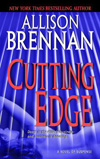
And don’t forget, coming from a woman who has a ton of memorable characters—main and secondary (!!) – our ownAllison Brennan’snewest book,CUTTING EDGE, hits the stores on TUESDAY, July 28th!

When security specialist Duke Rogan’s state-of-the-art computer system fails at a controversial bio-tech firm, a raging inferno spreads, and a grotesquely charred body is discovered in the aftermath. With an extremist anti-technology group claiming responsibility, the case grows even more complex when the victim’s autopsy unexpectedly reveals that he bled to death. Heading the FBI’s domestic terrorism unit, Agent Nora English is fiercely determined to track and stop a sadistic assassin.