Last Saturday, I went to the spa to celebrate my birthday. Before going, I decided to pay special attention to my people-pleaser tendencies — those numerous little efforts I make daily to put people at ease or to evoke a positive inter-relational response — because at this point in my life I’m examining many of the things I used to take for granted about myself. (And, just as an aside, let me tell you I’ll be delighted when I can finally move out of this introspective phase!!!)
Anyway . . . I like being nice; it comes naturally now. It’s fun to make people feel good. And it’s a real asset in my work.
What does this have to do with writing?
Everything, I think.
The longer I’m a writer, the more I’ve come to believe that this task, this creative calling, isn’t just about putting words on paper and honing/editing them to a marvelous sheen. Being a good writer is also about understanding. It’s about watching and thinking and analyzing and feeling deeply.
As a reader I often don’t give a rat’s ass for structure or plot, but I’m a total sucker for voice. It’s true that I do know some shallow human beings who manage to pull off wonderful literary oeuvres. I also know some fascinating writers — as people — whose works I can’t read. But the majority of folks that keep me coming back for more are those who are, indeed, in touch with a magnificently unique essence in themselves. That gem of an individual identity comes out in their writing as distinctly as their fingerprints would on a blotter.
I don’t know if this is true, but I suspect that my people-pleaser tendencies have pften nudged me to write things that I want others to like more than paying attention — perhaps — to deeper stories that I need to tell . . . even if they may not make others “feel good.” I’m not saying that Sasha or Darnda aren’t coming from a distinctive place; I’m not putting myself down. . . . Oh hell . . . I don’t know.
People-pleasing is safe, isn’t it? And it carries such pleasant dividends on a day-to-day level. But is writing the place to do it? Is this another case of marketing vs . . . whatever? Readers do expect certain things from established writers, but is that voice — that inner truth that comes out in some writers’ works — the real goal?
As often happens with my posts, I’m merely asking the question. And I’d love to hear your take on this.
I guess my question is:
Does the urge to please people get in the way of a deeper creativity?
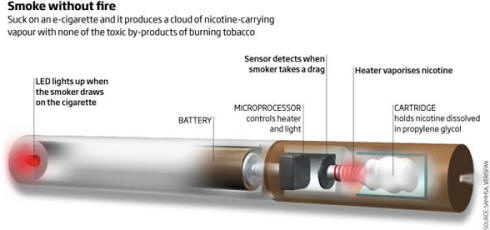
It’s a strange, strange world. I saw a guy in a bar a couple months ago with a fake cigarette in his mouth, this little electric light on the end of it pretending to be fire. I figured it was some kind of placebo stick to help people ween themselves off smoking.
Yesterday I picked up my own addiction placation device (a pack of Wrigley’s Spearmint gum) from the local gas station and saw the electric cigarettes for sale. I asked the attendant if they contained any nicotine, thinking maybe, like the “patch,” the device doled out just enough juice to keep a smoker in the game.
“Yeah,” he said. “This one holds about four packs. When it’s done you just replace the filter tip.”
Four packs? There’s no weening involved at all. It’s just a smoke-less cigarette. You might as well keep a set of works in the glove compartment and shoot the nicotine directly into your vein before hitting the bars. That’s smoke-less, too.
I don’t know, man. The world keeps movin’ along. Crazy shit keeps getting invented. Like the Internet. How long has it been around now? Eighty years? And computers? I remember using those IBM Selectric typewriters, thinking, fuck, I’m flying!
I’m really not that old, am I? I don’t know, my wife and I were in line at this local club last year, hanging out with the other club-goers, and someone said something about Justin Bieber, and one of the guys next to me said, “You could be Justin Bieber’s dad.”
Haven’t hit the local club scene since.
I idled at 1000 mph when I was young. I couldn’t get there fast enough. I’d heard rumors about people “settling down” as they got older, no longer interested in setting the pace for the rest of the world. I remember the song My Generation by The Who, with the lyric, “I hope I die before I get old.” It was my battle cry.
And, yes, I know that “old” is a state of mind. And yes, in my head I’m still in my twenties. I get all that. I even believe it on occasion. But, I just gotta say…sitting back and taking a rest sounds really good right about now. Stepping back, and out. Calmer waters. John Lennon wasn’t that old when he wrote the lyric, “I’m just sitting here watching the wheels go round and round.”
The world changes fast. Every new thing seems vitally important at first. We all grab it, just to keep up. But, really now, so much of that is just marketing. We’re conditioned to respond. It’s the American Way.
I’m not always sure I should share the thoughts that spin through my head. I mean, this is supposed to be a blog for mystery-thriller authors to discuss the craft of writing mysteries and thrillers. But sometimes I’m just not into talking about the craft. And sometimes the craft involves pulling back and observing the world and letting these little observations filter into the stories we tell. Filter like nicotine, four packs a pop. After all, we gotta set the pace for the rest of ’em.
When I first started to write, I always knew the end before the beginning. Each book was a journey towards a clear destination. It was the route there that was the challenge – one that usually took some unexpected turns along the way.
But more recently I’ve realised that I’m setting out with less of a definite destination in mind. In fact, even when I was quite close to the end of the current Charlie Fox novel, I didn’t really know exactly how it was going to end. And when I say ‘quite close’ I actually mean as I was entering the final few chapters.
Of course, while this might horrify the plotter and planner authors (of which I’ve always been one), those who write by the seat of their pants will consider this a normal state of affairs.
I’m not sure I do.
Far too often when I’m reading, the ending to a book is the most disappointing part. The story has gripped and engaged me right up to the point where it became clear that the author hadn’t really thought about how to finish things off. Then the ending becomes too pat, too hurried, too … unsatisfying, somehow, for the effort and commitment I’ve put into it as a reader.
But finding the right ending is hard.
When I wrote THIRD STRIKE I was faced with a choice of endings. Not for the main story itself – I had a good idea about that, but for Charlie’s personal journey. And it’s interesting to note here that the main story involved one of the major characters discovering, under extreme pressure, the very worst about themselves. It’s about people moving into the light while others move into the dark.
But Charlie’s own story could have had three possible outcomes – if you include the ‘don’t know’ option. My original intention was to write all three as separate epilogues and throw it open to my agent and editor to decide on the outcome they thought worked best.
The closer I got to the end, however, the less this idea appealed to me. By the time I was actually writing the epilogue, I knew there was only one way it was going to go.
As the author, I don’t regret the decision I made. I think it was right for the character at that point in her life. And – so far, touch wood – I haven’t had objections from readers to tell me different. I know I have had emails from readers who have become so wrapped up in Charlie’s character and her ongoing story that they occasionally berate me for choices she’s made. I think it’s a huge compliment that they see her as a real person in this way.
But I’m left wondering how much control readers actually want over their favourite characters. In some ways it’s a little like the difference between watching a movie and taking part in a video game, but in other ways I can appreciate it’s not the same at all. After all, in a movie the camera is usually an observer, an omnipotent narrator. In a video game, you are one of the participants. (And I freely admit I’m guessing here, because I don’t play them!)
So, do you want to watch a movie where you can alter the outcome at the press of a few buttons, or do you want to let the action unfold as the screenwriters and the director intended – to surprise you and carry you along to their choice of ending?
Equally, the multiple-choice books I remember from years ago all relied on YOU being the main character, either in order to find the warlock’s treasure or solve the crime. I don’t recall any of them where you were given the option to step in and alter the other characters’ lives without playing some active part in the story yourself.
Would you want that or would it completely spoil or alter the experience for you?
I only read a few of those multiple-choice books and my impression has been that they were an experiment that didn’t last long. (Another admission – I could easily be WAY wrong about that.) Besides anything else, they always seemed very clunky getting from one section to the next. Part of the joy of reading, for me, is to immerse myself in another world where the only thing that matters is turning the page. I want to be transported there wholeheartedly, not necessarily take part and help move the scenery. If I go to watch a stage show, I don’t want to be yanked out of the audience to participate – I want to sit back and be entertained.
With the advent of e-books, however, the ability to jump from one storyline to another has become a much smoother process. You no longer have to leaf through from one section to the next, but simply click on a link and you’re there. The possibilities are endless, not just for allowing the reader to control the story, but to include alternative endings.
But is this providing the reader with more choice, or taking it away from the author?
This week’s Word of the Week is krewe, which is any of several groups whose members are involved in the annual Mardi Gras carnival in New Orleans and take part in events leading up to the event itself, such as electing Rex, the king of the carnival. Many NOLA families have belonged to krewes for generations, and although the word is just a different slant on crew it now has particular significance in relation to Mardi Gras.
As an aside, can I mention a couple of upcoming events? I will be appearing with the Brewhouse Writers in Kendal on Wednesday, February 29th, for an evening of readings at Burgundy’s Wine Bar on Lowther Street, starting at 7pm.
I’m also appearing at East Boldon Library on Boker Lane in East Boldon, Tyne & Wear, as part of World Book Day, March 1st at 7:30pm. Would love to see you at either if you can make it.
Harold Pinter once remarked that all of his plays were in truth about silence. Whether the characters stood there mute or let loose with a blistering torrent of words, the real issue was their nakedness before each other, their silence.
That idea has been haunting me lately, especially since seeing Wim Wenders’s Pina, his 3D tribute to the choreographer Pina Bausch. I was especially moved by the sequences from Stravinsky’s Le Sacre du Printemps:
I left the theater once again feeling in the core of my soul that there is always something words cannot get to, cannot touch, cannot reach, no matter how elegant or clear or savage or right.
Not the best feeling for a writer.
The next day I met with Rebecca Hunt, my editor at Penguin for my book on character that will come out next year. And as we worked out the various strategies for the first rewrite, I kept trying to ignore this nasty itch in the back of my mind, this sense that despite all the work I’d put in, all the examples from novels and stories and films and TV shows I’d analyzed, all the elements I’d broken down, all the techniques I’d explained—not to mention having written four novels, each praised for its characterization—I was still dealing with something essentially elusive, as though I was trying to grab onto a quivery thread of mercury.
When is the line is crossed, between a fully realized character and one not so fully realized? The answer remains as enigmatic to me now as ever—perhaps more so.
Recently, I told a writer friend that I’ve come to use music more and more in my characterizations, sometimes thinking like an opera composer, taking the first impression of a character from a chord or sequence of chords, building from that a musical theme, a melody or sequence of melodies, and allowing the density of those chords, the beauty or discord of the melody, the timbre of the instruments I hear in my head playing the piece to inspire an insight into the character’s inner life.
The advantage of this, over a mere pictorial image of the character, is that music can change its quality so readily—through chord progressions, melodic inversions, tempo, timbre, dynamics—and it moves through time. An image can easily be a trap, locking in my conception of what the character can or can’t do. A character I see in my mind’s eye as handsome or sanguine too often becomes a slave to that impression, and can’t become slovenly or sickly or rude or vile.
I don’t know what it is about images, but they seem to define a thing, in the most limiting sense of the word. Images suggest a soul, some essential essence that cannot be violated or betrayed without the character becoming “inconsistent.” But a character who can’t contradict himself is a trope, a type, a construct, an idea. No matter how cleverly portrayed, such a character dances on the edge of cliché. Denis Diderot likened the human character to a swarm of bees—and it’s that sort of shapeless but still coherent vibrancy I consider crucial.
Ironically, by using music, I get to what Pinter was suggesting by discussing silence. I get at that ineffable, insubstantial trickiness, the ghost in the machine that defies definition, that remains dynamic and free and contradictory.
In my most recent novel, Do They Know I’m Running?, I used a piano piece by Faure to conjure for me the gentle inner life of an otherwise rough, rustic, uneducated (but not unintelligent) Salvadoran truck driver. It was the contrast I was after, the greasy muscular thoughtful man, and the unpredictability it created. I was gratified when a reader told me it was this character, especially his decency, that gave the book its core of hope despite its harrowing sequences.
The sly, sensitive protagonist, a budding guitar phenom named Roque, needed a blistering Santana solo to create a sense of the hunger within him, of which even he is unaware as the story begins.
His aunt, Tía Lucha, is a thin, sad, scrappy woman who I pictured as a clarinet, an instrument which, even at its most playful or aggressive, retains a certain lamenting wistfulness in its tone.
And Godo, the marine who returns from Iraq damaged both psychologically and physically, found partial inspiration in the jarring, grinding, mocking intro to Control Machete’s Sí Señor.
But I’m a musical bird, and such formulations suit me. The trick is to conjure an impression that stirs to life, and the willingness not to define it, explain it, figure it out, but to let it assume shape and form and sense on its own—even to the point of defying that sense and shape. There’s no small bit of magic involved—like a melody that rises up in the mind seemingly from nowhere. Or, again, like mercury, quivering at the touch: shimmering, slippery, but substantial all the same.
Do you have any tricks to keep your characters from becoming types or otherwise over-defined? Does a mental image of a character feel limiting to you? Or is it helpful, clarifying? When do you know you understand a character well enough to begin writing? Have you ever felt you knew your character perfectly, only to realize what you had was a stereotype, a plot puppet—not a character?
* * * * *
Jukebox Heroes of the Week: I’ve recently been turned on to a number of exceptional British acts by a friend from Manchester, Gordon Harries. One of the absolute standouts is Massive Attack, who create a kind of cinematic texture that would remind me of Pink Floyd if that band had ever been this good. (Caution: This is an eerie video):
It’s been more than a year and a half since I started my daily writing. During that time, I’ve missed only one session. For a moment I thought about giving up, the way a dieter does when he or she pigs out on an entire chocolate cake in one sitting and then feels that everything is undone.
But I didn’t give up and now I have hundreds of thousands of words, more each day, and I don’t know what to do with them all. It’s certain that many of those words are superfluous. There are thousands of “ands” and “buts” and, God forbid, the nasties that end in “ly.”
However, there are probably even more words that link together to make decent — if not brilliant –stories. Again, this is just a hunch; I have no idea if the short stories, novels and novellas I’ve written hang together at all.
Before I took the Master Class, editing had always been a pleasure for me, a time to hone and redo in a better way. In Oregon, I learned that editing can often be the death of a piece — it can suck the spirit and energy out of creative prose and process — though the writer has the best intentions. Since I’m seriously afflicted with thinkiness anyway, I’ve avoided the whole question of how to strike a balance between doing nothing and overdoing the editing (in my creative writing only; my writing at work is subjected to microscopic editing daily). Seventeen months later, I have no answer and a hell of a lot of words that need attention.
Working more than 40+ hours a week puts a dent in the hours I have available for everything else. Those 40 hours aren’t the whole picture either. There’s transport to and from work, coming down from the exhaustion of a full-time job etc. etc. There’s taking care of the kids, the house etc. etc. etc.
Some would say, “Pari, just get up an hour earlier to write when you’re fresh. That’ll buy you time to edit in the evenings.”
Great idea if I wasn’t already getting up at five so that I can fit in exercise. None of this is complaining; I love my job. I love that I’m writing daily. Perhaps that’s enough . . .
Who am I kidding? Once you have readers and they appreciate your work, you want more. The feeling is too wonderful! Too fulfilling! I want my fiction to be read again!
So what to do? How can I reframe the editing into something as meaningful — and as pleasurable — as the joy of the creativity so that I can commit again?
Any suggestions?
(BTW: for those that don’t know already . . . the growth I referred to last week was benign. Thank you for all of your kind thoughts. I’m still in pain but it’s bearable now.)
The past 10 days have been huge for me…a huge life stage for me…well, actually it’s a huge life stage for my daughter! You see, on Monday 6 February Grace started school.
The lead up to this event was pretty intense, and I managed to get myself very stressed about my ‘to-do’ list. Buy the uniform, buy new shoes, get the books, label everything, buy a new lunchbox (lots of research into that one!), hair ties in school colours, buy new drink bottle, etc. And while some of these may seem like ridiculously small things, I wanted everything to be perfect. And anyone who’s got young children will probably relate to the drink bottle dilemma. Do you know how hard it is to get a bottle that children will both drink out of AND that won’t leak? We’ve got a cupboard full of drink bottles/juice cups that cover Grace from the time she was six months old until now. Some leaked despite their marketing claims and others didn’t leak but for whatever reason she didn’t drink enough water (presume it was the mouthpiece/straw).
Anyway, once I had everything bought, labelled and ironed, it was time for her first day, which would be 9am-12.30. We walked up from our house to the school and she had a massive entourage. And, let me tell you, my daughter wears an entourage extremely well. In fact, she kind of expects it now. She’s our only child and my parent’s only grandchild, plus she has a larger-than-life personality that draws many people to her. On her first day, her posse included me, my hubby, my dad, my mum and my mother-in-law (Grace’s first day at school was the main reason my mother-in-law had come to visit from Ireland).
We wandered through the local streets, with Grace just about jumping out of her skin. In fact, there was a substantial amount of time spent actually jumping, with me telling her to take it easy because she’d wear herself out before she even got to school!
Many, many photos were taken (as you can imagine) and my dad bought along a very old piece of paper that had my name on it and I’d traced over the words “I started school today” with a crayon. I don’t remember writing this on my first day of school, but it was fantastic to be able to show Grace and then we got her to do the same thing later on.
So far, Grace is settling into school extremely well. She loves it and is excited to go there in the morning and was most upset on Saturday and Sunday when there was no school! As part of the way they’re easing the kids into the first year, they’ve also got Wednesdays off for the next three weeks. We decided to make the most of these last days and had a family day yesterday.
I don’t know how the next seven years of her primary school life will go, but I hope she’s always this enthusiastic about school. It sure makes things easier 🙂
I don’t remember my first day at school, even though I’m sure I was incredibly excited. Can you remember your first day at school? Or your kids’ first day? Looking forward to hearing some of your stories.
Back in the time of the dinosaurs, otherwise known as the days of my youth, recorded music came in the form of vinyl. And single songs were purchased not as electronic downloads, but as 45 rpm records, like this one:
Each “45,” as they were called, had an A-side (on which the song you actually wanted was recorded) and a B-side (which usually featured a lesser known song by the same artist). Most of the time, the B-side song was a dud, either an inferior cut taken from the same album as the hit on the A-side, or an orphan song that was so bad, the record company just couldn’t find a place for it anywhere else.
But there were exceptions to this rule.
On very rare occasions, the B-side song, instead of being a dud, was a great piece of music in its own right. Sometimes you were familiar with this song, and sometimes you weren’t. In the latter case, when you laid your turntable needle down in the grooves of that 45 B-side and discovered, much to your amazement, a terrific song you’d never heard before, it was like finding gold in your backyard.
One such B-side miracle for me was this song, which was my reward for buying the Rolling Stones’ “Honky Tonk Women” 45:
Though I may have heard this expression — “You can’t always get what you want, but sometimes, you get what you need” — before, it never struck me as a mantra to live by until I heard Mick Jagger sing it. Settling for what we already have and finding contentment in it, rather than obsessing over what we covet but don’t yet — and may never — possess . . . Wow. What a way to live. Surely, that’s the key to happiness, right?
But it’s so much easier said than done, especially for those of us who write. Because a writer is never happy with what he has. We are driven as much by ambition as we are inspiration, and our ambition is a harsh taskmaster that keeps moving the target of “success” farther and farther out of reach.
Still, knowing all this, I try to keep things in perspective, and scale my wants and desires to fit the real world, rather than the one I inhabit in my dreams. It’s how I remain sane.
For instance . . .
What I WANT:
What I NEED:
What I WANT: One night with this woman . . .
What I NEED: The rest of my life with this woman . . .
What I WANT:
What I NEED:
What I WANT: 2012 Ford Mustang Boss 302
What I NEED: 2010 Honda Accord Sedan – Used, low mileage
What I WANT:
What I NEED:
What I WANT: Harley Davidson Iron Horse 883
What I NEED: Harley Davidson Iron Horse 883
(Hey, I’m sorry, but some things can’t be compromised. This is where I draw the goddamn line.)
Questions for the class: So what are your WANTS versus NEEDS? And how do you separate the two?
Sometimes when it’s my turn to blog I have to scramble for ideas. But today, I had three potential topics!
Valentine’s Day. I lucked out and drew Valentine’s Day for my Wildcard Tuesday. So I should write a blog about that, right? You know, tracing the history, talking about what it means to me…yada, yada, yada. But forget it…I’ve got other things to write about today. And I’m sure there will be loads of blogs around on Valentine’s Day. And if not, just go to Wikipedia for your fix.
Option 2 was relevant to the date, because tonight (Aussie time) I’m launching the National Year of Reading at one of my local libraries. I’m one of the ambassadors and this is my first duty of the year. In fact, when this goes live I will have just finished giving my speech.
Option 3 came around on the weekend. While I believe writing is a craft more than an art, I still consider myself to be a creative, artistic person. And as a creative, artistic person I am upset, outraged and angry at the wasted talent of the one and only Whitney Houston. So much so, I considered writing a blog on it.
In the end, I’ve gone with option 2, the reading theme, because it seems so relevant to this forum, to Murderati.
For the launch I was asked to speak a little about reading and what reading and books meant to me. I’ve decided to write about some of these things today.
First off, I was lucky because I always loved reading. I didn’t need Harry Potter or fancy ebooks on iPads to engage me – I just needed a book. Sure, there were books I loved more than others, books that I read over and over again. Childhood greats like The Wishing Chair, The Lion the Witch and the Wardrobe and Famous Five and Nancy Drew come to mind. But pretty much any book would do me. I’d devour them, keen to move on to the next story, or the next book in a series.
So, what did I love about books and reading? Some people talk about the feel of a book, the feel of turning pages. But for me, although my childhood reading was solely hardcopy based, it was never about the feel of a book, it was about the words on the page, or more specifically about where the book would take me. You can pick up a book and be anywhere in the world, or not in this world at all. Whether it’s reading about a cop in the US, a bodyguard in England or reading about the hobbits travelling to Middle Earth, books take you somewhere else, give you another experience. Sometimes that experience can be grounded in reality or what might be possible, like crime fiction, drama or even romance stories (although many would argue they’re not based in any realism at all!). And at other times, the world you’re transported to is fictional, fantastical. Whether it’s travelling with Lucy, Edmund, Susan and Peter to Narnia or following the lives of Bella and Edward in Twilight, these books take you to another world, a world that is appealing, interesting or intriguing in some way.
Reading’s also about emotion, about how a story makes you feel. Reading has the ability, the power, to take you on emotional highs and lows. You can be inspired by triumph, moved or heartbroken by tragedy or drama, intrigued and challenged by a whodunit or you can simply get away from it all with an escapist read. These escapist reads could come in the form of classic fantasy novels, horror books, paranormal stories or even romance. And while some people like the more literary style of writing and others prefer a good vampire book, it’s all reading. And it’s all story telling. Sure, it’s changed a lot over the years. Originally it was people telling stories around campfires or ‘drawing’ stories. Then, as we evolved, stories became about the written word rather than the spoken word. They were about reading, not listening. And now, well in some ways we’ve come full circle with audio books that allow people to listen to stories, but they’ve also evolved to another level with ebooks. Our kids may read online, and via ereaders or i-Somethings, but they will still read. In fact, I think ebooks give these technology-savvy generations the ability to combine reading with gadgets and hopefully that will lead to an increase in the love of reading, and most importantly of literacy.
Reading is also ultimately why I became a writer – I think why anyone becomes a writer. Authors love hearing and reading stories, and most importantly we love telling our own stories.
However, I do have a confession to make. My reading is currently in a massive trough, which actually started when I got published. Like many authors, I found myself juggling tight deadlines and reading non-fiction research books instead of reading for pleasure. Plus I became a mother soon after I became published, which meant juggling the dual acts of motherhood and writing; and I’m also one of those authors who prefers not to read while writing. These things add up to not much reading.
However, I am inspired to read more this year. Inspired by the National Year of Reading, and by my role as an ambassador. What about you? What are your reading plans for the year? And what are your childhood memories of stories taking you to different worlds or on emotional highs and lows?
By the time most of you read this blog today, I will have survived (I hope) my oral surgery. I won’t go into the gory details, but I had to have something removed from my tongue. Yes, you read that right. Sitting on this end of the surgery — the night before — I have to admit I’m dreading this procedure. At best, the surgeon will just remove the whole darn thing that’s the source of worry. At worst, he’ll decide to only biopsy which means it might have to come off at a later date.
Blech.
Of course, since I’ve been living with this frightening prospect for a few weeks, and because I’m a writer, I’ve been thinking a lot about fear. Compound this with the fact that I just wrote an article about anxiety disorders for work, and the subjects of worry, fear, obsession, anxiety etc. are very much on my mind.
One of the things I’ve never quite understood is readers’ and movie goers’ attraction to horror. I kind of understand the adrenaline rush of it and the anticipation. But that’s never been a huge draw for me. I guess it’s obvious that at the state fair I rarely went on rollercoasters but adored Ferris wheels and merry-go-rounds . . . and the farm animals.
I think I understand the anticipation implicit in horror as well. There’s a tingliness that is very cool . . . fun, like foreplay. I’d be happy in that place for a long time before the resolution. Of course the resolution must come, the bump in the night must be revealed. I’d just rather it be a raccoon than an ax murderer.
Since I don’t really understand the idea of horror in the context of creativity, I did a little research. http://www.horror.org/horror-is.htm
This is a fantastic perspective. I have read and respect the astounding storytelling craft of Stephen King, Dean Koontz . . . our fabulous Alexandra Sokoloff. And I want to understand the attraction of this genre — and if you don’t think it’s a genre, I want to understand that too — so I hope everyone will chime in and educate me.
Unlike most Mondays, I WILL be able answer your comments since I expect to be home. The prospect of being at work when the Novocain wears off is just too daunting.
I guess the first really serious bit of writing I did was a short story called “Yahrzeit Candle,” which I wrote when I was twenty years old. I wrote it in the months following my father’s death. My writing changed overnight–suddenly I had things to say that could not suffer poor writing. And out came this story about a little Jewish boy who comes home one night to find his father stooped in front of a large candle. The boy’s grandfather has just died. The candle burns for seven days and the boy watches his father fall apart before it. The boy doesn’t understand; he thinks the candle is hurting his father. But when he gets close to the candle, when the smoke gets in his eyes, he is overwhelmed with memories of his grandfather. In the end, he tries to snuff out the candle, to save his father. His father wakes and pulls him back. They hug for the first time in years. The candle, having done its job, flickers out on its own.
I was attending a community college when I wrote it, and I entered two national short story competitions that had ties to the school. The story won both competitions, and there was a cash prize, too. I remember the day I went to my professor’s office to get the check for the awards. I remember his words. “You might not write a story this good for many years. Don’t worry about it. Just keep writing, and understand that it’s part of the process.”
We stepped out of his office onto the second-floor terrace and he handed me the check and the award letter. As soon as I took them, a gust of wind came and took them from my hands. The letter and check fluttered down into the bushes two stories below.
“Easy come, easy go,” my professor quipped.
Words to live by.
It’s interesting how I thought that first story would be the beginning of so much. It was, but not in the way I imagined. At the time, I thought the story would open doors (Eli Weisel called it “Shining, evocative and penetrating”). I thought opportunities would suddenly materialize and I would spend the rest of my life employed as a professional writer and film maker.
This life we’ve chosen, it doesn’t come easy.
I’m beginning to take a long-term look at it. It’s not just a job. It’s not just a career. It’s a life. What we write is what remains. Taken together, it marks our journey. From my very first short story (“Sammy the Dinosaur” at age 8) to this very blog post today. Every story, every screenplay, every poem, every blog. They are the atoms that define me. They are the things from which I evolve.
I might still end up supporting myself by my writing alone. It could happen. I could balance the load writing novels, screenplays and television episodes. Then again, it might not happen that way. I might have other jobs and write on the side. And maybe that’s not such a bad thing. As I’ve been told, “even Spinoza spun glass.” I haven’t done the research, but I take that to mean that Spinoza had a day job, in the circus or something.
If you think about it, precious few artists support themselves by their art alone. Even the ones we consider “great,” the ones who didn’t start living until they died.
I have a friend who is a Story Editor on a very popular cable series. He’s successful enough to be a showrunner now, for the spec projects he has sold. I told him that I would probably be writing a spec script for his cable show, to use as a writing sample in case Boulevard goes to series. (Boulevard has been optioned by a major TV producer). If I want a chance to write on the series (if a series gets off the ground) I have to show the producer a writing sample — a one-hour TV script for an existing series with a similar tone to my books. When I mentioned this to my friend he said, “Isn’t it amazing how we still have to write for free? It doesn’t matter if we’ve had books published or films made from our screenplays, we still have to write for free to prove to others that we can write.”
This is it, guys. This is being a writer. This is the commitment. If the stars align, we could all be millionaires. One book could do it. One spec script. It’s the dream I’ve lived on for years. Since “Yahrzeit Candle,” which wasn’t the most commercially viable project I’ve ever written.
But, you know what? It had heart. I wrote another heartfelt short story after that. And then my first feature script, which had heart. That project won another competition, and got me a film agent. And then I learned to write what I thought I was supposed to write. I wrote crafty, slick, commercial vehicles. And I lost my way. I lost my way all the way up to the point that I ditched it all and sat down to write my first novel, Boulevard. And that had heart.
I’ve spent the past year and a half writing my third novel. It was supposed to be bigger than Boulevard and Beat. It was supposed to be a commercial vehicle. I struggled and struggled and then abandoned it, to write something small and heartfelt. And, lo and behold, my voice came back. I just started writing the new piece when my wife begged me to go back to the other one, to reinvent it so that it wasn’t such an obviously commercial vehicle, to find my heart in the story. There was too much there to abandon. I agreed, and now I’m juggling both books. And looking for the day job that will support this passion of mine.
I’m writing what I want to write, what my heart tells me to write. It will take as long as it takes to do it well. I decided a while ago that novels are where I’ll put my best. In this one realm, I won’t compromise. It’s different than writing a zombie film, which, regardless of how much heart I manage to stuff into it, remains a zombie film to the end. It’s a commercial venture. I know that going in.
My novels, however…well, I hope they are commercial successes. I really do. But if they aren’t, so be it. I write books to make me happy. If I’m not enjoying it, I shouldn’t be doing it.


;)
;)
;)
;)
;)

;)
;)