No, not the kind that features hot librarians (not that there’s anything wrong with that.)
Lately, I seem to keep stumbling across (and saving) these amazing, beautiful pictures I find online of libraries around the world. So I thought I’d share some of my favorites with you.
This one is currently my computer desktop:
It’s the “Long Room” at the Trinity College Library in Dublin. Sadly, I understand it’s more of a museum now than an actual reading room. Still, it’s iconic enough that George Lucas reportedly used the image as the basis for the Jedi Archives in Attack of the Clones:
Trinity, I hear, was even contemplating legal action at one time. Not sure how you’d copyright a building, but that’s not my field of law.
There there’s this little lovely, taken at the Annex of the Senate Library in the Palais de Luxembourg in Paris:
Looks like miles and miles of books. Mmmmmm……
The Beinecke Rare Book and Manuscript Library at Yale looks like some futuristic computer core:
While the Thomas Fisher Rare Book collection at the University of Toronto is an awe-inspiring tower of words upon words upon words…
No post on this subject, of course, would be complete without a link to this, the panoramic view of the interior of the Strahov Philosophical Library in Prague. The pic is a big mother, 40 gigapixels in fact, so I figured I’d best not try to embed it here. But if you’re a lover of books and libraries, check it out and look around. It’ll make your eyes pop out of your head like you were in a cartoon.
I love these libraries. They’re like temples. They not only hold lovely and inspiring works of art, they’re works of art in their own right.
So…share with us, if you will. Point us at pics of your favorite libraries.
Later this year, I’ll be a guest author at a literary festival. The organizers asked me to teach a six-hour writing class for a group of aspiring authors, but the thought of standing alone in front of a class for six straight hours gave me a panic attack. After a few sleepless nights fretting over this frightening assignment, I finally got up the courage to say no. I just can’t teach this course.
Because what I know about writing novels wouldn’t fill six hours. I can talk for maybe an hour about where my ideas come from. I can talk for another hour about how I conduct my research. But my memories of getting from Point A in any novel (the first sentence) to Point Z (“The End”) are always pretty hazy. I can’t tell you much about it beyond the fact it meant long hours in one position and involved a great deal of moaning. A bit like the labor and delivery of my two sons.
Now, it’s true that Michael Palmer and I teach an annual weekend workshop on fiction writing for doctors, but during that weekend, we’re a tag team. When I run out of things to say, he jumps in and starts talking. And vice versa. That workshop covers far more than just writing; we talk about the business, numbers, getting an agent, book promotion, etc. We make our students stand up and read excerpts of their own stories. So it’s not as if I’ve ever lectured for hours on the writing process.
In fact, if you ask me to explain how I write a book, I’d have a hard time giving you much concrete advice, because the process of storytelling is not concrete. It’s rather squishy, if that makes any sense. I call it squishy because just when I think I’ve captured the plot, it oozes like an amoeba in another direction and I have to chase after it. A story is not a rock-solid building constructed with math and physics; too often it grows into a deformed, pulsating monster that consumes my life and sends its hapless creator into despair.
Writing a book is hard work. It’s frustrating, it’s unpredictable, and it will suck you dry.
I may not be able to talk about book-writing for six hours, but I can muster up a few personal storytelling tips that have served me through 23 books. And these have nothing to do with which pen you should use or which word-processing system or whether you should write in the morning or at night or upside down. Those things really don’t matter. But I think these things do:
1. Find a premise that makes you angry or sad or shocked or astonished. A premise that makes your heart squeeze or your stomach drop. A premise that is not just intellectual, but emotional.
2. Which means your story must never, ever be about “a slice of life.” Please. If I want slices, I’ll reach for salami.
3. Wait until you hear a character talking in your head, in a voice that’s so vivid, you’d recognize it on the street. The voice I hear is often very different from my own. Maybe it’s a character who’s far younger or funnier or more biting or just plain creepy. I’m not writing my story; I’m writing their story. But I can’t start writing until they talk to me.
4. Feel something. Every paragraph, every page, every scene, you must be feeling some emotion. Just as your characters are feeling something.
5. Write the scene from the point of view of the character who’s most uncomfortable or off-balance, who’s feeling the most internal conflict. The character who least wants to be there.
6. Tension — or conflict — is the engine that makes a scene move. Without tension, your story’s dead in the water.
7. Action is not the same thing as tension. Sometimes, action is just plain boring.
8. Show us Stuff Happening. Don’t tell us about it happening. Don’t tell us about a mother’s grief. Let us hear the squeal of the brakes. Let us see the mother kneeling, shrieking over her child in the road.
9. Don’t abandon a manuscript prematurely. Finish the first draft. Even a story that looks like a monster at the halfway point can morph into George Clooney.
Dear ‘Rati, Yesterday I sat down to write yet another Memorial Day post (at least my 4th) for Murderati. Every start ended with the same sentiment: There are still U.S. soldiers out there fighting and dying. There are still wars with too much “collateral damage.” Wars still flatten villages, rip families apart, and result in tragedy for many someones. The following poem was written three years ago and I’m running it for the third time on this national holiday. It’s now a tradition. I hope when you read it, you’ll understand why.
Be well, Pari
Somewhere today . . .
Somewhere today a young woman sits in a muddy blind, her uniform wet through. She knows she needs to pay attention to what’s happening, that she has to distinguish between a clap of thunder and the burst of a gun. But all she can do is think of her baby graduating from kindergarten back home . . . without her.
Somewhere today a boy reaches for an automatic with only one hand. The wind blows dust into his teeth and eyes. He manages to prop his weapon against a sand-filled sack, using the stump of his other arm—the one where the rebels sliced it off at the elbow—to keep the rifle steady.
Somewhere today a mother waits on the tarmac, watching the military plane land. It bounces two times on the runway. Her son would’ve laughed at that. Through the blur of tired and salty tears, she sees them lift the unadorned casket.
Somewhere today a father stares at the last letter his daughter sent him. He has memorized every word, read between every line so often it has merged with the next in a confused gray. Three weeks and nothing. Not a note, not an email, no text. He looks to the blue sky and wonders where she is, if she’s all right.
Somewhere today a young woman is shot in a border town – wrong place, wrong time – the “collateral damage” of a drug war she’s never played a part in.
Somewhere today a group of young men claim a village for their tribe kicking children’s toys aside in the abandoned huts of former friends.
Somewhere today war will blast dreams away cut lives short and make sorrows long.
Somewhere, someday, I pray we’ll have no need for this holiday.
Today I’m starting my research series. Once a month (i.e. every second blog of mine) I’m going to blog about some of the weird and wonderful research I’ve done in the name of crime fiction. From real-life vampires (today) to gurus and lock-picking… you’ll discover it all here!
So, vampires…seriously. And I should point out I did blog about some of this stuff when my fifth novel, Kiss of Death, first came out, but I don’t think any of you Murderati gang would have come across it. If so, please excuse the duplication.
It’s certainly hard to ignore the global phenomenon of vampires, with vampires definitely ‘in’. While Buffy the Vampire Slayer had a devoted following from 1996 to 2003 (including me), it was more of a cult following – nothing like the mainstream stars of the vampire world today. Many bookstores now have whole stands devoted to vampire books, and then there are TV shows like True Blood and Vampire Diaries and the book-to-movie success of Twilight. These creatures of the night are, of course, fictitious…or are they?
What the average Twilight-devotee may not realise, is that there are people who really believe they are vampires. I’m not talking about people who dress-up like vampires; nor am I referring to individuals who think they’re nightwalkers and can only be killed by a stake to the heart. Rather, what I’ll call ‘real-life vampires’ are people who genuinely believe they need to feed on other people’s energy to survive, usually via a donor’s blood. These people have been studied to a certain degree by both the medical and psychological professions, although not in much detail.
So how did I stumble upon real-life vampires? It started as a concept for a crime fiction novel – imagine a victim drained of blood and a local cult of real-life vampires. Are they the killers? However, when I started the research I discovered my fictitious concept wasn’t so fictitious. Turns out LA has a thriving vampire scene – check out www.ladead.com or for the clubbing scene try www.barsinister.net. In my search for all things vampire, I interviewed a few vampires from different areas, including the US, the UK and Australia.
Russell from Sydney is a self-confessed vampire in his forties who describes vampirism as “the need for additional bio energy that the body cannot produce.” Merticus, who’s one of the co-founders of the Atlanta Vampire Alliance (AVA) says: “Vampires are generally individuals who cannot adequately sustain their own physical, mental, or spiritual wellbeing without the taking of blood or vital life force energy from other sources; often human.”
My research turned up two types of real-life vampires – sanguine vampires who feed on blood, and psi-vampires who drain people’s spiritual energy. The traditional view of vampires is as blood-drinkers, but for real-life vampires it’s more about energy. Even those who exclusively satisfy their ‘thirst’ through blood usually talk about drawing out energy from the blood.
There are a few explanations currently put forward to explain claims of real-life vampirism. First off is the blood disorder porphyria, which is treated with haemoglobin, hence the connection to drinking blood. Not only do sufferers need blood, they are also sensitive to light, which gels perfectly with the vampire mythology. Problem is, if you drink blood it goes through the digestive tract and doesn’t enter the bloodstream. In other words, drinking blood wouldn’t alleviate porphyria symptoms. However many of the websites and forums I found suggested that real-life vampires are physiologically different, and have the ability to extract haemoglobin from the blood, even through the digestive process.
Then, there’s the psychological side of things and two major theories have emerged. The first is sexual sadism (vampire) coupled with sadomasochism (donor). By definition, sexual sadists derive pleasure from their partner’s or victim’s physical or psychological pain. Vampires are inflicting pain as they bite. Likewise, the donors could be seen as sadomasochists – people who need to feel pain to become sexually aroused.
The second psychological explanation for real-life vampirism is Renfield’s syndrome, named after Dracula’s insect-eating assistant Renfield. This psychological disorder is hypothesised to start with a key childhood event that leads the sufferer to find blood exciting. Blood and this sense of excitement is later linked to sexual arousal during adolescence, and into adulthood.
Of course, one simpler psychological explanation is that real-life vampires are suffering from delusions of grandeur. After all, mythological vampires are strong, powerful, perceived as sexy and almost invincible – pretty appealing, huh? Certainly the vampires interviewed in Carol Page’s Bloodlust: Conversations with real vampires came off as a little strange to say the least and delusional wouldn’t be too much of a stretch. In contrast, Merticus says of the vampire community he’s part of: “…the majority of our community are high-functioning, above average intelligence, sane, and rational members of society.”
In terms of the cause or reason for vampirism, the real-life vampires themselves are divided. Some say it’s physical, some say psychological, and some say it’s simply something you’re born with.
No matter how you explain real-life vampirism, the fact is these people really do exist. So, how does one become a real-life vampire? Unlike the vampires in fiction who are ‘turned’, real-life vampires talk about being ‘awakened’, usually as teenagers. There are lots of vampire dictionaries online, all with similar, if not identical definitions of awakening. In terms of the symptoms, the dictionaries talk about people preferring the night to the day and switching from nocturnal sleeping to diurnal sleeping. And, of course, developing “the thirst”, which refers to a thirst for blood and/or energy.
What happens if they don’t feed? Real-life vampires complain of headaches, stomach cramps and severe fatigue if they don’t feed, some even saying they’re unable to get out of bed in the morning. Russell’s in this camp: “If I do not regularly obtain energy I feel very drained and sometimes sick.” Others talk about severe mood swings and suggest they need other peoples’ energy to somehow balance out their own personality.
Are these people suffering from Renfield’s syndrome or poryphoria? Or perhaps they’re simply sexual sadists or delusional. Or is there some other, yet undiscovered explanation for individuals who experience a thirst for blood and other people’s energy?
At the end of the day it’s hard to know what the story really is with people who claim to be real-life vampires. Interestingly, my research did not reveal young Goth males obsessed with the vamp culture. Rather, I found older vampires who had nothing to do with the Goth scene. Research undertaken by the Vampirism and Energy Research Study backs this up, finding that 66% of the vampires who responded to the Study did NOT identify themselves as Goths and the average age was late twenties to early thirties.
There was, however, one thing that was unanimous on the forums I visited – they hate Twilight wannabes.
So, what are your thoughts on real-life vampires? Ever met any? Or maybe you are one.
And if you’re into book trailers, my bit of BSP (blatant self-promotion) is the book trailer below! Click at your own peril 🙂
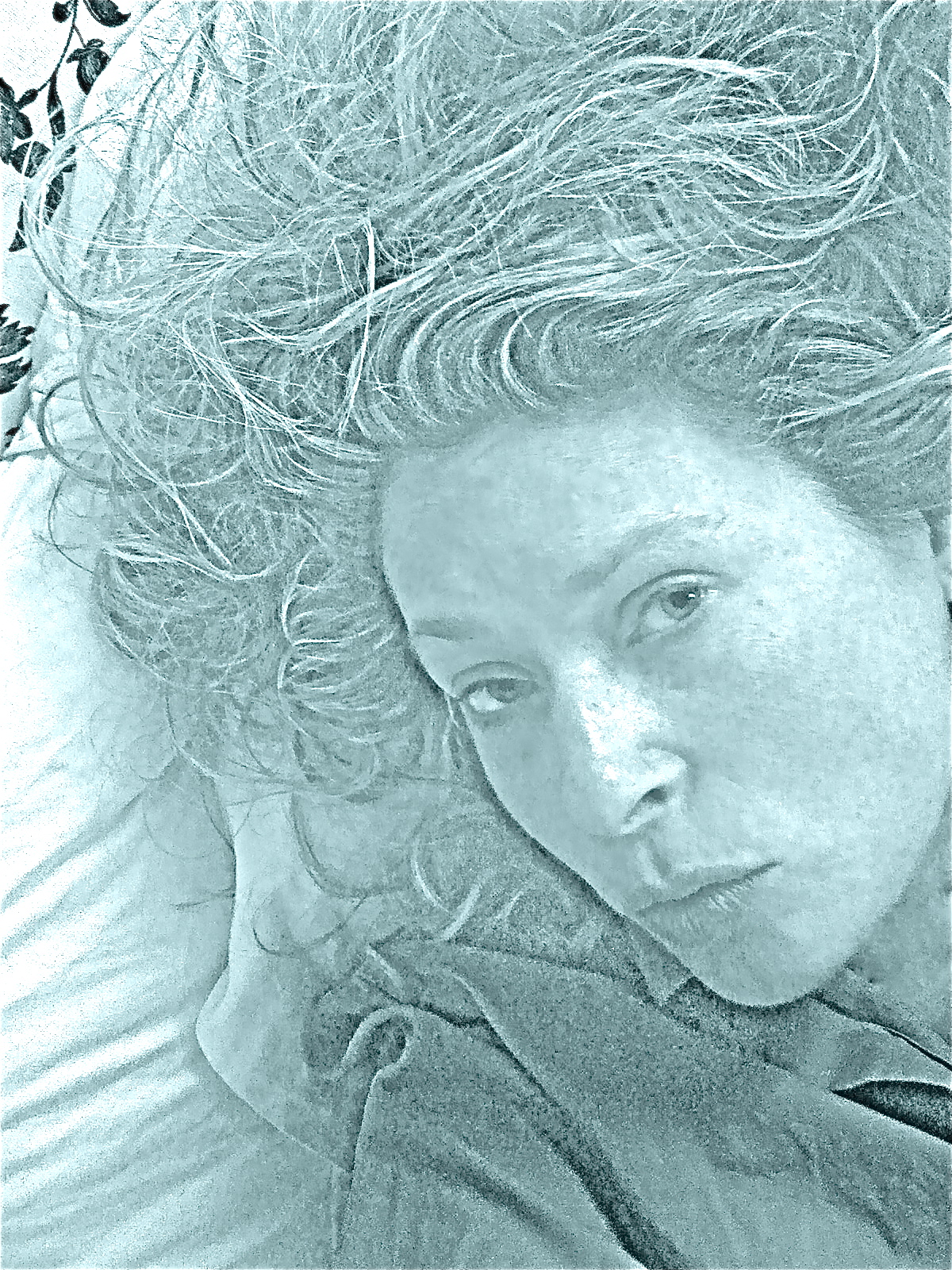
B) The bastard love child of Leonard Cohen and Frances Farmer‘s mugshot
C) Marie Antoinette on her way to certain death in an IKEA toile-de-jouy tumbrel, with a little Anne Frank around the crossed eyes
D) Her deadline looms, much better in the mental hygiene department but not so much on keeping up with the whole personal maintenance thing, despite having showered only this morning
E) She will appear on her next book jacket
Answer: um….. all of the above? Or, in other words, what I look like on deadline, with a second draft of book four due June first. In bed.
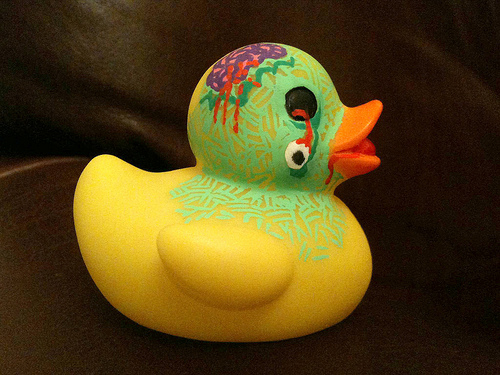
Although my daughter said “you look like a pouting duck. What those of us in my generation would call ‘so totally Myspace.'”
To which I replied, “except that I am part duck… zombie duck.”
Oh, and also? I have to pick my mom up at JFK the night before, and clean my entire apartment. Between now and deadline. Yea.
But I leave you with this:
Any tips on what you do when you have a huge deadline looming? I need all the help I can get…
If it’s May, then for crime fans in the UK, it’s time for CrimeFest in Bristol.
CrimeFest began with Left Coast Crime, which was held at the same venue, the Bristol Marriott, in 2006. (Well, Bristol is sort of the left coast of the UK, if you squint a bit…) The organisers, Adrian Muller and Myles Allfrey, had a sudden rush of blood to the head and decided to keep going. CrimeFest in 2008 was the result, and next year will be the event’s fifth birthday.
One of the highlights of CrimeFest is the gala dinner on the Saturday night. Not because I particularly enjoy such rubber chicken-type formal meals, but because Adrian and Myles always manage to rope in a highly entertaining Toastmaster for the evening. Last time it was Gyles Brandreth, who is a far funnier man live than any of his television performances ever led me to believe. (That’s not supposed to damn with faint praise, by the way – he was an absolute riot as Toastmaster.)
For this year it was originally going to be Don Winslow – one of my favourite authors – but when he was unable to attend, Christopher Brookmyre ably stepped up to the mic. This should give you an idea of how seriously he took the role.
I’ve been a fan of Chris Brookmyre for a while now, and even if you’re unaware of his work, his titles should hook you right in:
A TALE ETCHED IN BLOOD AND HARD BLACK PENCIL
ATTACK OF THE UNSINKABLE RUBBER DUCKS
ALL FUN AND GAMES UNTIL SOMBODY LOSES AN EYE
BOILING A FROG
A BIG BOY DID IT AND RAN AWAY
I mean, come on! How can you not love those?
Featured guest authors Linsdey Davis, Peter James and Deon Meyer also kept us smiling – particularly Deon’s description of real-life crime and inept criminals in his native South Africa.
[left to right – Myles Allfrey, Peter James, Lindsey Davis, Deon Meyer, Adrian Muller, Christopher Brookmyre in front]
Lindsey Davis was the recipient of this year’s CWA Cartier Diamond Dagger which made an appearance on the night, with Myles doing his burly security man bit. Not surprising – the diamond-encrusted dagger must be worth more than half the attending authors earn in a lifetime.
Of course, even if you didn’t fancy the gala dinner, there were plenty of very interesting panels running from Thursday to Sunday, put together by the incredibly hard-working Donna Moore.
As moderator, I asked each of them to come up with a brief intro that included one blatant untruth. This was to see just how believable they could be when making stuff up. Excellent, as it turned out. So convincing were they as liars that nobody in the audience actually got all four answers correct. In fact, only three people managed three out of four, so we picked a winner from those entries. Honestly, would you buy a second-hand car from any of this lot?
[left to right – Paul Johnston, Christopher Wakling, LC Tyler, Anne Zouroudi, me]
And just in case you were wondering how you might have done, here are their intros. I’ll tell you the answers later, and there’ll be a copy of the latest Charlie Fox paperback, FOURTH DAY, to the winner:
Paul Johnston: ‘I’m Paul Johnston. My twelfth novel, THE NAMELESS DEAD, has just been published. I’ve been fortunate enough to win a literary and literally lethal dagger and an engraved piece of plastic for my fiction. I spend most of my time in Greece, was at school with Gordon Brown, lived on a small island for six years, and have chaired over 300 authors at book festivals. Oh, and I’m frightened of Zoë Sharp.
LC Tyler: ‘LC Tyler is the author of four Ethelred and Elsie “Herring” mysteries, the latest of which is HERRING ON THE NILE. He is now a full-time writer but has done all sorts of other things in the past. Growing up in Southend he had holiday jobs selling ice-cream, working at Southend Airport and clearing mines from the beach. More recently he has been employed as a systems analyst, a cultural attaché and as Chief Executive of a medical royal college. He is an honorary paediatrician.’
Chris Wakling: ‘Christopher Wakling worked as a litigation lawyer before turning to writing full time ten years ago. He can fly a plane, surf small waves standing up, and walk on his hands. THE DEVIL’S MASK is his fifth novel.’
Anne Zouroudi: ‘Anne Zouroudi was led into writing her series of novels featuring Hermes Diaktoros, the Greek Detective, after abandoning a lucrative career – which included a spell working on Wall Street – to become a fisherman’s wife on a tiny island in southern Greece.
‘Like many authors, she’s held down some interesting jobs to fund the writing habit, including donning a butcher’s apron to sell pork pies and sausages, playing a begowned extra in a BBC production of Jane Eyre, and picking mutant jelly babies from a conveyor belt in a sweet factory.’
The Friday night CrimeFest quiz, which took place across the road from the convention hotel in the Green House bar, was a disappointment from our point of view. Our makeshift team were aiming firmly for last place, but were nudged off bottom spot by a team who remarkably knew even fewer of the answers than we did. Over the last few years we have telegraphed our complete lack of general crime-related knowledge by our choice of team names – Northern Rock (a UK bank that took a spectacular nosedive), MPs on Expenses, BP Complaints’ Department, and this year’s effort, The IMF Equality Commission. As you can imagine, we were gutted by this result, and are determined to train less in order to avoid a repetition next time. Or, better still, we may retire altogether and allow someone else to hog the inglory of the lower end of the order ;-]
I was particularly looking forward to my Saturday panel – ‘The Grass Is Greener: Thrillers – UK vs US’ – for various reasons, not least of which was that I was not moderating it, so basically all I had to do was turn up! I was sitting alongside fellow Best British Barry Award nominee Charlie Charters, as well as Steel Dagger-winning Simon Conway, and Matt Hilton. Nick Sayers, publisher from Hodder & Stoughton, had the dubious honour of moderating proceedings, although his opening gambit of announcing that three out of the four authors on the panel were published by Hodder, so he felt he could control them, was a temptation to misbehave that I almost couldn’t resist …
[left to right Nick Sayers, Charlie Charters, Matt Hilton, Simon Conway, me]
I admit that I’m never sure how serious to be on such occasions, and I tend to go for the entertainment as much as the enlightenment angle. Do you have any preferences, either when you’re watching a panel, or taking part?
Of course, one of the reasons I like going to events like CrimeFest is it’s an excuse to drag out a frock and a pair of legs, not to mention other bits of me, and get poshed up. Anybody who thinks writers lead a glamorous life has never seen us answering the door to the postman at lunchtime in our jim-jams. So, it was nice to have the opportunity for ‘stunt dressing’. Was it our Alex who coined that term – great one.
[me and Deon Meyer – I’m the one on the left – taken by Ali Karim]
As always, we came home having spent the weekend talking our heads off to friends both old and new. Apart from the odd bombast in the bar, it was a great chance to catch up and recharge the creative batteries, even if we did need a lie-in on Monday morning …
So, ‘Rati, a few questions for you this week. What’s the best panel discussion you’ve seen at a convention? What’s the worst and why? (You don’t have to name names if you don’t want to.) And can you spot the lies my Believable Sleuths told?
This week’s Word of the Week is jugulate, which actually means to cut the throat of, or to check a disease or similar by drastic means.
And just to leave you groaning, how do you kill a circus performer?
In my last post, I said I’d be submitting excerpts from my upcoming book on character as follow-up to my last contribution here. Well, good news and bad news, Penguin has purchased the book. But they’ve asked me not to post any more of its content on the web because they have first right of serialization, and are considering publicizing sections either online or in magazines. So please indulge my changing course.
There have been a number of posts these last two weeks dealing with the issue of the outsider. Over the past year, I’ve twice been involved with a particular group of outsiders — or perhaps I should call them insiders — thanks to the Bay Area writing team of twin brothers Keith and Kent Zimmerman.
A little more than a year ago, the Z-Men, as we call them, in association with Litquake, hosted the very first Literary Throwdown inside the walls of San Quentin State Prison. It took place at the brothers’ creative writing class on the San Quentin H-Unit yard.
I joined five other authors from the outside — Joe Loya, Bucky Sinister, Jack Bouleware, Anne Marino and Alan Black— competing against six inmate writers selected from the class.
Three Hollywood authors/screenwriters — twins Noah and Logan Miller, and Michael Tolkin — served as judges at the next week’s class.
In trying to reflect on what moved me most about the experience, I keep coming back to the intensity and generosity and humility of the men in that writing program. A number of them reminded me of former clients I had, working as a private investigator — guys who had made mistakes, serious ones, stupid ones, or who had suffered black periods of shoddy luck so savagely overwhelming they’d succumbed. Some had plunged face-first into oblivion — alcohol, drugs, rage — and all but drowned. Some had given in to the seduction of power crime provides, and awoken on the sharp end of its consequences. None would qualify as evil, but nobody was innocent either.
They had names like Rolf, Pitt, Frenchy, Banks, Mister Morrison, Big H, Daleadamown, Jo Jo and JFK, even Dinero D the Dynamic “P” (for pimp) and, yes, Buckshot (his given name, oddly enough). But they also were William and Tim, Dennis and Daniel, Kent, Raul, Jonathan, Todd. Almost to a man they possessed insight into what had brought them to that place, that prison, insight into their natures, revealing a depth of self-examination often rare in people on the outside, which was what made their writing so compelling.
And they were grateful. They appreciated the fact someone bothered to show up, pay attention, not dictate but share.
They also understood things about writing itself I wish more of my own students grasped so instinctively: Tell a good story, don’t waste time, momentum matters, be honest, focus on specifics, make it funny. And God, those guys can be funny. They can also break your heart.
Don’t get me wrong: I didn’t think I’d been transported to some kind of testosterone Magic Kingdom. There was bullshit on both sides, and a lot of feeling each other out, the natural cagey distrust of men with men, inside or outside, though accentuated by the higher level of scrutiny inmates live with day in, day out. They look at you carefully, assess you hard. By and large they were incredibly gracious and accepting in their welcomes, but they were also sizing us up. And my guess is they got us a hell of a lot more than we got them.
That sense guided me when I wrote my own piece. I knew that whatever I wrote, it had to be real, it had to be true, it had to strike hard and deep. Anything less was chickenshit, and the whole room would know it.
We were given thirty minutes to write longhand—no computers allowed—on a topic that was sprung on us right before we were told to begin. The topic was, “Damn, Back at Square One Again.” (To read what I wrote, go to the bottom of this post.)
* * * * *
It wasn’t just the inmates who impressed me.
Memoirist Joe Loya, himself a veteran of crime and prison, reached out to those men in a way none of the rest of us could. He let them know they had strengths and virtues every writer needs: a high tolerance for ambiguity, a knack for risk, a long experience of story-telling that lacked patience for vagueness, dishonesty or digression. And they all had at least one good story: the story of their arrest. (And yes, most of them wrote about it for the throwdown — everything from a screen door blown off with a shotgun during a speed binge to a DUI car wreck that killed two people.)
Screenwriter and novelist Michael Tolkin told them that he was blown away by the stories he heard — they were actually about something — and how strong they were compared to the recent offerings by the newly anointed geniuses in the New Yorker’s fabled summer fiction issue.
And Bucky Sinister read a poem from his collection All Blacked Out and Nowhere to Go that blew me down — it hit everybody hard. The kind of magical moment that can’t be faked. I was grateful, for I didn’t feel I’d given back as much as I’d been given. Mister Sinister bailed me out.
Oh, and as for the competition: The judges tallied, the votes were counted. We held our breath. The winners? The inmates. By half a point. (Frankly, I didn’t think it was that close.)
Last month, the brothers had me back, this time as a judge. Anne Marino’s creative writing class took on the inmates this time. I remembered some of the men from the first go-round, some were new to me, some of the ones I’d met before had been released and replaced by new faces. Again, the pieces were strong and wild, heartbreaking and funny. Once again, the inmates won — this time, going away.
For a good long while there’s been an upsurge of the throw-away-the-key zeitgeist in this country, a knee-jerk belief that people don’t change and everyone in prison deserves what they get, or worse. Criminals are animals to be kenneled and quarantined. My experience with these men in this classroom reminded me of just how mendacious and self-serving and just plain wrong that is.
Insight matters, and writing requires it. Men who write about themselves this honestly have what it takes to begin the long hard fight to change. I left that prison wanting to say one simple thing: Listen to them.
So, Murderateros: What would you have written about, given the theme: Damn, back at square one again? Do you believe people can change, or is that just bleeding-heart BS? Where do we draw the line between bad luck and bad character? And what about the families of the victims of men like this — do I mock their pain when I speak of these men the way I do?
* * * * *
Here’s what I wrote for the throwdown:
Twenty-four hours before my wife died, I walked out of her room at the Stanford Cancer Clinic, stood in the center of the reception area, and bellowed at the top of my lungs: “Who the fuck do I have to kill to get my wife out of pain?”
A mere twelve hours earlier, I’d made the decision to end all treatment and feeding. I’d given the hospital the go-ahead to let the love of my life die. I’d fought with her brother about it—he was a gentle, caring guy who believed in miracles and such. But I knew the science and I knew the odds and I knew, despite enough morphine pulsing through her body to anaesthetize seven men, my wife was still in horrible pain and demented from the drugs and the chemo. Her name was Cesidia Therese Tessicini—Terri, we called her—and she had stage IV epithelial clear-cell ovarian cancer, a death sentence, and I had no right to prolong her agony out of some sentimental need to hang on or prove I loved her not just to the end but beyond the end. I was her husband and I had power of attorney and I said do it, let her go. I did it because she gave me that power, sure. More to the point, I did it because I loved her and she knew that, trusted that. It still haunts me, ten years later, the guilt of that decision, even though I know I did the right thing, the loving thing. But guilt and love sometimes walk side by side in a human heart. They do in mine.
But back to the story—everyone told me they’d control her pain. And that was a lie.
In truth, some genius had decided to lower her medication level then bring it back up bit by bit until they knew just how much morphine she needed—this after already telling me they were baffled by her pain, baffled by how much morphine she needed, but not baffled about her needing it. They turned my dying bride into a guinea pig and I watched her writhe in pain for four hours until I couldn’t take it any more. The nurse was helpless, she could only follow the protocol the doctors had laid down. And so it was up to me, and there I was, in the center of the reception area, shouting like some demented creature who’d just escaped hell: “Who the fuck . . . do I have to kill . . . to get my wife . . . out . . . of . . . pain.”
There was just one doctor on duty. He sat there in the reception area, jotting notes in somebody’s chart. He was a young guy, hip little beard, chi-chi glasses, looked like he played tennis or rode a bike to keep fit. Probably a lady killer, ho ho. I strode up to him: “Are you treating my wife?”
He glanced over his shoulder at the door to Terri’s room. “She’s not my patient.”
Later, I’d tell myself: I’d be a hero in prison for killing this punk just for saying that. But in the moment, I said: “I was promised my wife wouldn’t suffer. Get in there and find out what’s wrong.”
He would later tell security that I lunged at him. I remember him shooting up from his chair and running away, and I just followed him. We’re probably both right.
Then a nurse’s aide named Esmerelda swooped in, snagged my arm, said, “Come with me, my dear,” and delivered me to a waiting room. She told me to sit there quietly, don’t come out, then closed the door.
She and the other nurses stuck up for me when security arrived, letting them know I wasn’t a menace. I’d not slept or eaten in days and I was raw and exhausted and despondent. But no threat.
A bargain was struck. I’d go home. The doctors would change Terri’s protocol and her pain would be treated as promised.
And that was why I wasn’t at her bedside when she died the next morning just before 7 AM. I drove in after hearing from her brother, crying over the phone, that she was “gone.” When I got there, I asked to be alone with her for a few minutes, and I kissed every inch of her body. I had never loved anyone like I’d loved her and I’d never been loved the way she loved me. But that was over now. Love was gone, death had won. I was alone again, but worse, because now I couldn’t pretend that being alone was okay, that it was enough.
Terri had sometimes joked that I was a Lone Wolf when she met me, but she’d changed that. And that was absolutely true. Because of her — and no one else in my life — I knew what it meant to trust, and I knew Terri would insist I not give up on that. She was dead but I wasn’t, and I would have to learn to love again.
But that would have to wait. For now, I was just back to square one. A lone wolf. Howling at a ghost.
* * * * *
Jukebox Hero of the Week: The late great Astor Piazzolla, whom I was lucky enough to see perform shortly before his death. He fought through decades of oblivion and opposition from traditionalists as he almost singlehandedly reinvented the tango. I once described his pieces as “music to die in your lovers arms by” — which, at the moment, seems apropos:
I first met Michael Koryta after the Edgar Awards in 2004. I was having a post-ceremony party. A long-time friend asked if she could bring agent David Hale Smith and one of his clients. The client’s name was Michael Koryta. His novel, Tonight I Said Goodbye, had been published by St. Martin’s Press after winning the PWA/SMP Prize for Best First PI Novel. Now it had been nominated for an Edgar for Best First Novel.
When the three of them showed up at my apartment door, I played hostess by immediately offering cocktails to my new guests. I paused as I poured Michael’s Makers Mark.
“Should I be carding you?” I asked.
“No.” He assured me I would not be breaking New York law by serving him. “A few months ago, yes, this would’ve been a problem. But I’m officially legal now.”
Wow. Twenty-one years old and already nominated for an Edgar. I told him I hated him, and we’ve been buddies ever since.
Because we’re friends, I hope Michael will forgive me for even mentioning age more than seven years later. In that time, he has become a full-time writer. He has published an additional seven novels. He teaches creative writing at the side of none other than Dennis Lehane. He has found fans in writers as diverse as Ridley Pearson, James Patterson, Michael Connelly, and Dean Koontz.
As the Wall Street Journal pronounced in a profile last year, “Michael Koryta does not fool around.”
He’s also one of my favorite writer friends. He writes, in my view, for the right reason (because he has to) and with the right objective (to create a better book every single time). It’s my pleasure to host him here at Murderati before the launch of his latest book, THE RIDGE.
AB: Congratulations on the launch of your new book, THE RIDGE. Tell us a little bit about the book.
MK: Thanks! It’s a kind of hybrid detective novel and ghost story, which is the blend I’ve been playing around with in these last three (SO COLD THE RIVER, THE CYPRESS HOUSE, and THE RIDGE). The book opens with a rural Kentucky sheriff’s deputy being called out to investigate the apparent suicide of a local eccentric who built — and lived in — a lighthouse in the woods. I wanted to write something that called upon a lot of the flavor of Appalachian folklore and legend.
AB: Let’s talk about the genre shift. As you mentioned, after five well-received crime novels, you switched gears in 2010 with SO COLD THE RIVER, which had enough of a horror/supernatural feel that reviewers were comparing you to Steven King. Since then, with both THE CYPRESS HOUSE and THE RIDGE, your work has continued in the direction of the supernatural. So what happened to move your work away from nuts-and-bolts investigating into the realm of the unexplained? Did you start seeing ghosts or something?
MK: I keep hoping to spot one, but so far no luck. I really hadn’t anticipated making this change. SO COLD just seemed to cry out for a ghost story — I was writing about a place that had a really bizarre history, bridged a full century, and was built on the legendary reputation of healing mineral springs. To go purely procedural with that seemed wrong. Once I’d introduced myself to writing mysteries that had a component of the unexplained, I fell in love with it. The change in form was really refreshing, and challenging. I found the supernatural stories a great deal harder to plot. That was part of the fun, though, figuring out how to sell this new wrinkle, first to myself and then — hopefully — to the reader.
AB: PD recently blogged here about genre shifting — and our readers’ reactions to it. How have your early readers reacted to the most recent books? And was their response a consideration when you envisioned your most recent books?
MK: Well, most of the feedback I heard was positive. Surprised, maybe, but positive. A lot of “I don’t usually read this sort of thing, but I decided I’d give it a chance because of your previous books, and I really enjoyed it.” That’s very rewarding, when readers are willing to follow you in some different directions. Now, I’m sure some people did not like the new direction, and that’s fine. You can’t worry about that. I really think you’re putting yourself in a very dangerous place when you consider reader response before writing a book. At that point you’re beginning to let the market dictate the material, and you can lose your creative soul awfully fast doing that. Was I worried people wouldn’t like the books? Sure. But I’m always worried that people won’t like a book, so that was hardly a new experience. AB: Four of your first five novels featured investigator Lincoln Perry, who also earned you an Edgar nomination for your debut book, TONIGHT I SAID GOODBYE. Will readers be seeing anymore of Lincoln Perry any time soon? What’s next for you?
MK: I’d be very surprised if I never returned to Lincoln, which is interesting, because when I wrote the last lines of THE SILENT HOUR I had a pretty firm sense that, whether I liked it or not, I’d just written the coda for him. I just didn’t see that character calling me back, felt as if I’d run the well dry. Now, three books removed, I’m beginning to think about him again. I miss writing about Cleveland. Lincoln was my window into Cleveland. So we will see. The next book is a traditional crime novel, nary a ghost in sight, and it’s about two brothers who lost a sister to violent crime when they were in their teens. It’s an idea I’ve been kicking around for several years, and it just kept circling back.
AB: You have now published three novels in twelve months. Can you tell us a little bit about your experience with both the writing pace and the publishing pace?
MK: There’s an element of smoke and mirrors to it. It would appear that I stepped up my writing speed dramatically. That’s not really the case, though. In fact, THE RIDGE took me 16 or 17 months, which is the longest I’ve spent on a book. What has been stepped up is the production pace. When I came to Little, Brown, Michael Pietsch, my editor, suggested that we break the traditional approach of having the hardcover out, then 11 months later the paperback, then the next hardcover. He wanted to increase visibility by shortening the time between books. We had long lead time with SO COLD, so it didn’t seem too intimidating to me. My writing pace didn’t have to change, but all elements of production were crunched like crazy, and kudos to the Little, Brown team for somehow pulling it off. We are going from copy edits to finished books on THE RIDGE in 10 weeks, I believe. That’s pretty quick! It is also operating with the idea that you don’t need to have a galley floating around for a whole year before release, and I think that makes a lot of sense.
AB: I know you’ll be traveling a bit for The Ridge. In fact, I’ll see you in Phoenix on June 25, thanks to Barbara Peters and The Poisoned Pen. Thanks to JT, we were talking here recently about the value of touring. Your thoughts?
MK: Can’t wait to see you. Pack your golf clubs. And Duffer. This will be the shortest tour I’ve done. That’s another side to the three books in 12 months routine: lots of travel. I’ve got to shut that down for a while if I intend to publish again anytime soon. Book tours are kind of mysterious to me. Financially, I think publishers have to be looking at it as a long-term payoff, because the only writers who are going to sell enough copies by touring to offset the travel costs are the writers who don’t need to tour, anyhow.
Events are pretty critical to indie stores, and indie stores are absolutely imperative to authors, particularly new or lesser known writers. I don’t believe there’s enough value to justify an author investing large amounts of his or her own money into touring. There are dozens upon dozens of extremely successful writers who almost never make appearances. Dean Koontz has sold more than 400 million copies and has never toured. When was the last time anybody spotted Grisham on the road?
Now let’s look beyond the #1 bestsellers, to those of us who are trying to hang in there and improve sales enough to get another deal and live to fight another day. I think you’re far more likely to gain ground doing that in the hours spent at the keyboard than in the airport. So I suppose my long-winded answer here is: moderate value at best. We’ve all seen writers who come out and beat the trail for 500 events and it doesn’t catapult them beyond a writer who did 10 events. Good publicity and good word of mouth are far more critical, and those come from writing good books, unless you have some odd hook like, you know, being Snooki.
Touring can be addictive for the writer because A) you feel productive, running out of airports and into cabs, and B) most booksellers are flat-out awesome people and you want to be around them. But I remain convinced that you’re going to benefit yourself most in the hours spent at the desk.
AB: We also talk a lot here about the increased pressures on authors to be their own publicity machines, especially on the internet. You have maintained a fairly close zone of privacy. What boundaries, if any, do you have about your presence as an author online? We’re happy to have you here on Murderati as a guest, but what are your thoughts about blogging regularly, friending readers on Facebook, and Tweeting?
MK: Kind of funny — I’m the infamously young writer of our current pack, and I’m the least social network savvy. After about five years I finally advanced to having a news blog! The publisher runs a books page on Facebook that is really good, but I’m not too active with my own page beyond putting up fun profile photos from Seinfeld. I have yet to tweet, though I’ve promised Little, Brown that I will give it a try.
You’re right that there really is no way to reach me directly on the internet. Part of my reluctance is a privacy issue, I suppose, yes, but more of it is based in time loss. You can lose HOURS on Facebook so easily! It’s amazing. But there are other things I’d prefer to be doing with those hours. I can see enormous value in being able to interact with your readers, but ultimately the interaction I’m most concerned with is the one they have with the story. Lots of readers felt and continue to feel personally touched by Dickens, but as far as I know he has yet to send a tweet or poke anyone on Facebook.
AB: You worked for a private investigator before you were writing full-time. What’s your best story from your PI days?
MK: You’re an attorney, and a law professor, and yet you immediately ask me to violate the confidentiality agreement I signed? Nice. I’ve got lots of favorites. Kind of high up there was a woman who had made a full disability claim. I spent a week outside her house watching while absolutely nothing happened, then went into a bar to hear my friend’s band play, sat down, and saw this lady making a giddy drunken fool out of herself on the dance floor. Reason I always kept a video camera in the car!
I also kept a hardhat and a roll of old blueprints that I got from dad, who is an engineer, because nobody questions a guy who’s pulled off the side of the road if he’s wearing a hardhat and has construction diagrams spread out on the hood.
There were some funny stories — a theft case that involved more than 200 pairs of panties stolen from one girl (who has 200 pairs of panties?!) and some tragic ones — a wrongful death case in which a child had been killed; putting together the narrative of that poor kid’s life was the most haunting and disturbing thing I’ve been involved with — but the job was always grist for the mill.
AB: I know we’ve both been blessed to have some of the most generous mentors in the crime fiction world. Who have some of your mentors been, and what lessons have you learned from them?
MK: Wow, yes, blessed is the word. I find over and over again that this is a wildly generous community. There’s no better example than Michael Connelly. He’s just the guy you want to be like, from the way he approaches the craft to how he carries himself and treats other people. Dennis Lehane, of course. He was still teaching when I started publishing, which I think is a remarkable thing, and I certainly benefited enormously from that and from just from being around Dennis. The great Laura Lippman! George Pelecanos, Stewart O’Nan. Steve Hamilton, who probably pays more attention to rookie writers than anybody else out there. I get nervous working on the list because I can go very long with it and still leave people out. I think the generation of writers who came right before ours really set a standard that’s been recognized and hopefully will be emulated in our little crime fiction world. There are an awful lot of us who will not forget the way a Michael or a Laura or a Steve treated us when we showed up at our first Bouchercon with a debut book and a dazed expression.
AB: Who is cuter: Duffer or XXX? (Why the hell can’t I remember your dog’s name?)
Because the name doesn’t matter, Duffer is going to win this competition, and everybody knows it. Especially Duffer.
AB: Aw, the sign of a true Mensch. Koryta doesn’t want Duffer subjected to competition.
I hope you’ve enjoyed learning a little more about Michael Koryta today. Today’s a travel day as he heads into New York for BEA, but we’ll both be checking in periodically to chat. One lucky commenter will win a copy of Michael’s new book, THE RIDGE. In a starred review, Publishers Weekly says, “Koryta delivers another supernatural thriller with punch….Part ghost story, part murder mystery, all thriller, this fast-paced and engaging read will have readers leaving the night-light on long after they have finished the book.” James Patterson says, “A man in love with the woman who shot him. Who could possibly resist that story? Not me. Read on, and discover one of the scariest and most touching horror tales in years.”
THE RIDGE hits stores on June 8. You can order THE RIDGE here.
P.S. Speaking of time wasted online, for the entire month of June, my website will host the first annual Duffer Awards. Each day we will post a new poll featuring two beloved characters nominated for very, very serious award categories like Most Likely to Win a Hot Dog Eating Contest and Best Shoes. Post a comment to enter to win weekly prizes including signed copies of my books and $50 gift certificates to your favorite bookseller! I hope the Murderati crowd will check out the Duffer Awards starting June 1 and every day in June.
I didn’t think I had to write a blog for today because the world was supposed to end … but at 12:02 a.m. I realized that I was still on the hook for a blog.
Just kidding. 🙂
If you read Alex’s post yesterday, you know that I had a very busy Saturday — soccer game, school fair, 22 kids at my house to meet for the prom, and then the problem I have with the ending of my book.
Here are the kids in my family room. Aren’t they lovely? (Mine is the fourth girl from the right in blue standing in front of the white tux.) It was a good day for the school: girls varsity soccer team won their third straight championship and the boys varsity baseball won the first game of the playoffs. Half the boys here were playing baseball only hours before; ditto for the girls playing soccer!)
But back to my problem ending …
I’ve written the last 40 pages six times. Or started to. I write, get to the pivotal climax, and realize that it’s not working. Back track, delete 2-3K words, write, think I’ve nailed it, then it fizzles. I *think* the sixth time is the charm. I’ve gotten farther into the final scene than in my previous attempts last night, and would have (hopefully) finished this afternoon except for all the activities.
Ironically, I had an ending pictured–not really any details, just the location. As the story progressed, I didn’t think that original location would work–I thought I’d have to jump through hoops to get all the players to the same spot. So I tried this and that and another thing and they fizzled. It was my fifth attempt that I incorporated the original location into the ending and that lightbulb went off. I had my missing ingredient. It tied everything together. Now I have everyone at the right place at the right time and it’s not contrived–as if my subconscious already knew there was no other option for these characters at this moment in time.
I’m off to write those final pages while I wait for the teenagers to come safety home from prom, then back from the after prom party nearby. (Which I know will be monitored to keep everyone in line. Not that I don’t trust them. But I was 17 once. A long, long time ago …)
I need your help. I updated my website last summer and really like it … but I think there are some issues. For years, my web hits have steadily increased, but now they’re stagnant and have been since the change, except for the week or two after a new book comes out. Unfortunately, I can’t really see what the problems are. Like why I need an editor–sometimes I know there’s a problem with a scene, but I can’t figure out what it is.
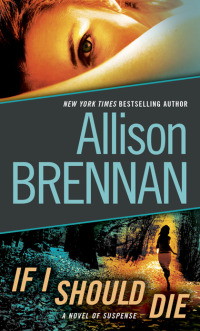
My web designer put the site together so that the main launch page would be easy to change, to incorporate my new release. We’ll be updating the launch page late this summer prior to the release of IF I SHOULD DIE on 11.22.11. But now’s the time to also incorporate any other changes to make the page stronger.
Please visit my website and help me fix it by answering the following questions:
1) What do you like BEST about my website.
2) What do you like LEAST about my website.
3) Is there any information you’d expect on an author site that you couldn’t find or was difficult to find?
I’m not particularly sociable today. If I had my way I would have stayed in bed. All day. Curled into a ball.
I’m writing through a particular madness. It’s had me for a few days now. I feel like I’m floating through a numb dumbness, answering questions when asked, nodding appropriately, making eye contact when necessary. I’m dodging decisions and putting off the things that should be done today but can wait until tomorrow or the week after.
I’m absolutely no help to anyone, except when I look directly at my wife and children and tell them I love them. With watering eyes. I’m as sensitive as a bee sting. I don’t trust myself to watch commercials because I know I’m easily manipulated by images of babies and puppies.
I have to be aware of when I get like this. I have to watch for the signs. The shortness of breath, the thousand-yard stare, the anxiety. I can pull the shit together if I have a story meeting or an interview or if I’m on a panel. I just compartmentalize the crazy and go with what I imagine appears normal. This is complicated by the fact that I know that normal doesn’t really exist.
Watching babies and petting dogs helps. Maybe that’s why I write at cafes. I see a lot of babies, I pet a lot of dogs.
I suppose I feel too much. I remember my mother telling me when I was in high school that I was too sensitive. This was when I was supposed to testify against my father in court for not coming through on sending me to college, as he had promised in my parent’s divorce settlement three years before. I guess that whole thing must’ve made me just a little bit…sensitive.
I often feel shame for feeling too much, when I know that others deal with a kind of pain I’ve never encountered. The pain of war, of losing a child, of homelessness and absolute poverty. The pain of hunger. There are so many things that bring a person down.
One cannot discount one’s own pain, however. We cannot assign a point system to compare our pain against another’s.
I’m a “day later” kind of guy, when it comes to shock. It hits me the next day. And then it lasts, well, as long as it lasts. I’m having a hard time writing through this one.
My wife tells me the moment of impact was Monday night, when my thirteen year old son had an earthquake-sized meltdown. He has Aspergers Syndrome and the worst case of OCD the specialists have ever seen. My wife and I have been fighting the special needs battle for seven years now. But Monday night was a watershed moment, because I was forced to face my helplessness in this battle. I came away from it knowing we’d be looking for a respectable, affordable outpatient or residential program somewhere that can provide my son with the tools he needs to live in this world. And, while that realization marks a positive step in my evolution as a caring parent, it also scares the hell out of me and makes me feel, somewhere deep inside, that I’ve failed. I think I’m smart enough to know that I’m stupid to make this about me. And, intellectually, I know that this does not represent my failure as a parent. But intellect and emotion don’t always agree.
I think I’m just scared. I want my son to be whole. He’s sweet and caring and unique and smart and oh-such a character. I want to see the best of him encouraged. I don’t want madness to envelop him.
Then Wednesday morning my wife’s father died. He was in the hospital and I wanted to visit him and I didn’t. Theirs was a complicated relationship, so it brings up complicated emotions for her. He was almost 90 years old – a man from a different era. He was a professional jazz pianist and composer, and he also painted and wrote short stories. He had given up writing decades ago, but his early short stories were published in an O’Henry collection. I read them and was blown away. I was going to ask him if I could publish them as ebooks. That’s what I was going to ask him, when I was going to visit him in the hospital, when I didn’t.
I spent the day yesterday with my boys while my wife was with her mother. We visited the university where I graduated from film school and I tracked down John Schultheiss, my old film criticism teacher, a man whose influence on my writing and film making cannot be over-sold. I hadn’t seen him in over twenty years. Me and the boys sat in the back of the lecture hall as he administered a final exam, and I was thankful as hell that I would never have to take another one of his tests again. Ultimately, we came face to face and I went all fan-boy. It was great, but it was sad, too. Because time ravages us. And my mentor has aged. I’m sensitive, remember. I’ve also been told that I’m nostalgic and sentimental. How the hell did I ever end up writing noir? It might have had a little to do with John Schultheiss, who taught me and Brett Battles the elements of film noir.
I was also babbling like a groupie, with mile-a-minute recollections of every wise word he had imparted, and how and where I’ve taken his advice into my own worlds of writing and film. I was like a silly teenager. Only later did I realize this was the trauma talking. Like I said, I have to watch myself when I get this way.
Maybe writing will bring me out of this funk. Like therapy, writing turns us inward. And, if we’re honest with our emotions, we’ll teach ourselves a thing or two.
I think this is why I’m struggling so much with my third novel. I don’t want it to just be a fun ride. Boulevard and Beat explore the world of sex addiction. I feel like they had something to say. I’m searching for what needs to be said in my third book. I’m trying to connect with what is true and human and honest. I’m turning inward, which is the only way I know how to do this shit. But it’s painful and I just want to zone out. I want to stay in bed. All day. Curled into a ball. I don’t want to face the hard stuff, and yet I know I’ll have nothing to write about if I don’t.
Living is madness. Writing is madness. Living, however, is easier than writing. I guess the only thing harder than living and writing is making a living writing.