Author Archives: Murderati Members


Research and the Internet

by Alafair Burke

When I was a kid, I remember my father (a writer) calling the number for the public library’s reference desk from memory.  I’d hear him say, “Phyllis, it’s Jim calling again.”  He knew their voices.  Their names.  They knew his.  For years, he always thanked the reference librarians who’d helped nail down factual tidbits he needed for his fiction.

Fast forward thirty years, and now I’m also a writer.  Like him, I also stop a few times a day to wonder whether my memory serves me correctly as I’m writing.  What year did that song come out?  How long would it take someone to drive from lower Manhattan to Buffalo? 

But unlike my dad, I don’t call the reference desk at the library for answers.  I take to the internet.  Thanks to tools like Google and Wikipedia, we have a seemingly limitless ability to pull up the most arcane information in seconds.  Google Maps allows us to take a virtual walk around a midwestern town we’ve never been to.  Online menus let us see what a character might order at a southern diner whose grease-soaked air we’ve never smelled.  I even use my Facebook friends as a modern-day version of Phyllis the reference librarian, asking my “online kitchen cabinet” for suggestions about fictional town names and the imagined decor for a successful man’s home office in the early 1980s. 

Yep, thanks to the Internet, an author’s job as researcher has never been easier. We don’t want emails from people telling us that a song playing at a character’s prom wasn’t written until her sophomore year in college, do we?  That’s why I love the archives of the Billboard Music charts. Did you know that the number one song the week of my birth was “Sugar, Sugar” by the Archies?  I did.  I looked it up.

We also don’t want a bunch of thirty year old characters with names like Barbara (too old — sorry Barbaras of the world) or Brianna (too young — sorry, really really sorry).  Did you know that the third most popular name for girls in 1981 was Amanda?  I did.  I looked it up.

A Name You Will Not Find in a Baby Name Directory

One downside to online research, however, is the potential for distraction.  Finding out what song was playing at Ellie Hatcher’s prom is worth a few-minute detour from the manuscript.  But, oddly enough, I never seem to stop there.  Instead, I decide I have time to look up the top song during the week of my birth.  Then I have to watch the song video on You Tube.  Then I have to stop by my own YouTube account to rewatch, for the fiftieth time, the video of my dog Duffer walking to daycare.

Then it’s a brief sojourn at Facebook, where friends Laura Lippman and Chevy Stevens have each independently sent me a link to this awesomely happy video of a hip hop french bulldog and his mad dance movez. 

Then I have to send that link to my 13-year-old nephew, who doesn’t realize it’s a video gone viral, and really believes that the hip hop dog is my Duffer and that the boy in his undies on the couch is my husband.  And then I have to laugh about that — alot — with my sister. 

Then I have to check out the links that friends have shared on my page in response to Laura and Chevy’s posts.  One of the links is to a website featuring funny pictures of upside down dogs

Nothing funnier than that, right?  Well, except maybe this site, courtesy of Karin Slaughter, featuring super creepy Easter Bunny pictures.

Before you know it, that answer to the song at homecoming has cost me an hour or so.  Even at her most loquacious, Phyllis the reference librarian never sucked up an hour.

This year, I’ve been trying very hard to separate writing at the computer from researching (and, more often, playing) on the internet.  Thanks to a tip from Lisa Unger (wow, lots of name-dropping today.  My friend Bobby DeNiro told me never to name-drop)  — anyway, thanks to a tip, I downloaded an internet-blocking program called Freedom, which allows me to lock myself offline for however long I decide.  If a research question comes up, I can jot it down for later.  I haven’t been as diligent as I had planned, but do find that Freedom helps me get words on the page when I actually crack down and use it.

And when I don’t use it, man, do I love the internet!

So tell me ‘Rati, what are your favorite online sites these days, for either legit research or total brain candy?

P.S.  If you’re like me and goof off online, feel free to share some madness on Facebook or Twitter.

Find a Happy Place

By Allison Brennan


It’s Easter Sunday, but I wanted to do a bit more than simply wish everyone a lovely and safe holiday. 

I don’t want this to be a religious message, but considering the day I hope you’ll indulge me a little. I’m not seeking to convert anyone, only to share one point I think we can all agree on.

Jesus said in Matthew, “Thou shalt love thy neighbor as thyself.”

Sometimes, I think that if everyone followed that one dictum, the world would be a much happier, peaceful place.

I know, it’s a rather Pollyanna thought, and considering that I write rather dark crime fiction, it may surprise some people that I’m generally an optimist. (Picture the starfish Peach in Finding Nemo: “Find a happy place! Find a happy place!”)

I don’t think it’s surprising, however, that even in all its darkness, crime fiction is at its root optimistic. Heroes risking their lives and making sacrifices to save others, even if they’re not paid to do so. And because justice isn’t always served on earth, it’s cathartic to deliver justice in fiction. It’s the hope that stories give—that there are people who care enough to do the right thing, people willing to fight evil, people who show their love of humanity through their actions. People who love their neighbor.

The last two or three years, I’ve reflected on the similarities between Catholics and our Jewish brothers and sisters. It started while researching my Seven Deadly Sins series and reading Jewish fairy tales and folklore. It’s not that I had any issues with Judaism, it was more that since I was born and raised Catholic, I couldn’t relate. And I realized that for all the differences we have, we have far more in common than I knew or understood. The similarities between the traditional Seder meal and the Last Supper are the most obvious, but the foundation of Catholicism rises out of Judaism. I found I could relate. So when my kids wanted to learn more about Passover this year and celebrate it, I was all for it. (We did more of the learning this year; next year we have plans for a traditional Seder meal.)

I think that not only is it important for my kids to respect and appreciate different faiths, but it’s crucial in our world today to understand those who may not agree with us. I’m extremely opinionated about many things, and believe my views are correct (who doesn’t, right?) But that doesn’t mean I can’t learn from or appreciate differing opinions. Again, perhaps a bit naïve, but it’s a philosophy that has helped me get through life. As Voltaire has been credited with saying, “I may not agree with what you say, but I’ll defend to the death your right to say it.”

If I can teach my kids to love others, they’ll not only be happier people, but also more productive citizens. They’ll find that happy place.

I would love for people to share something positive and reflective today, to illustrate the maxim, “Love your neighbor as yourself.” Maybe something you witnessed, or something you did, or something you read about. Toni sent me a link last month about the Japanese man who, after the tsunami, searched for his wife and mother. After finding them, he went back to search for others.

Or maybe a story closer to home. A simple act of love that showed you there is hope.

Have a blessed day.


Key Story Elements – Inciting Incident

by Alexandra Sokoloff

As I continue to work my way through the Key Story Elements

Okay, I admit there’s something more than a little OCD about this venture of mine, but it’s also a much more concrete endeavor than writing fiction, especially a first draft, which is where I happen to be in my novel, which makes doing this story elements thing oddly relaxing for me. 

Whether I’m blogging, writing, or teaching, I keep looking for ways to make the point that filmmakers take extra care with certain key scenes of a story. Filmmakers pay particular attention to all the ways they have at their disposal to underscore the significance of these moments – whether it’s delivering the pure visceral experience of the genre, revealing character, conveying theme, externalizing the hero/ine’s ghost – any and sometimes many of the above and more.

And to do that, they usually create those scenes as SETPIECES.

To review – there are multiple definitions of a setpiece. It can be a huge action scene like, well, anything in The Dark Knight, that takes weeks to shoot and costs millions, requiring multiple sets, special effects and car crashes… or a meticulously planned suspense scene with multiple cuts that takes place all in – a shower, for instance, in Psycho. Setpieces are the tent poles holding the structure of the movie up… or jewels in the necklace of the plotline. The scenes featured in the trailers to entice people to see the movie. The scenes everyone talks about after the credits roll.  They’re almost always used as act or sequence climaxes – and as certain key scenes, like the Inciting Incident.

And I think it’s one of the very best lessons we as authors can take from filmmakers.

So today I want to break down a key scene among key scenes – the INCITING INCIDENT, or INCITING EVENT, and show how a few of my favorite movies handle that scene.

The Inciting Incident is basically the action that starts the story. The corpse hits the floor and begins a murder investigation, the hero gets his first glimpse of the love interest in a love story, a boy receives an invitation to a school for wizards in a fantasy.

This beat also often called the CALL TO ADVENTURE (from Joseph Campbell’s Hero With A Thousand Faces, summarized by Christopher Vogler in The Writer’s Journey), and that’s the phrase I actually prefer, it’s just more – more.

But I’ve been watching a lot of classic movies lately (God bless TCM!) and the more I look at this story beat, the more I’ve realized that while the Inciting Incident and Call To Adventure are often the same scene – they are just as often two completely different scenes.  And it’s useful to be aware of when and how they’re different, so you can bring out the particular qualities of each scene, and know when to combine them and when to separate them.

In Jaws, the inciting incident is immediate, occurring on the first pages of the book and the first seconds of the movie: the shark swims into the Amityville harbor and attacks and kills a swimmer.   The protagonist, Sheriff Brody, is not present for the inciting incident, he’s not even aware of it.  The next morning he gets a phone call reporting a missing person, possible drowning, and he goes off to investigate, not having any idea what he’s about to get into.  It’s a very small moment, played over the ordinary sounds of a family kitchen in the morning.

But we’ve already seen the big setpiece inciting incident and we know what he’s in for.

However, I don’t think that Inciting Incident is the actual Call To Adventure.  I think that comes at the climax of Act One, when the bereaved mother of a little boy who was killed in the second shark attack walks out on the pier and slaps Sheriff Brody, accusing him of killing her son (because he didn’t close the beaches after the first attack) in front of all the townspeople.   And this is one of the best examples I know of an emotional setpiece: the camera just holds on the mother’s ravaged face as she goes on for what feels like forever, telling Brody that her son would be alive if he’d done the right thing to begin with.  And as she stands there against the sun and sky, the black veil she is wearing whips around her face in the wind… she looks like the Angel of Death, or an ancient Fate, or a Fury. It’s a moment with mythic resonance, in which Brody is called to right this wrong himself, to redeem himself for this unwitting and tragic mistake.   Now that is a real Call – not just to adventure, but to redemption.

It’s one of the most haunting scenes of the movie – and I find it really interesting that Spielberg uses it as his Act Climax instead of another shark attack.

The Inciting Incident of a love story is very often meeting the love interest.  In Notting Hill, Hugh Grant hovers in the aisles of his little bookshop, realizing that the customer who just walked in is the movie star Anna Scott (Julia Roberts).  In a prolonged moment he watches her as she browses, but he’s not just gawking at a celebrity.  It’s a classic depiction of how time seems to stop when the Beloved walks into our lives, and we get to experience that moment with him.

In Raiders Of The Lost Ark, the Inciting Incident and Call To Adventure are the same scene, and a whole lot of other things are going on in the scene as well – it’s one of my favorite Calls To Adventure for all the layers of it.

Professor Indiana Jones is called out of his archeology class by his mentor Marcus, who also serves as a HERALD here, too, summoning Indy to a meeting with a pair of government agents who will deliver the actual Call To Adventure. It’s worth noting as a technique that having this double layer to the Call – first a Herald appearing to say to the hero/ine, “There’s someone here with a job for you”, and then escorting the hero/ine to a different location where another set of messengers delivers the call, builds up the importance of the moment and the mission.

And the location of this next scene, where the government agents (US Army Intelligence) explain the mission, is very significant here. This scene could have been set just in an office. Instead, the filmmakers make it a setpiece all on its own by putting it in a huge, elegant, high-ceilinged auditorium with stained glass windows, creating a cathedral-like ambiance. The setting gives us a feeling of the import of this mission. And since the Call is one of the most exciting and crucial moments of any story, why not give it a setting to create an extra layer of excitement and significance?

We learn from the government guys that a Nazi telegraph has been intercepted and Hitler’s men are looking for Indy’s old mentor, Abner Ravenwood. Indy and Marcus interpret the telegraph: The Nazis have discovered an archeological site where supposedly the Lost Ark of the Covenant has been buried for millennia, and they think Ravenwood can help them pinpoint the exact location of the Ark. 

Hitler has been sending teams of Nazis out all over the globe collecting occult artifacts (this is historically true). Ominously, the legend of this particular artifact, the Ark, is that it will make any army who bears it invincible.

These are the really huge STAKES of this story, and our FEAR: If Hitler gets the Ark, it will make the German army invincible. World domination = not good.

So we also get a glimpse of what Indy is up against: his real OPPONENT is the ultimate bad guy: Hitler and the whole German army.

And our HOPE is that Indy finds the Ark before Hitler does.

This is also a good example of an EXPLAINING THE MYTHOLOGY scene – you often see these when the mission is convoluted, or fantastical – such as in horror movies, sci-fi, fantasy – and the scene often includes the hero explaining the rules to an outsider. Here, it’s Indy and Marcus explaining the history of the Ark to the government guys. And they also explain that the Nazis want to find Ravenwood because he has a medallion that can be used to pinpoint the exact location of the Ark (Indy draws all this on a blackboard, a SET UP for when we see him do for real it at the Midpoint).  So we also get the whole PLAN of the movie in this scene.

There is also a big SET UP and FORESHADOWING with the illustrations of the Ark bringing down the wrath of God on a blasphemous army – it’s a sketch of exactly what happens in the final scene.

However, although Indy knows the mythology of the Ark, he quickly adds, “If you believe all that stuff.” – indicating that he himself does not believe it. This is an action-adventure film, there isn’t a huge CHARACTER ARC here, but this is what it is: Indy starts out scoffing at the supernatural and mystical and ends up barely saving his life and Marion’s precisely by believing in the power of the Ark and showing reverence. (The secondary character arc has to do with reconciling romantically with Marion, although in the trilogy that doesn’t last long. There is also even a reference to this GHOST when Indy says, with some shame – that he and Ravenwood had “a sort of falling-out.”)

Also, adding to the THEME of world religions, there are several Judeo-Christian references in the University scene – the auditorium that looks like a church, with the stained glass windows, the leather-bound text that looks like a Bible, the references to the story of Moses and the Israelites and the Lost Ark of the Covenant and the wrath of God. Marcus’s voice echoes in the auditorium like the voice of a priest.

The tag line of the scene is Marcus saying: “An army carrying the Ark before it was said to be invincible”, leaving us a moment to think about that most important point as the scene changes. 

All of that, about a dozen key story elements – in one scene!   It’s really a miracle of compression.

Hmm.  I look at those three examples I just detailed above, all chosen because they were the first Call To Adventure scenes that came immediately to my mind, and I realize that even though they’re very different stories and styles, what those scenes all have in common for me is a sense of mystical, or even mythical, importance.  That’s certainly my preference as a writer and reader, but I also think that there should be something mystical and mythical about any Call To Adventure scene. It’s the scene that summons the hero/ine to the journey, and invites us, the reader or audience, to come along.  Shouldn’t that be magical?

I’ve also just realized that in my own current WIP, and the book I just finished, and also in my last thriller out, Book of Shadows, the protagonist’s Call To Adventure in the crime story is simultaneous with meeting the love interest.  I didn’t do that in previous books, and the Inciting Incidents and Calls To Adventure in my other books are separate scenes.  I wonder if I’m getting more efficient at storytelling – or if possibly my stories are getting more twisted!  But I look at what I’m doing now and I know it’s right that those two story elements occur together; it says something thematically that I definitely wanted to say, although I wasn’t really thinking about it at the time I wrote those scenes.

All of which I think illustrates the point that I’m always trying to make in my blogs and teaching – that taking the time to analyze a particular story element by looking at examples that really do it for you – can take your writing to a whole other level.

So do you have examples for us today of favorite Inciting Incidents and/or Calls To Adventure – from your favorite movies and books or from your own books or WIPs?

And, right – remember that we have Captcha on again and you have to type in the letters to get your comment posted.  Sorry, but it’s the spammers who should die.

Alex


THE LINEUP


By Stephen Jay Schwartz

Words

dropped arbitrarily on a page

as if shaken

from a container


A word or two

or three

strung together

forms an image


expresses an emotion


blocks of letters

and white space

somehow


calms me


I’m not a student of poetry but I know what I like. Some great poems and some great poets have influenced me greatly. My favorite poem is “The Love Song of J. Alfred Prufrock,” by T.S. Eliot. It was read to me aloud when I was seventeen, by a girlfriend’s father, at dinner, with wine and jazz on the stereo. The setting could not have been better. It affected me then and has affected since. The words evoke a nurturing melancholy that I choose to indulge. The poem touches me on a spiritual and physical level. It’s difficult to explain, but I guess that’s poetry.

Another poem which caught me early was “The Road Not Taken,” by Robert Frost. His simple words have provided a guiding hand for the big decisions I’ve made in my life. I’m also in love with playful poets, such as ee cummings and Ogden Nash. And Dr. Seuss.

I fall for the authors whose novels are poetic. James Joyce, Jack Kerouac, John Updike. Katherine Anne Porter. Jhumpa Lahiri. There are so, so many. I’m always amazed when I find poetry in unexpected places. For instance, I’m reading Marya Hornbacher’s memoir of anorexia and bulimia, called “Wasted,” and I’ve been captured by the stunning, lyrical quality of her poetic prose.

I’m also taken by the gritty poetry of Charles Bukowski. I like writing that is accessible. I like to experience the reflections of writers dealing with painful, often tragic issues. I like honesty in writing and I search it out in the poetry I read. Bukowski gives me that. He always makes me think, and he grounds me.

I suppose I strive to achieve a sense of poetry in my writing. I had an English teacher once who told me that everything I write should be original, that I shouldn’t depend on the creativity of others to form my thoughts. He was talking about my use of cliches, which he succeeded in eradicating from my work. But I took it one step further and applied it to the sentences I write. The last draft or two I do when writing a novel is dedicated entirely to finding ways to rewrite every sentence. I search for poetic, often obscure ways to reinvent the paragraph. It’s exhausting, but it’s my favorite part of the process.

Although I love poetic prose, I don’t consider myself a poet. I really haven’t put in the hard work to learn what I feel I should know about poetry. I don’t know any of the classic meters, I don’t recognize any of the literary references. I’m sure that Pound and Whitman and Yeats have amazing things to say, but I tell ya, I don’t understand the half of it. Someday I hope to enrich my life with a college class or two on the subject.

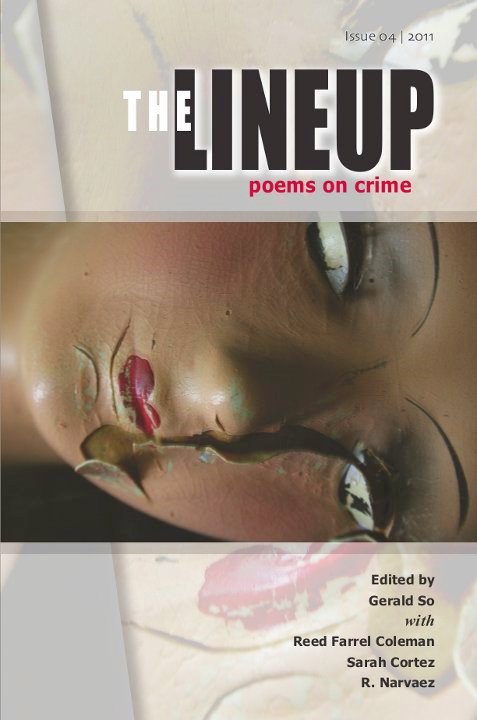
You can imagine how honored I was when Gerald So asked me to contribute some poetry to his fourth issue of the crime poetry magazine, THE LINEUP. I’m especially honored because the other authors I’ve joined are so renowned—Reed Farrel Coleman, David Corbett, Ken Bruen, Keith Rawson and numerous other authors whose works I’ve just been introduced to.

The work of these authors does what I had hoped—it takes me to a place of enraptured contemplation. Their poems examine the dark side of life, the moral ambiguity that drives people to commit crimes, the consequences that criminal behavior has on its victims. Bukowski-esque. Poetry about crime—what a great concept. The collection brings new insight to the phrase, “poetic justice.”

I hope you’ll check the book out. Copies can be purchased by clicking here, where you can also hear a free sampler of the poems being read. You can hear me read my contribution, called “Street Girls: Selected Memories.” You can imagine where that will take you…

Meanwhile, Gerald’s offer to participate has prompted me to dig out the poetry of my past. I wrote a lot after my father’s suicide, and while dealing with decaying relationships, and while searching for a place in this world. The stuff everyone writes about. And I’ve purchased a few more books of Bukowski’s work, just to keep the rhythm going in my head. Maybe Gerald has set me on a new course. If so, I’m indebted to him for getting me started.

Who do you feel are the “essential” poets to read? Who are your favorites? How does poetry affect you differently from prose? What do you think I should do to become a more learned student of poetry?

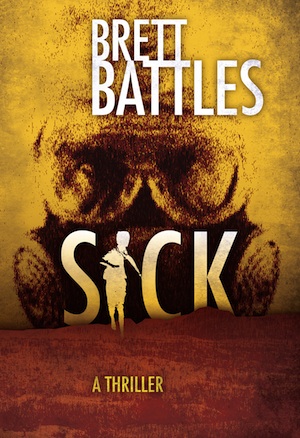
SICK

by Brett Battles

At some point today, SICK should be available in the Kindle store both in the U.S. and the U.K., at barnesandnoble.com, and at smashwords.com. In celebration of that, thought I’d give you a taste from the beginning:


A cry woke him from his sleep.

A young cry.

A girl’s cry.

Daniel Ash pushed himself up on his elbow. “Josie?”

It was more a question for himself than anything. His daughter’s room was down the hall, making it hard for her to hear his sleep filled voice in the best of circumstances. And if she was crying, not a chance.

He glanced at the other side of the bed, thinking his wife might already be up checking on their daughter. But Ellen was still asleep, her back to him. He’d all but forgotten about the headache she’d had, and the two sleeping pills she’d taken before turning in. Chances were, she wouldn’t even open her eyes until after the kids left for school.

Ash rubbed a hand across his face, then slipped out of bed.

The old hardwood floor was cool on his feet, but not unbearable. He grabbed his t-shirt off the chair in the corner, and pulled it on as he walked into the hallway.

A cry again. Definitely coming from his daughter’s room.

“Josie, it’s okay. I’m coming.” This time he raised his voice so he was sure she would hear him.

As he passed his son’s room, he pulled the door closed so Brandon wouldn’t wake, too.

Josie’s room was at the other end of the hall, closest to the living room. She was the oldest, so she got to pick which room she wanted when they’d moved in. It wasn’t any bigger than her brother’s, but Ash knew she liked the fact that she was as far away from mom and dad as possible. Made her feel independent.

Her door was covered with pictures of boy bands and cartoons—she was in that transitional stage between kid and teenager that was both cute and annoying. As he pushed the door open, he expected to find her sitting on her bed, upset about some nightmare she’d had. It wouldn’t have been the first time.

“Josie, what’s—”

His words caught in his mouth.

She wasn’t lying in the bed. She was on the floor, the bedspread hanging down just enough to touch her back. Ash rushed over thinking that she’d fallen and hurt herself. But the moment his hand touched her he knew he was wrong.

She was so hot. Burning up.

He had no idea a person could get that hot.

The most scared he’d ever been before had been when he’d taken Brandon to a boat show in Texas, and the boy had wandered off. It took Ash less than a minute to find him again, but he thought nothing would ever top the panic and fear he’d felt then.

Seeing his daughter like that, feeling her skin burning, he realized he’d been wrong.

He scooped Josie off the floor, and ran into the hallway.

“Ellen!” he yelled. “Ellen, I need you!”

He knew his voice was probably going to wake Brandon, but, at this point, he didn’t care. Josie was sick. Very sick. He needed Ellen to call an ambulance while he tried to bring their daughter’s temperature down.

“Ellen!” he yelled again as he ducked into the bathroom.

Using an elbow he flipped on the light, then laid Josie in the tub. He wasted several seconds searching for the rubber plug, then jammed it into the drain, and turned on the water, full cold. To help speed up the process, he pulled the shower knob, and aimed the showerhead so that it would stream down on her, and cool her faster.

Where the hell was Ellen?

He put the back of his palm on Josie’s forehead. She was still on fire.

“Ellen!”

He was torn. He wanted to stay with Josie, but the pills Ellen had taken must have really knocked her out, so that meant it was up to him to get help.

“Hang on, baby,” he said. “I’ll be right back.”

He raced into the hall and back to the master bedroom. The nearest phone was on Ellen’s nightstand, next to their bed.

“Ellen. Wake up.”

He shook her once, then picked up the phone, and dialed 911. As he waited for it to ring, he glanced back at the bed.

Ellen hadn’t moved.

“911. What is your emergency?” a female voice said.

He reached down, and rolled Ellen onto her back, thinking that might jar her awake. But her eyes were already open, staring blankly at nothing.

He flipped on the light. The skin around her mouth and her eyes was turning black, and there were dark, drying streaks running across her face from her eye sockets where blood had flowed.

“911. What is your emergency?”

“Oh, God. Help,” he managed to say.

“Are you hurt, sir?”

He touched Ellen’s face. It was as cold as Josie’s had been hot.

“Send help! Send help, please!”


And that is just the start. If you’d like to read more, you’ll be able to download a longer sample at the sites where it’s for sale. Or you can just buy the whole thing for $2.99.

I’m pretty jazzed about SICK, but I’m biased. So here’s what Elyse at popculturenerd.com has to say: “Like a fever, SICK makes you sweat and keeps you up all night, wondering what the hell is happening. It’ll make your heart race like someone shot you with an EpiPen. You think Battles was badass before? He just cranked it up to 500 joules. CLEAR!” I probably owe her a few bucks for that quote.

So, what did you think? Intrigued? Not? Something you’d want to read more of?

Get SICK for the Kindle here!

Get SICK for the Nook here!

Get SICK at Smashwords.com in most formats here!

What The Heck Do They WANT?

by J.D. Rhoades

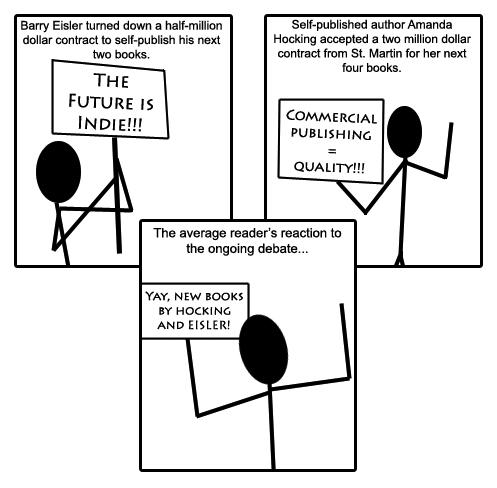
A few days ago, a tweet (or maybe it was a blog post) from the extremely cool and uber-talented paranormal suspense writer Kat Richardson pointed me at this cartoon from fantasy writer Jim C. Hines:

It was one of those observations that’s been, in the words of Jimmy Buffett, “so simple it plumb evaded me.”

Sometimes the discussion on book blogs can get a little, as they say, “inside baseball“. Some of us talk about e-publishing and platforms, royalty rates and market shares of various formats. Some of us talk  about process and outlining and marketing,  and we make predictions and projections and pontifications about the future of publishing. It’s interesting to writers, both currently published and pre-published,  because knowing about and discussing this stuff is part of our business.  It’s interesting to some readers, because they like seeing how the business works (or sometimes how it doesn’t work).

But I get the feeling that there is a larger mass of readers out there–Hines’ “average readers”– who couldn’t really care less about why Amanda Hocking went with St. Martin’s or whether Barry Eisler made the right decision to self-pub or whether Joe Konrath is the Antichrist (answer: probably not). They may not even read book blogs, and it’s highly doubtful they read Publisher’s Weekly or Galleycat. They’re the equivalent of Richard Nixon’s “Silent Majority”: the “real’ Non-“elite” folks who  every politician of every stripe claims they  represent. 

Which leads us to the question: as authors, how do we reach these people? And what the heck do they want?

The knee-jerk response “they want a good book” is glib but empty, because no one agrees what consitutes a “good book,” at least until enough people like something enough that it sells a great number of copies. In that case, however, there’ll probably be a considerable number of people who’ll tell you that no, that top-ten bestseller is not a good book; it is, in fact, absolute crap, while this book over here that sold less than a thousand copies is, actually, the best book ever written.

It gets even more confusing when you begin to realize that the people whose job it is to determine what that great silent-but-hungry mass of consumers wants often don’t really know either. We’ve all heard the multitude of stories about writers rejected by dozens of publishers who went on to become bestsellers. And how many times have we seen the author that was supposed to be the Next Big Thing in publishing turn out to be the literary equivalent of the Segway? (You remember the Segway. It was supposed to be the future of personal transportation, “transforming the way you work, play and live,” according to the company’s website. So, do you own one?)


Even some of the things you’d think would be reliable predictors of popular success sometimes fail us. Our Alex has brilliantly explained the idea of “high concept”: those ideas that have already staked out a place in our “mental real estate” so that when you see one, you go “Yes. That. Want that.”

 As an example, she uses PIRATES OF THE CARIBBEAN. Because everyone knows pirates, right? They’re cool.  Everyone wants to see a movie about pirates. So explain to me why POTC became a franchise while 1985’s CUTTHROAT ISLAND bombed so badly that it took Carolco Studios down with it.


It even has a monkey, for Chrissakes!

Likewise, one series of  YA books about young wizards at a magical academy spawned multiple sequels and made its author one of the richest women in the world; another, earlier one…well, they’re doing okay, but they didn’t make Diane Duane a millionaire, more’s the pity.


Yes, that “average reader” (or viewer) is an enigmatic critter. They want something just like something else, only different, and every now and then they want something really different.   The only way they speak is with their cash or plastic, and they seem to be saying something different all the time.

So, since no one really knows what’s going to be big and what’s going to bomb, what are we to do? Why, whatever makes us happy and gives us pleasure to write. Unless you can tell me what readers really want….


What’s your speed?

by Tess Gerritsen

My husband says I walk too fast.  He complains about this whenever we stroll together, even when we’re not late for any appointment but just seeing the sights.  “What’s your hurry?” he asks.  “Are you trying to make me feel like a slacker?” Really, I’m not; I just naturally walk fast. How fast?  I think people in Manhattan should stop being so pokey.   

Years ago, when I was working as a doctor in a Honolulu emergency room, I walked into a treatment room to sew up a cop who had a nasty laceration. Before I could say a word, the cop says, “You’re not from the islands, are you?”

“How the heck did you know that?” I ask, completely baffled.  As an Asian American, I look like half the population of Honolulu.  

“It’s the way you walk,” he said.  “You look like you have to get somewhere in a hurry.  Islanders don’t walk that way.”  

Now that’s an observant cop.

Another memory: my husband and I are in London, on a double date for dinner with my UK editor and her husband.  My editor and I walk together, and we both walk fast. We’re talking business while we walk, and we’re so engrossed in conversation that we’re not really paying attention to where our husbands are.  Suddenly we realize we’ve lost them.  They’re nowhere to be seen.  We halt on the sidewalk, wondering if they took a wrong turn or ducked into a pub somewhere.  A moment later the men appear, annoyed and grumbling about “these damn career women, always leaving their husbands behind.”

The thing is, I don’t think I walk fast.  This is just my natural walking pace and if I slow down, I feel as if I’m wading through molasses.  It’s something that’s inborn and not a conscious thing.  We each have our own natural rhythms that determine how much sleep we need and how fast our hearts beat.

In the same way, I think I have my own writing speed, and no matter how hard I try, I can’t change it.  I would love to write multiple novels a year.  I would love to have a new book on the shelves every four months.  The fastest I ever wrote was back when I was writing romantic thrillers for Harlequin, and one year I managed to write two books, but those were only 300-page manuscripts.  Now that I’m writing longer thrillers, I have to work hard to meet my book-a-year deadlines.

Now, this may have something to do with my chaotic process.  I don’t outline, I don’t plan ahead.  I plunge into a first draft and it goes all over the place and it ends up a mess.  Which means I have to spend the next five months cleaning it up.  Oh, if I could just have a logical system with notecards that summarize every chapter ahead of time.  If only I could approach it like an engineer with a blueprint.  But even if I could do it that way, I think I’d still be writing only a book a year.  Because of that natural rhythm thing again.  I write four pages a day and I’m bushed.  Whether those four pages are good or bad, they exhaust me.

And I have to wander off and make a martini to recover.

I’ve given up beating myself over the head about my pokey writing schedule.  Just as I’ve stopped apologizing for how fast I walk.  Too bad I couldn’t be a fast writer and a slow walker.

Then everything would be perfect.


A post of little things

by Pari

This is a post of little things because I’m making a very big dinner tonight. I started cooking last weekend and got the six dozen matzo balls out of the way. Yesterday I made the chicken soup and the butternut ratatouille. Oh, and did I mention the dozens of chocolate chip and pine nut meringues or the chocolate macaroons? Or the chopped chicken liver? Or the mock chopped chicken liver (veggie version)?

Today I’m preparing the brisket, the salmon with yogurt dill sauce, the sweet potato salad, the charoseth, etc etc.

Elijah – and my other guests – better be hungry!

Begin little things:

Spam #1: Captcha

Yes, we had to turn it back on. Alas, we had to turn it back on. One piece of spam won’t sink a blog, but close to 100 items a day tries anyone’s patience. So please take the time to type in those little letters in order to comment. We adore hearing from you. Believe me, we wouldn’t have decided to use this gateway process unless it was absolutely necessary to our sanity!

Spam # 2:  Please don’t send me your email newsletters, invites on FB, updates etc unless you know me and I’ve asked to be informed. I may sound like a grump, but it’s the accumulation of those little things that render me so.

Spam #3 Okay, so now I’ve exposed myself for the grump I am, I have a couple of questions. How does a person market ebooks w/o spam? How do you grow your virtual world w/o being utterly obnoxious?
Advice please.

Vote on my cover: This is a first mock-up of my FIRST piece of original fiction to be published only in ebook mode. Yep. I’m taking the plunge on a book that editors said was wonderful but that mystery readers wouldn’t want to read because it features a character who communicate with insects and other animals.

I disagree.

But back to the cover . . .

The difference between the mock-ups below is slight. As a matter of fact, it’s only the type of bee in the hand. But it’s enough to give each one a unique flavor. My question to you is which best implies the slightly mystical relationship between human and insect?

#1 — Light bee cover


#2 — Dark bee cover

End little things:

Back to my Pesach preparations. I’ve got to buy the flowers, clean the house some more, set the tables, count the dishes to see if I need to buy a few more plates and bowls . . .

But I do have one last question for you:

What smallnesses are affecting your world today?

Write what you know…or maybe not

by P.D. Martin

This is my first Murderati blog and I’m really excited to be part of the gang – some great authors here!

You’ll see from my ‘tag’ that I’m “The Aussie”; however, while I am an Aussie my books are actually set in the US. But more about that later. Given it’s my intro into Murderati I thought I better actually introduce myself 🙂 before I dive into the main part of my blog, which looks at writing what you know.

I grew up with a love of books, and was particularly drawn to fantasy and whodunits. I graduated from Nancy Drew and Famous Five (remember them?) to Agatha Christie at the tender age of eight and in grade five I wrote my first crime novella.

From there I went on a bit of a detour into maths and science, which led me to psychology at university. At this time I was also singing (yes, something totally different again), and through singing and songwriting I rediscovered my love of writing. But it was not an easy road!

After writing three unpublished young adult novels, I decided to try my hand at my other early love, crime fiction. The result was Body Count, my first published novel. Now I have written five novels featuring Aussie FBI profiler Sophie Anderson and one ebook novella.

So, now that you know a bit more about the newest addition to Murderati, I thought I’d focus on something I didn’t do when starting my crime fiction series…

There’s an old adage that’s often talked about when you start writing: Write what you know. It’s great advice, however, things don’t always go to plan!

Body Count is based on a dream (well, really nightmare) I had many years ago. In that dream, I was investigating the deaths of some friends. I was me, but I was also some kind of law enforcement officer. When I decided to turn the nightmare into a book, the first decision I had to make was about my protagonist. Would she be a cop? Crime-scene tech? What I was really interested in was criminal psychology; and so I decided to follow my gut and make my heroine a profiler.

My next step was research, which revealed that profiling wasn’t used nearly as much here in Australia as it is in other countries. It also seemed that the FBI was leading the way when it came to using profiling as a law enforcement tool.

So, now I had an FBI profiler (and ex-cop), but I’ve never been a cop or a profiler. My only link to this world was that I studied psychology and criminology at university. And to top it off, I was setting my book in the US, but I live in Australia.

So much for write what you know! At least my main character is an Aussie!

In many instances research can bridge the gap, including talking to people who are working in the field. It’s an invaluable step when you’re NOT “writing what you know”. The location can be tricky too, even with the wonders of Google Earth and Google’s street view. While these are amazing tools, it’s not the same as actually being there.

I’ve been to America several times, but unfortunately I haven’t been able to visit every location I’ve written about. Body Count was set mostly in Washington DC and Quantico, with a few scenes in Arizona. I managed to get to both DC and Quantico, but not Arizona.

The directions feature of Google Maps is also a great way to add in a sense of place – you can talk about your characters driving down particular streets and highways. Of course, the risk is that while Google Maps says to take certain roads from point A to point B, the locals might say something like: “You’d never take the I-10 at that time of day. Are you crazy?”

Google’s features are certainly fantastic tools for novelists setting their books overseas, and it also helps that I’ve got a few friends who’ve married Americans. So when I need to check an expression or a suburb in LA that ‘fits’ with my character, I’ve got people to call on.

I love visiting the States, and during my last trip I had great fun scouting out different locations for abductions, body dump sites, etc. That trip was to L.A., where my third, fourth and fifth books are set. And I also took extensive photos and video footage of one of my locations for book 5, Kiss of Death. I even posted some of the pics and video footage on my website for readers, as part of my ‘case file’ for Kiss of Death. One of the videos is below – it shows where my victim was attacked and the trail she would have been running down. Please excuse my commentary!

So, while there are disadvantages of NOT “writing what you know” I think it’s still possible to make it work. And on the plus side for me, any time I visit the US it’s tax-deductible!

Road Trip!

By Cornelia Read

I’ve been thinking a lot about driving, this week. Mostly because I had to do all that grownup paperwork stuff that owning a car requires–the kind of thing I suck at deeply and profoundly. I got a speeding ticket on the Merritt Parkway in Connecticut last week, then got pulled over in New Hampshire Sunday… and Monday. The New Hampshire stops were because my inspection was out of date. And then Wednesday I went to traffic court for a speeding ticket I got last November. Yea! Not!

Today I’m driving down to New York again, to do some pre-college stuff with my lovely kid, and see my little brother, and hang with the beau, and generally relish time in a city where there’s decent Chinese food and bagels. Yea! Really yea!!

I got that ticket on the Merritt driving my stepmom and half-sister up to New Hampshire from Brooklyn, to look at colleges and stuff.

“Are you sure you want to come all the way down to New York?” my stepmom had asked.

“Absolutely,” I’d said. “I LOVE driving.”

She laughed and said, “well, you come by it honest.”

Which is very, very true. Both my parents were huge road trip people, as were both sets of grandparents. My mom’s father hated flying–he got on an airplane once in the Thirties and swore he’d never do it again. Not because he was afraid they’d crash, but because they locked the doors and he had wicked claustrophobia.

“I’d have no problem with it at all if you could fly with the doors open,” he often explained. But as a result, he and my grandmother went everywhere by ship and train and car, forever afterward.

My father’s father was rather infamous for driving like a maniac everywhere he went, especially when he was going from lower New York up to the Adirondacks. Family myth holds that he was once passing another car on a blind corner when a logging truck suddenly appeared, hurtling towards him. He played chicken with it and it drove off the asphalt and on into the woods. With about five of my seven uncles in the car with him at the time.

My parents were big on cross-country road trips–separately, of course, since they split up in ’67. Mom was the leisurely sort, taking at least two weeks to drive from California to New York at the beginning of most summers. We stayed with friends of hers across the country, or camped out at KOAs along the way. And stopped at every garage sale and junk store she could find for all three thousand miles.

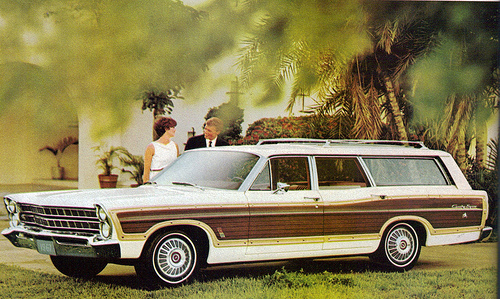
In ’72 we made the trip in a 1967 Ford Country Squire wagon she’d bought for $150–me, my little sister, my little brother, and our favorite babysitter at the time, who’d been over for dinner the night before we left so Mom invited her along for the hell of it.


I remember putting a silver spoon on some railroad tracks somewhere in Iowa, because we’d forgotten to bring a knife for our picnic meals. The train squashed it into an excellent slicer/spreader thing, which was way cool.

Unfortunately, Mom had ignored the garage guy who’d suggested she get the brakes done as she was buying the car from him in Monterey. She rear-ended a nifty little red Alfa-Romeo convertible in New Hampshire, that July, and I hit the back of the front seat with my bottom teeth.

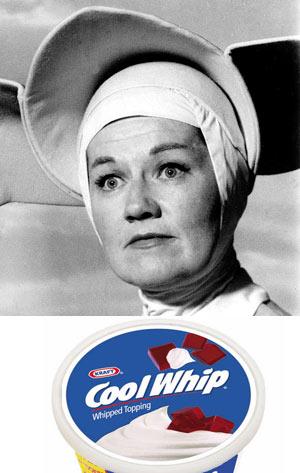
We stayed in this place that looked the the Tucker Inn from Seventies Cool-Whip commercials that night.

(And I did not know until Googling for a picture that Mrs. Tucker was played by one of the nuns from The Flying Nun. Cool!)

Mom instructed me to go downstairs to the coffee shop and order a “frappe” with an egg in it, since that’s what they called milkshakes in New England. This was my dinner, as the dentist at the ER had had to pull my two bottom front teeth forward with his fingers from their flattened position over my tongue, and had then given my four stitches on the inside of my bottom lip.

The waitress looked at me kind of funny, and I noticed that my beverage still had lumps of ice cream in the bottom of the glass when she served it up. I figured I could eat a lump of ice cream, so drew one up to the top of the glass with an iced-tea spoon, only to discover that the woman had put a hardboiled egg into my drink.

Dad was more about distance than garage sales, the times I drove with him. We did the California-New York jaunt together the following summer in four and a half days–only stopping in Elko, Nevada for an afternoon because they had a great Volkswagen repair place and excellent “broasted” chicken across the street at a Dairy Queen. Dad lived in his VW camper in those days, so we could just pull over wherever we were when he got tired late at night and sleep in the back.

This mostly worked out okay, except for the night we crossed the Continental Divide and were coming down the eastern side of the Rockies around midnight.

There are not a lot of places to pull over, when you’re going downhill that fast for that long. There was some kind of gorge over to our right that put kind of a premium on parking spots. Finally, when Dad was really bleary and wiped, we saw a sign that said “Garbage Cans, 500 Feet.”

He wheeled the van into the little spot and set the parking brake and we crashed hard on the mattress behind the front seats, both exhausted and immediately falling into comatose sleep.

Until suddenly the entire cabin of the van lit up with a bright light and we were simultaneously blasted by a very, very loud train whistle.

“Cornelia… do you remember if I pulled across any tracks?” asked Dad, rather calmly I thought.

“Um…” I said, racking my brain and pretty much ready to puke on my own feet with terror. But I didn’t have time to finish the thought as a very long freight train suddenly rocketed by, about four feet to my right.

We hadn’t seen the tracks because they were slightly below the level of the highway. Luckily.

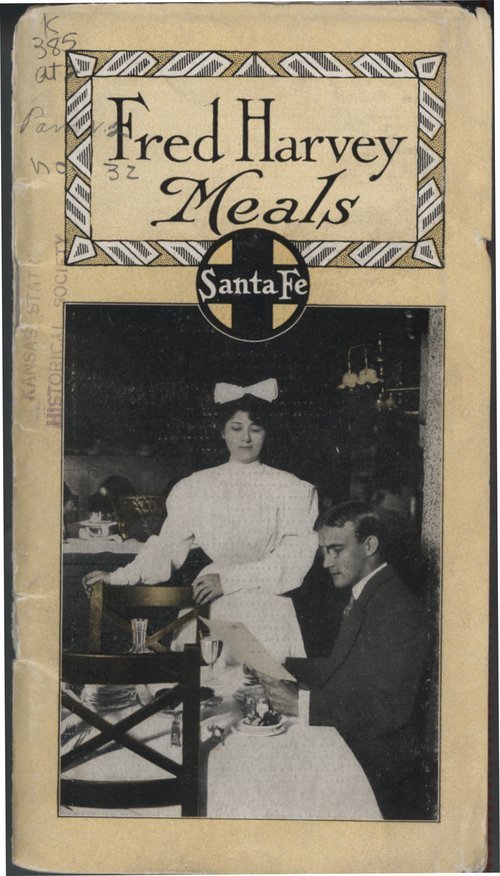
I guess travel is in all of our blood–Mom’s maternal grandfather ran a shipping line, and Dad was named after a family friend who opened a bunch of hotels near train stations throughout the Southwest: Fred Harvey.

I did a lot of driving cross-country myself, when my girls were little. I can advise you from actual experience that it is a REALLY REALLY bad idea to drive from Colorado to California along Highway 50 with a pair of two year olds in your back seat. There is a reason it’s nicknamed “The Loneliest Highway in America.” Also, it is really flat and boring. And if one of your kids should happen to do a face-plant into a concrete outdoor bench at a Dairy Queen along the way, you will be lucky if it’s the day the travelling doctor shows up in town that week to run the clinic. Even if your kid doesn’t need stitches.

Anyway, more driving today… and it’s awfully nice to have my iPhone tunes playing on the car radio instead of having to listen to “Brandy” on an AM station all the way across Iowa or Nebraska.

Do you come from a car family? Any great road trips when you were a kid?