Author Archives: Murderati Members


Slow

As you may or may not have noticed, I wasn’t around much last week, I was on vacation in the lovely mountains of North Carolina (folks from out West are asked to hold their “you call THOSE mountains?” remarks for the time being).

It was a bit of a departure for me, since vacations for the Rhoades clan have traditionally involved a lazy week at the beach.  But we had a free place to  stay at my folks’ condo on Beech Mountain, so we decided to seize the opportunity.

I’ve often observed that there are marked differences between the type of folks who like to vacation in the mountains and those who vacation at the beach. As I wrote a few years ago:

  • Mountain people are on the move: up the trail, down the slope, across the rock face. Beach people have to be reminded to turn over periodically so that the sunburn is evenly distributed. When they do move, beach people prefer an aimless ramble along the shore rather than a brisk hike up a steep slope.
  • Mountain people are into gear: backpacks, boots, bikes, skis, etc. Beach people tend to regard shirts and shoes as an imposition.
  • Mountain people love the breathtaking vistas of peaks and valleys. The peaks and valleys that appeal to beach people are covered (barely) by Lycra and Spandex.
  • Mountain people experiment to get the right ratio of nuts to raisins in the trail mix. Beach people argue over the perfect Margarita recipe.
  • Mountain people like freshly caught trout grilled over an open campfire. Beach people like shrimp broiled in butter or deep fried, especially in Calabash, N.C. (aka Arteriosclerosis-by-the-Sea). And don’t forget the hushpuppies.
  • Mountain people are exhilarated by the smell of clean, crisp air. Beach people get all misty-eyed at the scent of Hawaiian Tropic or Banana Boat.
  • Mountain people throw logs on blazing fires. Beach people rub aloe vera on blazing sunburns.

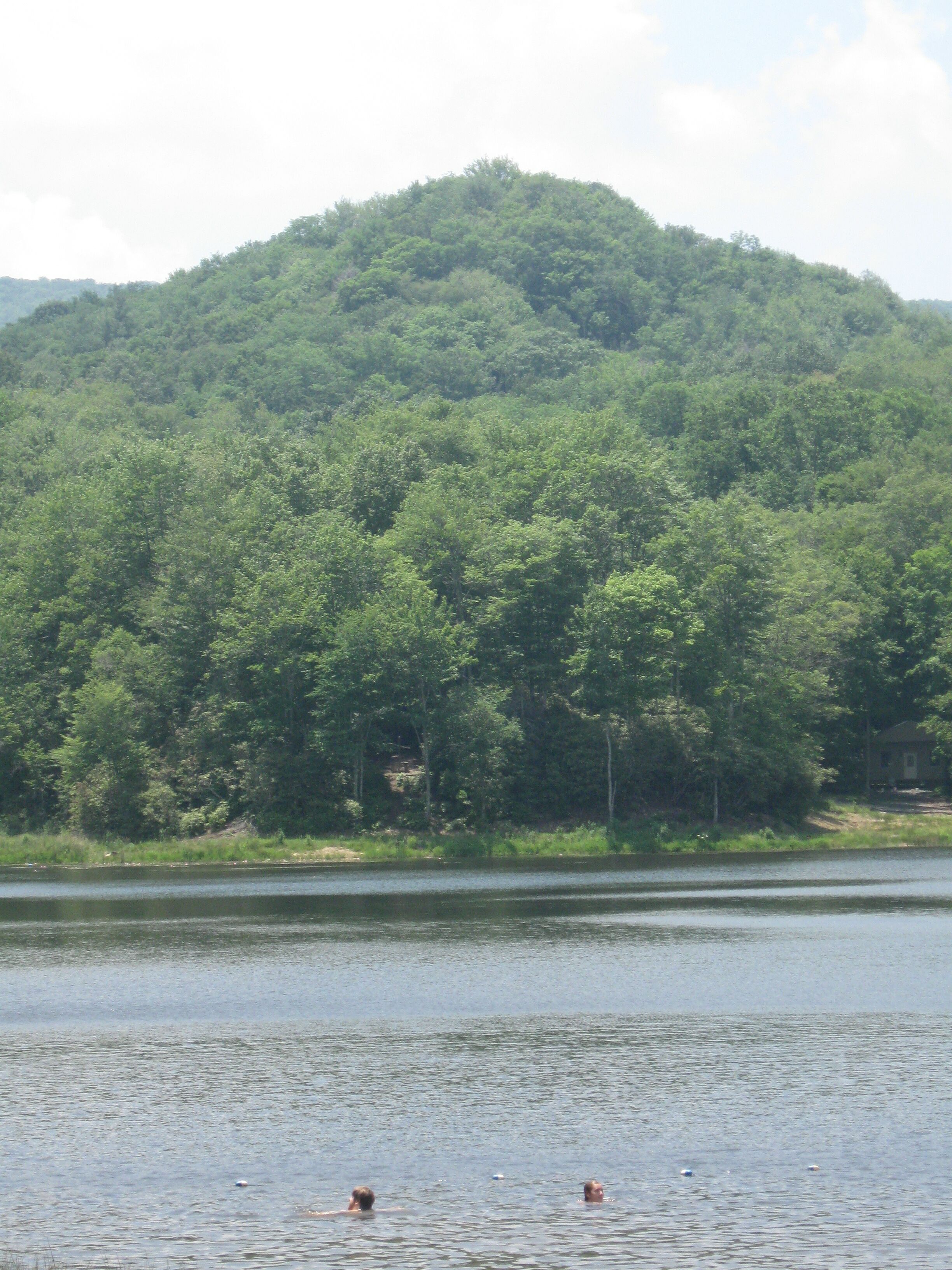
This is not to say I didn’t have at least some time to be indolent. We spent a day lounging by (and swimming in)  lovely, cool Wildcat Lake in Banner Elk:


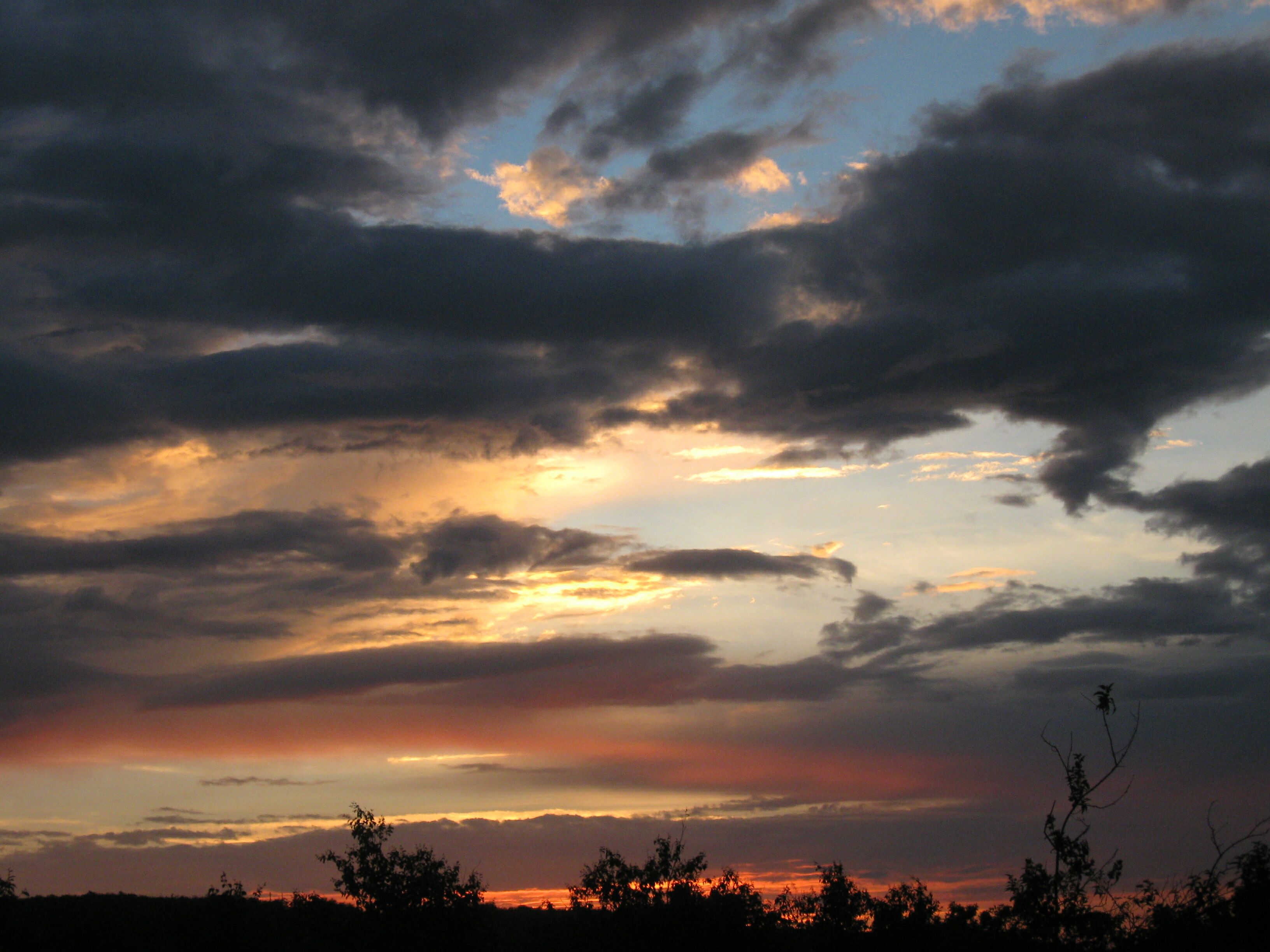
And I watched a few sunsets from the deck:


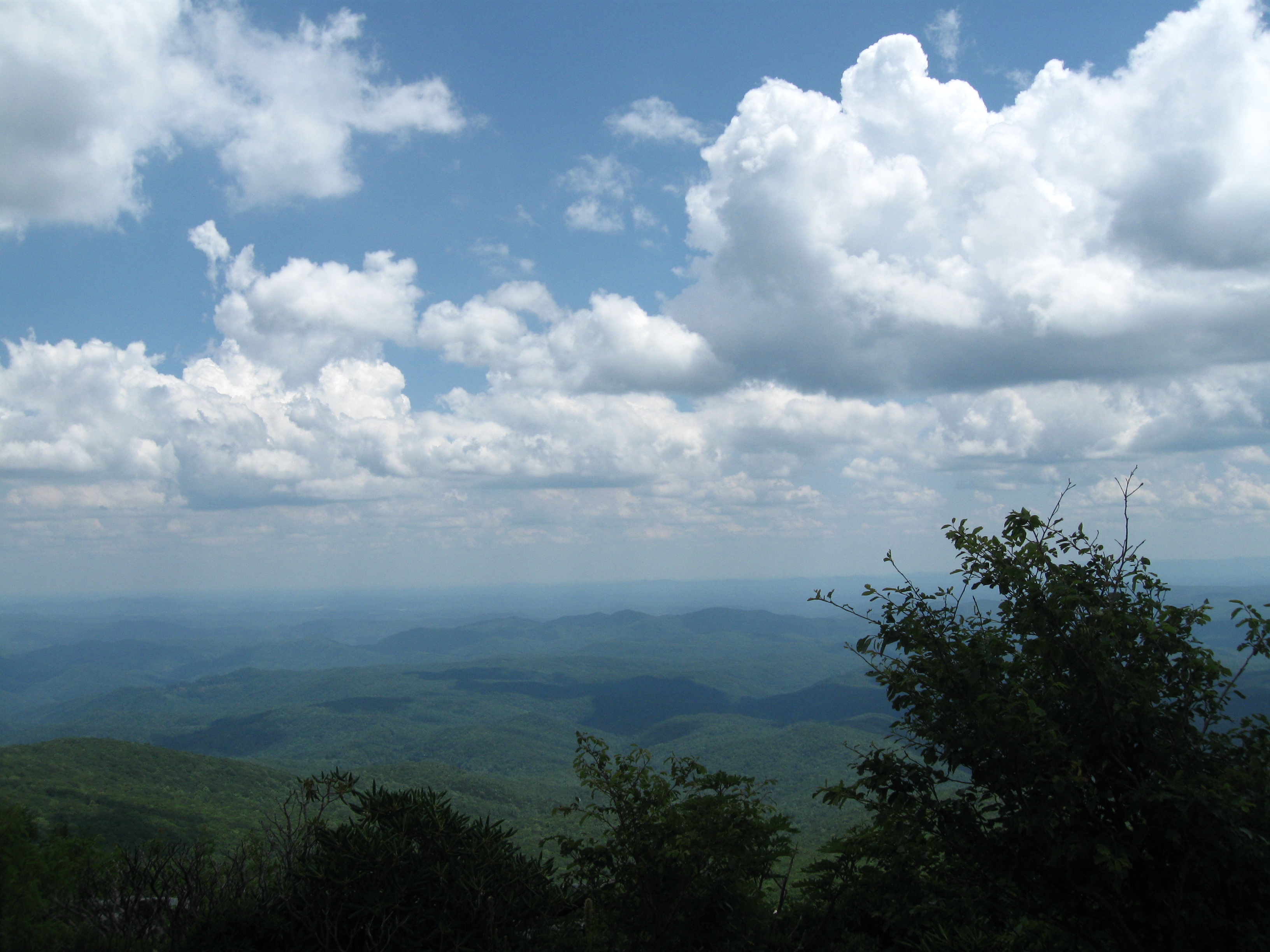
But there was also plenty of walking, to places like the Wilson’s Creek Overlook on the  Parkway, which you reach by a trail that closely resembles a stone staircase  3/4 of a mile long, but which rewards you with this view: 


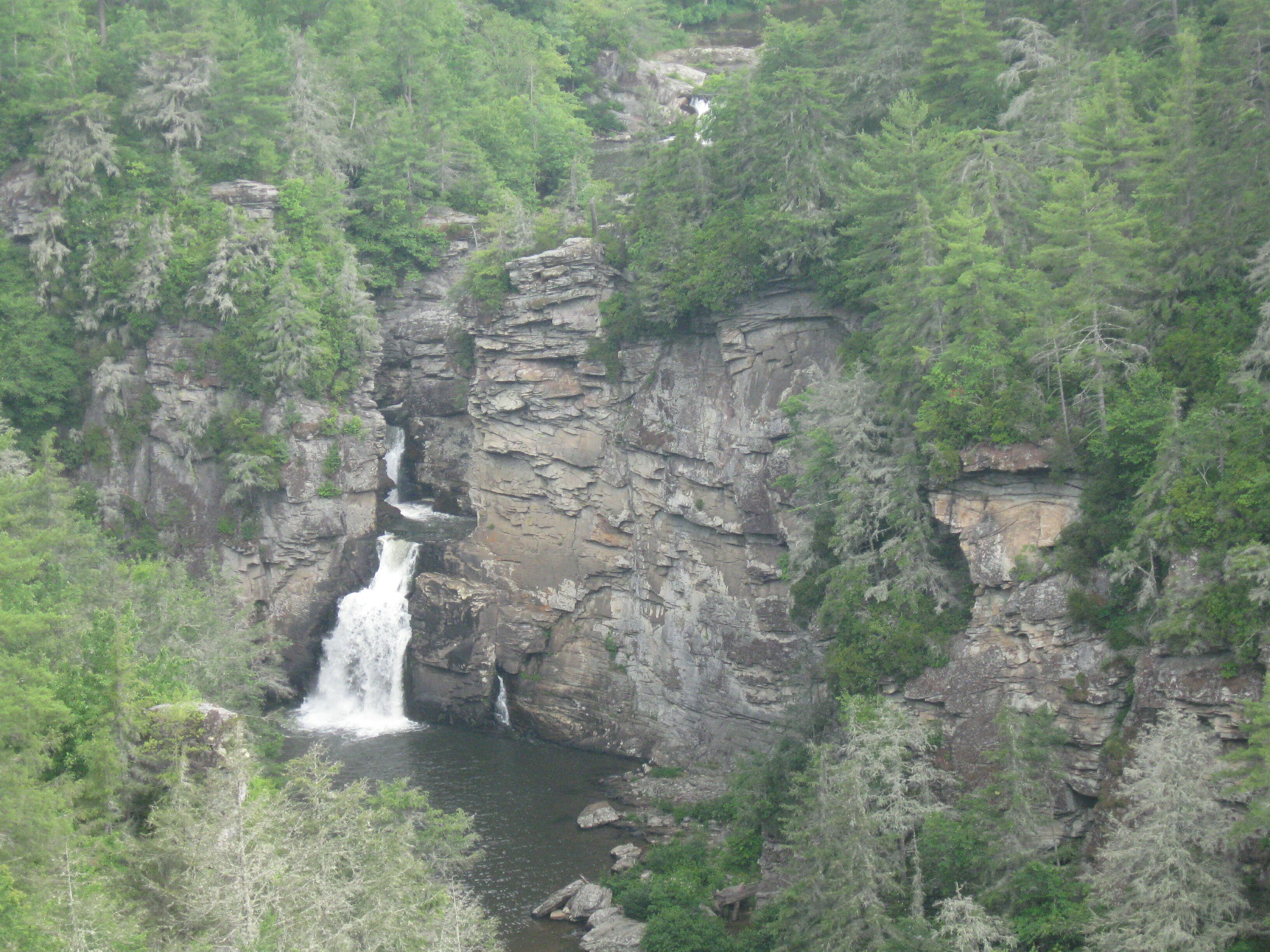
Or the hike to Linville Gorge:

 All in all, though, it was a chance to live a little more slowly. I still did a lot of the things I do every day, like check e-mail, but with every one I made myself answer the question, “do I really need to respond to this today?” With a very few exceptions, the answer came back “nope,” as I closed the lid on the laptop. Very liberating, that. I recommend it.

I got less writing done than I’d planned. But that was okay. I wrote when I wanted, and I got a clearer vision of where I wanted the book to go in its last act. A long walk in the mountains  will do that, when you’re not gasping for breath and hoping those spots in front of your eyes don’t mean you’re about to have some sort of aneurysm.

I also got a lot less reading done than I usually do on vacation. I’m typically pretty cocky about the number of novels I can burn through while lying on the beach. This time, I got exactly two read (Brad Thor’s STATE OF THE UNION and Ian Rankin’s A QUESTION OF BLOOD, if you’re interested). But I thoroughly enjoyed them both.

Which caused me to reflect: what the heck is my hurry when it comes to reading, anyway? Even with books I like, I tend to be constantly checking where I am in relation to the last page, eager to get to the end and go on to the next book in the TBR pile. And why brag, as i’ve been known to do, about how many books I read in a week off? Since when did reading become competitive for me?

When considering the question I came across this article on the “Slow Reading” movement. Seems that I’m not the only one to ask the question, “what’s your hurry?” when reading. “Mostly,” the article says, “the ‘movement’  is just a bunch of authors, schoolteachers, and college professors who think that just maybe we’re all reading too much too fast and that instead we should think more highly of those who take their time with a book or an article.” The idea goes all the way back to philosopher Friedrich Nietzsche, “who in 1887 described himself as a ‘teacher of slow reading.” Slow reading, the theory goes, increases comprehension and enjoyment of the text. It’s hard to do in this high speed, hyperlinked world, but now that I’m back to that world  after a week of living slowly, I think I’ll try a little slow reading. I know life’s short and work often demands speed…. but what’s the use of hurrying through your pleasures?

‘Rati, what say you? Anyone for some slow reading? Or do you do that already?

Dispatches from Hollywood

Today, my new book ICE COLD goes on sale in the U.S.  And this release, like every release before it, is filling me with a mixture of joy, excitement, apprehension, and yes — even a bit of dread.  Because I’m so good at imagining all the things that can go wrong.

So I’m going to distract myself from the book-release butterflies in my stomach by talking instead about my visit over the weekend to Hollywood.


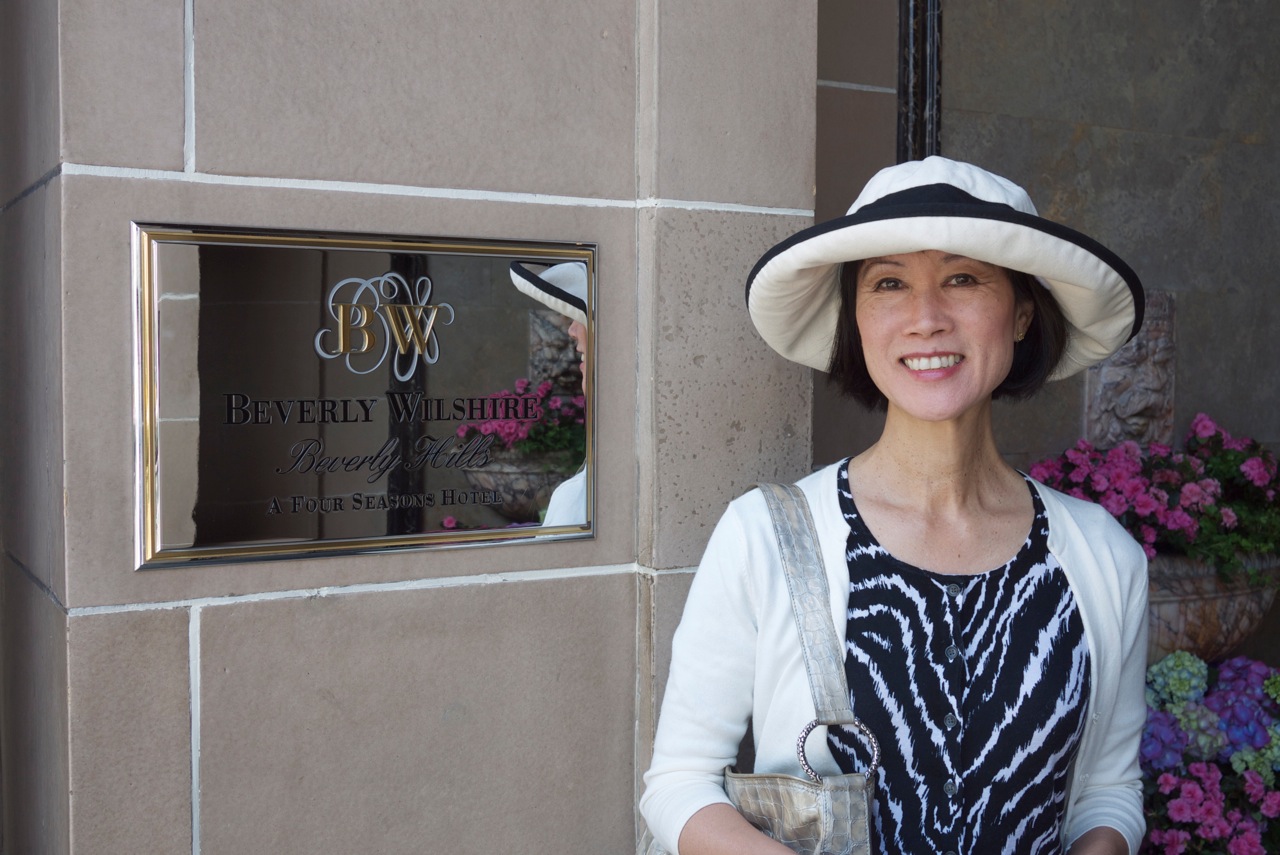
I was there for the “Rizzoli & Isles” press junket — which is a term I really didn’t understand until after this weekend.  TNT flew me out to L.A., put me up at the Beverly Wilshire (woohoo!), and treated me to a most amazing experience.  I was there to talk to radio DJ’s from around the country, who were also flown out to L.A. 

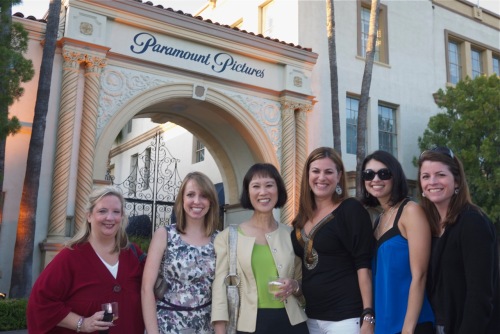
The first day started off with an evening cocktail party at Paramount studios, where I mingled with the DJ’s and kept having to pinch myself that I was actually at the Paramount lot.  Here I am with some of TNT’s marketing and publicity team.


It was the little touches that I kept oohing and ahhing over — they probably thought I was bonkers, but I got so excited about funny things like … well, just the paper cups and napkins!

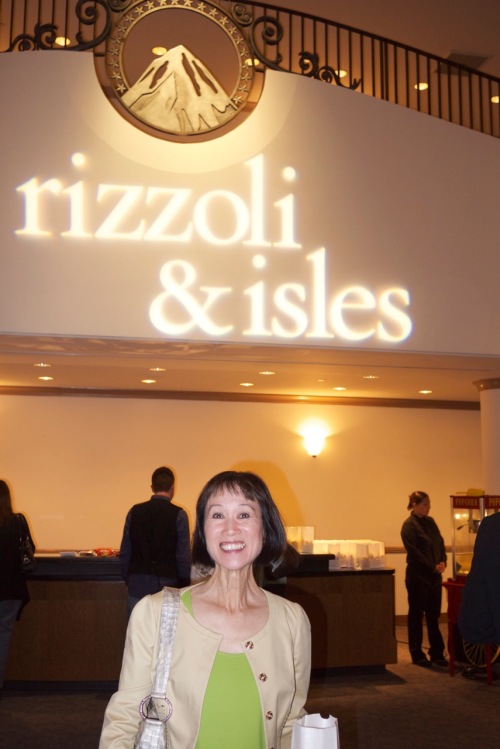
After cocktails, we all moved into the Paramount movie theater to watch a screening of Episode 2 of “Rizzoli & Isles.”  The theater is like a real movie theater, complete with popcorn counter and soda pop.  

Sitting in the dark theater, surrounded by the DJ’s, I was happy to hear them laughing at all the right places.  One of them later told me that he was exhausted by his flight to L.A. and was planning to take a nap when the lights went out … but instead sat up riveted to the episode.

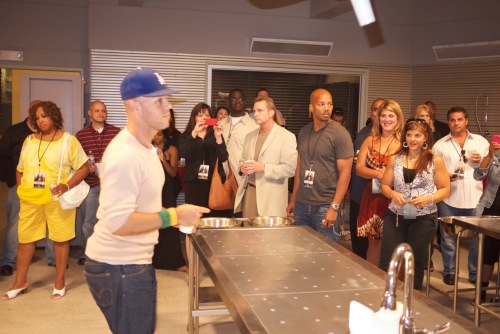
After the screening, one of the writers on the show, David Gould, took us on a tour of the “Rizzoli & Isles” set. Here we are at the morgue, which was furnished with real hospital equipment.  It looked like every morgue I’ve ever been in, with the exception of the red sink!

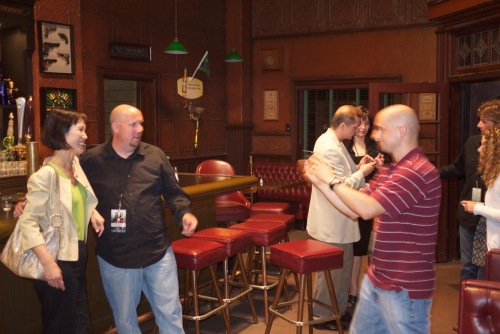
Then it was on to the set for the bar “The Dirty Robber” where Jane and Maura relax after work. 

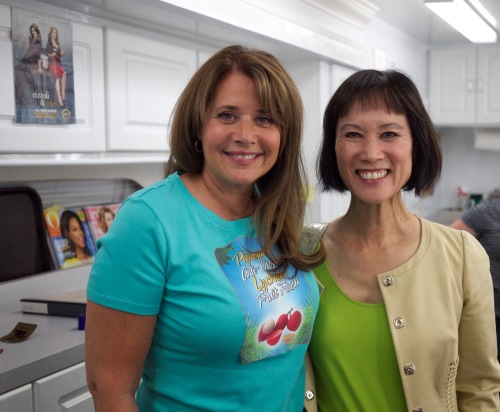
We also visited the makeup trailer, where Lorraine Bracco was getting ready to shoot her next scene.  Mind you, this was at 10 PM at night, so those actors work long, long hours. 


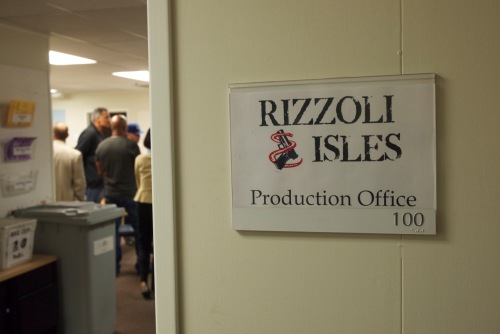
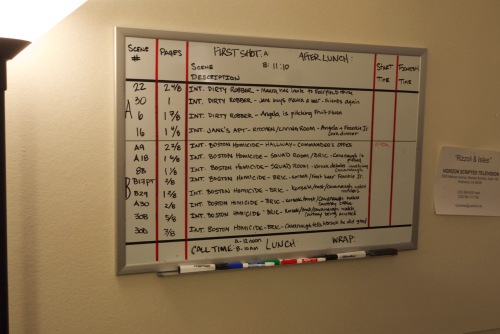
Finally, we got to peek in the production office, where desks and wall boards were covered with all the details involved with making a TV show happen. 


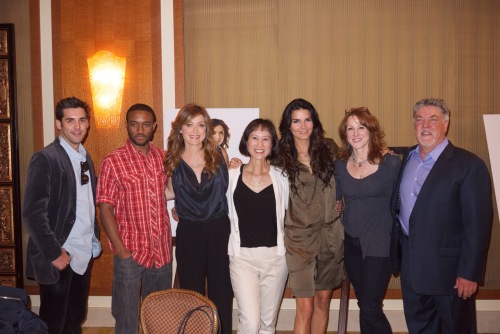
I got back to the hotel around 11 PM, crashed, and the next day got ready for round 2 of the fun: the radio interviews.  Angie Harmon, Sasha Alexander, Jordan Bridges, Bruce McGill, and Lee Thompson Young were on hand for the round-robin chats with the DJ’s.  


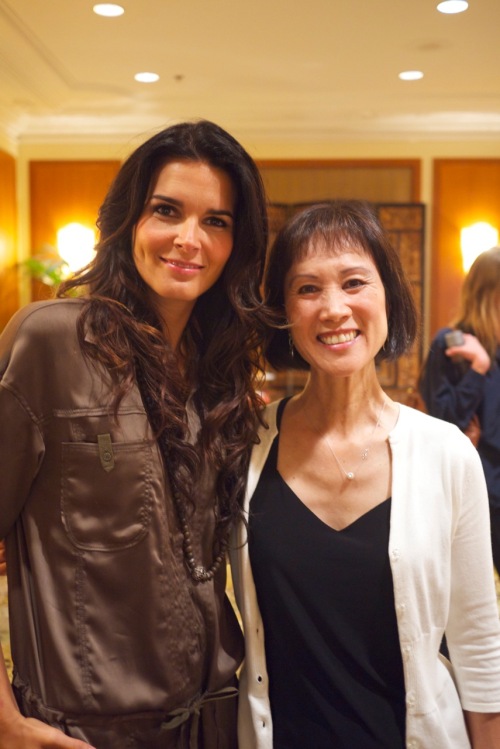
Me and Angie:

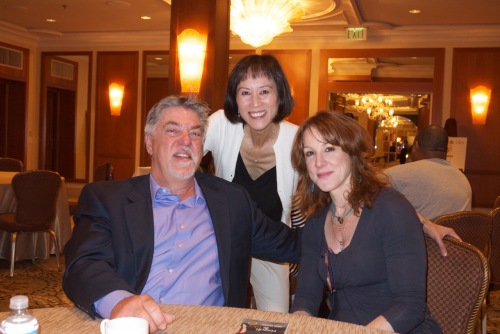
Me with Bruce McGill (Korsak) and Janet Tamaro (executive producer):

The 21 DJ’s were set up in booths in the hotel ballroom, and we went from booth to booth to be interviewed.  I was paired with Janet Tamaro, the writer and executive producer of Rizzoli & Isles, and we answered questions about where the characters came from and what it was like to adapt them to TV.  Janet really is like Jane Rizzoli — smart, quick-thinking, and thriving in a tough industry.  Obviously the perfect person to be writing this show! Each interview lasted only 4 minutes, and then we had to jump up and move on to the next DJ.  At the end of it, Lee Thompson Young told me he couldn’t believe how exhausted he was.

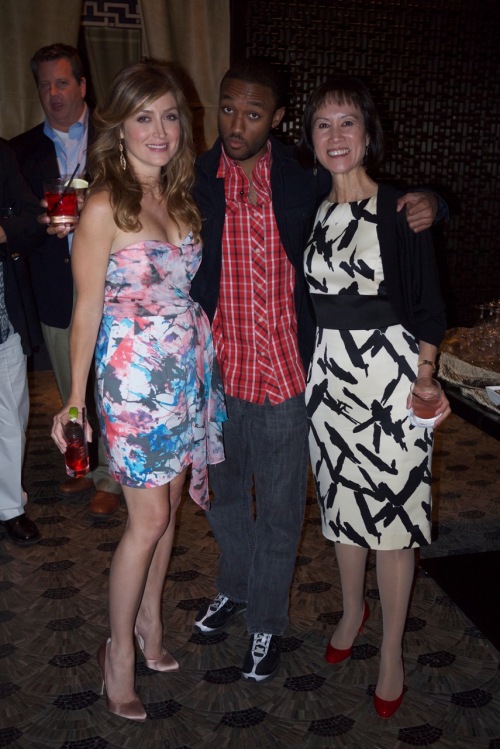
Then it was on to the really fun finale: the cast cocktail party! I got the chance to chat with Sasha and Lee. 

The next day, I was up at 4:30 to catch the flight home.  Still can’t believe it all happened — but if it was just a dream, it was a very good dream.

10 things I learned last week

by Pari

1.  I’m not a big city girl anymore.
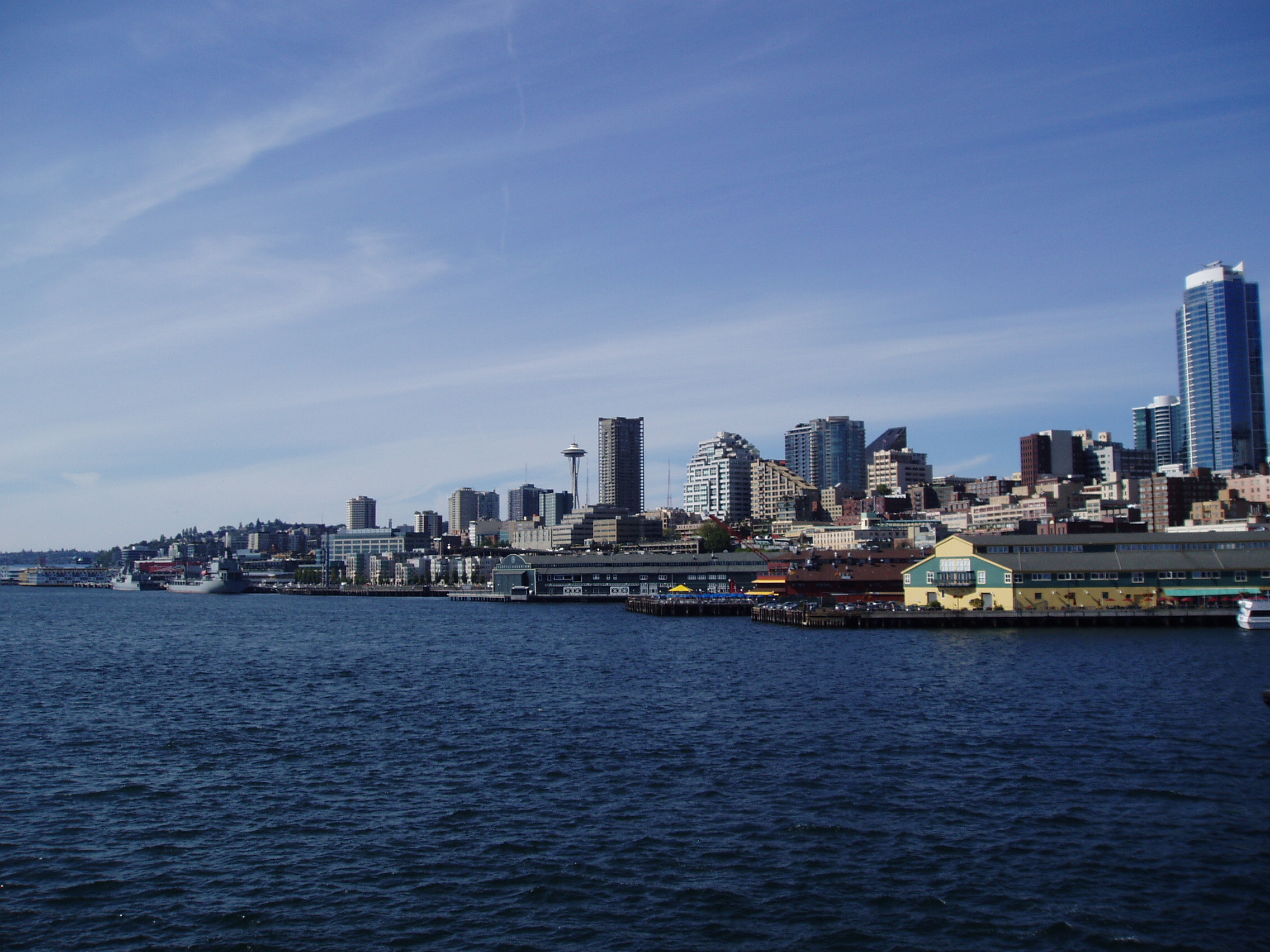
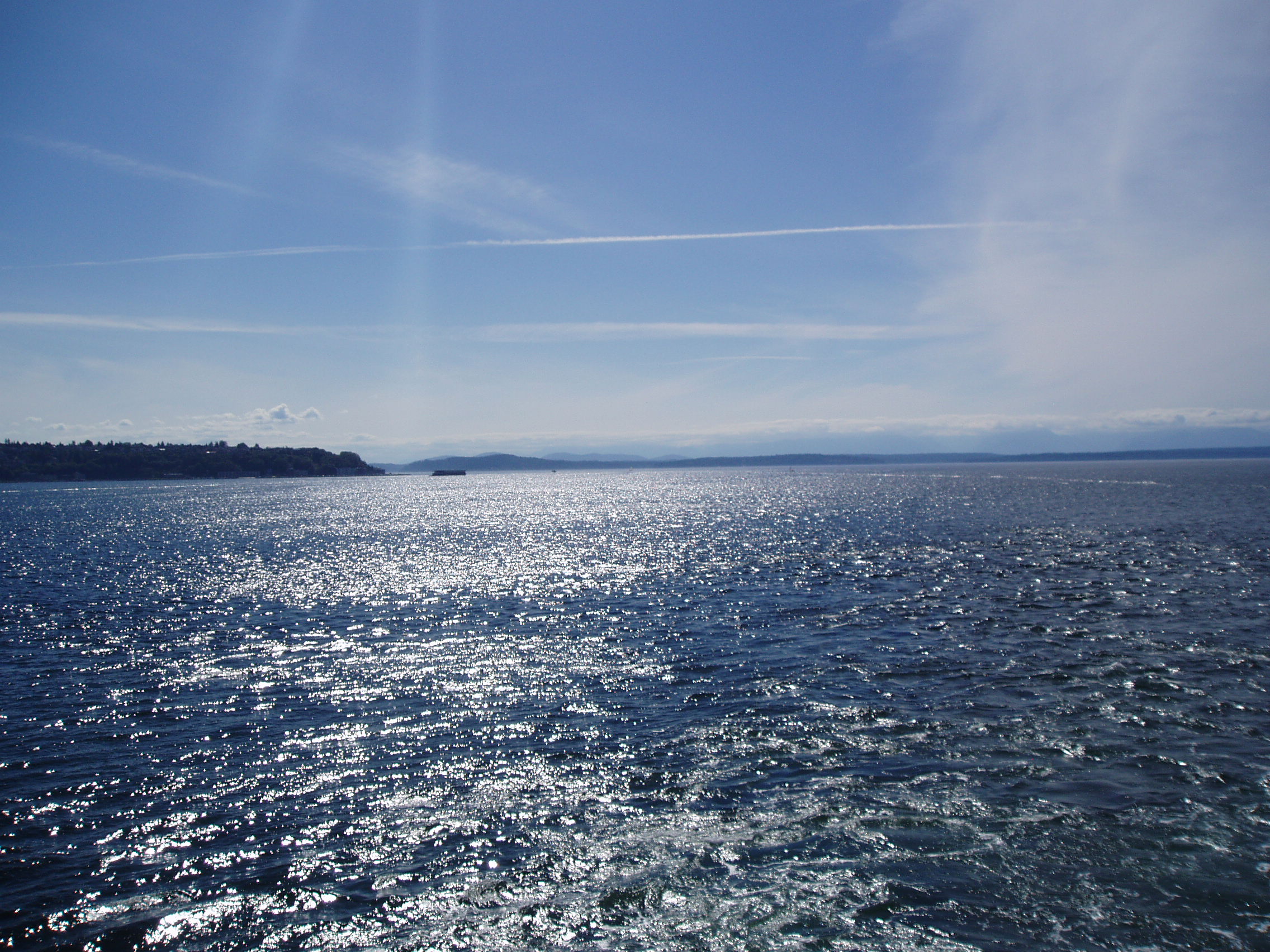
Last week our family stayed with friends on an island near Seattle. We thought we’d go into the city several times to sightsee (or visit my fav bookstore in the area). We did make the ferry crossing – once – and found that all we really wanted to do was get back to the island. I guess at this point in my life, I’m simply more impressed with natural wonders such as Dungeness Spit than any man-made structure.

2.  Don’t go to the Seattle Aquarium.
Frankly, I was stunned; it was very expensive and totally depressing. From the joylessness of every person working or volunteering there to the message that humankind is destroying ABSOLUTELY EVERYTHING to the gulag-like mammal/bird exhibits, the experience was a bummer.

3.  Deer are beautiful except  . . .
I spotted three bald eagles and two raccoons, a tiny squirrel, scores of jelly fish – deep red and some that looked like raw eggs – and sea stars that were purple, pink, orange, tan and yellow (my kids saw otters) all in the wild. To observe deer walking around without a care was a thrill.

However, my friends don’t feel the same way. Their new aspen tree has been denuded. Their garden has to be protected with fencing. So, yeah, I get it. Deer are beautiful except when they’re eating your yard.

4.  I’ll never tire of taking pictures of flowers.

5.  Yakima cherries really ARE that good.
Firm and sweet, deep red-purple and juicy. Yakima cherries are all that with a hint of tartness that surprises in every mouthful.

6.  Three people can polish off 42 oysters and still have room for a full Thai meal.

7.  Seven days without television is bliss.
No news blaring. No stupid, insulting shows. No commercials exhorting us to buy more of what we don’t need.

8.  Seven days without computer contact is heaven.
I read four books in six days, took daily long walks, ate wonderfully, and experienced so much gratitude about being alive that it altered my whole perspective on life. While I don’t think computers OR televisions are bad, I do know that I can quiet myself more easily when I’m not spending time with either.

And quiet heals my soul.

9.  Slowing down isn’t the same thing as stopping.
I wrote little but felt as if my creative center was working hard, rewiring for new projects and approaches. While I simply let myself be, connected with my natural rhythm, my being experienced a molecular peace.

10. Change is easy when you’re away from the familiar; it’s a challenge once you’re home again.
Within minutes of arriving at our house, the kids had turned on the television. Today, my first day back, I’ve spent at least three hours on the computer – sorting through emails, writing this blog, catching up – and I wonder if I’ll be able to remember, to evoke somehow, the calm I felt so strongly less than 24 hours ago.


Wish me luck.

Questions:

1. When was the last time you took a healing vacation – a calm one? Where did you go?

2. Are you a vacationer that prefers action? Visiting and sightseeing? Tell us about a vacation like that that you enjoyed.


Google and Me, and Horace Fabyan, and the Willeys

By Cornelia Read

Many years ago, when I had small children, was still married, and lived in Cambridge, Massachusetts, my intrepid spouse and I decided we should go camping over the Fourth of July weekend. Newly handy with Google (or Altavista, or whatever it was back then), I found us a campground that still had vacancies up in the White Mountains of New Hampshire, which I’d once visited on a high school ski trip.

We went to check out the hotel at Bretton Woods during the course of that trip, and on the way drove through a small crossing called “Fabyan’s,” which intrigued me. My dad’s mother’s maiden name was Fabyan, and it’s one of my middle names.

I was bored last week and started Googling dead relatives, and ended up finding out a bit more about an ancestor named Horace Fabyan, the namesake of that little White Mountains spot. He did indeed come from the same family in Maine that my Boston-born Grandmama Read derived from, but there was a whole other passel of info I stumbled into because I’d Googled old Horace, which I will relate below…


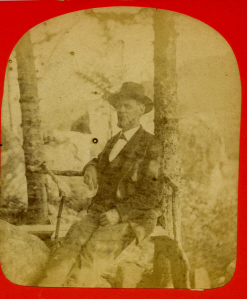
Horace himself

A random disaster in the early 1800s near Crawford Notch in these mountains, it turns out, launched not only the first serious wave of American tourism, but a school of landscape painters, a number of American poets and fiction writers, the concept of “artists-in-residence,” two of America’s first artists’ colonies, and even a bit of scary slang that’s still with us.

A hunter named Timothy Nash discovered Crawford Notch while tracking a moose over Cherry Mountain in 1771. He made a deal with the then-governor of New Hampshire–if Nash could get a horse through the pass, he’d be given a large tract of land in exchange, along the route of a proposed road at the head of the notch. Nash and a friend managed to get an old farmhorse through, at times having to lower it over boulders by rope. In 1775, the first official road was opened–a turnpike used to bring goods from Vermont to the ports of Maine.

Small houses along the way started putting up travelers for the night, turning a decent profit.

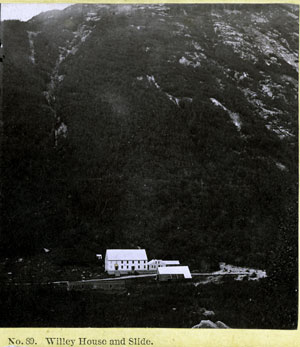
In the fall of 1825, a man named Samuel Willey moved into a house at Crawford Notch with his wife, five children, and two hired men. The three men spent a year enlarging the building into a serviceable inn for passing travelers.

According to http://www.nhstateparks.com/crawford.html:

During the night of August 28, 1826, after a long drought which had dried the mountain soil to an unusual depth, came one of the most violent and destructive rain storms ever known in the White Mountains. The Saco River rose twenty feet overnight. Livestock was carried off, farms set afloat, and great gorges were cut in the mountains. Two days after the storm, anxious friends and relatives penetrated the debris-strewn valley to learn the fate of the Willey family.

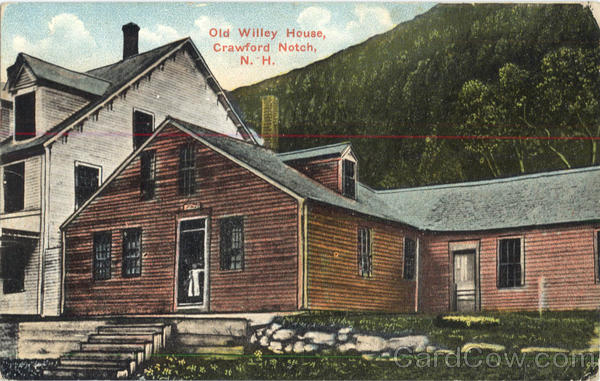
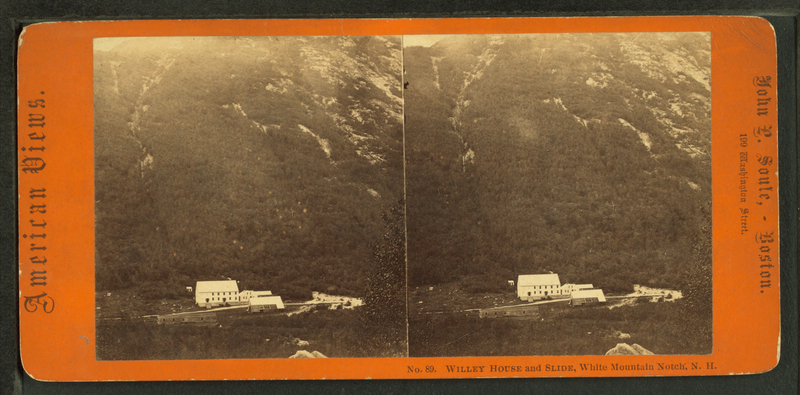
They found the house unharmed, but the surrounding fields were covered with debris. Huge boulders, trees, and masses of soil had been swept from Mt. Willey’s newly bared slopes. The house had escaped damage because it was apparently situated just below a ledge that divided the major slide into two streams. The split caused the slide to pass by the house on both sides leaving it untouched. Inside, beds appeared to have been left hurriedly, a Bible lay on the table, and the dog howled mournfully. 


Sixty years later, an elderly man named Ebenezer R. Tasker, who’d been an eyewitness among the first group of neighbors to arrive at the scene related what they found to the Lewiston, Maine, Journal. His account was reproduced in The New York Times on August 20th, 1894


I was a young boy then, and I suppose the events of that fearful period when the mountains echoed for days with the noise of rumbling slides, are impressed more strongly upon my mind than they otherwise would be….

On the 28th of that month it began to rain, and many of the farms in Bartlett, Carrol County, were damaged with landslides that covered the loam with gravel and rubbish in great tracts. At Judge Hall’s tavern in Bartlett the next day the farmers were sitting around the hearth when in came a man named John Barker, who told us about the fearful slide at the Willey farm.

Barker had visited the Willey farm, and not finding the family, concluded that they were safe at the home of a neighbor, Abel Crawford. But others among us thought differently…. [that night a group including Tasker and his father started for the farm]… All night we were struggling up through the notch toward our destination. At last we arrived and as soon as day broke we commenced our search.

The course of the mountain slide presented an appalling spectacle.  Its track had reached to within three feet of the house and had carried away one corner of the barn. Rocks, trees, and broken timber laid piled up and ended over all the track. The avalanche seemed to have suddenly stopped, for the lower end was more than perpendicular. The upper crust hung over the lower part and formed several large caves. Great crownds had arrived, as the story of the missing family had spread far and wide. No sign could be found of the bodies, until at last, noticing a cluster of flies about the entrance of one of the caves, my father called the attention of Mr. Edward Melcher to it, and the latter crawled in. He came out with a white, drawn face that scared me, boy that I was, nearly out of my wits. He told the crowd he had seen the hand of a man jammed between two logs, and indicated where to dig.

Three men took spades and soon revealed the body of David Allen, a hired man. Directly behind the body and clasping the hand of Allen was the body of Mrs. Willey. The remains of the rest of the family were recovered in like manner with the exception of three of the children, whose bodies were never recovered….

I suppose the family had started to escape from the house upon hearing the avalanche bearing down upon them, and had been overtaken in flight…. the house was saved by a big rock deeply imbedded in the ground, which first stopped a hemlock tree and then turned the course of the avalanche.

The tragedy, described as an “almost-miracle” (the house untouched, its inhabitants crushed) was reported nationally. As historian Randall H. Bennett reports in his book The White Mountains

“Soon after the Willey Disaster, hundreds of tourists began to flock to the scene of this great catastrophe. To accommodate these visitors, Horace Fabyan of Portland, Maine, built a hotel…”

The drama of the location drew dozens of writers and painters.

According to http://www.aannh.org/heritage/primer.php:

During this period artistic appreciation of the mountains reached its apogee. Nature poets such as John Greenleaf Whittier and Lucy Larcom brought forth cascades of verse.


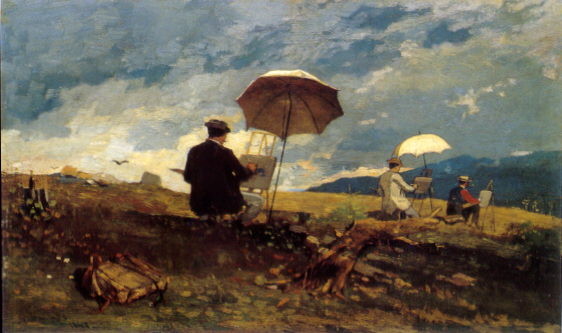
Winslow Homer, “Artists Sketching in the White Mountains”

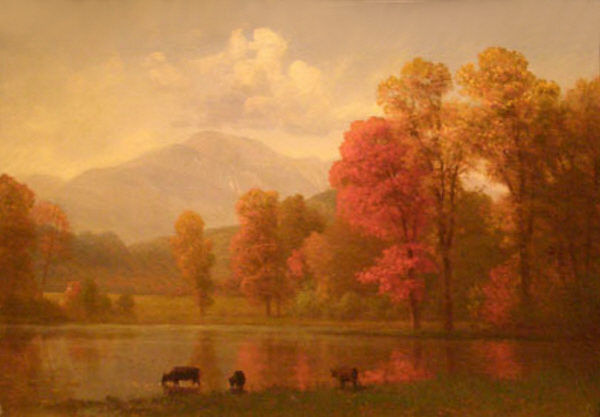
Many of 19th century America’s best-known landscapists worked in the White Mountains: Albert Bierstadt, George Inness, Thomas Cole, Asher Durand, John Frederick Kensett, Benjamin Champney, Homer Dodge Martin, Frederic Church, Winslow Homer, and photographer William Henry Jackson.

Two of America’s first art colonies sprouted in the valleys of West Campton and North Conway. Painters’ works drew tourists to the mountains, and souvenir-hungry tourists eventually drew more painters.

“Mount Washington,” by Alfred Bierstadt

Nathaniel Hawthorne based his short story “The Ambitious Guest” (click to read full text of story) on the Willey family’s tragic end. Published as part of his collection Twice-Told Tales, it made his reputation.
Thomas Cole, the foremost American landscape painter of the first half of the Nineteenth Century, wrote in his diary upon visiting Crawford Notch in 1828:
We now entered the Notch, and felt awestruck as we passed between the bare and rifted mountains. . . . The site of the Willie [sic] House standing with a little patch of green in the midst [of] the dread wilderness of desolation called to mind the horrors of that night. . . when these mountains were deluged and rocks and trees were hurled from their high places down the steep channelled sides of the mountains. . . .
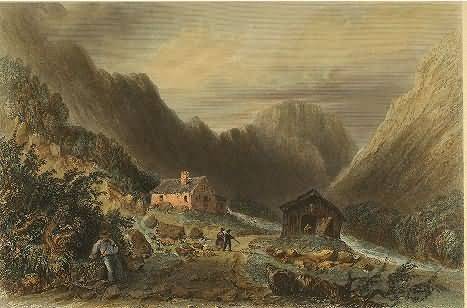
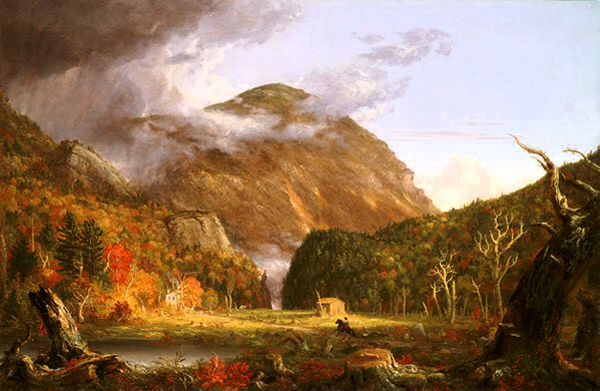
“A View of the White Mountains called the Notch of the Mountains (Crawford Notch),” by Thomas Cole

Cole chose to portray the Willey homestead as a bucolic haven–as it was before the avalanche–only hinting at the ominous events to come by means of the storm clouds hovering above the mountains.

Dave Thurlow of the Mt. Washington Observatory wrote of the Willey slide:

“Weather disasters sometimes transcend death tolls and economic disruption, to the level of religious and spiritual confusion about human frailty.” 
Writer David Schribman, says Thurlow, holds that the Willey’s story became the stuff of legend because “It raised questions about free will and the frailty of one’s judgement, and about the cruelty and harshness of nature itself.”
Jessica Skwire Routhie described the cultural impact of the Willeys’ demise on the American conscience as follows, in her paper “Diamonds, Rifle Rangers, and Rock Slides”


...Although debate over the significance of the Willey slide disaster continues to this day, most historians agree that the tale struck a chord with 1820s Americans because of what it suggested about the relationship between human beings and nature. The Willeys, while regarded with sympathy as “amiable and respectable” victims of an unfortunate tragedy, were considered to have suffered as a result of abandoning their allegiance to and faith in nature’s beneficence. Had the Willeys trusted that nature would observe the safety of their home and preserve it, and endeavored to face the slide in harmony with nature rather than in conflict with and fear of it, they would have escaped unscathed. Their story serves as a warning not only to those who remain ignorant of nature’s power, but also those who might foolishly attempt to subdue it… showing that when nature’s power, human frailty, and abandonment of faith are compounded, the result is disaster.

Such sentiments burgeoned into preservationism in the first half of the nineteenth century. Thomas Cole documented his thoughts on the subject in his “Essay on American Scenery”: “I cannot but express my sorrow that the beauty of such landscapes are quickly passing away — the ravages of the axe are daily increasing — the most noble scenes are made desolate, and oftentimes with a wantonness and barbarism scarcely credible in a civilized nation.”


The frisson of tragedy experienced at this site drew so many tourists, in addition to these artists (and certainly encouraged in their curiosity by the paintings, poetry, and stories further publicizing the plight of the Willeys,) that innkeepers began building more expansive hostelries to accommodate the new crush of travelers.
Enter Horace Fabyan, who not only bought an existing hotel to expand so that it could accomodate 150 guests (The White Mountain House, which Fabyan purchased in 1837.) By 1844, this hotel had become so successful that Fabyan bought the actual Willey House and built a second hotel beside it (both the hotel and the original Willey house burned to the ground in 1899.) The White Mountain House, in turn, was destroyed by fire in 1853. This was not an uncommon occurrence for many of the most famous hotels in the region–all of them large, wood-frame structures with only the most primitive means of fire prevention and fire fighting.
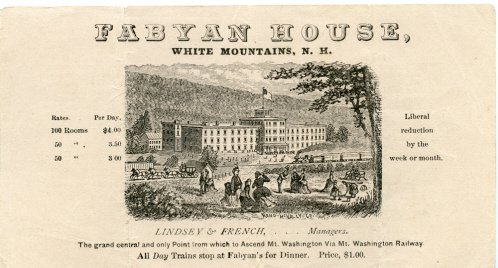
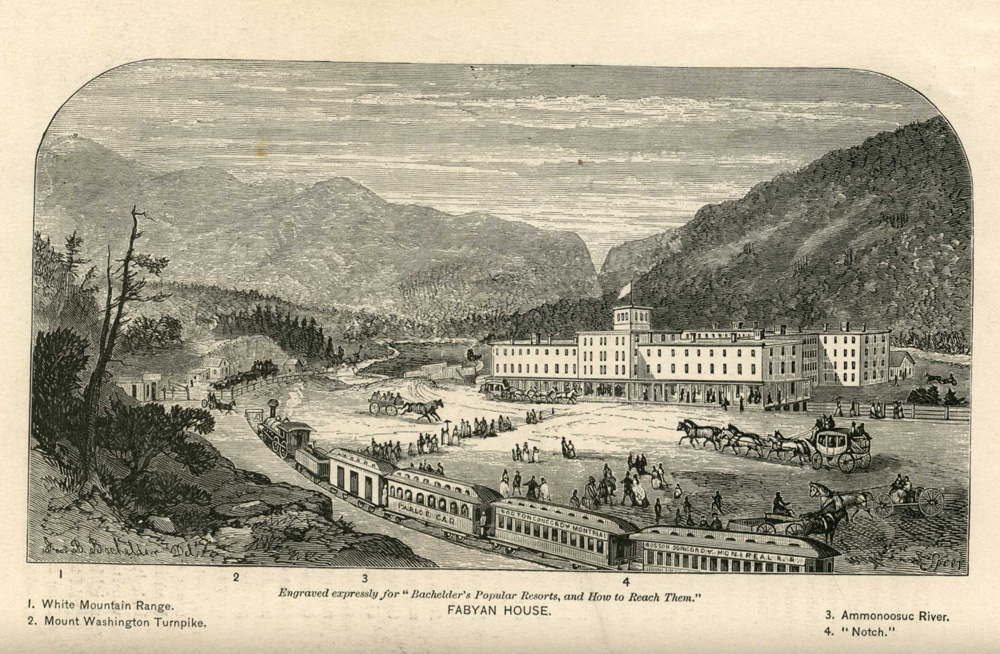
Fabyan gained such renown as a host in the region that when a new hotel was built on the site of his White Mountain House by a conglomerate in 1872, the owners named their new 500-guest accomodations “Fabyan House” in his honor.
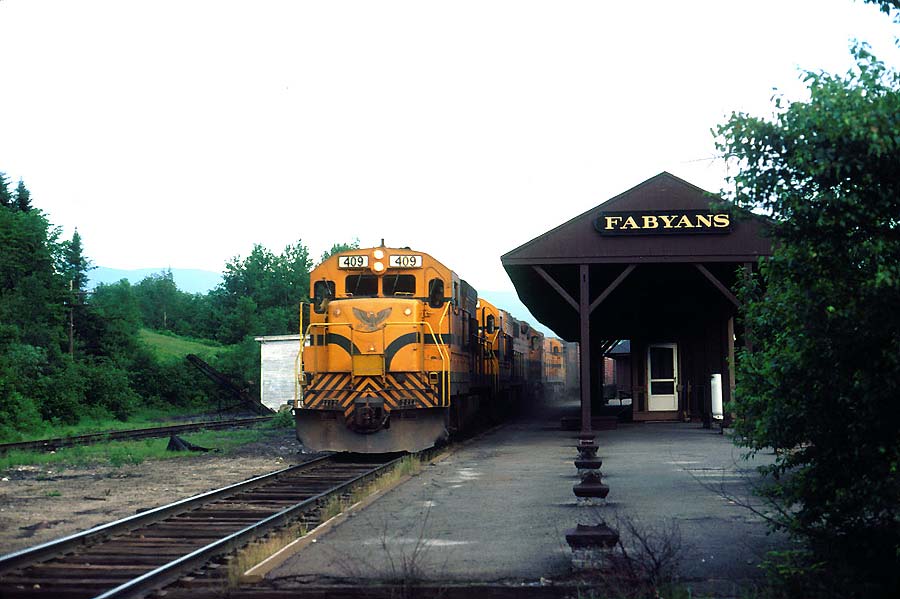
That hotel burned to nothing in 1951, and now the only evidence left of his impact on the region is the name of the railroad stop that serviced these grand hotels in turn.
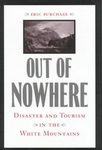
The original station has now apparently been converted to a restaurant and lounge. I might go for a sandwich… and I also want to find a copy of Eric Purchase’s book Out of Nowhere: Disaster and Tourism in the White Mountains, which sounds utterly amazing. Purchase does the most thorough job of delving into the cultural and artistic impact of the Willey disaster to date, illustrate the manner in which “the disaster becomes the apt juncture of the interacting forces of capitalism and art as they together create an American appreciation for nature.”
Purchase also says that the impact of the slide is the first American expression of the newly industrialized Europeans’ aesthetic response to natural “scenes,” particularly in the Alps, which gave rise to the concept of “the sublime.”
The book’s jacket copy sums up everything I’ve been trying to thread together here far better than I’ve probably done in my longwinded Asperger’s way…
In Out of Nowhere, Eric Purchase examines the surprising connection of this disaster to the rise of tourism in America, investigating developments that ranged from land speculation to new interpretations of the meaning of nature and landscape. The Willey tragedy, widely recorded in literature, art, travel writing, newspapers, and scientific journals, was the first natural disaster in the United States to capture national attention. Nineteenth-century Americans were intrigued with nature’s sheer perversity in destroying an entire family while leaving its house untouched. They marveled at such dramatic evidence of the natural world’s vastness and power. Suddenly the White Mountains became, in the public’s imagination, a mythical place where nature was preserved in its original, potent state.

Hundreds and then thousands of tourists, including artists, scientists, and writers such as Thomas Cole, Henry David Thoreau, Nathaniel Hawthorne, Henry James, and Charles Lyell, began traveling there every summer to take vacations amid the romantic landscape. The Willey’s undamaged house became one of the area’s most popular attractions-fittingly, Purchase notes, since Samuel Willey was among the first entrepreneurs of White Mountain tourism. It was businessmen, after all, not artists or intellectuals, who were the first to exploit picturesque notions of untamed nature in remote landscapes to lure wealthy tourists to their inns. Ultimately, the fame of the Willeys’ gruesome deaths only enhanced the tourist trade they had helped launch.

…Traces the rise of tourism in the White Mountains from the 1826 landslide which killed nine and garnered national attention. Arguing that this event marks the beginning of a new American awareness of landscapes, the author explores the European notion of the sublime (an appreciation of one’s insignificance in the face of the forces of nature) as it became harnessed by businessman wishing to bring wealthy travellers to their inns.
Anyway, that’s what an afternoon of Googling last week led me to discover about a distant cousin many times removed–old Horace Fabyan. Kind of cool, I think.
I wonder if that early American fascination with the physical evidence of tragedy has anything to do with our interest in crime fiction? That same frisson, that same wonder at how bad things happen to decent people, that same sense of needing to seek an explanation for the unexplainable?
What think you, O wise ‘Ratis?
And p.s.!! That phrase the Willey tragedy gave rise to? Remember this poor lost family the next time you say something “gives you the willies…”

A Father’s Pride Not Just in His Son

By Brett Battles

When I went to grade school back in the seventies, things were different. I’m not talking about funding or how I was taught the basics or even the relationship between students and teachers…sure, to a greater or lesser degree, aspects of all of those are different these days. But what I’m talking about today is something else, something that’s a lot more personal for me since the birth of my son fourteen years ago.

When I went to school, it was the very rare day when we would see any kids with disabilities. These kids were kept separate from the “general” population. In fact, they may have been kept on a completely separate campus…I’m not even sure. So when we did see a kid with autism or cerebral palsy or Down syndrome we’d, quite naturally for kids our age, stare. Even away from school you’d seldom see a special needs child. I did have a neighbor for one year whose brother was mentally handicapped but he was hardly ever out of the house, and when he was when didn’t know how to interact with him. He was just odd, and, in fact, many of us would just go home. That’s the way kids are.

I find that sad now, thinking back. It was a missed opportunity, not just for my neighbor’s brother and the other special needs kids, but for us. The problem was we had very little exposure to the disabled, so they were foreign to us, even scary because we just couldn’t understand them. I remember times people would joke about them and make fun of these kids behaviors. It was, perhaps unintentionally, mean. But more than anything it was simply ignorant.

All this comes to mind because my son, Ronan, just graduated from junior high. You see, he has Down syndrome. For those familiar with Downs you might have noticed there are many levels to the condition from high functioning to extremely low. Ronan falls somewhere in the high side of the middle, if that makes sense.

Unlike when I was in school, he spends part of his school days in classes with the non-special needs kids. It isn’t to really learn what they were learning, that’s not something he can do, it’s more for the socialization, not just for him but for the other students. In fact, I would actually argue that it is almost more important in the long run for “regular” kids than for my son. Don’t get me wrong, it’s great for him, too.

When Ronan went to junior high, where kids now had to go to a different classroom every hour for a new subject, he did have his special needs classroom, but for most of the day he was in the regular classes. But he didn’t go alone. They have this great program at his school where kids can become buddies for a special needs kid. They help their buddies to get to class and spend time with them and become their friends.

At graduation, I met the parents of Ronan’s buddy. The boy’s father was so surprised by how his son had taken to the program. He told me his son has patience for no one, but with Ronan he has become incredibly patient. He also said that his son was always talking about Ronan, so they made a special effort to meet him that morning. But their son isn’t Ronan’s only non-special needs friend.

At some point in the past two years, Ronan had become friends with two other boys, boys who weren’t necessarily the best students in the school nor always the most discipline, but they had taken to my son, and for both years of junior high, they would hang out with him. They even asked for special permission from the school for Ronan (alphabetically at the other end from them) to walk with them in the graduation ceremony. I watched as these two boys made sure he knew where he was going, guiding him to his seat, then leading him up to the stage when it was their turn. I admit I got a tear in my eye watching this.

Then after the ceremony was over (when I met my son’s buddy’s parents), I was surprised by how many of the other students made it a point of saying hi to Ronan. And you know what? Not one child there stared at him. He was just someone they were used to seeing.

And thought he was exactly they same as he has always been, he was also…normal.

Education has been under a lot of attacks over the years. They’ve been forced to do more with less. Sometimes they succeed. Sometimes they don’t, through no fault of their own. But in this area of demystifying the disabled, they’re doing a great job.

Things aren’t perfect. But they are certainly headed in the right direction.

The disabled are people, too. They just need a little more time and patience and understanding. They can’t help how they are. They, like all of us, are just living the best they can. The good thing is more and more people are realizing this. Someday, maybe everyone will. Given what I’ve seen of my son’s friends, I believe it will.


The Table

By Louise Ure


Have I neglected to tell you about The Table? Forgive me.

Bruce’s Aunt Hazel died last year at the age of 94. She had been a dietician on the civilian hospital ship HOPE back in the ‘60’s, traveling to Indonesia, South Vietnam and Sri Lanka to bring modern medical treatment, support and training to their suffering populations. She was a gentle, optimistic woman from North Dakota who never married but always stayed close to her five sisters and their offspring.


Bruce remembered her letters home – as early as 1961 – warning of an impending war in Vietnam and the possibility that America’s youth would be drawn into the conflict. “Go to Canada,” she said, prescient in her advice.

She was a woman who always took care of herself, saving money from each paycheck, and at the end, disposing of her possessions and arranging for her own long term care.

One of the items she set aside for Bruce was The Table.

It was seven feet long and two and a half feet wide, made from a three-inch slab of solid white granite with veins of black running like river deltas through it. The legs were wrought iron, thick and straight with flat-black spheres at the knee and ankle*.

It was a beast of a table. As heavy as original sin. As dramatic a statement as the stone tablets Moses carried back down the mountain.

Most importantly, it was an autopsy table.

Hazel had purchased it, decades ago, from an auction at Swedish Hospital in Seattle when they were doing major renovations, and hauled it back to her little cottage overlooking Lake Washington. She was so proud of it and frankly couldn’t understand why her dinner guests turned green when told the history of the new dining table. Neither could I.

Oh, how I coveted that table. I wanted it immediately and would have carried it back from Seattle on my back if I could. We could drive up and get it, of course, but the cargo areas in our cars weren’t long enough for that massive granite rectangle. Shipping it seemed like a likely option but we never got around to it.

So it wound up in storage at a friend’s house and stayed there for years, only to be freed unexpectedly four months ago when Bruce’s brother moved into that same friend’s apartment and set it up in his kitchen. He’s not using it for dining, but for a flat storage area. I think he enjoys its infamy as much as I do.

But he knows it’s on loan. It’s coming down to San Francisco. A friend in the antiques business will trailer it down with the next Bay Area load. I’ll need to hire a small army of weight lifters to get it up my stairs.

I’ve promised my brother-in-law another table in replacement. I’m thinking about a veterinary exam table.


Whatcha’ think, ‘Rati? Is this the perfect dining room table for a published crime fiction author? Wanna come over for dinner?


* I wish I could have included a photo of this magical table, but it’s still buried ‘neath the trash in my brother-in-law’s kitchen. I’ll take a photo of it in its new digs once I hire that cadre of he-men to bring it upstairs.


Greatest Characters of the Last Twenty Years

Entertainment Weekly, or the Bible as it’s called in my house, recently listed the Top 100 Greatest Characters of the Last Twenty Years

As its title indicates, Entertainment Weekly concerns itself with entertainment generally: movies, television, music, the interwebs, theater, and, yep, books.  Perhaps not surprisingly, the bulk of their hundred greatest characters were known from movies and TV.  Omar Little, Cosmo Kramer, Buffy Summers, Lorelai and Rory Gilmore, Homer Simpson.  Hard to argue with most of the choices.

Omar LittleThe list did acknowledge a few literary characters, but most of those were discussed in terms of their dual identities, existing both on the page and in film, such as Dexter Morgan, Bridget Jones, and Harry Potter. 

But as I perused the article, I was struck by how many of the TV and movie characters actually originated in novels and short stories.  My first instinct was critical.  Why, I asked, did the magazine make only brief mention of the original works while reserving celebration for the filmed or televised version of the character?  Why didn’t EW discuss both the literary and films versions, as the article did, for example, with Bridget Jones?

I realized, however, that as much as we readers like to say that adaptations “destroy” our favorite books, sometimes actors, directors, and screenwriters create something entirely new from literary inspiration, or at least sufficiently unique to take on new life.  When I think of Red from the Shawshank Redemption and Annie Wilkes from Misery (who both made the list), I think of Morgan Freeman and Kathy Bates, not the works of Stephen King in which they first appeared.


I confess that I had forgotten that some of my favorite characters had literary predecessors.  I can’t imagine Tracy Flick, for example, apart from Reese Witherspoon’s interpretation of her.

Forrest Gump, in my mind, looks and sounds forever like Tom Hanks.

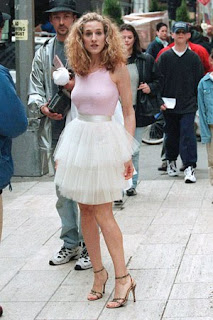
And, with all due respect to Candace Bushnell, when most of us hear Carrie Bradshaw, we think (for better or worse) of TV Carrie, not book Carrie.

BetterWay worse


Some adaptations stray so far from their source material as to be unrecognizable.  I’m told, for example, that the novel upon which Up in the Air was based did not have either of the two female characters who taught George Clooney so much about life.  Many people did not realize that the film O Brother, Where Art Though? was based on Homer’s Odyssey until the Academy nominated the screenplay for best adaptation.  In our own genre, I can’t be the only Michael Connelly reader who was, shall we say, surprised at filmmaker Clint Eastwood’s take on the character Buddy.

Two questions for discussion, one with subparts:

1) Who are your favorite literary characters of the last twenty years?

2) And which translations of literary characters to TV or film have been most horrific, accurate, or even improvements on the originals?

Technology and Books

By Allison Brennan


I broke down and bought an iPad.

I had planned to wait until HP came out with their version of a multi-purpose device because I’d seen a demo a few months ago and thought it looked cool. I thought I’d be a smart shopper and weigh the pros and cons of each. (Dedicated e-readers were already off the table because I wasn’t looking for a device only to read e-books and newspapers.)

Except, I have everything Mac and I really wanted the iPad.

There were two primary reasons I bought the iPad. First, I don’t have to get the iPhone because the iPad does everything else act as a telephone. I’m happy with Verizon, I really didn’t want to switch to AT&T, and why spend the money on a new phone when I really only talk to and text my kids, husband, and mom? I wanted the iPad to have a fast and easy way to check email, research, and write.

Which leads to the second primary reason:  I no longer need to lug my laptop with me on trips. I have two trips this summer (Thrillerfest and RWA) and I always write while flying. Pages, Mac’s word processing software, has an app as well. It’s basic and easy to use and readily converts to word. (I don’t write with Pages on my iMac, because I know and love Word, but for my first draft I can write on anything.)

The best thing is that the iPad recognizes Bluetooth and syncs up with a wireless keyboard (or a keyboard dock, but I already have a wireless keyboard.) I don’t much like the idea of writing a book on a touch-keyboard—I type over 100 word a minute, and I can just imagine the errors! (I wear out keyboards in about a year—I’ve had my wireless keyboard for six months and already the letters are fading. I doubt the iPad was tested by someone who writes a million-plus words a year between books, revisions, blogs, emails . . . you get the picture.)

The other night, I tested the iPad by writing the prologue for my March book. While it’ll take me a bit to get used to (after writing how many books in Word?) it’s easy and functional. And if I can get out of the habit of editing as I go (which really slows me down) I can get my first down-and-dirty draft written faster so I can spend more time revising and editing. (I suppose this is what Alex would call my outline, right?)
I downloaded a couple games . . . crossword puzzles and Flight Control. Flight Control is hugely addicting . . . I don’t recommend that anyone buy it because you won’t be able to stop playing. The other night, when I was tired and ready for bed at two a.m., I sat down and played Flight Control for an hour . . . I haven’t had this much fun since I discovered Angry Birds for my iTouch.

And of course I downloaded iBooks. I bought DUEL by Richard Matheson, a collection of short stories, because I figured I have never read a book on an e-reader and should start with short reads. I started the first story, but . . .

It’s going to take me a long, long time to read books in anything but print. I couldn’t really get lost in the story. The outside world gets in . . . when I pick up a print book, I am lost in the book. I don’t see or hear what goes on around me, I’m totally immersed in the story, as if I were truly a fly on the wall of the book.

I’ve played with most dedicated e-readers, and the iPad is definitely easy on the eyes and simulates a book with font, page turning, and appearance. The font and the font size are adjustable, and browsing the bookstore is a pleasure (I did download a bunch of sample chapters—I can see me using this to read openings to decide which books to buy  . . . in print.)

I won’t say I’ll NEVER read a book in e-format, because one of the nicest things about it is instant story—a minute or two to download a book I’m dying to read? I don’t have to wait 48 hours for shipment, or drive to the bookstore . . . but honestly, I’m not that lazy and instant gratification isn’t as pleasurable as anticipating and savoring something desirable.

Of course, it would be more of a pleasure if my books (Random House) were available through iBooks. But it’s only a matter of time. (As an aside, I’ve been reading articles where Markus Dohle, Chairman of Random House, talks about making major decisions about many things, including digital publishing. I think a cautious approach is smart—too many people, I believe, are in a semi-panic mode when I don’t think there’s any reason to fully panic about digital publishing. It’s like people think if they don’t act now, they’ll be behind . . . they want to be on the forefront of something . . . but aren’t really able to define what the “something” is. Panic can cause rash and unreasoned decisions, so while I am disappointed that my books are not available through the iBooks store, they can be bought through different apps and companies, and I do appreciate the serious contemplation as to whether the agency model is, in fact, the best model for publishing today, as well as a reasoned approach to digital publishing that will benefit the industry—both publishers and authors.)

But the coolest thing about this week isn’t my iPad, but my app—Ballantine created an iPhone app for me! I’m absolutely thrilled with it, and am looking for ways to value-add to the content. Possibly original short stories (like the ghost story available on my web page) or reader letters . . . but right now there’s already a lot on the app. My books and excerpts are there, tweets (now I really have to get into twitter . . . I much prefer Facebook) and signing up for my newsletter. It’s all great . . . I just with I had more time to work on it. If you’d like the free app, you can download it on iTunes, or here.

Any ideas are welcome . . . would you download a free app for your favorite authors? Why or why not? The app is designed to give more information and excerpts, will let readers know when a new book is available or when there’s new content. What would you want to see on an author’s app? How often would you want it updated? Only when there’s a new release or between releases?

Ultimately, no matter how fancy technology gets, no matter what happens with e-books or print books or iPhone apps or added content . . . readers read for the story. They want to be entertained. Whether to laugh or cry, be scared or contemplative or educated or simply escape for a few hours, readers read books for the story. And the story—the writing—is what us authors should spend most of our time developing.

Because without the story, none of the bells and whistles matter.

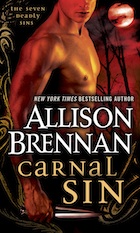
BSP: CARNAL SIN, book two of my Seven Deadly Sins series, will be released on Tuesday! So . . . download my app and read a chapter, or read here.

I also have a book trailer for the series, only 42 seconds … it’s not up on YouTube yet, but here’s a link on my website. Enjoy!

(I’m out at a Father’s Day BBQ with family in the mountains. I don’t know yet whether I’ll have Internet reception, but I’ll be back tonight if I don’t!)


The Central Action of a story

by Alexandra Sokoloff

I haven’t written a craft post in a long time, it feels like.   Actually, I wonder if craft posts annoy a lot of the Murderati readers.   Sometimes you all seem much more interested in the angst posts.  I like that about this place; it’s better than therapy.   Notheless, I’m all out of angst for the moment and am reverting to craft.

As I’ve posted here before, I’m not one of those readers who feels any obligation to finish a book I’ve started.   In fact, I very often sit down to read with ten or twelve books in front of me, and read the first few chapters of each before I settle on the one to read.    Much like an agent or editor, I’m sure.    If I like the opening, or the plot description, I’ll give it a few chapters.   If not – discard.   On to the next.  

This is a great way to get through that pesky TBR pile, as you can imagine.

Now, this is a useful exercise for authors and aspiring authors, on a whole lot of levels.

First, it really does put you in the shoes, or chair, and mindset, of an editor or agent.  Do you really think an editor or agent, with their hundreds of TBRs a week, is giving anything their full attention (unless it’s an auction, and their job depends on making the right decision about a particular book)?  

Of course they’re not.   They’ll start giving a book their full attention for the very same reasons YOU would – because it’s their genre, it’s a subject or arena that they’re interested in personally, and it’s well-written enough to suck them into the story.   The first two reasons are completely subjective, nothing you can do about that.   The third is completely within your control.

But – it’s important for aspiring authors who are in the midst of the submission process to remember that a lot of book choice is purely, completely subjective.   And if you keep in mind that a lot, in fact most, editors and agents will discard your book simply because it doesn’t appeal to them personally, you can both detach yourself from the trauma of being rejected (which you will be, repeatedly) and understand why you almost always have to make SO many submissions to score an agent and a publishing deal.

This read-and-discard exercise is also good for published authors.   It reminds me that all over the world people are doing the same thing with MY books – I get a few seconds to win them, minutes if I’m lucky, and am just as likely to be discarded as not.   More likely, actually.   For me, it’s a big reminder that my most likely readers are going to be my REPEAT readers – the ones who will give me more than a few cursory seconds, who are actually looking for my books because they already know they like the genre I write in, the characters and story worlds I create, and the themes I explore.   That’s a good thing to remember in a marketing sense, too, I think: Serve your core audience first.

And of course a main reason to do this is to remind yourself what hooks you about a book.   Which is going to be different for different people.   But what hooks YOU is likely to be what hooks the agent and editor you end up with, and subsequently your readers. 

It can be style, it can be suspense, it can be sex, it can be action, it can be narrative voice, it can be a character’s voice… for some people it’s a first line (that would not be me, I couldn’t care less about the first line of a book, and in fact have been known to discard books on the basis of a too-cute or trying-too-hard first line.    I do care about the opening IMAGE.).

But if I’m liking the way a book goes enough to keep going through a chapter or two, I’ll tell you the next thing that is absolutely crucial to keep me reading.

I need to know pretty quickly where the plot is going.  I want to know the author knows, and I want the author one way or another to tell me, so that I know there’s a direction to all this, and I can relax and let the author take me there.    If I don’t get that within the first few chapters, I get uneasy that the author has no idea where the story is going, and I toss the book.   It makes me crazy.

When I teach writing workshops, I find this is one of the hardest things for new writer to grasp.   In fact it is very, very often nearly impossible to get a new writer to describe the overall action of their story in a sentence or two.  Sometimes this is because there IS no driving action, which – in genre fiction, anyway –  is a huge problem.   But sometimes there’s a perfectly clear action of the storyline, the writer just hasn’t realized what it is.   Once they are able to identify it, a whole lot of extraneous scenes often can get cut, or brought into line with the action of the story, creating much more tension and suspense.

So this is why I use movies so much to teach these concepts – first because they’re a more common frame of reference; there are almost always so many more movies that everyone in a room has seen than books that they have read in common.   But also because movies are a stripped-down form of storytelling and it’s easier to remember and identify the main plot actions.

Last week I ended up watching 2012 (okay, so I’m a little behind).

Now, I’m sure in a theater this movie delivered on its primary objective, which was a rollercoaster ride as only Hollywood special effects can provide.   I was watching it primarly because I love apocalypse settings and John Cusack, not necessarily in that order.   But this is a movie I most likely would have walked out on in a theater, I’m definitely not recommending it, just found it a good illustration of some concepts I am always talking about.

I’m not going to be critical (except to say I was shocked and disturbed at some of the overt cruelty that went on in what was supposedly a family movie), because whether we like it or not, there is obviously a MASSIVE worldwide audience for movies that are primarily about delivering pure sensation. Story isn’t important, nor, apparently, is basic logic. As long as people keep buying enough tickets to these movies to make them profitable, it’s the business of Hollywood to keep churning them out.

But even in this rollercoaster ride of special effects and sensations, there was a clear central PLAN for an audience to hook into, a CENTRAL ACTION that drove the story. Without that plan, 2012 really would have been nothing but a chaos of special effects – as a lot of movies these days are.

PLAN and CENTRAL QUESTION (which I’ve talked about before, here and here) are integrally related, and I keep looking for ways to talk about it because this is such an important concept to get.

If you’ve seen this movie (and I know some of you have…), there is a point in the first act where a truly over-the-top Woody Harrelson as an Art Bell-like conspiracy pirate radio commentator rants to protagonist John Cusack about having a map that shows the location of “spaceships” that the government is stocking to abandon planet when the prophesied end of the world commences.

Although Cusack doesn’t believe it at the time, this is the PLANT (sort of camouflaged by the fact that Woody is a nutjob), that gives the audience the idea of what the PLAN OF ACTION will be: Cusack will have to go back for the map in the midst of all the cataclysm, then somehow get his family to these “spaceships” in order for all of them to survive the end of the world.

The PLAN is reiterated, in dialogue, when Cusack gets back to his family and tells his wife basically exactly what I just said above.

And lo and behold, that’s exactly what happens – it’s not only Cusack’s PLAN, but the central action of the story, that can be summed up as a CENTRAL QUESTION: Will Cusack be able to get his family to the spaceships before the world ends? Or put another way, the CENTRAL STORY ACTION: John Cusack must get his family to the spaceships before the world ends.

Note the ticking clock, there, as well. As if the end of the world weren’t enough, the movie also starts a literal “Twenty-nine minutes to the end of the world!” ticking computer clock at, yes, 29 minutes before the end of the movie.

(Remember, I’ve said ticking clocks are dangerous because of the huge cliché factor. We all need to study structure to know what NOT to do, as well. Did I talk about the clock in WHEN HARRY MET SALLY, yet? Great example of how to turn a cliche into a legitimate urgency.)

A reader/audience really needs to know what the overall PLAN is, even if they only get in a subconscious way. Otherwise they are left floundering, wondering where the hell all of this is going.

In 2012, even in the midst of all the buildings crumbling and crevasses opening and fires booming and planes crashing, we understand on some level what is going on:

– What does the protagonist want? (OUTER DESIRE) To save his family.

– How is he going to do it? (PLAN) By getting the map from the nutjob and getting his family to the secret spaceships (that aren’t really spaceships).

– What’s standing in his way? (FORCES OF OPPOSITION) About a billion natural disasters as the planet caves in, an evil politician who has put a billion dollar pricetag on tickets for the spaceship, a Russian Mafioso who keeps being in the same place at the same time as Cusack, and sometimes ends up helping, and sometimes ends up hurting. (Was I the only one queased out by the way all the Russian characters were killed off, leaving only the most obnoxious kids on the planet?)

Here’s another example, from a classic movie:

At the end of the first sequence of RAIDERS OF THE LOST ARK (which is arguably two sequences in itself, first the action sequence in the cave in South America, then the university sequence back in the US), Indy has just taught his archeology class when his mentor, Marcus, comes to meet him with a couple of government agents who have a job for him (CALL TO ADVENTURE). The agents explain that Hitler has become obsessed with collecting occult artifacts from all over the world, and is currently trying to find the legendary Lost Ark of the Covenant, which is rumored to make any army in possession of it invincible in battle.

So there’s the MACGUFFIN – the object that everyone wants, and the STAKES – if Hitler’s minions (THE ANTAGONISTS) get this Ark before Indy does, the Nazi army will be invincible.

And then Indy explains his PLAN to find the Ark – his old mentor, Abner Ravenwood, was an expert on the Ark and had an ancient Egyptian medallion on which was inscribed the instructions for using the medallion to find the hidden location of the Ark.

So when Indy packs his bags for Nepal, we understand the entire OVERALL ACTION of the story: Indy is going to find Abner (his mentor) to get the medallion, then use the medallion to find the Ark before Hitler’s minions can get it.

And even though there are lots of twists along the way, that’s really it: the basic action of the story.

The PLAN and CENTRAL QUESTION – or CENTRAL ACTION, if it helps to call it that instead, is almost always set up – and spelled out – by the end of the first act. Can it be later? Well, anything’s possible, but the sooner a reader or audience understands the overall thrust of the story action, the sooner they can relax and let the story take them where it’s going to go. So much of storytelling is about you, the author, reassuring your reader or audience that you know what you’re doing, so they can relax and let you drive.

So here’s a craft exercise, if you want to play along.   For practice take a favorite movie or book (or two or three) and identify the CENTRAL ACTION – describe it in a few sentences.   Then try it with your own story.  

For example, in my new book, BOOK OF SHADOWS, here’s the set up: the protagonist, Homicide detective Adam Garrett, is called on to investigate a murder of a college girl which looks like a Satanic killing.   Garrett and his partner make a quick arrest of a classmate of the girl’s, a troubled Goth musician.   But Garrett is not convinced of the boy’s guilt, and when a practicing witch from nearby Salem insists the boy is innocent and there have been other murders, he is compelled to investigate further.

So the CENTRAL ACTION of the story is Garrett using the witch and her specialized knowledge of magical practices to investigate the murder on his own, all the while knowing that she is using him for her own purposes and may well be involved in the killing.

If you’re working on a story now, at what point in your book does the reader have a clear idea of where the story is going?   If you can’t identify that, is it maybe a good idea to layer that in so the reader will have an idea where the story is going?

And for extra credit – give us some examples of movies or books that didn’t seem to have any central action or plan at all. Those negative examples are sometimes the best way to learn!

Or just tell us today – What hooks YOU about a book?   What will make you toss it across the room and go on to the next?

(And Happy Solstice on Monday, everyone… use the Force.)

Alex

ESCAPE HATCH

By Stephen Jay Schwartz

I once worked with a producer who told me he loved hiring writers with day jobs because they wrote with mad determination in an effort to lose those jobs.  Basically, they worked their asses off.  And, by “hiring” writers, I mean of course that he wrote up contracts that said something to the effect of: “We’re working on this screenplay together and we intend to sell it to a studio when it’s done, at which point, you’ll see piles of money.”  I think I only wrote a couple screenplays in this fashion, before I learned what the word “exploited” means.

Now I find more creative ways to ditch the day job.  And by that I mean I’d never be so irresponsible as to leave my job before the big money arrives.  And so the “ditching” becomes wish-fulfillment in the form of fiction. 

While I was on my ten-minute walk around the building where I work, a city bus pulled up beside me and opened its doors and the driver sat there, waiting, and my mind took the following journey…

                                               Afternoon Walk

                                        By Stephen Jay Schwartz

            He stepped out of the office for a quick walk around the building.  He didn’t know why he had taken his sports coat and briefcase.  Just a force of habit, he guessed.  He’d gone about twenty yards when the city bus pulled up beside him and opened its doors.  He looked at the driver who stared back at him.  He could hear the footsteps of two men, a half-block away, running to catch up.  They darted in front of him and up the steps to take their seats.

            The door remained open, the driver giving him a look.

            Terrance stepped onto the bus, fishing two dollars from his pocket.  He didn’t wait for the change.  He took a seat near the front as the doors came together with a hiss.

            He placed his briefcase on the empty seat beside him, loosened his tie.  He stared blankly at the city rolling past his window.

            His phone rang.

            She said, “Honey, I’m going to need you to pick Stewart up from the Brosnans at six-thirty, I’ll be with Wendy at her sister’s shower.  You got that?  Six-thirty.”

            “Yeah.”

            “And you can stop off at Sprouts on the way home, I need Echinacea with Goldenseal, and some rice milk, you know the brand.”

            “Okay.  I don’t think I’m going to be home.”  He pulled the tie completely off his neck and rolled it into a ball.  He stuffed the ball into his briefcase.

            “Why don’t you gas up the Beamer, too.  I’ll take it tomorrow.  You can have the Lexus.  What did you say about tonight?”

            “I don’t think I’ll be home tonight.”

            There was a pause on her end.  He almost forgot he had the phone to his ear.  He stared for a moment at a bag of groceries held in the hands of a very dark woman, a small woman, Terrance thought she might have been Guatemalan.  She stared at him, but through him as well.  Her body seemed to fit the hard plastic seat.  He wondered if she had been sitting there all day.

            “Honey, why don’t you think you’ll be home tonight?”

            “I’ve stepped onto a bus.”

            “What do you mean, aren’t you at the office?”

            “I left the office.”

            “What’s wrong with the car?  Why are you on a bus?”

            “I was taking a walk around the building and it came.  I haven’t been on a bus for as long as I can remember.”

            “Of course, Terry.  This is L.A.  And you have a car.  Listen, I gotta get going, enjoy your bus ride.  Get off at the next stop, I’m sure there’ll be a bus going back the other direction.”

            He looked around and didn’t recognize the neighborhood.  The bus stopped and people got on, and they weren’t the kind of people Terrance knew.  They looked him hard in the face as they passed.

            “I don’t think I can get off here.  I’ll have to take the bus to the end of the line.”

            “What?  Where are you?”

            “I think…Watts.”

            “Watts?  Jesus, Terry.  Well, wait until you get to a safe place and take a taxi back to the office.”

            Terrance leaned forward in his seat and addressed the bus driver.

            “Excuse me.  Where does this bus go?  Where’s the end of the line?”

            “Norwalk,” the bus driver said.

            “It’s Norwalk, honey.  I have to go to Norwalk.”

            “Terry, Norwalk is like two hours away.  Just get out of Watts and find the next safe place to get a cab.”

            “I think I’ll be going to Norwalk, Rachel.”

            “It’s three o’clock, by the time you get to Norwalk it’ll be five.  You’ll never make it back to the office in time, they’ll lock your car in the parking lot.”

            “I don’t think I’m going back to the office, no, I know I’m not going back to the office.”

            “Not tonight you won’t.  Jesus, I’ll have to use the Lexus tomorrow and you’ll have to borrow Tom’s Jetta for the day, if he’ll let you.  You’re not going to be home until after seven, Terry.  This really screws up my evening.”

            “I don’t think I’ll be home tonight.”

            Terrance leaned forward in his seat again, addressed the driver.  “Where do the buses go from Norwalk?”

            “Ain’t no buses from Norwalk.  Done for the night.”

            “Terry?” she said, her voice sounding small on the I-Phone. 

            “How do you go east from Norwalk?” he asked.

            “I don’t know, brother.  There’s a train station a mile from the bus depot.”

            Terrance considered it.  “Is it walk-able?”

            The driver shook his head in disbelief.  “Yeah, if you can walk a mile.”

            He didn’t know the call had disconnected.  He forgot all about his wife until his phone rang again.  “Hello?”

            “Terrance, what the fuck are you talking about?”

            “Sorry?”

            “You walked away from the office and stepped on a fucking city bus and you think you’re spending the night in Norwalk?”

            “No.  I’m not sure where I’m spending the night.”

            “I don’t have time for this.  Don’t call me again until you’ve got your head straight.”

            “I didn’t call you,” he said, but she had already hung up.

            He walked the mile in Norwalk and it felt refreshing to actually walk instead of pretending to walk on the treadmill at the gym.  The concrete sidewalks were broken in places, making his dress shoes dirty and scratched.  There wasn’t much to see except asphalt and old warehouse buildings, but the Jacaranda trees were in bloom and the world around him was covered in delicate lavender flowers that fell like snowflakes as he passed. 

            His phone rang when he sat down at the train station.  “Hello?”

            “I hope you’re back at the office.”

            “I’m at the train station in Norwalk.”

            “Good.  You can take a train back to downtown L.A.  I’ll check the Internet and get you the next one going out.”

            “I bought a ticket to Jackson, Mississippi.  It leaves in ten minutes.”

            “Terry?”

            Terrance rode the train for five days.  When he grew hungry he bought food from a snack cart.  He slept in his seat and in the clothes he wore.  He’d never been shaken so much in his life and for the first two days he had to resist the urge to throw up in his lap.

            When he stepped off the train he was aware immediately of the way the light filtered through the sycamore trees, the way the little oval leaves made shadows dance across his face and the ground and every surface he saw.  He was aware that the air passed easily through his lungs and it had a scent he’d never known.  He left the train, forgetting his briefcase, and tie, and phone.


This, of course, is fiction.  I do not fantasize about leaving my wife and children.  But I can imagine someone else who might.  How do the other authors here deal with everyday frustrations?  How do these issues show up in your writing?