Author Archives: Murderati Members


XLVI

By Stephen Jay Schwartz

Next week I’ll be looking down the barrel of my forty-sixth birthday. 

And I honestly don’t know how I feel about that.  When I turned forty a wise cop told me that Life Begins at Forty.

He was right.  Everything in my life changed around that time.  My marriage which was in the early stages of collapse came to the intersection of Right and Wrong and my wife and I both chose to take a Right.  It was an unpaved road with bumps and potholes and sinkholes and it’s gotten so much smoother since.  We’ve poured a lot of concrete.

Early forties is when I decided to write my first novel.  And in 2009, at 45, the novel was published and the New Life began.

The thought that comes now is…how many good years do I have?  I should have written that book when I was in my twenties, dammit! 

And then it occurs to me that I couldn’t have written that book in my twenties.  I wasn’t fully formed.  I wrote my first screenplay in my twenties and look where it is now.  I mean, really, you have to look, hard, in some forgotten storage unit.

So at 45 I’m ready.  And those next fifteen, twenty, thirty or forty years are going to have to do.  But how much can I really do from 45 to 80?

Let’s talk about one of my favorite characters.  You’ve seen his face before.  If I open my wallet I’ll see him on a five-dollar bill.  I can’t remember if I’ve ever seen his face on a higher denomination bill.

Benjamin Franklin.  Died when he was 84.  Lifted weights right up until the end.  When he was 81 he was the oldest delegate working on the U.S. Constitution.

He didn’t really do anything we remember him for before the age of 42.  Sure, he ran that printing press.  Had his own paper, the Pennsylvania Gazette.  Printed Poor Richard’s Almanac.  All great things, of course.

In 1748, when he was 42, he placed the printing business in the hands of his partner and turned to other interests.  There was so much more he wanted to do with his life.

And then he did them.  He wanted to figure out the nature of lightening.  He was a curious fellow.  So he put his mind to it and, well, you know the kite-and-key story.  He captured lightening in a jar, then created the first electric battery.  Then he came up with the lightening rod, which saved many houses and many lives.  

He was interested in the currents of the ocean and he studied them, and discovered and named the Gulf Stream.  He created the Franklin Stove, a device which directed heat from a fireplace into a room.  He invented a better street lamp, one that would burn all night.

I’m sure many of you appreciate the fact that he invented bifocal glasses.

He invented the glass harmonica.  He invented an artificial arm.  He founded the Library Company of Philadelphia.  He founded the Union Fire Company, which was the first volunteer fire department in the U.S.  He became Philadelphia’s postmaster and then was named acting postmaster for America.  He founded the Philadelphia Academy and the Pennsylvania Hospital. 

In 1751 he ran for an Assembly seat and won.  He was 45 years old.  He raised troops and served as a general in the French and Indian War.  He served in the Continental Congress to win the war against England.  He was working 12-hour days in Congress at the age of 69.

He helped write the Declaration of Independence.  He became governor of Pennsylvania.  At the age of 70 he began counting his age backwards every year, so that by the time he was 82 he was telling people he was 58. 

He tried to end slavery and served as president of an anti-slavery society.  He was trying to pass a bill to end slavery when he died. 

Okay, then.  My second book will be published when I’m 46.  Hopefully I’ll write a book a year, so by the time I’m 80 I’ll have…oh, you do the math.  And I still want to have a film directing career.  If I direct my first feature when I’m 49 then I can pump out a few films before I die.  Ten sounds like a good number.  Damn, I also want to get up to speed on the saxophone again, and I want to learn to play guitar and maybe electric bass.  I want to learn at least three languages – French, Italian and Spanish.  I’ve had an interest in sword-fighting for years, so that goes on the list.  And, as long as I’m writing and directing films, I might as well do some acting.  I kind-of like that whole Bono scene, you know, being a world diplomat, saving the planet, stopping wars, feeding the hungry.  Really, that’s always been on my list.  As long as we’re talking about Bono, I wouldn’t mind learning how to sing.  I still think I’ve got a shot at being a rock star. 

What, you don’t think I can do it all?  Do I need to go over Ben Franklin’s list again?  At least I’m not trying to invent anything.  That’ll free up some time.

So, what do you guys want to do with the rest of your years?
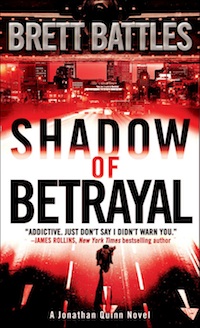
 

SHADOW OF BETRAYAL

By Brett Battles

I share my very good friend Rob’s reluctance toward self-promotion. But, unlike him, I do not have a wonderful wife reminding me that I should do it anyway. So I hope he doesn’t mind (and you all don’t either) but I’m going to borrow the spirit of his wife and do a little (brief) BSP today. 

On the same day Rob’s new book DOWN AMONG THE DEAD MEN came out last week, the mass paperback edition of my last book, SHADOW OF BETRAYAL, also arrived here in the states. Here’s a little teaser:

The meeting place was carefully chosen: an abandoned church in rural Ireland just after dark. For Jonathan Quinn—a freelance operative and professional “cleaner”—the job was only to observe. If his cleanup skills were needed, it would mean things had gone horribly wrong. But an assassin hidden in a tree assured just that. And suddenly Quinn had four dead bodies to dispose of and one astounding clue—to a mystery that is about to spin wildly out of control.

There are a couple of things I incorporated into SHADOW OF BETRAYAL that are personal to me. One would be most of the California locations. For the most part I tried to use places I frequent now or did in the past, and places that have special meaning for me. Also, there is a special child that is a central character in this book, a little girl named Iris who happens to have Down Syndrome. Down Syndrome, as some of you know, is a big part of my life as my son (who is just a week away from graduating Junior High) was born with it. These are some of the most wonderful, loving children in the world, and I hope I’ve been able to show that affectively with Iris.

So if you get a chance please visit your local independent bookstore or wherever you prefer to shop and pick up a copy. My pretend wife wants me to tell you that you’ll definitely enjoy it!


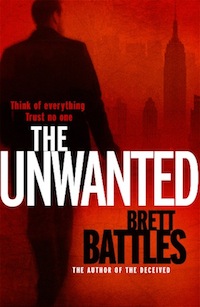
One last thing for any UK fans out there. In the UK, SHADOW OF BETRAYAL is called THE UNWANTED. The paperback edition for THE UNWANTED will be out October 14th, but a little treat here as I’ve just received the new paperback cover!

Thanks for indulging me, folks. Little to no more BSP from me until Apirl!


Okay, all…I’m going to give away two copies of SHADOW OF BETRAYAL, so in the comments let me know one of your favorite places. I’ll then put everyone’s names in a digital hat and pull out two lucky winners! (I’ll post the names of the winner in the comments, too, late Thursday night. So check back. I’ll need to get your address from you!)


Ready. Set. Go!

Let Me Take You To The Movies, Let Me Take You To the Show…

by J.D. Rhoades

It’s summer, and summer means big movies. A lot of us here at Murderati are big movie fans.Some have actually worked in show business. And some of us, to put it mildly, have really been through some bad stuff lately. I don’t know about you, but one of the things I can always count on to take my mind off the bad stuff for a little while is to zone out with a good movie. Or even a bad one.

 Here, therefore, is one ‘Rati’s far from comprehensive list of what looks good, what looks bad, and what looks mockably ugly at the movie house this summer. 

SEX AND THE CITY 2: I rather liked the HBO series when I first saw it, but by the time it stumbled to a close, I was getting weary of the characters, so I didn’t see the first movie. Nor do I plan to see the second. So why bring it up? Mostly because it gives me the chance to link to this  review, which I regard as the Best. Review. Ever. 

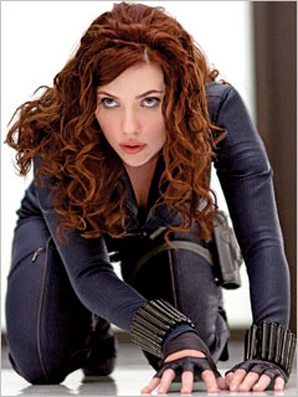
IRON MAN 2:  If you liked the first one, you’ll like this one. I did. Unfortunately, still no Black Sabbath on the soundtrack, but they make do with AC/DC. Robert Downey Jr. is funny, the battle suits are still way cool, Scarlett Johanssen kicks serious ass, and Gwyneth Paltrow really looks like she could use a decent meal. 


See what I mean? 
 
 WINTER’S BONE: Oh boy oh boy oh boy. I cannot wait for this movie. I don’t know anything about the director or any of the near-unknowns starring in it, but  Daniel Woodrell’s book was as dark and brutal a slice of redneck noir as you’ll find anywhere. I definitely wouldn’t recommend it as a light and frothy date movie. Still. 
 
 
THE KILLER INSIDE ME: Casey Affleck stars  as Jim Thompson’s sociopathic  sheriff Lou Ford. I didn’t think Affleck could pull off Patrick Kenzie in GONE BABY GONE, but damned if he didn’t do it, and I do love me some Jim Thompson. And it’s got Jessica Alba, apparently getting nekkid. So this one’s on my list. 
 
 
PREDATORS: Why? Why does this this movie exist? What was wrong with the original (the only movie to star two future state governors) that someone felt it needed to be remade? Is there any way Adrian Brody can pull off deathless lines like “If eet bleeds, ve can kill eet” and “GET TO DA CHOPPAAAH!” with the same panache as the Governator? We think not. 
 
GET HIM TO THE GREEK: Looks an awful lot like a rip-off of the 1982 film MY FAVORITE YEAR, another movie about a hapless underling trying to keep a wacked out, substance-abusing  star together long enough to make the big show. Russell Brand plays the Peter O’Toole role in the update, and while Brand’s no O’Toole, he’s still pretty damn funny, as is Jonah Hill. A definite maybe. 

JONAH HEX: Loved the comic. Love Josh Brolin. Love John Malkovich as a villain.  Hate Megan Fox’s “ain’t ah just the sexiest thang” drawl in the previews. Giving this one a miss. 

THE A-TEAM: Looks dumb. Probably is dumb. But that’s the point. Waiting for the reviews on this one.  If I hear that it can pull off dumb with style, then I’ll check it out. Actually, I’ll probably just wait for the DVD. 

THE EXPENDABLES: Sylvester Stallone directs a who’s who of action movie stars: Himself,  Jason Statham, Jet Li, Bruce Willis, Mickey Rourke, Dolph Lundgren, “Stone Cold” Steve Austin, and–do my eyes deceive  me?-Arnold Schwarzenegger his own bad self, in a shoot ’em up, blow-em-up,  action movie about mercenaries trying to pull off a coup in a mythical South American country.  How could this possibly go wrong? Well, plenty of ways actually.  It could be a mess. It could also be the most brain-meltingly awesome movie ever. I have got to be there to find out. 


THE TWILIGHT SAGA: ECLIPSE: No. Just no. And here’s why (clip NSFW): 
 

So  how about you guys? What’s on your must-see and must-miss lists this summer? 

On booksignings and BEA

I had the pleasure of attending BEA in NYC last week, joining the whirlwind round of publishing parties, panel discussions, and of course the author signings.  Although everyone I spoke to said the convention was quieter than usual this year, things certainly seemed to be bustling as I got out of my taxi at the entrance to the Jacob Javits Center.

The first thing I saw was a humongous two-sided billboard for Karin Slaughter’s upcoming book.  It was stunningly gorgeous and absolutely unmissable by anyone entering the building. 

Once inside the building, it took only a glance to see which books are getting big money thrown at them.  And judging by all the posters, the big title this year seems to be Justin Cronin’s hefty post-apocalyptic novel, THE PASSAGE.  Just in case convention goers missed seeing the posters, the title was plastered across all the plastic badge carriers you had to wear around your neck, turning every participant into a walking mini billboard for THE PASSAGE.  I guarantee, there isn’t a single convention goer who didn’t walk out with that title branded in their brains.

Other big names were, of course, getting big promotional splashes.  John Grisham.  Jon Stewart.  Marlo Thomas.  Barbra Streisand.  Unfortunately, I didn’t get to see any of their presentations because those were hot-ticket events.  The one speech I really wish I could have witnessed was the one by Sarah Ferguson, in what had to be an excruciatingly uncomfortable presentation by a celebrity doused in the fresh reek of disgrace.  One editor told me, “Thank god I didn’t buy her book!  What a nightmare it must be, trying to promote it at this moment in time!”

I had quite a bit of free time to wander the convention floor, and stopped in at the Mystery Writers of America booth, where I got a sweet hug from Margery Flax.  The most eye-popping booth was sponsored by Saudi Arabia, a gorgeous mini-Sultan’s palace with artfully displayed books.  Workman Publishing also got my vote for a fun display that made you want to sit right down on the floor and play with the merchandise.  In what looks like a peek into the future, there were quite a few booths offering services to authors eager to self-publish their e-books.  And plenty of booths were devoted to graphic novels. 

What astonishes me every time I visit these book shows is the vast range of what’s being published, from books about fly-tying for fisherman to books about — well, everything.  If there’s a subject that wasn’t covered by some book, somewhere in that convention, I can’t think of it.  As usual, I found myself drawn to the quieter corners of the trade floor.  Instead of fighting the crowds at the Hachette and Harper Collins booths, I wandered past booths where authors sat with displays of their self-published novels.  It was sobering to see how few convention goers seemed to take any interest in stopping by those booths, or even making eye contact with the authors.  The  self-published books offered a few interesting possibilities.  I lingered over a promising YA advice book about what it takes to become a doctor, and a few woo-woo books about the occult snagged my attention, but there was a wide range in how those self-published books were packaged.  Some looked absolutely professional; others were downright pitiful.  

On my last day, I took my place at the authors’ signing booths, where we gave away 100 copies of ICE COLD.  These signings can be excruciating for a new author who sits and stares at empty space while a line snakes around the corner for the hotshot author sitting next to him.  This time, I was happy to see a line waiting for me.  But that certainly wasn’t the case in times past.  One bookseller who came up to get her book signed reminded me of the first time she’d met me at a book fair years ago.  “You didn’t have anyone waiting in your line back then.  I felt so sorry for you, sitting there all alone.”

And that’s how it usually igoes for every new author.  The days when you just have to grin and bear it as you sit with your stacks of unwanted galleys, waiting for someone — anyone — to take pity on you and ask for your book.  (Did I mention these are free books?  Oh, the humiliation, when no one wants your book even when it’s free!)

If you’re a new author, it helps to remember that John Grisham went through the same humiliating ritual when he was starting out.  So did we all.  There’s nothing like being a writer to experience the sting of rejection.

Want to know just how humiliating a book signing can be? Watch this video.  It’s a riot.


Somewhere today . . .

Dear ‘Rati, 

I wrote this poem last year. It still expresses what Memorial Day means to me better than anything I’ve written before or since.
So please pardon the repetition. And if you know a soldier, or someone who awaits a loved one’s return, or someone who knows that will never happen again . . . please give that person a little extra love today.

by Pari


Somewhere today a young woman sits in a muddy blind, her uniform wet through.
She knows she needs to pay attention to what’s happening, that she has to distinguish between a clap of thunder and the burst of a gun.
But all she can do is think of her baby graduating from kindergarten back home . . . without her. 

Somewhere today a boy reaches for an automatic with only one hand.
The wind blows dust into his teeth and eyes.
He manages to prop his weapon against a sand-filled sack, using the stump of his other arm—the one where the rebels sliced it off at the elbow—to keep the rifle steady.

Somewhere today a mother waits on the tarmac, watching the military plane land.
It bounces two times on the runway.
Her son would’ve laughed at that.
Through the blur of tired and salty tears, she sees them lift the unadorned casket. 

Somewhere today a father stares at the last letter his daughter sent him.
He has memorized every word, read between every line so often it has merged with the next in a confused gray.
Three weeks and nothing.
Not a note, not an email, no text.
He looks to the blue sky and wonders where she is, if she’s all right.

Somewhere today a young woman is shot in a border town
– wrong place, wrong time –
the “collateral damage” of a drug war she’s never played a part in.

Somewhere today a group of young men claim a village for their tribe
kicking children’s toys aside in the abandoned huts of former friends.

Somewhere today war will blast dreams away
cut lives short
and make sorrows long.

Somewhere,
someday,
I pray
we’ll have no need for this holiday.


Subjectivity

By Toni McGee Causey

One of the most frustrating things about teaching new writers the ins and outs of publishing is trying to communicate just how subjective the business is. Grasping just how subjective the business can be is perhaps one of the first real steps into grasping the business itself — moving from starry-eyed newcomer to experienced writer. Those steps? Can be torture. Because when you do finally grasp just how random and coincidental and subjective the business can be, you finally have to acknowledge that you cannot control it. You move from being the God of the world you created to the person subject to an enormous amount of whims and choices beyond your control. If you’re a control freak (and I think most writers are, to a degree, especially about their own work), it’s positively painful to realize that your control can’t extend much further than who you query or whose offer you accept, should an offer be proffered.

I was teaching a few weeks ago at one of the library events I do throughout the year, and it was a crash course on publishing. The event was very well attended and several of the attendees came chock full of questions (which is wonderful — the time flew). But we kept circling around to the notion that they might not have control over some of the things they thought they’d get to choose about their books. Like cover. (coughcoughinyourdreamscough) If you’re really lucky, the publisher/editor will ask for your input and/or feedback once they have some designs, and if you really loathed something, hopefully they’d take that into account and not inflict you with a terrible cover, but often, they have reasons that go far beyond what you saw for the book … reasons that have more to do with market research and what’s selling well and what just hit the bestseller lists and on and on — none of which may be right for your book, but that’s impossible to predict.

When I was discussing this with the group, talking about subjectivity in general, I tried to use the dress metaphor. (I lost the men almost immediately.) We were talking about why not every editor will love every book, even when a book might go on elsewhere, and become a bestseller. Today, however, I had the perfect example right in front of me.

I’m in New Orleans. CJ Lyons is down teaching and I scampered over today to hang out during her down time today. CJ knew that one of my goals today was to take the time to look around at some of the galleries here for art. I’ve been doing some remodeling in my house and I have almost no art up anymore. Some things I just outgrew, some things I’m simply tired of, and mostly, my tastes had grown and changed over the last few years, so that what I wanted now was different. We meandered in and out of several galleries, and I suddenly imagined what an editor feels like when they’re perusing stacks and stacks of manuscripts: overwhelmed with the choices.

There are so many great artists out there, so many of them right here on this one street (Royal) that I could spend hours and hours angsting over the choices to be had. I didn’t have hours and hours, and I had a budget in mind, should something happen to grab my attention. And when you have that many choices in front of you–so many of them great–you have to create your own criteria to help whittle down the choices so that you can actually buy something.

For example, I eliminated certain styles of art immediately. I appreciate looking at them, I appreciate what the artist is doing (or tying to do), and I can see the value in them, see the impressive skills … but the bottom line was, I didn’t want to live with it. I didn’t want to wake up day in and day out and see it. It wasn’t going to bring me joy on that level, and it wasn’t something that spoke to me or resonated with me in a way that gave me new pleasure, every time I looked at it. An editor (and an agent) goes through this–they know that whatever they sign, they are going to be seeing it for a long long time. Maybe not day in and day out, but they’re going to be reading and re-reading and thinking about it and talking about it and figuring out how to do more with it and market it and then get it as much promotion as humanly possible. If it doesn’t really speak to them? That a lot of time to spend on something that is just technically good. If you had the choice of spending a lot of time on something technically good vs. something that blew you away, which would you do? Assuming they cost roughly the same, or both could at least be purchased by you — you’d be crazy not to pick the latter.

 Once I had automatically eliminated the obvious things that weren’t in my tastes/zone, I had to start whittling down the remaining choices. Many of them were beautiful works. Some were paintings, some were photographs. This is where budget and space contraints came into play. I could have spent more on something, if I’d found the exact right thing that grabbed my heart and held on and made me want to sit in front of it for hours, just mesmerized. I was willing to go there, for something like that. For the smaller things I was looking at, I loved what the photographer had done, (and it speaks to something I’m doing in my new work), so it resonated with me deeply and I knew that I would enjoy these smaller pieces. I saw a slightly bigger item at that same gallery which impressed me, but not enough for me to go so far over my comfort zone, budget wise. I bought the smaller pieces, and am not only happy with the purchases, I know I’m going to enjoy looking at them again and again.

A few shops later, I saw two pieces that I flat out loved. They were amazing works of art and I wanted them. Wanted. But there were two issues that prevented me from having an automatic “yes.” (1) I wasn’t sure if I had the right spot for them. You don’t buy something that large  and that dynamic without knowing where you’d hang it, and I wasn’t sure if I even had the right place. (2) I wasn’t sure it was ultimately what I wanted. If I was going to blow my budget by that much, I had to feel like it was something I couldn’t live without. Something I’d feel bereft at losing. Something I’d lament not having, day after day.

An editor is faced with the same sort of issues. There are small projects she/he will love and/or enjoy and while they may not be masterpieces, they are something the agent/editor connects to and will not mind living with for a long while through the course of the book. But for an editor to spend a lot of money on a big project, they have to have two things going in: they have to absolutely love it in order to convince those with the actual money to part with said money and they have to believe, in the world of their business, that this gamble is going to pay off. In my art choices, I only have to gamble my daily satisfaction–I’m stuck with something that expensive, and if it turns out to be a bad choice, I don’t want to have to be reminded about it day after day. But imagine if you are not only reminded of it … imagine if your job hinged on its success. If you’ve got the passion for a project and tout it up the ladder and convince everyone to spend a lot of money (both on the project and on marketing) and then it doesn’t sell? Your career as an editor could be over or in serious jeopardy. So you’ve got to really really love the work to go that distance. Even for an established writer, with a built-in audience.

It’s a subjective world. We can’t control the business, and we can’t say “I’ll be happy when …” and then put things like “sell” or “sell X number of books” or “hit X list” at the end of that sentence, because those things are outside of our control. The only thing we can do is control the quality of the work. Do the very best we can do and put it out there, in as many ways as possible, to interest the one right buyer (gallery [art] or agent [books]) who can then get it to the right audience. We need to look at the work for satisfaction, not the career trajectory, because to do anything else is to court insanity. The day everything goes really well and we think we can take the credit for that? Is the day we’ve bought back into the delusion and no good can come of that.

So love the work. Enjoy the process and the people you meet along the way. Don’t worry about all of the other things beyond your control. Do the best you can do to educate yourself about the process, of course, and the best you can do to put your work into the rights hands, and then let go and move on to the next work. (Unless you’ve self-published, which brings with it a host of problems, because you have to do everything yourself.) If you want the NY publishing career, know that, at best, you will control only a little of it, and that is mostly what you put on the page.

The good news is, there are lots of people with lots of different tastes. With a little education and tenacity, you can get your work in front of many of those people and increase you chances for good luck.

Please Welcome The Fabulous Reece Hirsch

By Cornelia Read, kind of

I’d like to thank everyone in the Murderati Tribe for your kindness over the last couple of weeks since my father’s death. I’m still feeling a little wobbly, but the memorial gathering my stepmother Bonna organized in Calabasas, California, was beautiful, with about 150 friends and family members attending–including three wonderful pals of mine who drove down from the Bay Area, setting out at 6:30 a.m.: Sophie Littlefield, Julie Goodson-Lawes, and Muffy Srinivasan. My daughter Grace and I are now back in New Hampshire and feeling way better about it all.

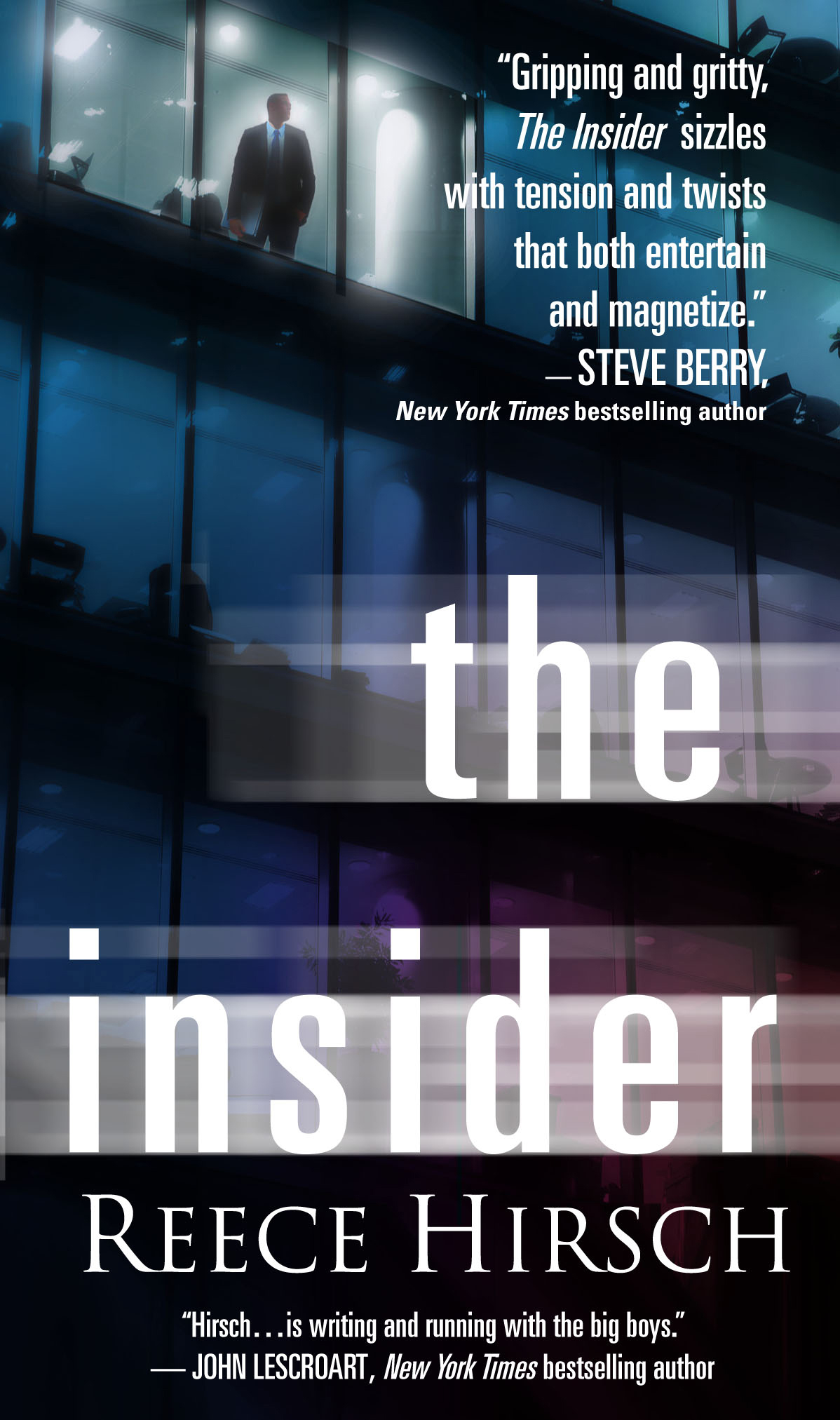
And on a much happier note, please allow me to introduce Reece Hirsch, an extraordinary writer whose debut thriller The Insider deserves wide attention…


My debut legal thriller The Insider is the story of Will Connelly, a young corporate attorney in a big San Francisco law firm who is on the verge of making partner.  He thinks that becoming a partner will solve all of his problems but, in fact, his troubles are only beginning.  In the week after being elevated to partner and taking over a major technology company merger, Will becomes the prime suspect in a colleague’s murder and an unwilling participant in a complex criminal scheme that involves the Russian mob, insider trading and a secret government domestic surveillance program.


Who’s wilder on tour, rock bands or authors?

Rock bands may have the edge when it comes to sex and drugs, but you just can’t beat writers when it comes to committed drinking.  Writers drink like they mean it.  Anyone who’s been to the hotel bar at a Bouchercon can testify to that. 


Offer a favorite sentence or passage from another writer.

Here’s a favorite passage from Kingsley Amis’s Lucky Jim that might describe the night after the Bouchercon hotel bar:

Dixon was alive again. Consciousness was upon him before he could get out of the way; not for him the slow, gracious wandering from the halls of sleep, but a summary, forcible ejection. He lay sprawled, too wicked to move, spewed up like a broken spider-crab on the tarry shingle of the morning. The light did him harm, but not so much as looking at things did; he resolved, having done it once, never to move his eyeballs again. A dusty thudding in his head made the scene before him beat like a pulse. His mouth had been used as a latrine by some small creature of the night, and then as its mausoleum. During the night, too, he’d somehow been on a cross-country run and then been expertly beaten up by secret police. He felt bad.


How do you relax?

See the two responses above.


What is your favorite indulgence, either wicked or benign?

 My subscription to DirecTV’s NFL Sunday Ticket, so that I can watch all of the Minnesota Vikings games.  They rip out my heart every season, but in a good way.  I’m not quite sure if this indulgence is benign or wicked.


Readers love to find little factual errors in novels.  How’s THE INSIDER holding up to that scrutiny?

My book has a chase scene and shoot-out set in the middle of San Francisco’s Gay Pride Parade.  The scene features the aptly named Dykes on Bykes, a fixture of the parade.  I was informed that I incorrectly placed the bikers in the middle of the parade when they are, in fact, always at the forefront, marking the launch.  I stand corrected.

But what really concerns me is my upcoming appearance at the annual fundraiser for the Electronic Privacy Information Center in D.C.  That consumer privacy group is referenced in THE INSIDER and the book touches upon encryption and domestic surveillance issues.  At that fundraiser, I’ll be facing a room full of about 200 privacy and security wonks and wonkettes.  If anyone is going to call me out on my book’s handling of data security issues, it’s that bunch.


If someone were to write your biography, what would be the title and the subtitle?

I Fought The Law (And The Law Won).  (I’m a partner in the San Francisco office of Morgan, Lewis & Bockius.)


Why do you write?

Given the demands of my legal practice, there are a million reasons why I shouldn’t write.  I suppose I just can’t help myself.


Recommend five or more books on a single subject of personal interest or expertise.

I am a film fanatic with a predilection for the films of the Seventies.  Here’s my list of great books about Hollywood:

The Player by Michael Tolkin

Get Shorty by Elmore Leonard

The Devil’s Candy by Julie Salamon

The Last Tycoon by F. Scott Fitzgerald (the Pat Hobby stories are also great)

Easy Riders, Raging Bulls by Peter Biskind

The Kid Stays in the Picture by Robert Evans (Audio Book).  This is a rare instance where the audio book improves immeasurably upon the text.  There’s nothing like hearing Evans himself ask the reader a question, then answer it with, “You bet your ass it was.”


Okay ‘Ratis, how about your indulgences, wicked or benign?

Cross Enough To Spit

Zoë Sharp

This is not the blog I was intending to write this week. In fact, it’s not the blog I’d already written.

But I’m so angry I could spit.

It’s not the kind of anger where steam comes out of your ears and the blood vessels in your eyes burst and the cords in your neck stand out, and you can stride about and break china while raging at the world.

It’s a small, pointless, useless kind of anger. The kind that burns you up inside so cold and fierce it makes your hands ache.

You see, I’m angry over something stupid. Something that is done and out there and I can do nothing about.

A simple mistake on somebody else’s part, that probably seems little more than a minor slip-up to them. The kind of everyday error that will be forgotten in the time it takes to drink half a cup of coffee, take a phone call, have a smoke break.

But I’m a crime writer. I deal in the what if. And, in this case, I deal in the what did as well.

Yesterday, I arrived home to find waiting for me a copy of one of the magazines I photograph for – and you’ll excuse me if I don’t tell you which one. At first, I was delighted. I’ve clocked up another front cover. All kudos. Lovely.

Then I had a leaf through and found an advert for a company involved in one of the photoshoots. The advertising department had previously phoned to ask if they could use one of the photos I’d taken in the advert. As always, I said yes, but asked if it would be possible to have a photo credit. ‘Photo by…’ or maybe ‘Photo courtesy of…’ and my name.

Nothing else. I don’t have a website for the photography. When I first started doing it, such things did not exist, and since then I’ve never needed one. Editors in the field know my work. If new ones want examples, they can take a walk through a newsagents and they’ll find plenty.

This advert had my name on it, in small print below the picture. So far, so good.

In much larger print across the bottom, it also had my work email address. Still no problem, although I didn’t ask for it. I only tend to do magazine shoots, or favours for friends, so I don’t really need for people who don’t know me to get in touch.

It also had my mobile number, which started me getting a bit twitchy, but the final straw was my home telephone number. And, just in case anyone didn’t fully appreciate that fact, it had a helpful (h) after it.

Now, there will be many of you who are sitting there at this moment, going, “So what?” And, to be honest, that’s what the person in the advertising department was clearly thinking when I called to point out their mistake. Particularly as the biggest cock-up – as far as they were concerned – was the fact that they’d managed to include all my details, but no contact information at all for the company whose services they were actually supposed to be advertising, who will rightly feel slightly miffed about the whole thing.

I’ve probably bored you all before with the story of the incident that kick-started my interest in self-defence as well as my career in crime writing. But for those of you who don’t know, many years ago, when I was working freelance for a motoring magazine, I went out to do an interview with a guy who was supposed to own an interesting collection of cars. When I arrived at his house, he seemed very surprised that my Other Half, Andy was with me.

And the collection of cars did not actually exist.

That was not long after a real estate agent called Suzy Lamplugh had gone to show a mystery client around an unoccupied house. She was never seen again.

And I began to wonder what would have happened if I’d turned up alone to do that interview, alone. What was this guy planning to do then?

Shortly afterwards, the death-threat letters began. Whenever my photograph appeared alongside my regular monthly column in the magazine, the letters arrived. Cut out of newspaper like a ransom note, calling me female filth, scum, telling me my days were numbered.

Telling me they knew where I lived.

The police never pinned down who was sending them, and eventually they petered out without my poisoned-pen pal ever making good on his – or her – threats.

But it made me careful, wary. I had a mobile phone long before it was the norm, so I couldn’t be tracked via my land-line number to the village where I was living at the time. I opened up a PO Box address in the nearest large town, so I could receive mail without it coming to my home address, and printed only that and the mobile on my business cards.

And, of course, I learned a LOT of self-defence.

I was reminded of this when I was at the CrimeFest convention in Bristol last weekend, because I did a short self-defence demonstration for one of the In The Spotlight slots on Saturday morning. Aussie author Helen Fitzgerald ably volunteered to be my crash-test dummy, and together we showed the standing-room only audience how to avoid being stabbed or strangled.

But the best form of self-defence, I told the crowd, was not to be there in the first place. Not to put yourself in a position where you needed it.

Not to have your home telephone number published in a magazine.

But how do you explain all this to someone for whom it’s no more than a little slip-up that will be forgotten by lunchtime, and not carried home with them at the end of the day?

So, am I overreacting? Have you ever had a minor incident that shook you up even though, technically, nothing happened? Or do you see people taking risks with their personal safety, oblivious?

What makes you angry in a small way?

This week’s Word of the Week is chapfallen (or chopfallen), which means ‘dropped jaw’ from chap or chop (jaw or jowls), hence depressed, crestfallen, dispirited. It dates back to the 16th century; today we associate jaw-dropping with surprise rather than sadness.

Women in Peril


By Louise Ure


Maybe it’s just because I’ve been on a Stieg Larsson kick the last couple of weeks. I haven’t ordered the third in the series yet, but both The Girl With the Dragon Tattoo and The Girl Who Played With Fire are steeped in the world of violence against women. Whether it’s the kidnapping, torturing and killing of women explored in the first book or the horrors of the sex trade in the second book, Larsson focused on the perils women face today and created a kick-ass heroine in Lisbeth Salander (who one blogger called “a deviant Lara Croft”) to confront the problem.

And when I turned on the local news this morning, all four lead stories were about crimes against women. The continuing hunt for the killer of a 24-year old Asian woman. The carjacking and rape of a woman driving late at night in a Mercedes SUV. An elderly woman assaulted on a nature trail as she was walking a dog. No progress in the case of a dismembered young girl’s body found in a suitcase.

While I’m glad that the media and our best selling novelists decry crimes against women, the stats just don’t support the emphasis.

  • Yes, 95% of all rapes and sexual assaults are against women.
  • But only 44% of all armed robberies in the U.S. are.
  • Only 33% of all assault victims are women
  • And only 25% of murder victims (1/3 of whom were killed by a partner or spouse).


But in books, TV shows and news stories, the number of female victims are much higher. I fear that in all three cases (news, film entertainment and literature), women-in-danger stories equal ratings and sales.

In an article in the U.K.’s The Guardian last fall, author and critic Jessica Mann discussed an increasing trend in crime fiction to write plots with male antagonists and female victims that come close to “sadistic misogyny.”

“Each psychopath is more sadistic than the last and his victims’ sufferings are described in detail that becomes ever more explicit, as young women are imprisoned, bound, gagged, suffocated, stabbed, boiled or buried alive,” she said.

A publisher quoted in that same Guardian article added, “Dead, brutalized women sell books, dead men don’t.”

Publishers have a shorthand name for this: Fem Jep, if the details aren’t too gory. Torture Porn, if they are.

I’m equally culpable in my own work. The victims in my novels are primarily women and the protagonists (all women) definitely fall into the Female-in-Jeopardy mold by the end of the book. I can only blame that on the fact that I write about what I know and what I am most afraid of.

Val McDermid, when asked about women writing more violent plot lines, said: “When women write about violence against women, it will almost inevitably be more terrifying because women grow up knowing that to be female is to be at risk of attack. We write about violence from the inside. Men, on the other hand, write about it from the outside.” I’m not sure I agree with her inside/outside definition, but I do know that women can write equally dark and violent books as men do.

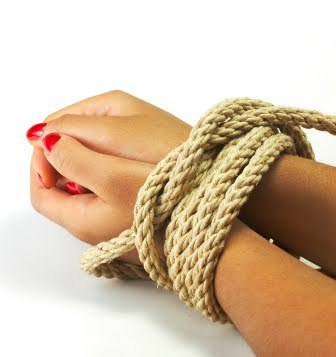
If the success of these Women in Peril novels are any indication, we don’t want to read about cats or kids in jeopardy but there better be lots of man-on-woman danger involved. It’s as old as The Perils of Pauline and as new as The Girl Who Kicked the Hornet’s Nest, but these days the women are likely to rescue themselves instead of waiting to be untied from those railroad tracks.

How about you, my ‘Rati pals? Do you enjoy reading Fem Jep novels? Do you enjoy writing them? And when does Jeopardy turn into Misogyny? 


Are You There, Dog? It’s Me, Margaret.

by Alafair Burke

It’s eighty degrees and I’m writing this from the newly remodeled Washington Square Park, where the fountain – now symmetrically aligned, thanks to Mayor Bloomberg — enthusiastically welcomes in summer by spraying bare-chested SPF’d children and apparently un-SPF’d ripple-abbed men (not that I noticed).

Perhaps because I’m typing this as a crazy-ass homeless dude in a multi-colored wig and butterfly-patterned skirt harangues me about the carry-out lunch that awaits my attention on the bench next to me,* I’ve decided that dog watching is a safer park habit than people watching.** But it’s nearly as interesting.

No day in Washington Square would be complete without the dogs. The big ones. Little ones. Happy ones. Neurotic ones.

And my afternoon of dog watching got me thinking about my relationships with pets. As some of you know, I have a special relationship with my French Bulldog, The Duffer. My tremendous respect for him is reflected even in his name. I wanted to call him Stacy Keach. My reasons should be self-evident.

Stacy Keach and the Duffer (which is which?)


My  husband, however, was perplexed by the choice. “People will think a dog called Stacy is a girl.”

Um… so?  And, more importantly, we would not call him Stacy.  We would call him Stacy Keach. Every single time. Because that would be his name.  My husband put his foot down, but that didn’t mean I was going to cave for some stupid dog name. No Fidos or Fluffies here. But Duffer? Yeah, that might work. But only he had to be THE Duffer. All regal and stuff.

The Duffer’s my first dog, and I have to admit I’m still surprised by the love, affection, and empathy I have for my little friend — and which, yes, I believe he has for me. I truly believe he has moods and feelings and expressions that leap from that one-of-a-kind mug of his. I talk to him constantly and imagine what he would say back to me if only he could.

Does this make me insane? Maybe. Or more optimistically, maybe my internal (and sometimes external) running dialogue with the Duff is just a sign of my overactive imagination. Or it could be a recognition that animals, although lacking our ability for language, opposable thumbs, and fire making, have attributes that we chalk up to feelings and emotions in humans, but to our own imaginations in our pets.

I mean, is it not obvious that the dog in this photograph

was in a different mood, and yet the very same silly beast at his core, as in this video? (Warning: NSFW)

Dogs are not alone in their unique personalities. My agent and his wife recently welcomed two new kittens into their home. One is named Ellie Hatcher, and her brother is called Mickey Haller. In light of her namesake (my series protagonist NYPD Detective Ellie Hatcher), I was rooting for Ellie to be one playful yet take-charge, bad-ass mo-fo of a cat. But guess what? It’s her twin brother Mickey (named for Michael Connelly’s Mickey Haller) who’s the rapscallion. If he were a human being, he’d wear overalls, carrying a peanut butter sandwich in one pocket, a slingshot in the other. Mickey’s the feline equivalent of Dennis the Menace.

Ellie? She’s earnest. Tentative. Watchful. The kind of girl who’d tell on herself if she ever broke the rules. Sigh.

I’m not the only writer with pets on her mind these days. The wonderful Laura Lippman recently blogged about once helping out Reba, “a hang-dog dog, shy and mopy.”  (She’s following it up with a contest. Just post a memory about your favorite pet or pet name, and be entered for an advanced copy of her eagerly anticipated novel, I’d Know You Anywhere.)

Perhaps because we recognize that our pets have personalities, it’s no surprise that writers have looked to pets for fictional characters.  It’s fashionable these days to diss cozy mysteries where cats solve crimes, but some pretty damn good books occasionally make room for the non-human animals.  (Have you read Garth Stein’s The Art of Racing in the Rain?  The entire novel is narrated by a dog, and it’s actually good.  I kid you not.)

Sometimes the addition of a pet tells the reader something about its person.  Leave it to Stephanie Plum to find a best friend in Rex the hamster.  Readers also become attached to literary pets in their own right.  I’ve lost track of the number of times I’ve been asked whether James Lee Burke‘s daughter actually owned a three-legged racoon named Tripod.  (The answer, for the record, is no.)

I like to think I’ve created a true character in Vinnie, French bulldog pal to Samantha Kincaid.  I conjured Vinnie well before I was a dog owner myself. He’s a little lazy, likes his people, and makes loud, fast snorting noises like an old fat man when he eats. He’d sound like Buddy Hackett if he could talk.  And he finds endearing but frustrating ways of expressing his displeasure when Portland cop Chuck Forbes moves in.  (I’m not alone in my frenchie obsession.  The Kellerman family has a beautiful dog named Hugo, and Jonathon Kellerman‘s Alex Deleware has a frenchie as well.)

So, here’s my question for the day: Who are your favorite literary non-human animals?  What do they add to their books, either vis-a-vis the human characters or in their own right?  Which pets do you wish could talk, and what would they sound like and say?

*A further aside about the aforementioned homeless guy.  He wanted to know what I was going to use to eat my lunch.  “A fork,” I said.  His response?  “Well go fork yourself!”  Jesus, I love this city.

** In addition to dog-watching, I also got in some simultaneous people-walking. Random things that have happened at the park while I’ve been typing: A three-year-old banged his drumsticks on the bench next to me; two hand-to-hand drug deals (that I noticed, at least, though I haven’t been going out of my way to look for them); an orange-haired Asian kid nearly knocked a mohawk dude over with his hoola-hoop; and the little girl on the Razor scooter proudly declared, “I’m super really stinky.”  I swear, I’m not making this stuff up.  Today’s officially a great day.

Watching: Modern Family

Listening To: Sade

Reading: Lee Child’s 61 Hours

Surfing: LOST re-enacted by cats (you’re welcome)

If you enjoyed this post, please follow me on Facebook, Twitter, and my mailing list.