Author Archives: Murderati Members


A Chat with Bestselling Author Lisa Unger

by Alafair Burke

I’m still on the road for 212, but was lucky enough to lock in bestselling thriller author, Lisa Unger, for a little chat here at Murderati.  If you’re not yet reading Lisa’s books and following her online, you should be.  She is not only a master plotter, but also a talented writer whose characters stay with you long after you close the book.  And lucky for us, she’s also incredibly thoughtful about the creative process. 

Lisa’s excellent novel, DIE FOR YOU, is out in paperback this week. 

For readers who don’t know the premise of your wonderful novel, DIE FOR YOU, please tell us a little about the book.

Isabel Raine has the pefect life.  She’s a bestselling novelist, close to her family, in love with her husband Marcus.  It’s not a perfect marriage; there have been problems — an affair, a miscarriage. But Isabel loves the man she married, can’t imagine her life without him.  Then, on a day like any other day Marcus, an inventor of computer games, leaves for an important meeting and doesn’t come home.  In the frantic search for him that follows, Isabel comes to realize that the man she married is a stranger.  She didn’t even know his real name.

In addition to being a story about Isabel’s search for the truth about her husband, it’s also about marriage and how well we really know each other.  It’s about family and the ties that bind.  Everyone in DIE FOR YOU has a secret heart.  So, it’s about that, as well, how sometimes we hide ourselves from the people we love the most.

You live in Florida, but DIE FOR YOU takes readers to the streets of both New York City and Prague.  How did you decide to set the book in these locations, and how were you able to depict them so credibly?

I lived in New York City for thirteen years, and visit many times a year. So it really is one of the places I know best.  When I close my eyes, I can hear it, smell it, taste it.  And it has occupied such a huge place in my heart and imagination for so long that my novels seem to naturally begin there. 

In 2007, I spent five weeks in Prague.  And the city itself – its dark history, its gothic beauty – inspired DIE FOR YOU.  I wandered the streets of that city with my husband and daughter and just let it sink into my skin.  I kept thinking that Prague was a city of secrets, that beneath its pretty cobblestone streets beats a dark heart.  I love that energy … it’s the same pulse in New York, and even in Florida.  This idea — that beneath the glamour of New York City, the beauty of Prague, or the sunshine of Florida lurks something feral — is fascinating for me.  The same might also be said for the lives of many of my characters.

Did your time in Prague change anything about your creative process or writing habits?

Initially, I went to Prague to vacation.  I needed a little time off after writing BLACK OUT to recharge creatively.  But the city so inspired me that I couldn’t keep the pages from coming.  DIE FOR YOU is the first book inspired by a place; so that was a change.

My schedule fell into place much as it is at home; early mornings from 5 AM writing while my husband takes care of our daughter, and afternoons as a mom.  But, of course, as a mother nothing is every seamless. Since my daughter always comes first, I have to be creative and very flexible about when I get my pages done.  That’s true whether we’re in Prague or Florida.  I am always performing a balancing act!

You have an active presence online, with thousands of Facebook friends, regular Twitter posts, and an active blog.  What do you see as the advantage, both for you and your readers, of social networking?  What do you see as the proper balance between letting your books stand on their own and allowing readers to get to know the woman behind the books?

Facebook and Twitter are fantastic ways to stay in touch with readers.  I love the feedback, the connections.  And I love the way those connections intersect with the real world, how people turn up for appearances because they know me on Facebook.  In an industry that’s changing all the time, Facebook is an important tool for authors in terms of creating exposure and allowing for an unprecedented relationship with readers.

I try to be very organic about my posts and my blogs, only writing when the spirit moves me and only about things that are important to me.  So in that way, I’m pretty open.  I feel like I owe this my friends/fans/ followers. When they hear from me, I want it to be real – whether it’s about my books, other authors I want to support, what I’m thinking, feeling, listening to, watching. 

In some respects, the social networks are about marketing.  But the relationships one creates there are true.  Finding the balance is tricky.  I had a nudge from a follower on Twitter.  She said she hoped I was hard at work on the new novel because I hadn’t tweeted in a while.  And it’s true that the more focused I am on my work, the less present I am online.  It’s about the writing first.  Everything else – marketing, publicity, blogging, social networks – come after the craft. I think readers who follow me on the networks know this about me.

I know that you have made book touring a family event.  Can you talk a little about your experience touring with your family?

Touring with the family is not for the weak.   My daughter was four months old when she went on her first book tour.  I couldn’t NOT go; and I wasn’t about to leave my munchkin behind.  But getting on the road with your four- month-old, nursing infant requires the mobilization of a small army – my husband, my parents, friends in various cities.  Not to mention the gear … stroller, car seat, breast pump, massive diaper bag.  Of course, now she’s four – and it’s easier in some ways (less gear, for one thing), harder in others. As crazy as it can be sometimes, I can’t imagine doing it any other way.  Touring can be very stressful – and although traveling with your family doesn’t make it LESS stressful certainly – it keeps everything very real.  There’s never any forgetting what’s important.

Because I’m on tour right now, I’ve got touring on the brain.  Are you willing to share the craziest thing that’s ever happened during your travels?

There have been so many crazy moments on the road, especially with Ocean!  There was a funny piece in the New York Times about our various adventures.  I always say that she has been breastfed in the parking lots or back rooms of hundreds of bookstores across the county!  I had to nurse her before each event to be sure she didn’t freak out in the middle of a talk.  At first I used to do it in the car, because I was shy.  After a couple of cities, I just asked for a place to nurse before each event.  And everyone seemed to take this in stride – media escorts, bookstore owners.  The folks at Stacey’s in San Francisco said, “Everything comes after feeding the baby!”  And this is so true.


You are known as one of the smartest plotters in the thriller genre, but I happen to know that you don’t outline your books in advance.  Tell about your process for creating such seamless plotting and pacing without advance planning?

Aw, shucks.  Thanks for that, Alafair.  Anything can be the germ for a novel.  A voice I hear in my head or someone I keep seeing.  It might be a poem or a news story or lyrics from a song.  And if it stays and repeats, spins out and grows, then it’s a novel.   I never know how a book is going to end, who is going to turn up, or what they are going to do day to day.  I write for the same reason that I read, because I want to know what’s going to happen.  And it has always been this way for me.

You and I have talked about this before.  And it all sounds very magical.  But I’m not sure it is really. I have been an avid reader and a writer most of my remembered life.  I have studied virtually every type of writing from journalism to poetry, from play- and screenwriting to the novel.  My entire education and every goal I’ve had personally and professionally has focused on the craft.  So because of that I suspect that I have internalized the form to the degree that it’s almost second nature.  I think like a fiction novel.  

I am also full of faith and wide open to the possibilities of the blank page every day.  So I am fully waiting and ready for the magic.  And when the magic doesn’t come, I am dedicated to the craft.  Plot flows from character. I hear my characters.  I respect and have empathy for them.  I get to know them and don’t seek to control their actions or consequences.  I am ferociously curious about life and people.  And I never get tired of exploring all of these things.  And it’s in that place of faith and empathy that my plots evolve, just as life does. 

How do you like to spend your time that’s not spent reading and writing?

I am a brilliant golfer.  I love it.  Can’t live without it.  Okay, not really.  (Alafair, knows better than anyone what a complete lie this is.) I do, however, have a pretty active lifestyle, enjoying boating, kayaking, tennis, walking, and yoga.  My husband and I are total foodies and love to entertain.  Traveling is high on our list of the most important things in life, so we make it a point to get somewhere new every year.  But mainly, I just enjoy doing all these things with Jeff and Ocean.  So even if we’re just home watching a DVD, that’s pretty great, too!

A CHANCE TO WIN A FREE COPY OF LISA’S NEW TRADE PAPERBACK OF DIE FOR YOU

I hope you enjoyed hearing from Lisa about her writing process as much as I always do.  I find her dedication to the art of writing so inspiring. Thanks, Lisa, for stopping by Murderati, especially on… your birthday!  Happy Birthday!! 

Now, on to the comments section.  Of course Lisa and I would both welcome your responses to her remarks.  But I’d especially love to hear folks answer the last question I put to Lisa: How do you like to spend your time that’s not spent reading and writing?  We have quite a community here at Murderati but we usually talk about our shared love of books.  I thought it would be fun to have a day when we talked about our other passions as well.  So to enter a raffle for a free copy of DIE FOR YOU, just post your response by 9 am (PST) tomorrow: How do you spend your non-book time?
 

The Subconscious Writer

By Allison Brennan

At RT one year, I sat on a panel with other thriller writers. One fellow author was shocked that I don’t plot. He was even more surprised when I told him that I didn’t know what was going to happen in the book I was writing at the time.

Thriller writers tend to be plot driven and for most of them, not having a roadmap—at least of the basic plot points—can be paralyzing. But thriller and mystery writers aren’t the only people out there who can be anal plotters. Take the fabulous Suzanne Brockmann, who writes romantic suspense. 

I took an online class from her in December of 2003 about writing connected stories (as opposed to a series.) I had just sent out THE PREY to agents, including several who were reading the full manuscript, and I was very excited because I’d never had so many request the complete with my first four manuscripts.

I was stunned when she shared with the class that she was a plotter. Not only a plotter, but an uber-plotter—she had 100 page outlines before she even started writing the book! She admitted that it takes her longer to outline the book than it does to write it. She had color-coded notebooks, multi-book character arcs and subplots, and all these were clearly labeled.

I thought to myself, “If this is what it takes to get published, I’ll never be published.”

If I was told I had to write a detailed outline before someone would buy a book, I would very likely stop writing for publication. I’d rather write the entire book first, then create an outline. 

I do not know where my story is going when I start. I do not know where it is going to end. I know who the hero and heroine are. (Most of the time—twice I’ve been wrong.) I know the basic crime. I don’t always know why, I don’t usually know the villain or if I do, I don’t know why. I don’t know who’s going to live to the last page or who is going to die. Well, except for the hero and heroine because I write romantic suspense and they kind of have to survive, or it wouldn’t be romantic suspense.

Getting to the end is half the fun of writing. Finding out what happens is thrilling. If I knew the ending, I wouldn’t write the book. It’s enough to know that my hero and heroine are going to live, and the bad guy is going to get what’s coming to him.

To quote Stephen King. “Why be such a control freak? The story is going to end up somewhere.”

This isn’t to say that all thriller or mystery writers are plotters or all romance writers are organic storytellers. It’s just that I think aspiring thriller writers think they need to have a structure and detailed outline before they write because of the complexity of most thriller plots.

I’m here to tell you that no, you don’t have to.

You CAN if you want to. I’m not going to tell anyone NOT to plot their story just like I’m not going to tell anyone they HAVE to write organically. Our brains are wired differently and one thing I learned early on is that no one can tell anyone else the best way FOR THEM to write a story.

I have a workshop I’ve presented a few times called “No Plotters Allowed: Solutions to Writer’s Block for Those Who Can’t, Won’t or Don’t Plot.”

I’m thinking of renaming the subtitle of the workshop to “The Subconscious Writer.”

I’m deep into writing currently untitled Lucy Kincaid #1. Friday night I was stuck. I had everything set up and I started writing what I thought was the next scene, but it just wasn’t working. Something felt off to me. (Organic writers tend to “feel” problems in the story. I know, it’s sounds all wishy-washy and stupid, but it is what it is. And I really hate the word “pantzer.”) I put the book aside and started working on a title. My title had been rejected (NO WAY OUT) and I didn’t like what my editor  came up with, then I submitted another title, which they liked but didn’t feel was right, so it’s back to the drawing board. (Aside: Lucy #1 is coming out in January of 2011, and Lucy #2 is coming out in March 2011. Lucy #2 has a title—we think. It’s not approved yet. So I was trying to match the rhythm of that title.) I scoured my thesaurus and bookshelves, pulling out words that have some relation to the story.

Betrayal. Bait. Stop. Tempt. Lose. Lure. Love. Murder. Kill. Dying. Death. Trap. Shoot. Ruin. Entrap. Chase. Thrill. See. Touch. Watch. Predator. Web. Seduce. Snare. Break. Fear. Retribution. Stalk.

That’s about 10% of my list of words. Then I moved to phrases, which may or may not be title-esque. Cry Me a River. Dying Breath. Taking the Heat. Don’t Look Back. No Time to Run. No Way Out. Edge of Danger. Web of Lies. Over Her Dead Body.

Again, that’s just a small fraction of what I had written on seven sheets of notebook paper.

Then I went to bed.

Saturday morning I woke up with not only a title (actually, four good titles that all have the same basic foundation) but I’d solved my story problem!

When I was stuck Friday night, as I often do I skimmed what I had already written. This is bad for me because I usually start editing as I go and that takes time, and often sends my story in new directions. (At least when you’re on a tight deadline, it’s bad.) But since I’d already edited the beginning of this book to death, it was tight and I wasn’t doing major editing, just small tweaks here and there. So when I went to bed, I had the whole story in my head, as well as a couple hundred words and phrases swimming around.

I realized when I woke up that I had the solution already written in the book. I didn’t have to fix anything, it was already there. It was as if my subconscious had the story down even when I didn’t know it.

I thought Character A was watching Lucy out of a sense of paternal protection, and even though he’s a bad guy, he didn’t want to hurt her. He was more worried about her.

It’s not Character A at all! I realized that in two specific places in the story before the midpoint, Lucy had the distinct impression of being watched. But she has a fear of being watched, and knows this about herself, and thus has learned to dismiss the sensations because they happen whenever she’s in public.

My husband thinks I’m very strange. I told him that I was excited because the guy I thought was watching Lucy really isn’t, it’s this other guy who I didn’t even know about but he’s been there all along! Seriously, I had two scenes where he was there and I didn’t even know. When I re-read them this morning, it was so damn obvious you’d think that I’d planned it out. Dan said, “But these are your characters. You’re the writer, you tell them what to do.”

Um, no. When I start telling my characters what to do, they put on the brakes.

My editor is sometimes amused with me, I think. I always do a round of revisions. Always. Even if the book is pretty tight, I always go through it with editorial notes. Virtually every book I’ve written has a completely different ending than the first manuscript. My editor likes this because she feels like she’s reading a completely new story. Most people think I’m insane because I essentially write every book twice. But I don’t see how I can do it any other way. I’ve tried. It doesn’t work for me.

Yesterday, Alex commented about fast writers and swore at me (in her loving, kind and non-judgmental way, of course!) I’m not a fast writer. I’m a subconscious writer. I’m writing 24/7, just not always at my computer. I run through dialogue in the car (when I’m alone—thank God for hands free phones because people think I’m talking to someone else and not myself!) I play the what if game. I think about my characters and how they would react to different situations. When I’m sitting down actually writing, I write fast, but the physical writing is only a small part of the writing process.

In a way, I suppose this is plotting. (Shiver.) But 99% of the time I don’t write down that verbal dialogue I played with. I don’t use a plot point that came to my head playing what if? I don’t put my characters in situations where I know what they’ll do—or, they’ll do something completely different because of a factor I hadn’t considered.

Every writer I’ve talked to has lamented their process. I tend to freak out near deadline when I don’t know what’s going to happen. I write frantically, excited to finally know how it’s going to turn out, and hoping I don’t get stuck. I usually know who the bad guy is, but sometimes even I’m surprised.

And that, for me, is half the fun of writing.

Over at Murder She Writes on Thursday, I posted a short story I wrote called “Ghostly Vengeance” that was printed in a the Walmart “Book of the Month” selection printing of ORIGINAL SIN. I finally got permission to post it on my website (it’ll be up at Seven Deadly Sins Books later this week, but I wanted to give my blog readers an early preview.) Hope you enjoy it!

And no, I didn’t plot it out or know what was going to happen. In fact, when they asked me to write a short story with the ORIGINAL SIN main characters, my editor asked what I’d write. I said, “How about a ghost story?” 

Then I wrote it.


What is love, anyway?

by Alexandra Sokoloff

It’s spring, and love is in the air, at least professionally.   This week I go to Columbus to the Romantic Times Booklovers convention, one of the greatest conferences for me, despite what I write.    The week after I’m teaching a full day workshop again in Jacksonville, Florida (which I will never again be able to think of as anything but Flo Rida) for the First Coast Romance Writers (open to the public).

Because RWA (the Romance Writers of America) is so very, very, VERY good about offering craft and professional sessions to its members, both online and in person at their chapter meetings and specially organized events,  I end up teaching my Screenwriting Tricks For Authors workshops for romance writers more than anyone.   So I’ve started to feel a little guilty about the examples I use in my workshops, which are, well, intense would be the nice word, but homicidal would often fit.

Now, the whole reason I use movie examples to begin with is that most of us have actually SEEN the movies I talk about – it’s an instant frame of reference.   While books are much more hit and miss.   Also, movies are such a compressed form of storytelling that you can look at the structure of a movie much more easily and diagram it (yes, like diagramming a sentence, just don’t ask me to do that).

So even though I’m using Silence of the Lambs and  Raiders of the Lost Ark and Jaws and Presumed Innocent for the romance writers, they all know exactly what I’m talking about.

But sometimes I feel like a fraud at these things because I read so very, very little romance. 

I had several interesting conversations with a debut author during my last workshop, a wonderful, fantasy weekend in Santa Rosa with the Black Diamond RWA chapter.   She asked me if mystery and thriller writers look down on the romance genre and I said, “Well, yeah, I think they (we) do.”    And I don’t think it’s because of the subject matter, actually, although there are those men who say loftily that if there’s a sex scene in a book they just skip right over that.    (Personally I’ve got to wonder about those men – if they’re any good at all in – well, not just bed, but ANYWHERE.)

I ended up saying that it’s because a lot of romance is badly written.    I know, that’s a huge generalization, but wait, I didn’t leave it at that.   I think there are two pretty good reasons for why there’s so much bad romance out there.    In books, that is –the other is a much longer post.)

One reason for badly written romance books is a lot of people aren’t reading them for the writing.   In the same way that men aren’t “reading” Playboy for the articles.    Those of you who don’t ever read romance don’t necessarily realize that quite a lot of it is soft porn.   Sometimes porn porn.   Sometimes way-out-there fetish porn, too, you really have no idea until you get out there exploring a little.   I mean, I grew up in the Bay Area and am no stranger to strange, but even I have been shocked at the – imaginative – content of books I see at RT, for example.

The second reason is the business model of a lot of romance publishing.    Which is a hard sell of titles for one dedicated month, and then on to the next month of titles.   It’s a kind of disposable attitude.    

And as part of that business model, romance authors are expected to write three, six, even nine books a year.    I’m not saying quality can’t happen under those circumstances, some people are just fast.   Allison, for example,  !@# her.   

But in most cases I think it’s a little less likely to get a great book out of that kind of speed.

And maybe, just maybe, love  is a hard thing to write about because it forces us to confront our deepest desires and fears, things we aren’t even conscious of half the time.

But from my point of view that’s exactly what you’re going to have to do to write a romance book that’s going to endure past the one-month business model hard sell.

And if you’re writing a love story into ANY book, you have to do the same thing.    Yes, I am talking about theme again.    Every time we deal with the subject we’re saying something about it, whether we intend to or not.    If there’s no compelling reason for your characters to be together, if there’s no love theme they’re grappling with, grasping for (and overcoming or not), well, you’re diminishing the meaning of love.   Or saying greatness isn’t necessary in that kind of relationship, maybe.   Not very inspiring, is it?   I don’t think so, anyway.

Well, so how can we bring more meaning to the love relationships in our books, whether we’re writing romance or not?

You know my prescription for everything by now.    Make a list.   What are ten love stories or love plots that are meaningful to you?   Or that have been done particularly well, in your opinion?

Four Weddings and a Funeral

Next Stop Wonderland

Notorious

Bridget Jones’ Diary

Notting Hill

When Harry Met Sally

Philadelphia Story

Rebecca

Bringing Up Baby

Much Ado About Nothing

Casablanca

Sleepless in Seattle

(I cheated a little with my list because I’m looking for particular examples for my workshops – my personal list would look somewhat different.)

Now that’s a list of both romantic comedy, which is more along the lines of typical romance, which demands a happily ever after ending, and classic romance, Casablanca and Rebecca, and subplot romance, like Notorious.

 Four Weddings and a Funeral and Philadelphia Story are probably my favorites of that list.

Four Weddings appeals to me on a very personal level because writer Richard Curtis, as is his wont, is not just exploring love relationships between two people, or several sets of two people,  but the group love dynamic of a posse of friends.    In fact, in that movie, the group dynamic is one of the factors keeping the hero, Charlie (Hugh Grant) from settling down to marry – and has kept every single one of the others single, except the one truly married couple in the group, the gay couple who can’t legally marry.    (Wonderful, scathing truth, there).   

That group dynamic has always resonated deeply with me, and I imagine it struck a chord for a lot of people.    Also in terms of high concept the film is great, because most of us have experienced  that totally exhausting year that every single person you know gets married and your entire social calendar revolves around weddings.   I certainly could relate at Hugh Grant groaning as yet another embossed linen envelope arrived in the mail.

But the real beauty of Four Weddings is the underlying theme that there is something magical about a wedding that opens the door to love – not just for the couple involved, but potentially for everyone who attends.   The structure of the film is a round-robin, where at each wedding at least two people find the loves of their loves, and we see that wedding next, or the preparation for a wedding, or at least the deepening of the relationship with a promise of marriage.   This is something I think most of us would like to believe about weddings – that there is an encompassing magic there, a kairos that invites something life-changing.

When Harry Met Sally is an enduring romantic comedy not just because of the great chemistry between Billy Crystal and Meg Ryan and the charming documentary clips of elderly couples talking about how they met and fell in love – but because it explores a strong theme:  Can a man and woman really ever be friends?    And we experience the great treat of watching Billy and Meg both become friends and fall in love.

Next Stop Wonderland and Sleepless in Seattle are examples of the theme of the soulmate – that there is someone out there who is destined for you, and that the Universe will guide you to that person.   Next Stop Wonderland shows two people whose paths cross over and over again, with all kinds of attendant signs that these two people are supposed to be together, but they don’t meet until the last few seconds of the movie.    Sleepless in Seattle explores the same kind of fatedness, and similarly keeps the hero and heroine apart until the end of the movie.   I admit, this kind of thing just turns me inside out – I would love to believe that there is one person who is all that, and that all of life is conspiring to help you find that person.

Notting Hill is an interesting story because there’s no one person who’s the antagonist (even though Alec Baldwin does a charming turn as the movie star boyfriend) – the obstacle to Hugh Grant’s and Julia Roberts’ relationship is her fame, and each sequence explores a different aspect of that celebrity and how it keeps the couple apart.

I love Philadelphia Story, too – it’s an interesting, sophisticated underlying premise, that Cary Grant knows that Katharine Hepburn will never be able to love him fully until she steps off her pedestal and has a roll in the mud.   It’s only after she abandons herself and sleeps with Jimmy Stewart (oh, come on, you know they did), that she is fully human to love Cary.

So how about it, ‘Rati?   What are some love stories or love plots that really do it for you?    What themes have you explored or would like to explore about the meaning or nature of love?   Either in books, or in life…

– Alex


24-HOUR SCHWARTZ


by Stephen Jay Schwartz


“The important thing is this:  to be able at any moment to sacrifice what we are for what we could become.”

Charles Du Bos


I can’t find the quote now, but I remember Augusten Burroughs saying that his only regret in life was that he stayed as long as he did in the advertising job he hated.  It kept him from being what he was born to be—a full-time author.

I’ve been writing for a very long time now.  Things got serious when I was in college, after I placed well in this big screenwriting competition and I suddenly had a film agent.  I didn’t want to call myself a writer until I was sure it would stick.  I waited until I heard other people say it before I made it my own.  I remember the exact moment it happened.  I had gone to this advertising agency to watch a rough cut of the movie “The Abyss.”  I had somehow talked my way into getting hired to write copy for the film’s trailer.  I was in a room with the advertising producer and he was on the phone and I heard him say, “I’m with the writer now.”  I looked around—there was no one else in the room.  I realized that I was the writer.  I was the writer!

What a moment.  This was how I wanted to be defined, forever.  A thought, an idea that I’d had in my head had actually escaped into the real world and had been accepted by others.

Of course, what I really wanted to do was direct films.

I pursued these two passions side-by-side.  And, like a person who studies to be an actor, I took expendable employment.  Flexibility was important.  I did not pursue a career other than writing and filmmaking.  Which meant that I had a lot of jobs I actually hated.  They were merely jobs, not passions.  In the meantime, life happened.  I fell in love, got married, had kids.  And the “expendable” jobs became what others might call “careers.”  They became the kind of jobs that others fight to get.  But they weren’t the careers of my choosing.  They were only supposed to be links in a chain.  Disposable.

If I had chosen a career outside of writing and filmmaking, I might have chosen law.  Maybe environmental law.  Or I would have worked for Greenpeace or the Sea Shepherds.  Teaching seemed like a great idea, and yet teaching was something I always figured I’d do later, after I learned something worthwhile to pass along.  It was a “later in life” goal.  For, like, when I’m older, like…in my forties.

I look around at many of the authors on Murderati and I see people who had valuable careers either before they became full-time authors or in conjunction with their writing careers.  I guess if you intend to be an author you figure you better have a job you love, because it will be a long time before you’re living off your writing.  But when you go to film school you think that every shitty screenplay you write is going to make a million bucks.  So, you’re always just a few months from living the dream.  And the jobs you take in-between end up as “filler work.”

On Murderati I see people who love that other thing they do for a living.  Dusty seems passionate about his work in law.  I don’t get the sense that he’s waiting for an opportunity to leave his “day job.”  Tess is a doctor and, although she might not be practicing anymore, she chose a noble profession to pursue before becoming a full-time author.  We have business-owner authors here, photographer authors, active-mom authors.  What I see here are people who are themselves one hundred percent of the time.  24/7. 

When you have a day job, and it’s not what you’re made of, what you live is a lie.  You compartmentalize yourself to death. 

The times I’m a full-time writer are the times I’m a fully realized participant in this wonderful thing called LIFE.  Those times I am 24-hour Schwartz.

For the most part, however, I’ve let these day jobs define me.  Ninety-five percent of the writing I’ve done has occurred in the evenings and weekends, after the nine-to-five of whatever job I’ve got to keep food on the table.  I wrote ten screenplays this way.  I wrote Boulevard this way.  I wrote Beat this way. 

Even when I worked for Wolfgang Petersen, an exciting, high-profile job as his Director of Development, I still considered it a day job.  Especially so, since I didn’t even have time to write evenings and weekends.  It was 24/7 D-guy work.  I had to leave the job just so I could find myself.  Find the writer.

After I left the film business, I worked my way up to a steady, well-paying sales job that had nothing to do with writing.  I continued to compartmentalize my life, being one person forty hours a week and another on evenings and weekends.  And the resentments I’ve had over making this compromise has led to addictive behavior and, at times, depression.  For the “me” I had given up, I felt entitled to certain compensations.  I used the money I made to buy the things I thought I deserved—a home I couldn’t afford, a car I couldn’t afford, family vacations.  Consolation prizes.

Maybe subconsciously I wanted to fail.  Maybe I didn’t want the personal possessions to own me.  Gradually, things reached a boiling point, with the economic crisis, with the outrageous loan on my house.  And now that the house is slipping away, I see an opportunity.

I mean, is there anything really keeping me in Los Angeles?  My kids are home schooled, so we’re pretty much mobile, without too many strings attached.  No house, no complicated school entanglements. 

Still, there’s that pesky day job. 

I’ve had so many mature, responsible business associates tell me that I’d be a fool to leave it behind.  “Just stick it out, until that movie deal comes around.”  Guess what?  I’ve been waiting for that movie deal for twenty-five years.  That movie deal…sure, it might come.  But I’m done waiting for it.

I remember when I was making around thirty-thousand dollars a year and I asked a friend if he thought it was wise for my wife and I to try to have a baby.  I was worried that I wasn’t financially ready.  “If you wait until you’re ready you won’t ever have children.  You’ll never have enough money, you’ll never be prepared.  But if you do it, you’ll find a way, and then you’ll realize that you had enough to make it work.”

I didn’t have enough money, but we had our first little boy.  And we made it work.  And I ended up making more money, just enough to take care of the one boy.  So we decided to have another.

I’m looking at my job the same way.  If I’m not Stephen Jay Schwartz 24/7 then I’m dying.  If I can’t support my family as a writer, then I have to shed the overhead, and simplify my life.  And if I still need a day job, I’ll find something that speaks to my heart. 

Thankfully, my wife and kids are behind me.  In fact, they’re pushing me to make a change.  The scariest thing is the not-knowing.  Where will we be in three months?  Eureka, California is looking pretty good.  There’s an ocean close by.  It looks affordable.  I could do some farming, maybe.  You know, Humboldt County and all.  And there’s a university close by.  Maybe it’s time to explore that teaching thing.

Or I could wait for the film deal to come through…


PS – I’ll be on a panel at the L.A. Times Festival of Books at UCLA tomorrow (Saturday) called “Dark Tales from the Golden State” at 3:00 pm in Dodd Hall.  I’ll also be signing from 12-1 tomorrow at the Mystery Bookstore booth (#411), and on Sunday I’ll be signing from 11-12 at the Book Soup booth (#330) and at the Mysterious Galaxy booth (#614) from 1-2.  Come by and say hello if you’re in town!


INDEPENDENT LOVE

By Brett Battles


Am I talking about the freedom to love who or what you want?

No…well, yes, but no.

The freedom to love yourself.

Ah, no.

The freedom to love the Independent Party?

…shaking head…no. A thousand times no.

I mean, you’re free to love all those things, but I’m talking about true independent love. The love of the independent bookstore.

I kind of think of independent bookstore like good Irish pubs. You can go into any and feel at home. But you always have your local, the one right around the corner, where they know you so well that you can just drop in for a chat and not even buy a drink, or a book…though buying is always appreciated.

My local is the wonderful Mystery Bookstore in West Los Angeles, California. It’s probably no more than five or six miles from my place, but due to the particulars of my fair city (ah, traffic, and stop lights…how I love thee), it’s about a twenty minute drive (fifteen if I’m really, really lucky…and am not stopped for speeding.)

Confession: I never visited the store before I’d become a soon to be published author.

Now it was not because I had no interest, rather it was because I didn’t know the place existed. (I blame my own ignorance.) But once I did know I made it a point to drop in and say hello. My first visit was either on December 30th, 2006 or January 2nd, 2007. I remember because it was definitely right around New Year’s Day, and just six months prior to when my first novel was to debut.

I met the incredible Bobby McCue that day. He’s the manager of the store. I also met the absolutely wonderful Linda Brown, the assistant manager. (Both of whom have helped me above and beyond on numerous occasions since.) I introduced myself, told them about my book coming out, and said that I was also local. They took me under their wing immediately, and I’ve been returning over and over again since.

Their staff is also wonderful, and is always welcoming when someone they know shows up. The funny thing is, they’re just as welcoming when someone they don’t know walks through the door for the first time.

Last year, the store came under the new ownership of Pam Woods and Kirk Pasich, and the only thing that seemed to change was that the place got even better.

I’ve chosen this moment to talk about them because this is the BIG WEEKEND. The Los Angeles Times Festival of Books is Saturday and Sunday within walking distance of the Mystery Bookstore on the UCLA campus. As always, the store has a PRIME location for their booth (#411), and an outstanding schedule of signings. (Me…I’m signing on Saturday at 2 p.m. with T. Jefferson Parker, Robert Crais, Gregg Hurwitz, Ed Decter, and my good friend and Murderati compadre Robert Gregory Browne…a signing group you don’t want to miss!)

But wait! That’s not all!

Every year on the Friday evening before the festival, the Mystery Bookstore throws a huge party. I’m sure upwards to two hundred people show up throughout the evening. My guess would be that 75% of the attendees are authors, and the rest are lovers of the genre. It’s a ton of fun with people who think like we think, and enjoy the things that we enjoy. In other words our friends, whether we’ve met them before or not.

Most parties, you’ll either find me along the wall just observing or not even there. Not this party, this one is like coming home.

In fact, that’s what going to the Mystery Bookstore is like everyday. Coming home.

If you’re in the area, coming to the party. If you’re not, try to make it next year! You won’t regret it.


Tell us about your “local” or favorite independent bookstore. And are you coming to the festival this weekend?

(Apologies for potential lack of responses as I’ll be traveling a good part of the day and unable to check the internet. But I promise to read everything, and, hopefully, see many of you this weekend!)

I’m Asking the Questions Here: E-Book Edition

by J.D. Rhoades

As I mentioned in my last post, I’ve recently followed the example of some other “traditionally” published writers: I’ve put one of my novels (one that never found another home) up as an e-book-only offering for Kindle and other e-readers. Both Joe Konrath and Lee Goldberg have reported some good results from their excursions, and Konrath seems to have become convinced he’s going to make more money this year at  e-pubbing than at the traditional kind.

So far, I haven’t quite gotten to the point that Joe has,  where he’s selling 180 e-books a day. But things are percolating right along for STORM SURGE (available for Kindle HERE and other formats HERE).

I have, during the course of this experiment,  had occasion to drop in and lurk on message boards and blogs and the like where the Kindlers and Nookies and their brethren of the little silver screen congregate. I’ve seen some issues raised there about which I’d like to get some feedback from our loyal readers.

One subject  that seems to get a lot of talk is “Why the hell hasn’t Big-Ass Publishing released the new Byron B. Blockbuster novel for Kindle?” Followed by the inevitable, “It must be corporate greed!” Sometimes, the author even gets the blame, although I don’t see as much of that lately.

It does seem true that  the standard practice for publishers is to release the hardcover first and the e-book later. This, IIRC, was one of the sticking points in the whole Macmillan/ Amazon kerfluffle a while back.

The strategy appears to be based on some assumptions, one of which is that e-book buyers also buy print books and  people who have e-book readers won’t buy the hardcover if there’s a cheaper alternative.

Which leads us to our first set of questions, which are oriented towards finding out  “is that necessarily so?”

1. How many of you read:

a) exclusively print?

b) exclusively e-books?

c) both, but mostly print?

d) both, but mostly e-books?

2. If your answer is “c” or “d” and the e-book and hardcover came out at the same time for the same price, which would you buy?

3. If the e-book came out later, and you knew it would be cheaper, would you wait? Does the answer depend on the book?

4. Are there circumstances under which you’d buy both? Have you done that?

Price is a big issue. I recognize the arguments that producing an e-book still entails the same editorial, design, etc. costs as a hardcover. Still, there are a lot of readers out there whose breaking point seems to be  $9.99. A thread on the Amazon message boards titled “Boycott Books Over $9.99” recently had to be restarted when it rolled over 10, 000 posts. In my own experience,   BREAKING COVER for Kindle was once $14.99 (it’s $12.99 now), and I got e-mails from people who were extremely pissed,  and not in the happy British sense of that word. 

Konrath’s Hypothesis holds that people buy cheap e-books: if they’re cheaper, they’ll sell more and make more money for the author. (STORM SURGE, by the way, sells for $1.99)

So our second set of questions  has to do with price.

5. If you have an e-reader, was it the promise of cheap books that lured you to it?

6. What’s your  “breaking point” price for an e-book?

7. Do you resent an e-book priced nearly as high as a print book?

One thing that I’ve noticed about e-publishing is how easy it would be to market non-standard length works, such as the hard-to-sell novellas (17,500 to 40,000 words) and novelettes (7500 to 17,499 words). It’s just not practical for a traditional publisher to print and  sell those , unless they’re part of a collection, and how often does THAT come along?  So:

8. Would you buy a shorter work for an e-reader? Have you?

9. What would you consider a fair price for a novella or novelette, as defined above?

So let me hear it, cats n’ kittens. Lay some of that sweet knowledge on me.

Stop me before I panic again

I sat down today to write a blog about what’s more important to readers, plot vs. character.  But I’m completely unable to focus on my planned topic because news bulletins about that erupting Icelandic volcano (I won’t even try to spell its name) keep distracting me. In fact, all weekend, I’ve been unable to read, write, or do much of anything because I’ve now got a volcano fixation.  Especially after a brief scare earlier today, coming from MSNBC, that a plume had appeared above a second Icelandic volcano, an even bigger one named Hekla. (Update: now MSNBC says that report of a second volcano was incorrect. Thanks a lot, MSNBC, for scaring the crap out of me.)  

I know a number of folks in the books biz who are personally affected by that spreading cloud of ash. Publishers couldn’t fly to the London Book Fair.  My UK editor is stuck in Italy. And I just got a Facebook message from fellow thriller writer Linwood Barclay, who’s stranded in Paris and won’t be able to join me at dinner this week.  That volcano is disrupting peoples’ lives, professions, and pocketbooks.  

But my obsession with the volcano isn’t about mere disruptions; it’s about what else could happen.  I can’t write because I’m paralyzed by visions of disaster.  Airplanes grounded for months, even years.  Nuclear winter, mass starvation, food riots, revolutions. I’m thinking of what happened in Europe during the disastrous Little Ice Age.  I’m looking out my window at the bay and wondering if we could live on seaweed once the food runs out.  Or would we be better off in the woods, hunting for game? What happens when all the deer starve to death? What happens when ravenous city folk from Boston and New York come up to steal what little we’ve got left?

Maybe it’s time to get a gun.

I’ve always been way too good at that game of “What’s the worst that can happen?” Give me a disaster, and I can do you one better.  That’s the downside of being a thriller writer; our imaginations take us straight to the dark and scary places.  But when those scary places are extensions of what’s actually going on around us, well, sometimes we wander into loony land.

I’m embarrassed to say, I’ve been there.

About a week after 9/11,  after you’d think the initial shock would have worn off, I woke up one morning in an inexplicable panic.  The world was ending, and I had to protect my family from starvation. I drove straight to my local supermarket and began buying boxes and boxes of Kraft packaged macaroni and cheese, something I’d never eat under normal circumstances.  But there I was, loading boxes of it into my shopping cart, along with jars of peanut butter and cans of tuna and cling peaches.  When I got home, my teenaged son looked at that bag of weird groceries and said, “Um, mom?  Are we actually eating macaroni and cheese for dinner?”

No, we did not eat it.  We never ate it. Those boxes sat in the closet for about a year, an embarrassing memento of the day mom let her imagination get the better of her.  Finally, I donated them to a food pantry.

Then there was bird flu.  Oh god, there was bird flu.  I had made the mistake of reading The Great Influenza by John Barry, a fascinating and alarming look at what happened during the 1918 pandemic. Just about the time I read it, outbreaks of bird flu were going on in Asia. I began clicking on the CDC website several times a day. I had frightening conversations with pandemic officials about how all social order would disintegrate.  No food delivery, empty supermarkets, failing electrical plants and water supplies, dead bodies stacked up on sidewalks.  I studied the worldwide migratory patterns of birds.  I worried about getting our sons home to Maine where I could look after them. 

And here’s another stunningly embarrassing confession I have to make: I bought supplies of Tamiflu.  Yep, I shelled out hundreds of dollars to make sure that my darling sons would have it available when the pandemic took hold and every drugstore in America was emptied of its Tamiflu supplies.  They probably still have their Tamiflu stuck somewhere in the back of their medicine cabinets, where it will be ready for when the end of the world happens.  Assuming the drug hasn’t already expired.

Then there’s the swine flu scare.  And the tsunami that will wipe out Maine when that volcano in the Canary Islands blows up.  And the Yellowstone volcano that will wipe out north America.  Oh, and don’t forget there’s an asteroid that’s headed straight toward us, though we don’t know about it yet.

A vivid imagination can be a crippling thing.  It can make you lie awake at night, obsessing over all the terrible things that can happen to the future of mankind.  Or even worse, to your kids.  But that same imagination is what fuels the stories we tell.  Without it, “the worst that can happen” would be a lot less alarming.  It would amount to a few thousand canceled flights, instead of worldwide Armageddon.  And how boring a book would that be?

Now if you’ll excuse me, I’ve got to go check on my Tamiflu supply. 


You are what you read

by Pari

Have you ever heard the expression: “You are what you eat?”

Well, I’m beginning to believe that I am what I read.

I came to this conclusion last week when I decided to stop reading Charles Ives: A Life with Music by Jan Swafford. It’s a gorgeous book, magnificent prose, but it depressed the hell out of me. To say Ives was ahead of his time is about as obvious as saying the sun sets in the east. In spite of almost constant rejection, this American composer kept trying, kept beating his head against the wall, kept putting up with musicians and audiences that reviled his creative viewpoint.

Perhaps some of you would find inspiration in his story.

I didn’t.

Each night I read and felt bleaker and bleaker about creativity, the creative urge. In the mornings, I’d carry that despair around without even realizing its source. Then it hit me: the book, no matter how wonderful, was making me bluer than blue. 

So I returned it to my cello teacher and began reading The Soul of Money.

Ah . . . much better.

Up until that point, I’d never thought about how much books influence me while I’m reading them. And it’s not always the message; it can be the feel of the work or what I know about the author.

My first year in college, I was almost incapacitated when I had to read four Russian classics in a week. I remember sitting at a table in the student union and staring at my hand, curled around a glass of water, and getting caught up in this extraordinarily deep contemplation about the meaning of hands, of water, of life . . .

In grad school, it was St. Francis of Assisi by Nikos Kazantzakis. . .  and I couldn’t get enough feta cheese, Kalamata olives, pita bread and Retsina. Obviously I was responding to the author here and the gusto of his storytelling.

Alice Hoffman’s writing makes me see magic in the world. Jenny Crusie helps me find the humor. Thomas Eisner makes me look closely at the smallest creatures on the planet with awe and fascination. (Click on Eisner’s photos of butterfly wings; you can look at his bio later. I’ll wait.)

So  . . . am I a murderer because I read so many mysteries? Am I hero? Not exactly. But when I’ve connected with a book, it absolutely affects my day-to-day experience while I’m reading it.

Right now, I’m in a very interesting place; here are the books on my bedside table:

The Soul of Money – Lynne Twist

Rainbow’s End and Other StoriesJohn M. Floyd

Wicked Plants: The Weed that Killed Lincoln’s Mother and Other Botanical AtrocitiesAmy Stewart

The Turquoise ShopFrances Crane  (She happens to be one of our ghosts of honor for LCC Santa Fe)

Dying in StyleElaine Viets

Occupation WriterRobert Graves

A Gathering of DoorwaysMichael Jasper

Writing Mysteries – edited by Sue Grafton

A little bit of this, a little bit of that . . . and I’m in a pretty good mood.

How about you?
Do the books you read influence your daily experience of life while you’re reading them?
Can you track similar responses?

Or am I utterly mad?

That Kind of Week

By Cornelia Read


Okay, so this week I have completed both my taxes and financial aid forms for daughter Grace, and then I flew to Houston (via Cleveland, which I can’t help but remember was always referred to by my first stepfather as “The Mistake by the Lake,” even though the airport is perfectly fine.)

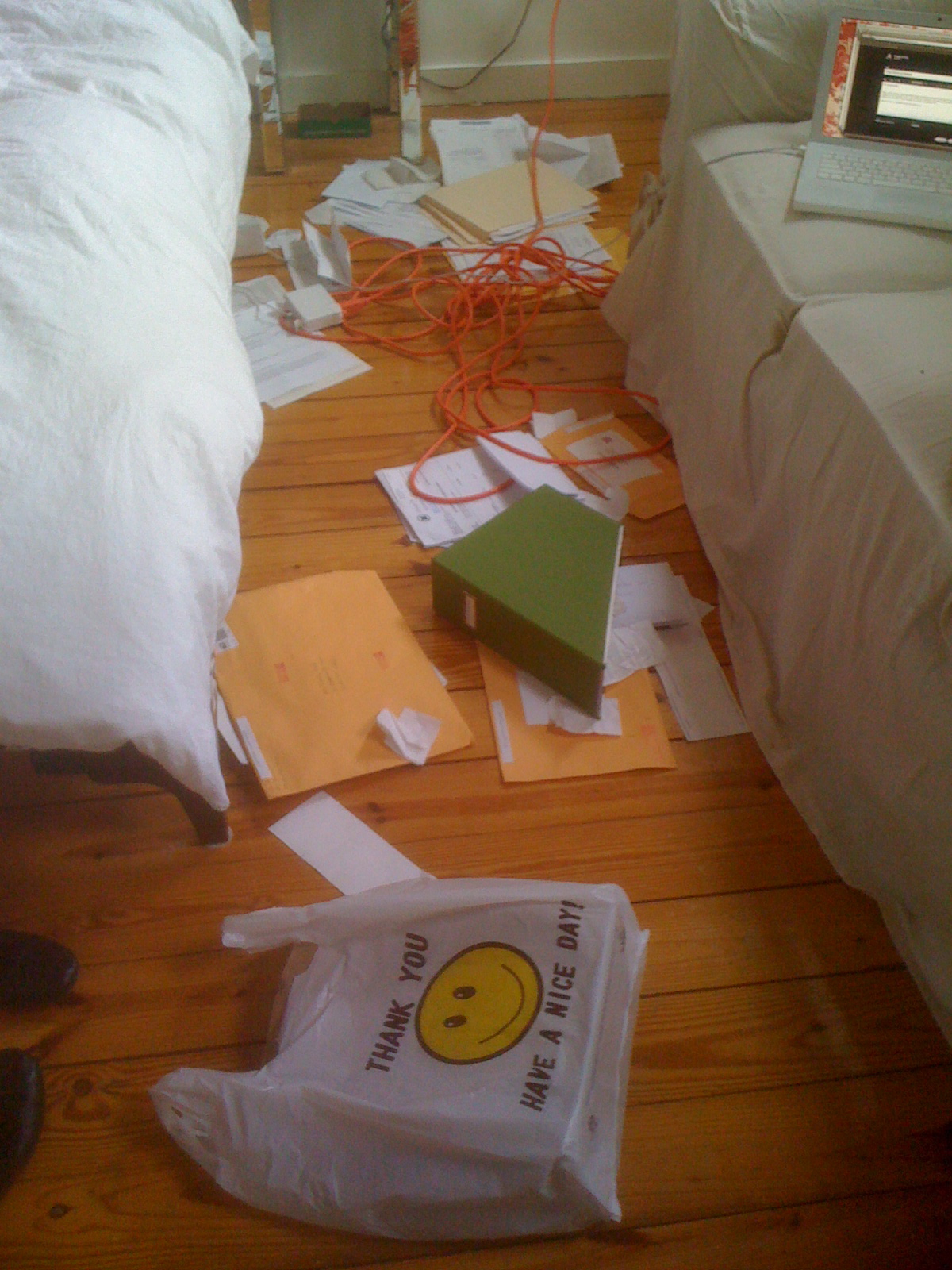
Here is what my bedroom looks like right now:


 (Oh, and “have a nice day” my ass, BTW. It’s mid-April, who are we kidding?)


Because A) I think doing taxes is a perfectly good reason to take to one’s bed and B) when you get to that point in the paperwork where the IRS asks you what form of accounting you use, I always wonder why there’s not a box to check that says “lightning rod for entropy in the universe.”

Or just a picture of this with an X next to it:

And here is what I would like to say to the IRS:


And here is about how well my brain is functioning:


Did I mention what my bedroom still looks like, since I finished the taxes and everything at the very last minute before leaving for the airport? Here’s another shot:


And here is what I feel like, after this week:


So, you know, having to post the day after Neil Nyren is making me feel kind of like this:

Even though I’m sure to the IRS I look like this:


And now I must turn my attention to book number four, which I think I just thought up a title for on the airplane (Crash and Burn, considering it’s about an arsonist and my marriage falling apart and stuff). Though even though I  had a fabulous time in Houston, I am still feeling as though this should be my theme song right now:


But mostly, because it’s all over with, I feel like singing this:


Or maybe doing this:


Although, hey, I would like to sing this to the IRS on behalf of all taxpayers:


‘Ratis, what song would you pick to illustrate this week?


(p.s. For Chris and Louise, the Shonen Knife version:)


In and Out of Shadow

by Zoë Sharp

As a photographer, shadows interest me, but as a writer, they fascinate me. Darkness has a tendency to be absolute, but shadows are open to such interpretation according to mood. Take this picture, for instance, which I took a couple of years ago. It’s of a giant (well 66ft high with a 178ft wingspan) contemporary sculpture by Anthony Gormley called The Angel of the North, just on the outskirts of Tyneside in the north-east of England. Ever since the first time I saw it, this has seemed sinister to me, and I deliberately took this photograph to highlight that feeling. But to the people clustered happily round the statue’s base, it clearly had no such overtones.


And here’s the same statue, taken by Echostains on a totally different day, which gives a totally different view to my own. Blue skies, bright sun. What sinister air?


Everything we do and say is open to interpretation according to the mood of those witnessing our words and actions. Confidence to one person is arrogance to another. One person’s joke is another’s insult. I’ve been guilty for making an offhand remark that was probably somewhat thoughtless on my part rather than purposely cruel, just as I know I’ve made the occasional pointed comment that went straight over the intended person’s head. Many years ago I once wrote an entire comic column gently mocking someone, and they apparently read and enjoyed it without the slightest inkling that they were the target of my dubious humour. (Perhaps this simply demonstrates I’m not very good at that kind of thing…)

Written words are open to far more interpretation than spoken ones. Somebody once told me that there are six ways to read a letter, depending on tone and inflection. I don’t know if that’s true, but I’ve certainly gone into pits of despair reading more (or less) into a brief email than was ever intended by the sender. The immediacy of email and text is causing a real problem, I think. How many people who now email and/or text on a daily basis were ever prolific letter writers before such media came along?

Emails are dashed off, sometimes in anger and haste, only to be regretted later. I have, on numerous occasions, written a vitriolic email and put it in Drafts for a suitable cooling-off period. Quite often, the email never gets sent, but the act of writing it at all has enough of a therapeutic effect.

Because, sadly, the Internet has made it a lot easier to be nasty to people without consequence.

In the past, I’ve been on the receiving end of both death-threat letters – carefully cut out of newspaper like a ransom note – and abusive phone calls left on my answering machine. Both instances involving calling in the police, although there was no satisfactory follow-up prosecution. Now, if I get an email I don’t like, I have a tendency to simply delete it, so the consequences for those who send such poisonous missives are so much less.

Authors, these days, have moved far more into the spotlight. A few short years ago, the only way to contact an author was a letter via their publisher, which was often opened in the office beforehand, just to make sure it contained nothing too outlandish. Or you could approach them at an event, which takes a lot more bottle. Authors could hide in the shadows if they so desired, because there wasn’t the opportunity for self-promotion. Authors were expected to write a good story and that was the beginning and end of it. The only thing the public knew about them was the brief paragraph in the front of the book itself.

Now, of course, an author has to have a website, and most likely a Facebook page and Twitter account, and take part in blogs and online discussions, most of which we are happy to do. Writing is a solitary business and sometimes it’s nice to emerge, blinking, into the light.

We are encouraged to reveal more and more of ourselves, our personal lives and our thought processes, because our readers like to know what makes us tick. Not only that, but we are also encouraged to be performers. We are moving further and further out of those comfortable shadows, while some of our audience is retreating further and further into them. People can open up a dialogue with an author and receive replies, without ever revealing their real name or location.

Pay-As-You-Go mobile phones, and instant email addresses make it hard to trace the senders in any case. I’ve had weird emails from people posing as fans (mainly blokes, I have to say), who lull me into a false sense of security with relatively normal questions to start with, and then start asking coyly if I’m married and what I’m wearing. The awareness of being somehow a ‘public figure’ prevents you from telling them where to get off in no uncertain terms, because you know that would cause more problems than it would solve.

I wonder if the written word is to blame for this. People ask inappropriate or invasive questions without being able to directly gauge the reaction of the person they’re asking. But, having said that, writer friends have reported amazing behaviour from people at conventions. Following an author into the restroom and pushing a book to be signed under the wall of the stall while they’re otherwise engaged is not unheard of.

So, what are your views on this, ‘Rati? Should people be a little more open about themselves before they ask for more information about their favourite author? Do you like the anonymity of the Internet, or does it freak you out just a little? Have you any scary stories to relate?

This week’s Word of the Week is mishguggle, which is a lovely Scottish word meaning to bungle.