Author Archives: Murderati Members


Forgive the Tiger Talk

 by Alafair Burke

Unless you’ve been in a stuffing-induced food coma since Thanksgiving, you’ve probably heard that Tiger Woods was in the news lately for more than just his game.  Given my obsessions with golf, celebrities, and secrets, I can’t resist sharing a few random thoughts I had on the matter. 

When the story (insert virtual air quotes for those of you disgusted by the news coverage) first broke, I tried to convince myself I had high-minded reasons for following it.  At first, I feared for Tiger’s well-being after the initial reports of serious injuries.  Then as a former domestic violence prosecutor, I wondered whether Florida law enforcement was seriously considering investigating Tiger’s wife as some reports suggested.

But there’s also the voyeurism.  We all know (I hope) that we don’t really know celebrities, only the public images that publicists and managers have carefully crafted for us.  But despite that cognitive understanding, consistent and prolonged exposure to those public faces sometimes creates sticky impressions of familiarity.  After more than two decades of nightly Letterman monologues, I confess that David Letterman seemed like a known quantity.  And after countless golf tournaments and Nike ads, so did Tiger.

Now I know.

But I’ve been thinking less about Tiger than about his women.

Rachel Uchitel, the woman first named by the National Enquirer, has seen more than an average person’s media coverage, as photographs online track her journey from grieving 9-11 widow to healing new bride to red-velvet-rope vixen. 


Who is the woman behind all of these faces?

And then there’s Tiger’s wife, Elin Nordegren, who went from swimsuit model to au pair to marriage and motherhood.


I’ve seen countless images of her biting her nails at the 18th green, smiling at her husband, and holding the babies, but I’ve never heard her voice.  Who would have suspected that quiet, smiling, waif of a woman had it in her to (allegedly) take a pitching wedge to the windows of a Cadillac Escalade? 

My guess is she’ll stand by her man, at least in the short-term, but we’ll all be wondering whether it’s out of love or savviness.  With Tiger struggling to hold onto his commercial endorsements, reporters claim Elin’s out to revise her pre-nup. Ten years of marriage no longer required.  55 million dollars instead of 20.  Perhaps clauses that penalize further “transgressions”?*  Jewelry, candy, and flowers just aren’t going to cut it.

We love to fret about the public fascination with celebrity scandals, but I have to confess that I get it.  When I was a prosecutor, my daily work let me peer behind the facade to reveal the secrets people carry.  Celebrity scandals satisfy that same itch – the realization (and validation) that everyone makes mistakes, no one is what he seems, and we all have multiple personas.  That perfect son, husband, and father might be an insatiable dog on his trips to Vegas.  That scantily clad hostess at the nightclub might have lost someone she loved to tragedy.  And that quiet wife in the background might just be a hundred solid pounds of fortitude.

Thanks for tolerating my Tiger talk.  Is anyone else willing to out themselves as a celebrity watcher?  What seemingly superficial stories have kept you riveted and why?

*I found no comfort in the company I was keeping by following this story when I learned the following (pathetic) tidbit: After Tiger’s public admission of “transgressions,” online searches for the definition of that word topped Google’s search list. 

Epic Novels

By Allison Brennan

I bought UNDER THE DOME by Stephen King the day it came out. I had to. I’d heard a birdie tell me it was up there with THE STAND, which is still to this day my favorite book.

I can’t say that I’ve loved every story King wrote, but since he’s pleased me far more than displeased me, I am a loyal reader. It was a King book that was the first, and only, time I read a book for pleasure twice. (THE STAND.) And the first time I began but never finished a book because I just couldn’t get into it, was also a King book (INSOMNIA.)

But when I heaved the 1074 page tome titled UNDER THE DOME out of the Amazon box, I had a tingle. It felt different than the last few books of his that I’ve bought but haven’t read. I opened it up. And I swear, if I didn’t have a looming deadline and five kids to transport and feed, I would have sat down and read it straight through, rising only for potty breaks and water, because of the first three pages. It’s pretty much what I did when I discovered THE STAND in 1982. Except then I was 13, had no children, no job, and could spend fourteen hours a day reading if I wanted to.

It was the POV of the woodchuck that sold me.

I read THE STAND over Christmas break when I was 13, and I am hoping–praying–that my deadline is met, my kids are well-behaved, and I’m done reading the debut novels for the Thriller Awards. I want nothing on my plate the week between Christmas and New Years so I can read this book.

Epic novels usually mean big stories that take place over years or generations. They may be one meaty book (like GONE WITH THE WIND) or a series of books (like John Jakes American Revolution series.) But epic also means larger-than-life, or a big story that perhaps doesn’t extend to the original hero’s great-grandchildren, but details a single story so completely that you could have lived it.

Few authors–perhaps no authors outside of King–can “get away with” writing a 1074 page novel and have success. Some of the YA novels are meaty, however. Libba Bray’s Gemma Doyle trilogy began at 500 pages, then 600, then the final story over 800. My YA daughter devoured all three books–1900 pages–and would have read them one right after the other if they’d all been published when she started the series. In fact, she said each book got better. I think she re-read them all as well.

800+ pages is still rare.

I’ve been thinking about this as I write book two in my Seven Deadly Sins series. There are two primary types of series. A series with the same characters but each book is written almost as a stand alone; while the characters may grow through the series, nothing pivotal happens in one book that is going to make a reader coming into the middle of the series balk. The other type is a series that builds on itself, that what happens in book one lays the foundation for book two and so on.

I’ve been trying to straddle the two types of series. SDS can’t be a series of quasi-stand alones because each book is built on the initial situation in book one, chapter one where the Seven Deadly Sins are released from Hell as incarnate demons. I’ve resolved this problem for book two in part by moving the location plausibly from my fictional town of Santa Louisa to Los Angeles, and the change of setting has definitely helped create a whole and separate story that is still closely linked to the first.
Yet, when I held UNDER THE DOME, I considered what if . . . what if I could have written my series as one epic novel? The thought had never occurred to me before because it simply isn’t done. Much. And it would have taken at least a year to write, if not longer, plus time to edit and produce a 1000+ page book. Few authors could survive more than a year or two without a book on the shelf with their career still intact. Especially not a mass market author like me. Considering that ORIGINAL SIN, the first book which checks in at a mere 464 pages, took me longer to write than any of my 12 previous novels, I don’t think the two year window would have been unrealistic.
It’s a moot point, obviously, but something that has been on my mind for a few weeks. I’ve come to the conclusion that 1) mass market commercial fiction may publish epic series, but not epic single novels; 2) some authors transcend publishing “rules”; and 3) some genres–like fantasy and YA–can support longer novels (600+ pages) which may or may not be “epic” but have a sense of being larger-than-life, meaty, worthy of a reader’s precious time.

But just like long books may lose readers because of the size, so do short books. My mother was sorely disappointed in a couple recent books by some of her favorite authors that were only around 200 pages. She felt she didn’t get enough story or depth for the money. And if I were to spend $20 on a hardcover, I’d probably be kind of ticked if I felt the story was truncated or superficial.

However, one of my all-time favorite books is a very short book. ANTHEM by Ayn Rand comes in at 68 pages. The Cliff Notes for ANTHEM are longer!

How do you feel about big books? Short books? Epic novels or epic series? Do you re-read favorite books and if so, which is your favorite re-read?


STEP RIGHT UP AND SPIN THE WHEEL…

By Stephen Jay Schwartz

Next week I check in for Jury Duty, and I really wish I could afford to be placed this year.  As it is, I’ll have to try to appear “unappealing,” so I don’t become one of the chosen ones.  I think saying I’m a crime novelist will do the trick.

A number of years ago I had one of the coolest experiences ever.  I was working at Disney Studios and they paid my normal salary while I was on Jury Duty.  Out of the dozen or so jobs I’ve had in my life, this was the only time my employer actually paid for Jury Duty.  Which was great, because I sat on that jury for three weeks.

It was a murder trial.

Now, I’d spent some time pulling cable on Judge Wapner’s The People’s Court, and I even worked as a director’s apprentice on an episode of Jake and the Fatman, so I figured this courtroom thing was going to be a piece of cake.  I soon learned the difference between “TV Land” and The Real Fucking Deal.

Here’s the scenario:  A guy and a girl in their twenties were sitting in the front seat of a car.  They were a couple.  Their “friend” was in the back seat.  The girl was driving, with her boyfriend in the front passenger seat.  The guy in the back pulls a gun and shoots the other guy in the back of the head.  He tells the girl to keep driving.  They end up in her apartment, where he rapes her at knifepoint, and then leaves.

What I found amazing was the killer managed to create an excuse for every bit of circumstantial evidence connecting him to the homicide.  It seemed that, through the discovery process, he was able to study the evidence gathered against him, and then create, probably with the help of the cheeseball lawyer he’d hired, a convenient explanation for why it looked like he had killed someone.

I can’t remember all the details, except that the two guys were going to “jack” some guy’s house that night, that they’d shot up a drug-dealer’s apartment earlier, blah, blah.  These guys were not missionaries.  Ultimately the suspect said that it was the girl who did it, that she killed her boyfriend and came to him looking for help to get rid of the gun and other evidence that was still in the car.  This explained his fingerprints at the scene, it explained the blood on his hands and clothes, it explained his behavior when he was questioned.  Her boyfriend’s body, by the way, was left in the car.

There was no usable evidence tying him to the rape of the girl.  Basically, after all was said and done, it came down to his word against hers.  Yet, in my opinion, the circumstantial evidence was enough to hang the guy.

As jurors, we heard testimony from ballistic experts, gunpowder residue experts, the coroner, blood spatter professionals, and a private investigator, among others. 

And then we heard the testimony of the girl.  I’ve never heard anything so real, so intense.  And I’ve never seen a film, TV or stage actor come across more believable.  Although her words did not constitute “evidence,” they left an indelible mark on my mind. 

I knew nothing about the other jurors during the trial.  None of us discussed the case.  We did it by the book.  Then came the deliberations.  Suddenly the place was alive with character, passion and conflict.  It was Twelve Angry Men, with the addition of women. 

After all the evidence had been considered, after days of detailed analysis, we had eleven jurors prepared to convict the guy.

One juror held out, because he thought the prosecutor had an attitude.

Yes, the prosecutor had an attitude.  He was like a caricature of a1950s ex-homicide cop, with the same antiquated Dragnet-era prejudices.  He’d come right up to the Jury Box, his fingers shaped like a gun held in the air, and dramatically yell, “Pow!” while describing the deadly gunshot.

Eleven of us ignored his antics.  We looked at the evidence and made the best decision we could.  One juror held out.  And that constitutes a mistrial.

As I see it, a guilty man was set free that day.  Of course, the state could’ve chosen to call for a re-trial.  Or they could’ve plea-bargained a deal with the guy’s schiester lawyer.  I never learned the outcome.

A couple years later I was again placed on a jury and I couldn’t wait to get started.  I wanted to sit on another murder trial.  Then came the case:  A small dent on the back of a car, a driver suing his insurance company, a stack of chiropractor bills, the insurance company proving beyond the shadow of a doubt that the driver was trying to bilk the system. 

Boooooring.

I guess you never know what you’re gonna get when you spin that jury wheel.

What about the Murderati Clan – what have you taken away from the Jury Room?  (And I’m not talking about pencils and staplers!)


Interlude

by Brett Battles

We’ve talk about music here a lot. Music that inspires us. Music that entertains us. Music that we like for no particular reason.

One of the topics that comes up often with a lot of writer friends is which of us can listen to music while we work, and if we can, what kind of music do we listen to. I think I’ve even discussed it here before.

Well…it’s on my mind again because I’m just finishing up the draft of my stand alone, and music has played an integral part in keeping me focused and on pace.

I’ve mentioned in previous posts that this particular novel has basically thrown itself on the page as fast as my fingers can hit the keys of my laptop. I started it at the beginning of November, and (hopefully) am finishing it this week. Fastest book I’ve ever written. All I can say is that I couldn’t have done it without music.

Since I work for the most part at coffee shops, and exclusively at one coffee shop/café in particular, in addition to keeping me moving forward, the music also drowns out the noise of what’s going on around me.

For this book, I created a specific playlist on my iTunes to write by. I’m one of those people who has no problem listening to lyrics while I write…though, oddly, when I do re-writes I prefer my tunes to be instrumental. (And, yes, I have a specific playlist for that, too.)

This particular writing playlist is made up of music that hits me on an emotional level. These are songs that heighten my creative juices, and, I’m pretty sure, actually increase my heart rate. Sometimes I’ll even sway back and forth as I type…yes, even in public. (Ask Tim Hallinan if he’s seen me closing my eyes and get my groove on, he’s working at a table ten feet away as I write this.)

I love being in an emotional state when I write…Anyway, since I am in the middle of writing the climax, I thought I would share that playlist with you. I’ve provided links so you can hear each.

In no order (or, in iTunes parlance, Shuffle Mode):


Yellow – Chris Martin 

I’ll Stand By You – The Pretenders

Saeglopur – Sigur Ros

Answer – Sarah McLachian

Levon – Elton John

Pink Moon – Nick Drake

You’re Beautiful – James Blunt

Into My Arms – Nick Cave – (Great Video!)

The Loneliest Guy – David Bowie

Five Years – David Bowie

The Blower’s Daughter – Damien Rice

Wires – Athlete

A Thousand Miles (Interlude) – Vanessa Carlton – There’s a commercial at the start of this, but video worth the wait

My Immortal – Evanescence

Falling Slowly (From the movie ONCE)  – Glen Hansard & Marketa Irglova

Untouched – The Veronicas


You might like some, you might not others. But one thing they all have is an emotional tug that, for me, pulls me from word to word to word.

Okay, ‘rati, let’s hearing some of your favorites…emotional and/or just for writing.

The road to Hollywood

by Tess Gerritsen

By the time you read this, I will be in Los Angeles.  I’m going there to watch the filming of the pilot TV episode of “Rizzoli”, which is based on characters from my crime series.  Even now, as I pack my suitcase, I’m marveling that it’s all actually happening. I don’t quite believe it.  I keep expecting to get a call from my agent telling me, “Never mind.  It’s all fallen apart.”  Because that’s the way it almost always goes.

 I should know, because I’ve been down this road of dreams before. And the one lesson I learned a long, long time ago is that Hollywood will break your heart.

It’s not that I haven’t had something produced before.  Back in 1993, CBS aired a TV movie of the week called “Adrift,” starring Kate Jackson and Bruce Greenwood.  The TV movie was based on a screenplay I’d written.  Although the script was changed, and two other writers were listed first as writers, I still got the “Story by” credit, and shared the screenplay credit.  The movie was filmed in New Zealand, and I didn’t have the money to fly down there and watch the production. But it was quite a thrill sitting in front of the TV some months later, seeing my name pop up on the credits, and watching scenes that I had dreamed up play out on the screen.  

And that was my lone success in Hollywood.  After that came sixteen years of disappointments.  

My first thriller, HARVEST, was bought outright by Paramount for a generous purchase price.  A screenplay was written, changing pretty much everything about the story.  The project died.

BLOODSTREAM was optioned.  Twice, I think.  Nothing happened. Project dead.

Feature film rights for GRAVITY were bought outright by New Line Cinema in a very major deal that showed up on the front page of Daily Variety.  Three different screenplay versions were completed, including one by the very talented Michael Goldenberg.  The film rights were later transferred to 20th Century Fox.  And there the project died.  Of course.

THE SURGEON was optioned twice.  And died.

THE APPRENTICE was optioned once.  And died.

I grew so jaded by the whole disappointing process that when my agent called to say that Bill Haber of Ostar Enterprises wanted an option to develop a TV series based on my characters, I didn’t see the point of celebrating.  I had no illusions that anything would come of this deal, either.  I had stopped paying attention to Hollywood.  My job was to write books, and that’s what I stayed focused on.

Then I began to notice that there was something a little different about this particular option deal.  For one thing, soon after the agreement was made, I got a call from the delightful Bill Haber himself.  He wanted to tell me how much he loved the characters of Jane Rizzoli and Maura Isles.  He promised me they would make it to the screen exactly the way I’d created them.  He told me he was going to find just the right writer for the script, and that he believed this project was actually going to happen.

I thought he was funny, charming, and a bit deluded.  I knew how Hollywood worked.  It’s all about promises and bluster which, 99.9% of the time, never delivers.

A year went by.  

To my surprise, Ostar Enterprises renewed the option for yet another year.  Every few months, Haber would call just to say hello, and I loved hearing the enthusiasm and pure joie de vivre in his voice. He told me that he had convinced a writer named Janet Tamaro to tackle the pilot script. With writing credits on “Bones,” “Lost,” “CSI,” and “Sleeper Cell,” she is definitely a go-to writer for crime dramas.  I was delighted to be kept in the loop on all these developments. But I still didn’t let myself get excited.  I knew it just wasn’t going to happen.

Months went by.  

Then another call from Haber, happily announcing that after several revisions, Tamaro’s script was wonderful.  And they were sending it over to TNT’s director of programming for approval.  Fingers crossed!

Yeah, right, I thought.  My fingers are permanently crooked from staying crossed for sixteen years.  Come on, Hollywood, break my heart again. You know you’re going to.

I packed my bags and left for a long-planned trip to Turkey.  While there, I got a two-line email from my CAA film rights agent:  “Good news.  TNT has issued a cast-contingent production order for ‘Rizzoli.'” So there I am, on a sailboat off the Turkish coast, wondering whether it’s worth celebrating yet. I don’t like that word “contingent.”  To me, that’s just legalese for “we’re prepared to break your heart again.” 

When I get home, I call Bill Haber.  He says they’re preparing a list of actresses they want to approach for the part of Jane Rizzoli.  Without just the right actress, the whole deal would fall apart.  (Which is what I’m sort of expecting, anyway.)  My CAA agent assures me that they’ve landed a terrific director, and everything is moving in the right direction. I’ve heard that before.  I put the whole thing out of my mind, and get back to the manuscript that’s due in a few months.  

I leave for Connecticut, to speak to a library.  I wake up in my hotel room to find an alert on my Blackberry.  It’s an article from the Hollywood Reporter, announcing that Actress Angie Harmon has been cast in the lead role as Jane Rizzoli.

Suddenly, everything has changed.  This much I understand about Hollywood: once the star talent has signed on, the deal comes together fast.  And it does.  

Within the next few weeks, other actors sign on.  Sasha Alexander as Maura Isles.  Lorraine Bracco as Jane’s mother, Angela.  Bruce McGill as Detective Korsak.  Lee Thompson Young as Barry Frost.  Jordan Bridges as Frankie Rizzoli.  And Billy Burke as the all-important romantic lead, Gabriel Dean.

A month before production is scheduled to start, Janet Tamaro, who is now co-executive producer, calls to invite me to watch the filming.  

That’s when I really, really knew it was going to happen.

They’ve already started production. The shoot will last about 2 1/2 weeks, and I’ll be there during the second week of filming.  I’m fully aware that this is just the pilot, and TNT may choose not to pick it up as a weekly series.  But this is way, way beyond anything I ever expected. I assumed it would fall apart, as every film deal before it has.  I didn’t even bother to hope.  

Maybe it’s like finding true love.  The harder you look for it, hope for it, hunger for it, the less likely it is to happen.  But if you turn your back and just get on with your life — and your writing — suddenly, there it is. 

For once, Hollywood didn’t break my heart.


NaNoWriMo & MeMo

by Pari

Contests and I have a fairly testy relationship. You see, I don’t tend to win them. And not winning tends to engender all kinds of pesky feelings like, well, insecurity, anger, envy . . .

Yeah, I know. Pretty unproductive, hunh?

So when I heard about this whole wacko NaMoWriMo contest – the writing of a 50,000+ word novel during the month of November when holidays demand attention too – I wondered why anyone in his or her right mind would sign up. What possible benefit could there be to having to write so fast there wouldn’t be time to edit? I mean, really. That would just be another 50,000 words added to the crappy inventory of crappy stuff already out there.

Of course, I wasn’t thinking about anyone else’s output. Just my own. 50,000 words in 30 days? It’d have to be crap. Right?

(At this point you might wonder how, with such a negative attitude, I manage to get up each day. . . especially at 6 AM. Believe me, it’s a struggle.)

Well, this year, having gone to the intensive master class and wanting to put a fire under my productivity anyway, I defied all my initial objections and committed.

From November 1 until today . . .

I didn’t
— upload a single word count at the website
— sign up for a single forum to chat with others about the experience
— watch videos for encouragement
— talk with friends or anyone else about what I was doing (not really)
— edit my prose
— worry about the crappy quality of the writing DURING the act of writing (night-time sweats were another thing, of course)

I did
WRITE 52,000+ words in 26 days*

And today, after “winning” this contest, I’m sitting here wondering if I should bother turning in the manuscript for the final word count.

Because, you know what? I’m not sure I need other people to know I’m a winner on that website. My sense of accomplishment has more to do with having done it than announcing it to the world (except my Murderati buddies, of course).

But I’ve got to admit, I feel GREAT! 

I’m not done with the novel yet – maybe 2/3 of the way through – but I know where I’m going with it. As of tomorrow, with the end of the contest, I’ll have time to do a little research on some questions that came up during the writing. And I think, realistically, I’ll have the first draft of the entire book before the end of the year.

Sure . . . some of the writing in this new book is really bad. Some of it is really good.

So what?

I’m 52,000+ words closer to completing a new novel than I was on November 1.

The beauty of committing to NaNoWriMo – at least for me – was just that. I committed. I didn’t second-guess myself about the writing. For 26 glorious days, I ignored all the junk that can impede a writer’s originality and output. [During the same time period, I also wrote a few short stories and an article for a local magazine.]

And you know what?

I really, really felt like the writer I want to be. Butt in chair. Working. No excuses. Reveling when the words flow. Pushing through when things get tough and the Muse and I are trying to find ways to torpedo each other. 

I loved it all.

Every damn minute of it.


Today I’m wondering about several things:

—  Have you participated in NaNoWriMo? If so, what did you think of the experience?

— Should I upload my manuscript? Is there a benefit to doing that of which I might not be aware?

— If you haven’t tried NaNoWriMo, is there another similar experience you’ve had where you were required to jump in without self-censorship and just make it happen within a defined period of time?

I’m looking forward to your answers today. Our conversations are always so interesting.


*I had to go out of town during the contest and couldn’t be alone to write during that time. So I had to finish early.

Thank You. Thank You Very Much.

By Cornelia Read

I am having Thanksgiving in Vermont with my cool auntie and uncle-y and life is good. I was thinking Thursday about all the things I am thankful for this year, and would like to share my top ten in the hopes you will do the same.

1. I am thankful for my kids.

2. I am thankful for my health.


Some day, I’d like to be thankful for health insurance, too.

3. I am thankful for my friends.

4. I am thankful for the thousands of hours of pleasure reading has afforded me, and thankful that I might in some small way return the favor.

6. I am thankful my divorce is almost final.

7. I am thankful for my gigantic nutty extended family, without whom I’d have very little to write about.

8. I am thankful for my new home, even if it’s probably going to snow eleven months out of the year here.

9. I am thankful that things are looking up.

10. I am thankful that my third book is coming out in March, and that my fourth book seems kind of okay so far.


How about you guys? What are you thankful for?


Always Happens …

by Zoë Sharp

The irony does not escape me, as the only non-American member of the ‘Rati crew, that the Thanksgiving blog falls to me. So, Happy Thanksgiving, folks!

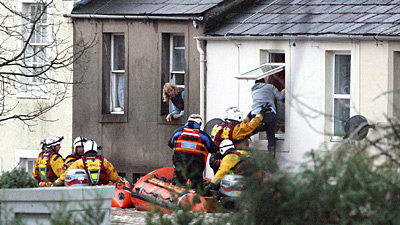
I must admit, sitting down and having a family celebration has not been high on the priority list over here this last week or so. Cumbria has been struck by torrential rain and dreadful flooding, and yesterday we had our first power-outs, no doubt as a result.

But, at least we haven’t had to be rescued by breaking holes in the roof of our house and being winched to safety, like others elsewhere in my home county. We’ve had flash-flooding at home in the past, though, including sudden mud slides, and all the victims have my absolute sympathy.

I could say a lot more about this, but I won’t. I realise that to many it’s a small disaster in a small corner of a small country. It would appear that my attempts at serious, heartfelt blogs are often not my most successful efforts. I’ve tried it a couple of times now and been met with something close to embarrassed silence, so I’ll change the subject and get back to the writing.

Not that that helps much. I’ve been researching the cheery subject of coma patients this week, with the assistance of the ever-knowledgeable DP Lyle MD. Doug is an award-winning mystery author as well as having practised as a cardiologist for the best part of thirty years, and he’s been brilliantly helpful when it comes to my medical queries, because it bugs me to get things wrong.

In trawling round the Internet looking for answers, though, I came across this article about how TV and movie portrayals of coma patients are not only inaccurate, but can influence relatives of genuine coma patients into incorrect decisions, based on their false perception of the condition. Coma patients on TV and in the movies always seem to look like sleeping beauties, with perfect muscle tone, healthy tans, and no apparent method of receiving long-term nutrition, never mind, erm … getting rid of anything. (See Steven Segal in ‘Hard To Kill’, one of his more incredibly cheesy efforts.)

And that led me, as is so often the case, to what other common misconceptions arise from the movie world, and onward, almost inevitably, to Movie Clichés. Here are some of my favourites.

All cars, when pushed off a cliff, or involved in an accident, will explode in a giant fireball. How the auto manufacturers have been getting round the stringent crash-testing regulations all these years is anybody’s guess.


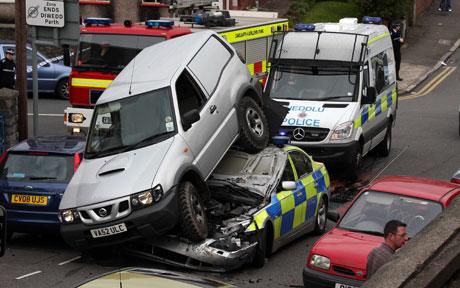
All police vehicles involved in a car chase will end up crashing into either each other, or civilian vehicles, and at least one will end up on its roof.

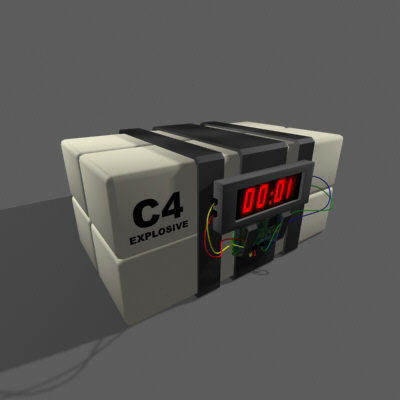
All time bombs will have a handy digital countdown readout, prominently displayed for the hero to find in the nick of time. However, the hero will not be able to disarm the device until there is one second remaining on the clock. The exception to this is the nuclear bomb in the James Bond movie, ‘Goldfinger’, which was disarmed with the readout on 007, of course.


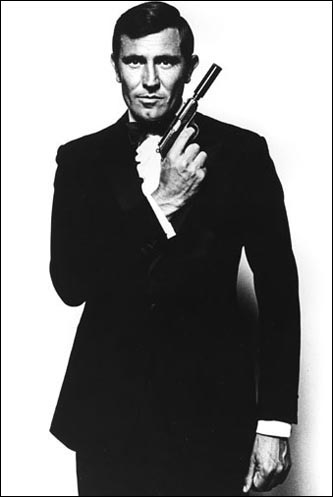
All movie heroes will creep around in dangerous situations carrying their guns up by their faces, so the camera can get a nice dramatic close-up of the actor’s face and the gun in the same shot.

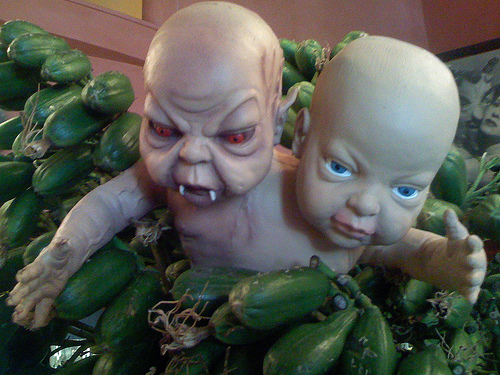
Of all twins, at least one will be born evil.

Dogs instinctively know who the bad guys are and will bark at them. Unless the movie hero is trying to creep into the enemy stronghold in the dark and it’s time to make the audience jump. In which case the hero will either a) calm the dog with a hard stare or b) move away, when the dog will stop making noise immediately, and the villain’s guards will not come to see what the fuss was all about. Under NO circumstances will the hero kill the dog.

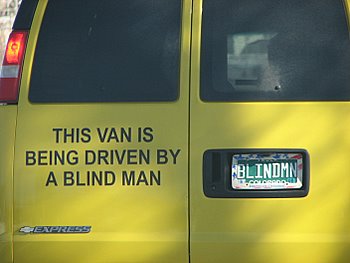
If a movie has a male character who is blind, at some point he WILL end up driving a car. (‘Sneakers’)  Or, if a female character, she will end up tapping around a bloodstained building while being stalked by the killer. (‘Blade: Trinity’)

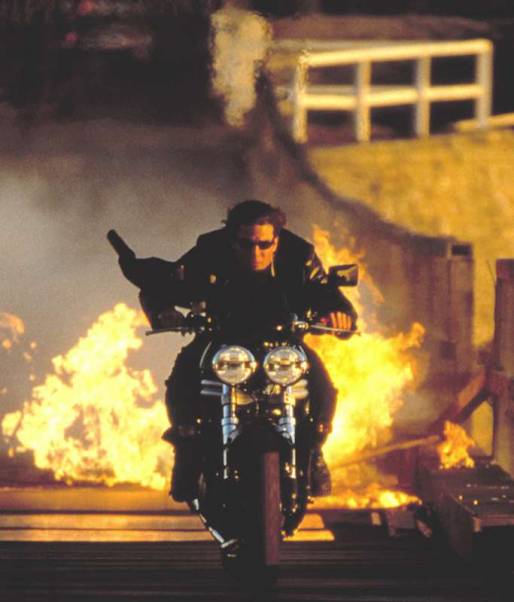
All motorcycles ridden by the hero will morph from a race replica during the highway chase scene, to dirt bike, complete with knobbly tyres, for any off-road bit of the sequence. The engine note will remain the same throughout, however, and won’t belong to either bike in any case.

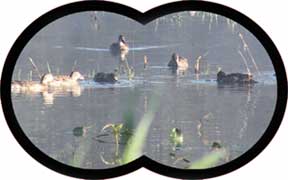
Anybody looking through binoculars will see a a binocular-shaped view, regardless of how the human eye/brain works.

Whenever anybody walks into a bar in a western, there will be a fist-fight, usually involving the piano player.

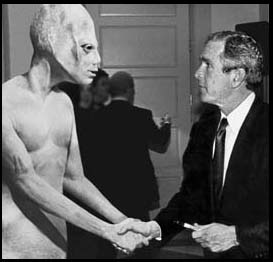
Aliens in movies will almost always have the anatomy of a man in the rubber suit.

(Erm, the alien is the one on the left – I think.)

The only exception to this is ‘Starship Troopers’, which played on our general phobias of creepy crawlies and was therefore genuinely scary IMHO.

And finally, any alcoholics portrayed in movies will be able to give up the drink when called upon to do something important to the plot, and not show any side-effects, withdrawal symptons, etc.


There are hundreds more, I’m sure. What’s your favourite movie cliché?

This week’s Phrase of the Week is to ride roughshod. It came from the practice of shoeing horses with the nails deliberately left protruding so as to provide better grip in icy or wet conditions. In the 1700s cavalry horses were often roughshod or had sharp objects attached to their hooves to damage the enemy during a charge. However, it was quickly discovered that the poor horses did as much damage to themselves, so this idea soon fell out of favour. It’s interesting, though, that if someone tries to ride roughshod over you, they could be doing themselves more harm than they realise in the process …

If I don’t respond to comments right away, it could be that we’ve lost power again, so please bear with me. It’s just started tipping it down again …

Oh, nearly forgot – if anyone’s going to Collectormania at Olympia in London this weekend, I’ll see you there on the Saturday. Drop by the Mystery Women booth and say “Hi!”

Cover Me

by J.D. Rhoades


A few days ago, I was browsing in one of those big chain bookstores when a title on the “staff recommendations” shelf   caught my eye:


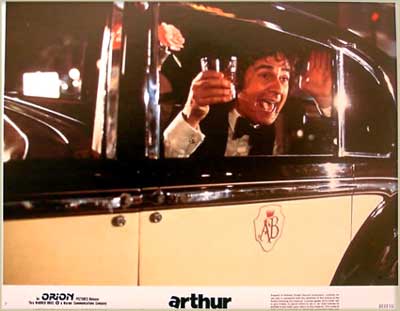
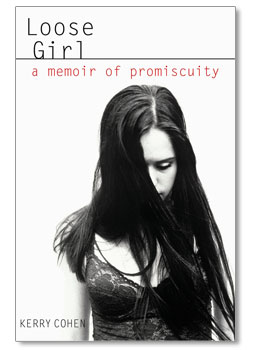
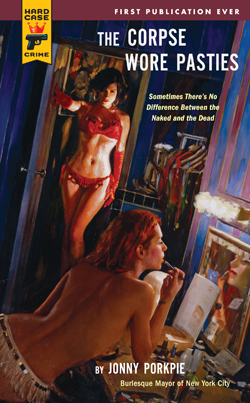
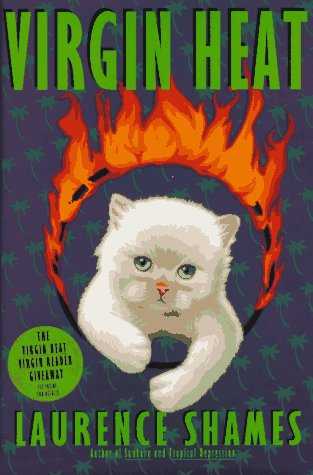
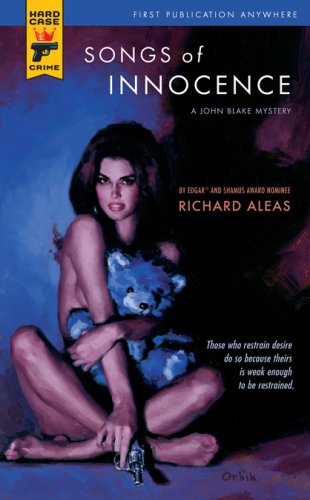
Two thoughts went through my head, one following hard on the heels of the other: (1) “Hmmm, that looks interesting,” and (2) “If you are ever seen in public reading this book, you will be marked for life as the skeeziest middle-aged creep ever to walk the planet.”

I didn’t get the book.

Yes, I’m one of those people who  read in public. You can see us in the parks and restaurants, our meals or drinks barely tasted, our minds wandering in whatever world we’ve decided to carry with us to wherever we’ve come to rest. But as a public reader, I occasionally find myself leaving a book at home, even one I’m totally into, because of the cover.

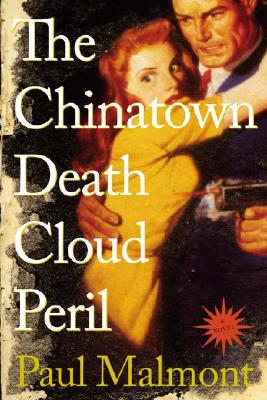
I’ve heard that in Japan, it’s not considered remarkable for middle-aged salarymen to openly read hard-core pornographic manga on the subway. But I can’t imagine even sitting in Mac’s Breakfast Anytime reading,  for example,


Or:

without drawing stares.


It was awkward enough the Christmas I opened a box at my in-laws’ house and pulled out a gift from my sister-in-law:


 which resulted in those frozen smiles my mother- and father-in-law  always get when they’re confronted with something even vaguely risque. (They are, to be fair, extremely nice people, but they don’t know from hardboiled, much less noir).

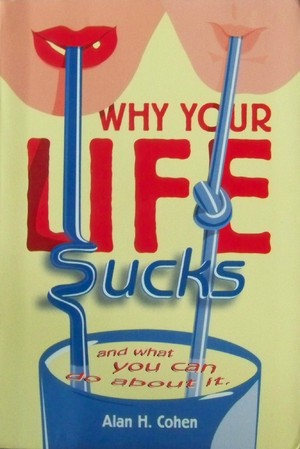
It’s not just the covers with steamy subject matter or scantily clad women. I don’t go in much for self-help or self-improvement books (can’t you tell?) and I’ve never read


But can you imagine reading it in front of a room full of people? And what would you think of someone reading one of these:


over their MegaMaxi Enchilada and ElGrande Nachos (with extra cheese) at Bob’s Burrito Barn? Nothing complimentary, I’m thinking.

Culturally sensitive guy that I am, I once left


at home because I was paranoid about getting the stink-eye from the wait staff at the Peking Wok.

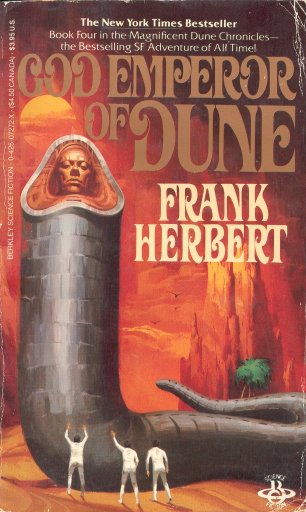
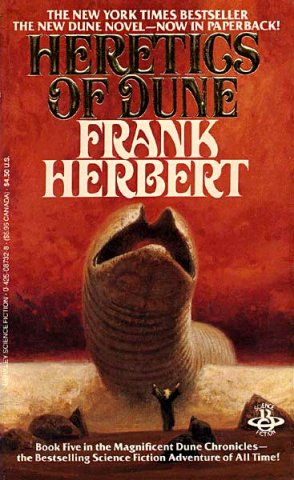
I’m sure that the science fiction fans among you are familiar with the phenomenon. SF and fantasy, after all,  are famous  for some of the cheesiest, worst-conceived covers ever. There are, of course, the types of fantasy covers that John Scalzi once summed up as “strippers with swords,” but there are some classic SF covers that, shall we say, give one pause. Like these…


…which are, to put it mildly, Freudian as hell.

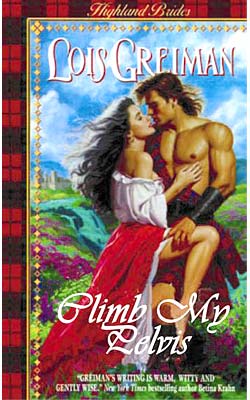
What do you think? Am I just being neurotic?  Do you read in public? Have you ever left a book home that you wanted to read because of the cover? Or do you just not give a damn? I’m particularly interested in hearing from the romance fans, who are used to stuff like this:


(Okay, that’s not an actual title. It’s from this great website of Romance Covers That  Never Were, which I recommend to all).

Hope all the US ‘Rati have a happy Thanksgiving, and all our non-US friends…well, have a good Thursday!


Disappearing Inc.


By Louise Ure


Back in August I got an email from an old friend, Jake Young, the Managing Editor at WIRED magazine. “I generally avoid spamming my friends with WIRED stories, but this one – about how to ditch your current life and start over – seemed perfect for you.” 

He was right.

In that article, WIRED writer Evan Ratliff chronicles the attempt by Matthew Alan Sheppard to fake a suicide and disappear. And writing the story led him to wonder just how difficult it would be for someone to drop out of their current life and disappear completely in this digital age.


“Starting over, however, is not as simple as it used to be. Digital information collection, location-aware technology, and post-9/11 security measures have radically changed the equation for both fugitives and pursuers. Yesteryear’s Day of the Jackal-like methods for adopting a new identity — peruse a graveyard, pick out a name, obtain a birth certificate — have given way to online markets for social security numbers and Photoshop forgeries. Escapees can set up new addresses online, disguise their communications through anonymous email, and hide behind prepaid phones.

In other ways, however, the advantage has tipped in favor of investigators. Where once you could move a few states over, adopt a new name, and live on with minimal risk, today your trail is littered with digital bread crumbs dropped by GPS-enabled cell phones, electronic bank transactions, IP addresses, airline ID checks, and, increasingly, the clues you voluntarily leave behind on social networking sites. It’s almost easier to steal an identity today than to shed your own. Investigators can utilize crosslinked government and private databases, easy public distribution of information via the Internet and television, and data tucked away in corporate files to track you without leaving their desks. Even the most clever disappearing act is easily undone. One poorly considered email or oversharing tweet and there will be a knock at your door. As missing-person investigators like to say, they can make a thousand mistakes. You only have to make one.”


He decided to find out for himself and on August 13, 2009, Evan Ratliff disappeared.

Although he had an emergency link to his parents and his girlfriend, no one, not even his boss at WIRED who had organized the hunt, knew what his name would be or where he would go.  His goal was to remain undiscovered for thirty days. If someone tracked him down they were to approach him and use the word “fluke” and take his picture. The prize money for the discovery was $5000, much of it coming from Evan’s own pocket.

The “hunters” – some professional missing-persons trackers and some high-tech junkies – were given lots of personal information to aide in their pursuit, just like the police or a regular PI would discover in looking for a missing person. In Evan’s case they knew his middle name, his credit card and telephone numbers, and his email and Twitter accounts, along with the fact that his diet was gluten-free and he was a rabid soccer fan.

Here’s the story of his run. 

Evan’s accounting of the time-consuming, attention-requiring, ultimately lonely life of the runaway is an incredible read. Traveling under the name James Gatz (the name that Jay Gatsby drops to start over in The Great Gatsby),  he was far more wiley and technologically savvy than I would ever know how to be, using online cut-outs and identity concealing apps, hitching rides, making up friends, and making it through several close encounters with nothing more than sheer bravado. I’m not sure I would have been as successful, although I think I would have done better in the disguise department than he did.

But it got me thinking: could I disappear? If I needed my own version of Witness Protection or just wanted to drop out and get away from sixty years* of being Louise Ure, could I do it?

Ratliff says to go someplace you’ve been before so that you at least have a cursory overview of the city and its transportation system. That doesn’t sound right to me; I think I’d have to go places I’d never been before otherwise I’d likely run into old friends on the street or haunt my old favorite restaurants. I guess that means you’d be looking for me in the mid-West.

I’d have to give up smoking; there are too few smokers, especially of my brand, to not be obvious.

What else would give me away? My book buying habits? My tendency to visit liberal blogs? My love of Golden Retrievers? My absolute inability to not check in with my family.

What about you, ‘Rati? What one “trick” would you be sure to use? What would catch you up in the end? And have you ever want to just disappear?


* BTW, I’m not really sixty yet. I always add a few years just so I can get used to saying it by the time the real age rolls around. And in the meantime I can bask in those “Gosh you look good for your age!” comments.