Author Archives: Murderati Members


Scary Stories

A man was driving late one night when he saw a young woman walking by the side of the road. Thinking that it wasn’t safe for her to be out and alone so late on a lonely country road, he stopped and asked her if she needed a ride. She gratefully accepted. She told him she was trying to get home and gve him directions to her house. The driver tried to engage the girl in conversation, but she was strangely uncommunicative, telling him only that she wanted to go home.


When they arrived at the darkened house, the driver got out and walked around to the passenger side to open the door, thinking to walk her to her front door. 

She was gone. 

The puzzled driver walked up and knocked on the door, wondering if the girl had somehow managed to get out without him noticing. An old woman answered. When she saw the man standing there, she smiled sadly.  “I know who you’re looking for,” she said. “And she’s not here. She was my daughter. She was killed in a car wreck ten years ago on her way back from the prom. And every night on this date since, some man has come here, telling me that he picked her  up by the side of the road. But she never makes it home.”

***

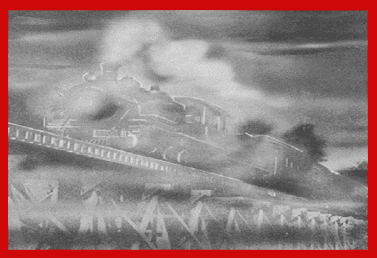
Maco, North Carolina, lies along the line of the old Atlantic Coast Line Railroad. On a foggy, rainy night in 1867, a brakeman  named Joe Baldwin was working the night train headed for Wilmington. By some mischance the caboose became uncoupled from the train and stranded on the tracks. Joe knew another train would be along soon and his duty was to try to stop it before it collided with the stranded caboose. He ran down the tracks, swinging his lantern.


When he saw the lights of the train behind, he waved even more frantically. Unfortunately, the oncoming locomotive failed to see him in the fog. It struck poor Joe, killing him instantly.

Since that night, people walking along the tracks near Maco Station have reported a strange light appearing alng the tracks, moving from side to side. They say it’s the ghost of  Joe Baldwin, searching for his severed head.


***

In the early  19th century, in the town of Bath in Northeastern North Carolina, there lived a dissolute young man by the name of Jesse Elliot. Jesse loved to drink, gamble, and race Fury, his champion  stallion. He’d never been beaten on that horse, and he swore he never would.

One Sunday, a stranger, all dressed in black, arrived in town on a huge black horse. He challenged Jesse to a race, and Jesse, already half drunk, agreed. Some of the other citizens of the town scolded him fotr drinking and racing on Sunday, but he laughed them off and had another drink. 

The race began, the horses thundering down a nearby country lane. The stranger’s horse kept up with Jesse’s, then began to overtake him.


As they rounded the big oak tree that was the halfway point of the race, a spectator called out that it looked like Jesse was going to lose this one. “I’ll ride this horse to victory or I’ll ride him to Hell!” Jesse shouted back. At that moment, Fury pulled up suddenly, throwing Jesse against a nearby tree and killing him. The stranger pulled up beside Jesse’s limp body, and for years, onlookers would shiver as they described his chilling laugh. Then he spurred his horse and rode away, never to be seen again in those parts.

To this day, you can still see a set of mysterious depressions in the ground near where Jesse died.


Nothing grows in them, and obects placed in them are gone the next day. In the 1940’s, a newsreel cameraman named Earl Harrell came to Bath and performed an experiment. He filled the holes with dirt and leaves, then made a webwork of back thread over them. The next day, the thread was undisturbed, but  the holes were empty. The locals debate whether the mysterious depressions are the hoofprints of Fury or of the great black stallion whose rider tempted Jesse to his death.

I hope you have a happy Hallowe’en this weekend! And please share your favorite ghost stories, from wherever you live.


Fear of Ice Cream


By Louise Ure


Gelatophobia. Okay, I know it doesn’t mean Fear of Ice Cream, but gelatophobia is what I’ve got.  The fear of being laughed at.

(For the moment, I’m going to ignore the topic of words that don’t look like what they really mean. “Gelatophobia,” for one. “Rosacea,” for another. It should be a beautiful Latina’s name instead of a skin desease. But that’s a blog theme for another day.)

Unlike our Rob, whose video rendition of “Mandy” in last week’s blog post proves he does not suffer from this malady, gelatophobia has shaped me in ways that I could never have imagined.

And I blame it all on the circus.

We weren’t big on family outings when I was growing up. We had one driving vacation as a family and that was to Disneyland and San Diego. I got a nail in my foot at Disneyland and got picked up by the cops as a lost child in San Diego.

I remember only one family dinner in a restaurant and that was a Bob’s Big Boy. My mother learned her lesson after that. I’ll bet the waitress still has nightmares.

And then there was the circus. All five of us kids were lined up like jaybirds on the sixth row of bleachers, close enough to smell the elephants, far enough away that everything still looked like magic. I was enthralled.

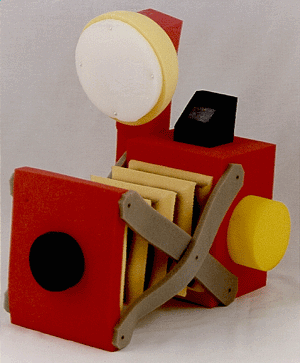
Until the clowns came out, of course. Six of them crawled out of a car the size of a pram and began honking and squirting and big-foot flopping all over the ring. One clown with a bright red nose held an oversized camera, the old-fashioned kind with an accordion baffle and flash bulb on top. He looked high and low through the crowd and settled on me as his partner.


Feeling fully justified in taking my place in the center ring, I proudly joined him in the arena. He fussed and primped and tsk-tsked, all the while making sure I was posed correctly. Then he stood back and clicked the shutter release.

Somehow, with his fertile imagination and hand gestures, he got us to believe that that bulky old Kodak had morphed into a new fangled Polaroid and it spit out the picture …


 … of a donkey.

I have hated clowns ever since, but have lived in greater terror of the sound I heard that day – the full-throated, cackling derision of people laughing because I was the butt of their joke.

I’ve rarely been on the opposite side of that feeling. I don’t laugh at pratfalls or choose to see pie-in-the-face comedies. I don’t make fun of people’s looks or mistakes (unless the mistakes are grammatical or the attitudes suggest that uniquely evil combination of arrogance and ignorance).

And I don’t go to the circus anymore.

But I realized that my gelatophobia had colored other areas of my life as well. Take sports, for example.

I tried to ski once and wound up goring a would-be rescuer with my pole as he came to save me on the bunnyslope. I gave up running after coming in second in a relay race. You’ll never see me on a karaoke stage.

Stupid, I know. But there you are.

On the other hand, I was awarded with immediate praise when I first started painting with oils, I took naturally to the ballet-like stretches of Pilates, and flying a plane seemed like second nature to me. Those continued to be hobbies and habits for a long time.

Which brings me to writing, of course.

I wrote my first book in five months after accepting a dare from a friend. I credit my writer’s group for that initial rush of praise; had they been less fulsome, I would have abandoned it in a nanosecond. The early success of securing an agent and selling the book when it was finally done sealed the deal.

I never would have/could have been one of those writers with six manuscripts in a box under the bed; one of those writers who aspire, who practice, who get better and better with no recognition of their talent but their own unflagging determination and belief.

I admire them – those with hearts much stronger and surer than my own – those people who try and fail and get up to try again. Even if they’re on the receiving end of the literary equivalent of that crowd’s laughter.

Think it’s too late for me? Is sixty too old to start competitive diving?


LU

Book Reviews, Served With a Healthy Side of Snark

by Alafair Burke

When writers say they don’t read book reviews, they’re usually referring to their own.  Not me.   Whether I should or not, I do read reviews of my own books.  I don’t, however, read book reviews generally.  I peruse the New York Times Sunday Book Review, as well as the book sections of the magazines to which I subscribe.  I also find myself really enjoying Huffington Post’s new book section.  But I wouldn’t say I make a point to have my finger on the pulse of critical response.

Perhaps the casualness of my book review browsing explains why I spotted a common thread among three reviews I happened to read last week.  My brow first furrowed when Entertainment Weekly panned Michael Connelly’s Nine Dragons as a novel that “read like it had been scribbled during a red-eye from Los Angeles to Hong Kong.”  Those were some hard words to handle, coming as they did from my pop-culture bible about my crime-writing God.  Apparently also for book blogger Sarah Weinman, who tweeted, “What bug crawled up [the reviewer’s] butt?”  Can’t we all just get along?


It turns out the reviewers were just firing up their keyboards.  The following Monday came Janet Maslin’s review of Barbara Ehrenreich’s Bright-Sided: How the Relentless Promotion of Positive Thinking Has Undermined America.  Maslin treats Ehrenreich’s thesis as “the makings of a tight, incisive essay,” then dismisses the admittedly “short book” as still “padded with cheap shots, easy examples, research recycled from her earlier books and caustic reportorial stalking,” with a central point “that’s as obvious on this book’s last page as it was on the first.”

But Michiko Kakutani wasn’t going to let her colleague take the week’s prize for creative dissing.  Her review of Jonathan Lethem’s Chronic City is so scathing I felt myself wincing with every new phrase.  Just a few?  “Tedious, overstuffed.”  “Insipid, cartoon version.”  “Sorely tries the reader’s patience.”  “The characters turns out to be an annoying and tiresome lot.”  And finally, “lame and unsatisfying.”

Yikes.

Don’t get me wrong.  This isn’t yet another writer railing against a bad review.  Nor is it a claim that reviewers should only review books they enjoy.  Nor is it a general indictment of the enterprise of reviewing.  Nor am I claiming that the above reviewers were inaccurate. 

Instead, I find myself asking questions: If a reviewer concludes that a book stinks, what is the appropriate tone for the resulting review?  Does the reviewer do enough by saying the book is (to their mind) bad, or does colorful condemnation help make the point?  Do scathing one-liners make for more effective — or at least more readable — reviews, or are they just unnecessary snark?

I ask because it seems to me the few bad reviews I read (hopefully not mine, fingers crossed) seem to be getting snarkier.  Maybe I’m wrong about that.  Like I said, I don’t scour book reviews, so my sample size is woefully unscientific.   And if you listen to Brad Meltzer, stinging reviews are nothing new.

But it would make sense if reviewers were getting meaner.  With newspapers struggling generally, and book reviews taking a disproportionate hit, reviewers and their editors might reason that readers would rather see blood shed on the page.  And if their main competitors are websites and blogs, well… let’s just say there’s no shortage of churlish comments online.


Author who read a bad review? Or reviewer who read a bad book?

I’d love to hear your thoughts.  Are reviews getting snarkier?  Should they?  And, best of all, what are some of the harshest reviews you’ve ever read (or received)?

I’ll start.  (1) Maybe.  (2) Honestly not sure.  (I know, I’m very decisive today.)  (3) The Independent (UK) on my debut novel, Judgment Calls: “Does the name Burke ring any bells? Why, it’s James Lee’s daughter and she’s written a legal thriller about as thrilling as a trip to the dentist. Dull as ditchwater, in fact. She’s a former assistant DA in Portland, and if I was [sic] her, I’d have stuck to the day job. Me, I’ll stick to her daddy’s books.”  Nice.

You’re Not Normal: Speech to the New Jersey Romance Writers

By Allison Brennan

Below is the speech I didn’t give to the New Jersey Romance Writers last night. Sure, I started the speech as it’s written. I gave parts of the speech verbatim (cough cough–sort of–cough cough) but I ended up going off on tangents and sharing stories that came to me as I started speaking. For example, my story about my morgue tour? I elaborated far beyond what I wrote. But what happened was that I ended up skipping chunks of the speech because the wise and wonderful Madeline Hunter kept making strange hand signals to me and I realized that she was telling me TIME’S UP! It took me awhile to get it :/ . . . but then the light bulb hit: that’s why Roxanne St. Claire told me to practice the speech and time it! So I wouldn’t go over my allotted time.

Though, if I didn’t go off on tangents (that related to the speech) I would have been under time. But honestly? I couldn’t have done it any other way. I was just being me. Which was the theme of my speech.

Warning: There are typos and probably some non-sequiturs and I didn’t actually read this speech in its entirity after I wrote it because I wanted to be conversational and I was nervous that if I edited it too much, it would be stiff and formal. Forgive me. It’s been a busy week.

But not half as busy as Alex driving cross-country with her cats.


Speech to the New Jersey Romance Writers

October 24, 2009


You’re Not Normal


I have a confession to make.

Okay, it’s not much of a confession—it’s not like I’ve kept it a big secret. I don’t plot. I don’t outline. I barely write a synopsis. In fact, I only write the bare minimum required for only two reasons: when it results in a check (some contracts pay part on proposal) or when I have to get something to the copy department so they can, you know, write the back cover copy. Copy that I inevitable have to change because (cough, cough) I only wrote the copy because I had to and never looked at it again and whoops, didn’t I tell you that I changed the heroine’s name to Beatrix and the hero has only one leg? And the story takes place in Denver, not D.C., and it’s not a mass murderer but an identity theft ring?

Plotting is like speaking.  I don’t plot, I don’t write speeches. Because writing the speech is like planning what I’m going to say days—or weeks—before I say it. What’s the fun in that? And it’s written—the written word doesn’t always translate well to the spoken word. If you doubt me, go buy my audiobooks. I listened to one chapter on SUDDEN DEATH and scared myself—and realized maybe the audio book deal wasn’t the best idea on the planet.

As Stephen King said, “I don’t think my books would’ve been as successful as they are if the readers didn’t think they were in the hands of a true crazy person. When I start a story, I don’t know where it’s going.”

I get that.

Last year, I was asked to give a speech to the Emerald City Writers Conference. I didn’t think twice about saying yes—this was in Washington, and I love Washington and have been trying to get my husband to agree that fog and gray skies are a good thing, but he thinks I’m insane because I like the rain more than the sun. Anyway, I agreed and didn’t think about writing a damn speech, because what’s the fun in that? But other people—people I adore and love and who mean well—thought I was insane.

“What do you mean you’re going to wing it? You can’t wing it,” said my friend Roxanne St. Claire. “You have to write the speech. Edit the speech. Rehearse the speech. Give the speech six hundred times to your dog until you know it by heart, but still print it out in twenty-four point font double spaced and put it in front of you in case you forget.”

I laughed. But she was serious.

Then Margie Lawson—you all know Margie Lawson, the woman who helped make the guy who invented highlighters a billionaire?—told me that not only did I have to write the speech, I needed a theme.

Theme? What theme? I don’t do themes.

Of course you do, she informed me.

No I don’t, I insisted.

She then told me that all my books had themes and I stared at her like she’d grown horns and she laughed at me (again) and wouldn’t tell me what the themes of my books were after I informed her I had no themes.

Bitch.

I didn’t need to write a speech—I’d simply jot down some bullet points and all would be good.

But between two little demons–Rocki on one shoulder and Margie on the other (where was my angel, dammit?) I began to panic. On the flight to Seattle, I wrote a damn speech on my laptop.

I hated it. I can’t even remember what I wrote, but I revised the so-called speech all weekend until Sunday morning when I had to give it and realized it sounded like crap, and it wasn’t in a conversational order, and I didn’t put down half the stuff I wanted to talk about and it was, ahem, kind of short I realized after beginning, so I winged it, but kept referring to his miserable excuse for a written speech and kept getting lost and forgetting my train of thought.

After that dismal failure, I said never again. I would never agree to speak to another group EVER.

Except . . . I’d already committed to speak here. And there are more people. And my mentor, the brilliant and talented and wise Mariah Stewart is in this chapter. And I hate failure.

So I wrote a speech. See? I figured, writing a speech wasn’t really plotting, because it’s not fiction. It’s like having a conversation with a couple hundred friends, right?

But I still needed a theme. Margie told me I needed a theme. What is a damn theme, anyway? I write to entertain people, not to educate them.

But before a theme, I needed an idea of what to talk about, right? Something smart and witty and motivational.

Right.

When all hope was lost and I thought bullet points might still be a good idea, I read a message from someone on one of the RWA loops that said something like:

“I’m so glad to find people who think like me, who also hear voices in their heads. I’m normal after all.”

Hmmm. Normal. Right.

I have news for you. For that woman and every person in this room.

You’re not normal.

And why in the world would you want to be normal anyway?

Suddenly, there was my theme! “You’re Not Normal!”

Do not tell me that this isn’t a theme, because it’s the backbone of my entire speech and Margie said I had to have a theme. So it’s my theme and I’m sticking to it.

This woman who unwittingly gave me the entire idea for this speech is not the first writer I’ve heard who said something equally stupid. Ok, maybe stupid is harsh. How about immature? Really, you think it’s normal to hear voices? I’m sure that if we were all in the psych word together we’d think it’s normal too.

But honestly, why would any of us want to be normal? Normal is boring. And who decides what normal is anyway? Some government agency? No thank you. I’m not normal. And neither are you.

As they sing in my church, “Rejoice and be glad!”

Alleluia. Rejoice and be glad that you are different! That you stand out! That you’re strange and beautiful and unique.

I realized how . . . . um, unique . . . I was when I went to dinner with my husband about a year ago.

It was a private dinner, with his boss and bosses wife and a couple other people. Nine of us I think. Lori, the boss’s wife, is a fan of mine and we’ve chatted on line a couple times. She asked about my research, and I’d recently toured the morgue. So I told her about the autopsy I viewed, and then about the bodies lined up in the crypt—and about why maintaining good pedicures is so important because when you’re lying, dead, in that cold room the only thing anyone can see is your feet—and all the feet there were ugly as sin. I know, that’s mean to say, but it’s true.

I also shared what a body looks like when it’s been underwater for twenty-four hours. It’s not pretty.

I think my husband kicked me under the table a couple times before I realized that maybe my trip to the morgue wasn’t appropriate dinner table conversation.

But she’d asked.

Maybe it was more like the question, “How are you?” No one really wants all the details, more a general, “I’m fine, took the kids to the park yesterday and we had fun.”

When they ask, “So, what did you do today honey?” They don’t really want to know how you sat in Starbucks for two hours discreetly watching men and women who met online having their first “date.” I swear, I stopped going to one of my favorite Starbucks because it became a meeting place for MySpace dates and I was so distracted watching the body language and trying to figure out their backstories.

Being unique—i.e. not normal—runs in families. One late afternoon, I’d picked my oldest daughter up from practice. We were driving along a country highway and spotted a large dark green garbage bag in the gulley next to the vineyards. The way it was lying, with the shadows of the vines and trees that formed a windbreak, I thought, That looks like a body.

Just then, my daughter says, “Mom, did you see that garbage bag? It looks like dead body.” Then she adds, “Do you want to go check?”

Writers will often say they hear voices in their heads. Okay, there is something just not right about that. I don’t hear voices, and I’m sticking to that story.

I read an anonymous quote that hit home: “Many people hear voices when no one is there. Some of them are called mad and are shut up in rooms where they stare at the walls all day. Others are called writers and they pretty much do the same thing.”

On the other hand, I’m a talker. When I’m in the shower or the car I verbally run through scenarios and plot points and sometimes I forget when someone’s in the car. My son has been known to say, “Mom, stop talking to yourself.” Just the other week, my oldest daughter asked, “Are you talking to yourself again?” And ironically . . . I wasn’t. Not really. I was sort of thinking out loud about stupid drivers. But the fact that she mentioned it like it was commonplace had me wondering how much I talk to myself and don’t notice . . .

Thank God for hands free phones. Other drivers will just think I’m talking to a friend!

And who are our characters anyway? We know them, right? Sometimes I talk out plot problems with my two older daughters. One of them will suggest a solution, and I’ll say, “But Moira wouldn’t do that.” Or, “Well, Robin is scared of the dark. She wouldn’t check it out.” My daughter tells me I talk like my characters are real people. Well, I know they’re not. I don’t expect them to walk down the street and say hello. Most of them wouldn’t anyway, they’re too busy J . . . but I do feel like I know them. I know how they’ll react in different situations. I know how they think. I get into their heads, walk in their shoes, and so when my daughter suggests something I have to consider not what I would do, but what they would do. And as I verbalize it, I use shorthand so yeah, it sounds like I think they’re real.

And sometimes I even run dialogue outloud. Now that’s fun!

Embrace what’s unique about you. Because you don’t want to be normal. Like a friend of mine, a bestselling author, tried to quit smoking, but quitting destroyed her creativity. Maybe it’s subliminal that she doesn’t think she can write without a cigarette, therefore she can’t write without a cigarette, but I totally get why she didn’t end up quitting. Your creativity is what makes you unique. Special. Not normal. It makes you shine. It doesn’t matter whether you’re published or not, whether you have twenty million books in print or ten thousand, whether you’re a mega-bestseller or a debut author or a struggling midlist author. Your creativity is different than every other writer on the planet. The way you look at the world—from big brush strokes of color and feelings and human interaction to the fine details of  individual motivation and personality traits.

Ok, who in this room HASN’T had someone tell them, “If I only had the time, I too could write a book.”

I swear, I want to shoot the next person who tells me that. I’ll bet it’ll happen by the end of the week. I hear it all the time, and I’m tired of being gracious and saying something like, “I’m sure you could,” or even something a little snide like, “Well, you have to make the time.” Because honestly? They can’t write a book. If they could they would have already tried. Because that’s what writers do—we write. We can’t not write. That makes us different in the eyes of the world, those who think they can, but really can’t. Those who don’t understand the fun of the “What if” game. Those who look at a man with a briefcase and see a man with a briefcase, instead of what we see. A terrorist with a bomb. An undercover cop with a wire waiting to pay a ransom. A lawyer with divorce papers in the briefcase on his way to get his client’s wife to sign, only to realize when he gets there that he was the other man who caused the break-up in the first place. An unemployed salesman on his way to a job interview, desperate because his sister is dying and he has agreed to provide for her three children, but he has no job . . .

So when people tell me they, too could write a book, if only they had the time, I just give a half-smile and nod and mentally think, what a dumbass.

I didn’t promise I wouldn’t swear in this speech. Apologies. Ok, I’m not really sorry. When I wrote this speech I wrote it stream of consciousness. It was a good compromise—no plotting, just write out a speech as if I was talking to a small group of people and let it just come out.

For writers, we are different from everyone else out there, but we’re also different from each other. When we see a man with a briefcase, we all come up with different scenarios for him. We play it through in our head. We tell different stories with different voices.

If we all had the same voice, books would be boring. If every story sounded the same, why not just figure out the formula and have a computer write it?

Your writing voice is truly unique, and you should celebrate it.

Henry Miller said writers have antennas who are tuned into the cosmos and draw out ideas. Natalie Goldberg said our bodies are garbage heaps: we collect experience and make stories from the decomposition of food. Claude Bristol said undoubtedly, we become what we envisage.

Does that make Henry a space alien or Natalie a pile of decomposing trash? What are you?

I sold my fifth complete manuscript. I had hundreds I’d begun and never finished, but I did type THE END five times before I sold. The first four books will never see the light of day, and that’s a good thing. But I needed to write them. I was discovering my voice.

Few of us write our first book and sell. Oh, yeah, sure, some of you out there have sold or will sell your first book. Well, blech. Most of us aren’t that good out of the gate. I sure as hell wasn’t. I needed to practice. I learned something with each of those stories, things I couldn’t really put into words, except one: voice. I was finding my voice. Strengthening it.

Some of us start writing what we think we should, only to discover that our natural voice is lighter or darker; we write a historical but realize we shine in the contemporary world. We write romantic suspense but discover we’re actually funnier on paper than we are in real life and end up with a romantic comedy.

Too often our voice is stifled by well-meaning people who want to mold us into what they think we should be. Parents, spouses, children may tell us what we want to hear, or be passive-aggressive, or downright ornery about  what we write. Crit groups can be jewels that help you find your weaknesses and fix them; sometimes they can be stumbling blocks.

But honestly? We—you and me—are our worst enemy in discovering voice. We tell ourselves we have to write this—and we have a long list of reasons to justify it. We tell ourselves we can’t do something, or shouldn’t, or should. We limit ourselves, we reign in our creativity because we don’t want to go over the top or too far.

But when you’re discovering your voice, that’s the time you should never stifle your exuberance. You should let the story run away with you and take you places you’d never go on your own. Does it matter if that particular book gets published? Or does it matter more that you discover what works and doesn’t work for YOU?

Editing is your friend. But that first draft—as Morpheus said to Neo, “Free your mind.” Let go. Let the story pour out naturally, and then you will find your voice. Then your talent will help you hone it, shape it into an enjoyable story.

Your voice is unique to you. Being unique is good—if you write like everyone else, what’s going to make your story stand out when an agent is rushing through the fifty-seven partials she had that month? What’s going to make an editor sit up and read more? Yes, you need talent. That’s a given. You need to know how to write. But lots of people know how to write. Not everyone has discovered their voice.

It’s not easy. Who said it would be? Honestly, anything worth having isn’t easily achieved. You need to work for it, want it, sacrifice for it. Look into your muse and figure out what you really should be writing. Free your mind. Let the story flow. Don’t worry about the damn rules that someone else made up—you can address the ones you want to in editing. Too many times we second guess ourselves as we write.

Stephen King once said, “No, it’s not a very good story. Its author was too busy listening to other voices to listen as closely as he should have to the one coming from inside.”

You have to listen to your voice, your own voice, because that’s the only way you’ll know for certain that what you write is YOU. When you die deep, write with the doors closed, listen to yourself, and write your passion, you will have discovered your voice.

But it’s not easy. There are times I sit there and doubt myself. Okay, every day I sit down at the computer I doubt myself. But when the muse hits, when I’m in the zone, I don’t think about whether the word is right, the sentence make sense, the scene is ultimately necessary. I simply write what I see and hear and feel in my head. I put myself in a characters shoes and become part of the story. I put aside the doubts temporarily. They never leave forever, but I can bury them enough to let the story tell itself.

Doubts are bad news—doubts make us do stupid things. For example, writing to the market. Yeah, I know, you always hear: don’t write to the market. Don’t do this, don’t do that, you have to do this, whatever. But the market thing kinda sticks with us because we’re thinking, well, maybe we’re doing something wrong, maybe we’re not writing what will sell, so we have one eye on the market and the other on our manuscript and honestly? You can’t write like that.

Case in point: me. I write pretty dark. Even my humor is on the dark side, and that’s my voice. It took me five books before I discovered my voice—practice is important, and I’m a slow learner. But I honestly believe that no one can tell you how to write or what to write, that the only way you can write what’s in your heart, write your passion, is through trial and error.

But that dang market—remember 2003? Chick lit. It was big. It was hot. It was selling. And here I was, writing romantic suspense and I thought, well, maybe I should write a chick lit mystery. My voice . . . mystery . . . with chick lit. Think: first person, humor, murder. I liked the story. My critique partners liked it. Then, I found an agent with my romantic suspense—my fifth book—and after we sold I asked if she’d read some of my other material. Sure, she says. I sent her what I had of Fish or Cut Bait about 200 pages—about a slightly overweight teacher who had a doctor husband and as they celebrated their five year anniversary on a cruise ship, Gemma, my heroine, doesn’t tell her husband that if he doesn’t rekindle their romance, she’s getting a divorce that she doesn’t want. She’s insecure and thinks he’s flirting with a blonde bimbo and then the blonde turns up dead, and Charlie is on the run as her killer—but he didn’t do it. Gemma is almost positive. That’s where my 200 pages ended . . . my agent emails me a couple weeks later and essentially says, while she really liked my heroine, I wasn’t funny and stick to suspense.

Voice is something that is unique. It’s not normal—it’s special. It’s all you. You can’t fake it, though some people think you can. When you discover your voice, the angels sing and you dance around the computer or pour yourself a glass of champagne. But discovering it isn’t easy. Would you want it to be? If it was easy, everyone would do it. If it were easy, you’d be bored. Achievement, the sense of accomplishment, comes because you’ve done something you couldn’t before, something you weren’t positive you could do. Discovering your voice, honing your voice, making it stronger, comes from practice and it’s all you.

If I can impart any advice, it would be this:

Write. And write some more. No one is so good that they can’t learn. I still take classes when I have time, I still edit and revise, and even now, though I know my voice, I’m comfortable with my voice, I know I can do better.

Write for yourself first. As Stephen King says, write with the doors closed and edit with the windows open. Or something like that J . . . essentially, don’t listen to everyone when you’re writing your rough draft. It needs to be you, all you, warts and all. Then you edit and revise and send it out to your trusted critique partners, you trusted editor or agent or ideal reader. Someone or several someone’s who will give you quality advice based on your voice and not theirs, your vision and not their dreams.

Don’t write to the market. Write with passion what fits your voice and your vision and then, and only then, when it’s done, when it’s you, then look to the market and see where it fits or how you can position it to fit. The market isn’t evil—it’s there! But it’s changing all the time. And honestly? Good books that transcend the market sell all the time. The passion that comes through when you discover and hone your voice will make your work shine, whether you’re writing what’s currently popular or not.

Anne Lamott said, “We are a species that needs and wants to understand who we are. Sheep lice do not seem to share this longer which is one reason why they write so little.”

Don’t be sheep lice. Go forth and write!


Sometimes you just have to drive

by Alexandra Sokoloff

So the reason I’ve been so scarce around here for the last month is that it’s October.   When you write scary books you quickly realize you will never have a Halloween season to yourself ever again.  

Also, because of a family illness, I had to get back to California – with my cats.   Instead of flying, I decided to drive, and luckily my sister was up for doing it with me.   I kept a journal and am excerpting it here, because anyone who hasn’t driven this country really is missing the experience of a lifetime.

———————————————————————————————-

Road trip, Day One, Saturday  (Raleigh NC to Hickory NC)

A friend of mine who’s obsessed with ON THE ROAD has pointed out to me that in that book, going West is always happy and optimistic and full of adventure, and going East is always sad and depressively introspective and fraught with setbacks.   Which obviously means that just by geographical orientation this has to be a happy trip.

Actually my sister and brother and I live for road trips.  We were programmed for it early on during the family’s summer cross-country trips – pile into the station wagon and drive a different route every year so we could experience the country.   Like, all of it.   A huge, priceless gift we got from our parents.   Well, and Dad just loved to drive.

We’ll miss M. on this one, but E. and I travel pretty much perfectly together – she’s really one of a kind: Dorothy Parker’s wit, Julia Child’s effervescence (and cooking skills), and the artistic sense and surrealist mind of Salvador Dali.   We drive until we drop, tell each other stories, pull off whenever anything looks interesting, and laugh until we’re sick.  The trick here is, we’re going to have to drive eight good hours a day to make it to an event I have to do in Vegas this week, AND – we’re taking my 14-year old cats, also sisters, but who hate each other and Do Not Travel Well.  We have kitty Valium but they’re still way too old for this on top of everything else they’ve been through in the last few months, and most of the stress I have is about how they’re going to hold up.

This first day was a little – um – nuts: I was committed to teach a writing workshop for a half day before we could hit the road.   Lucky for me I could do this one in my sleep, because I’d had all of 20 minutes the night before.

The workshop went spectacularly well even in my unconsciousness and then I had to race back to get the house in order, pack more stuff into the car than I would have thought possible and then hit the road…

… just in time to get caught in a crazy traffic jam around the U 2 concert at local Carter-Finley Stadium.  (I heard people were just abandoning their cars along I-40 and walking, a mini-Woodstock.)  It took us 20 minutes to get a half a mile, but then we were out of it (saw the back up for the next 30 minutes of driving, though).   I’d been blocking that U 2 was in town that night and I’d miss them, but there was a radio station playing A to Z U 2 songs that night, so E. and I got a mini-concert of our own.

The full moon was up and the sky was so bright that we could see the whole landscape on the road to Asheville, a totally different experience than that tunnel of black that I-40 here usually is, just beautiful.  

The open road is always about endless, infinite possibility to me.   The world is huge and it’s all available to us, every second.  I am grateful to have this chance to vacuum out my head, and become open to everything.


Day 2, Sunday  (Hickory, NC  to Somewhere, Tennessee)

 7 pm            

We are now in a rather dubious motel at the side of I 40 in Tennessee, somewhere between Nashville and Memphis.   Not as bad as those scary motels conveniently located right behind the ubiquitous “Adult Superstores” along 40 (is “Adult Superstore” a Southern code word for brothel?).  The room is actually clean, and totally fine for a night but I suspect illicit truck stop activity is soon to come.   It was just raining too hard not to pull off, and no other options in sight.

But the door is double-bolted and chained, the cats are mellower tonight, and we’re watching Titanic on HBO as I write this.   Will never make it up to the end; I don’t care to see Leo’s oh-so-romantically-tragic death anyway.   But man, those eyes…

So the day…

Not much sleep between 3 am and 7 because of feline hysteria, but still felt fine in the morning.   E and I drank five cups each of that incredibly sugary motel vanilla cappuccino (which I think is like a whole week’s worth of calories) and then hit the road.   A gorgeous fall day: blue, blue sky with wispy clouds, and even saw some turning leaves – just a taste of the psychedelia to come.

We made a brief stop in Little San Francisco – I mean, Asheville, and did a quick tour around downtown – stopped in at Malaprops to sign books and at Street Fair to buy hippie clothes.   I got at totally great orange and purple and teal leaf-embroidered tank top for fall.  I absolutely love Asheville, really must spend more time there.   It has that sensual, mystical quality of San Francisco and New Orleans – and what a riot of fragrances and colors and art and books and architecture and coffee and every sensual pleasure.

Too, too short a time there, but we got a taste.  Then up over the mountains (love that one tunnel, very filmic) and crossed into Tennessee, which immediately has a different feel to it.   Still forest and leaves, but the roads are carved between rock cliffs.   The sky was getting gray and truckers honked at us every few miles.

My sister is on a quest – she’s obsessively trying to recreate – food-wise – the eating highlights of a West-to-East cross country trip we took about four years ago.    Her rule is that we eat regionally, and today her mission was The Bean Pot in Crossville, TN (where the time changes from Eastern to Central).   I have to say she was right – those are the best beans and cornbread sticks I’ve had anywhere, ever.   The restaurant itself is almost a parody… I think I hope it’s a parody.   Beside the door is a horrifyingly realistic mannequin of a mountain boy straight out of Deliverance – or Texas Chainsaw Massacre.   He’s in a wheelchair, legless, wearing denim overalls, gap-toothed and vacant-eyed.   One of his arms is attached to an invisible wire and the woman behind the register will pull the wire to make him wave hello and goodbye to customers.  Nightmare-inducing.  The souvenir shop next door sells racist table implements and statues of dogs lifting their legs to piss, along with all manner of Confederate flag apparel – but sadly, not a trace of the cactus penises we remembered from our last trip and have always regretted not buying, even just to prove they exist.

The rain started early afternoon and got steadily harder.   I was glad to have remembered to have the windshield wipers changed, something that never would have occurred to me in Southern California, but after five years in NC, I was ready.   The rain made it easier to have to drive right by Nashville, another totally great city that we had a charmed evening in on our last road trip.   But with JT and Randy living there,  I can go play any time I want.

The soundtrack today was nonstop 70’s, lots of singing along, and let me tell you, no matter what you think your problems are, it’s nothing compared to the travails of poor Lola at the Copa – Copacabana.


Day Three:   Monday   (East of Memphis, TN  to Fort Smith, Arkansas)

It’s so nice to wake up in the middle of nowhere! Foggy and cool this morning, very green all around, trees and fields.

E. wanted BBQ but we couldn’t find any that early in the morning, and she had never been to a Waffle House and we don’t have them on the West Coast, so we did that for the experience.  

Crossed through Memphis, over the Mississippi, my favorite river, on that great bridge, into Arkansas.

E. had some business to do today so she made some phone calls while I drove and spaced out.

Arkansas is a state I know not much about, except of course for the Clintons, but visually and geographically it seems to be divided along I-40 into three very different terrains: the Eastern side is relatively flat with fields of this almost surreal marigold color, bordered by very unforesty trees, more like oaks and apple trees.   After Little Rock, the Western side turns into woodland with lots of water – lakes, rivers, creeks.   And then suddenly, the Ozarks, which are stunning, very low hills and vegetation I’m not familiar with, but just beautiful vistas.   And apparently it’s wine country. 

We got a lot of driving done today – left early and pushed through, but the cats were not happy campers for most of the time, and we were tired, too, so we gave up around five and found an Ozarks motel with a view out the window that goes on forever and the perfect local restaurant right across the parking lot: Big Jake’s, with photos of prize-winning livestock in the lobby, a very cool model train running all the way around the balcony of the dining hall, and dead animals hung on the walls.

We had big plans of doing yoga in the room tonight with a DVD we brought, but maybe tomorrow!  It’s not even nine, but I’m crashing.

Oklahoma next, which means a day of roadside tamales of the gods.


Day 4 – Tuesday –  Fort Smith, OK to Amarillo, TX

Today was Oklahoma – where the wind really does come sweeping down the plain.

There was a thunderstorm when we woke up this morning so we waited it out a little but still managed to leave by nine.   There was instantly a different feel to the day.   The sky is enormous, a huge bowl, and it was so liberating to be able to see horizon again.   That is one thing that really continues to unnerve me about Raleigh:  no vistas. 

As I remembered, Oklahoma is a gorgeous state in a totally different way from anything in the South:  vast fields…. All kinds of fields… of yellow flowers, sage green ones with shiny pretty waving grasses by the road, red freshly plowed ones, and even black ones dotted with white cotton.    We had a spectacular cloud show all day long in that endless sky, constantly changing layers, some dark funnels of rain, and then the sun coming out after a few hours.    And signs every few miles marking a different tribal nation.   Would really love to go back to graduate school in American history… um, next lifetime.

Oklahoma City would be interesting to hang out in for a day or two, just for the wonderful historical downtown – SO Midwestern:  all shopfronts and great examples of Plains architecture, which I recently learned about on an architectural tour of Chicago during ALA that made me just about rabid to read more about the history of American architecture.   That I might be able to get to before the next life.

We couldn’t stop, though, because in the afternoon I had to stop for 45 minutes to do a four-way phone interview with a Vegas radio station and Rhodi Hawk and Sarah Langan, the other dark suspense authors I’m going to be doing this Southwest tour with.   Elaine and I were in the middle of nowhere so we pulled off at a Cherokee Trading Post with a huge cutout billboard of a feather-headdressed chief against that bowl of blue sky, and I did the interview on my cell phone in the parking lot with a strong and really noisy wind whistling around me and a family of bison staring at me from a nearby field.  The connection was terrible on my end and I could hear the host’s questions but not a single word of Rhodi’s and Sarah’s answers, and I can only hope what I said was vaguely in the ballpark of a coherent conversation.   And on top of all that, halfway through the interview I had to run out into the parking lot, phone in hand, and help E. rescue a turtle heading straight for the freeway in an apparent suicide attempt.

One of those absurd moments my screenwriting partner and I used to call – EXTREMELY ironically – “The glamorous life of a Hollywood screenwriter.”  

It was pretty great, even so.

Back on the road, and the cats were being placid after spending the interview prowling around the car and eating, so we pushed on, and crossed into Texas just after four.  The landscape, again, was immediately completely different; I always marvel at that fact of border crossings.   Who decides these things?  Or does the landscape change to fit the character of the state after it becomes a state?

Texas is much flatter than OK, and a lot of scrub brush and smaller trees at the border.  Signs for bail bonds, derelict gas stations, and oil wells almost immediately, even if they’re tiny ones.

And then the land opens up into this immense, bare flatness, with very gentle curves of hills and low dry grass and patches of yellow, and the occasional steer, under a HUGE sky.

Now you can really tell you’re on Route 66; the Americana is non-stop.   The billboards are endlessly entertaining:  “Free 72 ounce steak”   (isn’t a usual steak, like, eight ounces? The mind boggles.)   “Five miles to the Jesus Christ is Lord Travel Center.”  (We didn’t have the nerve to stop.)   “Two miles ahead: the largest cross in the Western Hemisphere, a spiritual experience you will never forget.”

I wouldn’t call it a spiritual experience, but it WAS a big cross, sort of ominously impressive against the darkening sunset.

But the sunset – now that was a spiritual experience all on its own – it started out pearlescent, all those clouds in that huge sky, and then went on for HOURS, climaxing in shimmering reds and golds and purples – and then even more spectacularly, the sky went deep blue and the clouds appeared backlit, as if painted on to an enormous theater scrim.   Just jaw-dropping.

We hit Amarillo exhausted – just enough energy left to stop for tamales.

Which were, of course, divine.


Day 9 – Los Angeles

She’s seen her share of devils in this angel town.

–       Shawn Mullins, Rockabye

You can check out any time you like… but you can never leave.

  –  The Eagles, Hotel California


Aaaahhh!!!!   L.A.!!!  Again!   How did I end up here again???

Well, okay, my trip journal went to hell once we hit the Southwest – some very crazy driving back and forth – dropping my sister and the cats off at a hotel in Vegas (E. threatening the cats with a debauched night of bourbon and whores once I left), meeting Rhodi and Sarah for our booksigning in Vegas (Books in Vegas!  Who knew?), jumping in the car with Rhodi and driving back to Phoenix to meet Sarah for another signing, circling down to San Diego for another, then up to L.A. for yet another signing and then cruising around the Southland for about two dozen bookstore drop-ins.   I have one whole day off and then flying to Indianapolis (up at 3 in the morning – please just kill me) for the World Mystery Convention.   (Which Steve has recounted beautifully here).

There were four border checkpoints en route to San Diego because of some recent drug cartel shootout, and I kid you not, Rhodi and I froze like deer in the headlights each time a border cop leaned in the window to ask us, “Where are you coming from?”

I mean, how do you possibly start?

And then one of them threw in a trick question:  “Where are you headed?”

I swear, it was something out of Monty Python and the Holy Grail.

It’s a good thing we don’t look like Mexican drug runners, and/or were perhaps showing some leg at the time, or you may never have heard from me again.

– Alex

 ——————————————————————————————————————-

November is Nanowrimo, National Novel Writing Month, in which thousands, maybe hundreds of thousands of writers, commit to writing 50,000 words of a novel from Nov. 1 to Nov. 30.

I’ve been doing a Nanowrimo prep on my blog, and there’s still time to get yourself in gear.   Come on, you know you want to!


SO NOT HOLLYWOOD


By Stephen Jay Schwartz

What impressed me more than anything about Bouchercon was the warm reception I received from a community of authors who had no doggone reason to be so damn warm and accepting.  But there they were, the top mystery-thriller writers of our day, opening their arms to one and all.

I only knew a few of these folks when I arrived, but I left knowing most everyone.  Because that was their way. 

At Bouchercon you walk into the hotel lobby to find yourself swallowed into the bar scene where those you know introduce you to those you’ve only read or heard about.  I arrived nervous, wondering who I might know, wondering if I would be accepted into a group whose members had paid their dues and earned the right to be there.

I stepped into that bar to encounter Alex/Brett/Cornelia/JT/James Scott Bell/Alan Jacobson/F. Paul Wilson/Christa Faust/Marcus Sakey/Sean Chercover/Lee Child/Rebecca Cantrell/Bobby McCue/Rebecca Cantrell/John Gilstrap/Matt Hilton/Naomi Hirahara/Jason Pinter/Howard Shrier/Kelli Stanley…you get the picture.

And everyone, every single one of them sang the praises of every other one of them, shared the stories of their successes and failures, shared the little tidbits of advice that had been shared with them by others or had been learned through their own hard luck efforts.  And they listened to the stories of my successes and failures, nodding their heads, patting my shoulder occasionally, smiling or showing concern when appropriate. 

Someone always arrived to take my hand, to guide me to someone they wanted me to meet.  To someone influential, someone that might advance my career.  Not a single author hoarded this information.  They passed me eagerly, from hand to hand.  As they did with everyone.  I was not singled out.  I was not the exception. 

And the readers, and the fans, and the writers-yet-to-be-published were welcomed as well.  In the same fashion.  Everyone had access to everyone else, and everyone respected the boundaries of others.

A special treat for me was meeting some of the readers of our Murderati blog site.  The warmth I felt when people like Allison introduced herself, reminding me of some of the things we’ve shared in past blogs, allowing me to get a glimpse into her world as a writer and lawyer in San Francisco.  I can’t count how many times someone came up to me to say they read my posts on Murderati and that they had hoped to meet me at Bouchercon.  The thing I wrote most commonly when signing my book was, “Thanks for your enthusiasm and warm smile.”  Because everyone I met was enthusiastic, everyone had a warm smile. 

“You sound like you’re at camp,” my wife said as I rat-a-tat described the events of my days.

“Camp, yes…”  It was exactly like camp, without the tents and bugs and campfires and bad food.  The camaraderie was the same.  The silliness was there also, like the drunken 3:30 a.m. bar songs in the lobby of the Hyatt with shouts of “Shut the fuck up!” from a room somewhere around the tenth floor.  Or Alexandra Sokoloff, Joe Konrath and others waltzing through the lobby in their bathing suits on the way to the hot tub, carrying a tray filled with beer.  The security guys stopping by once in a while to tell them not to drown, saying that they didn’t mind at all so long as the bathers kept the riff-raff from other hotels from invading the pool (not knowing, of course, that none in Alex’s party had a room at the Hyatt).

Each day was more exciting than the last.  The things I loved the most:  Brett Battles receiving the Barry Award for Best Thriller of 2008; his inviting me to share the celebratory dinner with just him and his editor; the phone call I received from my publicist to tell me that, after only four weeks in release, I had landed on the L.A. Times Bestseller List; the wonderful review I received in the L.A. Times the next day; the crowd that attended my panel; watching my books disappear off the bookstore shelves; the friends I met for the first time; the hugs and handshakes at the end.

I realized how unlike Hollywood was the Bouchercon experience.  The world of Bouchercon = “Come on in, there’s always room for another author!”  The world of Hollywood = “Fuck you get out of my way who the hell let you in to begin with?”

Hollywood is a tough place to hang your hat.  Everything devolves into Social Darwinism where the strongest, fittest, most predatory players find great success.  There are always exceptions to the rule, of course, and I’ve met a few talented, successful screenwriters who are accepting of others.  But I haven’t met many happy screenwriters.  Film is a director’s medium, so what the screenwriter ends up doing is writing a blueprint for the director’s vision.  That’s great if the screenwriter is directing the film.  However, that’s not generally the case.

At Bouchercon I met a whole lot of happy authors.  Sure, not a lot of Ferrari owners in the crowd, but at least we authors get “final cut.”  Our vision stands on the page.  And, while we’re all generally a bundle of insecurities, at least our insecurities don’t manifest into arrogant behavior that isolates us from the one, true support group we can enjoy—our peers. 

The authors in our genre, the authors I met at Bouchercon, understand this.  We are a support group.  It’s hard enough just to get published.  We don’t need to compete with ourselves.

So, is it a wonder I fell into a minor depression the minute the conference closed?  How can anyone go back to his day job after that?  How can anyone face the daunting creditors?  Bouchercon gave me a glimpse of what life could be, if only I could live it 24/7. 

The depression coincided with another event—the passing of my grandmother, who was 103 years old.  She died ONE DAY before her 104th birthday.  I had visited her just last week, after four years away, when I traveled to Denver on my book tour.  She was fine and healthy and full of humor.  She had another twenty years in her for sure.  Then one little bladder infection and it was all over.  She died Saturday morning, as my mom was flying in for her birthday.  My mom waited until Sunday afternoon to tell me because she didn’t want to ruin my time at Bouchercon.

Life and death, ecstasy and grief.  I experienced it all over the course of one weekend.  Thankfully, I had a great support group to share it with.


AT PLAY IN THE FIELD OF THE WRITTEN WORD PART 2

by Brett Battles

When we last left off after part 1, I was finishing my proposal and about to send it to my agent. If you recall, I mentioned that I was doing something different that neither my agent nor my editor was expecting.

Now I can tell you what I did…instead of giving them a single, stand alone book proposal, I gave them three completely different ones.

Yes, I said three…individual…story proposals.

Each included the following: A) a ten to fifteen page outline, and B) sample chapters of around thirty pages for each idea.

I know. You’re thinking, What? Are you crazy?

Perhaps. After all, I turned in approximately 120 pages of written material…for a  proposal!

(Wait. I am crazy.)

Here’s how it happened. Earlier this year I was at a point with the book I was working on that I had a break of a few days, and, as luck would have it, an idea for a stand alone came to me. In a two or three day period I typed up nearly forty pages of the beginning of the book. Then I saved the file (we’ll call this idea #1), and went back to the manuscript I was working on.

When August came around, my publisher and I agreed that the next proposal should be for a stand alone instead of the fifth in the Quinn series. Almost immediately I had a new idea (idea #2) that I was excited about. I worked on it for several weeks, spending a lot of time just thinking things through. I ended up devoting a lot of time on the trip I took in late August working on it, and had things pretty much had it all figured out by the time I got on the plane to fly home.

Funny thing about flying, often I’m struck with random ideas that momentarily consume me. (Many times they involved planes, for obvious reasons. One such idea occurred on my trip to Bouchercon last week.) This moment of inspiration happened to me on the first leg of my journey back to the States, and for three hours I wrote long hand in my notebook the first couple chapters of a new book (you got it, idea #3). When I got home I still had a few weeks before my proposal was due, so I allowed myself some time to flesh out this new idea and see if it was worth sending in. I’m sure my initial thought was that if it was better than idea #2, it would be the proposal I’d submit.

As I continued on it, I definitely liked where it was going, but I also found that I still really liked idea #2. That’s when the scandalous thought hit me: why not send in both and let my publisher decided.

And seconds after that thought crossed my mind I remembered the story from earlier in the year.

Knowing I probably shouldn’t, I went back and reread it anyway. Damn if I didn’t liked where it was going.

Okay, fine, I told myself. I’ll send them three. Because I knew I’d be happy to write any of them. Let my editor weight in on which one should be next.

As a side note, I should say that this method of giving multiple choices was also ingrained in me during my working days in television graphics. The thing was, if someone wanted a main title for their show…let’s say TRUE HOLLYWOOD STORIES (one of the shows on E! I rebranded)…if you show them one idea they won’t like it. But if you give them choices, they’ll feel like you really put thought into it, and will pick one.

In the case of my proposal, reason behind given multiple ideas didn’t equate to my time at E!, but my thinking was definitely influenced by my process there. The real reason I sent all three was because I was happy with all of them so it didn’t really matter to me which one I did.

The last Friday of September, I emailed the proposal to my agent without any warning about what she would receive. Was she impressed? She sounded like it to me. That following Monday, she send it on to my editor.

Since my proposal was rather bulky, and my editor also had other things on her plate, it took a couple weeks for her to get back to me. She finally did the Friday after my last Murderati post (two weeks ago tomorrow.) Thankfully, she was very happy with all the material, and while she liked aspects of all three idea, she went with idea #2.

(Funny tangent…the down side of doing this (besides all the extra work) was that once I sent the proposal in, one of the ideas started to pick at my mind. And since I had nothing else to do, I put in a little time on it, developing it further. And, you guessed it, that wasn’t the one chosen. Oh well, it’ll be the next one if I have any say in it!)

So I’m back at the daily writing thing now, working on making idea #2 into a finished, kickass stand alone. I’m pretty excited about it, too, because I’m using a lot of my personal past in it…(the book is largely set in my hometown.)

Now, would I advise doing your proposal in the manner I did? Ah…no. What works for one person, doesn’t necessarily work for all. I will say I don’t plan on doing multiple ideas for future submissions, though, I guess, you never know.

Questions for today:

Brett…crazy/not crazy? (Perhaps we should skip that one.)

For writers, how much thinking to you put in before you start a new book? (Not talking necessarily about outlining, just working the idea and characters in your mind.)

Readers, does this behind-the-curtain stuff even interest you?

And finally…and this is most important…I would love to hear any ideas on topics you like me, or other Murderati contributors, to discuss!


A special hello to all the new friends I met at Bouchercon, and to the old ones I got to spend time with and get to know better. It was an excellent conference and I can hardly wait until next year. If you weren’t there, try to come next time. Hell, it’s in San Francisco! Who’d want to miss that?


You’re bound to offend someone

by Tess Gerritsen

If you want the whole world to like you, becoming a writer is not the way to do it. 

I was reminded of that a few weeks ago when I received a number of emails from readers who had just read THE KEEPSAKE, and they had a bone to pick with me.  They were all miffed because of a scene where my heroine must fight off a ferocious pit bull, which is defending the bad guy’s lair.  How dare you malign pit bulls, the readers said.  You’ve slandered an entire breed of dog!  Pit bulls are as gentle as any other breed, and you are perpetuating a harmful myth.  Because of this, you have lost our respect, etc., etc., etc. These complaints all came in within days of each other, so I think I must be on the fecal roster of a pit bull club, whose members decided to simultaneously flagellate the author for her crimes. 

Now, it’s true that they do have a point. Pit bulls are no more likely to attack a human than is any other breed. And the pit bulls I know personally are all disarmingly sweet and utterly harmless.  So why did I choose to identify the vicious dog as a pit bull when, statistically speaking, you’re far more likely to be bitten by a chihuahua?

Because, quite frankly, “vicious guard chihuahua” just doesn’t do it for me.  

I wrote back to these readers and apologized for maligning their beloved breed, and promised to do better by pit bulls next time.  But honestly.  If I write about vicious German Shepherds or poodles or schnauzers in my next book, I’m bound to get complaints about that as well. I guess I could just describe the dog as “enormous, with razor-sharp teeth” and avoid singling out any breed. But then some dog lover, somewhere, would be offended that I made the vicious animal a dog to begin with. “Why couldn’t you have made it a chained leopard or something?” they’ll suggest.  

The point is, with every book you write, you are bound to offend someone, somewhere.  And chances are, they will write you about it.  Like the hospital laboratory tech who read THE SURGEON, and was spitting mad at me because my villain was — you guessed it — a hospital lab tech.  “Do you really think I sit in my laboratory, dreaming up ways to torture women?” he asked.  “You’ve maligned lab techs everywhere!” 

As a novelist, you are forced to make choices in every scene you write, and those choices mean you will occasionally cast some profession, some hobby, some product, even some dog breed, in a bad light. And readers will assume that you are revealing your own personal bias.

Men have written accusing me of being a man-hater, because my villains are so often men.  Nurses have written accusing me of disrespect for their profession because one of my fictional doctors was brusque with a fictional nurse.  Hunters are angry at me for writing about a clueless hunter who shoots himself in the foot.  (As we all know, hunters never shoot themselves, doctors are never brusque with nurses, and serial killers are never men.) 

What’s a writer to do?

Consider disabling the email feature on your website. (I’m thinking about it.)  Or learn to ignore the upsetting ones. If a reader has a politely worded criticism, that’s one thing.  But when you open an email and see it turning angry, just hit delete. Don’t let it ruin your day. Such people don’t deserve a response.  They’re probably not even expecting a response.  They just want to scream at you, and as we’ve all learned from watching those angry town hall meetings, it’s the red-faced screamers who come off looking bad. There are a lot of angry people out there, and their hair triggers are set to go off at the slightest provocation. That provocation may be as minor as you writing about a forgetful octogenarian (you’re showing your ageism!) or an overweight girl (what do you have against hefty folk?) If we live in fear of all the people who might get angry at us because of something we’ve written, we won’t dare to write another word.


Back to School Night


by ALL OF US!

Okay, you know the rules. Add a sentence or even a paragraph to the story and let’s see where it goes. Last time, a couple of entries were out of order. I’ll try to patch in every once in a while to move things along if necessary.

I hope this works . . .
Pari


Lorena Jackson stood just below the stage with her back to the angry parents assembled in the school’s cafeteria. She used a felt tip pen on the overhead transparency to explain why Walt Whitman Elementary School had failed to meet the state’s Adequate Yearly Progress requirements for the fourth year in a row.

“We’ve appealed the decision on several of the standards,” she said, regretting her misguided decision to be the school’s principal, to try to lift it up from its horrid reputation and ghastly neighborhood. “Given our demographics, it’s not fair to expect progress every year.”

“How about one in four?” shouted someone in the middle of the crowd. Other parents mumbled. Just because most of them worked two jobs didn’t mean they wanted to blow off their kids’ education. How dare this woman act so high and mighty?

“Now, now. Let’s have a little decorum here,” said the principal. “You wouldn’t use that behavior in front of your children.” These people were barbarians. Half of them never showed up for their parent/teacher conferences . . . let alone when there was a school performance or team-spirit event.

“Hey, Lady! Stop treating us like idiots!” yelled someone else. Didn’t the principal know how much it took for them to get to this damn meeting in the first place? The lost time at work?

“Stop acting like one,” said Alesha Freeman softly enough so that only her friend Rosa could hear.

They’d been sitting there in that hot building just like everyone else. But unlike some, they actually thought Jackson had been doing a pretty good job. She’d gotten rid of deadwood, cleaned up the drug problem– little kindergartner thugs– and had even gotten computers in some of the classrooms. Why were people trying to lynch her now?

Rosa frowned. This wasn’t how the evening was supposed to go. Jackson was supposed to give her presentation and get parents in the mood to visit their children’s classrooms to meet the teachers. It was supposed to be a real feel-good event, not a feel-like-hell one.

“Come on,” said Alesha. “Let’s get out of here before someone decides to shoot her.”

“Yeah.” Her friend nodded. “I want to meet Alejandro’s teacher. He’s real happy in her class.”

The two women edged through the pressing bodies of standing parents to the double doors. Outside, the air was crisp with the first real night of Autumn. Someone a couple of blocks away was cooking barbecue. Alesha and Rosa walked to one of the rows of portables, searching for their children’s classrooms.

Rosa found hers first. “Hey, let’s meet near the office and walk home together.”

Alesha smiled. “See you then.”

Two hours later, Rosa waited for her friend. She hugged herself, regretting she’d left her sweater on the kitchen chair when she’d rushed out of the house to get to the school in time. Rosa opened her cell phone to check the time. Alesha should’ve been there by now.

But Alesha never came.


10 Things I’ve Learned

by Toni McGee Causey

Keeping with the theme from my last post here, I’ve been looking at various other disciplines, at their fundamental truths, and using that perspective to think about writing. This practice is a bit like seeing the furniture moved around in your favorite room—you start to notice the walls again, and the windows and the scenery, where it had become too predictable before to prick your awareness.

So, here are a few fundamental truths about writing and creativity that I’ve observed:

#1

A strong writer isn’t afraid to toss out a good idea.

I like Alex’s approach to collecting ideas that she blogged on yesterday, and it’s a tremendously useful exercise.  One of the things I’ve found in the classes I’ve taught is that a lot of writers (whether new or experienced) are afraid to let go of a really good idea.

They’ve got the experience to grasp that it is a really good idea, one that has weight and length and depth and texture and lights and darks and those are hard to come by. But just like every cute thing is not something you can hold onto, not every idea is one you should write. Not every idea is right for you, no matter how good it is. And hanging onto that really good idea that you can’t make work means that you’re not able to have the freedom to explore other ideas and see if, maybe, instead of just really good, they could be great.

A lot of times, people think that they’re holding onto that really good idea because it’s not professional to quit on something, or that it’s indicative that they won’t finish what they’ve started, so they are determined to soldier through. And while this can be true, if it’s a perpetual thing, I’d believe that if you already know you’re tenacious and not prone to quitting, then the real reason behind hanging onto a really good idea that just isn’t working for you is fear: fear that you’re not going to have another really good idea. Or worse, that you’ll never have another idea at all.

This is the same trait that induces people to latch onto an offer or a sale or a relationship because they feel like it’s the best they’re going to get, that another one isn’t going to come along. It’s human nature to wonder about that, but it’s generally wrong. If you latch onto something because you’re in love with it? Wonderful. If you think that’s the best you can do and you’re settling? Even a little? Set it aside, and give yourself the chance to find out what else you can do.

All of which boils down to trust. Trust your instincts. Trust your gut. If you can’t let go of the really good idea because you love it beyond measure, but it’s just not working, then set it aside and trust that you’ll come back to it when you have the chops to do so. If you never ever have another idea, it’ll still be there, won’t it? But give yourself the chance to explore, to see what else is out there in the universe.


#2

To enrich the full experience, you sometimes have to hold back a part of it for delayed gratification.

In architecture and in landscaping, this is called “denial and reward.” If you walk up to a house that is clearly magnificent, but easily visible from every angle on the grounds, there may be a sense of awe, but that experience is flat and over once the totality is already perceived.

However, create a winding path to the building where the view is obscured, but hinted at through partial views, or framed by unique architectural features such as an arch of a tree or a grove of oaks or suddenly rising out of a path of stunning gardens, and the anticipation of the total experience increases—the appetite is whetted—so that when the building is finally viewed, there is a greater satisfaction.

Life is replete with examples. The person who walks up and starts yammering about their entire life history the first time you meet them is going to be off-putting.

They may have had an interesting life, but it’s too much, too soon, to fully appreciate it. However, give us a little to whet our appetite and then let us discover more on our own, and that same person, same life history, could be fascinating.

Or, put in another example, we allow kids to dress up and trick or treat for candy rather than just go buy them a couple of sacks of their favorite junk, because it’s the work they have to do for it that gives them pleasure. They have to be creative, they have to cover a lot of ground, they have to see themselves as a different creature—all to get the thing that is rather common, but it’s the experience that they’ll remember.


So it’s true with stories. Resist the urge to give every piece of back story up front, every detail of history, the total of who the people are. Let us wind down some paths toward the totality by creating denial and rewards—give us greater and greater glimpses along the way, expose angles of the characters in new light and new detail as we go. We will love you for it.


#3

Use juxtaposition to frame the quality you care about.

I want you to watch this video of an artist drawing the subject of a woman, and I want you to especially note a couple of things:

1)    the artist uses decisive dark lines for some features and builds the shadows stage by stage until they are not just dark, but they are layers of charcoal from grey to black which give the subject contour and depth

2)    those dark decisive marks are juxtaposed against the white of the rest of the image which

3)    gives us a really strong image of a very soft, curvy, vulnerable face.

Had the artist used soft shades, backed off of those shadows, the overall effect wouldn’t have been a softer woman, but a poorer image. It’s the juxtaposition of lights to dark, hard strokes to soft that frames and evokes the quality that the artist wanted to achieve.

http://www.youtube.com/watch?v=a_h3hyifCsU

Juxtaposition is one of the best tools we have as a writer.  If we never see the darks of the character, we can’t appreciate the lights, whether they’re the protagonist or the antagonist.


#4

A straight path is a boring path.

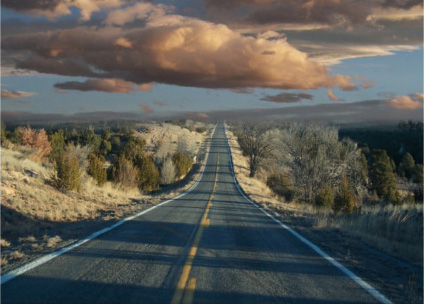
Have you ever driven through Texas? Or Oklahoma? I have. That big, wide-open plain is shocking for someone like me who is constantly surrounded by immediate horizon here, with trees on every perspective, so the first few moments of traveling through that big big sky feels utterly freeing.

And then, not terribly long afterward, all that freedom and that straight line of road from here to waaaaaaaaaaaaaaaaaaaaay over there, with no bends or turns or scenery in the middle gets extremely boring. (No offense to those who live in the great big plains, but wow, how you do not fall asleep driving is a flat miracle.)

Now, on the other hand, hairpin turns that are organic to the story–meaning, it’s a mountain, of course there will be hairpin turns (organic) but how they’ll happen and when and how the characters will navigate them will keep us interested.

If, in your stories, the story arc is carried straight through – problem……solution – then the story will be flat and boring. Each problem should have what the characters believe is a straightforward solution—but that very solution should create a new problem that whiplashes them into a different direction. They need to be challenged in new and greater ways with each failure as they keep trying to solve the problems in order to accomplish the one overall task set up at the beginning of the story. Keep the curves in the road and you’ll keep us interested.


#5

“If you can’t explain your ideas to your grandmother in terms that she understands, you don’t know your subject well enough.” – Matthew Frederick in 101 Things I Learned in Architecture School

I think that’s pretty self-explanatory.


#6

Be persuasive.

You have opinions, you believe in something. You do, whether you’re bashful about it or not, you have some perspective on the world that is uniquely you. If you’re a writer or endeavoring in any other creative art, you do so because you think you have something to say.

So say it.

Have faith in it.

No execution of any art is perfect. But persuasiveness in art, absolute conviction in a viewpoint often makes us forget the imperfections, particularly if we get to see that conviction through unique characters and conflict.


#7

You cannot know everything in the beginning in order to prevent yourself from failing, so you might as well move forward and try for success anyway. To stand still and do nothing is to fail already.

When you were two and toddling around…

(my granddaughter, Angela Grace) 


… you didn’t know what the joy of being able to run and leap was going to feel like, and you didn’t know that what you were doing was taking baby steps, though you might have perceived some difference in what you were doing vs. what your siblings or parents could do. Still, you put one foot in front of the other and when you mastered walking, you moved on to running.


When you were four and riding your tricycle, you did not yet know what driving or flying would be like, though you saw cars and planes. You may have even been inside those vehicles, but until you were responsible for navigating the actual car or plane or truck or train, you could not know all of the obstacles you’d have to avoid, preparations you’d have to make, maintenance you’d have to see to, obligations you’d have to field, or the freedom of the open road. Yet, you peddled that tricycle for all it was worth, racing around the yard.

Writing is the same. Start somewhere. You’ll eventually grow and improve and then you’ll see the next level to learn. But you’ll never see that next level if you don’t master the one you’re on now.


#8

It’s not always about you.

It takes a tremendous amount of ego (and hope) to believe that if we create something, someone somewhere else is going to want to see it or hear it or read it. It takes even more ego to think those people might want to pay for the privilege to do so. This is normal. It takes a big ego to sustain any sense of self while going through the learning curve and getting negative feedback. It’s that sort of ego that is a distinctive divide between those who will send out their work for potential evisceration and those who will keep it safe from persecution—which, of course, prevents it from being seen/purchased.

However, once a work has left the artist, it is no longer about him or her, any more than a child is “about” his or her mother. That work has to go out into the world and interact with the world on the world’s terms, not the artist’s.

Everyone who views/sees/hears art does so with their entire life informing them as to how to respond.

All of their experiences, their hopes, dreams, failures, frustrations, lies, truths, expectations, cynicism, education (etc.) comes to bear in that first moment when they interact with the art.

Their mood of the moment, their stress, their time limits all have influence in their perception.

The artist cannot control those things. Because of that, art… arts… in that moment when the participant and art intersect. It is not about the artist in that moment, but is, rather, about the experience of the person interacting with the art. You can’t make everyone appreciate the same thing or appreciate it in the exact same way—they’ve come to that thing with too many differences. So, keeping that in mind, it is no wonder that the very thing some people love, other people hate. There is no universal when it comes to art, because there is no one single experience we all share, save for being human, and even that is somewhat questionable.

So when a work is out in the world, expect it to be hated, hope that it will be loved, and move on to the next piece. The world’s reactions to the art no more validates you as a person than it does eviscerate you. It just is. Let it go.


#9

“No” is not the end; it is simply an invitation to pursue new ideas, new angles, new opportunities to re-think, reconfigure, and persuade.


#10

Work the problem.

You do not build a city in a day. You build it brick by brick, yard by yard, building by building, road by road.


You won’t solve the problem by simply naming it and then whining about it. You solve it by breaking it down into solvable parts, working those solutions, and using those solutions to help you break down the bigger problems. You solve the problem by asking for others’ perspectives, by researching, working, listening and learning. You solve the problem by going to see what had been done before you historically and how someone else solved something similar.

If all of that fails, then you challenge how you’ve defined the problem, because often our failure in problem resolution is that we don’t fully grasp the organic cause of the problem to begin with. If linear cause and effect aren’t cutting it, think in 3-D.

Think associationally. [My Word doc is informing me that I totally pulled that word out of the ether.] Think in context. Think in layers. Turn the problem around and upside down.

One of the things that bugs me about watching a lot of sci-fi shows with ships in space is that they often treat space with an up/down forward/back context, as if the ships are cars on a highway. But as Orson Scott Card’s fabulous Ender’s Game so beautifully illustrated, there is no up and down in space.

The solution to problems can sometimes require us to break out of our own mold of thinking—how we think can be as much a part of the problem as the problem itself. So challenge the way you’ve defined the problem, challenge your assumptions. You may surprise yourself in that you are suddenly seeing the problem from a different angle and there, lo and behold, is the solution.


So that’s my ten. How about you? Any premise that you learned in one field that you can now apply to writing or any creative endeavor?