Author Archives: Murderati


Murderati Word Jumble

ARAHARIH IMOAN

My throat starts to close and my hands get clammy whenever friends at a gathering start talking about board games. “Scramble! Boggle! I bet Naomi’s good at that,” someone usually says.

Well, quite the contrary. I stink at Scramble. I’m a little better at Boggle but not much. Crossword puzzles, not for me. It’s embarrassing to admit this, but I’m not much of a wordsmith. Nor do I produce words well under pressure. I could never be an advertising copywriter like my Murderati mate Louise Ure because 1) I’m not clever and 2) composing anything in public gives me heart palpitations.

The one word exercise I do find fun is word jumble. Maybe it’s because it’s more of a solitary activity. I also enjoy chaos, so attempting to make sense out of a mess is more my nature perhaps. (And like word search, it’s pretty darn easy.) So in subbing today (J.T.—not to mention Tony and Alex—are at Book Expo in NYC, those lucky dogs), I’m going to offer you a Murderati Word Jumble.

So this is how it works:

Each of these jumbled words needs to be rearranged into a word in a Murderati blogger’s title. You need to not only rearrange the word correctly but also note the title of the book which contains the word. (To be fair, there will be no proper nouns or foreign words—especially Japanese ones!) Every single current Murderati contributor, including guest bloggers, are represented once. The bonus jumble at the end contains a word in the title of one of Michael Maclean’s short stories (you can link to his website to do a search).

If you think that you have all the answers, including the book titles, e-mail them to me by Saturday, 9 a.m. PST at nhirahara@juno.com. The fourth person to provide the right answers will be the winner! (This will make some allowances for the time difference.) I will post the answers as well as the winner in the comment area later that day.

What does the winner get? A signed, first edition/first printing of the Edgar Award- winning SNAKEKSIN SHAMISEN! How about that?

And ’Ratis, feel free to join in as well. (If you win, though, no book for you—you get only my undying affection. The next non-‘Rati to answer correctly will get the prize.)

If this word jumble leaves you wanting more, feel free to create your own and post it in the comment section so we can continue to play.

After all, it’s Friday, right?

YRVE

TIGRH

GRIFCON

TEYRPT

THIHC

DYOBGEO

TIWIGNA

URASGRD

KKNNAISSE

WHIGROARN

BONUS: Maclean Madness

ATHGRTIS

TMI

They say a little knowledge is a dangerous thing.  I’d have to disagree when it comes to writing fiction.  Fiction is like a river.  It needs to flow to survive (and a few rapids thrown in when it comes to crime fiction).  When a story gets bogged down by heavy detail and technobabble, the writer has effectively created a log jam.  The river stops flowing and the water turns foul.

Agree, disagree, I don’t care, I stick by this.  I like stories with pace.  It doesn’t have to be a fast pace but I don’t want the story to get sidetracked with too many little asides and procedural blah-blah-blah.

I really should listen to myself sometimes.  During the writing of Paying the Piper, I dug myself a big pit that took six rewrites to get myself out of.  I tend to steer away from procedural things when it comes to cops, etc.  I write about “everyman” characters (or Novice Heroes as it’s been dubbed).  I tend not to make my leading characters cops or FBI agents because I don’t know the mindset well enough.  However, I broke that rule for Paying the Piper.  I have an FBI agent as an important secondary character.  FBI procedure is important to the story.  I did my homework and inserted the FBI procedures into the story, like a diligent little writer.  It seemed like the right thing to do.  It wasn’t.  It was bloody boring.  I’d killed the pace stone dead.  Bugger!

The problem was I felt this obligation to insert everything into the story that I’d been told.  The story’s subject matter was very important to the FBI.  They’d spent a lot of their valuable time outlining all this information to me.  I felt that I needed to get this down as faithfully as possible out of respect for these people and the work they do.  That’s all very nice to the FBI, but not my reader.

Getting every detail correct is great for non-fiction book about the FBI but not for a fast paced thriller.  It was time to break a few G-man hearts.  It was time to cut.

I didn’t ignore what I was told.  I just became selective.  What did my readers need to know to understand what was going on?  If I showed the characters doing something, did the reader need an explanation to back it up?  I decided no.  The story isn’t about how the FBI do their job.  The story is about a vindictive kidnapper tearing a family apart.  This simple analysis became my mantra.  So I removed everything extraneous to the story and kept only what was relevant.  As I trimmed, the flow returned and the excitement was back.  This was a story worth reading again.

This is the problem with research.  A strong and varied knowledge base, while essential can be explained away in a couple of sentences on the page.  I can spend a day researching the ballistics of a 9mm pistol, but all I need to know is that a couple of rounds at close range are going to hurt a person quite bit.

Details are important, but the story is more important.  Everything else is TMI.

Yours streamlined,
Simon Wood
Paying_the_piper PS:  I received the cover art for Paying the Piper.  It’s quite bold.  I’d just like to point out that no teddy bears were harmed in the making of this cover.  A professional stunt bear was used.

In Memoriam: Gone Too Soon

by Pari Noskin Taichert

Flag_2 Memorial Day affects people in different ways. There’s the pride of having fought for one’s country. There’s the remembrance of bravery and courage under astounding odds. There’s the chauvism of those who believe wars are necessary . . . and the fury of those who believe they’re not.

For me, this year, there’s heartbreak.

The other night, I went to our local school board meeting. In addition to the issue I wanted to address, there was a ceremony to commemorate the Albuquequerque Public School graduates who have died in the Iraq war so far.

A high school honor guard started the service. The commander yelled his incomprehensible instructions with precision in a high monotone.  The slap and clack of guns being cocked and handled filled the air. The thump-thump of marching feet brought a hint of military parading to the proceedings. The boys presented the colors, holding the flags at 75-degree angles and then resting the poles on the floor. Each teen stared straight ahead, emotionless, head shaven and mouth set in a hard line.

Every one of them looked so young to me . . .

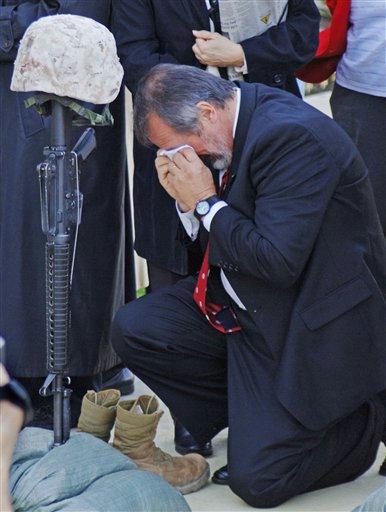
Father_cryingAs a parent, I trembled with the thought of losing my own children to a sniper’s bullet or a roadside bomb. I could hardly breathe, thinking about one of those kids before me — without legs or arms.

As a writer, I imagined what it would be like to say goodbye to a child, knowing that he or she was deliberately going into harm’s way. No matter what the reason or rationale, it would tear me apart.

That night, I cried . . .

All of us probably have compelling and oft-opposing takes on this particular war — and I don’t want this post to be a discussion about that. It’s not my purpose today.

Instead, no matter what you feel, please join me in taking a moment to remember all of those young people — the sons, daughters, sisters and brothers —  in this century and those before, who lost their lives far too soon.

Peacestatue_2 Peace.

(The photos can be seen in context at these links:
man crying
children’s peace statue in Santa Fe, NM)

KING OF THE MONSTERS: David Wellington

Interview by Mike MacLean

David Wellington’s career is a real Cinderella story, only with FLESH EATING ZOMBIES instead of wicked stepsisters.  Even if undead cannibals aren’t your bag, Wellington’s road to America’s bookshelves makes for one fascinating story. 

Instead of following the traditional route, (agent…publisher…bookseller…reader)  the talented Mr. Wellington cut out the middleman.  He wrote a serialized novel, Monster Island, and posted it as a blog, available to Wellingtonauthorpicture_5 anyone for free.  The result was an online phenomenon that led to a three-book deal with Thunder Mouth Press: Monster Island, Monster Nation, and Monster Planet.  If that’s not impressive enough, Wellington has already landed yet another three-book deal, this time with Three Rivers Press: Ninety-nine Coffins, Vampire Zero, and Thirteen Bullets, which just hit bookstores this week.

Via email, I spoke to Wellington about writing, publishing, and things that go bump in the night.          

MM: What made you decide to serialize this work onlline rather than to take it to a publisher?

DW: A friend of mine, who is now my webmaster and chief online marketer, Alex Lencicki, had a website–a blog to be exact.  He came up with the idea of writing a web serial.  I thought it might be an interesting experiment.  I really wasn’t thinking about publishing the story at all.  I had an idea for a zombie book I wanted to try and he said it sounded great, so I asked him for six months to do research, to work up an outline, and so on.  He said the web didn’t work like that–I would be starting the following monday.  I had to write the book in real-time, basically, putting up a chapter every monday, wednesday and friday and doing all the research and editing in between posts.  It was exhilarating–and maddening.

1560258500MM: What other challenges did you face writing a serialized work?

DW: Well, I’d never done one before.  There just weren’t a lot of opportunities for serials before the web came along–it was a lost art form, something Dickens and Conan Doyle used to do, a nineteenth century thing.  I actually went back and read a lot of old pulp stuff trying to see how they worked.  It’s a very restrictive medium–every chapter has to end in a cliffhanger, you can’t expect people to remember subtle details when it’ll be months between plot developments.  Yet it also infused the book with a crazy anarchic energy I’d never seen in my writing before, and I think that’s what really drew people to it.

MM:  Even after getting a contract, you continue to publish your work online for free.  Why?

DW:  It was just too much fun to stop.  Publishing online meant I could get instant feedback from my readers.  They felt like they had a special access to the book and I felt like I had a friendly focus group ready to tell me whenever the writing wasn’t clear or if a certain character’s actions felt off.  It’s a lot of work but it makes me a much stronger writer.

MM: Has offering your work on the web for free cut into hardcopy book sales?

DW: Not at all.  Most people who read the books online want to own them, either as a souvenir of something in which they invested five months of their lives, or to see how the book has changed between web and print.  Others want copies they can give their friends.  I hear a lot of people say they’d rather read a paper book they have to pay for than one they can read for free on a computer screen.  Regardless of why, people seem happy to pay for the books once they go to print.

MM:  Why zombies?

DW: That’s an easy one–I grew up in Pittsburgh, PA, where George Romero made his zombie movies.  We used to watch them on tv uncut and in prime time, even when I was just a little kid.  I think I saw zombie movies before I’d even heard of Dracula or Frankenstein. 

MM:  What’s your favorite zombie movie?

DW: Night of the Living Dead.  It’s the one that started it at all, and it’s still the best.  Romero didn’t just change zombies with that movie, he changed American film.

MM:  As a true zombie nerd I have to ask this question.  What did you think of the controversial "fast-walking" zombies in the Dawn of the Dead remake?

DW:  The way you know that zombies are really an archetype, and not just a fad, is that you have so much freedom when working with them.  Romero’s zombies were slow and shambling and they were terrifying simply because they weren’t fast but they also never gave up–they would slowly gain on you no matter how fast you ran away.  The zombies in the remake of DotD are scary because they’re probably faster than you are, so running isn’t an option.  I’ve seen talking zombies, zombie animals, romantic zombies, zombies with super-powers, zombies that are undead and zombies that are still alive but sick, zombies possessed by demons–and they all work.  There’s something essential and horrifying about the zombie that is strong enough to stand up to whatever you want to add to the genre.

MM: Name an author we should be reading but aren’t?

DW: Well, there’s a good zombie book called Xombies by Walter Greatshell that came out a year too early to be part of the zombie renaissance.  Well worth checking out.  In terms of general horror, people should be reading more Ramsey Campbell–the man’s a genius of style and should be taught in schools alongside Faulkner and Joyce.

MM: As I mentioned, 13 Bullets is out this week.  You’ve stepped away from zombies in this one to explore the world of vampires.  Why the change?  How is this book different than others in the genre? 
13_bullets_2 

DW: It takes a few minutes to post a book online, but it can take up to eighteen months to get a book published and in stores.  I had a long time to wait between Monster Island’s web success and finding out if it worked at all as a printed book.  I’m a nervous fellow by disposition and the time lag was driving me nuts, so I did what I always do when I’m feeling at odds and ends–I started writing again.  Thirteen Bullets was originally going to be a short story but it kept growing.  It turned out to be the best thing I’d ever written.  I’d been reading a lot of vampire novels at the time that were essentially romance novels–the vampires were actually dating and sometimes marrying the human heroines.  That didn’t work for me.  I remembered reading Dracula for the first time and being actually scared!  Vampires were supposed to be monsters, evil, unnatural creatures.  The vampires in Thirteen Bullets are less Christopher Lee or Gary Oldman and more Max Schreck–the very creepy actor from Nosferatu.  They’re hairless, they don’t read poetry, and instead of taking you for a nice dinner they’d rather rip your head off and drink out of the stump.  Thirteen Bullets is violent and bloody and thoroughly unromantic, but it also has a fun side because I play with a lot of the vampire clichés, turn them around and make them nasty.

My thanks to David for taking the time to speak with me.  If you’re interested in his novels, you can check them out for free at http://www.brokentype.com/davidwellington/.  If you like what you read, please support the author by purchasing a hard copy version. 

As always, Murder fans, I leave you with questions.  Would any authors out there consider publishing a novel online?  Why or why not?   And could an online crime novel earn the same success as something from the sci-fi or horror genres?

Does it have to be this hard?

by Alex

In between catching up on all the STUFF that piles up when one is finishing a novel…  taxes, vet appointments, eye exams, thank you notes, gardening…

I’ve been letting myself do a lot of reading.  (So nice, to be out on the porch, in the Spring, in one of those classic rocking chairs, just – reading… watching plants grow and the world go by…)

This time, uncharacteristically,  I am not reading with a particular project in mind.   See, I’m not one of those writers who can’t read other authors while I’m starting/in the middle of/finishing a book or script.   I don’t tend to pick up on other authors’ styles.   Not at all, actually.   I have too many of my own special issues which color every word and character and theme that I put to a page to worry about duplicating anyone.   It’s just not really conceivable.    I wouldn’t be writing anything, at all, if there were already something out there that I could read instead of having to write it.   To be blunt (and not for the first time) I just don’t like writing that much to bother, if it already exists.

So I tend to read a LOT of similar books in my genre when I’m writing on a project, for many reasons, not the least of which is to remind myself that if I don’t write this, I’ll never be able to read it,  because no one ELSE would be fool enough to write it.

And because I’m not officially working, I get to read ANYTHING this week.   I have let myself be very eclectic… very, very eclectic… what some writer friend of mine refers to as foraging…  because I want to be absolutely sure what I want to write next before I commit to it.

I wrote something really hard this last book.   It’s a great idea – high concept premise, great characters (“So CASTABLE!!!!  as we say in Hollywood…).  But very difficult emotionally.   I had to go to very dark places.  It wasn’t a lot of fun.   I’m writing something at least as hard this next book.

And I was kind of wondering if it really had to be this hard. 

So I’m reading a wide range of books, including a lot of books that are bestsellers, but not particularly hard books.  Those I’m not going to name so that I can be more honest about them.    As usual I didn’t find much that gripped me, and as usual I didn’t bother finishing most of them because I wasn’t engaged enough to care.   Out of probably four dozen books there were only two that I really read:  Barbara Kingsolver’s PRODIGAL SPRING and Denise Mina’s THE DEAD HOUR.  I’ve read a lot of Kingsolver, I’m a huge fan.   I’ve never heard of Denise Mina, but I’ll for sure be reading her again.

Now the bestsellers I read are all recent titles by established writers –  not the breakout books that made these authors bestsellers to begin with.   Still, I understand why the books sell.   It’s pretty much about premise.   The books have big, thriller premises.   You can pitch them in a logline and GET what the story is and think, “Yeah, I’ll try that story.”    There’s a fairly unique hook.   The books are also competently plotted – the stories are taut, and flow well, there’s (on the surface) a good cast of characters with good balance between protagonists and antagonists). 

But.

I just didn’t care.

I like reading for premise and plot.   I do it often.   But what was missing was actual empathy with the characters.   What was missing was a sensual feeling of actually being INSIDE the story, of having it happen to me, too, instead of just watching.   Very bad things happen to the people in these bestsellers I was reading, including to children, but I shed not a hint of a tear for them.

In PRODIGAL SPRING, on the other hand, Kingsolver had me weeping – I mean completely dissolved – over a lost duckling.   I’m STILL mourning that duckling and it’s been over a week and it’s barely a paragraph of the book.   But the effect on the characters was devastating, and because I was completely devoted to those characters it was devastating to me, too.

In THE DEAD HOUR, a co-worker of protagonist Paddy Meehan’s is seriously injured and the scene where the Paddy walks into the hospital to visit her friend, not knowing what she’s going to find, is excruciating. 

I’ll remember those characters, because those authors made them live, and made me feel what they were feeling.   I can’t walk even around the neighborhood now without being acutely aware and exhilarated by the lushness of Spring all around me, because Kingsolver just made me see and feel and smell and pay attention to it it all in such intricate detail.

It’s an extra layer of complexity and emotion that makes most other books look like mere outlines of books in comparison.

So I guess (she said gloomily) I’ve got the answer to my question.

Yes, it has to be this hard.

Because anything less, and you’ve missed an opportunity to touch readers in a way that won’t be forgotten – that might actually change them a little.    A way that means something.

So how can we not?

Damn it.

So I want some more books that are not just outlines of books.   Genre or non-genre (well, preferably genre!)   Read anything realy good lately?   Something that maybe even made you cry?

The Increasing Dangers of Sock Puppets

by JT Ellison

I made a BIG mistake this week.

On Monday night, I was innocently watching television when I saw a commercial with a sock monkey. On Tuesday, I was in a local bookstore and turned a corner, coming face to face with… a traditional sock monkey. Even my late night viewing has been corrupted. Phantom of the Opera has been on a never-ending HBO loop, and there’s an antique cymbal playing grinder monkey, one which makes me cringe with distaste because he looks like a sock monkey. Putting aside the delightful Kristy Kiernan’s hallucinations of spider monkeys and my own disinterest in the real beasts, the fake ones always capture my attention. They seem to be making some kind of resurgence. Whether they are on television, made from all natural ingredients or whatever, sock monkeys are suddenly EVERYWHERE I LOOK.

Now before you start thinking I’m just plain crazy, allow me to explain the genesis of this…  well, fear is the only truthful term I can apply here.

When I was a little girl, I read a book called Baleful Beasts and Eerie Creatures, an anthology of short stories edited by Andre Norton and illustrated by the legendary Rod Ruth.

              Baleful_beasts_and_eerie_creature_2

I remember reading this book one night when my parents were out. I had a babysitter. Mistake number one, no parents to turn to in my hour of need. Mistake number two, getting scared to death by the story of the basilisk yet continuing to read the damn thing. Mistake number three, looking at the illustrations. There was no way you couldn’t spend hours staring into the creatures eyes, especially that stupid basilisk. Mistake number four, allowing the book to stay in my room.

Of course I didn’t leave the book in my room. After I finished reading the stories, I took it into the living room and left it on the coffee table. But it ended up back in my room. At the time, I was entirely confident it was that damnable Patchwork Monkey, his nasty little fingers grasping the pages of the book, creeping, creeping up the stairs to my room, depositing himself on my night side table where he could sink those viciously sharp little teeth into my neck whilst I slept, unaware. But since I couldn’t sleep that night, kept drifting in and out, all I could understand was I heard dragging footsteps in the hallway, a hulking monster came to my door, and the book was placed with great care on my bedside table. See that little sucker, just sitting in the tree? Can’t you imagine those stringy red lips opening, those sharp little monkey teeth…

SHUDDER

Man, it still gets me creeped out.

And I know it’s in my old boxes in my parents place, which means Mom is going to be stuck going through them looking for this treasure, which is sadly out of print and sells for $200 on eBay.

Why am I searching for the book? I have an idea for a story that is going to take some research into the Gothic and horror world to make work properly. This is something I avoid at all costs. Why would I spend any time scaring myself more than I already do? It’s bad enough to delve into the mind of serial killers and comb autopsy reports on a daily basis. My imagination is always on overdrive. Toss in the supernatural element and I’m going to be a total basket case for months.

Yet I’m compelled to travel this road, to search for better ways to tell a story, for deeper meaning, for alternate routes into my readers minds. I’ve been trying to get up the nerve to open a couple of Stephen King novels. Or watch a spooky movie. Anything to start the desensitizing process.

I figure this would be a good place to start. It’s a test of sorts. Do the stories that freaked me out as a kid still wig me out? If not, if I can read them as a writer and appreciate their menace, maybe I can move on to bigger and better stories.

What would you suggest? Any books or movies that I can start my research with that won’t leave me jumpy but will give me the essence of the genre? And if you’ve got some good Gothic recommendations, please include them too!

Wine of the Week: 2003 Affentaler Pinot Noir Monkey Wine (Baden)

————————–

If you want to read something exceptionally cool, visit The Rap Sheet blog for J. Kingston Pierce’s one year anniversary celebration. "You’re Still The One" has been a week of fascinating single title mysteries considered under/unappreciated at the time of their initial publication. Many famous, not so famous and familiar writers, bloggers and industry folk’s opinions are represented. My TBR pile will never be the same.

Royale With Cheese

Everyone knows the scene between John Travolta and Samuel L. Jackson in Pulp Fiction about the little differences between nations—even the way the world sees a burger from Mickey D’s.  As a foreigner in this fair land, I’ve had to assimilate to a certain extent.  Where I’ve had to change most is in language.  My accent catches an ear (and always will.  I ain’t changing it for you guys) but the words that I say snag at times.  If I talked as I would with friends back in England, most Americans would be lost.  So I listen.  It’s quite amazing how different English-English is from American-English.  It’s  surprising how much word usages change even within California.  There are NorCal turns of phrase and SoCal turns of phrase.

My travels have been bouncing me between southern and northern California recently and I’ve noticed the little differences.  Take freeway speak.  In SoCal someone is likely to say, “I took the Ten to the Four-Oh-Five.”  All very Robert Crais sounding, but Bobby C. would stick out San Francisco way, as if he’d just called the place, “Frisco.”  Bay Area folks will say, “I took I-80 to I-5.”  Northerners tend to use their I for their interstates.  Southerners tend not to.

This is a very conscious thought when it comes to writing and getting character dialog right.  Know thy people.  No wonder so many writers stick to their geographical locales.  It may be subtle but it sure does stick out when you’re wrong.

I noticed a little British/Irishism in Ken’s post from the other day.  Ken said “…when I had to go to hospital…”  Ding, ding, ding.  Ken omitted the word ‘the’ before hospital.  Brits and Irish drop the ‘the’.  I didn’t even notice I did this until Julie brought it up, because it drives her mental.  Americans tend to use English very formally.  The British twist and turn the language at every turn.  A friend of mine hates that I turn nouns into verbs.  Her all-time unfavorite is “are you gyming it tonight?”  Julie particularly hates it when I use ‘me’ instead of ‘my’, as in, “You got me keys?”

When I’m with American friends, I’ll slip into my Englishisms, but I’ll play it straight when I’m with strangers.  At least, that’s what I thought.  When I went home to England the other month, one of my chums mentioned, “You haven’t changed.  You sound just the same.”

Nice, I thought.  Mission accomplished.

“It’s just the words you use.  It’s straight American.”

Ouch

It’s true though.  I have developed an American turn of phrase.  It’s an occupational habit.  I’ve forced myself to sound American.  Like a left-handed person trying to write right-handed, it’s going to stick after a while.

A few people have spotted Englishisms in Accidents Waiting to Happen and they are there.  It was originally written three months after I’d arrived in the US.  Some nine years later, readers won’t find similar errors.  I know me’s American lexicon, now.  Have no fear, guv’nor.  I sound dead yanky now, don’t I, like?

So I’m always listening to the way people speak.  Writing is theft most of the time and I’m stealing all the bloody time.  I could steer away from writing American settings, but where’s the fun in that?  That’s the cool thing about language.  It’s so changeable and malleable.  It’s the little differences, y’know.  Like a Royale with Cheese.

Happy eating,
Simon Wood

They’re (Not) Gonna Put Me In the Movies

By J.D. Rhoades

Over at the message board at Lee Child’s website, a topic
that springs up pretty much weekly is “which actor should play Jack Reacher?”
The answers, as you might imagine, range widely, and some of them, quite
frankly, make me scratch my head and go “huh?” So far, however, I’ve never seen
a suggestion quite right to play Lee’s quintessential bad-ass (although I must
say, the suggestion of this guy

22m_3intrigued me). So I began to wonder: is there
really an actor out there who’s capable of bringing a character like Reacher to
the screen? Consider that one of the things that most clearly defines Jack Reacher
is silence. How many times in the books do we read that Reacher doesn’t answer,
or doesn’t speak, in response to some dimwitted question,  some unnecessary verbiage on the part of the
bad guy, or just because words aren’t necessary? Much of what goes on the books
goes on internally, inside Reacher’s head. How do you bring something like that
to the screen?

Which then leads us to the question: are there some books
that simply can’t, or more properly, should not be filmed?

Now, don’t get me
wrong, I hope someday all the writers I know and love  get big fat movie contracts and rake  in  huge honkin’ piles of teen coin. There have
been some screen adaptations that have actually done justice to their source
material (The Maltese Falcon, The Talented Mr. Ripley) and some that have actually improved upon it (The
Godfather
, Road to Perdition). I hope all my friends and acquaintances are as lucky.

But I also think back on how some of my favorite
books just didn’t make the jump to the silver screen. The Ice Harvest was a
huge disappointment to me, for example, despite having three of my favorite
actors (John Cusack, Billy Bob Thornton, and Oliver Platt) in major roles. And
don’t get me started on the mess David Lynch made of Dune. The book is one of
the greatest SF novels of all time; the movie is a Foul Reek in the Nostrils of
God. The Dune TV miniseries wasn’t great, but it was only ridiculous, not horrifyingly
awful. It may just be that there is no way to bring Frank Herbert’s sprawling,
complex future society to life.

Of course, the same sort of thing was said about Middle-Earth. (Some are still saying it, but I’m not one of them).

So, today’s questions for discussion are:

(1) What favorite book or books do you not want to see on screen for fear they just wouldn’t translate well?

(2) Conversely, which screen adaptations do it right, in your opinion? And what makes the difference?

(3) What do you desperately want to see onscreen?

(4) And finally, is the Transformers movie  gonna kick ass, or what?


A TALE OF TWO CHILDHOODS

By Ken Bruen

As a child, I was guilty of the worst crime in the Irish calendar, I was quiet.


In fact, I never spoke and those who know me now, wonder if maybe, I wasn’t

a better gig then.

Moving on

Sitting beside me was a lad named Gerry, full of vim and vigour and as they

say, even then

most likely to succeed

Right behind us was a lad named Sean, from the poorest area of the town

and to be poor then, meant watching for the rent man on a Friday night and

alerting your mother to turn off the lights so he might believe you were out

As if there was anyplace to go

And lights out didn’t convince the rent man of anything, save you hadn’t

paid the light bill

Fast forward

Gerry, two years ago, hadn’t quite become the success they’d planned and

the circus was in town and,

a few pints to the worst, he went down at 4 in the morning to pet the tigers,


as he felt they might be lonely

They took both his arms off

It was indeed, dare I say, Tabloid fodder

He was front page for all of a day

Got over thirty large in compensation

With the help of new friends, he blew the money in five weeks

I ran into him last year when my French translators were in town

See, see the casual way I inserted that, like I have whole realm of translators

and last year, it was the turn of The French.


I was in the bathroom and Gerry came in, asked me to am…………….help him

to relieve himself, he had refused any artificial limbs, telling me

“Them yokes never fecking work.”

I’m thus engaged, when the translator walks in and not only am

I……….manhandling……….but with a person who is obviously physically

handicapped

My dark rep in France was………………….SOLID

Gerry asks me to light him and I put a cigarette between his lips, fire him up

and he goes

“How are them books doing for you?”

And my heart is scalded, torn in a thousand ribbons, and I know the sheer

decency he was raised in, I say

“Doing ok now, thanks."

And armless, he moves off, ensconced in a cloud of nicotine, says

“You were always a hoor for them books.”

I met Sean last week, he has just been named as the third richest man in

Ireland,

ahead of Bono and trust me, that is serious bucks or Euros or

whatever you measure in

and he is just about the coldest person I’ve met in many an era

and believe me, I’ve met some cold ones,

most of them I’m related to, more’s the Irishe-d pity, mainly through

alcohol and

he says

“I don’t read fiction.”

Right off the bat, like I’d asked him

“Do you read fiction?”

Subtext here………………….do you read me?

None of that false bonhomie,

“Gee, haven’t seen you in twenty years, how the devil are you?’

No wonder he’s rich

Reminded me of the old adage, if you want to know what god thinks of

money, look who

he gave it to……………………Madonna?

I muttered something along the lines of

“Hasn’t Ireland changed so much?”

Piss poor, you think I don’t know?

And then the moment, he gives me the full on eye fuck, says

“But I’ve read your most recent offering.”

Don’t you love him?

I wait cos waiting is what, not so much what I’m best at, but I’m most

accustomed to and

he’s used to making pronouncements and then, he adds

“You need to write a bestseller.”

Got it

Memo to self

Wake up, say yer prayers, have a shower,

ring your child before she goes to school and


am………………write bestseller

I have it

When I was young, the old people, they’d see some poor afflicted soul,

they’d bless themselves, utter

“There but for the grace of god…………………”

I think about that and guess what, when I utter that, who do you think I see

as the afflicted soul?

Hint……………when I had to go to hospital

after I got me jaw broken at a book launch,

who came to see me, said

“I’d have brought a book but I couldn’t carry it.”

It’s not MY fault . . .

by Pari Noskin Taichert

GradeLast week in Albuquerque, a senior who *failed his English class, and had missed three times the allowed number of days in a semester, realized he’d dug himself into a hole. His politically influential parents complained that no one informed them of his problems (not true) and, because policy hadn’t been followed, he should walk the stage with his classmates.

Over the objections of both the teacher and the school’s principal, a higher-up administrator changed his grade.

As a parent, I’m furious for so many reasons about this. As a community citizen, my anger spawned action. I wrote to members of the Albuquerque Public School Board of Education and the Mayor. I called and spoke with the NM Secretary of Education. I’m in touch with the local teacher’s union. My husband and I are seriously considering starting a blog, website or petition called "overhaul  APS" to provide feedback to a school system we believe aspires — at best — to mediocrity while claiming excellence.

All of this has me thinking about personal responsibility . . . and taking action.

I hear and read a lot of complaining in our literary world:
Speaker_21. No one understands the brilliance/marketability of our manuscripts.
2. Agents are rude.
3. The publishing industry is screwed up.
4. Editors don’t edit or know what they’re doing.
5. Reviewers don’t know what they’re doing.
6. Newspapers and magazines don’t support literature.
7. Nobody’s reading.
8. Libraries are under-funded and closing.
9. Readers don’t buy new books anymore.
10. Writers have to market their own work.
11. Writers market their works too much.
12. Independent bookstores are closing.
13. Nothing good gets printed anymore.
14. Even though there are more books, there are less real choices.
15. I can’t make a living at this profession.

. . . Wow. All these excuses.

Where do our responsibilities  — as  writers and readers — rest?

The obvious answers for writers are:
1. to write the best material we can.
2. to hand in our manuscripts/short stories on time.
3. to entertain.
4. to provoke discussion or thought.

Do our responsibilities go beyond that?

Should we concern ourselves with turning around the industry? For example, should all writers boycott Simon and Schuster until the publisher rethinks its new position on rights? Should we educate readers about their choices and the potential lack of them as fewer and fewer publishers become bigger and bigger? Should we advocate for libraries, encourage literacy, support the advertisers on book review pages so that they keep paying for those sections in print publications? Should we explain to consumers how the publishing industry works — advances and royalties and unfunded book tours — so that readers understand that their purchases really do matter?

I don’t know.

That’s why I’m asking you.

And, readers . . . what are your responsibilities in this dance?

* the picture of the hand is from THE ITHACAN.