Author Archives: Murderati Members


And The Winner Is …


By Louise Ure

The crime fiction community is certainly not shy about patting itself on the back. Maybe it’s a reaction to that whole “genre fiction isn’t as important as literary fiction” guff, but we sure do like to celebrate ourselves with awards.

Here’s a partial list of some of the mystery awards out there.

• The Edgar®
• The Anthony
• The Agatha
• The Thriller Award
• Theakstons Old Peculier Crime Novel of the Year Award
• The Shamus
• The Lefty
• The Dilys
• The Crime Writer Association (CWA) Dagger Awards
• The Nero
• The Barry
• The Gumshoe
• The Macavity
• The Simon & Schuster/Mary Higgins Clark Award
• The Arthur Ellis Award
• The Lambda Literary Award
• The Lovey
• The Quill
• The Davitt Award
• The CrimeFest Awards
• The Bruce Alexander Memorial Historical Mystery Award
• The Reviewers Choice Award
• The IPPY (Independent Publisher Book Award)
• The Hammett Prize
• The David Award
• The Ned Kelley Award
• The SMM/Minotaur First Crime Contest
• The Spotted Owl
• The Falcon Award

Some of the awards (like Mystery Writers of America’s Edgar®, the granddaddy of them all, beginning in 1946) are determined by a committee of member-writers who make the selection. Others are more reader/fan based, like the Anthony or the Agatha. In those cases, attendees at mystery conferences like Bouchercon or Malice Domestic vote for their favorite crime writing of the year.

Other awards winners (e.g. The Barry, The Macavity) are selected by the followers of a particular crime fiction organization or magazine (Deadly Pleasures and Mystery Readers International, in this case).

The criteria for an award might be broadly stated (like The Nero’s “for literary excellence in the mystery genre”) or much more narrowly defined, like this list for the Simon & Schuster/Mary Higgins Clark Award:

“The winner is selected by a special MWA committee for the book most closely written in the Mary Higgins Clark tradition, according to the following guidelines set forth by Ms. Clark:

* The protagonist is a very nice young woman, 27-38 or so, whose life is suddenly invaded. She is not looking for trouble – she is doing exactly what she should be doing and something cuts across her bow (as in ship).
* She solves her problem by her own courage and intelligence.
* She’s in an interesting job.
* She’s self-made – independent – has primarily good family relationships.
* No on-scene violence.
* No four-letter words or explicit sex scenes.”

Many of these awards are U.S.-centric, but others are also geographically specific, like the Falcon (“to honor the best hard-boiled mystery novel published in Japan”), the Arthur Ellis (“recognizing excellence in Canadian crime writing”) or the Ned Kelly (Australian authors only). And while the Spotted Owl Award celebrates the “best mystery by a Pacific Northwest author” many U.S. states also have prizes for the best crime fiction set in that location or authored by a resident.

With all this going on you’d think that each and every one of us — fiction writer, non-fiction writer, short story writer and debut author – would be covered in glory by now. We’d each have so many blue ribbons and commemorative plaques and prize-winning teapots and crystal statuettes that we’d have no room for cups and glasses in the cupboard anymore.

Not so … but it’s nice to dream.

I don’t have a “favorite” award, although I must admit I go all Sally Field (“You like me! You really like me!) just thinking about those jury-of-your-peers committee review awards. On the other hand, there would be nothing nicer than getting one of the public vote awards and knowing your work resonated with the people it was supposed to: people who love to read crime fiction.

And while I don’t think awards do much for sales, if they make just one publisher, just one bookseller, just one hesitant consumer take another look at your work, there’s nothing wrong with that.

Last year’s book, The Fault Tree, is a finalist for a few awards this year and I can tell you – as a person who has both won and lost awards in the past – that the nomination itself is the most important part for me. It says, “Somebody somewhere thought you did something right once.” And it gives me a reason to sit down at the computer in the morning and try to do it again. Sure, it would be nice to win, but I will already have been buzzing with the nomination for three months anyway.

So how about you, ‘Rati? Do you have a favorite award or judging system? Do you think awards matter? And has seeing award information on the cover ever made you pick up a book?

The Pros and Cons of the Mass Market Paperback

By Allison Brennan

When writers dream of being published, they picture their first book with a shiny hard cover. The pretty, sturdy tome that doesn’t fall apart after two readings, with beautiful covers that look fabulous on the bookshelf–face out or spine out. Hardcover authors automatically receive respect, reviews, and a larger percentage of royalties on a hefty cover price. People look at you with respect and admiration because you’re published and you have an actual hardcover real book to show for it; something that looks and feels professional and respectable.

Mass market paperbacks (MMP—also known as Paperback Originals, or PBO—I use them almost interchangeably, depending on the sentence) became popular as a commercial alternative to the hardcover in the 1930s. They’re produced more cheaply than hardcovers. The paper is of lower quality–both the pages of the book and the physical cover– and the books are “mass produced” at a lower per-unit cost, thus profit (for both the publisher and the author) is less per book—for example, roughly SIX copies of a mass market equals the royalties for ONE hardcover.

The average MMP is priced at $6.99 or $7.99. Some are lower (special releases, re-issues, special promos, Harlequin category novels); some higher (the over-sized paperback—see Sandra Brown, James Patterson, Jonathon Kellerman, etc); but the average maximum price point both MMPs coming out in 2009 and 2010 is about $7.99. Just take a look at IPDA.

In researching the history of paperbacks, I was surprised by a comment I saw on multiple websites, including Wikipedia (not the best site for research, but one that people crazily trust) which says in part:

“Paperbacks can be the preferred medium when a book is not expected to be a major seller.”

Times are a’changing. And I wonder if anyone truly knows what the market is going to look like in 5, 10, 20 years. But MMP are major sellers and a staple of the publishing industry. While hardcovers are the elite–and where the profit is–MMP are no longer the cheap dime store throwaways. (Which, BTW, are no longer cheap or throwaways, if you peruse the collector websites!)

My mother used to believe that the superior books were published in hardcover, and the inferior books in MMP. She used to buy books from the Mystery Guild, believing they were simply cheaper hardcover releases printed on inexpensive, poorly trimmed paper, not realizing that many of the books she enjoyed were originally published as MMP!

After I was published in MMP, my mom tried many other PBO authors and was surprised that they were just as good as many of her hardcovers. And as she read more hardcover authors she was surprised that some of the books were poor (in her opinion) and said to me that she didn’t understand how publishers decide who gets to be hardcover vs. MMP because some of the hardcovers are “really bad” (her words!) and some of the MMPs are “good enough for hardcover” (her words!)

Today, the decision to publish in MMP, trade paperback, or hardcover is largely an economic one—not based as much on the subjective quality of the story, but on the targeted readership. Marketing, baby. In the end, it’s all about where the money is.

Romance has historically been published in MMP, led by the boon of Harlequin who still dominates romance today. Romance readers read a lot—four, five books a week. They also are willing to try a variety of genres and more open to blended genres (i.e. romantic suspense, mysteries, thrillers, fantasy, etc. The only genre that is still very hard to break into among romance readers is science fiction, still a predominately male genre.)

When someone reads 15-20 books a month, spending $20-25 per book is almost impossible. Libraries come in handy, but romance readers also like to re-read their favorite books (something I don’t understand, as I rarely re-read books.) The $6.99-$7.99 price point is easier to swallow.

And if you agree that the quality is comparable to a hardcover, then the lower price is a time for celebration.

It used to be that hardcover authors had to sell XX books in order to get a lucrative paperback deal, which would put them in all the groceries and drug stores. It was coveted, as Stephen King notes in his book ON WRITING when he sold the paperback rights to CARRIE. This is why I don’t understand why PBO authors get dissed today.

But we do.

I have 12 published MMP novels, all of which hit the NYT list and each have spent 3-5 weeks on the USAT list. (The first three books hit the extended list.) They do pretty well, at least well enough that I was able to get another contract. Yet you won’t find them in most indie bookstores.

I’ve wondered why, and I haven’t figured out if indies don’t like my books because they are labelled “romantic suspense” or if they don’t like them because they are MMPs. I’m inclined to think that it’s a combination, though I know that some of my fellow Murderati PBO authors have had trouble finding their releases in indie stores.

I want to support Independent bookstores. I love indies. In high school, I shopped at Kepler’s in Menlo Park, and here in Sacramento I used to love Tower Books. But everytime I see a link or blog about supporting an indie, I feel a brief stab of anger. Why am I asked to support indies when they don’t stock my NYT bestselling books? Even my hometown major indie only stocks two copies of my newest release (and rarely, if ever, my backlist)—and it’s right down the street from the State Capitol where I used to work. The manager told me that he reorders when he sells a copy, but as we all know it’s the displays—the face out, the front of store placement, the handselling—that makes the difference.

The best indies, for me, are the new and used bookstores that specialize in romance and mystery titles. They stock my books, both new and used. (I have no problem with new & used bookstores, BTW, but that’s a debate for another day.)

CUTTING EDGE, my latest release, was supposed to be my first hardcover. I didn’t want it to be a hardcover—it was the last book in a trilogy—but when we went to contract in early 2008, my publisher felt it was the right time to launch me in hardcover. Fast forward six months . . .the economy crashed and burned and they felt that maybe now it wasn’t such a good time to be coming out in hardcover.

I’ll admit, though I was a teeny tiny disappoints, I was mostly relieved—primarily because I really, really, REALLY didn’t want the third book of a trilogy coming out in hardcover. I understand their reasoning (marketing, sales), but as a reader FIRST I didn’t agree. So I was fine sticking with PBO.

I do want to come out in hardcover someday, for reasons that I’ll outline below. But if I do, I want to write a series or stand alone novels—not change up the format mid-series or at the end of a trilogy. Now in my career I might have a little more say in it. But ultimately, it’ll be the call of the publisher. Because in the end, it’s about growing sales. You can say it’s about money–and obviously that’s part of it–but format is about maximizing sales.

Romance isn’t the only genre that is predominantly PBO. More and more mysteries and thrillers are being released as PBOs (either as trade paperbacks or MMP.) Jason Pinter, JT Ellison, Joseph Teller, Rick Mofina all started as PBO authors. James Swain, Robert Gregory Browne are two very talented authors I can think of who started in hardcover, but moved to PBO to find their market. And as the economy stagnates and as readers pinch pennies, the PBO format looks better and better to launch authors.

Post dime novels, and putting straight romance aside, PBOs are predominately used to build an audience to eventually launch an author into hardcover. This has been successfully done with Nora Roberts, Jayne Anne Krentz, Sandra Brown, Lisa Gardner, Tami Hoag, etc. Notice how these are romance or romantic suspense or former romantic suspense authors? Anyone jump in with non-romance writers who started as PBO in the last ten years and successfully made the leap into hardcover. As the publishing industry changes there will be more names like Rick Mofina and Jason Pinter on the “jump” list as well because in the end we all want to be in hardcover even when we’re happy with MMP. 

And believe it or not, it’s not about the money. (Or, it’s not ALL about the money.)

PROS of Mass Market Originals

  • Price point. Readers are more willing to give new authors a chance when they don’t have to spend a lot of money to read the book. Avid readers care about this as well. Not everyone wants to wait for a library book.
  • Format. A paperback is easy to cart around and read in the doctors office, on an airplane, at your son’s football game.
  • Quality. MMP are comparable in storytelling quality as hardcovers. I’d wager that the same percentage of MMP that you consider crappy you’d assign the same percentage to hardcovers.
  • Audience. MMP are widely available. Because they are cheaply produced and take up less space than a comparable hardcover, they are available in groceries, drug stores, walmart, target, etc. Distribution is fantastic. You can build an audience—starting small, then moving to hardcover when you’ve reached the “magic first printing” (I’ve heard anywhere from a first printing of 400,000-600,000, but I think for comfort publishers are looking at over 500K mimimum.) The reason? You’ve built your base. And they know that you’re not going to be selling 250K in hardcover, because you’ll split your readership between your hardcore fans and those who aren’t willing to fork over $25 for 4-8 hours of entertainment.) For example, if you’re selling 250,000 units in a PBO, you’re not going to be selling 250,000 hardcovers. Probably between 50-100K is my guess, but since I have no empirical evidence.)
  • Potential. If you do well in MMP, you can make a good living writing paperbacks. Advances are similar, and often higher, than many of the hardcover book deals. (For new and midlist authors at least. Big hardcover bestsellers generally make shitloads more money than most bestselling PBO authors.) Authors can “fail” in MMP with their first book or two but still rebound. It’s much harder for a hardcover author to fail and rebound, especially in this economy. It’s happened, but Robert Gottlieb, the President of Trident Media Group, once said that you get one shot at hardcover. I believe him, which is why I’m in no rush to make the jump.
  • Production. It’s very easy (and relatively cheap) to go back to press. Books are stripped for credit, as opposed to being returned whole (at the publisher’s shipping cost.) A 50% sell-through for a well-distributed bestselling PBO is good; a 50% sell-through in hardcover is the kiss of death. (Let me make something clear. There is a dispute as to what a good sell-through is. Rule of thumb is 50% in MMP, but I’ve heard many authors quote their editors saying that 80% was “ok.” The bigger your print run, the closer to 50% you can get and still be considered successful. If you have an 80% sell-through in MMP, your publisher didn’t print enough books.)
  • Print Runs. Publishers are often more willing to push a MMP with a greater print run because the per unit cost is so much less. If it flops, they don’t lose as much as if a big hardcover flops. They’re more willing to take risks because the investment is less.


CONS of Mass Market Originals

  • Reviews. Don’t expect to get many (if any), and don’t expect to get noticed by newspapers and industry publications. When PW reviews dozens and dozens of hardcovers and trade paperbacks and only 4 MMP per issue—and I’d wager that the number of MMPs released is 2-3 times greater each month than hardcovers and trade combined—there is definitely a bias against the MMP format, at least for review space. And as more review space is cut in print media, it’s the MMPs that will be axed first.
  • Respect. Like writing romance to many genre writers, or commercial fiction to many literary fiction authors, PBO authors are often snubbed by the industry or fellow authors. I think this is getting better over the last few years as more authors who are not writing romance are bring published as PBO, but there’s still this perception that lesser quality books are published in MMP. This is an extremely hard perception to break. (Tess Gerritsen has blogged about this, having done both–write romantic suspenseand be a PBO author, before writing hardcover crime fiction. In an interview with THE DARK SCRIBE in October of 2008 after THE KEEPSAKE–great book BTW–came out, the intro included the sentence: “Gerritsen continued to churn out formulaic romantic suspense novels until a chance dinner conversation about the Russian mafia and organ harvesting ignited the idea to blend her medical background with the suspense formula she knew so well.” I doubt that Tess would call her early books “formulaic” or that she “churned” them out. I’ll bet she worked damned hard on writing an entertaining romantic suspense novel.)
  • Pigeonholed. You get stuck writing MMP unless you change it up dramatically, which may also piss off your readership. It’s like when I was working in the California State Assembly–I had a specialty, and I was good at it, but I was bored out of my mind after doing the same thing for years and years. I kept asking to do something different. I even came up with new ideas. They kept giving me more money to do what I was doing. (And it was about this time I started seriously writing. I was BORED.) Sometimes, it’s not about the money. But in publishing, you also have the risk-aversion factor. If it’s working, why mess with it? (Author boredom maybe? Creative flexing?)
  • Library market. Very small for MMP. You pretty much have to be a bestseller to get into the library market. This is expected, since MMP have a limited shelf life—hardcovers can be read multiple times, but MMPs begin to fall apart after 4-5 reads even when treated with care.
  • Shelf-life. If you’re in MMP your book is generally stripped 3-6 months after release date. If you’re a NYT author you MAY have your backlist on the shelves of major bookstores (but they’ll strip copies that go over the corporate designated stock number.) In Walmart, Target, airports, groceries, etc. you have 1-2 months. Maybe three months if it’s a major release (paperback releases/reissues by mega hardcover authors–not PBOs–often last longer.) Harlequin authors have a one-month shelf life. If you’re writing a single title series, having your backlist unavailable can be the kiss of death. (On the flipside, if your flopping hardcover fails you might have longer shelf-life, but they still get shipped back. Ouch.)
  • Publicity/Marketing/Tours/Signings. If you’re in mass market, you don’t tour unless you pay for it (usually—I’m sure there are some MMP authors who have had publisher-paid-for tours; speak up or forever hold your peace. I haven’t heard of them except for special promotions like a Levy Bus Tour with multiple authors.) The bulk of the publicity and marketing $$ is spent on hardcover releases, which have a higher profit margin for the publisher than MMP.
  • Rights. Hardcovers get more exposure, more recognition, more subsidiary sales, greater chance at book club deals, film options, audio rights, etc. The risk is greater, therefore they get the bigger push.
  • Releases Dates. Hardcovers are generally released on ANY Tuesday (sometimes Mondays). MMPs are generally released en-masse by the publisher on the same date. For example, all Random House PBO titles for August 2009 were released on July 28th. Some publishers will split their releases between the last Tuesday of the month before and the first Tuesday of the release month. But you’re fighting for finite slots in stores. 


BOTH PRO AND CON

  • Quantity. In hardcover, one book a year is standard. Sometimes two. Some authors (Linda Howard, Nora Roberts, Lisa Jackson) will release 1-2 hardcovers a year and 1-2 PBOs. James Rollins has one hardcover under the Rollins name, and a MMP fantasy series under James Clemens, per year. (And he’s adding a YA novel—three books a year. Who heard of such a thing!?!) But PBO authors are expected to write at least two books a year, and three is smiled upon. For fast writers, this is great. You can build your name faster, and if you are consistently producing good stories, you’ll grow your audience through word of mouth and name recognition (if you always have a new book out readers see your name a lot. But the book has to support the investment.) But if you’re not a fast writer, being a PBO author means it takes much longer to build your audience because of all the “cons” listed above (lack of industry attention, shorter shelf life, no reviews, etc.) My friend and very talented romance writer Susan Andersen writes one PBO a year. She couldn’t write faster to save her soul (we’ve talked about this!) Nor should she. But it can be a negative in a format that expects speed. On the flipside, hardcover authors who can and want to write more than one book a year often are held back (or used to be) because the market has a hard time supporting multiple hardcovers (this, too, is changing–but I’m still not sure how it will play out.)
  • Genre. Some genres sell exceptionally well as MMP and flop in hardcover; some sell better in hardcover than as a PBO. Romances generally perform much, much better as paperbacks, while straight mysteries don’t. And when you blend genres, you can get screwed if you’re published the wrong way. But who knows what’s the right way? This is where risk and trial and error come in.
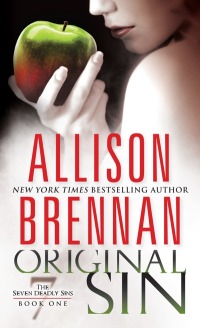
  • Covers. THIS is changing. Cover art for MMP has been getting so much better, but historically the covers were pretty much interchangeable. I see a lot of hope for cover art (especially after getting my cover for ORIGINAL SIN.)

I, personally, love being a PBO author. There’s no way I could have built the audience I have now, as quickly as I have—and an audience who consistent puts me on the New York Times list (thank you thank you thank you!)—as a hardcover author. But that doesn’t mean that someday I wouldn’t like to have a hardcover. My Seven Deadly Sins series will be published as PBO and that works for me, though as I finish the revisions on ORIGINAL SIN (no, I don’t have an ending yet, but I’m working on it!) I can’t help but think that, but for the economy, this book would have worked very well as a hardcover.

For more on the history of MMP: IOBA or here.

I’m sure there are many other PROS and CONS to the MMP, and for some authors the PROS may be a negative and vice versa. I’d be interested in your comments. And don’t forget (blatant self promo here!) that CUTTING EDGE is on sale now (by me) and the third Bobbie Faye book (all new!) called WHEN A MAN LOVES A WEAPON is also on sale now. BOTH original mass markets. 

AND the winner from my last blog, who gets a copy of Toni McGee Causey’s CHARMED AND DANGEROUS (Bobbie Faye #1) and SUDDEN DEATH (the first of my trilogy) is . . . . Eika!!! Please email me your mailing address and I’ll get those right out 🙂


The Big Twist

by Alexandra Sokoloff

WARNING: there are SPOILERS everywhere in this post, so I am providing an up-front list of the books and movies I discuss, so if you haven’t read or seen some of them and would like to, unspoiled, you may want to proceed cautiously.

Presumed Innocent
The Others
Oedipus (but honestly, if you don’t know that one…)
Chinatown
The Sixth Sense
The Crying Game
Seven

A Kiss Before Dying
Fight Club
Identity
The Eyes of Laura Mars
Psycho
Don’t Look Now
In Bruges
Boxing Helena
Open Your Eyes (Abre Los Ojos)
Falling Angel
Angel Heart
The Murder of Roger Ackroyd
No Way Out

Eastern Promises

As mystery and thriller authors, designing story twists is a regular part of our job. After all, we don’t want our readers to guess the identity of our killers before our detectives do! We employ classic story tricks… I mean, literary devices… like red herrings, misdirection, false leads, false alibis, plants and payoffs, irony and unreliable narrators, to keep our readers (or viewers) guessing.

If you’re interested in building your skill at twisting a story, I (as always) advocate making a list (ten at least!) of stories that have twists that you really respond to, and analyzing how the author, screenwriter, or playwright is manipulating you to give that twist its power, so that you can do the same for your readers and viewers.

I also think it’s helpful to realize that these techniques have been around since the beginning of drama, or I’m sure really since the cave-dweller storytellers (“The mastodon did it!”). Knowing the names of techniques is always of use to me, anyway!

And I’d also like to note up front that big twists almost always occur at the act climaxes of a story, because a reveal this big will naturally spin the story in a whole other direction. (If you need more explanation about Act Climaxes and Turning Points, read here.)

Let’s break down some different kinds of twists.

* ANAGNORISIS

The Greeks called twists and reveals Anagnorisis, which means “discovery”: the protagonist’s sudden recognition of their own or another character’s true identity or nature, or realization of the true nature of a situation.

This is always a great thing if you can pull it off about the protagonist, because we kind of expect to find out unexpected things about other people, or have surprises come up in a situation, but to find out something you never suspected about yourself is generally a life-altering shock.

So here’s a big twist that has worked over and over again:

* THE PROTAGONIST IS THE KILLER (or criminal), BUT DOESN’T KNOW IT

– We find probably the most famous twist endings of world literature in Sophocles’ OEDIPUS THE KING (429 BCE) in which Oedipus, the king of Thebes, is trying to discover the cause of a devastating plague in the city, only to find that he himself is the culprit, cursed by the gods for killing his father and marrying his own mother.

– I’ve talked at length about the influence of Oedipus on the Polanski/Towne classic film CHINATOWN (discussion here).

– But the noir mystery FALLING ANGEL, by William Hjortsberg, and Alan Parker’s movie adaptation of that book, ANGEL HEART, steals its twists from Oedipus as well: PI Harry Angel is hired by Louis Cyphre to find Johnny Favorite, who owes Cyphre (his soul, turns out!). Angel finds out he himself is the man he’s looking for, Johnny Favorite, and also that he’s slept with and killed his own daughter.

– PRESUMED INNOCENT (book and film) is another take on the Oedipal detective story, in which main character and detective (by dint of being a ADA) Rusty Savage is guilty, not of the murder of his mistress, but of infidelity, so he protects his wife, the real killer, from detection.

PRESUMED INNOCENT also employs a great bit of misdirection, in that the victim was sadomasochistically bound and apparently sexually tortured and raped – there was semen found inside her. So even though the cheated wife would ordinarily be the prime suspect, we and all authorities rule her out.

* THE UNRELIABLE NARRATOR

Another literary device that makes for a powerful twist is the unreliable narrator.

– Agatha Christie surprised and therefore irked some critics with this one in THE MURDER OF ROGER ACKROYD.

– THE USUAL SUSPECTS has won classic status for its now famous reveal that meek Verbal Kint is the nefarious Keyser Soze he’s been talking to the police about, using random objects in the police station to add details to his fabricated story.

– FIGHT CLUB puts a spin on the unreliable narrator, as antagonist Tyler Durden is revealed to be an alter ego of split-personality narrator Edward Norton (called just “The Narrator”, which is a sly little hint of the device being used.)

– Of course multiple personality disorder can be used as a twist all on its own, most famously employed in PSYCHO, but also in, hmm, let’s see… THE EYES OF LAURA MARS, and dozens of cheesy ripoffs of the concept (fascinated as I am by MPD, this is one device I’m not sure I’d ever want to tackle, myself).

– The 2003 movie IDENTITY takes the MPD twist several steps further: EVERY character in the movie a different aspect of John Cusack’s fractured personality.

* KILL OFF AN IMPORTANT CHARACTER UNEXPECTEDLY

– While I’m thinking about it, PSYCHO has another famous twist, which I’m sure at the time of the film’s release was just about as shocking as the reveal of “Mother”: the apparent main character, Janet Leigh, is murdered (spectacularly) at the first act climax.

– This was copied much less effectively but still successfully in the 1987 thriller NO WAY OUT, in which the apparent love interest dies at the first act climax.

– The Brian DePalma film THE UNTOUCHABLES kills off a beloved sidekick (the Charles Martin Smith character) at the Midpoint, and as I recall I didn’t see that one coming at all (until he got into the elevator, that is…)

* THE “BIG SECRET”

The big secret reveal, done well, means a pretty guaranteed sale and often gonzo box office. Some famous examples:

– THE SIXTH SENSE. We all know this one: the child psychiatrist who seems to be treating a little boy who claims to see dead people turns out to be – one of the dead people the boy is seeing. This one is especially interesting to note because writer/director M. Night Shyamalan went through several drafts of the script before he realized that the Bruce Willis character should be a ghost. Which goes to prove you don’t have to have a great twist planned from the very beginning of your writing process – you can discover a perfect twist in the writing of the story.

– THE OTHERS takes a page from SIXTH SENSE and triples it: they’re ALL dead. A young mother and her two light-sensitive children think their creepy old house is haunted. A climactic séance reveals that actually the mother has shot herself and the children and THEY’RE the ones haunting the new family in the house.

– THE CRYING GAME’s famous twist reveals gorgeous, sexy Dil, whom we have fallen in love with just as surely as main character Fergus has, is a man. That was a twist that hit squarely below the belt, as writer/director Neil Jordan forced us to question our own sexuality as well as our concepts about gender.

THE CRYING GAME has a couple of earlier twists at the first act climax, too: IRA soldier Fergus becomes more and more sympathetic to his personable hostage Jody, enough so that Fergus lets Jody run free when he takes him out in the forest to execute him. We kind of saw that one coming. But then there’s a horrifying shock when on his run to freedom Jody is suddenly hit and killed by a truck. Devastating, and totally unexpected.

– EASTERN PROMISES. In one of the most emotionally wrenching reveals I’ve seen in a long time, Viggo Mortensen, the on-his-way-up chauffeur for a prominent leader of the Russian mob, turns out to be a Scotland Yard agent so deep undercover that in the end he is able to take over the whole mo
b operation – but must give up Naomi Watts in the process. A wonderful “love or duty” choice, which you don’t see often, these days. And if that isn’t enough to convince you to see the film, try: Viggo. Naked and tattooed. In a bathhouse. For a five-minute long fight scene. Did I mention he’s naked?

– We see another great reveal about the nature of a protagonist in BLADERUNNER: Harrison Ford, the replicant hunter Deckard, is himself a replicant.

* IRONY

Actually this whole post was inspired by my recent structure breakdown of THE MIST, the film, which takes the idea of its shocker ending from a line in King’s original novella, but gives it an ironic twist that is pure horror:  After battling these terrifying creatures for the whole length of the movie, our heroes run out of gas and the protagonist uses the last four bullets in their gun to kill all his companions, including his son (with the agreement of the other adults).   And as he stumbles out of the car intending to meet his own death by monster, the mist starts to lift and he sees Army vehicles coming to the rescue.   People loved it, people hated it, but it was one of the most devastating and shocking endings I’ve seen it years.

* OTHER COMMON PLOT TWISTS:

Here are several twists that we’ve all seen often:

– The “S/he’s not really dead” twist – as in BODY HEAT (and overused in ten zillion low- budget horror movies).

– The “It was all a dream” twist: OPEN YOUR EYES, BOXING HELENA (I’m not sure what you’d have to do to make that one play, it’s so universally loathed.)

– The “ally who turns out to be an enemy” twist: as in John Connolly’s EVERY DEAD THING, William Goldman’s MARATHON MAN,

– And the “enemy who turns out to be an ally” twist: Captain Renault in CASABLANCA, Professor Snape in the first Harry Potter (and then reversed again later…)

* JUST BE ORIGINAL

A twist doesn’t have to be as cataclysmic as a “big secret” reveal. Sometimes a plot element or action is so unexpected or original that it works as a twist.

– I was watching THE BIG HEAT the other night, shamefully had never seen it, and there are several big surprises. I knew that too-good-to-be-true wife was going to die, but I was totally unnerved by villain Lee Marvin throwing a pot of scalding coffee in girlfriend Gloria Grahame’s face. Although you don’t actually see the burning, that brutality must have made people jump our of their seats in 1953. Then (although she’s one of my favorite actresses of all time and totally up to the task) I was equally shocked to see Grahame’s character take over the movie from hero Glenn Ford (kudos to writer Sydney Boehme and director Fritz Lang for that) and shoot another woman (a co-conspirator of Marvin’s) so that key evidence will be revealed, then go after Marvin herself and burn him in exactly the way he burned her (before he shoots and kills her).

What works as a twist there is the sudden primacy of a seemingly minor character – especially a woman who would normally just be there for eye candy. Sad to say, but portraying a female character who is as interesting as women actually are in real life still counts as a standout.

– In the movie SEVEN there’s a great twist in the second act climax when John Doe, the serial killer the two detectives have been pursuing, walks into the police station and turns himself in. You know he’s up to no good, here, because it’s Kevin Spacey, but you have no idea where the story is going to go next.

And of course then you have that ending: that John Doe has always intended himself as one of the seven victims (his sin is “envy”), and the infamous “head in the box” scene, as Doe has a package delivered to Brad Pitt containing the head of his wife so that Pitt will kill Doe in anger.

Hmm, can’t end this post with that example – too depressing.

– Okay, here’s a favorite of mine, for sheer trippiness: Donald Sutherland being killed by a knife-wielding dwarf in DON’T LOOK NOW – and the delightful homage to the scene in last year’s IN BRUGES.

And the above are not even scratching the surface of great plot twists – I could really write a book.

So, everyone, what are some of your favorite movie and book plot twists? Writers, do you consciously engineer plot twists? And editors (if Neil isn’t in the Hamptons this weekend…), on the level – are you more likely to buy a book that has a big twist?

– Alex

Related posts:

What are Act Breaks, Turning Points, Act Climaxes, Plot Points?

Plants and Payoffs

SQUAT


By Stephen Jay Schwartz

I used to think I knew him. And his cousin, Jack. But now, after forty-five years, I realize I don’t know Diddly Squat or Jack Shit.

I’d like to think I’ve become smarter over the years. Maybe I’m just more handy. Like, I’ll know how to turn off the gas the next time there’s an earthquake. And I can hail a taxi in New York City at rush hour. These are things I now know.

But there’s something bigger that confounds me. It’s this thing we’re all doing here. This thing called Life.

And what’s weird is that I had it all figured out when I was eighteen. Life was a simple through-line, no subplots. Hero takes journey, faces zero obstacles, succeeds. Everybody loves him.

I think the first sign that things would be different came when I was twenty years old and my dad killed himself. That, in the movie business, is what’s called the End of Act One.

Hence came drama and escalating action. It’s been twenty-five years since, and I’m still deep into Act Two. I suppose I should be happy about that. I want to stay in Act Two as long as possible. Ultimately, some terrible crisis will propel me into Act Three, and we all know what happens after that. The End.

Throughout Act One and much of Act Two I insisted I had learned the way things worked. With each knew year of life came greater understanding of the great mysteries I had encountered. I gave simple, pat answers for what were truly complex questions. I actually thought the question, “Why is the sky blue?” required a scientific answer. Worse yet, I thought it could be answered at all.

I’ve always been drawn to the people who asked the questions, as opposed to the people who provided the answers. In college I was drawn to Jack Kerouac and writers of the Beat Generation because they questioned authority. I was drawn to Ken Kesey and the Merry Pranksters, to Timothy Leary, to Abbie Hoffman, because they, too, questioned authority.

But the Angry Young Man energy that fueled my interest in people who questioned authority gradually settled, and I started to see the many different sides of the complex problems in life. I realized that the world didn’t really exist in black and white, bad guys versus good guys. I found that I occasionally empathized with the authority figures. Sometimes what they were fighting for made more sense to me than the rest.

As my anger subsided, my awe for life’s unanswerable questions overwhelmed me. I realized I would never know the answers. So why not focus on asking great questions?

And that is how a work of art is defined in my mind. The exploration of life—through oils, charcoal, sound waves, digital bytes, film emulsion, words on a page…

I am not impressed by a well-told story, if that story only tells the actions of plot and relates the feelings of fear, anger, love or anxiety that directly result from that plot. If the story is only the perfect execution of dramatic structure, I might as well take a nap. I get excited when I witness the question asked anew: “For Godsake what is this thing called Life???” When that question vibrates off the page, I get excited. I want to see how other writers approach this. I want to see how they handle it in memoir, thriller, crime fiction, fiction and science fiction. It’s what makes Asimov so appealing. His short story “Bicentennial Man” wasn’t just about a robot trying to fit in, it was about the African American struggle for equality in the 60s. Asimov’s work is always about so much more than the crafty execution of plot.

I think people yearn for guideposts in their lives. I know I do. I read books in hopes that some new wisdom will be revealed to me, that the author will, with taste and subtlety, leave little breadcrumbs behind so that I might find my way. And when I recognize this quality in a writer’s work, I stand up and scream his or her name from the tops of the roofs. I want everyone to know of them.

One of the extraordinary things about my debut year is that I’ve had the opportunity to meet writers whose work gives me this sense of awe. My conversations with them fill me with optimism. We are travelers together, we occupy the same raft, and yet our experiences are vastly different, and our survival stories unique. I enrich my journey through the experiences they share through their art.

I hope my own work contains the qualities I look for when I reach for something to read. One never knows. One can only try.

If any of you happen to meet Diddly or Jack along the way, I’d love an introduction.

BOOK TOUR, BOTH REAL AND VIRTUAL

After what can only be described as a fantastic evening at the Poisoned Pen Bookstore in Phoenix last night, my real-world tour for the release of SHADOW OF BETRAYAL is almost done. I’m not sure what the exact audience count was, but it had to have been north of 75. That was thanks, in large part, to the amazing Barbara Peters and her staff who not only scheduled a great three author event, but also publicized it far and wide. I was there with John Lescroart and Steve Martini, two great authors who are also a lot of fun.

I’ve got to say, I think multi author events are really the way to go. It’s great for the people who attend because they get exposed to authors they might not be familiar with, and it’s great for the authors because of the very same reason. It becomes a cross-pollination of audiences. I know that many people who came last night for either Steve or John ended up also buying my books, and I also know the same happened for in reverse.

Anyway, as I said, I’m almost done. I do have an event this Saturday at 2 p.m. at the Lancaster Library in Lancaster, California, where I’ll be appearing with our own Robert Gregory Browne. (If you’re around, I hope you can make it!) Then another event in mid-September. And that’ll be about it.

But as the real-world tour is winding down, my virtual tour is just getting into full swing! I’m in the middle of a blog tour that will last all month. I’ll be doing interviews, writing a few articles, and generally having fun. One of the more interesting things I did was an interview where I was the interviewer and my main character Jonathan Quinn was the interviewee. You can read it here.

I’m also the victim…eh…subject of Murderati regular commenter Karen Schindler’s TEN QUESTION TUESDAY. That was a lot of fun, too!

http://miscellaneousyammering.blogspot.com/2009/08/ten-questions-tuesday-with-brett.html

That’s just a couple of the places I’ll be. I’ll be posting a list in the next day or two on my personal blog. So check it out when you have a chance.

Finally, I just wanted to also thank all of you who came out and saw me as I was out on the road, and to the wonderful bookshop owners and employees who do such a great job for all of us (fans and writers) everyday!

And for those of you I didn’t see, hopefully we’ll do it next time.

what’s your platform?

I first heard the term “author’s platform” about 4 years ago, when I was one of the presenters on a publishing panel.  An aspiring author in the audience complained to us: “I’ve been told it’s impossible to sell a first novel these days unless the author has a platform.”  Being clueless about the term, I didn’t know how to respond.  The word “platform” conjured up in my mind a wooden box or some sort of rickety stage, and I couldn’t see how that was going to help anyone sell a book.  Luckily, an editor on our panel was able to jump in with the answer that yes, having a platform is a real plus, but it’s not necessary for a first sale.

Since I didn’t want to look stupid, I just nodded as if I knew what the hell they were talking about.

Although I haven’t heard the word officially defined, I’ve since come to my own understanding of what the term means.  Your life experience, your area of expertise, and your public persona are all part of your “platform.”  It qualifies you as just the person to write that particular book, and it makes you more promotable as an author. If you have a platform, you’re not just another novelist who’s dreamed up a story; you’re someone with a unique perspective who has secrets to share, someone with real information that makes journalists come calling.  

And yes, it does sell books.

I had to write nine books before I figured that out for myself.  I started off as a romantic suspense author, and even though I’m a physician, my stories had almost nothing to do with medicine.  Instead they featured cops and spies, with only an occasional nurse or physician appearing in the cast of characters.  As a romance author, I was writing without a platform, and even though I was getting published, I couldn’t make a living on it.

Then I wrote a medical thriller, HARVEST.  Suddenly, people got interested in my books. A major publishing deal and much publicity followed. Yes, the book itself had something to do with it.  But I’m convinced that none of it would have happened, no matter how good the manuscript was, if I hadn’t been a doctor.  My platform was my medical background. An Associated Press interview focused on the fact that I was a doctor writing about what I know.  The press releases emphasized that I was showing the secret world behind operating room doors.  With enough research, it’s certainly possible that a non-medical author could have written HARVEST.  But would the book have gotten as big a push from my publisher and from the press?  I doubt it.

So yes, having a platform really does make a difference.

I can already hear the moans of despair out there from aspiring writers.  “What if I don’t have a platform?” you ask.  “Am I doomed to never sell a book?”

Ah, but the chances are, you do have a platform.  You just don’t realize it yet.  A platform can be any number of things.  It can be your occupation or some off-beat hobby.  It can be the fact you’ve spent every summer as a Civil War re-enactor.  Think about your life.  Think about your passions.  Think about what makes your life experience unique, about the secrets you know that other people don’t know.  These are all interesting details that will make you promotable.

You don’t have to be a celebrity to have a platform. Are you a geologist?  A social worker?  A waitress?  Any one of those occupations could be woven into a compelling book, and you already have the platform to write and promote it.  I, and many others, love reading about restaurants. If you’re a chef, just think of the inside tales you could tell on book tour while promoting your restaurant mystery. 

I recently read the galley of a debut mystery novel featuring a Maine park ranger.  The book is going to get a big push by the publisher, and it’s not just because it’s a good book.  The author, it turns out, has the background to talk with authority about Maine park rangers.  Read his book, and you know you’re getting the inside scoop.  You’ll also start to believe that the author is the protagonist, that they even look alike.  When that cross-identification happens, it’s magic for sales.  It’s what makes fans believe that Lee Child is Jack Reacher and Kathy Reichs is Temperance Brennan.  If you the author share the same occupation as your protagonist, readers can’t help but wonder if you’re secretly writing about yourself — and they love thinking that they know the real you.

“But what if I don’t want to use my platform?” you ask.  “What if I’m a rocket scientist but I want to write a novel about pirates on the high seas?”

If your book is really, really good, then platforms don’t matter.  And if it’s really, really lousy, a sky-high platform isn’t going to help you sell a dud.  But if you do have a platform, it only makes sense to use it.  It took me nine books to finally make use of mine.  And once I did, my career took a decidedly upward turn.

Recently, I met a veteran cop who’s sold a number of short stories to a major publication.  He’s attractive, personable, and well-spoken.  He’s written a novel, but it wasn’t a mystery novel. His literary agent sent it back to him, asking: “Where’s the cop novel? I want a cop novel.”

“I don’t want to write a cop novel,” this cop said.

This is his dilemma.  He can obviously write, but the books he wants to write won’t make use of his platform.  What should he do? Write what he wants to write, or write the story that he’s immensely qualified to write, the story that his agent is clamoring for?  Does he follow his passion or should he bow to the realities of the market?

I think he should write the cop novel. Once he’s a published author, once he’s made a name for himself, perhaps he can expand his horizons. 

But it’s something every author has to decide for himself.

Are literary agents necessary?

This is the kind of question that can get a person into trouble, isn’t it?

After months of going back and forth with my agent about my new manuscript, a little frustration comes naturally. After rewriting said manuscript completely at least once more, revising it again, and cutting out nearly 60 pages from the original work, I’d have to be brain-dead not to wonder if I was doing the right thing.

Why did I listen to many of my agent’s suggestions?

Well . . . some of his points made incredible sense to me. On top of that, I respect his knowledge and sensibilities about the genre. And I’m hungry to be a better and better and better writer.

The members of my critique group thought I was insane to do all that to a manuscript that they thought would’ve sold anyway. They urged me to send out the book myself. I’m sure several of my cohorts on the ’Rati would’ve had the same advice.

Yet, I made the decision to listen. In the end, will all that mishmoshing result in a sale?
I’m waiting to see.
My agent has had tremendous success with other writers; we’re both hoping he will with me.

In the meantime, my question remains: Are literary agents necessary?

When I was learning the business side of writing, everything I read and learned about the industry would’ve answered, “YES!”

It seemed like an immutable law, as much a given as the sun rising in the east and dogs liking liver treats.

Sure, there were tales about people who’d gotten published without an intermediary, but those were the exceptions, the stuff of myth.

Then came 9/ll, the anthrax scares, and the word on the street was that publishers wouldn’t open anything from anyone they didn’t know. In this new and paranoid environment, agents became even more essential.

However, quiet success stories continued to make me wonder about conventional wisdom. One that comes to mind right away is Pati Nagle who negotiated a three-book deal with Del Rey. She used an entertainment lawyer after the contract was offered.

Her answer to my question would be “NO!”

So which answer is right? Which would benefit the many writers — the ones reading our blog for advice — that are striving for publication right now?

IMHO, people need to really weigh the pros and cons of seeking literary representation in their careers. As Toni wrote yesterday, they need to look at what makes the most sense for them.

Below are two lists to begin the conversation. I note the pros and cons in no particular order — and am sure I’ve missed many in both categories — but hope that we can examine this question frankly for everyone’s benefit.

Pros

  1. Contacts: access to — and attention from – editors who make the real decisions in publishing
  2. Business advice
  3. The abililty (to potentially) negotiate larger deals than a writer might do on his/her own
  4. An advocate for the author to the publisher—editors and accounting
  5. Legal and other specialized knowledge about the industry and trends therein
  6. Up-to-date knowledge of the good, bad and the ugly about the publishers themselves
  7. Current knowledge of the movements of editors across imprints and houses
  8. Editorial advice (at least I like that in my agent)

Cons

  1. It’s often more difficult to get an agent than it is to get a publisher
  2. Time wasted researching and querying to find a good, reputable agent
  3. Another block between the writer and the publisher/editor
  4. Loss of income to a “middle man”
  5. Potential pressure to write what you don’t want to write
  6. Dishonesty/lack of transparency in money/editor querying
  7. Lack of enthusiastic representation or, worse, misrepresentation
  8. Personality or ethical conflicts

What do you think?

Are agents necessary?

Why?

__________________________________________________________________________________

A program note:

Tim Hallinan will be my guest at Murderati next Monday, August 17. He’s written a provocative piece “Bleak is the New Black” that I think will spark a fascinating discussion. Please stop by and make him welcome.


To Vegan or Not To Vegan…

by Toni McGee Causey


Is alcohol vegan?

See, it started innocently enough. Not long ago I was at a conference, where I met up with a dear friend who’s recently become vegan. And let me tell you, she looks gooooooooood. Like ten years younger, thinner, prettier. She glowed, people. All glowy with the good. I, being no dummy, immediately asked what in the hell had she done? Who had she sold her soul to and where could I line up?

Then she told me she’d become a vegan.

Now, at this point, I had had exactly one (1) appletini.  


(It was my first, ever, and let me just say for the record that it is a damned good thing I am too lazy to learn how to spell “appletini” much less make them, because otherwise? This blog would be brought to you by the letters J A I and L.) Anyway, in the warmth and happiness of said appletini, “vegan” didn’t sound so scary.

It was the second appletini where I sort of lost my mind, because “vegan” actually started to sound easy. I could feel better and get healthy and lose weight and be proactive, all in one move. Lots less choice of things to eat, but hey, that just simplifies life, right? Simplification is good. Smart. I even hauled out my iPhone and started recording her suggestions of what I could eat and in that moment, I knew I could pull this off. This was going to be great! I only sort of worried when “tofu” featured prominently on a couple of her menu suggestions, but I then realized (and this was the part of my brain which was suggesting I have another appletini) that hell, I eat crawfish. How traumatizing could tofu be?

I was allllllll the way back in the hotel room before I had the epiphany: Cheetos are not vegan.

I think I might’ve broken the world record for “fastest failure of a diet.”

The thing is, it works for her. Really works.

But it would never work for me. I don’t have the same inclinations, the same desire, or enough patience. [I am not exactly the most patient of people.] [I know, I know, that comes as a HUGE shock to you all. Buck up.]

I do know what works for me: plain old exercise. Boring, non-glamorous, just-do-it walking and weights. Doing these things consistently.

Oh, but that other method was tempting, partly because she’d had quick, amazing results. Partly because it seemed kinda cool to be able to say, “I’m vegan.” Like wearing a costume or stepping into some other role.

It’s tempting, isn’t it, to try to fit into a slot that someone else does well, which is clearly successful? It’s like, “Well, since they know what they’re doing and that works, maybe that’s what I should be doing, too.”

Trying to be “like” someone else, trying to write like someone else, trying to write “to the market” – are probably the most destructive choices a writer can make.

It’s great to learn from others. It’s a smart move to see how someone else accomplished something and analyze what they did and why. But the next step after that is to then see how it fits you—your life, your experiences, your style. Your voice. And then choose what works for you. Not how you can contort yourself to fit into what others do, but what you would like to use of what they do to enhance your own voice.

What do you bring to the table? Who are YOU? Value that. Look at it carefully and appreciate it, because it is your gift. It is what will make your characters and your story and your plot unique. Your take on the world, how you see it, your perspective.

Me? I am, at my best, a hopeful cynic. I am pretty sure that there are people out there who are not only going to shoot themselves in the foot, but they’re going to reload and aim at the other foot. I am hopeful, however, that they will miss at least one of those times. It is the suspense of watching that in action which fascinates me. It is how I frame the world, how I make sense of what is happening around me, how I communicate and function. [If it helps, I had written two books before I was able to explain that.]

Be authentically you. That’s who we’re going to want to get to know. That’s who we’ll value.

In the meantime, tell me at least one thing you’ve done in your life which just did not “fit.” (C’mon. I cannot be the only person who’s tried a diet or [and no, I am not posting a photo] gone blonde.) What harebrained thing have you done?


Pilgrims! SCREE!! SCREE!!! SCREE!!!!

By Cornelia Read

So last Sunday I moved to New Hampshire, which is kind of a trip. This means I have lived in seven states in my life, officially (NY, HI, CA, MA, VT, CO, and now NH–not necessarily in that order.)

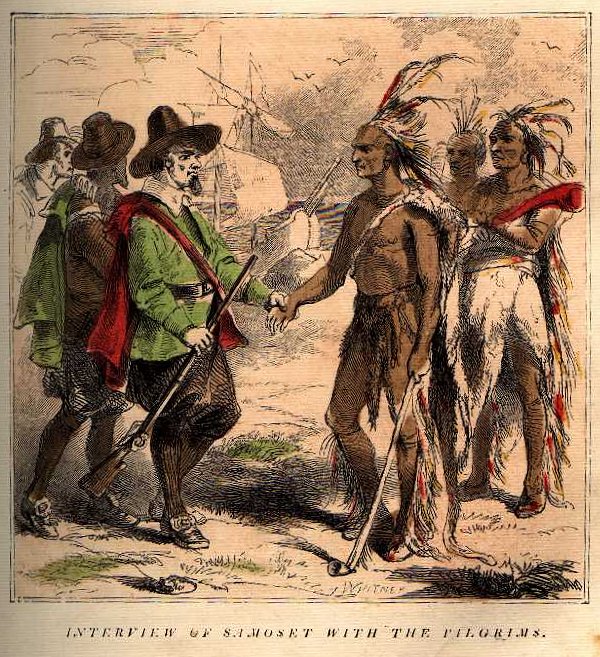
I kind of have a thing about New England, though, in that I think my Puritan ancestors are going to rise up from the mists and get me for not being all Pilgrim-y and shit. I mean, those people had a serious attitude problem.

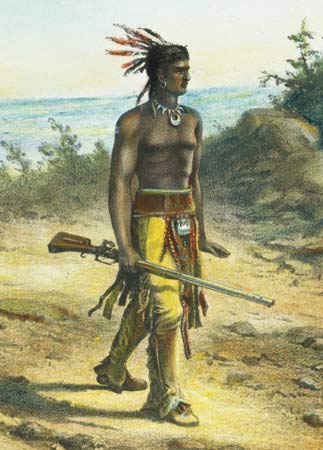
(well, okay, maybe these ones are just pissed off because they’re not sure whether they’re supposed to be Pilgrims or leprechauns–or maybe they’re more worried about how much better-endowed the Indians are– but whatever.)

I once had to write a paper in college about William Bradford’s Of Plimoth Plantation, and the shit seriously freaked me out (Although I did like my line about how when they executed the teenage boy who had had sexual congress with {if memory serves} a cow, a horse, a goat, two sheep, and a turkey, and then buried him with the also-executed cow, horse, goat, and two sheep, that “one could surmise the turkey did not survive the initial encounter.”)

Ahem.

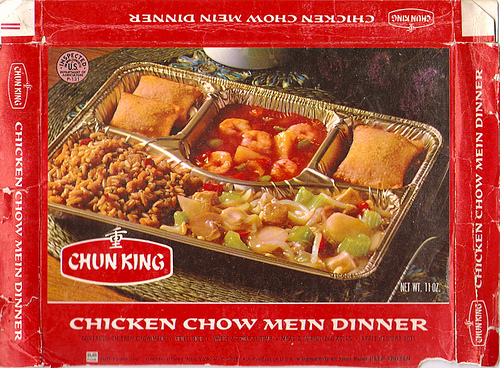
I flew east with no furniture and only a couple of duffel bags full of stuff, so I’ve been thinking a lot about what makes someplace feel like home. I did bring five pictures with me… menus from a South American cruise line illustrated with a bunch of people in “native” garb that used to hang in my Smith grandparents’ kitchen. My favorite one is the Nicaraguan chick, who’s pulled her skirt up so she can roll a cigar on her thigh. If I’d packed a scanner, I’d reproduce that here, but I didn’t oh well.

Oh, wait… I totally have my iPhone, so here:

And I also brought the dessert menu from this really cool funky restaurant in Carmel Valley which only operates on Monday nights at the Cachagua General Store (50 points to the first person who spots why I saved it):


Okay, yes, I ALSO like the Marcus Aurelius quotation.

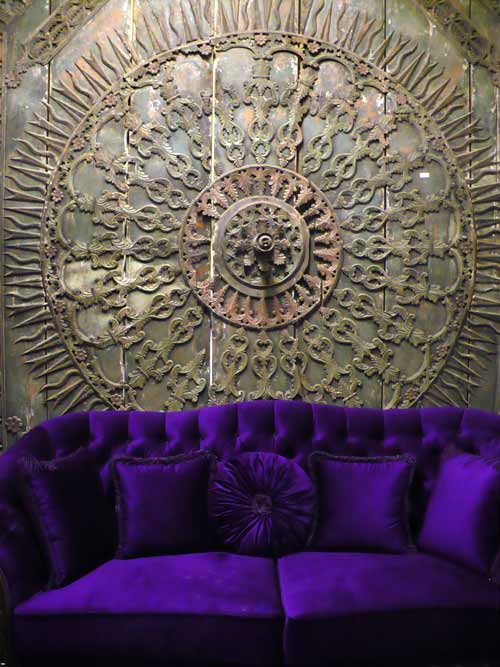
Other than that, I threw out about half my clothes and just brought sneakers and stuff. It’s been fun hitting garage sales to stock up on the usual crap, and my pal Candace just left her third husband and so offered me some of her furniture from their house in Vermont, now that she’s in Texas. This includes a truly hideous purple naugahyde sofa, which feels really karmic since I once had a purple naugahyde sofa in Syracuse, which even made it into chapter one of my first novel. It’s really a tossup which one is more hideous. I’m hoping someone buys my house in Berkeley so I can light this one on fire and go to IKEA. Seriously.

(if it were this one I might not mind so much. Sigh.)

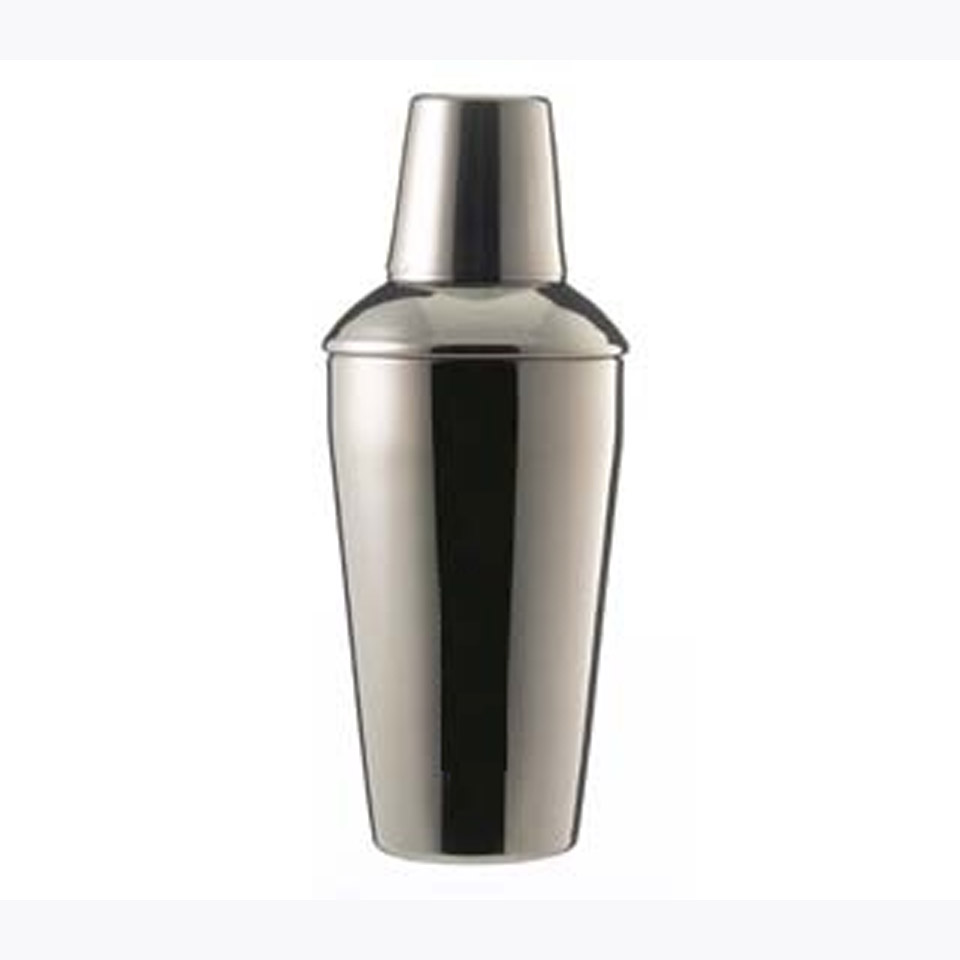
Yesterday I drove three hours to go to a church sale in Vermont with my Aunt Julie. I scored four chairs, two tables, an old floral print, a pitcher, a salt shaker, and the ever-important cocktail shaker (take *that*, pilgrim scum!!)

What’s really cool about being here so far is that I scored an astonishing apartment, right on the Squamscott River in an old mill building. It’s about twice as big as my house in California and has twice as many bathrooms, for about a third of my old mortgage payment. This may seem like less of a bargain in February, of course.

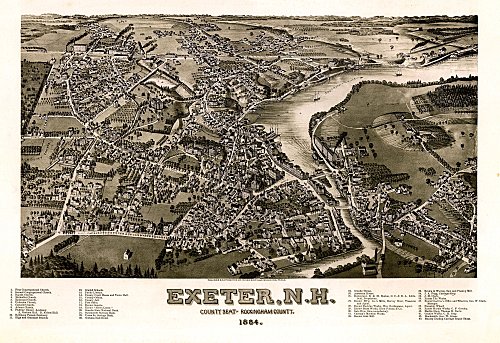
Here is a bird’s eye view (look for the smokestack):

Here is a closeup, as of yesterday rather than in 1864:

Here is what it looks like on the inside:

(This is the living room, pre-purple-sofa. Note distinct lack of furniture. Mom found the rug in the dumpster. For a sense of scale, the windows are about twelve feet tall.)

So what’s kind of weird about all this is that I’m in a completely new-to-me town, and I’m going to be writing a novel about moving to Boulder, Colorado, fifteen years ago. Right now I’m in about the same state of mind as I was in Boulder–figuring out where the drugstore is, and whether or not they have decent Chinese food (which is my gauge of a locale’s level of civilization. Also Mexican food, but hey, it’s New England. Pilgrims definitely still trump decent salsa up here.)

I know this is a very scattered post, but I’ve driven 900 miles in the last two days, I’m not fully unpacked yet, and I can’t figure out how to make Candace’s TV work, except for channel three, which is a really boring channel.

How about you guys… what makes a place feel like home to you, and what makes a place somewhere you can feel settled enough to write? I’m already missing going to my writing partner Sharon’s house every weekday, and desperately missing my writing group, and my Bay Area mystery peeps.

Also, if you live in this neck of the woods, what’s the best thing about being here, and how do you survive February? All suggestions most welcome…

In the meantime, I am hoping to run into Squanto.

I have a feeling he knows who delivers the primo Szechuan around here.

And if any Pilgrims ask where I moved to, tell them Vermont.

Also, if anyone wants a house in Berkeley, I’ll trade you my old one (click here to see it) for a decent sofa.

p.s. that is SO not my furniture–the broker brought in a stager. But the blue stove is awesome and the built-in espresso maker speaks thirteen languages. Pinky swear. Open house tomorrow, I think.

Working It Out …

by Zoë Sharp

First of all, I’ll start with an apology. I’ve been kinda quiet these last couple of weeks. (Oh, so you hadn’t noticed I was missing …?) Put it down partly to rushing about the country, going to Harrogate, and Caerleon, and partly down to needing some time to reflect on a lot of things. One of which is how we deal with people, and therefore how our characters interact and deal with each other.

Every now and again, somebody explains a theory to me and it just clicks. A little light bulb comes on in the brain and some abstract concept finally takes shape and form. So it’s been this week with something called Transactional Analysis. Not something I’d come across before, but once I had, I realised I was seeing it everywhere.

Now, I know it doesn’t exactly sound enthralling, but stick with me on this. Transactional Analysis, known as TA for short (although that still means Territorial Army to me) is a theory of psychology developed in the 1950s to explain how people are put together and how they relate and function in a group. Don’t worry, I’m not going to get all psycho-babble on you. (I’m blonde, remember).

TA works on the basis that everyone has three ego-states – Child, Adult, and Parent. These are present regardless of age and actual status as a parent. They govern your reactions to others. Most of us, most of the time, function on an Adult to Adult basis, but it’s very easy to slide into another response, forcing the other person to also alter their stance. Wikipedia gives the following examples.


Straightforward Adult to Adult exchange:

A: “Have you been able to write that report?”

B: “Yes – I’m just about to email it to you.”


Child to Child would be:

A: “Would you like to skip this meeting and go watch a film with me instead?”

B: “I’d love to – I don’t want to work any more, what should we go and see?”


And finally:

A: “You should have your room tidy by now!” (Parent to Child)

B: “Will you stop hassling me? I’ll do it eventually!” (Child to Parent)

These fall into fairly set patterns of behaviour and can go backwards and forwards like a tennis match. The problems occur when people cross from one ego-state to another during an exchange.


So, what starts out as an Adult to Adult exchange is altered by the response.

A: “Have you been able to write that report?” (Adult to Adult)

B: “Will you stop hassling me? I’ll do it eventually!” (Child to Parent)


and will often force A into a suitable Parent to Child response:

A: “If you don’t change your attitude, you’ll get fired.”


Equally, you can break this cycle, so:

A: “Is your room tidy yet?” (Parent to Child)

B: “I’m just about to do it, actually.” (Adult to Adult)


Of course, it may not be comfortable for someone who is in a Parent ego-state, and expecting a Parent to Child/Child to Parent reaction.

A: “I can never trust you do to things!” (Parent to Child)

B: “Why don’t you believe anything I say?” (Adult to Adult)


The trick, of course, is to be measured in your response, otherwise what should be reasoned argument comes across as petulance, which is not quite the same thing.

Of course, within these ego-states are other sub-states. Parent has the controlling aspect, and the nurturing aspect, which can both be negative and positive. Everyone wants to be encouraged and praised when they do well, but sometimes this can turn to smothering. Everyone wants to be guided, but not to the point of oppression, or being lectured to.

Likewise, the Child ego-state is either adaptive or free. Everyone needs, at some time or another, to follow instructions and do as they’re told, but being too adaptive can lead to submission, and too much freedom goes beyond confident, outside-the-box thinking into just plain rebelliousness and displays of temperament.

The more I think about these automatic underlying responses to the behaviour of others, the more sense it makes. For example, have you ever been in the situation where you’ve watched the reactions of a colleague, boss or friend towards another person, and thought, ‘If I’d said that to my colleague/boss/friend, they would have bitten my head off …’? If this is the case, perhaps that other person is not allowing your colleague/boss/friend to force them into playing the Child to Parent role, and your colleague/boss/friend is reacting accordingly by going for the straight Adult to Adult response. It’s probably completely subconscious rather than directed at you personally, and you have to react very carefully to turn this around and not head instantly for rebellious Child mode.

TA reasons that everyone’s psyche has these three ego-states and we naturally slide between them in all our dealings with other people. The problem comes when the balance becomes upset, either because you feel you’re being bullied by another person – constantly falling into the Parent to Child mode – or even because you feel you have to bully someone to get them to respond as you believe they should.

The answer depends on your temperament and self-confidence, to a certain extent. If you feel lectured by someone close to you – as often happens in a relationship where one partner Always Knows Best – then making a gentle joke of it is often the best way forwards, so they recognise what they’re doing and it’s not being pointed out to them in such a way as to provoke an angry response.

In a business relationship, sitting down and calmly explaining to the person that you have a problem with them and asking how best to solve it is the only way forwards – forcing an Adult to Adult exchange and not letting it degenerate into a Child to Parent slanging match. (Cue cries of “It’s SO unfair!”)

Anyway I found all this stuff fascinating, because it gives me plenty of food for thought about the way my characters interact with each other. And as I’m just planning the next book where Charlie has to bodyguard an immature girl, there will be plenty of scope for Parent to Child interactions.

So, my questions are, does this make any sense whatsoever? Have you ever felt yourself reacting to others in the ways described and not been aware of it? Do you think this is a useful character-building tool from a creative writing point of view?

OK, lesson over, now to have some fun!

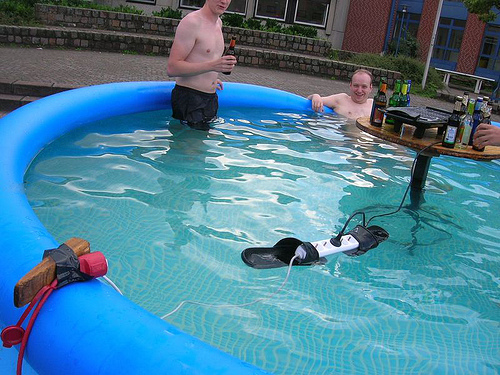
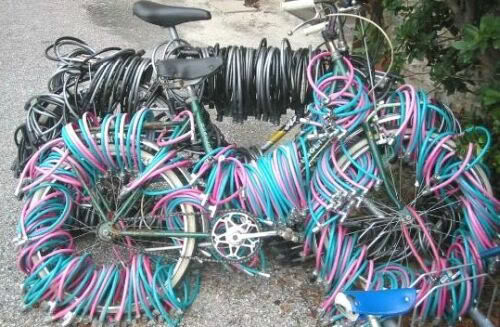
I came across these pix this week, wonderful examples of creative stupidity or ingenious bodges, all of them, and I thought you might enjoy them.


This week’s Word of the Week is suppedaneum, which is the support under the foot of a crucified person. I’m not sure what bothers me most about this – the fact that such a footrest was devised to prolong the agonies of crucifixion, or that it has a special name.