Author Archives: Murderati Members


She’s All That

By Stephen Jay Schwartz

It’s time to give props where props are due. This, to my supportive and enthusiastic wife, Ryen.

She’s all that. And more.

The more is something I never would have guessed when I met her twenty years ago at that Hillel dance in college. She was such a cutie then, cute as a little button. And exactly my type, with her long, long blond hair, her great smile and bright blue eyes and thin, petite body. Features that she’s kept to this day. I have to admit, what grabbed me first were her looks.

I knew she read a lot, but I also knew she read the kind of novels I didn’t read, like…historical romance. And she watched a lot of television, which wasn’t really my thing, since I had just come out of film school and was buried in the Gigantic Technicolor Epics of World Cinema.

Her background, however, would sneak up and save me.

Years into our relationship I began working as a development executive in Hollywood. Soon I was reading two screenplays every night after work and fifteen to twenty on the weekends. We got married, and I realized that if we were going to make this relationship thing work we were going to need to find a way to reduce the workload. The way I had it figured, if we split that “weekend” read between us, with the two of us reading Friday night and all Saturday day and night, we’d have Sundays off. I gave her screenplays to read and asked her for a verbal synopsis, or pitch, of each screenplay. If the screenplay was good, or if the subject matter seemed appropriate for the film company that employed me, I would read it myself. Before long she became my “ghost reader.”

And we had Sundays off.

What surprised me, however, was that she was really, really good. From the start. No learning curve. Her sense of dramatic escalation, plot, character and dialogue stood out as something exceptional, something I rarely saw, even though I was surrounded by people whose job it was to analyze and develop story for films.

When I wrote BOULEVARD, Ryen read every word, sentence and chapter behind me, every night. She found the subject matter disturbing; this wasn’t the kind of stuff she liked to read. But she got it. She knew where I was going and what I needed to do to get there. And when I pulled punches she caught them. When I skirted the darkness she turned me around to face it.

I’ve never encountered anyone with such a natural sense of plot. And I think a lot of it came from her total immersion in television as a child, combined with her addiction (and that’s what it was – I bet you didn’t think I could get the word addiction into yet another blog!) for historical romances. Both forms of storytelling adhere to specific formulae regarding primary plot development, subplot development (usually a romantic plot-line), plot points, and standard three (sometimes four) act structure. Ryen didn’t know any of this. But she knew all of it. She knew it so well she didn’t have to think about it.

And so I’ve discovered that my wife is not just a supportive mother to our two young boys, whom she home-schools. She is not just a sensitive and understanding partner who endures the dramatic mood swings of an over-anxious writer. She is not just the perfect cheerleader to my occasional touchdown pass, or the chummy grade-school coach who’s there to pick me up when I fall. The girl is all that. And more.

Was it fate, then, that the young girl I met at the Jewish dance would turn out to be the brilliant, natural story editor I would need in order to find success as a novelist twenty years later?

I need her now more than ever. As I drown in the research of my second novel, as I write and rewrite scenes and chapters that will never see the light of day. I depend on her to review, organize, and focus my thoughts into coherent lines of plot and real-life characters whose dilemmas demand real-life empathy.

But don’t think it’s easy. She’s got her opinions and, by God, she’s always right. If you think it’s tough receiving criticism from your friends, try getting it from your wife. All…the…time. I put my foot down recently when she suggested that I correct the spelling of “labridoodle” in my bio. “It’s spelled with an ‘a’,” she said. “Labradoodle.”

“It should’ve been spelled with an ‘i’ to begin with,” I insisted. “It’s a made up word anyway, for a made up dog, a Disney dog, a dog that consists of parts of dogs that should never have been combined. Labridoodle is cuter and it’s the way I choose to write this silly new word to describe our silly new dog.”

But she won’t let it go. For my labridoodle “win” I have to give her a two-page rewrite on the sex scene I’m writing for my next book, because the scene reads, “too cute, too silly, too…Disney.”

We spent most of last weekend tearing apart my next book’s plot, again, and rebuilding it into a story worth telling. It was a painful and humbling experience. She took the inspired mish-mash I had and gave it direction. I would lend her out to every writer I know, but I’m afraid she’d kill them. She delivers brash bullets of truth. She tears my heart out and feeds it to the demons she keeps in her tote bag, with her sharpened pencils and antibacterial hand gel.

The girl’s an ego-killer. But she wouldn’t do it if she didn’t care, if she didn’t want my work to be the best it could be. And, shit, it works. She’s got something, man. Something that eludes me. I’d be a fool not to listen.

So, Ratis, who do you turn to when you want an honest, intelligent perspective on your work? Who watches your “blind side?” Is it your editor? Spouse? College professor? Another writer? A workshop?

A Moment in the Spotlight

by Brett Battles


Two years ago almost to the day I was chomping at the bit because my debut novel was within a week of coming out. As I near the release of the paperback of my second novel, THE DECEIVED (out next Tuesday!…makes a wonderful gift!), and the release of the hard cover of my latest novel, SHADOW OF BETRAYAL (out July 8th…also makes a great gift! – for those of you in the UK, this book is entitled THE UNWANTED and will be out July 2nd!), I started thinking about what my old friend and new Murderati blogger, Steven Schwartz, is going though in these next few months leading up to his debut release date.

The excitement, the nervousness, the feeling like the day will never get here. I’m sure all of that is starting to take hold of him. It’ll build up, and build up all the way to that release date to the point he’ll almost burst. If he’s like me and a lot of other novelist I know, he’ll see that date as this awesome stone marker on the timeline of his life. And it is. But the actual pub date will more likely come in quietly than with a roar.

Unlike when a movie opens, or a TV show debuts on the tube, a book launch is gradual. There is no public notification that something big has happened. No mass rush to the theater (or in our case, the bookstore) to get a view of your story. Most people probably won’t even buy your book on the first day it’s out. And if you go out to do some drop-in signings (that’s visiting bookstores just to sign stock), you’ll find that more than one doesn’t even have your book out on the shelves yet. Hell, I went to one place nearly a week after my pub date, and they hadn’t even unpacked my novel yet.

Still, there is nothing like that first pub date. And I’m so excited for Steve as he goes through his.

None of that is to say that subsequent publication days are not exciting. They are. They all are.

With SHADOW OF BETRAYAL coming out soon, I’m once again thrilled. I can’t wait until it comes out, and I hear what people think. There are things in this story that set up things in the next book, and in books three or four down the line. And, yet, like always, it stands alone so that new readers don’t have to read the first two Quinn books to know what’s going on.

But unlike when my debut came out, I also now feel other things.

I’m concerned about (in no particular order): how the fans of the Quinn series will react to the new story, the state of publishing, how well will the new book sell, a new contract that’s still a year away, what do I need to do to extend my reader base, writing a new stand alone or series so that I can up the amount of output I have each year, writing a new Quinn novel, not loosing track of all the ideas that keep jetting through my mind, the future of publishing, the future of publishing, the future of publishing…

And I’m not the only one who feels this way. Most other authors I’ve talked to have the same reoccurring thoughts and concerns. Our own Tess has often blogged both here and at her own blog about her worries each time a new book comes out.

By saying all this, I’m not trying to belittle the struggle all writers go through to try to get published. I’ve been there for sure. And I know I’m lucky to be where I am now.

What I’m really saying is that I envy Steve in the fact that he’s living in the moment of his debut year. It’s a great time, and Steve, you should cherish it all! But in even so, I kind of like being where I’m at now. As much as the future scares me, it also excites me. There are so many possibilities, so many potential opportunities. In a way, it’s like reading a good book, you really don’t know where things are going to go, but you can’t help turning the page.

For all of you who are still chasing that first pub deal, I hope for you the best so that you, too, can experience that rush that comes with your first book release. And when it comes time for your subsequent releases, you’ll know what I mean about the other stuff.

If all has gone as planned, I’m back home now…but just barely. So if I don’t answer comments right away, it could mean I’m still asleep, or just…well…loopy. (No cheap shots, Rob!) Still, would love to hear your thoughts.

Every Day

Our children sometimes forget about us.

When they get to a certain age, they go off to find their way in the world, and their parents (most often their father, who tends to be the more aloof of the two) become something of an afterthought.

I don’t mean this in a negative way. If you’ve done your job right, that afterthought will usually be a good one, a comforting one. But their lives are their own now and your part of it in the day-to-day scheme of things is less important than it once was.

And that’s as it should be.

If we’re good parents, we raise our children to be independent, but always knowing that they can call on us if they’re in trouble, or if they need advice or support. The job of a good parent is, I believe, to provide that support without judgment. Give them the advice they seek, yes, but do it without the color of “I know what’s best for you.”

Because you don’t. What’s “best” for any individual is something they have to figure out on their own. And that includes our children.

If you’re offering advice that they choose to ignore – despite the fact that it was given based on your experience and knowledge and understanding of the world – then you should accept that they’re old enough to make their own decisions and that this may mean making a number of mistakes as well.

I certainly made my share.

Being a parent is full of heartache and joy – mostly joy – but we can’t control our kids forever. And I think that parents who continue to try to lord over their children well after they’ve left the nest, are operating out of selfishness. They want this control because it makes them feel better. Not because it’s necessarily what’s best for their child.

Here’s my approach to parenting: Nurture. Encourage. Support.

But give them space. Don’t second-guess every move they make.

Oh, and worry. Worry plays a big part in being a father. And I do a lot of it. But I usually keep it to myself. I don’t want my irrational – and sometimes rational – fears to impede their growth.

My son graduated from college this past weekend. He’s a smart, sensitive, likeable young man who has spent the last four years searching for his passion and, I think, has finally found it. It’s a passion he had all along, but it’s something he wasn’t sure for all those years that he could turn into a reality. Now that he’s older and has spent some time in the world – even the insular world of college – I think he realizes that he’s in control of his own destiny and has a good shot at making his dreams come true. He has a plan of action mapped out and that has, I think, fueled him to push forward.

But beyond all that, he’s just a good kid. Someone who is, I believe, destined to contribute greatly to the world. And I couldn’t be more proud of him.

My daughter – our first born — has a Master’s degree in education and has just finished her fourth year as an elementary school teacher. My wife and I traveled up the coast with her this past weekend to watch our son graduate, and it’s always nice to spend time with her. She’s intelligent, funny and has one of the quickest wits of anyone I’ve ever known. And despite the fact that she’s been through more heartache in her life than most people her age, she has managed to get through it all with a largely positive attitude and a sense of optimism that I sometimes marvel at.

Her work is her passion. How many people do you know who actually say the words, “I love my job?”

Not many. But she’s one of them. And she’s exceptionally good at what she does. She is, I believe, the model of what every teacher should be. Committed, passionate, talented, creative and tireless.

And I couldn’t be more proud of her.

Whenever I’m with my kids, I see myself in them. The good and the bad, but mostly the good. And there is no greater reward than that.

With Father’s Day coming up this weekend, we’ll do the usual dinner thing, but I think it’s not so important that my children celebrate me as their father.

What the day should be about is me celebrating of my fatherhood. I’m the one who is lucky to have them. I’m the one who is lucky they turned out to be the wonderful children they are.

I probably don’t tell them this enough, but I can’t imagine loving anyone more than I love my kids, even during those times that I’m relegated to the back of their minds.  Even though I no longer control their destiny.

When I look at them, at what they’ve become – and how they continue to grow – my chest tightens and the tears well up and I feel nothing but pure joy.

And every day is Father’s Day for me.

Research almost got me arrested

Among the reasons I love being a novelist, I’d have to put the fun of research at the top of the list.  Thanks to my drive for accuracy, I’ve hung around autopsy rooms, been present at the CT scanning of an ancient Egyptian mummy, and toured behind the scenes at Johnson Space Center.  Seldom do these jaunts get me into trouble.  But every so often, I’m reminded of the old adage that curiosity kills the cat.

It can put a writer in jail, too.

My near-arrest happened while I was doing research for my biological-disaster-in-space novel, Gravity.  The book takes place partly in orbit aboard the International Space Station, and partly at Johnson Space Center in Houston.  My hero, Jack McCallum, is a physician who was once in the astronaut corps, but because of a medical condition (kidney stones) will never get the chance to fly in space.  So he’s left NASA and returned to working as an E.R. doctor in a local hospital.  Now, it doesn’t really matter whether that hospital is real or fictional, but since I was already spending the week at NASA, I thought I might as well choose a real hospital for one of Gravity’s scenes, which takes place in an emergency room close to NASA.

My husband and I drove to Miles Memorial Hospital.

Since he and I are both physicians, we felt pretty comfortable walking in the front doors and taking a look around.  The lobby was busy with visitors and employees and volunteers going about their business.  I had a little notebook, in which I sketched the layout of the lobby, and my impressions of the of the place.  I checked out the gift shop, noted the location of the elevators, and just sort of wandered around trying to imprint the atmosphere in my head so that I could later write about it accurately.  We walked into the waiting area of the emergency room, took a look at where the ambulances would pull in, and again I jotted down notes.  Finally, I wanted to see which floor the ICU was on, so we rode the elevator up to that floor, just so I could see in which direction one would have to turn to walk there.  

At no time did I enter a patient area; I stayed only where a visitor who was there to see a patient might go. Finally satisfied that I’d seen enough to describe the hospital accurately, my husband and I rode the elevator back down to the lobby and headed toward the exit.

That’s when two burly security guards closed in and took us into custody.

They brought us into a back room and told us the police had been called and were on their way to arrest us. What were we guilty of?  “Trespassing,” they answered.  They’d been watching us on their security cameras, and were certain we were up to no good.  

“But we’re physicians!” we protested.  

Yeah, right.  They wanted to know what we were doing wandering around the hospital, and what exactly was I writing in that little notebook of mine?

It didn’t help that my husband had his medical license in his wallet.  It didn’t matter that I told them I was a novelist, merely there for research.  We were trespassers, and we were going to jail.

As time ticked by, and I imagined those scary Houston cops arriving to clap on the handcuffs, I kept trying to convince the two security guards that I really was a novelist. But how do you prove it?  Anyone could claim to be a writer.  Anyone could say they were doing research.  At the time, I had no website to send them to, and I had no I.D. in my wallet that said “Tess Gerritsen, novelist.”  Even worse, my pen name and my legal name are not the same.  So even if I claimed to be “Tess Gerritsen,” where was that documentation?

Suddenly, I remembered that I had a few copies of my novel Harvest in our rental car. I’d brought them along to give as gifts to my contacts at Johnson Space Center.  “Let me show you one of my books,” I told the guards.  “That will prove I really am Tess Gerritsen.”

But they wouldn’t let me walk to the car.  They wouldn’t let me out of their sight.

Finally, one of them agreed to escort my husband to the car to retrieve the book.  A few minutes later, my husband and the guard returned with the copy of Harvest.  Thank god, it had an author photo.  Also, thank god, the author photo actually looked like me.  The guards studied the book, studied my face, and suddenly broke out in smiles.

“Can we have your autograph?” they asked.

They got their autographs, and I didn’t get arrested.  We found out they were suspicious of our behavior because, several weeks earlier, a newborn had been abducted from another Houston hospital.  They thought we might be baby-nappers, there to steal an infant. Lucky for us, we never went near the obstetrics ward.

Ever since that experience, whenever I travel anywhere on research, I bring copies of my books.  It’s not just to give away as gifts (although they’re usually very much appreciated.)  It’s also to prove I am who I say I am. 

I’m not the only author who’s been forced to resort to an author photo to get out of a fix.  One author told me about the time she had the sickening realization, while standing at an airline counter, that her wallet had been stolen.  She had a plane to catch and no I.D.  But she did have her airline ticket and a copy of her book — with her author photo.  They let her on the plane.

Another author told me that he showed up for a flight one day and was immediately pulled aside and interrogated by TSA because his name (quite an ordinary one) was on the no-fly list. Despite hours of protestations that they had the wrong guy, he finally pleaded with them to check out his author website.  One look at his author photo, and they excitedly realized he really was the famous author he claimed to be.  Their next question was entirely predictable:

“Can we have your autograph?” 

Ever since then, this author always travels with a copy of one of his books.  And makes sure it has a good author photo. 

That’s an excellent idea for any author.  Your author photo may be the only thing between you and a jail cell.


My two fathers

“I forgive you,” my dying father said.

A week later at his memorial service, as the eulogies droned on, I endured the confused glances from Dad’s friends and acquaintances. No one knew who I was; they had no idea Dad had ever had a family before his current one—even though we’d all lived in the same town for nearly forty years.

Sitting next to Dad’s second family in the funeral home, I thought about what it meant to be a parent.

What had gone through my father’s mind when he left my mother with 18-month and 6-year-old daughters? Even in his anger toward her, how could he so immediately divorce himself from our young lives?

During the drive to the cemetery, I sat in the limo with Dad’s second wife and children. I felt alone, save for my baby daughter whom I clutched in my arms. Looking out the vehicle’s window on that hot July day, I held a different father to my heart, a man who’d totally taken responsibility for my sister and me from the moment he married my mother.

It couldn’t have been easy.

“Don’t touch me!” I yelled the first time my stepfather Paul tried to spank me. “You have no legal right to touch me!”

That defiance presaged years of trouble: Fifth grade—I ditched two weeks of school. Sixth grade—I started sneaking out of the house at night. I was labeled an “underachiever” by the time I was ten. I hung out with hippies, smoked dope before I hit adolescence. This isn’t bragging; I’m merely exposing a fraction of my rebellion to give you an idea of what Paul had to put up with.

And he did it with love, grace and a good dose of stern discipline.

Through the years, a change occurred. Perhaps it was those Sunday morning breakfasts, just the two us, at the restaurant before he went to play golf and I had to go to religious school. Maybe it was when I won those academic awards or wrote the long letters home during my year as an exchange student to France.

Somehow, along the way, the two of us—we mighty adversaries—became dear friends.

My biological father always lingered in the background. I had to see him at least every six months because mother had gotten into the habit of having him provide our free dental care. (Which, btw, left me terrified of dentists until I was 43.) I had this vague idea that I was supposed to love him, but wondered why? He didn’t seem to care about us, didn’t try to be part of our lives.

My young confusion turned into wrath. I hurt my father deliberately at times, excluding him from important moments of my life.

Then I had my first child.

What good was my anger doing anyone?

I decided it was time to stop the nonsense. How could I be a good parent if I carried my past grudges and fury, transmitted them actively, to another generation?

Through both of our efforts, Dad and I finally found a gentle peace. It still had its edges, but most of the time we focused on being compassionate to each other rather than bringing up past pain.

During Dad’s final illness, I was struck by the love my father’s second family had for him. Listening to them talk and joke, watching them change his urine bag and give him sponge baths, it was obvious Dad had embraced his new family as thoroughly as Paul had embraced my sister and me.

It was a seminal realization.

In fairy tales, blended families never work.

In my story, the miracle is that both of my fathers got a second chance. Even more astounding—they succeeded where they’d failed before. And what a blessing for all of us stepchildren that we understood what a gift we’d been given.

Paul was a wonderful father to me.

Dad was a wonderful father to his new family.

Somehow, in these circles, I find comfort.

There is enough love to go around.

Happy Father’s Day.


twitter vs. facebook vs. myspace vs…. oh holy hell, how do you internet

by Toni McGee Causey

And yes, I’m using internet as a verb.

Now, this is not a post about whether or not we should spend our time on the internet utilizing things such as twitter, facebook, myspace, etc. I’m taking it as a given that:

1)    there are a whole bunch of people who are on the internet on social sites because they like to interact with others. (My genius, it astounds you, yes?)

2)    there are a whole bunch of other people who are not on the internet because they think social sites are either a waste of time or boring or masturbatory and they believe that the onset of this fascination with having to post constant snippets of what we’re doing throughout the day is the indication that our society is in a freefall of decline. (#doomedsocietyfail, for you twitter only people.)

3)    and since that group #2 isn’t on here to voice their opinion, I will give you the brief versions of their objections, translated into site-specific-speak so they will be counted:

a)    Twitter version of objections:   u ppl suck, u spnd 2 mch time u shd B wrkng

b)    Facebook version of objections:   The Non-Internet People would like you to know that they participated in sixteen hundred charity walk-a-thons, cured three thousand and twelve diseases, adopted five-hundred and forty-two dogs and one cat, were kind to children and little old ladies, and smelled actual real flowers today. What are you doing?

c)     MySpace version of objections:   You wankers.

That said, social sites are here, and we all (the rest of us), seem to like them. We could debate whether or not the sites are a good thing or a bad thing, whether they are, in fact, the signal of the imminent destruction of the fabric of society or a source of information and a creation of bonds across socio-economic boundaries or whether or not it’s really important that you know that Joe Q Public had accidentally shaved his left eyebrow today, (which might be a handy thing to know if you ran into a one-brow guy in an alley, you’d understand that glowering expression was a demonstration of his embarrassment and angst at having been caught with just one brow and not an indication that you are about to die at the business end of a bloody pipe)…. ANYWAY… we could debate all of that.

But what I really want to know is how do you interact?

I have been online since… hmmm. ’94. Not exactly the first wave, but not long after. I’ve blogged (we used to call it “journaling”) for over ten years now (and wish I had all of those archives). When I first started writing a journal online, there were maybe a thousand people putting their life and thoughts up on the internet and there was a huge debate about it (a) being a fad that would dissipate within a year and (b) that no one would want to read the thoughts and observations of someone’s personal journey and (c) it was too hard to do, because we had to code by hand. In fact, I remember the first WYSIWYG editor I used and noting that some people who shall remain nameless (Kymm Zuckert, I love you) who was one of the very very first journallers online had an “edited by hand, WYSIWYG is for pussies” note at the bottom of her journal. I learned more about my career from the internet and friends I met there than from every bit of school I ever had combined. I’ve stayed on top of hot topics and learned the most interesting (and random) bits of facts. So for the record, I kinda love the internet with a gooey chocolate-covered fervor.

Right now, though, I am dating Tweetdeck. I like the program for its obvious attraction—I can open both twitter and facebook in its own column. For twitter, I can open a column where I see replies directly to me (and unless I close the program, they stay there, so if I’m away from the computer for a day and come back later, I can see that someone replied). I can see direct messages. (The plus to direct messages is that none of us can spend hours on email exchanges—these have to be 140 characters in length. The downside? Tweetdeck does not let you send a direct message to someone unless they are following you. So if you are following them and want to respond directly and only to them, you must send it publicly via an @reply, and sometimes, I just don’t wanna.) The advantage I have with Tweetdeck is that it automatically refreshes, and I can leave it on in the background and scan it at a glance, see the conversations, jump in where I want, or go back to work.

Tweetdeck also has a feature that lets you post simultaneously to Twitter and Facebook. This, to me, was a good thing—if I’m posting some observation (random), it’s generally meant for both groups. Sometimes I am responding to something on Twitter, but I want my friends on Facebook to see it, too, because it is a link to something I think is either funny or interesting. However, if you leave that damned little Facebook box checked, Tweetdeck will post everything you reply to over to Facebook… particularly “re-tweets.” (For the uninitiated, “re-tweets” is the ability to see a tweet from someone else, click a button and send that item out to all of your own followers—with the designation “RT @originalpersonhere” in front of the tweet to indicate just who posted the original item.) 

(It has been pointed out to me that a lot of Facebook people really do not like the double-identical posts, even the ones where it is an original post. Um. Oops.)

What I really do not like about Tweetdeck is that I can see the Facebook status updates in a column, but I cannot post a comment there without it pulling up my browser and opening a new window. If I’d wanted multiple windows open, I wouldn’t need Tweetdeck, now, would I? I also cannot see my email account, which, in a perfect world, would be open in another column. (I have heard about Google Wave… but as  Mary Frances Makichen  pointed out in a link to a review (that I have now lost), it may have real issues of linearity—which means, it may be very difficult to follow conversations. The real benefit right now of Twitter and/or Facebook (I rarely check Myspace) is that they are linear. The conversations are relatively easy to follow, or backtrack if you’ve lost track. Google Wave may address this issue, since it has been pointed out to them from beta testers.)

So, while dating Tweetdeck has been nice, I think it may be my temporary boyfriend. I’m looking for something that’s handier, does everything in one place, and allows for cross-platform interactivity. Yes, I know, I want it all.

Which leads to a wide open set of questions today (answer as many as you’d like):

1)    Do you Twitter? Facebook? Myspace? All three? Have a preference? (post links people!)

2)    Which is your favorite? Or is your time evenly divided?

3)    How do you interact? Regular browser open to that page? Some application?

4)    Do you think interacting on these sites has helped your life? Interfered with your productivity? Sucked up too much time? Helped your career?

5)    If you had to make a wish list for everything that a social-site-interface would do, what would you love to have incorporated?


Rolling, Rolling, Rolling… Keep Them Dogies Rolling…

By Cornelia Read

I am a bad, bad ‘Rati again this week. I’m sitting here late on Saturday morning (well, okay, technically ten minutes into Saturday afternoon…) and just getting around to posting. I’m on the edge of my bed, which needs to be stripped and all the sheets and stuff laundered, looking at five open duffle bags with crap spilling out of them, two laundry buckets, a pile of about thirty framed photographs, my daughter’s guitar and foot locker and two large suitcases from school back east, all of my china, and an eight-foot by ten-foot rug with a map of Centre Island, New York, on it which my grandparents needlepointed together in about 1970. I’m trying to decide what goes into my new storage space, and still have to go back to my old house to get the two-drawer file cabinet filled with my writing and collected letters from the last thirty years or so, and go to my friend Sharon’s son’s middle-school graduation barbecue party this afternoon, then meet my mom tomorrow to move down to her house for the rest of the summer. And I’m wondering if the work on my old house will get done on time, and whether anyone will buy it, and whether I’ll be able to make the rent on my new apartment in New Hampshire until the next time I get paid, and meanwhile wondering what the hell happened to my life, in general. Oh, and what I’m going to be doing for my fourth novel.

Basically, I’m forty six years old and starting over. Completely. Which will probably turn out to be a good thing, but at the moment it’s kind of scary–like I’m standing at the edge of a cliff with my toes curled over into the abyss below, and all my pals are telling me that it’s going to be totally fine to jump, because the wind is strong and they’ve got my back. And I kind of believe them, but still, it’s A CLIFF, you know?

Which for some reason makes me think of the following scene from Apocalypse Now. “Someday… this war’s gonna end….”

What would really help right now is to hear some stories about times when you guys had to start over, and how it all turned out okay. I’d be deeply grateful to anybody willing to share one of those, just about now.

Don’t Miss It

by Zoë Sharp

In India, it falls on March 14th. In the United States, on April 13th. In Australia, April 22nd. Us poor saps in the UK have to wait until June 2nd, a little ahead of Canada at June 6th. But for the put-upon folk of Sweden and Norway, that celebrated day doesn’t fall until July 29th.

What am I talking about?

Tax Freedom Day. Officially, Tax Freedom Day is, according to Wikipedia, the first day of the year on which a nation as a whole has theoretically earned enough income to fund its annual tax burden. The precise date is recalculated every year by the Tax Foundation. April 13th was this year’s average date for you happy Americans, although it varies from state to state. In Alaska it was actually March 23rd, whereas the people of Connecticut had to slog on to April 30th before their federal duty was done.

And no, this isn’t a rant about the level of overall taxation, although according to the Tax Foundation, back in 1900 you would have been all settled up by January 22nd. Think yourself lucky. Over here, income tax was introduced by William Pitt the Younger in 1798 as a ‘temporary measure’ to pay for weapons and equipment for the forthcoming Napoleonic wars. Oh, that old story …

But this is not a history lesson, either.

This is a very roundabout way of me asking, “Do you enjoy what you do?”

You better had, because – if you’re living in the States – you’re working the first four months of the year for the benefit of others. We’re working the first half. And perhaps the reason for the Scandinavians famed black-and-white Bergman-bleak demeanour is the constant reminder of their fiscal responsibilities.

But for the majority of us, we’re so busy putting one foot in front of another on this rocky road we’re travelling, eyes down, trying not to stumble, that we don’t have time to admire the view. I know people who work nine-to-five, five days out of seven, who can’t begin to wind down from the stresses of the working week until halfway through Saturday. By Sunday lunchtime, the spectre of Monday morning is starting to loom large and wind them back up again.

A few years ago, we took on handling PR work for a client who was … difficult, shall we say. Not deliberately so, I have to admit, but a combination of being both somewhat indecisive and extremely busy does not make an easy combination for any business relationship. But we were offered a decent retainer and we leapt into the job with some enthusiasm that gradually dwindled as the months wore on.

Going to see the client involved getting off the motorway and dropping down a long hill into the town. Eventually, it got to the stage where our spirits would sink with the descent. There was a petrol station about halfway down. We’d stop to fill up even if we didn’t need to, just to delay our arrival by a few minutes more.

Eventually, we realised that the money was simply not worth it, and we parted amicably. They were – and still are – very nice people. But we’ve met a lot of very nice people that we would not like to work for. People who do not suffer from stress personally, but are definitely carriers.

And if dealing with such people causes you unhappiness, you have two choices. One, rearrange your life so you no longer have to deal with them. Or Two, rearrange something within yourself that means you can cope with them more easily, because they sure as hell are not going to change to suit you. Most of the time, there is no malice in them. They probably have no idea they’re making you miserable.

And if there is, and they do, then you owe it to yourself to take Door Number One.

Easy to say, hard to do, I know. The grass is always greener and cleaner on the other side of someone else’s fence. Press your face up to the rosy-tinted glass and the view inside is always more tempting than the garbage-strewn street in which you stand.

As a species, we need a certain amount of stress in our lives. Stress gets the heart pumping, leads to the endorphin rush of relief. No pain, no gain. But too much pain is bad for anybody.

So, are you happy?

And if the answer is anything other than a resounding, unequivocal, unhesitating, “Yes!” what will it take to make it so?

The glib answer is always a lottery win, a publishing deal, the number one spot on the New York Times best-seller list, but those are material things. If you believe you are dependent on outside factors for your own contentment, you always will be. Living in poverty is miserable, sure, but there are plenty of miserable millionaires, too. Financial wealth won’t cure all your problems, it will just give you a whole new different set to worry about, to cloud your day and clog your mind.

So, what do you want? And how are you going to get there? There’s the old story of the traveller stopping for directions in rural Ireland, only to be told, “Well, if I were you, I wouldn’t be startin‘ out from here.”

Are you where you want to be? And, if not, what have you done today to bring you one step closer to it? After all, your tax commitment for the year is complete. From here on in, you’re working for yourself.

Some people never have a clear ambition in life, while others have a goal that they never quite attain. I’m not entirely sure which is sadder. Ask an average teenager what they want to do when they’re finally paroled from the education institution, and what you get mostly is a laid-back, dunno shrug. OK when you’re mid-teens. Not so cool when you’re hitting bad-back middle-age and you realise you’re probably closer to the finish line than you are to the start.

Unless you’re into reincarnation, life is a one-shot deal, a one-lap race, a never-to-be-repeated opportunity, a last-chance to see.

Don’t miss it.

This week’s Word of the Week is guarish, meaning to heal.

PS. I finally got around to sorting out some of the pictures from CrimeFest and Mayhem in the Midlands, which you can view from the picture gallery page on my website.

And now, a bit of BSP. I’m thrilled to have been nominated for the CWA Short Story Dagger for ‘Served Cold’, which was first published in the States the Busted Flush anthology, A HELL OF A WOMAN, and first published in the UK in THE MAMMOTH BOOK OF BEST BRITISH CRIME. As the other nominees are Lawrence Block, Sean Chercover, Laura Lippman, Peter Robinson and Chris Simms, I hold out absolutely no hopes of winning, but shall bask content in their company until the results are announced on July 15th.


Also, many congratulations to our Louise for her Nero Award nomination for THE FAULT TREE.

Murderati’s Gift List for Dads N’ Grads

by J.D. Rhoades

It’s that time of year again…the time when corporate America, half a year away from the Christmas bump, starts nudging you to spend some of your hard earned green on the father or graduate in your life. (Not that I’m complaining, mind you).

As we know, crime writers and dedicated crime readers sometimes have tastes that are, shall we say, a little different. So for that father or graduate in your life who’s also an aficionado of murder and mayhem, here are some gift ideas:


From SUCK UK comes Dead Fred: the pen holder.  When those last few revisions or copyedits are made, take out your frustrations by plunging your favorte writing instrument into the heart (or other organs) of this little man made of “silicon rubber”. Pretend he’s that guy who wrote the nasty one-star Amazon review!  From the people who brought you Splat Stan!

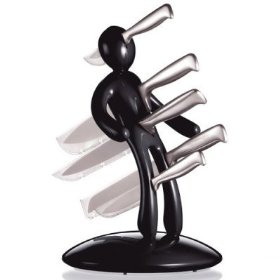
If your new graduate is moving out of the house (and ‘fess up, you’re praying that they are), they’re going to need some stuff for their new digs. For the kitchen,  may I offer  “The Ex” stainless steel knife set and holder from CSB:


A real conversation starter (or possibly stopper) for your next dinner party. Show the guests the cook is not to be trifled with!

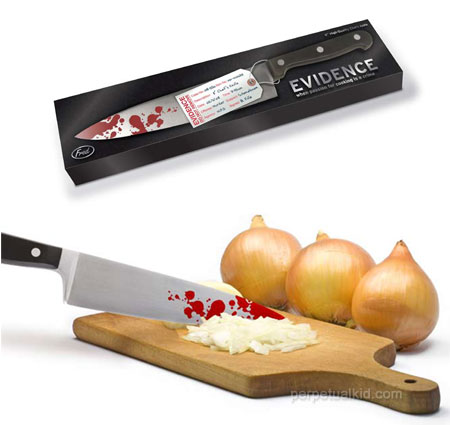
Or perhaps, the Evidence Chef’s knife from Perpetual Kid:

“The perfect accessory to the crime,” promises the manufacturer. The blood, they also assure is, is “food safe.”

I’ve always said, nothing says “get out of my kitchen!” like a bloodstained knife.

With all those knives around, you know that, ah, accidents could happen. For the big “accidents,” I’d suggest good legal counsel. for the little ones, however, there are the Crime Scene Bandages:


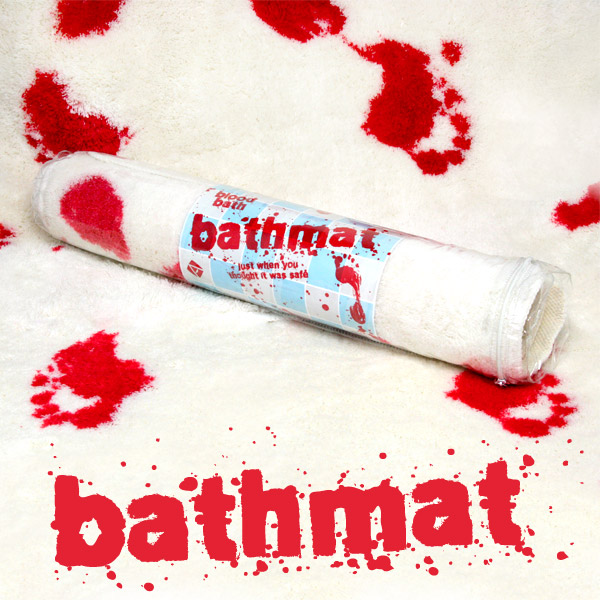
For the Dad or grad who’s a Hitchcock fan, you can  pay tribute to the famous scene that makes you think twice about bathing with the “Blood Bath” shower curtain and matching bath mat:


These sanguinary accesories may not guarantee that all your guests will come back..but it will assure you that the right ones will!

For inside the shower, there’s the Guns and Roses soap from Better Livng Through Design: 


Make every kill a clean kill!

As for me…well,  you know me. I ask for nothing. I give and give and never take. It’s the way I am. But if you insist…


So, what are you getting YOUR Dad or graduate for this most festive of seasons?


My Choice


By Louise Ure

1977. It was the coldest January in New York City for the last fifty years, averaging only twenty-two degrees for the entire month. Snowfalls were frequent and imposing. I had moved from the desert six months before and now searched out routes through Grand Central Station and two hotel lobbies to get from my fifth floor walk-up to the ad agency using only three blocks above ground. I dreamed of fur coats.

I was settling in to my new adventure. The grocer on the corner knew my face if not my name and saved me a bunch of white daisies every Friday. I’d found a good pizza place that delivered. I’d begun asking ad agency girlfriends for the name of a good dentist or doctor in the city.

Putting down roots, I thought. At least the kind of shallow, superficial roots that a single woman, a newcomer, a kid with her first job on the lowest rung of the ad agency ladder could claim in a big city.

Dr. M, the gynecologist my friend Nan recommended was brusque in a friendly “I’ve got a train to catch to the Hamptons” way.

“Congratulations,” he said. “Looks like you’re due early June.”

Four months pregnant? Not possible.

The only guy I’d slept with in the last four months was a co-worker at the ad agency named Steve Something after a particularly drunken office party, and he’d pulled out in time, hadn’t he?

A “splash pregnancy,” Dr. M called it, making it sound like a ride at a theme park.

How could I have been so oblivious to this new life inside me? It’s not so hard to do, I promise you. Years of binge dieting, strenuous sports and a dabbling with drugs had left me with a menstrual period that was less than predictable and there were no other symptoms that I would normally have associated with pregnancy.

Growing up in Tucson in the ‘70’s, everybody had a plan for what to do if your birth control failed. I’d heard about a curandera on the south side of town who combined her midwifery skills with witchcraft. I had the addresses of two clinics across the border in Nogales if it came to that. I knew myself well enough even then to know that – married or unmarried – I did not want children.

I hadn’t needed those abortionists’ numbers when I lived in Arizona, and by the time I got back from my years in France, Roe v. Wade had become the law of the land.

And that meant that right now – January 1977 — I didn’t have to spend the rest of my life with a man I hardly knew. I didn’t have to forsake my life’s dream of a career in order to carry a child to term as a single woman without any resources in the city. And I didn’t have to die in a pool of blood with a straightened clothes hanger inside me.

Others might have made a different decision, something that fit more neatly into their religious or moral worldview. But those same people would likely have considered my fornication or use of contraceptives a sin or a crime as well. I made the decision that was right for me.

Surgery was scheduled for eight a.m. When I woke afterwards, there was a deep dull ache inside me, but it had nothing to do with my heart. There were no recriminations. No second thoughts.

I chose to walk home from the hospital, shuffling through ankle-high snow on the sidewalk toward my apartment, five blocks away. Every breath in that sub-zero air felt like a new beginning.

An idling car at the curb honked when I walked past. It was another woman I’d seen upstairs. She lived upstate, she said, and her boyfriend had come to get her after the procedure. She invited me into the car.

I had a momentary pang of jealousy that her boyfriend was there for her, but promptly dismissed it. I had not even told Steve However-You-Spell-His-Last-Name about his impending fatherhood. His vote didn’t count in this. It was my body.

My new friend’s surgery hadn’t gone as easily as mine; she was pale and panting when her boyfriend swung the car to a parking space in front of my building.

“Come in,” I said. “We’ll rest.”

Upstairs, her boyfriend boiled water for tea while she and I spooned and slept in my small bed. She cried herself to sleep and there was a deep-red pool of blood on the sheets where she lay. I don’t know which direction they took when they left – upstate or back to the hospital – but I hope she’s stopped crying by now.

I did, years later, reconnect with Steve The Splasher and told him about our missed history together. He thanked me. Said he would have made the same decision, but would have hated to ask it of me at the time.

As a teenager, I did not join the fight for the right to decide what happens to my body. Others did it for me and I am grateful for that.

Then, last week, Dr. George Tiller was killed in the lobby of his Wichita, Kansas church for performing legal medical procedures for women in his clinic, and I fear that all that effort thirty-some years ago may have been for naught.

Many others have died before him, or been bombed, or maimed, or threatened. And this intimidation and violence is working. Legal abortions are NOT available today in 87% of the counties in the U.S. because of fear of retribution from extremists in the anti-abortion effort.

This is not the way America should work.

I do not mean this as a diatribe against those in the anti-choice movement who are willing to engage in rational and reasonable debate about the issue. We agree on many things, I imagine. We both want to decrease the number of abortions performed, and we want to support those women who choose to raise a child or offer it for adoption. And I wouldn’t mind seeing birth control costs covered by insurance, as well. They pay for Viagra? They can damn well pay for contraceptives.

This is, however, a plea for all of us to put a stop to the bullies who want to persuade with violence.

I was pretty sure we had ceded that “home of the brave” designation with all the fear mongering speech of the last several years. But if violence against those who are legally supporting reproductive rights goes unprosecuted and unpunished, we will also have lost “the land of the free.”

Try to change the law, if that’s what you want to do. But do not presume that a loaded gun replaces a vote.

And this time, I’m joining the fight.