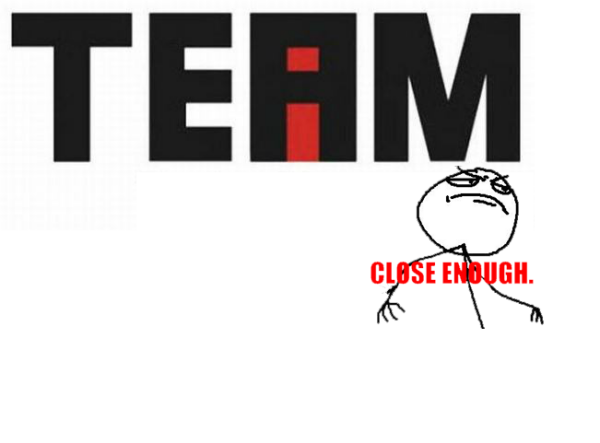
“Somewhere along the way, someone is going to tell you, “There is no “I” in team.” What you should tell them is, “Maybe not. But there is an “I” in independence, individuality and integrity.” Avoid teams at all cost. Keep your circle small. Never join a group that has a name. If they say, “We’re the So-and-Sos,” take a walk. And if, somehow, you must join, if it’s unavoidable, such as a union or a trade association, go ahead and join. But don’t participate; it will be your death. And if they tell you you’re not a team player, congratulate them on being observant.” – George Carlin
Dammit, George, I wish I’d said that.
For months I’ve wanted to write a blog about “teamwork” and then, just last week, a friend posted the above quote on his Facebook page.
My entire adult life has been a study in individuality versus conformity. I can’t help but feel I’ve been the odd duck at every job I’ve had.
I remember when I was young and just out of college, working as an assistant in the marketing department of Buena Vista International at Disney Studios, Burbank. I spent the previous year making a half-hour, 35mm film which I wrote and directed, but hadn’t finished. It was a crazy, amazing, impossible feat built on the backs of a hundred or so craftsmen and artisans, everybody donating their time and talents. I had some wonderful actors involved (it was Chuck Connors’ last role) and I’d spent all the credit I didn’t have to put the film in the can. But I needed to reshoot a few scenes before taking it all into post-production, and I didn’t have a dime of credit left.
I took a chance and sent an inter-office memo directly to Jeffrey Katzenberg (man, am I dating myself) and two weeks later I got a call from the head of production. First thing he said was that I had a hefty set of balls. Then he told me that Jeffrey had forwarded my memo to him with a note saying, “Can we help this guy out?”
So, I had Disney on my side, but they could only offer free services on certain things, like time in the sound studio and foley rooms. I’d still have to pay for the sound editors and foley artists. And, since they rented their production equipment from other studios, I’d have to rent this equipment myself, at a discounted rate. Ultimately, things fell apart and the project died a slow and painful death (Chuck Connors called me once and said, “Schwartz, are you going to finish this film before I die?” A couple months later he died. I guess the answer to that question was, “No, Chuck, I’m not.”)
I was in the middle of this mess when my boss at BVI Marketing “took his business across the street,” meaning he left BVI to take a job at Universal. Shortly thereafter, a new President of Marketing came to Disney. In an effort to bond with his staff, he scheduled lunches at the Rotunda (special VIP-only restaurant at the studio) with everyone in the department. I met him for lunch and mentioned my aspirations to direct films, and the note I’d sent Jeffrey, and Jeffrey’s favorable response. The new president nodded sagely and then, at the end of lunch, said, “Remember, now. We’re in the business of marketing films, not making them.”
I went back to my lonely cubicle and posted his quote above my computer. I wanted to read it every day as a reminder that I did not fit in, that I was in the wrong place, the wrong job. This, at a time when Disney was pushing the word “Synergy” into every inter-office memo. Trying to convince us that we were one big, happy team. Home Video supported Marketing supported Distribution supported Production supported Public Relations. I’m surprised I never heard the phrase, “There is no ‘I’ in Synergy.”
Two weeks after my lunch date I was fired.
I always had mixed feelings when I left a job. I recall the scene in the movie Jerry Maguire when Tom Cruise is driving away from his job, singing Tom Petty’s “Free-falling” (“I’m freeeeee….free-falling…”). It’s a perfect metaphor. So free, before the fall.
It sucks being a team player, but just try making a living if you’re not. I’ve spent a good part of my life in sales, where the world is defined by Dale Carnegie (“How to Win Friends and Influence People”) and a thousand Carnegie off-shoots. Most of the popular business and management books include chapters on “Teamwork,” or “Corporate Unity,” or “Synergy.” Somewhere along the way some smart-ass came up with the phrase, “There is no ‘I’ in Team.”
I’m the square peg in the circular hole. I can talk the talk, but my heart won’t sign on.
For most of my life I’ve felt alone in my day jobs, wondering why I can’t seem to get with the program.
And then I became a published author. I met thousands of people just like me. They wore their “I’s” on their sleeves. Independence, individuality, integrity.
I feel comfortable in their company, as we all seem to come from a similar place. At the core we’re fragile individualists. It’s as though something in our past drove us to protect ourselves from the hypocrisy we observed. We learned early that we cannot trust what is written in books, and so we were drawn to write books of our own. We understand the irony. We don’t believe political ads or commercials or the narcissistic views of our employers.
We share the same struggle and plight. We balance our individuality with conformity. We join the Team while suppressing the “I.”
Hey, boss, there’s no “I” in Weekend, but it’s here just the same.
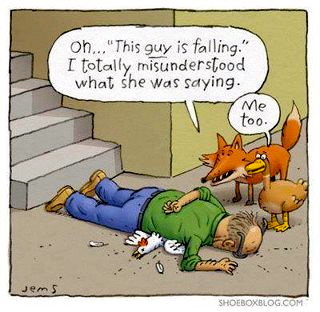
I like unintentional humour, and a good deal of amusement can be had from slips of the ear ― words misheard, misinterpreted or simply misunderstood. I’d no idea, though, until I started looking into the subject, how many different words there were to describe this phenomenon, so I thought I’d share some trivia with you.
First up is a Homonym, which is when two or more words have the same sound or spelling, but differ in meaning, from the Greek ‘same name’.
A nice example comes from ALICE’S ADVENTURES IN WONDERLAND:
“Mine is a long and sad tale!” said the Mouse, turning to Alice, and sighing.
“It is a long tail, certainly,”’ said Alice, looking down with wonder at the Mouse’s tail; “but why do you call it sad?”
Homonyms are closely related to Homographs and Homophones.
A Homograph is one word that is spelled exactly the same as another, but which not only has a different meaning, but often a different derivation as well. A Homograph can also be a Hetronym, from the Greek ‘other named’. A good example is the word ‘sewer’, meaning both a place for sewage, and someone who sews. The derivation of the former is from the Latin, meaning related to water, but the derivation of the latter is from the Sanskrit meaning thread or string.
Occasionally, Homographs are spelled identically, but pronounced differently according to the meaning, hence:
“When I tear my fingernail, I shed a tear.”
Whereas Homophones are two words that are pronounced the same but have different meanings. Such as:
“I shed a tear as I watched him climb onto the top tier of the podium.”
Although, come to think of it, both Homographs and Homophones could fall into the overall category of Homonyms.
Confused? Stick around.
Then we get to Oronyms, which is apparently a word invented by Gyles Brandreth, and quite frankly I wouldn’t put it past him. An Oronym is a sequence of words that sound the same as another, with endless comic possibilities. The brain hears speech not as individual words but as an overall flow which it has to try to interpret, and what with accents and mispronunciation and slang, it’s hardly surprising that occasionally we get it wrong.
“The stuffy nose can lead to problems.”
“The stuff he knows can lead to problems.”
Actually, by far the best example I can give of Oronyms at work is the Four Candles sketch by the Two Ronnies.
Many words are easily confused, and among the most common are:
Accept – to receive or take in
Except – other than
Lead – metal
Led – past tense of to lead someone or something in a given direction
Rein – means of controlling a horse
Reign – the rule of a monarch
Principal – the head of a school, person being protected by a bodyguard
Principle – a rule or guideline
Androgynous – having both male and female characteristics
Androgenous – having only male offspring
When it comes to song lyrics, the human ear has even more fun and misinterpreting words. The mishearing of words in a song is so common that American writer Sylvia Wright coined a term for it taken directly from her own experiences when as a child she misheard the words of the ballad ‘The Bonny Earl O’Moray’:
“Ye Highlands and ye Lowlands
Oh, where hae ye been?
They hae slain the Earl O’Moray
And Lady Mondegreen”
The last line should actually have been ‘And laid him on the green’ but for years Ms Wright believed that the unknown Lady Mondegreen had met a similar fate as the Earl O’Moray and came up with the name Mondegreen to describe it.
Since then, of course, the practice has been rife, with one of my favourites being the Kenny Rogers song, ‘You picked a fine time to leave me, Lucille’. For years I heard this as:
“You picked a fine time to leave me, loose heel.
Four hundred children and a croc in the fields”
Instead of the far more mundane:
“You picked a fine time to leave me, Lucille
Four hungry children and a crop in the fields”
Personally, I think I prefer the first version.
The Jimi Hendrix song, ‘Purple Haze’ contains the line:
“Excuse me while I kiss the sky”
Which was so often misheard as:
“Excuse me while I kiss this guy”
that he actually sang the alternative version in concert.
I think my latest favourite has to be the modified lyrics to the new Bond theme, ‘Skyfall’. Instead of:
“Let the sky fall, when it crumbles
We will stand tall
And face it all together”
Let’s have a rousing chorus of:
“Make a trifle, make a crumble
Build my cake tall
And we’ll eat it all together”
All it needs is cake. Now, doesn’t that make you feel better? So, ‘Rati, what are you favourite examples of any of the above? Let’s hear ’em!
No Word of the Week this week. I think you’ve had quite enough.
I spent last weekend attending the 2012 Noircon, the biannual lovefest to all things noir devised and convened by Lou Boxer and Deen Kogan in Philadelphia.
I love this festival, which is far more intimate and writer-centric than most others I’ve attended. The participants largely form a congress of equals, and there is never a great divide between the contributions of the various panelists and the comments from the floor. It’s a smart group, widely read and not shy, and I always come away learning more that I could have imagined.
This year was particularly exceptional, with what at times seemed to be a continuous string of highlights. That said, one presentation stood out for me—the keynote talk by Robert Olen Butler.
Butler’s a gracious, witty, generous man with a knife-like body and a steel-trap mind. An astonishing talent, he’s written thirteen novels, six story collections, nine screenplays, an essential guide to writing (From Where You Dream—trust me, read it), and has won the Pulitzer Prize for fiction and a Guggenheim Fellowship in addition to an almost unseemly bundle of other awards and distinctions.
Why, I hear you ask, is such a literary hotshot slumming at Noircon?
Well that’s an interesting question, one ironically answered by Otto Penzler the day before Butler spoke. Otto explained how, after studying English and American Literature at the University of Michigan, he discovered crime fiction and promptly realized that its best practitioners owe apologies to no one.
Butler agrees, not just in theory. His most recent novel, The Hot Country, is a historical thriller set in Mexico in 1914, combining intrigue from both that country’s revolution and the worldwide cataclysm routinely known as World War I. The plan is for nine more novels in the series, all to be published by Otto Penzler’s Mysterious Press.
But what Butler chose to discuss at Noircon was craft—specifically, the way in which fiction mimics the cinematic portrayal of events in the mind. (His remarks, I now know, were a distillation of his chapter, “Cinema of the Mind,” within From Where You Dream.)
The American filmmaker D.W. Griffith, Butler informed us, once remarked that he owed everything he knew about cinematic technique to Charles Dickens—who died years before the advent of film.
By way of example, Butler turned to the following passage from Great Expectations, which appears shortly after the narrator, Pip, sets the stage, identifying himself and his family, then continues:
Ours was the marsh country, down by the river, within, as the river wound, twenty miles of the sea. My first most vivid and broad impression of the identity of things, seems to me to have been gained on a memorable raw afternoon towards evening. At such a time I found out for certain, that this bleak place overgrown with nettles was the churchyard; and that Philip Pirrip, late of this parish, and also Georgiana wife of the above, were dead and buried; and that Alexander, Bartholomew, Abraham, Tobias, and Roger, infant children of the aforesaid, were also dead and buried; and that the dark flat wilderness beyond the churchyard, intersected with dykes and mounds and gates, with scattered cattle feeding on it, was the marshes; and that the low leaden line beyond, was the river; and that the distant savage lair from which the wind was rushing, was the sea; and that the small bundle of shivers growing afraid of it all and beginning to cry, was Pip.
“Hold your noise!” cried a terrible voice, as a man started up from among the graves at the side of the church porch. “Keep still, you little devil, or I’ll cut your throat!”
A fearful man, all in coarse grey, with a great iron on his leg. A man with no hat, and with broken shoes, and with an old rag tied round his head. A man who had been soaked in water, and smothered in mud, and lamed by stones, and cut by flints, and stung by nettles, and torn by briars; who limped, and shivered, and glared and growled; and whose teeth chattered in his head as he seized me by the chin.
“O! Don’t cut my throat, sir,” I pleaded in terror. “Pray don’t do it, sir.”
Butler called our attention to several techniques here, all of which have cinematic elements, and there are two particular points that stuck with me, involving the first and the third paragraphs.
Butler noted that the first paragraph serves as what in film is routinely called the establishment shot—setting the story in its initial setting. We start at a distance in a long shot then move in to the nettles of the churchyard and the headstones in arresting close-up, then look out across the landscape again, as though to put those deaths in perspective.
That perspective is not local. Dickens moves beyond the “low leaden line” of the river to : “the distant savage lair from which the wind was rushing … the sea.” A great many writers might leave that phrase out. Such an omission, he argued, would be a mistake, for the establishment shot doesn’t just lay out the scenery. This crucial phrase broadens not just the physical landscape but the thematic one, extending our view not just to the immediate environs but to the world at large, setting the stage for so much of the story to come, and hinting at its universality.
And then, with incredible boldness, Dickens snaps us back again to “the small bundle of shivers growing afraid of it all and beginning to cry,” the narrator himself, Pip.This movement in and out creates a marvelous sense of the larger savage world and the small scared soul that form the essential focus of the tale, and do it subtly with this implicit, cinematic movement in and out of the action.
Similarly, the third paragraph might readily find itself in many a writer’s Dead Darling file—another error. It’s not just the unnerving description of Magwitch we’d lose. Note the suspense that builds by separating “I’ll cut your throat” from “‘O! Don’t cut my throat, sir,’ I pleaded in terror.” Note also how that tension is created and how it builds. There are no independent verbs in the main clauses of any of the sentences, for the desired effect is one of attenuation—Pip staring in terror at the man emerging before him—and verbs in grammatical structure are the device for conveying movement in time. Omit them, and you’re standing stock still.
The next example was one with which more of the crowd was familiar, the first few paragraphs from the second chapter Dashiell Hammett’s The Maltese Falcon:
A telephone-bell rang in darkness. When it had rung three times bed-springs creaked, fingers fumbled on wood, something small and hard thudded on a carpeted floor, the springs creaked again, and a man’s voice said:
A switch clicked and a white bowl hung on three gilded chains from the ceiling’s center filled the room with light. Spade, barefooted in green and white checked pajamas, sat on the side of his bed. He scowled at the phone on the table while his hands took from beside it a packet of brown papers and a sack of Bull Durham tobacco.
Cold steamy air blew in through two open windows, bringing with it half a dozen times a minute the Alcatraz foghorn’s dull moaning. A tinny alarm-clock, insecurely mounted on a corner of Duke’s Celebrated Criminal Cases of America—face down on the table—held its hands at five minutes past two.
Spade’s thick fingers made a cigarette with deliberate care, sitting a measured quantity of tan flakes down into the curved paper, spreading the flakes so that they lay equal at the ends with a slight depression in the middle, thumbs rolling the paper’s inner edge down and up under the outer edge as forefingers pressed it over, thumbs and fingers sliding to the paper cylinder’s ends to hold it even while tongue licked the flap, left forefinger and thumb pinching their end while right forefinger and thumb smoothed the damp seam, right forefinger and thumb twisting their end and lifting the other to Spade’s mouth.
He picked up the pigskin and nickel lighter that had fallen to the floor, manipulated it, and with the cigarette burning in the corner of his mouth stood up. He took off his pajamas. The smooth thickness of his arms, legs, and body, the sag of his big rounded shoulders, made his body like a bear’s. It was like a shaved bear’s: his chest was hairless. His skin was childishly soft and pink.
He scratched the back of his neck and began to dress. He put on a white union-suit, grey socks, black garters, and dark brown shoes. When he had fastened his shoes he picked up the telephone, called Graystone 4500, and ordered a taxicab. He put on a green-striped white shirt, a soft white collar, a green necktie, the grey suit he had worn that day, a loose tweed overcoat, and a dark grey hat. The street-door-bell rang as he stuffed tobacco, keys, and money in his pockets.
As with the Dickens example, the main focus again resided on the creation of a series of mental images that form a vivid film-like sequence, visually clear in our minds, even including camera angles—the ceiling light shot from below, followed by the close up of the rolling of the cigarette, both mimicking Spade’s own focus.
But there’s more than that, too. Once again, suspense gets created through the use of detail an impatient writer might discard—or never visualize to begin with. Spade rolls himself a smoke right after learning his partner, Miles Archer, has been killed. We don’t know as yet for sure that the two o’clock phone call concerned Archer, and it’s not until later we’ll learn Spade was sleeping with Archer’s wife. Instead we get this enigmatic, slow-motion rolling of a cigarette. Its intrusion into the scene piques our interest, precisely because it doesn’t quite fit. It suggests without stating outright that Spade has something serious on his mind, and yet in the casualness of the activity we also sense no great alarm. There’s even a hint of relief.
Note: Interestingly, the day before, Lawrence Block had remarked that Hammett, sensing that his literary success might well depend on his novels being made into films, deliberately limited his descriptions to only what could be seen and heard. This wasn’t, as many have believed, a nod to Hemingwayesque technique. It was a professional calculation.
In the Q&A that followed his talk, Butler noted that as a teacher in the Ph.D. program at Florida State, he encounters some of the best aspirants to literary fame to emerge from the various MFA programs across the country. And all too often, “They know the second through tenth most important things about writing, but they don’t know the first.” The first, he explained, was that stories are about yearning.
He suggested that genre writers often understand this point well—if they sometimes have an insufficient grasp of the next nine most important things about their craft—because genre often has the yearning built into the premise of the form. Crime fiction is driven by the search for justice, romance novels by the craving for love, science fiction by the need to humanize technology, etc.
His talk burned a nasty little hole in my brain, and as soon as I could I got my hands on a copy of From Where You Dream and I’ve been devouring it ever since.
So, Murderateros — how does the cinema of the mind guide you in your writing? Do you take time to envision camera angles? Do you consider tempo in your descriptions? Do you play with quick alteration betweeen and long shots and close ups to create a dramatic effect between thematic or narrative extremes?
* * * * *
There were a great many other excellent presentations at Noircon, including but not limited to:
—Well-deserved awards bestowed on Lawrence Block and Otto Penzler, with interviews of both men, giving Block a chance to, among other things, recount his days as a writer of lesbian romance novels, and Otto an opportunity to discuss how obscenely cheap real estate was when he bought his first store in Manhattan.
—A panel on music with SJ Rozan and John Wesley Harding (who writes crime fiction under the pen name Wesley Stace), complete with songs.
—A wickedly lurid, funny, and confessional true crime panel with Megan Abbott, Allison Gaylin, Wallace Stroby, and Dennis Tafoya.
—A blackly comic panel of cautionary tales from Hollywood featuring Lawrence Block, Duane Swierczynski, Anthony Bruno, and Ed Pettit.
As I said, I had a gas, and I fully intend to return in two years. Even without Lulu Lollipop.
* * * * *
Blatant Self-Promotion Segment: For all the month of November, Open Road Media/Mysterious Press is featuring 100 titles for less than $3.99, including The Devil’s Redhead at a nifty $2.99.
If you haven’t yet read it, pick it up. If you have, share it with a friend. (Or an enemy. I can live with that.)
* * * * *
Jukebox Hero of the Week: In tribute to John Wesley Harding, who so graciously regaled us with song, here’s “Ordinary Weekend,” which he wrote after reading Jim Thompson’s The Killer Inside Me. (In his performance for us, he remarked somewhat sheepishly he should have practiced, and ended up forgetting several verses, only to offer some of the best advice I’ve ever heard: He said years of performance had made him utterly un-selfconscious about fucking up. Not that anyone cared. We were enthralled):
The scene: A cool fall day. The wind blows yellow cottonwood leaves against an insanely blue sky. Inside a coffee house, the late afternoon sun shines gold through large windows and turns the floor’s Saltillo tiles a glossy Mexican chocolate. Fresh red chile ristras hang on hooks from the adobe brick walls. An espresso machine growls over murmured conversations and laughter. The air smells of cinnamon and vanilla and piñon smoke from a nearby fireplace.
A woman, her long gray hair braided loosely, joins two writers already deep into a holy discussion about their craft. She places her steaming cup of Amaretto-laced apple cider onto the wooden table before pulling out a chair.
“ . . . I just don’t feel like I can ever write as well as he does,” says one of her multi-published friends. He is a tall man with sun-darkened skin and a bushy mustache that looks distinguished now it’s more salt than pepper.
“I know what you mean,” says the other writer. He is just as old, just as experienced, just as successful. “Some days, I feel like giving up.”
“Why?” the woman says, stirring her drink with a cinnamon stick. She notices that some of the clay she’d been working with earlier in the day is still under her short fingernails. The realization makes her self-conscious. She breaks off a small piece of the stick to dig at the dried dirt.
“Because it’s just so depressing.” The first writer leans back in his chair with a loud sigh.
“Yeah. And then there’s the whole problem of marketability. I started something yesterday, spent hours on it, and realized that with this crappy market my agent would probably throw it right back at me,” says the other writer. He glances out a window at the parking lot. “No one’s taking risks on anything new.”
“Who cares what your agent thinks?” says the woman. “Why not just write what you want to write?”
Both writers shake their heads.
The first says, “You just don’t understand.”
“Here’s what I understand.” The woman smiles at them. “The two of you are lugging around so much baggage you’re about to pull your bony shoulders out of their sockets.” She takes a deliberate sip of her cider, licks her unadorned lips and holds up her fingers to make her next point. “You say to yourself, ‘I’m not productive enough. I’m not good enough. I’m not original enough or successful enough’ . . . or whatever self-flagellation you’re into at the moment.”
“So what’s your point?” One of the writers says. “That we should be totally self-satisfied? That we shouldn’t ever strive to be better?”
“Oh, come on. You know me better than that.” She puts down her improvised nail cleaner. “I’m an artist too. I want to constantly learn and grow.” The woman reaches out to pat the first writer’s hand. “I just prefer to frame things a little differently. I mean, so what if you’re not as good as some other writer? Readers don’t all want the same thing.”
The second writer frowns, but he’s watching her intently.
“And, so what if that piece you wrote isn’t marketable in New York? You can publish it yourself, if you believe in it enough. Or save it until publishers do want to take risks again.” The woman shrugs. “I guess I’m just wondering if the baggage you’re carrying is helping, or hindering, you?”
That’s the question I’ve been pondering all week. Baggage is necessary for most travel. We all carry it, but sometimes I think some of those clothes or tubes of toothpaste just don’t serve us anymore.
Here are my questions for you, my Murderati friends: Do you know your own baggage? Is it helping you on your creative journey? If not, do you have a way to shed a couple of the heavier pieces?
As anyone who interacts with me on Facebook knows, I got a little tense this election week. Not that that’s unusual. And I doubt I was the only one here who wasn’t getting much work done in the last few days. At the same time, I can’t really afford to take time off, given the deadlines I’ve got going on, even if most of them are self-imposed.
But the Universe lined itself up for me,as it so often does. Actually, some people would say it ALWAYS does, even if that’s not the way it looks on the surface. But that’s another blog!
I just finished a second draft of my new book, BLOOD MOON, and I don’t know about you all, but I find it REALLY REALLY hard to take the advice I am always giving other writers: to take time off in between drafts of a manuscript. Even when I know it’s the best possible thing I can do for the next draft. But the next logical step in my process required research, in fact, a research trip to San Francisco. I know, I know, rough life. So on Tuesday I just got in the car and drove up, meaning I got to watch election returns in downtown Oakland (massively fun and obviously a huge party…)
And now I’m running around the city to locations I’m using in the book.
Now, I lived in the Bay Area for years, it’s not lke I don’t know what I’m writing about. But there is nothing like revisiting a city, neighborhood, park, street, whatever, while you are in the headspace of your characters, looking specifically for those details that will color in your book. And that’s really how I think of it – coloring in. I have the outlines of the story, but now I have to add those layers of light and shadow, color and sound and smell. And the feeling of being in a place.
I did a great panel at Bouchercon this year and the fabulous moderator, Daniel Palmer, who knows my acting background, asked if I used acting techniques to develop character. And of course I do. I don’t think about doing it, its just something I’ve done for so long that I couldn’t imagine not doing it. A lot of conveying emotion on stage is about creating that emotion inside of you, first, and then layering on the physical manifestations of that emotion so that the audience feels it, too.
So all this walking around in the actual physical world of my story is what really helps me to get the sensual reality of that world and whatever the characters are experiencing onto the page. I need to FEEL it. I can do research online and read books, and craft an approximation of an experience from that research and my own memoreies of experience, but it’s a lot harder for me than being there in person. In fact I have been doing so much walking that I can barely move at night, but it’s the only way I really know how to do this. Driving it won’t cut it.
But I’m a really physical person. Kinetic learner, psychologists call it. And the kind of writing I like to do and read is a lot about creating a sensory experience. I realize that not everyone is like this, because there are books out there that do very little to create a sensory experience., and people buy them anyway, so someone must be getting something out of them. But that kind of book rarely does anything for me. I want all six senses n ny books – especially that sixth sense of SENSING – the unseen stuff, the things that make your skin tingle. Synchronicities. A smell that takes you back to your childhood. Walking into the exact scene that you have been thinking about, and realizing the epiphany that your character will have there.
So for today I’m wondering – are you guys aware of what experiences you most want to read or create in a book, the way I find sensory experience (including the visual) my prime pleasure in reading? What is that draw for you, and what do you do in terms of reearch and craft to create that? Does acting technique play a part?
Or in reading, which authors/books are great examples of the experience you most want in a book?
(Sorry for the typos and short post today – I’m working on my iPad, which is not an optimum blogging experience!)
Last weekend saw the final part of a writing tour I’ve done this year for Writing Australia. While some authors get to tour a lot, and probably too much for their liking, that’s not generally the lot for us mid-list authors. So my last interstate dash was met with the excitement of someone who doesn’t get to travel for work much, if at all.
At the beginning of the year, Writing Australia (via Writers Victoria) asked me if I’d take part in a tour, where they’d sponsor my airfares and appearance fees so that other state writing centres could access a range of teachers. In this case, me!
It’s been great fun…I’ve done a weekend course in Canberra, a whole weekend of activities as part of the Salisbury Writers’ Festival (blog about it here) in South Australia, and this weekend I took a one-day workshop in Hobart on wrting crime fiction and popular fiction; and a one-day workshop on crime writing in Sydney.
All the centres have been wonderful hosts and the tour was expertly put together by the Director at Writers Victoria.
I’ve received excellent feedback from all the attendees at my workshops and I’ve had a blast! I mean what’s not to love? Downtime at the airport – great time to fire up the laptop and get a few hundred words done over a glass of wine or beer. A hotel room to yourself, TV in bed, and time to myself. I think the latter is something many parents (and dare I say it, mothers) don’t get much of, so when we do it’s appreciated. Of course, I missed my two munchkins enormously, but I also think I lapped up the ‘me time’ and also made sure I made the time productive, where possible.
I’ll give you a sample with a breakdown of this weekend. Cab to the airport in the afternoon. Wasn’t a whole heap of time at the gate, so I read on my Kindle. Love my reading time! Arrived at the Hobart airport and then onto the hotel. Decided to treat myself to a good-quality steak dinner and delicious wine – Kindle in hand. Then back to the hotel room where I eyed the bath and noticed that not only was it deeper than ours, but I didn’t have to clear a million bath toys to get into it. Hot bath, bit of TV in bed, more reading. Heaven.
Then there was the course (great fun) followed by two hours to kill before heading to the airport. Cheese platter, glass of red wine, laptop out and some writing time. Gold.
Arrived into Sydney late, so didn’t do any more work but I did read for half an hour or so before it was sleep time.
Next day was the course (great fun again) and then my hour at Sydney airport was spent writing with a beer.
Like I said, who can complain about touring??
I have to confess, while I first took up teaching to add another income stream, I LOVE teaching. I love talking to eager students, I love seeing their faces light up when something clicks or excites them. I love watching them leave the venue at the end of a day with their heads spinning with information but also feeling inspired.
So, Murderati. What courses have you taken part in recently, as either teacher or student? What makes a course ‘good’ to you?
By the time you read this (I hope), someone will have won the U.S. Presidential election and someone will have lost it.
To most Americans, the election was a battle between two men with fundamentally different ideas about the role government should play in our everyday lives. For others, it was something much greater, a virtual war between the Powers of Darkness and the Agents of Light over the very soul of this nation. If you think I’m exaggerating, you haven’t been reading some of the Facebook “discussions” I have been over the last several months.
Because it’s easier to get people to the polls by convincing them their vote could make the difference between putting the Son of Satan in the White House and a decent, God-fearing human being, the political arena is an ideal setting for this kind of silly, provocative oversimplification. But politicians are not the only ones who like to describe every human conflict as one pitting Good against Evil.
We crime writers have a tendency to reduce things to those very same extremes.
Of course, we do it for the sake of high drama, not election results. In the interests of maximizing the stakes in a thriller, for instance, we often go in for villains who are simply heartless monsters, rather than complex people with conflicting motives. Conversely, our protagonists are soldiers of righteousness, angels with dirty faces who have no doubts, whatsoever, about the virtue of their cause. God is on one side and the Devil is on the other, and there’s no way to mistake which is which.
Gray areas are okay for literary fiction, the reasoning goes, but readers of mysteries and thrillers only have eyes for black and white, the better to root for the latter as they hungrily turn pages.
I can’t view the world that way, no matter how popular such fiction is. Just as I know Barack Obama is not a freedom-hating Muslim and Mitt Romney is not a Scrooge-like robot with contempt for all poor people, I also know that real “good guys” and “bad guys” come in all stripes and colors, and that their needs and motivations cannot always be described in a single line. I keep this thought in mind whenever I enter my polling booth and whenever I sit down to write. Nobody in this world wears horns and a barbed tail, nor walks with a halo consistently overhead.
The shorthand of Good versus Evil might win (and lose) elections, and it might sell a boatload of crime novels, but it’s just not for me.
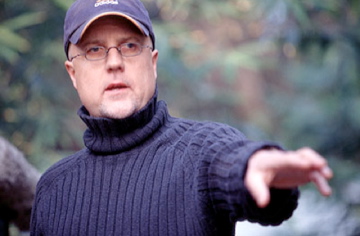
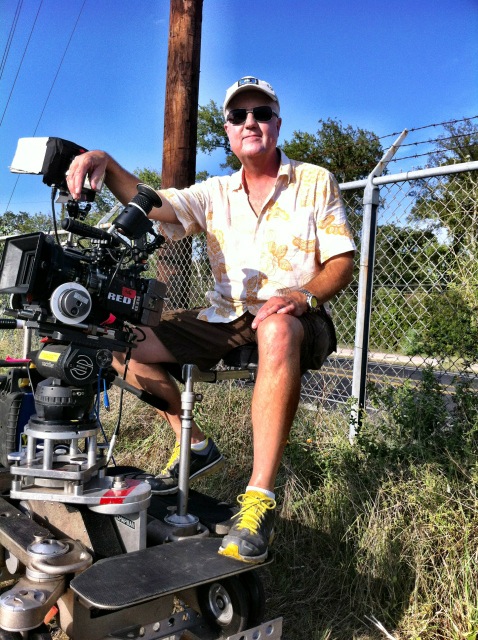
If you’re going to do two things today, vote, and read this interview with my good friend, the remarkably talented commercial and film director Blair Hayes.
I met Blair many years ago when I was a development exec working for Wolfgang Petersen. Blair is one of the top commercial directors in his field, with clients that include Pepsi, Federal Express, Kodak, Budweiser, American Express, Nintendo, Verizon and many more. He has received all the top commercial awards — the Clio, Addy, One Show, Mobius, IBA, and even a First Place Golden Trailer Award for the theatrical trailer of “Austin Powers: The Spy Who Shagged Me” (“…If you see one movie this summer see “Star Wars”, but if you see two movies, see Star Wars and Austin Powers!”)
Blair’s creative energy is infectious. Actors love working with him, and the list of celebrities he’s directed in commercials include Denzel Washington, Richard Gere, Geena Davis, Andre Agassi, Barry Bonds, and Cal Ripkin, Jr.
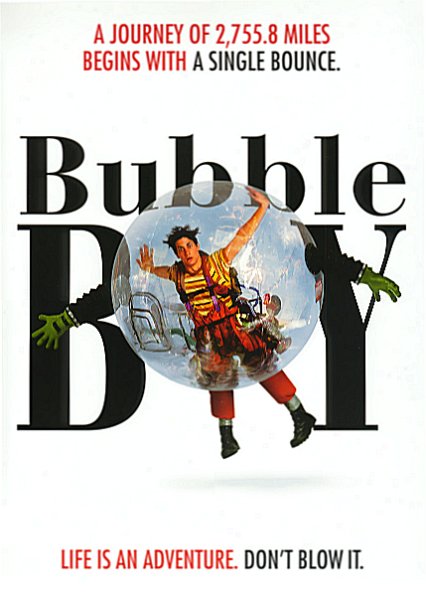
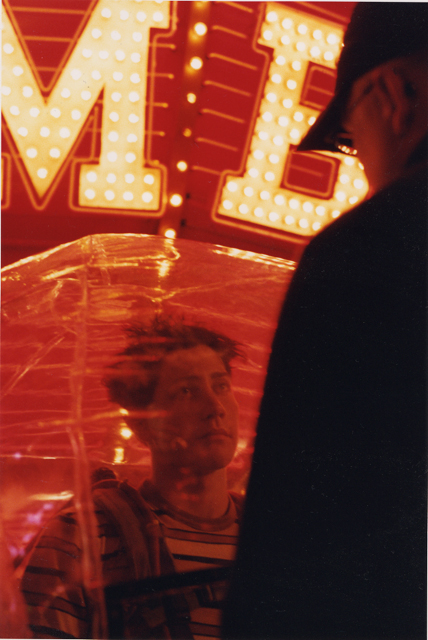
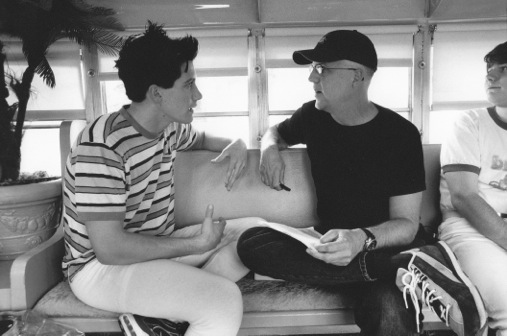
In 2001 Blair directed his first feature film, the cult classic, “Bubble Boy”, for Touchstone/Disney Studios, starring Jake Gyllenhaal. I was fortunate to have had a small part to play in this process, as I was a “go-to” person for the scripts that Blair was considering to direct at the time. I knew he’d found the right project when I read an early draft of “Bubble Boy.” Blair gave me the opportunity to help develop the project with a series of notes I provided over the course of several months. I remember visiting the set a few times, watching the magic evolve despite a tight, chaotic schedule and the inevitable financial and technical obstacles involved in making a feature-length film where the star is encased in a “mobile bubble” throughout. Blair also honored me with an invitation to join him and a few select people — his girlfriend (now wife), mom, film manager, and Jake — at an opening night dinner in Beverly Hills followed by a limo tour of the different theaters where Bubble Boy appeared. If you haven’t seen Bubble Boy, rent it. Now. Before you go to the polls. It’s irreverent and hilarious.
In 2004 Blair directed the pilot, “Fearless”, for Jerry Bruckheimer Television, starring Rachel Leigh Cook and Eric Balfour. He also designed, directed, and photographed the award wining opener for the series, “Push, Nevada”, produced for ABC TV by Ben Affleck and Sean Bailey, and served as a visual consultant on the series, shooting scenes to visually punch-up the look of each episode.
Forays into long-form filmmaking aside, Blair still find his greatest passion in commercials. “Telling a story, provoking a response–be it a laugh, a tear, or a scream–in 30 seconds, is the toughest challenge there is – and the sweetest when it works!”
Blair grew up the son of a career marine officer and diplomatic serviceman, living for many years in South America and Thailand. He graduated with a BFA in film and a minor in music from the University of Miami and did post graduate work at USC in screenwriting. He currently lives in Topanga, California, where he shares a house with his beautiful wife, actress Boti Bliss (“CSI:Miami”), his adorable two-year old son Ashby, three enormous dogs, and the occasional Topanga Canyon snake.
Stephen: We have something in common in that we both studied music before settling in on our chosen, creative careers. For me, music influenced everything I did in the arts. My writing wouldn’t be the same if I didn’t feel the crescendo and diminuendo, the staccato and legato of every sentence. How has music influenced your career as a film maker and commercial director?
Blair – Opening line to my uncompleted first novel: “That quick, stridulous tone, like some strategically placed dissonant semi-quaver, lingered familiarly and perfectly in the air, ending abruptly and crudely in a resounding “thwack” as screen door met frame.”
The two studies are intertwined and inseparable. I can always find in music the perfect metaphor for what I am going through in life – career or otherwise. I can’t tell you how many frustrated musicians I have encountered in the film business, including, *sigh*, me.
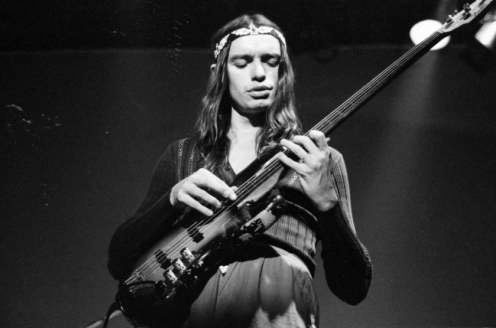
Stephen – I understand that you had some connection to Jaco Pastorius, the great bass player from the jazz fusion band Weather Report. How did you come to meet him and how has he influenced your creative process?
Blair – I studied music at theUniversity of Miami in the late seventies, my principal instrument being bass. Jaco was teaching there as well as playing with several of the various rocdk and jazz ensembles. The first time I ever saw him perform was one of my earliest “door moments,” you know, those pivotal moments you encounter where you have some sort of epiphany – and a door opens or closes for you. Though I openly derieded his playing to my roommate as “too many notes,” I knew in my heart that I was witnessing a divinely gifted individual. What was actually going on in my mind was, “okay, either I study my ass off and woodshed til my fingers bleed to get as good as this guy or toss in the towel now and acknowledge I will never get to that level.” I knew in my heart the answer.
(The brilliant Jaco Pastorius, of Weather Report)
Stephen – And yet you didn’t have the same response to film. What motivated you to become a professional film-maker and commercial director instead of a studio musician?
Blair – To be perfectly honest, it was a combination of seeing Jaco and realizing I was never going to be that good and meanwhile having professors saying shit like, “less than one percent of you will ever go on to anything more than teaching accordion to grade school children”, and other such discouraging stuff. I knew I had to switch majors and saw that UM had a film department and thought, “hey, all those countless hours in movie theaters and in front of the boob tube has certainly prepared me for this!”. And that is honestly how it happened.
So, basically, I owe my career to Jaco!
Stephen – That’s wild, Blair – I had a very similar experience in music school. I spent one year at North Texas State University, one of the top jazz schools in the country, studying saxophone performance. I was a somewhat decent musician, but everyone around me was insanely good. I noticed that I was having more fun in my English courses and, after one of the many days when I skipped my Sight-Singing and Ear-Training course to argue literary style with my English professor, he suggested I leave music school to study film and literature in Los Angeles. It was the right move.
You ultimately chose film-making as the preferred medium in which to express your art. Have you always seen stories as images, or do you feel equally comfortable telling your stories on paper?
Blair – My primary effort both on the page and on the screen is to tell the story as “experientially” as I can. You know, intimately and personally. I just want to be provacative; be that a laugh, a tear, or just a reflection on something. So a lot of what I’m known for visually is what some might call impressionistic. I call it jazz.
If you want to see a few samples, go here, here, and here.
Stephen – What was film school like for you? What were your goals and expectations?
Blair – I honestly wouldn’t recommend film school to anyone these days. Not with DSLR’s and the multitude of inexpensive ways to record an image. In film school, other than the theory and film history stuff you learn (all of which is terrific at chatting up girls and geeks), you don’t really get to know anything substantive until you actually get your hands on a camera, which, in most cases, isn’t until your senior year. That’s when you really learn something. All the theory, the history, didn’t do me a bit of good professionally. You know what did? Knowing how to thread a Movieola! As a PA (production assistant) right out of college, on my very first job (back when everything was shot on 35mm film), I was asked if I knew how to run a Movieola (the ancient though venerable rackety machine that was the industry norm for editing and viewing dailies on location). “Yes!”, was my enthusiastic reply. I even knew how to repair the torn sprocket holes that would inevitably occur when the director would take over the running of the machine…
Stephen – What was your experience after film school? Did you march into Warner Brothers with that reel in your hand? How did you end up in commercials?
Blair – I became a commercial director really by default. I never intended to be a commercial director (how low brow can you get???); I totally believed that diploma in hand, I would be granted the reins to “Citizen Kane 2″. But, as fate would have it, I started working as a production assistant primarily on commercials and started moving up the old ladder, to production coordinator, location scout (which was really fun because I was creatively contributing to the project), then assistant director and ultimately producer. But all the while “what I really wanted to do was direct.” By the time I was in my mid-twenties I was producing for some of the biggest and best commercial directors in the business, including Ridley and Tony Scott, and making very good money, but it just wasn’t where I wanted to be. So I self-imposed a goal to be directing by the time I was thirty. And to really light the fire I also said to myself the day I produce for someone younger than me is the day I give in and realize, “that’s it, I will be a producer the rest of my life”. And guess what? The occasion presented itself to me in my 29th year and that was it: I sold my house and financed a showreel of spec spots that I directed. The reel worked. I got representation as a director right away and that was that, I was on my way. Now the only frustration was that I wasn’t directing movies…
Stephen – How did you make the move from being one of the top commercial directors to directing a feature film for Disney?
Blair – One of the production managers working for me on a commercial, who also worked for Jerry Bruckheimer, saw my reel and asked if I’d be interested in directing a movie and if it would be alright with me if she showed my reel to Mr. B. Needless to say, after I peeled my ass from the floor, I ran to give her all the reels she could carry. A week later I was ushered into the presence of Mr. Bruckheimer, who was incredibly complimentary of my work and asked If I’d like to direct a movie for him. That’s it. That’s how it happened. I ultimately did not make a film for Jerry Bruckheimer, but word got out that I was on the short list of directors he wanted to work with and then the agents and managers came out of the woodwork. I had also directed the trailer for “Austin Powers 2: The Spy Who Shagged Me”. The one where you think it’s Star Wars only instead of Darth Vader it turns out to be Dr. Evil, “If you see One Movie this summer, see Star Wars. But if you see two…” That garnered quite a lot of attention.
Stephen – How did the Bubble Boy opportunity come about?
Blair – My agents and manager started sending me stacks and stacks of scripts to read. They were pretty much all the shit that everyone had passed on. Then I got “Bubble Boy” and literally laughed aloud (for me a rare occurrence) at least four or five times so I knew it was something that I could get behind for the next year and a half of my life.
Stephen – How did you get hooked-up with Jake Gyllenhaal?
Blair – Jake was one of many many young men who came in and read for the role. We all (the producers, casting director and myself) knew he was the guy the moment he started reading.
Stephen – I remember a lot of hair-pulling going on when you were in production. Was the experience a dream or a nightmare?
Blair – Actually, the production of the movie was the fun part. Once the studio was happy with the dailies (I was told lunch time screenings at Disney were standing room only) they pretty much left me alone. It wasn’t until post production and all the other chefs came into the kitchen that it got less than fun.
Stephen – Why are movies so hard to make? What gets in the way?
Blair – Well, as my experience was working for a studio, I can only speak to that. And honestly, the hardest part is just what I mentioned before, too many cooks in the kitchen. I honestly don’t know how any good studio pictures ever get made. Most of them come from experienced directors that, having “proved themselves”, get a little less interference. But even the big boys get notes.
Stephen – How has the film industry changed since “Bubble Boy?” How have you had to change to keep up with the times?
Blair – I don’t really know because, frankly, I’m not really playing in that arena, I do Commercials. But both worlds have really become stripped down financially and therefore have become all about how to create the maximum bang for the minimum buck. Which is of course, also where some of the best filmmaking in the feature world is happening today, e.g.,”Butterfly and the Diving Bell” and this year’s “Beasts of the Southern Wild”. This is the type of movie I intend to do next. That or a Wes Anderson sort of pic; visual, personal journey sorta thing.
I recently directed a “short” film. I say short in italics as it’s 43 minutes long. Didn’t write it; it was a one act play written by Andrew Fischer, who, along with my wife Boti and the other actor in the film, Guy Birtwhistle, were all members of Howard Fine’s Masters Class. Howard Fine is one of the most well-known and respected acting teachers in Hollywood. Bo came to me along with Guy and Andrew about directing it. I loved the material and jumped onboard immediately. It’s a wonderful piece that takes place all in one long evening in one house. It was great fun to do. We rehearsed for months, something I had never done before (we had only a couple weeks rehearsal time for BBoy). I really learned the value of rehearsing – with good actors, of course. Being 45 minutes long it fell into a category that was too long for most short film competitions and too short for feature film festivals, but from the get-go we were just making it for the love of the piece and the experience of bring it to life. I also composed the music (to get back to your first question). Something I had been wanting to do for a long time.
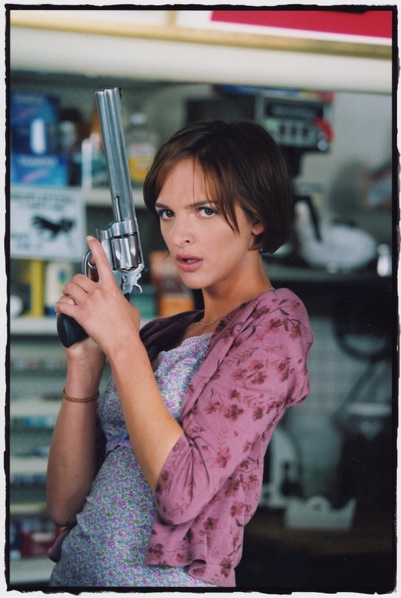
Stephen – Your lovely wife, Boti, plays a now legendary cameo in “Bubble Boy,” one that makes me laugh from the moment she appears on screen. How did you and Boti meet?
Blair – I met Boti Bliss on a commercial shoot. She was the girl Damon Wayans and David Arquette were fighting Chop-Sakey style over in an AT&T commercial. It was honestly love at first sight for both of us. We started dating shortly thereafter and moved in together 13 years ago. We tied the knot officially two years ago when we got pregnant. And now share the house with the World’s Most Adorable Child, Ashby Buck.
Stephen – I often wish that I could be reborn as Ashby – the kid with the cool, artistic parents, the three enormous dogs and the house in Topanga. I’ve seen photos of him at work in his art studio and playing piano and drums…and he’s two years old. You and Boti are giving him the best that can be given.
Thanks for giving us a peek into your life, Blair. We’re all waiting to see your next creative endeavor!
Unless you’ve been living in the far reaches of the solar system, you’re no doubt aware that there’s a new James Bond film out. You’re probably also aware it’s called Skyfall, it stars Daniel Craig, it’s directed by Sam Mendes, Adele’s done the theme tune and the final third is a bit Marmite, dividing the audience between lovers and haters. There are other things you may not know (or not particularly want to know, come to that). The bar at the beginning where Bond avoids the scorpion and the beach he’s living on was where we went for our holidays this year. It’s in Turkey. And it’s lovely. There you go, a scoop. You heard it here first. No, you’re welcome.
You’re probably aware of other things about it too. The Aston Martin DB5 is back (and looking gorgeous), Judy Dench is brilliant as M and it’s officially fifty years of James Bond movies. Yes, Doctor No, the first Bond film, was released on 5 October 1962. Before I was born, he said coyly. It’s also fifty years since the Beatles released their first single. Another landmark. Next year it’s fifty years of Doctor Who. Our cultural icons are getting old.
Or perhaps not. The Bond franchise has constantly renewed itself. Daniel Craig is, as we all know, the sixth actor to play Bond. Judy Dench the third M, Ben Wishaw the third Q. One of the themes of the movie is whether Bond’s too old to still be doing what he’s doing. And the answer – well, what do you think? I’m not giving too much away to say Craig’s signed for two more films. But still. It’s a fine fifty year celebration and the ending I thought was exceptionally clever. It not only finished everything off that had gone before and provided a coda, (as one reviewer said) but it sent the franchise full circle to start again. Acknowledging the past, playing to it, and renewing itself for another half century all at the same time. Like I said, very cleverly done.
However, while it is renewing itself – and has done, if you see the end of the new one – what it can’t do is use the same cast. Sean Connery, the first Bond is way too old to do it now. Some would say he was way too old when he did it in the early Eighties in the non-canonical Never Say Never Again. Ditto for Roger Moore and George Lazenby. The rest of the original supporting cast are all dead. So it’s renewal and rebirth for a new age.
Doctor Who does the same thing. Matt Smith turned thirty last week. He’s the youngest actor to play the thousand year old Time Lord (yet, I think, the best at carrying the character’s age), and the eleventh incarnation. The change of a lead actor is less surprising in the case of Doctor Who, it’s a show that thrives on change, in fact actively welcomes it. It could easily run for another fifty years. Another hundred, even, because the premise – time travelling madman in a box – is so brilliantly versatile. It’s probably the one idea in fiction I wish I’d thought of. And yet I’m sure I would have rejected it for being too massively, stupidly unworkable. Which, of course, shows what I know.
But my point is the same for both franchises. Our culture constantly renews itself, retelling the same stories over and over in ways that we can currently recognise or that mean something to our lives now. Yet while they’re doing that, these cultural monoliths also have one eye on the past. They acknowledge their history and build on it. They’re creating next generation nostalgia while providing it for the original audience. They can do that. It’s in their natures.
A writer once told me that Marvel Comics would retell the same stories every five years. It was market economics: their target audience would grow up by then and move on and the comics had to be ready for the next one. He did tell me this before the nostalgia boom hit and middle aged men who should know better still kept reading them (and some of them – mentioning no names – still wear the t-shirts), but the point is a valid one. For instance, how old is Peter Parker? He was a teenager in 1962 when he was bitten by a radioactive spider. Now, given the fact that he didn’t die of leukaemia and went on to develop super powers, he doesn’t look much older now. Likewise characters who repeatedly die to be reborn. Captain America and the Human Torch are two of the latest examples while over at DC they’ve killed and resurrected both Batman and Superman. (In fact they’ve just killed off the whole of the DC universe and rebooted it. That takes some doing.) This is fine. This is in the nature of us. We need constant renewal in our culture.
Why? Because, as I said, we need to retell the same stories to ourselves in ways we’ll understand. But there’s something else, I think. It keeps us young. Well, up to a point.
We don’t notice that we’re aging. Well, yes we do, when our knees give out and we start to forget things, but on a day to day basis we don’t notice. That’s because we live most of our lives inside our own heads and we only get to see the way other people view us when we happen to look in a mirror. And then we usually wonder who that old bloke is grinning back at us. Or I do anyway.
Inside our heads we don’t age. We don’t get older. We’re the same in our forties as we were in our twenties. Or at least we tell ourselves that – the truth is probably different. But we still think we feel the same as we did then. And we want our culture to reflect that.
We don’t want to see an old Sean Connery being Bond. We want the younger, fitter model. Because that’s who we identify with. We want Matt Smith as Doctor Who, a young man in an old man’s body. We don’t want a tired old Batman. We want a fearless hero who knows that criminals are a cowardly lot and is prepared to take them on. Why? Because when we read, when we look at a screen, we want to see ourselves reflected back at us. Not the boring, tired old selves that we really are, but the stylised, idealised versions. The heroes we want to be and believe we are. We want our heroes to not get old. Because if they don’t we might stay young too.
But as I said earlier, it’s also the fiftieth anniversary of the Beatles releasing their first single. And that’s when mortality hits us.
For a start, there are only two of them left. Cancer took one, a mental gunman took the other. And the two that are left are old. Admittedly they’re trying not to be and not to look it, but they are. And I’m sure that inside they don’t feel any different to the young men who recorded ‘Love Me Do’. I’m sure they’re just the same as the rest of us. They can’t renew themselves. They can’t cast younger versions to continue on as the Beatles. They can’t reinvent themselves and stay young because we want them to. And that’s sad, really.
I felt something similar when Doctor Who came back on TV in 2005. Here was something I used to watch as a kid, and love. I read the books, bought the merchandise, even went to a couple of conventions. Loved it. And now it was back. But it was still a great show, in many ways much better than the one I’d enjoyed as a kid. But there was one big difference. I was sitting there watching it with my own children. And that was one of the biggest intimations of mortality I’ve ever felt.
So yes. Our culture can renew itself. Up to a point. And we can try to do the same. Up to a point. So what do we do? How do we respond? Enjoy it, I suppose. Even the getting older bit.
Because as my mother (a huge Bond fan herself, incidentally) always says, ‘It’s better than the alternative’.
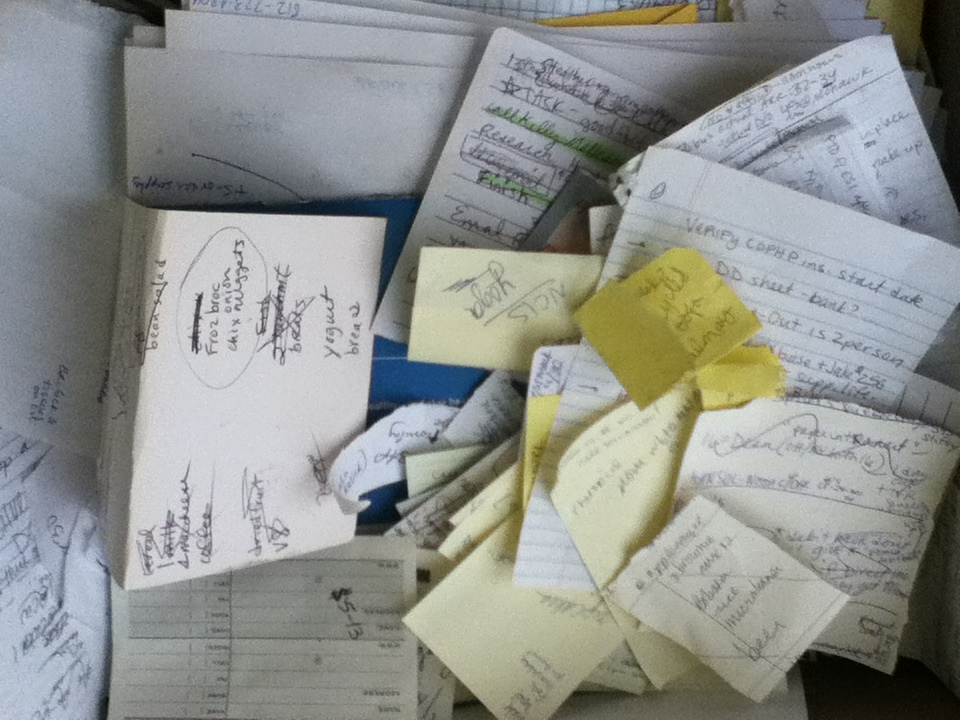
My life is run by two lists. One is the day job list, which cannot be set aside. I run a thirteen-state Western Region for my sales job and my travel and daily activities are dependent upon the schedules and daily lists of dozens of other sales reps and distributor representatives. This list weighs me down.
List Two is the everything else list, which includes ALL of my writing endeavors and obligations, as well as my personal business issues, medical, housing, kids’ school obligations, bills to pay, and the never-ending “honey-do” list. This list weighs me down.
In addition to these two enormous lists, which I keep as separate computer files, I generally write a Daily To-Do List, which combines the twenty or so most important things that must be done each day, culled from List One and List Two.
I used to experience great joy crossing things off these lists, but the trick has grown old. I no longer find happiness in the process.
I’m over-committed and I have no idea when it’s going to end. I will have to experience a complete lifestyle change for the deluge to stop, and I don’t see this happening for a long, long time.
I used to be able to juggle a week’s worth of commitments in my head. Each week I’d do a quick review and prepare for everything that would happen in the next seven days.
Now I focus on what’s supposed to happen today only. I see exactly what’s in front of me and nothing more. I’ll go through my entire Monday without realizing that Tuesday morning I’m boarding a flight to Minnesota. And that ain’t good, because sometimes I need an extra couple hours in my day to launder the underwear. God forbid I should need a little dry-cleaning done.
My creative commitments are insane. Judging two major competitions simultaneously (aka, reading hundreds of novels and short stories), researching and writing a new Hayden Glass novel, writing a short story on assignment, doing panels and speaking engagements…it’s crazy. And I know I’m not alone – most authors I know are just as busy, and most of them are juggling day jobs, as well.
At a recent sales meeting I learned that when people focus on more than three goals their chances of succeeding at anyone of these goals falls dramatically. When you have more than seven goals you might as well give up. You can’t do everything and do everything well.
Point in case – what the fuck is going on with my writing? Where is my third novel?
When I wrote Boulevard and Beat I had two major commitments. The day job and the book. That’s where my head was. Worked during the day, wrote at night. I finished two good, solid books that way. Since I’ve been published I’ve allowed myself to be torn in a hundred directions and the end result is…no book.
I have made one major addition to my commitment bucket, however. I’ve decided to make my family a priority. So now I have three major responsibilities – the day job, the current novel, and spending time with my family.
So, what happens next? I fill my schedule with so many commitments that one of my three important goals gets axed. I’ve learned from experience that I cannot risk endangering the day job, so that one stays. I’ve also learned that taking on any new responsibilities is not worth alienating my wife and kids.
And thus the thing that gets the shaft is my writing. Because, when I’m REALLY working on a novel I spend four or five hours at it every night, after the day job. Another eight to ten hours each day of the weekend. Which means there’s no time for anything else, except work and whatever I can schedule with the family.
Like many of you, I don’t like to say no. I love being available for all the cool things that being an author affords us. I love being the guest speaker at an event, even though it means I’ll spend two weeks preparing for it. I love being part of the committee responsible for bestowing one of the great writing awards to one of my fellow authors, even though it means I’ll be reading five hundred novels in four months. I love being asked to contribute to publications with original short stories or poetry, even though the process will take valuable hours and days away from the work I put into my novel. I always want to say YES to these opportunities.
But there’s only one me, and the gap between when my last novel came out and when my next one launches is growing ever wide.
These are good problems to have, I concede. I’m fortunate for the good fortune. But I’m scattered, and I wonder if the process has caused the good work to suffer. I wonder if focusing on twenty goals is killing the potential for success of goals one-two-three.
No wonder the years are passing by. There’s no time left to contemplate, to think, to reminisce. Not when there’s so much to do.