I’m not sure if this is a truism, but it seems the older many people get, the more closed and self-protective they become. I get it. I really do. Life has a way knocking the impetuosity out of a soul. You get the wind slugged out of you a few times and more fool you if you step into the storm again without so much as a raincoat or umbrella.
So how to reconcile that natural tendency with the very essence of creativity, the stepping out onto the ledge with one foot in mid air because, let’s face it, we have to put it there?
The business of living life and surviving challenges often forces us to curl in like a morning glory at the sun’s zenith. And yet, we writers are collectors of experiences. If we don’t have them, we can’t then process them through our particular sieves into whatever mush we are compelled to produce.
For those of you who have been walking my journey with me through the prickly landscape of the dissolution of my marriage, it will come as no surprise that I’m realizing now how many times I’ve said, “no,” without intending to during the last 18 years. Being first part of a couple and then a parent, I found myself putting on the protective layers of those identities to the detriment of allowing myself to be open to the unexpected. As with much of my current realizations, there is no blame in this – no regret or finger pointing – just a curious fascination with the process and the results.
And in this case, I’ve noticed the nos in my life and have decided to intentionally shift the balance back to a more interesting center.
In short, I’ve begun saying yes again.
When I re-read the above statement, a stereotypic image comes to mind: A woman standing on a large boulder in the middle of a gorgeous lake, a gentle breeze blowing her long auburn hair and gossamer blue and white gown. Ah, there she is, a symbol of freedom with her arms outstretched – embracing all that life has to offer . . . .
Nah. That’s not quite what I’m talking about here.
I’m talking about little yeses . . . yeslets — the allowing oneself to let go of the no in small ways — to invite tiny but welcome experiences in like going to the Draft Horse Pull at the New Mexico State Fair with a group of friends. It’s something I’ve never done before and might not have done if I hadn’t decided to say “yes” more. Another yes: hanging out with a friend with no purpose other than to hang out and talk. Another yes? Going to the Albuquerque Youth Symphony concert on Sunday just because I wanted to experience — and support — young people who through hard work can make something truly beautiful.
With each of these small yeses, my creativity grows in energy and dimension.
Simply put, I didn’t know it would happen, but I’m enjoying my writing, my forays into visual art, and my life more because I’ve let yes back into my life.
Today let’s talk about yeses.
When was the last time you said yes to something you wouldn’t have before? What was it to? What was the result of that yes on your life/perspective/creativity?
Several months ago, I wrote a guest post for Timothy Hallinan’s fine blog regarding the “writer’s process.” Those last two words are in quotation marks because, as all of us here clearly know, there’s no such thing as a singular “writer’s process.” Every writer’s process — his way of getting words on paper so that they form a publishable manuscript — is different. Asking me to describe “the” writer’s process is like asking all the Iron Chefs how to make a soufflé with the expectation of getting only one answer.
Anyway, one of the areas I touched upon in my post for Tim’s blog (Tim’s one hell of a writer, by the way; his novel THE QUEEN OF PATPONG is not to be missed) was where we writers get our ideas. Big surprise that, huh? Because that’s always the first thing readers and others who don’t write for a living want to know: Where the hell do we find all those incredible stories?
The question is usually posed as if the answer must be some deep, dark secret. I think what the people who pose it are generally envisioning is a vast network of hidden depositories — lockboxes that only we writers know exist — in which Great Ideas are kept. We surf to the Great Ideas website, login using our writers-only password, find a lockbox nearby and then slink off under cover of night to open the box and withdraw the Great Idea inside.
Voila! Our next book is practically in the can!
(Oh, if it were only that simple. . .)
Naturally, there is no such network of lockboxes. There are no hidden Great Ideas. All our Great Ideas are right there out in the open for anyone and everyone to see. Here’s how I explained what I mean in my post for Tim’s blog:
A Non-Writer and a Writer are walking down the street. Both take note of a mismatched pair of running shoes dangling from their bound laces over the back of a vacant bus bench.
The Non-Writer thinks (if he or she thinks anything at all):
“Hmm. That’s funny. I wonder what that’s about?”
The Writer thinks:
“An all-clear sign left by one criminal conspirator for another.”
“A poor man training for his last marathon before cancer takes his life has just boarded a bus and left his only pair of running shoes behind.”
“A grifter’s wife, throwing his worthless ass out again, has just tossed his clothes out of the window of their fourth-floor apartment, starting with shoes she’s been careful to tie up in mismatched pairs just to twist the knife.”
You see? And none of this is particularly deliberate. It just happens. It’s how our minds work. We see or read something that piques our curiosity and runaway extrapolation occurs. Mind you, it isn’t always great extrapolation (as the three examples above probably indicate), but every now and then, something genuinely wonderful results from it.
So where do I get my ideas? Everywhere. The thing is, they’re only “ideas” because, as a writer, I’m able to perceive them as such; what the Non-Writer dismisses as mere background noise I latch onto as seedlings that could grow stories in a hundred different directions.
Go figure.
I was thinking about all this yesterday during my thrice-weekly bike ride to the gym, because I caught myself finding Great Ideas in damn near everything and everyone I encountered. Such as:
Two police cars, one unmarked, the other a black-and-white, splitting off to cruise my ‘hood in two different directions.
My first thought: Watch one of them pull me over. On my bike. Always trying to keep the Black Man down.
(Well, okay, this wasn’t a Great Idea, it was just paranoia. And no, neither cop gave me a second look.)
But my NEXT first thought was:
They’re after the wrong guy. Somebody’s called in a false report, claiming they’ve witnessed a crime that never actually occurred, because. . .
A long line of cars waiting at a Metro line rail crossing for a train that, it seems, is never going to come.
My first thought: Persons unknown have hacked into the Metro transit system, and this harmless traffic snarl is just a dry run for. . .
Two old men, one at least twenty years older than the other, circling a car for sale sitting in a dry cleaner’s parking lot: a classic, perfectly restored ’64 Chevy Malibu.
My first thought: They’re father and son, and the son intends to gift the car to the old man because it reminds them both of the son’s mother, who. . .
A homeless man stretched out on the sidewalk, unkempt but totally coherent, lighting a cigarette with theatrical flair.
My first thought: This is a goddamn shame. Exactly how and when did homelessness become something undeserving of America’s outrage?
(But I digress.)
My NEXT first thought: He learned to light a cigarette like that in Europe as a young man, when he served as a valet to. . .
A pair of ornate, wrought-iron gates, flanking a quiet residential street; open now but clearly once intended to close off the sidewalk on both sides to unwanted visitors.
My first thought: Those gates weren’t meant to keep people out. They were meant to keep people in. During World War II, this street led to a private hospital, where a former surgeon in the U.S. Navy was conducting secret experiments on. . .
And that’s how it goes for me, all day, every day. Springboards for stories are everywhere. My wife sees a car at the curb, coated with dust and sporting a windshield crawling with parking tickets; I see the corpse going to rot in the back seat, behind the tinted windows that only days ago had served as a curtain for the last sex act the deceased will ever know.
Most of these Great Ideas of mine are anything but, and I forget about them as quickly as they come to me. But some stick. They grow and gather momentum, almost of their own volition, until I’m too drawn in to do anything but massage them into a full-blown narrative or die trying.
So there you have it: My answer to the dreaded “Where do you get your ideas?” question. I don’t go looking for them; I just stumble upon them, my writer’s intuition (think of Superman’s X-ray vision) enabling me, countless times a day, to see beyond the hard outer shell of something ordinary to the infinite and extraordinary possibilities lurking within.
But hey — if anybody wants to create that secret network of idea lockboxes? Sign me the hell up.
Questions for the class: Readers, what’s the best answer to the “Where do you get your ideas?” question you’ve ever heard? And writers, I’m not going to ask where and how you get your ideas — that would be too easy. But I am curious to know how often you come up with one too good not to keep. Once a day? Twice a month? Exactly how efficient is your own personal idea-generating mechanism?
So I was just sitting (okay, LYING ON MY SOFA) here, reading JT’s wonderful post about NOT SETTING GOALS this morning (it’s still Friday, as I’m typing), and I’m thinking to myself, “yes, this is wonderful advice for people who HAVE TROUBLE WITH SETTING TOO MANY GOALS.”
Because I set, like, not enough of them, I think. Except for goals such as, “um… dude, maybe you should try thinking about thinking about setting a goal or something. Next week.”
Well, actually, I set goals like, “I will stop being such an asshole-procrastinating-bitch type person and perfect myself OVERNIGHT, and start keeping actual to-do lists which I will then NOT FORGET ON THE F TRAIN ON THE SEAT NEXT TO ME WHEN I AM LOOKING THROUGH MY BAG FOR MY iPhone HEADPHONES,” for instance.
Ahem.
And then I get to the part of her post where she quotes Leo Babauta, about making oneself NOT set goals:
“What do you do, then? Lay around on the couch all day, sleeping and watching TV and eating Ho-Hos? No, you simply do.”
Yeah, right Leo. Actually, I’m lying on the couch right now, and I would be eating a Ho-Ho, FOR BREAKFAST, only that would require getting up and walking around the corner to Steve’s C-Town grocery on Ninth Street and PURCHASING a box of Ho-Hos, which seems like entirely too much trouble.
(I would have inserted John Belushi’s classic “Little Chocolate Donuts” thing from Saturday Night Live, but NBC seems to police Youtube pretty intensely so I offer you the following lovely homage in its place…)
As my daughter and I decided about a month ago, we both suffer not from OCD, but from “OC… um… whatever.”
Meanwhile, the final (please GOD) draft of my fourth novel is due a week from today. O joy, o rapture unforeseen. (Look! SQUIRRELS!!!)
Maybe I should make some flan.
Because, come to think of it, I don’t actually LIKE Ho-Hos all that much. I mean, if you’re going to blow calories like that, why not eat something good? Like a doughnut.
Except that maybe an apple fritter would taste even better…
But really, I think I’d like to be JT when I grow up. That would be a worthy goal. She is an awesome woman. And an actual grownup. And I bet she writes her novels sitting up instead of lying down on her sofa, which is what I’ve been doing for about the last book and a half. When I actually leave my bed and meander over to the sofa, which requires a great deal of coffee.
But the concept of me EVER getting to be even a tenth as organized and thoughtful as JT is strikes me as being about as likely to come true as me growing up to be Batman.
I ran into a high school friend on the sidewalk yesterday, here in Brooklyn. We talked about all kinds of stuff because she was supposed to be going to yoga class and I was supposed to be going to my new bank. And we cracked each other up by admitting that we have both realized we have a problem with transitions.
Diana discovered this when she was talking with a friend about her procrastination, and he said, “yes. This is called having difficulty with transitions.”
And she said, “THAT’S IT! THAT’S PERFECT!!”
And he said, “Yeah, um… I know that because I teach Kindergarten, and it’s something we work on a lot with the kids. Who are, like, FIVE.”
So I told Diana I’m so bad with transitions that it requires a great deal of concentration and willpower for me to bathe, most days. “Because I just look at the bathtub, and I think, ‘you know, I’m DRY right now, and if I get in there I will be, like, WET. And it will be, um… different.”
And then of course once I am actually IN the shower/bath, I have the reverse problem, which is that I’m wet, and it’s warm and kind of cozy, and it seems like an awful lot of trouble to get OUT of the shower/bath,
because then I will drip on the floor and everything and start getting cold, and then I think about how the reason you get cold is because evaporation is an endothermic reaction, in that it requires energy for the water to become a vapor and leap off your skin, so it sucks up heat to do that and everything, and then I wonder if that isn’t EXOthermic, and remembered that this is why I got a D- in high school chemistry for the year, but I also remember that evaporation is additionally a really neat-jeato way to refrigerate things when you’re camping. You just dig a hole in the dirt and wrap your food in a wet towel, and it will stay cool for quite a while. Except then of course your food is in the ground so that’s a really crappy idea if you’re camping someplace that a lot of bears hang out. Or, you know, even ONE bear. Or probably coyotes. Or, like, dingoes, if you’re in Australia or something. And I wonder if Meryl Streep watches Buffy the Vampire Slayer, because I hope it would make her laugh if she realized they named the band “Dingoes Ate My Baby.” Or was it “stole my baby?”
Anyway, as my pal Muffy always says about the difficulty we share with the whole transition-to-bathing thing, “you know, I just have to tell myself, ‘Muffy, no one has ever REGRETTED taking a shower.'”
Maybe I should make some flan.
Or just get off this sofa and go buy some little chocolate donuts. For lunch. Because it’s almost lunch time.
Back to the novel… Wish me luck, and some of JT’s mojo, please
Part of an author’s life is publicity. And, let’s face it, for the most part publicity is fun! You write in a cocoon for many, many months and then you emerge and get to flap your wings and show off all the pretty patterns. Well, it’s kind of like that.
For many authors, I know publicity can be a drag. For the shy, retiring type of author, publicity can be daunting and scary. Then there are the really, really big authors who do world tours and get a few weeks taken out of their writing schedule each year. They’re shepherded from city to city, country to country and plane to plane. I can see that after the first world tour (or maybe the tenth) that might get a little old.
For most of us, the publicity rounds are more sedate. And it depends on your publishing house and publicist too. My five books are released in Australia through Pan Macmillan Australia. They assigned me a fabulous publicist and for the two weeks around the launch of each book I’d block out time for media interviews. Lots were over-the-phone radio interviews, but then also some print stuff with the occasional photo shoot. However, in the US I didn’t have a publicist and so the publicity and media stuff was pretty much non-existent. The other weird thing about publicity is that by the time a book is released, you’re already well into writing the next book. So you have to get your head out of the current WIP and back into your last book.
But that’s not what this blog is about…today I want to talk about the best photo shoot of my career to date. And it’s not to publicise an upcoming novel. Next month, 7-9 October, I’m part of an Australian crime convention called SheKilda. It’s only the second of its kind (the first/last one was 10 years ago) and I’m hoping it’s going to be like Bouchercon for Aussies. It’s being hosted by Sisters in Crime Australia, so it’s only female crime writers (authors, journalists and TV writers) but there are still over 70 authors on 35+ panels. Needless to say, I can’t wait!!!! I’m using the pun – a killer weekend.
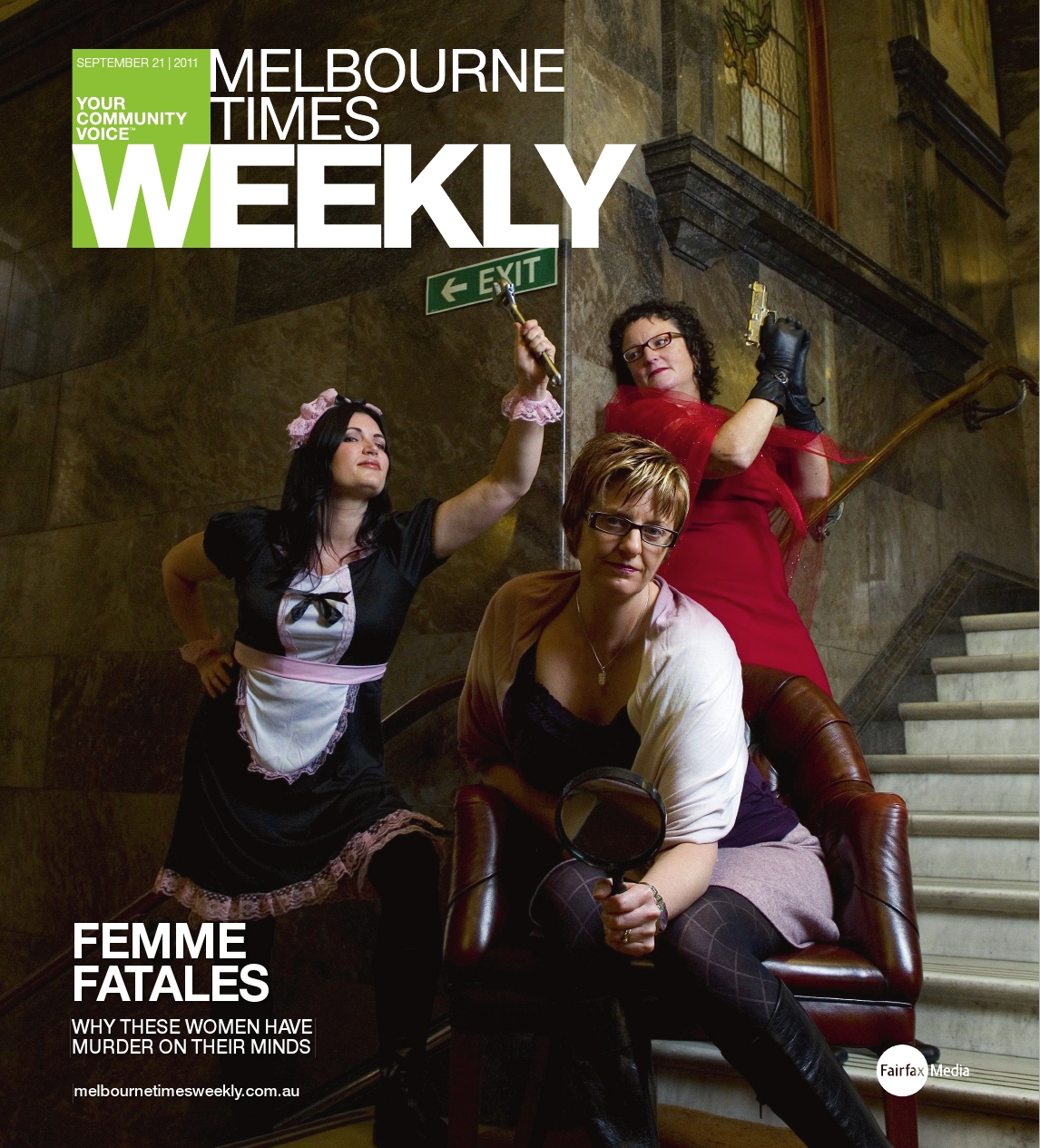
But I’ve digressed again. So, a couple of weeks ago, as part of the publicity for SheKilda, I was asked to take part in an interview with two other Melbourne-based authors, Angela Savage and Leigh Redhead. First I went into city and talked to the journalist over coffee, then the next day we met at the Victorian State Library for the photo shoot. The theme: modern-day Cluedo. The three of us had to pick a colour – my first difficulty. You see, like many Melbournians about 90% of my wardrobe is black. Anyway, I managed to hunt out some purple and so I was Professor Plum (in the library – literally).
The first pose was on a Chesterfield with magnificent lights in the background. Angela Savage lay on the lounge with a dagger, Leigh Redhead had the gun and I had a magnifying glass. The second pose was Leigh lying on the lounge, me lying on the top of it (balance was required, people!) and Angela behind us, looking a little too excited to be holding a rope in her gloved hands. This one made it into the article and I also got a way less slick pic on my little camera.
Next we were near an old marble staircase. I was sitting, magnifying glass in hand (I sooo wanted a gun) and Angela and Leigh were behind me, backs against the wall like they were about to kill each other (or maybe me). That one made the front cover of the Melbourne Times Weekly and is also the pic featured in the online version.
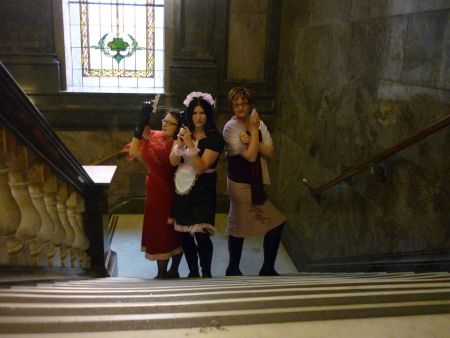
Then we did a Charlie’s Angels style pose. Again, I got one on my camera. This was a special moment for me, because I was able to play out one of my childhood fantasies — I was one of Charlie’s Angels! Sad, but true 🙂
I don’t know if you can see it in the pics, but it was a seriously fun shoot. Angela, Leigh and I were like excited school girls – with fake guns, knives, etc. And while most photo shoots take 5-15 minutes, this one went for nearly two hours!
It’s all in the look When you’re posing for photos, it can be hard to work out what expression to use. Even though we were having fun and getting into it, do you go for sexy? Serious? Smug? Leigh and I joked about the classic crime writer “look”. Crime authors need to refine a little sexy smirk that says: “I know something you don’t know.” And the thing we know? Whodunit. And that’s kind of important in a murder mystery.
Anyway, thought I’d share this fun photo shoot with the Murderati gang! For those of you reading this blog in Australia, please get yourselves to Melbourne 7-9 October! We’ve already got people coming from interstate and of course around Victoria. And tell all your friends about this amazing event. I’d rather not wait another 10 years for the next one, which means this one has to be a HUGE hit 🙂
To the authors out there…what’s been your most fun publicity event/piece? To the readers and aspiring authors…do you think you’d like the PR side of writing?
Note: Much of this same material was also posted by Jeremy on the Bouchercon and Crimespree blogs.
We broke the history of film into five time periods (see below), picked three films from each era, then named our absolute favorites. We then bickered and snickered about each other’s picks, and had a generally grand old time.
The hour deadline prevented us from discussing all but the first two time periods, though, and the last two “conceptual” categories, which we added for fun: Sacred Cow I Would Most Like to Gore and Little Known Film Worth Seeking Out (go to the end for these categories, which are probably the most fun).
The great joy of the panel was shooting ideas back and forth with other obsessive film lovers whose tastes both conformed and contrasted—or flatly contradicted—my own. And I was often glad someone brought up a particular film because it got so close to being one of my top three, and I hated not being able to include it. I wish we could have just hung around and talked movies for hours, because what everyone had to say about film always got my engine running.
But it was also fun to see how vehemently perfectly bright, well-informed people can disagree: Todd praisedThe Silence of the Lambs while Megan considered is a sacred cow in need of goring. Todd reveres Rear Window while that was my sacred cow, etc.
I thought you might enjoy seeing which films got chosen by whom and why. I’ll go through my fellow panelists’ picks after naming my own, which I chose largely to play the crank, the iconoclast, the connoisseur of the obscure—I know, you’re stunned.
Note: This is a tediously long posting, so just scroll through till you see a title you either know about or would like to learn about, or something else catches your eye. Where a film title bears a link, it leads to a trailer or other video concerning the film.
Classics (Pre-1945)
Top Pick:
M (1931) Director: Fritz Lang; starring Peter Lorre
The reason this is my top pick is because it provides one of the greatest performances on screen, ever: Peter Lorre’s confession as the child killer during the trial sequence near the movie’s end. This feverishly impassioned monologue is one of the most psychologically and morally complex in all of film, combining dread with self-pitying manipulation and the very real horror of helpless self-recognition. The film also fuses a brilliant story with a stunning visual technique without sacrificing a gritty urban realism. The irony at the heart of the film—that a child killer so energizes the police, without making them efficient, he obliges the city’s criminals to search for him themselves—is compounded with the resonance of the rise of Nazism. M is by no means an allegory—Lang was far too sophisticated a storyteller for that—but on reflection, even as one continues to root for the criminals, who seem to provide the ironic moral anchor for the film, it’s hard not to recognize an unsettling subtext: The social element that proclaims to want to protect children (while secretly pursuing its own illicit agenda), that goes about it with efficiency and skill and even with the trappings of due process, may in fact be, well, a bunch of criminals. (The fact Lang’s first film in the US after fleeing the Nazis, Fury, would focus on mob justice is hardly surprising.)
Remaining Two of Top Three:
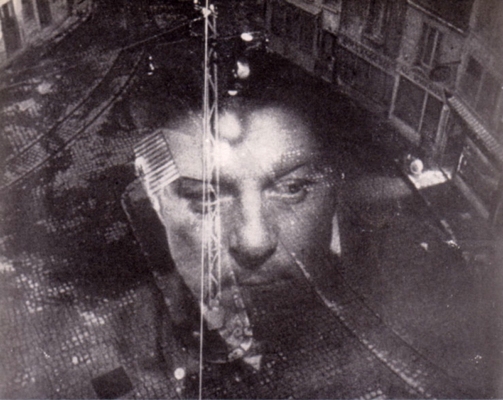
Le Jour Se Leve (1939) Director: Marcel Carné; screenwriter: Jacques Prévert; starring Jean Gabin, Arletty
From the same director/screenwriter team who created Les Enfants du Paradis, a beautiful, tough love story that begins with a murder and ends (surprise!) tragically.
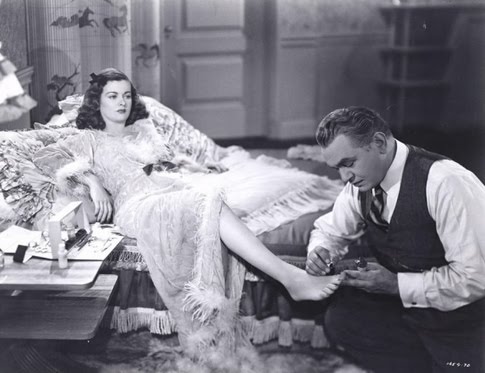
Scarlet Street(1945) Director: Fritz Lang; starring Edward G. Robinson, Joan Bennett, Dan Duryea
Another offering from the great Fritz Lang, this one made in America, and a gritty, uncompromising remake of Woman in the Window (1944), which Lang felt had been sentimentalized and sanitized by studio bigwigs.
Other Panelist Picks:
Megan Abbot:
Top Pick: Double Indemnity (1944) I was with Megan all the way, until she brought up the “vaguely homoerotic rapport” between Fred MacMurray and Edward G. Robinson. What can I say, I just can’t go there, even on a bet, when very drunk. But Barbara Stanwyck is breathtaking, even when she’s guilty as, well, sin. Maybe especially then.
Remaining Two Picks: Roaring Twenties(1939) and Laura (1944)
Russel McLean
Top Pick: Public Enemy (1931) Russel, a Scot, said his idea of America and Americans was largely formed by this film and others like it. “No list is complete without it.”
Remaining Two Picks: Murder My Sweet “Dick Powell brings a very different kind of Marlowe to the iconic one we all know from Bogie’s performance.”
The Maltese Falcon“With apologies to all those who have recently jumped on the cool-to-bash-the-falcon bandwagon” (meaning David Corbett, who considers it a sacred cow).
Todd Ritter:
Top Pick: Shadow of a Doubt (1943) “Hitchcock’s warped love letter to small-town America. Joseph Cotten has never been more menacing and Theresa Wright never more plucky.” (Todd’s a Hitchcock scholar, btw.)
Remaining Two Picks: M“Fritz Lang’s dark procedural makes criminals the cops on the hunt for child killer Peter Lorre in pre-war Berlin. No one comes out looking good.”
The Thin Man “As effervescent as champagne and as snappy as a stick of Wrigley. The plot is a throwaway. The keepers here are the dialogue and the chemistry between Myrna Loy and William Powell.”
Wallace Stroby:
Top Pick (tie): Public Enemy(1931) and Dead End (1937): “Crime in a social context: Prohibition and the Depression, and how American gangsters are made.”
Remaining Pick: The Maltese Falcon (1941): “Dashiell Hammett’s world view invades popular culture. An obvious pick, but any film you can easily name multiple characters from 70 years after its release deserves to be included.”
Cold War Crime (1945-1965)
Top Pick:
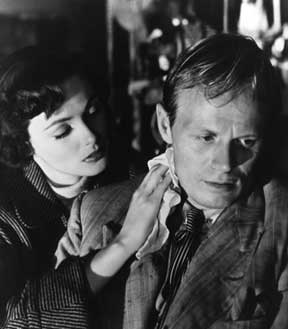
Il Bidone (“The Swindle”—1955) Director: Federico Fellini; starring: Broderick Crawford, Richard Basehart, Giulietta Masina
Filmed between the shooting of La Strada(1952) and Nights in Cabiria (1956), with a typically beautiful score by the incomparable Nino Rota, it tells the story of an aging smalltime hustler plagued by his own feckless past who seeks to redeem himself by supplying the money for the schooling of a daughter he has rarely met. The story was inspired by anecdotes Fellini heard from a petty thief on the set of La Strada. Bogart was Fellini’s first choice for the film’s “intense, tragic face,” but the actor’s lung cancer made that impracticable. The director recruited Crawford after seeing his image on a poster for All the King’s Men (1949). Plagued by Crawford’s alcoholism, shooting was difficult and critical reception scathing. The film did miserably in Italy and was not distributed abroad until 1964. Pity—it’s a rare gem.
You can watch the movie online in nine ten-minutes segments, starting here.
Remaining Two of Top Three:
Night and the City (1950) Director: Jules Dassin; starring Richard Widmark, Gene Tierney, Googie Withers)
Seriously, this might be my true favorite from this era. A visually stunning film with crackling dialog and mesmerizing performances from some of the greatest British character actors you’ll ever see. But it’s Widmark’s film, and he’s incandescent.
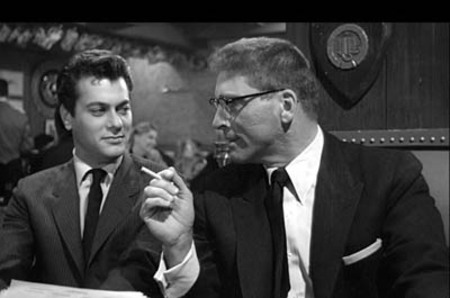
Sweet Smell of Success (1957) Director: Alexander Mackendrick; starring Burt Lancaster, Tony Curtis
Okay, it’s not a crime movie, so shoot me. It sure feels like one. Criminals could learn a few things from J.J. Hunsecker (modeled after Walter Winchell) and Sidney Falco. Absolutely some of the best dialog ever written. (“The cat’s in the bag and the bag’s in the river.”… “I’d hate to take a bite out of you. You’re a cookie filled with arsenic.”) Stunning visually, with Lancaster and Curtis in their best roles.
Other Panelist Picks:
Megan Abbot:
Top Pick: In a Lonely Place(1950) A subtle exploration of post-war male violence. Megan admitted this might just be her favorite film of all time, even though as an adaptation from the Dorothy Hughes novel it veers off-track to the point the two versions are irreconcilable. But Gloria Grahame was never better, and Bogart got to play a bad guy (almost).
Remaining Picks: Naked Kiss (1964) —“The eeriest, sexiest first five minutes of a film you’ll ever see,” from the great Sam Fuller—and Gilda (1946).
Russel McLean:
Top Pick: Psycho “With apologies to Todd but to my mind its a goddamn perfect movie.”
Remaining Picks: The Killing “The heist is perfection.”
A Touch of Evil “Yes Charlton Heston plays a Mexican, but what an opening…”
Todd Ritter:
Top Pick: Rear Window “Hitch’s finest hour, with James Stewart and a never-more-luminous Grace Kelly watching the neighbors across the way. Pure cinema. Pure fun. Pure suspense.”
Remaining Picks: The Third Man “A zither-scored tour of war-ravaged Vienna, full of shifting alliances and looming shadows. Orson Welles’ entrance is one of filmdom’s most memorable.”
Sunset Boulevard “Gloria Swanson’s titanic performance anchors this dark-as-night Hollywood noir. Maybe the most cynical movie about the movies ever made.”
Wallace Stroby:
Top Pick: Rififi (1955): “Influenced by American gangster dramas, this brilliant French heist film (directed by Jules Dassin, by then blacklisted from America), it went on to influence a generation of crime novelists (Donald E. Westlake, etc.) and filmmakers (Stanley Kubrick), who in turn influenced more French films, etc., etc.”
Remaining Picks: Kiss Me Deadly (1955): “Atom-age noir: Thuggish detective Mike Hammer chases the “Great Whatsit” and nearly unleashes the Apocalypse.”
The Killing (1956): “The heist as a complex machine, slowly breaking down. Stanley Kubrick plays with time, directing a cast of noir veterans in a script co-written by Jim Thompson.”
Revolution (1965-1980)
Top Pick:
Chinatown (1974) Director: Roman Polansky; starring Jack Nicholson, Faye Dunaway, John Huston
My one safe, obvious pick. But it’s a no-brainer. Polansky and screenwriter Robert Towne argued violently over the ending, and parted ways. Polansky’s ending won, and became iconic. (Towne mocked it as “the tunnel at the end of the light,” but decades later conceded it was the right choice.) The story is based in part on Oedipus, with art direction that makes the most of the self-blinding that serves as the core metaphor of the Sophoclean version (note how many times eyes, eyeglasses, windshields, etc., are key to the film—and foreshadow the ending). But the most important and impressive aspect of the film is the way it turns the detective genre on its head. Instead of the PI hero digging deeper and deeper until he uncovers the truth, we see him as intrinsically self-deluded, uncovering clues and unraveling the scam but always missing an essential truth, until he winds up once again in Chinatown as though driven by Nietzsche’s dictum of eternal return.
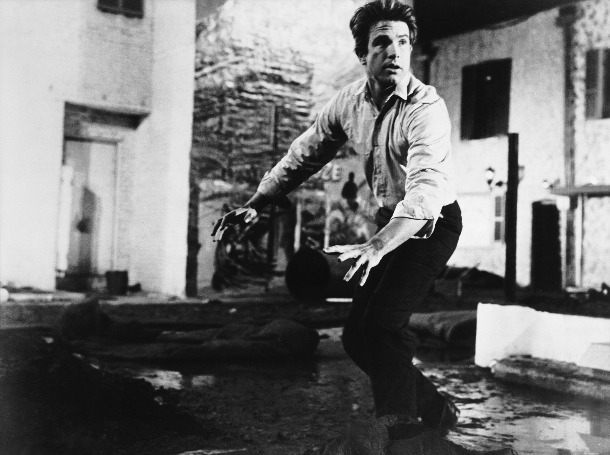
Two years later, Penn would direct Beatty again in the spectacular Bonnie and Clyde. But this remains a sentimental favorite of mine. With Penn’s stunning photography and buzzsaw editing, Eddie Sauter’s brutal score (with Stan Getz on sax), it was called French New Wave from Hollywood (and yes, that was intended as a compliment). I saw it maybe five times over a marathon weekend of TV showings in LA, and was mesmerized. Beatty’s performance is every bit as electric as Widmark’s in Night and the City, but in much tighter confines. He plays a stage comic who—for reasons he’s never able to determine—has alienated someone in the Detroit mob, forcing him to flee. He’s trying to pick up his career in Chicago, hoping for the impossible—that he can both be a success and not be noticed. Guess what happens.
Cassavettes is one of those directors you’re supposed to like even if you don’t. The “art as medicine” metaphor—even if you hate it, it’s good for you. Normally I loathe such nonsense, and parts of this film are damn near unwatchable. (If you ever go to a strip club in LA and a guy named Mr. Sophistication is introducing the girls? Run.) But the film is also frightening in ways more conventional films never get to. The emotions are genuine and therefore shocking in places—as when, at an underground casino, a wife derides her dentist husband when they’re brought before a roomful of gangsters to discuss the extent of the man’s losses. She’s clearly, viscerally terrified, and her contempt for her putz of a hubby crackles. So too, the actual murder scene and the subsequent attempt by the gangsters to clean up a situation they thought they had under control—all these scenes generate a kind and a level of fear I just don’t feel often at the movies. So I forgive a lot of cinematic sins that maybe I shouldn’t, especially given how many other great films came out during this era (like Mean Streets, Taxi Driver, The Friends of Eddie Coyle, Dog Day Afternoon, Scarecrow, Cool Hand Luke, King of Marvin Gardens, Serpico, The Godfather—all brilliant.)
Other Panelist Picks:
Megan Abbot:
Top Pick: Chinatown (1974)
Remaining Picks: Mean Streets (1973), Badlands (1973)
Russel McLean:
Top Pick:Point Blank “Lee Marvin embodies the tough guy aesthetic in a way no one else can match.”
Remaining Picks: Get Carter“The ultimate in so-called Brit Grit – “Your eyes haven’t changed, still two pissholes in the snow”
In the Heat of the Night“They call me MISTER Tibbs – a perfect film that’s stood up to the test of time, imo.”
Todd Ritter:
Top Pick: Chinatown “Forties noir as seen through the haze of the seventies. The script is genius, Polanski’s direction rules and Nicholson and Dunaway have never been better. A masterpiece, pure and simple.”
Remaining Picks: The Conversation“Sound is a character in Coppola’s other classic from 1974. Captured the paranoia of the Watergate years right as it was happening.”
Dressed to Kill “Violent and absurd. There’s not a subtle bone in Brian De Palma’s body, and thank God for that. A film worthy of the era in which it was made.”
Wallace Stroby:
Top Pick:Get Carter (1971): “Brit gangster Jack Carter (Michael Caine’s greatest performance) comes home to Newcastle to avenge his brother’s death. An almost perfect film, without a single false note.”
Remaining Picks: Mean Streets(1973): “Dead End, 70s style. Smalltime hoods in Little Italy make choices that seal their fates.”
Rolling Thunder(1977): “Vietnam vet returns to a world he doesn’t understand, hits the vengeance trail with a sawed-off shotgun and a sharpened hook for a right hand. Half arthouse, half grindhouse.”
Reaction: Reagan, Glasnost and the Tech Boom (1980s & 1990s)
Top Pick:
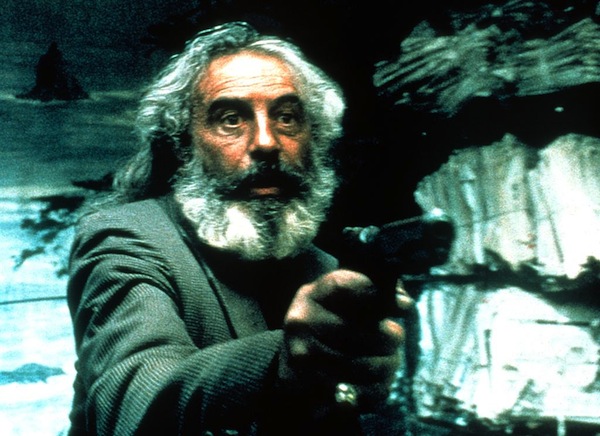
Bellman & True (1987) Director: Richard Loncraine; screenplay: Desmond Lowden; starring Bernard Hill, Derek Newark, Richard Hope
I have sung my praises of this film, and the novel on which it’s based, before on Murderati. It’s not just one of my top five favorite crime films, but one of my top five favorite films of any kind. A British bank caper with a father-son love story at its heart, it’s smart, brisk, unique and moving, with gripping and at times heartbreaking performances from a cast comprised largely of character actors, and a script that strips bare the folly in all human longing but leaves the odd, chimerical dignity of its characters fully if tragically intact.
Remaining Two of Top Three:
Glengarry Glen Ross (1992) Director: James Foley; screenplay: David Mamet; starring: Al Pacino, Jack Lemmon, Ed Harris, Alec Baldwin, Jonathan Pryce, Alan Arkin, Kevin Spacey)
Again, not really a crime film—though, unlike Sweet Smell of Success, a crime actually does occur and get investigated in the course of the story—but it qualifies because it strips bare the greed, hunger, envy, deceit and rage that motivate so much of the behavior we think of as criminal, reveals how embedded that behavior is in human affairs—specifically business—and shows us how intrinsically human, if also shameful and repellant, those motivations are. When I first saw this movie, I told a friend, “I just saw a monster movie, and all the monsters were salesmen.” Substitute “crime” and “criminal” for “monster” and you’ll see why I include it in this list.
(A note on the director: James Foley did indeed direct crime films, including two of my favorites from this same period: At Close Range (1986)—with Sean Penn and Christopher Walken, call it Redneck Noir—and After Dark, My Sweet (1990)—with Jason Patric (in his first lead role), Rachel Ward and Bruce Dern, my personal favorite Jim Thompson adaptation.)
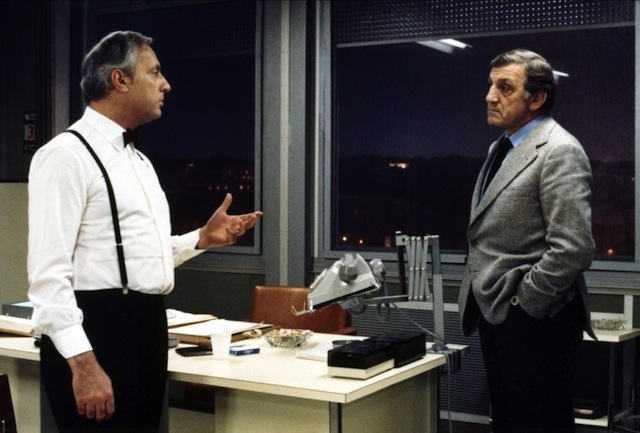
Garde à Vue (1981) Director: Claude Miller; starring: Michel Serrault, Lino Ventura, Romy Schneider
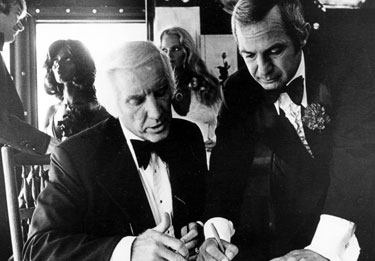
Another tense, poignant, gripping film that shamefully remains an obscurity. A wealthy socialite, dragged in his tuxedo from a New Year’s Eve Party, is interrogated for the murder of a teenage prostitute. It was remade as Under Suspicion with Gene Hackman and Morgan Freeman, but this version is almost unwatchable. The remake removes the key element that makes the original so compelling: It takes place almost entirely at night in the cramped confines of the police station. The claustrophobic effect of that setting is crucial, especially with the chiaroscuro lighting and the spider-with-a-fly patience of the cops. Heightening the tension is the portrayal of the cop by the legendary Leno Ventura, and the socialite by an arrogant, restless, übermasculine Michel Serrault, most famous (ironically) for his quirky, super-femme turn as Albin in La Cage aux Folles. Romy Schneider appears late and only briefly, but she is deadly.
Other Panelist Picks:
Megan Abbot:
Top Pick:Goodfellas(1990)
Remaining Picks: Blue Velvet(1986) and Dressed to Kill(1980)
Russel McLean:
Top Pick: Midnight Run “One of my ultimate comfort movies.”
Remaining Picks: Shallow Grave“D’you think I wouldn’t sneak a Scots film on here? For my money the only truly decent film Danny Boyle made.”
LA Confidential“Filming the unfilmable and doing it well.”
Todd Ritter:
Top Pick: The Silence of the Lambs “Much ink has been spilled about the cat and mouse game played between Jodie Foster’s Clarice Starling and Anthony Hopkins’ Hannibal Lecter. The emotional resonance, though, comes from watching Foster as a damaged striver facing down inhumanity everywhere she turns.”
Remaining Picks: Fatal Attraction “The thriller that defined the eighties. It wouldn’t be nearly as good without Glenn Close, who infuses a madwoman with humanity while simultaneously scaring the shit out of every American male with a libido.”
Wild Things “The greatest movie Russ Meyer never made. Look past the lesbian liplocks and teacher-student threeways and you’ll see a film that sets the bar low but clears it by a mile. Brilliant.”
Wallace Stroby:
Top Pick: At Close Range (1986): Crime as a family affair. Sean Penn and Christopher Walken give two of their best performances as father and son criminals who come to a violent parting of the ways.
Remaining Picks: Goodfellas(1990): The greatest film about workaday gangsters ever made. Brutal, funny, invigorating, exhausting.
Thief (1981): Michael Mann’s first look at the inner life of the high-end professional criminal, vastly superior to his later Heat.
Quite possibly my favorite film of all trime. Despite having so many elements of a crime picture—bank robbery, corrupt cops, underground dog-fighting with gang members putting their pit bulls in the ring, and a former revolutionary turned hired assassin—it’s actually a drama of the human heart. (I seem to possess an undying quest to see a crime film where none exists.) But like the other great films from this director—21 Grams and Biutiful—without the crime elements, the movie would lack much of the tension that makes it work. Narratively ambitious—without the preciousness that sometimes mars Tarantino’s efforts—it’s a multi-layered, intertwining story of two couples and a broken father, all searching for, trying to preserve, or hoping to reclaim the great loves of their lives. As the title suggests, it takes an almost dog-like ferocity to pull it off. Because, as the title suggests, love is a bitch.
Remaining Two of Top Three:
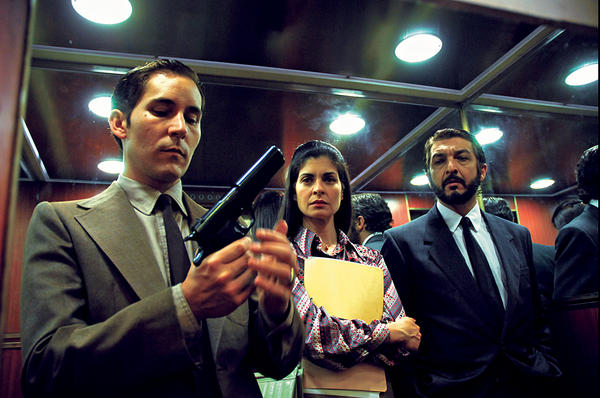
The Secret in their Eyes (2009) Director: Juan José Campanella; starring: Ricardo Darín, Soledad Villamil, Guillermo Francella
This time period (2000 to present) presented my biggest problem in picking a top film, because so many of the good films were great, and equally stunning. I love this picture, and consider it almost flawless. Its wedding of past and present into a single seamless narrative, and its subtly underplayed portrayal of political events at the time of the Peron restoration in Argentina, give the film its intelligence, while the love stories at its core, one tragic, one bungled but not yet lost, give it an elegiac heart. Ricardo Darín, like Vincent Cassel, is one of those leading men in the Bogart tradition with an intrinsically flawed face you can’t take your eyes off of. His performances (see also El Aura and Nine Queens) are understated, intelligent, witty and mesmerizing. But it’s not just Darín who makes this film work. The performances are stellar across the board—especially that of Guillermo Francella, an Argentinian comedian in his first dramatic role; and if you don’t fall in love with Soledad Villamil, you just might be an alien life form.
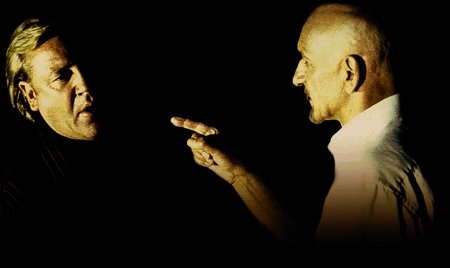
Sexy Beast (2000) Director: Jonathan Glazer; starring Ray Winstone, Ben Kingsley, Ian McShane, James Fox
Another flawless film, imho. The old trope of the gangster who’s left the trade only to get sucked back in gets a stellar makeover in sunny Spain and rain-drenched London. Witty, brutal, gorgeous, with some of the best dialog ever written and Ben Kingsley’s most stunning performance ever—call it the anti-Ghandi—it’s another British bank caper but so much more. Just slightly less narratively innovative than Memento (which came out the same year), it nonetheless moves in and out of present and past with deft fluidity, creating suspense, not confusion. Ian McShane has never been so steely or menacing, James Fox more weasly, Ray Winstone more endearingly rough—and Amanda Redman, as “Dirty Deedee” Dove, will steal your heart, even after the shotgun scene (maybe because of it).
Other Panelist Picks:
Megan Abbot:
Top Pick: Zodiac(2007)
Remaining Picks: Mulholland Drive (2001) and American Psycho (2000)
Russel McClean:
Top Pick: Kiss Kiss, Bang Bang “Perfection – the Russian Roulette scene alone is worthwhile.”
Remaining Picks: Narc “The kind of gritty crime drama it feels like we’ve forgotten how to make now.”
The Limey “Essentially an update of Point Blank in style – Stamp’s the toughest guy on screen since Marvin.”
Todd Ritter:
Top Pick: Zodiac“Not so much about murders than about how those crimes can burrow into the consciousness of a city and stay there for years. Gorgeous and terrifying in equal measure.”
Remaining Picks: Match Point “Woody Allen transplants the plot of An American Tragedy to modern London and lets our anti-hero get away with it.”
Mulholland Drive “Wonderful weirdness from David Lynch. It could be seen as the flipside to Sunset Boulevard. Or it could all be a dream. I don’t know, and I don’t care.”
Wallace Stroby:
Top Pick: The Pusher Trilogy (1996-2005): “Three films about the Danish drug trade, following different characters in the same environment, hot-wired and supercharged by Drive director Nicholas Winding Refn.”
Remaining Picks: Zodiac(2007): “Real-life noir, scrupulously faithful to the facts of the case. It gets under your skin in a way few movies do, not immediately, but stealthily and insidiously. A puzzle without an answer, a door without a key, an obsession with no catharsis.”
Gomorrah (2008): “The real Godfathers. A multi-storyline crime epic, based on a nonfiction book, about how organized crime corrupts nearly every strata of Italian society.”
SACRED COW I WOULD MOST LIKE TO GORE
Rear Window (1954) Director: Alfred Hitchcock; starring James Stewart, Grace Kelly, Raymond Burr, Thelma Ritter
My problems with Hitchcock are that his films, despite their flawless pacing, brilliant cinematography, heart-stopping surprises and witty repartee, are too cerebral, too contrived, too conspicuously “artful” for my tastes. I rarely stop realizing I’m watching a movie. (I have this same problem with a lot of Tarantino’s films, and with Martin McDonagh’s In Bruges, even though I enjoyed them all.) As I said on the panel, Hitchcock has never broken my heart—though he came close in Vertigo—and this for me is the bright line between very good and great. Admittedly, he’s scared the bejeebers out of me once or twice, largely because I know he doesn’t give a damn about human beings, and will toss a character off a cliff—or Mount Rushmore, or the Statue of Liberty—in a heartbeat. But in Rear Window he completely lost me. I just don’t care. It’s all set-up without a payoff I can buy into, a contrivance not a story, too precious, too neat. I don’t hate it. I just don’t care if I never see it again, and wonder why everyone else seems to venerate it. (It’s Todd Ritter’s favorite Hitchcock film; he considers it “perfect” in every way. That’s why there’s horse races, as they say.)
P.S. Hitchcock’s taste in blonds tends toward the impeccably bland. I loved a woman who called herself a dirty blond mutt, and she was sexier in a heartbeat than Grace Kelly, Kim Novak and Janet Leigh combined.
Other Panelist Picks:
Megan Abbott:Silence of the Lambs (1991) “Phony feminism.”
Russell McLean:Lethal Weapon “The movie that typifies Mel Gibson’s career; a film that somehow blinds people to how truly muddled its plot is and more importantly how clearly awful Mel is in a part that might have been amazing if given to another actor – say Bruce Willis or Jeff Bridges. Its just a mess, and I will never understand how people could have fallen for it at the time and how it spawned so many goddamn (increasingly worse, too) sequels.”
Todd Ritter:No Country For Old Men“Sometimes a movie should deviate from the book, even if said book is written by Cormac McCarthy.”
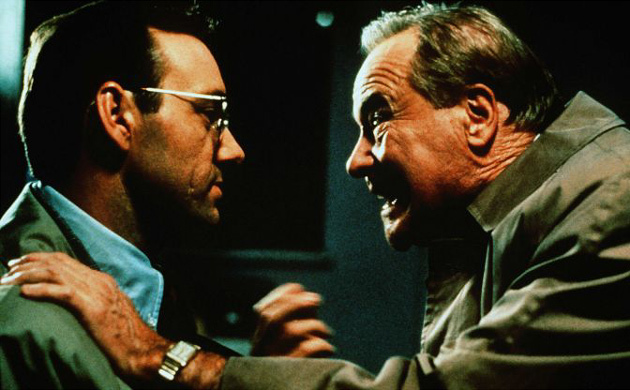
Wallace Stroby:The Usual Suspects (1995): “Half-smart, and nowhere near as clever as it thinks it is. Doesn’t play fair narratively. A piffle of a film, hanging on a single fine performance by Kevin Spacey.”
LITTLE KNOWN FILM WORTH SEEKING OUT
Well, my whole list seems to fall into this category. But for the sake of adding one more—because few joys are greater than discovering something rare you never knew about, but wonder how you missed it:
Cry Terror (1958) Director: Andrew L. Stone; Starring: James Mason, Rod Steiger, Neville Brand, Jack Klugman, Angie Dickinson, Inger Stevens
How, I hear you ask, did a film with a cast like this ever fall between the cracks? Blame the vagaries of corporate distribution. I forget the particulars, though Eddie Muller explained them to me once, but it had something to do with the rights lapsing and the successor no longer existing so no one could assert ownership of the rights to the film—ergo, it languished. Pity. Eddie’s shown it twice at the LA Film Noir Festival, and I saw it on TV when I was a kid. Rod Steiger leads a group of extortionists who kidnap a whole family to dragoon the husband/father (Mason) into their scheme. Neville Brand has never been more sub-humanly creepy (with Inger Stevens in a slip), Rod Steiger scarier, James Mason more haplessly heroic. And Angie Dickinson as the moll: Now there’s a blond you can sink your teeth (or whatever) into.
Good news: The film’s once again available, on DVD, as of September 30th. (I’ve already pre-ordered my copy.)
Other Panelist Picks:
Megan Abbott:Fingers (1978)
Wallace Stroby: One False Move (1992): “Flawless blend of character and action in Arkansas-set crime story about a trio of killers coming home one last time, and a local sheriff (Bill Paxton) who’s in way over his head.” (I totally agree with Wallace on this.)
* * * * *
So, Murderateros—did we miss a crucial film you believe deserved mention? Do you disagree with our logic or our choices? What film would you have fought for had you been on the panel?
* * * * *
Jukebox Hero of the Week: Well, if you’ve gotten this far, you deserve a cookie. To redeem myself just a bit among those who think of Hitchcock as God—and consider me an apostate, a heretic, a heathen for refusing to genuflect before the altar—and to mend a fence with Gar, who listed Vertigo as a romantic touchstone, let me concede that Hitchcock had, among many other virtues, the best scores of any filmmaker of his time, due to the inimitable Bernard Hermann, my favorite composer of film scores ever, and that the love theme from Vertigo is a particular favorite:
As you all know, we here at Murderati do love us some fellow writers. It’s my pleasure today to interview the wonderful Denise Hamilton. Give her a hearty welcome!
Congratulations on the launch of your new book, Damage Control. Tell us a little bit about the book.
Damage Control is a political thriller with elements of surf noir and grrrl noir. (Already an editorial aside. Surf and grrrl noir? Love! – AB)
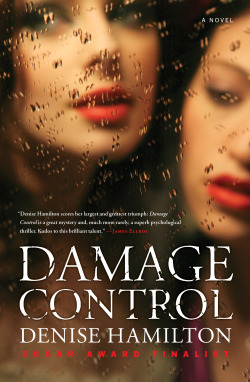
It’s a standalone that introduces a young ambitious PR exec named Maggie Silver. Maggie’s divorced, with an upside-down mortgage and a mom who’s outstayed her welcome as Maggie’s room-mate. As the book opens, Maggie’s just landed a new client – a politician whose pretty young aide has been found murdered. When Maggie walks into the conference room, she’s shocked to discover the client is U.S. Senator Henry Paxton, the father of her glamorous but troubled high school friend Annabelle. The girls had a fierce, intensive, psychologically obsessive friendship in high school but something bad happened on a beach one night that sundered them and haunts them into adulthood. As Maggie defends her old friend’s Dad, she must decide for herself if he’s as innocent as he claims and face the ghosts of a past she thought was long buried.
What’s your favorite recent political scandal, and how should it have been cleaned up?
Oh my, such a smorgasbord to choose from! Well, the biggest jaw-dropper, despite the years of rumors, was definitely the grotesque carnival of Arnold Schwartzenegger’s love child. And I am not sure how you clean that up. I think his people and Maria Shriver’s people actually did a good job on that one. They didn’t speak to the press, other than with prepared general statements. They rode it out, except for Arnold’s cringe-inducing t shirt that said “I Survived Maria.” Way to alienate half the population, dude.
But as a way not to run a damage control campaign, Weinergate is a good case study. Dude should have manned up immediately, admitted everything, begged forgiveness of the public and his wife, then scampered off to rehab ASAP while the PR folks trotted out experts to explain his compulsive exhibitionism and risk-taking as a psychologically addictive disease. The basic rule: Always tell the truth, or at least don’t tell lies, because they’ll come back to haunt you. “Own” your story and always have some comment, because if you don’t, others will. The Internet abhors a vaccuum. I’m sure that some of your loyal readers will take one look at the book’s jacket image and description and think it’s a big change from the noir, atmospheric, Chandleresque, Denise-Hamiltonian novels that first brought them to. Is this really a change from your previous work? And was reader response a consideration when you envisioned your most recent books?
Publishers are always trying new things with book jackets. I really like this cover, there’s an Art Deco feel to it that isn’t all that far from one of Chandler’s – or perhaps Patricia Highsmith’s – psychologically twisted tales. You can tell the two girls on the cover are connected by fierce, conflicting emotional ties. Damage Control is a political thriller with definite elements of noir. I wanted to expand my range, while still staying true to the gritty, sexy and glamorous feel of my earlier books. This protagonist has a family so that’s a departure for me. Maggie’s mom, a cancer survivor, lives with her and I wanted to depict a complicated mother-daughter relationship filled with anger, love, frustration and annoyance. In other words, like real life. But like my other books, there’s also a strong romance (or two!).
If you got to play casting agent, who would play Maggie Silver and Sen. Henry Paxton? Oooh, and while we’re at it, who gets the role of your series character, Eve Diamond?
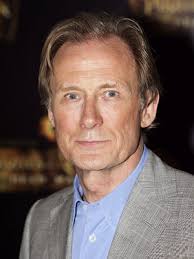
Oooh, I want British actor Bill Nighy for Senator Paxton. And he’s very senatorial, with that high forehead and leonine blond hair. Can you tell I have a wee crush on him!
I assume Denise means this version.
Not this one.
For Maggie Silver, perhaps Kristen Dunst and for Eve, Natalie Portman or Jessica Biehl. But you know, ask me next week and I’ll have other ideas.
Speaking of Eve, do you have any plans to bring her back soon?
I have about half an Eve novel written, but it will depend on what my publisher wants next! I’ve also got an outline for another standalone that I’m excited about. And some readers want me to bring back WWII girl spy Lily Kessler from The Last Embrace, which was my 1949 Hollywood novel. In addition, I’ve got a draft of an urban fantasy novel I work on in my ‘spare time.’ Hah! So there’s a lot to choose from.
You write a monthly perfume column for the LA Times. What’s up with crime writers and fragrance? (Our own Jonathan Hayes is fragrance obsessed as well.)
I didn’t realize there were so many writers who love perfume and vice-versa until recently. I thought I was alone in my secret little obsession. But there’s a whole online world out there. I’m particularly fond of vintage Carons, Guerlains, Diors and Chanels. All the classic French houses. My mom was Russian-French and as a kid, I’d sit in the bathroom, lining up her crystal flacons on the tile counter, spritzing myself silly and acquainting myself with the different notes. Creating perfume is an art form like painting, composing and writing. The finest noses are olfactory geniuses. But the first perfume I got obsessed with as an adult was Donna Karan’s Chaos, which is now discontinued and highly sought-after on ebay. That story became my first perfume column for the LA Times.
You worked for ten years on the staff of the LA Times. I’m often asked whether I’d be a crime writer if I hadn’t worked first as a prosecutor. I know it’s a bit like being asked, “What would you be like if you weren’t you?,” but I’ll ask anyway: Would you be a crime writer if you hadn’t been a journalist? And what’s your best story from your reporting days?
I was always writing stories as a kid, so I think I would have found my way into a writerly profession somehow, but I might not have landed in crime fiction – despite my love for LA’s mid 20th century crime writers – if I hadn’t worked at the Times. I did thousands of interviews, wrote thousands of stories, probably more than 1 million words. Journalism took me into prisons and courtrooms, on police raids, into the living rooms of distraught families, into hospitals and to crime scenes.
As to the best stories from my reporting days, they’re the ones I wove into the plots of my first novels: the immigrant Chinese kids living alone in big mansions or running with youth gangs in The Jasmine Trade, the teenaged girl who was murdered by her street kid boyfriend in an abandoned building, the wealthy tourist family who arrive at LAX with a little girl who’s being smuggled into the U.S. for nefarious purposes. Those were all ripped from headlines of stories I wrote in my 10 years at the Times. It was a wonderful training ground for a writer and a gold mine of raw material.
About a billion years ago, you, David Corbett, and I spent a few days in London together with a handful of other writers for a joint launch of our first novels published in the UK. That would have been January of 2004. I had met my now-husband only two weeks earlier, and you and Corbett were very generous to listen to me gush about him. That was before my Duffer was born. How has your life changed since then?
Oh my! Yes, I remember you lit with a romantic glow as you described him to us. I’m so very happy it led to a life together (raises virtual champagne glass).
That was a wonderful tour, it was so much fun to hang out together, to talk books and eat yummy meals and hang out at the bar and visit with Val McDermid and Mark Billingham and the Orion folks. It’s hard to believe so much time has passed. But my kids are 13 and 15 now, a bit easier to leave at home with Dad when I go on tour. We’re animal lovers here too, by the way. Two saucy, spoiled cats and a young blue-eyed husky-mix named Sirius White (he’s got white fur, so definitely not a Sirius Black! But he’s quite the dog star!).
How can readers get in touch with you if they want to continue hearing from you year-round? Are you a Facebooker? Tweeter? What are your thoughts on how social networking fits into a writer’s life?
I welcome readers to write and friend me on FB. And I’m DeniseHamilton_ on Twitter, which I find a lot of fun, and a great way to convey news, musings, links to interesting stuff and just pithy bursts about what I’m up to. I’m always amazed at what gets the most comments, like a recent post with pic I wrote about making apricot jam. I do think that pics are important, I know my eye is drawn to them in the posts of others.
Social media is a great way to keep in touch with readers and other writers too but one also has to maintain the discipline to write. For me that means a separation of church and state. Since I’m a morning person, for me that means doing the creative writing in the morning, then moving into answering email and doing social media once I feel like I’ve punched the fiction clock. Of course life is messy and these boundaries crumble regularly, but we’re talking aspirational.
Thanks, Alafair, for inviting me to guest at Murderati. I also appreciate your smart and incisive questions. No wonder you were such a great prosecutor.
Thanks, Denise, for being a terrific guest!Denise will be checking in throughout the day to respond to your comments. She’ll also send a copy of DAMAGE CONTROL to one lucky commenter.
Denise Hamilton’s crime novels have been finalists for the Edgar, Anthony, Macavity and Willa Cather awards. She also edited Los Angeles Noir and Los Angeles Noir 2: The Classics, which spent two months on bestseller lists, won the Edgar Award for “Best Short Story” and the Southern California Independent Booksellers’ award for “Best Mystery of the Year.”
Her books have been BookSense 76 picks, USA Today Summer Picks and “Best Books of the Year” by the Los Angeles Times, the South Florida Sun-Sentinel and the Toronto Globe & Mail.
Find out more about Denise and read an excerpt of DAMAGE CONTROL over at her website, here.
St. Louis has a much prettier downtown than I ever would have guessed. Great architecture.
However, all the women dress like 1980’s hookers at night (just agreeing with Greg Hurwitz, there).
All male authors would give it up (writing) in a heartbeat to be rock stars (Mark Billingham).
Always keep asking for the hotel you really want and you’ll get it (the suites were dreamy.)
The world may be crumbling but people are still reading my books and happy to see me.
Always be aware of readers hovering who are too shy to talk to you unless you make eye contact and smile or sometimes walk right over and pull up a chair.
Never, ever miss a panel that Val McDermid is on. You will always get the best writing advice and the best laughs of your life.
Ditto Harlan Coben.
There are good moderators, stellar moderators (Tom Schreck, Hank Philippi Ryan) and moderators who should never be let near a microphone, let alone called upon to moderate.
And: it is the panelists’ responsibility to take control of the panel if they are so unfortunate as to end up on a panel with a bad moderator. We owe that to the audience.
There are few thrills as great as being up on a panel and seeing people in the audience pull out their Kindles and order my books as I’m speaking.
There will always be one day that the hotel is so cold it will take the rest of the conference to thaw out. Not bringing a coat is suicidal.
If you wait long enough, misogynists do accrue a critical mass of fury and bad karma and get their comeuppance.
Always go to the one-on-one interviews.
Always go to the heavy-hitters panel.
It’s sad when Lee Child isn’t there.
If I were casting Ridley Pearson it would hands-down be Tom Hanks.
I’m not the only one who is outraged that anyone could hold Lisbeth Salander up as this feminist heroine when the first thing she does in the second book is get a boob job to feel better about herself (Thank you, Karin Slaughter).
Nothing makes me happier than seeing teenage girls so into reading.
There is no better place to meet British men.
Weather.com lies.
You will always get EXACTLY the information/information/kick in the ass that you need (thanks, Harlan).
There is no better way to find new favorite authors. (Last year, RJ Ellory, the year before, Mo Hayder, this year I suspect it will be Colin Cotterill and Simon Toyne. Yes, I love those Brits.)
Steve Schwartz would rather go to Ireland for 3 weeks than to St. Louis for four days, even though ALL HIS FRIENDS WERE THERE.
I might move back to San Francisco just to hang out with Michelle Gagnon, Sophie Littlefield and Juliet Blackwell.
I need to go clothes shopping with Rae Helmsworth and Maddee James.
If you set an intention to meet someone, they will walk up to you in the bar and start a two-hour conversation.
If you don’t, you’ll meet someone just as great.
There are not enough hours in a day.
Even if you feel near death you can still achieve major enlightenment by half-sleeping in panels and letting your mind drift to your book.
Be that as it may, I will never make it to an 8 a.m. panel that I am not actually on.
Not just me, but everyone I know in this community pines for a recreation of the first Thrillerfest. That would be in Phoenix, people. PHOENIX.
Sex happens. (Okay, I knew that.)
It majorly sucks but is also strangely comforting to hear from Those Who Know that writing is just hard. Hard, hard, hard. And it never gets any easier. But at least we’re not suffering alone.
I would rather dance than eat.
However, if you want to eat well and laugh lots, follow JT Ellison.
We owe Judy Bobalik, Ruth Jordan, and Jon Jordan more drinks and massages than we can possibly pay out.
Mystery authors have the greatest life on the planet.
I love you guys.
Never, ever miss it.
————————————————————————————
Of course, my question today is – What did YOU learn at Bouchercon? Or give us a few gems from other cons. We can create our own McGuffey Reader, right here.
My first novel, Boulevard, would not be what it is if I hadn’t discovered Miles Corwin’s brilliant nonfiction book Homicide Special. As a crime reporter for the Los Angeles Times, Miles was given unprecedented access to the elite Robbery-Homicide Division unit of the LAPD where he spent a year of his life shadowing the homicide detectives on their daily call-outs. Homicide Special became my Robbery-Homicide bible and by the time I finished writing my novel I had read Corwin’s book at least five times. His writing is so lean and vivid that I jumped at the chance to read his other nonfiction books, The Killing Season and And Still We Rise.
All of his work captures the daily lives of hardworking detectives, cops, teachers and social workers as they navigate a dark, uncertain world few of us will ever observe first-hand. Miles brings you to the heart of it. His prose is fantastic and he knows his stuff. When reading his nonfiction work I thought that if this guy ever tackled fiction he’d be one of the best. Well, he’s done it. His first novel, Kind of Blue, came out last year to rave reviews. And, as I suspected, his novel leans heavily on his experience with the Robbery-Homicide Division. I was fortunate enough to share the dais with Miles and Marcia Clark recently on a panel at the Los Angeles Times Festival of Books and I loved hearing him talk about his journey from journalist to nonfiction author to fiction author. He’s a fascinating and talented man and you’re going to love getting to know him. Please welcome Miles Corwin…
The day I received permission from the LAPD to write a nonfiction book about the elite Homicide Special unit was the day I began thinking of writing a novel.
The chief of police agreed to give me complete access and allow me to shadow the detectives from the time they received the homicide call-outs, to crime scenes, death notifications, autopsies, witness interviews and, finally, to arrests. I knew this was a remarkable opportunity to write a compelling nonfiction book, but it was also a great opportunity for a crime novelist. During the year I tracked the detectives I always carried two steno pads. On one pad I took copious notes for the nonfiction book – Homicide Special.
On the second pad I jotted random notes for a crime novel I intended to write – Kind of Blue.
I included amusing dialogue, humorous anecdotes, unusual things I saw at crime scenes, mannerisms of the killers and the cops, or anything else that I thought would give a crime novel a sense of verisimilitude.
During the course of that year I had lunch every day with homicide detectives and listening to them swap stories was also a great source of material. I stole a few of those anecdotes and reshaped others. One detective said that when he worked Hollywood Homicide, he’d frequently get a call in the middle of the night, awake from a deep sleep, pick up the phone, and always hear the same question: “Are you naked?”
It was a supervisor’s greeting before he dispatched the detective to a homicide scene.
I filed this away and figured this could provide a light note in a dark novel.
By the end of my year with the unit, I had filled numerous notebooks with material. I had a lot of ideas about plot and dialogue and forensics, but I still didn’t have a main character – the most important element of any crime novel.
One morning, the great crime novelist James Ellroy arrived at the unit. He was researching a cold case for a GQ magazine article. Ellroy took a group of detectives to lunch at the Pacific Dining Car near downtown Los Angeles and I joined them. Ellroy, a terrific raconteur, told us he’d been arrested a number of times as a young man. One night, he said, he was busted after breaking into an apartment and he happened to look at the metal name plate of the LAPD cop who was handcuffing him. The cop’s name was Moscowitz. Ellroy said that he thought to himself at the time, “What’s a Jew doing as a street cop?”
I thought this was an interesting question. And I figured if this question intrigued Ellroy, it might interest readers. So I decided that my protagonist would be a Jewish detective. This clicked because I’m Jewish and I got to know a few Jewish cops during my year at Homicide Special. One told me that when he graduated from the police academy, all the other families seemed so happy and proud of their sons and daughters. His family, he said, was not particularly pleased. I thought this was interesting and could provide some good conflict in the novel between my main character and his family, particularly his mother.
I now had everything I needed to begin the novel. I was faced, however, with a great challenge. In some ways, I felt I was hamstrung because I knew too much. I discovered that much of detective work is, frankly, boring – examining records, perusing documents, tracking down witnesses, sifting through forensic reports, and other elements of the paper chase. A novel dominated by this kind of detective work simply wouldn’t interest readers. So I had to find a way to keep the book realistic, but insure that the narrative was compelling enough to keep readers reading.
When I started writing Kind of Blue, I felt a bit insecure because I had never published any fiction. But I also realized that I had a great advantage over most crime writers because I had a fount of specialized knowledge to draw from. I had worked as a crime reporter for the Los Angeles Times for a number of years. And before writing Homicide Special, I spent six months following two homicide detectives in South-Central Los Angeles for the nonfiction book The Killing Season. I learned a tremendous amount from the two detectives, Pete Razanskas and Marcella Winn, and I was able to transmogrify some of their knowledge and experience into passages for my novel.
Most reporters believe there is no such thing as too much access. I discovered that there is a downside to an abundance of access. When the Homicide Special detectives began investigating the murder of Robert Blake’s wife, I was with them every stop of the way. At the time, this seemed like a serendipitous opportunity. During the trial, however, when I was cross-examined by Blake’s attorney for more than five hours, and he tried to use me – unsuccessfully, I believe – to sully the reputation of the LAPD, I had second thoughts about the access I had pursued. But after writing Kind of Blue, I realized that being grilled in a criminal trail by a defense attorney, just as the LAPD officers had been, provided me with more insight into what detectives endure, insight that I could parlay into realism for my fiction.
Corwin, a former crime reporter for the Los Angeles Times, is the author of three nonfiction books: The Killing Season, a national bestseller; And Still We Rise, the winner of the PEN West award for nonfiction and a Los Angeles Times Best Book of the Year; and Homicide Special, a Los Angeles Times bestseller. Kind of Blue is his first novel. The next book in the Ash Levine series, Midnight Alley, will be released in April 2012.
Corwin lives in Altadena with his family and teaches at the University of California, Irvine.
(Please give Miles a hearty Murderati welcome. I am still traveling overseas and will do my best to pipe in with comments in-between stops)
I was intending to write my blog this week about going to the Bouchercon World Mystery Convention in St Louis, but in thinking about the whole trip the theme of it gradually developed into something else.
An exploration of courage and fear.
That might seem like quite a leap, from a convivial gathering of authors to questioning what scares the bejaysus out of you, and how you get past that feeling, but it kept coming up.
To begin with, we landed in Chicago and spent nearly two hours getting through Immigration. Why? Fear. Fear of letting someone into the country who might be undesirable, who might be unfriendly. Fear of letting the wrong one slip through unnoticed.
Our first morning in Chicago, Andy and I, and fellow Brit author Anne Zouroudi went up what used to be the Sears Tower but is now the Willis Tower, to the observation Skydeck on the 103rd floor. Since the last time we went up to the Skydeck, they’ve built four glass boxes that extend four feet out from the side of the building and allow you to step out onto nothing and look straight down to the tiny toy cars and people in the street below.
After the initial leap of faith, as it were, it didn’t bother me. And especially once you put a camera in my hands. Somehow, the act of taking pictures steps you outside what’s happening, makes it not hard to understand how war photographers and camera operators put themselves in danger. As soon as you look through the lens, you’re somehow disconnected from what’s happening through the viewfinder.
After this we rewarded ourselves with a Food Tasting & Cultural Walking Tour of Chicago’s Bucktown and Wicker Park districts, once fairly infamous neighbourhoods but now gentrifying rapidly, although there was still some very entertaining lawn art to be found.
As well as gorgeous food, it was a wonderful way to see some of the architecture of the area. And because the culture was slipped in amid the culinary treats, we swallowed it all just as eagerly. Plenty of lessons on how to painlessly include backstory to be absorbed there . . .
Anyway, we started off at George’s Hot Dogs for authentic Chicago hot dogs – no ketchup, if you please:
Then to Hot Chocolate for the most superb hot chocolate drink I’ve ever tasted, plus homemade marshmallow:
Not to mention the cakes on offer at The Goddess & Grocer.
Plus the ice cream at iCream, where liquid nitrogen creates instant any-flavour frozen deserts.
That makes it sound as if there was no savoury element to the tour, but that wasn’t the case. We also took in the Piece Pizzeria and Brewery, and the Sultan’s Market Middle-Eastern Deli and Store, but I was much too busy eating to take pictures at this point.
But I digress. On the Wednesday evening, I took part in an event at Lisle Library in Chicago, hosted by the delightful Patti Ruocco. As well as the usual talk and Q&A, Patti also asked me to do a self-defence demonstration, for which she kindly provided some plastic training daggers. As we were flying out to the States the day after the tenth anniversary of 9/11, I decided that trying to bring my usual rubber knife through Customs might not go down too well.
Anne very kindly volunteered to be my Crash-Test Dummy for the evening, and we went through a few knife defences and escapes from strangleholds. And again we are back to fear, and how to avoid being paralysed by it so that you are unable to act, unable to defend yourself with any degree of success. Even against a cake with attitude:
Then it was on to Bouchercon, via a brief stop in the wonderfully named Normal, Illinois, for breakfast at a traditional Mom & Pop diner – Uncle Tom’s Pancake House & Restaurant:
Of course, some people find the prospect of appearing on panels at such an event absolutely terrifying. It makes them physically sick. The only thing that’s ever bothered me is the possibility of nobody turning up. And as soon as I know we have an audience, I’m fine. Having a signing line is even better, because somehow that means that whatever I said on the panel did not completely alienate my potential readers!
It’s been a couple of years since I was last at Bouchercon, and it’s only when you go back that you realise what you’ve missed. It was just so nice to bump into friends, old and new, to sit and chat about books and writing and the business itself. I never fail to come back from B’con raring to get on with the latest project, and this was no exception.
But there is always a certain amount of fear underlying the work. Is it good enough? Will people ‘get’ it? Will they either love it or hate it, or will it just be yet another ‘OK’ read. Fear of failure seems to be a motivator with every writers, published or unpublished. And the few that don’t appear to suffer from any kind of self-doubt? Well, maybe they should . . .
For us, though, a visit to the States is never complete without firearms. I’d put a ‘Have breakfast and go to the gun range with Zoë Sharp’ lot into the charity auction, so we went to check out Top Gun Shooting Sports in nearby Arnold, Missouri. We took Anne with us, as well as other Brit virgin shooters Russel D McLean and Chris Ewan, plus Bouchercon Albany (2013) organiser Al Abramson, Blake Crouch, and his cover designer, Jeroen Ten Berge.
Without naming names, not everyone was as happy about getting up close and personal with genuine firearms as perhaps they thought they might be, while others grew horns and came out with big grins on their faces. It’s one case where a healthy fear and respect for what you’re doing is definitely a Good Thing.
For those who were unable to get to the range, Beth Tindall from Cincinnati Media had contacted a friend, Arbon ‘Doc’ Hairston of Fair Warning Systems, who runs firearms training simulators for law enforcement. Doc brought along various semiautomatics, revolvers, and even a pump action shotgun, along with training simulations that he uses to teach people when to shoot and when not to shoot. The guns are real, but hooked up to CO2 to work the action and provide a certain amount of recoil. A lot of fun was had by all who had a go, but somehow the fear factor was missing. Not difficult to see how kids brought up on video games have lost any respect they might have had for the dangers of real weapons.
In the charity auction, Brit crime fan Lesley ‘Mitchy’ Keech was the winning bidder, and as she wanted to attend the Bouchercon Sunday brunch, we arranged to take her for breakfast and to the gun range on the Monday morning after it was all over.
We also took fellow Brit thriller writer Matt Hilton with us. He agreed that, after firing the simulator, firing the real thing was a whole different ball game.
I tried to instil the basics of gun safety into Mitchy, starting off with only one live round in the chamber so she could get used to the feel and the noise of it, and giving her a good solid stance to shoot from. We let her try various SIG, Glock and Smith & Wesson 9mm semiautomatics, and also a couple of .357 magnum S&W revolvers. And finally they brought out an MP5 submachine gun, and she put a full clip through that, beginning on single shot and moving up to full auto. Those targets were definitely not getting up again!
I hope we made the experience fun without causing too much fear beyond just the right amount. After all, without the rush of endorphins (endogenous morphine) released by the pituitary gland and hypothalamus during periods of excitement, stress, or danger, how do we know we’re really alive?
On the Monday afternoon, we went up the Gateway to the West – the St Louis arch. An amazing feat of engineering, with an ingenious elevator system to get you to the cramped viewing area right at the peak of the arch. And as we rode up there, I could only think of all the people we knew who would completely freak out at the experience, first of the confined space, and then being over 600 feet off the ground.
But if something doesn’t particularly scare you, then doing it involves no courage. Or does it?
So, ‘Rati, if you went to Bouchercon, did you have a great time? Did you go up the arch?
And what was the last thing you did that really scared you?
For me, the answer to the first question is, “Hell, yes!”
And the answer to the second is going on the Bomb Bay water ride at Wet ‘n’ Wild in Orlando Florida a few years ago. (And I’m talking squeal-like-a-girl-scared here.) You climb about eight storeys up, stand in a cylinder shaped like a cartoon bomb, which they winch out over a narrow chute filled with running water. They leave you there for an agonising few seconds, then a floor drops away and you PLUMMET down the chute until it levels out at the bottom and the force of the water being squeezed into places you don’t even want to think about, brings you to a stop.
Once was enough.
This week’s Word of the Week is horripilation, which means a contraction of the cutaneous muscles causing erection of the hairs and gooseflesh. The correct word for when all your hair stands on end. From the Latin horrere to bristle, and pilus, a hair.
One last thing. While we were away, my Twitter account was hacked, so please be careful about following any dodgy links that don’t obviously come from me. We also had problems logging on to Gmail, as it didn’t like the fact we weren’t at our home computer. So, apologies for any delays or confusion.
Warning: This post contains a somewhat whimsical graphic of an active penis.
Here’s some simple advice: when you live in the Greatest City on Earth, never leave it.
Never go on vacation. Never fly somewhere to meet someone you met on the Internet, no matter how incredibly hot they are. Refuse all invitations to weddings and funerals. If you get the urge to leave, lie down and order Chinese for delivery.
The honest truth is that no good can ever come of leaving the earthly Eden that is the island of Manhattan.
However. If you absolutely must leave the island, the annual Bouchercon crime fiction festival is a fantastic reason to go. What’s not to love? A couple thousand bloodthirsty readers, writers, agents and publishers marooned in the middle of an unfamiliar city is a surefire recipe for hilarity. Oh, the days start off innocently enough – friends hugging, a Who’s Who of international crime fiction doing panels and interviews, hilariously awkward authors having “casual chats” with fans, that sort of thing. But after dark, the event transforms into something dark and glittering – if you’ve seen the grainy snapshots and Paris Hilton nightvision-style cellphone videos taken in the hotel bars starting around 2 AM, you’ll know what I mean. Really, this conference should be called Debauchercon.
I’m sitting in St. Louis Airport, on my way home after B’con11. O St. Louis, City on the banks of the mighty Big Muddy! How you have abused me! It wasn’t the conference – Bouchercon was as great as ever. It wasn’t your citizens, charming and polite to a tee. It wasn’t the packed hordes of fundamentalist Christians in my hotel, surging through the halls and elevators of my hotel in a tsunami of sensible clothing and “Love Life” badges (even though my neighbors did insist on rising at the crack of dawn – every. freakin’. day). Your streets are handsome, your Downtown has some of the best-looking old skyscrapers and covetable factory spaces I’ve ever seen.
It’s your food. And I know that you can’t judge a city’s food by its Convention District fare – if you visit NYC, and eat only in the Times Square/42nd Street area, you’d probably eat pretty poorly too. But by God I had some appalling swill here!
The gold standard seemed to be the sort of cuisine generally served heaped on platters in front of the TV on Game Night: battered, fried to a crisp, dipped into Ranch dressing mix blended with mayonnaise and blue cheese. Never before have I seen such liberties taken with produce – hey, chef who came up with“Fire-roasted artichoke hearts, served with sweet chili sauce and chipotle sauce”? They’re putting together a tribunal in the Hague to investigate your kitchen crimes.
What’s so frustrating about this was that there’s clearly good food to be had. The town lies on a river in the middle of fertile plains, surrounded by vegetables and some of the country’s best pigs. There’s no need for everything to be a variation on Buffalo chicken wings – that’s what Buffalo’s for!
The wrongness of this state of affairs was proved by dinner at Niche, where the food was so good I almost wept. The maple custard with roasted chopped porcini mushrooms and a dashi “caviar” was one of the few validations of this whole vogue for making little membrane-clad spheres of liquid, and the Jonah crab appetizer (crabmeat, flaked pink grapefruit, shiso leaf, mint, avocado panna cotta and shards of cocoa glass) was revelatory. The ingredients are there, and the cooks are there, too – Niche chef Gerard Craft has said that there’s a thriving food culture there, with serious cooks and fantastic food blogs; given the culinary wasteland that was downtown, I’m sure he’s right, since people here must be forced to fend for themselves.
Gerard Craft of Niche:
Of course, I’m exaggerating wildly (not about Niche, though, which is excellent), but, still: too often the food across this great land of ours looks right, but is miles away from tasting anywhere near decent. The word “fusion” has been used to justify some of the worst atrocities of this young century; if you don’t know how exotic flavours go together, why not work with the flavours you do know? There’s nothing wrong with American food – and so much right with American produce! Or buy a copy of Dornenburg and Page’s excellent Culinary Artistry, which clearly outlines which foods go well together, and (just as importantly) which are in season at any given moment.
Bouchercon is always a fantastic conference – tightly plotted and elegantly executed. I spent quite a lot of time hanging out with Chevy Stevens, who is as wonderful as she is Canadian. It was her first B’con, my third, but we agreed: for authors, at some level, it’s a bit like high school. There are all sorts of competing hierarchies, some based on obvious metrics (book sales and fame, mostly), others on less readily quantifiable criteria (coolness, edginess, connectedness, attractiveness). The bar where the authors gather is like a lava lamp of cliques, clots of friends and colleagues forming, gradually budding off other little blobs which then merge to form new, bigger blobs.
I don’t mean to imply that it’s ruthless or exclusive – on the contrary, it’s actually a pretty friendly bunch, particularly if you can prove your worth. And even if you can’t, most of the authors I know are pretty good about supporting newer writers.
But there’s a very clear sense of who’s made it and who hasn’t, and all sorts of confident assertions of advances and sales and print runs for this guy’s or that gal’s books. The talk is often fairly gloomy these days, with authors worrying about declining advances and print sales, and how to negotiate the ebook market. This is one of the reasons it’s kind of nice to hang out with the best-selling crowd, for whom life seems to be an endless series of expenses-paid readings in Amsterdam, Rome and Mumbai, options moving quickly into production, or how a new Twi translation means that their sleuth can finally reach the Akan people of Southern Ghana.
I was on three panels. The first was a forensics panel, with Jan Burke, Marcia Clarke, Stefanie Pintoff and Doug Starr, ably chaired by Leslie Budewitz. There was a decent crowd, and the discussion was vivid and spritely, with Marcia talking about how hard she had to push to get blood on OJ’s socks tested for DNA, and me trying delicately to explain that the OJ Simpson trial was one of the best things to happen to forensic science in the last century, since it caused us to radically tighten procedures for obtaining, securing and storing forensic evidence.
The music panel – Mark Billingham, Roger Ellory, Brian Glimer, me and Rochelle Staab, with Wallace Stroby cracking the whip – was altogether more rollicking. An enjoyable portion of the session was spent dissing the music of Phil Collins, and, eventually, Paul McCartney, comme il faut. Actually, the Macca stuff wasn’t so much a diss of the music (anyone who hates Band on Run is a bad person) as a diss of the man himself. There was music love aplenty, and some feisty Brit-on-Brit badinage (between Mark, Roger and myself, there were enough Englishmen to start shifting that Boston Harbor tea back up into the boat), but at the end of the day, it was a bunch of middle-aged white people sitting around talking about music, which only gets you so far before the nostalgia begins to clot thick and lumpy.
The next day I signed with Joe Finder at the Crimespree booth. The wonderful Denise Hamilton, celebrated noir author and LA Times perfume columnist stopped by with perfume samples, at which point I learned that Joe, too, is a scent aficionado – he’s even friends with Luca Turin, the brilliant sense scientist and perfume critic, a personal hero.
Some weeks back, Denise had introduced me to the Perfumed Court, a kind of samizdat distributor of perfume samples and decants. I try consciously to develop my sense of smell – something I’ve done since my food writing days; my interest is mostly in smelling things analytically, rather than in perfume. I collect essential oils, but my attempts at perfumery have mostly served to remind me how gifted real perfumers are (like the amazing Swiss parfumier Andy Tauer – if you can, try and find his L’Art du Désert Marocain, a heady exotic, warm with coriander, rock rose, jasmine and cedar).
I went a bit wild at the Perfumed Court, buying about 20 different samples, of which the most interesting was Sécretions Magnifiques. A succes de scandale from the punkish French perfume house l’État Libre d’Orange, SM is inspired by bodily secretions – breast milk, blood, semen. Denise had pronounced it “unwearable”, so I ordered it immediately. But the sample I’d received wasn’t at all offensive – it was powdery and dry, and smelled quite nice when my friend Jill modeled it for an evening. So I’d asked Denise to bring some of her official sample to B’con just to make sure I’d got the right thing.
Sitting at the booth, chatting with Joe and the occasional passerby, all was fine and dandy. Denise arrived with her little sack of product, and I wasted no time dousing myself liberally with the magnificent secretions. Both arms.
And that was when my troubles began.
Within seconds, notes of half-cleaned fish bones, curdling milk and blood-spattered abattoir floor swum around me, underneath them a dank plateau of metal, stale sweat and flesh fold grime. I was near-gagging as the smell intensified; it occurred to me that the perfume was a synthetic, and that it would be impossible to scrub off. I leapt to my feet and lurched through the hallways to the men’s room, spent 10 minutes washing and soaping and scrubbing, my arms shocked pink, my head spinning with nausea as I tried to sluice the vile syrup from my skin.
It may have been post-traumatic stress, but for the rest of the day I kept getting Magnificent Secretions flashbacks.
Nonetheless, the afternoon was fun. Maddee James, who designs web pages for many in the mystery community, gathered writers up for a game. The audience was small, but select, including power book bloggers Erin Mitchell of In Real Life, and Chantelle Aimée Osman of Sirens of Suspense. Let’s see: Brett Battles, me, Will Lavender, Boyd Morrison, Stefanie Pintoff and Eric Stone all played this game where Maddee gave us a book title and author eg James Lee Burke’s Rain Gods. We each had to write what we thought would be the first line. All the first lines – including Burke’s original – were read to the audience, who had to guess which was the real one.
It sounds a little involved, but it was actually pretty simple, and really hilarious, mostly because the participants were so funny. My favourite line was Eric’s, for Rain Gods, in fact. It wasn’t the entire sentence so much as his creation of the phrase “displaced Vietnamese shrimper woman” that just killed me…
After that, my panel obligations were done, so I hung out and schmoozed, in the tremendously inept way in which I “schmooze”. I spent a lot of time saying hi to people, including finally meeting David Corbett and JT Ellison and Zoe Sharpe, among the Murderati. I hung out with old friends, made some new ones and caught a few panels. There were so many great authors there, but I’m trying to work on my new book, so I limited myself to buying just three books, picking up Will Lavender’s Obedience, and John Rector’s The Grove and The Cold Kiss. And I have a list of other people I want to read. We’ll see.
Anyway, all in all it was a great Bouchercon.
And in truth, I even enjoyed the bad food. Something one of my old girlfriends never quite understood was that an appalling meal is much more satisfying than a mediocre meal, since then you get to really tear it apart.
Anyway! Another sprawling post from me. David Corbett, if you’ve made it this far, I owe you another drink. I was ready to pay out in St. Louis, but you were all over the place! Next time, buddy.
Anyone else have any Bouchercon reminiscences they’d care to share with the class?