Author Archives: Murderati Members


MAGICAL OPTIMISM

by Stephen Jay Schwartz


First of all, I want to thank Murderati for delivering Indonesia. I never know what’s going to come from writing this blog. Those three hours I spent on a bus with James Ellroy came after someone read my blog. I was invited to teach at the Omega Institute in New York as a result of my posts on this site. Through Murderati, I’ve been invited to contribute poetry and essays for publication and speak at conferences and workshops. But, until now, I had never been handed a country.

It seems my last blog, Synergy, was re-posted on various Facebook walls across Indonesia and now I have twenty-five new Indonesian Facebook friends. I don’t know if any of them have read my books, but they’ve all read my blog. So – thank you Murderati, thank you Internet, thank you Facebook. Whatever comes of the rest of my career I will always know this–there was a day when I was big in Bali.

That said, I’ll return you to our regularly scheduled post.

Magical Optimism…

My eleven year old boy opens his eyes and sees the world he wants to see and magically it is there. I remember I was once like that, when I was a boy younger than his years. The magical optimism slowly faded as I encountered adults who knew better, men and women who’d correct me when I was wrong. As the years advanced I grew up to become an optimistic realist, but a realist none-the-less. Although it is easy to slip into the slough of the cynic, I’ve generally fought to keep a “glass half-full” attitude.

My son re-booted my operating system recently when two things occurred.

Thing One: Noah’s favorite flower is the bright yellow sunflower. My other son, Ben, saved a couple seeds from destruction and planted them and they sprouted. Their little green stems grew and dangled and needed help and I convinced Noah, who had taken over the project, that we should tie their little vines to a tongue depressor with a fuzzy little pipe-cleaner from his arts and crafts supply kit. He trusted me (I’d taken a class called Greenhouse Management when I was in high school, which was really the slacker’s way out of taking Biology II) and I tied one of the nascent plants to the wooden stick and just about broke it in two.

The plant was a goner. I’d broken it in such a way that just a sliver of green connected the top to the bottom. It was only a matter of time before it would turn brown and shrivel up like a sun-stroked earthworm. I put a little Scotch tape around the break and prepared my son for the worst.

“It’s not going to make it, I just want you to know.”

“Maybe it will,” he said.

“I’ve lived a lot longer than you, kid, and I’ve seen things. Experience tells me that plant is going to die.”

“I’ll just keep watering it,” he said.

And sure enough, somehow, that plant sprang a sliver of green glucose cells and built an elbow to tie the two halves together. Now this little plant has grown thick and strong and healthy. It continues reaching for the sky today. In all my year of Greenhouse Management I never saw such a miracle.

At approximately the same time, Thing Two occurred.

Thing Two: While cleaning our fish bowl I accidentally let the fish (a beta) fall into the sink among the dirty dishes and general scum. I tossed the dishes to the floor, yelling, “Shit! Shit! Shit!” until I’d found the flopping creature and, after several tries, grabbed and tossed it back into the fish bowl.

Experience told me this story wasn’t going to end well for the kids.

Sure enough, a couple weeks later the fish developed a brown scab on the left side of his body. A couple days after that the scab appeared on the right side as well. It took another day for one side to eat into the other, creating a gaping hole.

There was a hole in our fish.

Experience told me this was not a good sign. The hole grew larger in the coming days and soon the fish stopped eating.

“I’m sorry, Noah, but this doesn’t look good. I think you should say your goodbyes.”

“Don’t give up,” he told me. “We can save his life.”

“I don’t know, I’ve lived a long time and I’ve seen things. My gut tells me it’s time to pull the plug.”

Taking a stab in the dark I suggested that maybe the local pet store had something to “fix the hole.” Sure enough, my son came back with a bottle of what I considered to be voodoo googlygock with instructions to add ten drops to the bowl, twice daily. We began treatment immediately.

The substance seemed only to blacken the water, creating a charcoal haze in which our fish would spend his final days. And the hole remained. I mean, I could see the toaster oven through the fish. I was surprised the thing had lasted this long.

And then the fish began to eat.

Days later Noah said that the hole was growing smaller. Ah, life through the eyes of a child, I thought as I peered down to study the beta. But he was right, the hole was smaller.

It’s been a month since this thing began and the hole is nearly gone. The fish, which was old to begin with, is older still, yet appears as healthy and playful as a young fishling. Maybe the playful part is my imagination talking, but he sure looks fit.

The point, if I may return to the purpose of writing this blog, is that my “realism” was really cynicism in disguise. If I had gone with my instincts, i.e. my experience, I would have seen that sunflower sapling strangle our fish in a whirlpool of toilet water as they made their way to the city sewer. I would have euthanized them to save myself the trouble of watching them die slowly, over time.

I didn’t know there were any other options. An eleven year old boy told me there was.

I think these two occurrences illustrate the fact that we occasionally need a paradigm shift. In my case, I needed to adjust my concept of what is and isn’t real. The way I lived my life had been tainted by negative experiences I accepted as truth. Noah did not have those experiences and he was strong enough to resist them when I suggested they were universal truths.

Maybe optimism is just a way of seeing life as it should be, and then participating in its positive outcome. Maybe a person’s good fortune is anchored by his positive attitude.

My boys will encounter great struggles in their lives. It’s unavoidable. They’ve already experienced the loss of their home. The negative effect this has had on their personalities has thus far been minimal — they veered toward the positive. Life in an apartment isn’t tough, it hasn’t stopped them from doing the things they love, like hanging out at the beach and enjoying their music and art classes. If anything, it’s removed some stress from my life, which removes stress from theirs.

I hope their optimism continues to flourish. I hope the people they encounter, the ones who thrive on gossip and negativity, won’t have an impact on their development. And I’m glad as hell my boy was there, like a young bodhisattva, to teach me the ways of the world.


To Finish First . . .

Zoë Sharp

August 2011 will go down in my diary as being the month of a lot of firsts. And I’m not talking about the first UK riots for years, either, although what’s happening over here is shameful and I feel I should be apologising on behalf of all the people who have not nipped out armed with a balaclava and a brick to get themselves a new free iPad. I tweeted last night that ‘Nothing quells a riot like rain. No rioting in Cumbria tonight then . . .’

Which brings me back to those firsts. Personal firsts. I’ve finally got myself on Twitter. Somebody – in fact, let’s face it everybody – told me it would be a huge time-suck. They weren’t kidding. I opened my email to find a chunk of notifications, and the faster I tried to go through and deal with them, the faster more of them kept popping into the Inbox. Eventually I had to give up and go and lie down in a darkened room.

And because the words ‘biting off’ and ‘more than I can chew’ are generally quite relevant to me, and because I never like doing things the easy way, I’ve also just opened up a couple of pages on Facebook, too. A personal page and an author page. Don’t ask me why I’ve got two. I think one might have been an error, and when I’ve got the hang of things, I might try and sort that out.

And in the middle of all this, I’ve launched my first eBook. Of course, I already have several of my Charlie Fox series out in e-format, but those were all taken care of by publisher, Allison & Busby. This is the first time I’ve had to think about everything that goes into a book from the title page to the meta-data. And the cover.

My brain is dribbling out of my ears and has been doing so for most of the week.

Looking into eBooks has been a huge subject, and I’m hugely grateful to all the people who allowed me to pick their brains while we’ve been wading our way through the sludge of disinformation out there. And oh boy, let me tell you, there’s a lake of confusion and opinion, much of it just plain wrong.

Eventually, though, we’ve managed to fight our way through, up to our necks in it and holding our noses, and develop a workable system for putting in a Word doc at one end and coming out with an eBook at the other. And when I say ‘we’ basically I mean my Other Half, Andy. Before I know it he’ll be drinking Jolt cola and snowboarding . . .

At the outset, we were told to farm out the conversion process, but never one to take the path of least resistance, Andy decided it was something he wanted to get into, and he has done so with such gusto that he’s now going to offer a conversion service for other authors who have out-of-print backlist that they want to get back out there in digital form. He’s putting together a website for this new venture and as soon as it goes live I’ll let you know – probably via twitter and facebook!

Of course, with hindsight, I realise now I should have started our eBook experimentation with the first book in the Charlie Fox series and gone from there.

Needless to say, I didn’t.

You see, I had this crazy idea that the easiest – for that read ‘smallest’ – thing to convert would be a digital anthology of short stories. I’m trying to introduce the word e-thology into common usage for this, which I hope everyone will pick up and run with. (Come on, it’s better than describing successful Olympic athletes as ‘medalling’ – which sounds vaguely pervy, doesn’t it?)

I already had four existing Charlie Fox short stories, with varying degrees of exposure. One, ‘Postcards From Another Country’ for example, had only ever been seen as an added extra in the back of the US mmpb edition of FIRST DROP.

So, I thought I’d just dash off another Charlie Fox short, put them all together with an excerpt from KILLER INSTINCT and some other Bonus Material, and join the digital revolution.

Yeah . . . righto.

For a start, ‘dashing off’ a short story proved more frustrating than I’d imagined. Maybe it’s because in the past I’ve always tended to wait for a prod from an outside stick before I get going, but I had what seemed like a good idea for a short with a highly chopped-up timeline. In theory, it was great. In practice, I banged my head against that particularly brick wall until the room spun, and couldn’t get into it. (Erm, couldn’t get into the short story, not the room – that would just be silly.)

Now, when I’m working on a book, I’ve found that if the thing won’t budge, it’s because I’m trying to write it in a direction the story really doesn’t want to go. But for some obscure reason I thought the short would get a move on if I just kept pushing hard enough.

It didn’t.

It was only when I eventually realised the futility of my efforts – and that wonderful old saying about there being no harm in turning back if you’re on the wrong road – that I made any progress at all.

When I say ‘progress’ what I mean is that I completely abandoned my first attempt and started again with a totally different idea. But before I knew it, this new ‘short’ story (ha!) had grown to close to 12,000 words. (Don’t ask me what that is in pages – us Brits use different size paper and everything. And what if there’s a lot of dialogue on a page, or you have a character who st-st-stutters?)

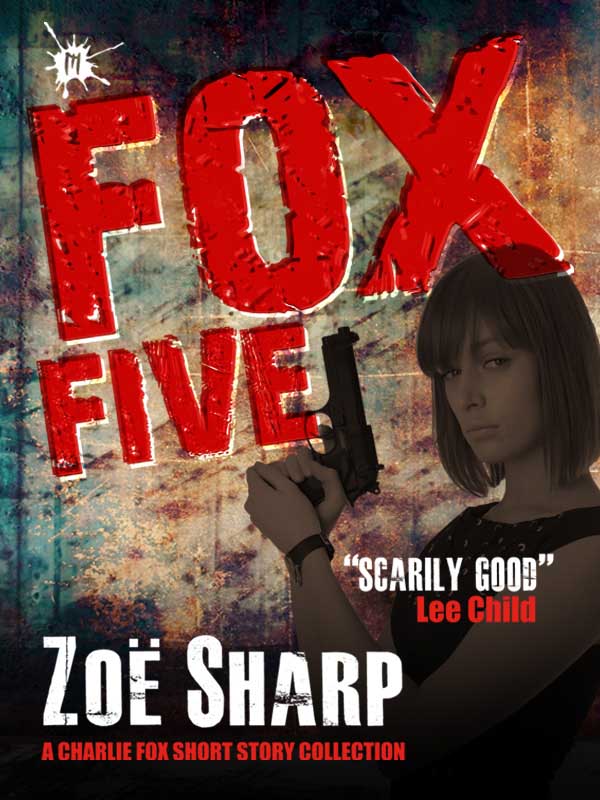
So, now I have a collection of five Charlie Fox short stories which spanned her career from civilian with ‘A Bridge Too Far’ right up to professional bodyguard with the new semi-epic ‘Truth And Lies’. The e-thology is called FOX FIVE: a Charlie Fox short story collection, and this is what it looks like:

The cover design was done by the very talented Jane Hudson at NuDesign, a graphic designer who has always astounded me with her creative chops and her ability to manipulate PhotoShop and Illustrator. I hope you’ll agree that she’s done a terrific job. Covers for the other early books in the series are on their way and I aim to have the whole backlist out before Bouchercon in St Louis September, together with the individual short stories from FOX FIVE. And then I shall collapse in a heap and sleep for several days.

So, ‘Rati, do you like the idea of an anthology – sorry, e-thology – of short stories featuring your favourite character? Or would you be tempted to give it a try to see if the character might become a favourite before plunging into any of the books?

And just in case you do, I’m offering free downloads of FOX FIVE to the first 50 people who email me on AuthorZoeSharp [at] gmail [dot] com. All I ask is that if you like what you read you post an online review, even just a few lines.

Right, I’m off to try and catch up with all this online stuff!

This week’s Word of the Week is e-thology, meaning a digital collection of short stories, as opposed to ethology, which is the science of character, or the scientific study of the function and evolution of animal behaviour patterns.

Neveldine & Taylor

By Jonathan Hayes


I was sauntering (yes, I saunter) down Fifth Avenue one beautiful day this spring when I spotted Michael Weston walking with a friend. Weston’s name might not be familiar, but if you watch movies or TV, you’ll recognize him – he’s one of the finest character actors around. You might remember him as the young psychopath in Six Feet Under who carjacks David Fisher, dousing him with gasoline and torturing him brutally:


When I saw Weston on the street, I wanted to approach him and tell him I’d just seen one of his movies, and that I thought he was great in it. I decided not to interrupt his morning, and I’ve regretted it ever since. In Pathology, Weston plays a psychopathic junior pathologist who persuades other young residents to kill people and then challenge their colleagues  to figure out how they did it. It’s a typically arch slice of gonzo exploitation from the writer/director duo Neveldine & Taylor, whose films are so over-the-top that they make the bloodiest Tarantino flick look like a PBS documentary on the history of the finger sandwich at Wimbledon.


In Pathology, for example, it’s not enough to have doctors on a murder spree, their moral decay must be underscored by autopsy room slaughter orgies, with the pathologists smoking crack while shagging hookers and each other on the dissection tables. (Don’t click on the following, more representative, clip if you’re delicate, btw.)


I wanted to tell Weston that I was a forensic pathologist, and that I’d just seen Pathology, and just how wrong everything about it was, and just how much I’d loved it.


Writers and lay people often ask me just how realistic shows like CSI are. I think that Mark Neveldine and Brian Taylor have the right attitude: who CARES? If the story really moves and the dialogue is strong, the only people who’re really going to sweat the forensic science will be the occasional entomologist, pissed off by the misrepresentation of scene interpretation by arthropod succession. It’s all make-believe – you just have to decide on what your own tolerance for the improbable or impossible is. And in Crank 2, even the characters are aware of the absurdity of their narrative, commenting frequently on its implausibility.


What I love about Neveldine & Taylor is their unapologetic embrace of excess – not just the extreme violence that is a hallmark of their work, but the excess sex, the excess swearing, the formal excess of their visuals and soundtrack. We all know what “good films” should be like – take the slate of any Best Motion Picture Oscar contenders and you’ll see nearly identikit films about decent heroes or heroines struggling nobly against overwhelming odds. And the closer the films come to the ideal of “goodness” – which is to say, the more they resemble a period Merchant and Ivory production, ideally plus Nazis, or a physical disability, or both – the more likely they are to win. The 2010 nominees were far more interesting than usual (in part because there were ten of them, which let weirdness seep in at the margins) but seriously: do you think any movie other than the anodyne The King’s Speech ever stood a chance?

It’s not that The King’s Speech was a bad film – on the contrary, it was very good. But sometimes, you just need someone to come along and gut the plump burgher of Good Taste.  We need someone to validate the flawed and the profane. Vulgarity and tastelessness provide an important balance for etiquette and decency, and they work best when delivered without apology. So we have South Park, one of the funniest, most incisive forms of social critique we’ve had in decades, half the dialogue bleeped for obscenity, rendered in primitive cut-out blobs. 


Most of all, raw, deliberately graphic and extreme work that flies in the face of traditional notions of decency and “art” is exhilarating – it’s fun to see someone speak the Unspeakable. Even when it misfires horribly, as it usually does, I’m grateful when writers and directorss say Yes to risk. Case in point: in Crank 2, we are shown the genitals of a horse (erect!), a ferret and Jason Statham; it’s delightful.


Neveldine & Taylor have now finished five pictures: Crank, Pathology, Crank 2: High Voltage and Gamer. They also wrote the script for Jonah Hex; they were slated to direct, but walked away from the project over “creative differences”. Hex, a flaccid commercial failure, is interesting, since it shows how critical the team’s creative visual approach is to the written material. Pathology is satisfying, but I think much of the pleasure I took in it related to its scabrous trashing of my profession. Gamer, a sci-fi thriller set in a future where video gamers play first person shooters using living people as their combat arena avatars, had some good ideas, and looked great (a lot like the amazing Xbox video game Gears of War, actually), but ultimately failed to connect. The heavy material and the presence of “real” relationships (the major warrior and his wife and daughter) dragged the narrative down.


The masterpieces of the Neveldine & Taylor oeuvre are unquestionably Crank and Crank2: High Voltage. And I think they are legitimate masterpieces, particularly the sequel. The title is a polyvalent pun – “crank” can mean variously to move quickly, to intensify, an irritable eccentric, an aggressive rotational action, and methamphetamine, all of which apply to these movies. 


This is high concept cinema at it’s finest. (I’ll now spoil a little here, although nothing you wouldn’t guess from the fact that there’s a sequel). In Crank, anti-hero Chev Chelios (a ridiculous name, and one of my all-time favourites) is a professional hit man who wakes up to discover that his enemies have poisoned him with a drug cocktail that’s shutting down his adrenaline system. Unless Chev Chelios manages to keep his heartbeat rocketing through constant stimulation (exposure to drugs, pain, danger and, of course, sex) his heart will stop. And there you have it: Speed in a thorax.


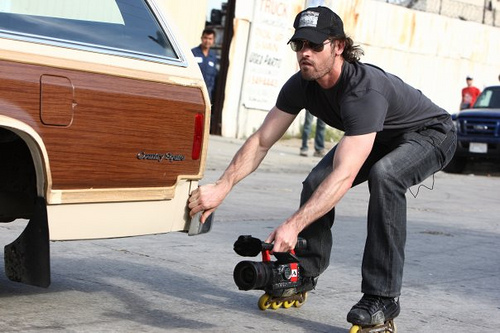
Chelios (Jason Statham) is a defiantly one-dimensional character. Told by his drug-abusing, defrocked physican/pimp friend Doc (Dwight Yoakham) that there’s no cure for the “Beijing cocktail”, Chelios chooses to spend his remaining time on the planet exacting revenge. What follows are 90 minutes of the most intense, obscene, violent action captured on film. (On video, actually – the films are shot in high-definition video, many by Neveldine himself on rollerblades with a hand-held consumer grade video camera, dragged behind a car unprotected at 50 mph.)


Crank is a cathartic, noisy blast of pure adrenaline, a sky dive with a malfunctioning shute distilled into two drops of pale yellow liquid, cut with bleach and blown up your nostrils by an Indonesian shaman while a Latvian dominatrix screams for her money. It’s disorienting, exhilarating and incredibly, exaltingly, blindingly fast.


But if the first film was a complete rush, Crank 2 is a hurricane blast – faster, denser, harder, stronger. The yellow liquid is now shot into your veins by syringe, and the dominatrix has found a gun. At the end of Crank, Chev Chelios plummets 10,000 feet from a helicopter over L.A., managing during freefall to snap the neck of his worst enemy and to leave a farewell message on his girlfriend’s voicemail. He smashes into the roof of a car and ricochets off onto the street, facing a camera, inert; we hear his last two heart beats, see his pupils dilate, and then he’s dead.


Crank 2: High Voltage kicks off with a squad of triad goons scooping Chelios’s body off the street with a shovel, and rushing it off to a lab for resuscitation. Learning that the plan is to keep him in suspended animation, harvesting his impressive organs whenever a crime lord needs replacement tissue, Chev Chelios escapes. He discovers that he’s been fitted with an artificial heart; Doc informs him that to stay alive, he’ll have to recharge himself constantly with electricity. Chelios races off to recover his heart, along the way repeatedly zapping himself with any current he can get his hands on. Or his tongue. Or his nipples – you get the picture.


The other characters are as one-dimensional as Chev Chelios – effectively, this is cartoon violence, so it makes sense to have a cast of caricatures. The film is a delirious picaresque set in a Los Angeles populated exclusively by ne’erdowells and demimondaines – all the men are homicidal thugs, all the women are whores or strippers, even Chev Chelios’s girlfriend (Amy Smart). The language is graphically sexist, racist and homophobic, and yet the film revels in its population of misfits, rewarding the audience with a final climactic Battle of the Marginalized on Catalina in which an army of Latino gang-bangers confronts armies of gay, black leathermen in body harnesses and studs, and multiracial prostitutes in almost nothing.


Crank 2 is a completely postmodern film, the purest exercise imaginable in speed and surface, sound and fury signifying nothing but sound and fury. As a formal composition, it’s an astonishing achievement – it’s hardly surprising that the film was screened at the Whitney Museum of Art.


Now, I’m not suggesting that everyone will love these films as much as I do – I’m sure many will absolutely loathe them. But for me, these things are an astonishing blast of fresh air.


So, what about you? Do you ever find extreme things can be completely refreshing, or is that just me? Remember: there’s no such thing as a guilty pleasure.


When books cross borders

by Tess Gerritsen

Lately I’ve been thinking of cutting off all email accessibility from the public because it gives me heartburn to receive messages like this one:

Recently I was in an airport bookshop where I spotted a new book of yours that I’d never seen before.  I eagerly bought it, only to discover later that I’d already read the story, but it was published under a different title.  I am thoroughly disgusted by your greedy ploy to encourage double purchases, and I will never buy another one of your books.  Shame on you and your publisher!

or:

You and your publisher should be ashamed of yourselves for selling the same book twice, under different titles.  I cannot believe that you would stoop to such a tactic.  I have demanded a refund but the bookshop refuses to give me one.  How money-grubbing can you get?  

The reason for these complaints has to do with the fact I am published in different countries around the globe.  In the UK, my thrillers are published by Transworld Publishers.  In the U.S., my titles are published by Ballantine Books.  Anyone who’s sold foreign rights understands that, with each new territory you sell to, you are dealing with a separate publishing entity, and each publisher will choose its own cover design, use its own translators, and yes — specify its own title for the story.  Not surprisingly, my book ICE COLD will not have the same title in Germany, where it’s called TOTENGRUND.  Nor will it have the same title in the Netherlands or Turkey or … the UK.  Yes, even though they speak English across the pond, the UK is a foreign country.  (Although some Americans refuse to believe this.)  Englishmen drive on the left and they have foreign currency and no, they do not think of themselves as Americans with cool accents. Nor do they believe they are required to publish books under the same titles that we do.

Which is why I’m getting those angry letters.

Because the UK is a different readership, my publisher there prints my stories with locally appropriate spellings.  E.g., neighbor becomes neighbour.  Sometimes my UK publisher also has a differing opinion on what the title of a book should be.  THE KEEPSAKE, for instance, fell flat as a title for the UK market, where the word “keepsake” had little significance.  Instead, Transworld opted for a more visceral title: KEEPING THE DEAD.  My US publisher, however, thought that KEEPING THE DEAD was way too visceral for delicate American tastes.  Each publisher has control over its own territory, and so the book was published under two different titles.  Transworld distributes to the UK and its territories; Ballantine distributes in North America.  In theory, their markets should not intersect, and readers in the UK should not be buying the US version and vice versa.

But then we come to world travelers.  And the internet.

Once a traveler leaves his home territory and enters another, he also enters a different market.  Just as you will not find paracetamol in a US drugstore, you will most likely not find acetaminophen (Tylenol) in a UK pharmacy.  Travelers have learned to expect that the names of drugs may change once you cross a border.  But they have not yet accepted the fact that the titles of books may also change in foreign countries.  Internet sales add another complication because suddenly an American can go onto Amazon.co.uk to buy a book published in the UK.  Or UK readers may go onto Amazon.com and buy a book published in the U.S.  This foreign-published book isn’t supposed to be available to them at all, but the internet doesn’t know that.  The internet is just there, at your service, to give you what you demand.  And when you accidentally buy the same book, under a different title, whom do you get mad at?

The author.  Because of course it’s our money-grubbing fault that this happens.

For awhile, I was so guilt-stricken by the thought of all these readers paying double for the same book, that I’d offer a free title to everyone who complained. I’d mail out the books, free of charge. Then one day I realized that providing the free books, along with the foreign postage to mail them, had costed me hundreds and hundreds of dollars. I also wondered how many of these were authentic complaints. Maybe word had gotten out that Tess Gerritsen was an easy mark, willing to send out free books at the drop of an email.  So I stopped doing it.

I also got fed up with being called a crook, a money-grubber, and a cheat.

I know I’m not the only author in this position.  A US mystery bookseller told me that she gets complaints all the time from customers who come in asking for UK editions of books, and then demand their money back when they discover it’s the same book they’ve already read.  I know authors who are forever explaining why their UK editions have different covers and titles.  On my own website, I point out the international differences in titles.  Still these double purchases happen, and the internet has made this worse.  

Consumers need to be alert to the issue.  On Amazon.com, the U.S. site, you can find  my UK editions KEEPING THE DEAD  and THE KILLING PLACE for sale.  But neither of these titles is offered by Amazon.com itself; they are available through third-party sellers, and once a book gets into third-party hands, it is beyond anyone’s control. Likewise, Amazon.co.uk only sells the American editions through third-party sellers.  Shouldn’t that be a clue?

Nevertheless, it’s the author who’ll get blamed for it.  On Amazon.com, in response to an annoyed reader, I offered this explanation:

“This is the UK version of THE KEEPSAKE. It is published by Transworld in the UK and its territories and WAS NEVER MEANT to be sold in the US. Each publisher releases its own edition in its own market area. Unfortunately, with internet sales (which erases all geographical boundaries) this book may be inadvertently purchased twice.  Please do not blame the publishers, as each company intends to sell only in its own market. But online sales and international travel makes it impossible to control where their editions end up.”

The responding comment was:  “That is NOT an excuse!”

For some readers, no explanation will ever suffice.


Hello. Nice to meet you again.

by Pari

It’s been a bumpy trip lately. My gratitude goes to so many of you who have stood on the edges of my rocky road, handing me bottles of fresh water and homemade granola bars, when my energy wanes . . . . Truth be told, I wish I was further along on this journey, more settled, but for now my solace comes from the fact that most of the potholes I’ve hit haven’t turned into sinkholes.

In fact some have been quite interesting, including various shifts in self-perception.  Several of the identities I clung to with such determination for close to two decades have become fluid, liquefying  in my still gripping hands. 

Wife to single woman
Writer-at-home to full time office employee
Mom always there to Mom always rushing somewhere

In the middle of all of this movement, one identity I abandoned has returned. For years, I was the woman who wrote Sasha Solomon. In 2008, I dropped that image cold to pursue other projects, to grow “beyond” a character and series that simply weren’t going to do much for my future career as a writer. After all, no one at the New York houses wanted Sasha. I wasn’t going to hit it big with her. Why waste the time writing her anymore?

Well . . . 

A month or so ago, when my personal turmoils made me doubt other people’s perceptions of me as a strong, intelligent and independent woman, I decided to revisit the Sasha book I’d abandoned three years ago. Rather than read any of that previous work, I simply started adding to those 100+ pages. I’ve now begun picking certain sections at random – selecting a page number – and infilling with more vivid descriptions or twisting a certainty into something more interesting. 

The book is at least 200 pages and I still have no idea where it has come from or where it might be going (though I’ve written at least one potential climax and ending). This is a very strange way to write a book, but I’m not anguishing about it at all. You see, I know that the story is going to come together eventually. I’ll print out all these pages at some point and start fashioning a cohesive whole. Since I’m a pantser by nature and writerly disposition, this is status quo – though I’m very curious to see the result of such a peripatetic approach to this particular tome.

More important than the final product this time though, is the process. 

I’m honoring the pleasure of living with Sasha’s persona in my head and heart again. I really like the woman – warts and all – because she’s just so fun and tough and full of herself. It’s not that I want to be her; I just want a friend like her right now: Someone who isn’t afraid to call things the way she sees them – even when they’re nasty or upsetting. Someone who can find humor in just about anything and has such an irreverent way of looking at the world in the first place.  Someone who is just as flawed – actually much more flawed – than I am and who is completely unapologetic about it. 

Writing Sasha feels like coming home to a place I hadn’t realized I’d missed.

 —  I thought it might be fun today to discuss this:

Who, of the many characters you’ve read, would you most like as a friend right this minute?

Why?

Writers: Have you happily rediscovered a character you thought you’d abandoned?


THE DREADED WTF MOMENT

by Gar Anthony Haywood

I’m presently reading an espionage thriller by a bestselling author I’ve never read before and I’ve really been enjoying it.  Or at least, I had been up until page 184.

Prior to page 184, I had been thrilled — no pun intended — to discover that the writer in question is quite good at just about everything I think is important.  He knows his subject — international terrorism and the associated U.S. political backbiting — backwards and forwards, yet he never burdens the reader with more detailed info than is necessary.  His book’s general premise is intriguing and relatively plausible.   And his dialogue, for the most part, rings with just the right balance of drama and authenticity.

Don’t get me wrong — this guy’s no le Carre.  (Not that anybody other than John le Carre himself really is.)  His requisite villain — a professional assassin with a code name plucked from the animal kingdom — is as standard issue as they come: brilliant, unfeeling, feared by all who know him, capable of killing a man with nothing more than the feather pulled from a down pillow, blah blah blah.  When his generally fine dialogue does take an occasional dip for the worse — usually during a lover’s quarrel unrelated to matters of national security — it tends to hit bottom with a real thud.  And his protagonist — a CIA desk jockey with limited field experience — couldn’t be a more obvious stand-in for Tom Clancy’s Jack Ryan were he to enter every scene whistling the end title music from Patriot Games.

(I know what you must be thinking right about now: This was a book you were enjoying, Gar?)

Still, for all the annoyances noted above, the author’s overall writing was solid enough, and the story he was telling sufficiently compelling, that I was happy to go right on riding the train he was piloting.

Until I hit the dreaded WTF moment at page 184.

For those unable to guess what I mean when I refer to a “WTF moment,” I’m talking about the specific place in some books where the wheels come flying off.  Not just one or two wheels but all four, bringing what had been a perfectly enjoyable journey of the mind to a rude and unexpected halt.  Because the author has just done something too dumb, or lazy, or transparently manipulative, for you, the reader, to forgive.  The trust you had in him to tell his tale with skill and precision has been broken, and there’s no getting it back.

That’s the WTF moment.

On occasion, this insult comes with the added injury of malice aforethought.  Not only has the book’s author abruptly yanked you out of his story, he’s done so by way of underestimating your intelligence.  He’s tried to get an elephant-sized plot device out of the room right under your very nose, preferring sleight-of-hand to fixing something he knows damn good and well is broken, and he’s counting on you to be too dim-witted to notice.  Or, if you do notice, that you’ll be too mesmerized by his genius in general to give a damn.

Most WTF moments aren’t quite as sinister as all that, however.  They’re just innocent mistakes.  Giant, momentum killing errors in judgment that a good editor should have caught but didn’t.  WTF moments of this kind aren’t infuriating, they’re simply deflating, because they’re indicative of either a breakdown in the system or a writer who’s not quite as good as you were hoping he’d turn out to be.

Let’s take pages 184 thru 187 of the spy novel I’ve been reading as a prime example.  Here’s the set-up:

A female newspaper Reporter in Washington, D.C., as headstrong as she is beautiful, is about to turn a story in to her editor that will blow the lid off a huge conspiracy involving members of White House staff.  Naturally, said members want all copies of her story destroyed before her editor or anyone else can read it, so a Thug For Hire (TFH) is ordered to break into her apartment and steal/erase all her computer files while she’s out on her nightly run with her trusted dog Bruno.

Unfortunately for her, the Reporter twists an ankle badly at the start of her run and returns to her apartment sooner than expected, while the Thug For Hire is still up in the study on the second floor.

Okay, people, let’s pause for a moment to think this through.  Assuming killing the Reporter is not part of the TFH’s assignment — and it isn’t —what’s the most logical sequence of events at this point?  I’ll give you a few seconds to consider the question . . .

Ready?  All right, the following is how things actually go down in the book:

The Reporter closes the apartment’s front door behind her, sits down on the living room couch to remove her shoes and inspect her tender ankle.  She hobbles into the kitchen, fills a freezer bag with ice, and grabs a beer from the fridge.  Now she limps upstairs to the bathroom, removes some pain reliever from the medicine cabinet, washes a couple pills down with the beer, and closes the cabinet’s mirrored door — revealing the reflection of the Thug For Hire, suddenly standing in the bathroom’s open doorway behind her!

She starts to scream but the TFH grabs her, clamps a hand over her mouth and uses very impolite language to tell her to keep quiet or she’s dead.

The Reporter (as headstrong as she is beautiful, remember) heel strikes the TFH’s shin, then whirls to drive an elbow into his cheek, forcing him to release her.  She flees into the hallway, then the study, noticing as she enters the latter that the intruder has been screwing around with her MacBook.  She grabs the phone, picks up the receiver, starts to dial
9-1-1 . . .

. . . but the Thug For Hire reappears in the doorway to point a gun directly at her face.  He drops some more impolite language to demand she put down the phone.

“Who are you?” the Reporter wants to know.

The TFH tells her again to hang up the phone and promises not to hurt her if she complies.

Bruno — who hasn’t been mentioned once since he and the Reporter returned home — barrels up the stairs to the rescue, barking like the house is on fire.  But barking is all the big guy’s up for, apparently, because upon reaching the staircase landing, he stops to flash his teeth and bark some more at the man in the hallway threatening his master with a gun.  The TFH promptly shoots the animal dead.

“You asshole!” the Reporter screams, then just for good measure, issues the insult again with some impolite language of her own tacked onto the end.  Still holding the phone, she goes on to ask the TFH twice if (Name of Evil White House Staff Person) sent him.  (He did.)  “Answer me, goddamnit!” she cries.  (He doesn’t.)

Instead, the TFH orders her one more time to put down the phone.   “Now!”

Headstrong as ever, the Reporter presses on with her call to 911.  The Thug For Hire shoots her in the head.  He moves in to finish her off.  She begs him not to shoot her in the face.  “Please, God, anywhere but in the face!”  His angry scowl softens and he grants her wish, firing two silenced rounds into her chest before leaving her apartment for good.

Riiiiiight . . .

If nothing about what you’ve just read had you thinking “What The F?”, nothing ever will, and you may feel free to exit this blog post, stage left, to spare yourself another minute of my ridiculous nitpicking.  On the other hand, if you, like me, hardly know where to begin to list all the jaw-dropping missteps our bestselling thriller writer made in the scene above, let’s just give it a try anyway, shall we?

  • Why the hell didn’t the Thug For Hire slip out of the apartment while the Reporter was a) massaging her ankle in the living room; b) refrigerator-diving for ice and beer in the kitchen; or c) downing some aspirin with her back turned to the bathroom door?  Or better yet, why didn’t he just knock her unconscious so as to finish his work in her home undisturbed?  As he wasn’t wearing a mask, choosing to reveal himself to her instead all but guaranteed he would have to kill her, which wasn’t part of his employer’s instructions.
  • When the Reporter breaks free from the TFH in the bathroom, she can’t make it downstairs to the front door on that bad ankle, but shouldn’t she at least start screaming her head off?  Or try locking the study door behind her to buy some time while she calls for help?
  • Looking down the barrel of a silenced handgun, why does the Reporter choose to subject the TFH aiming it at her to a Q & A, rather than put down the phone as instructed?  What makes her think this guy won’t pull the trigger if she doesn’t do what he says?
  • Exactly what kind of golden retriever is Bruno, anyway?  The olfactory-challenged kind that abhors violence?  It takes him what feels like forty minutes to realize an intruder is in the Reporter’s home, and when he finally does, he roars up the stairs only to stop in the hallway to bark at his master’s assailant from a distance, as if he hates to bury his teeth in a man pointing a gun at his owner until such nastiness becomes absolutely, positively necessary.
  • Does the Reporter have a death wish we haven’t been told about?  The TFH has just killed her dog in cold blood, proving he is indeed capable of using the weapon he’s threatening her with.  And not only is she still not ready to put down the phone as directed, she wants to call the guy an asshole to his face and continue grilling him: Who are you, who sent you, answer me, goddamnit!
  • If the thought of getting shot in the face was so terrifying to the Reporter, why didn’t she put the friggin’ phone down when a man aiming a gun at her face ordered her to — THREE TIMES???
  • Do Thugs For Hire generally grant a victim’s final request to be shot in the body part of his or her choice?  Or is this particular TFH, beneath all the foul language and propensity for violence, just a really nice guy?

Needless to say, all these WTF moments rolled into one has seriously dampened my enthusiasm for this book.  Which is a real shame because I’d been thinking it was a great read up to this point.

But was it really?

One of the things that happens when I hit the wall of a WTF moment is that I begin to wonder what other, similarly egregious flaws in a book I might have missed earlier.  So I go back to look, scanning the pages with a more critical eye this time, and lo and behold, more often than not, I find even more things amiss.  Suddenly, a fine but imperfect read has just become an ordinary one, and a writer I was beginning to think could be a new favorite of mine has instead been reduced to just another piker.

As an author myself, I understand how and why most WTF moments happen.  The writer has a plan for his characters and he needs things to go down for them according to that plan.  The reason Bruno didn’t fly up the stairs immediately upon the Reporter’s return to her apartment to attack the intruder within, like almost any dog with a working nose would have, is that, had he done so, none of what followed could have reasonably occurred.  So Bruno had to stay downstairs, silent and invisible, until his owner could discover the intruder herself and engage in a little suspenseful hand-to-hand combat with him.  The TFH remained in her apartment, rather than slink out unnoticed while he had the chance, for the very same reason, logic be damned.

Whether the thriller writer in question resorted to such a series of cheats consciously or not, he lost me as a reader for good at page 184, and that’s really all that counts.  So let this be a lesson to you, my friends.  To hell with typos and misspellings — scour every line of your next novel, first and foremost, for WTF moments — those scenes in which you’ve written something that defies all common sense — and eliminate them.  Because your editor might not notice them, “editing” being what it is today, but a discerning reader most likely will.

And it’s your reputation that will take the hit.

Questions for the class: Am I being overly critical here, or do you suffer WTF moments as unkindly as I do?  What’s the biggest WTF moment you’ve ever encountered as a reader, and what’s the biggest one you’ve ever caught in your own writing prior to its publication?

Double You Three

By Cornelia Read

I gotta say, I totally love me some Writer’s Almanac. I first got turned on to this when I was driving my kids to school in Berkeley, as it came on the Bay Area’s NPR station every morning at nine a.m. If you are not familiar with this fine institution, it’s basically Garrison Keillor telling you about which writers’ (and writerly persons’) birthdays it is, every day. And then reading a groovy poem out loud. Which is kind of awesome, really.

These days, since I have outlived the maximum-chauffeur years, child-wise, I get it as an email around midnight every night. I miss the lagniappe of Mr. Keillor’s voice, and the poem comes at the beginning rather than the end, but it’s still pretty damn amazing on a daily basis. Just, Snacks-‘o-Thought, in a rather lovely way. And sometimes the conjunction of people born on the same day seems almost prophetic or something. Like, better than a horoscope.

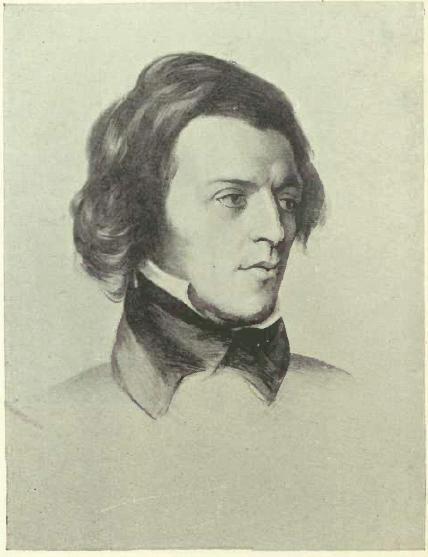
But last night was an especially good one, at least for provoking snacks ‘o thought on my part. First off, today is Alfred, Lord Tennyson’s birthday.

And I never knew before that he went through a total shitstorm in his life while quite young and gave up writing for ten years, commenting later: “I suffered what seemed to me to shatter all my life so that I desired to die rather than to live…” which just, well… mon semblable, mon frere. Let’s leave it at that.

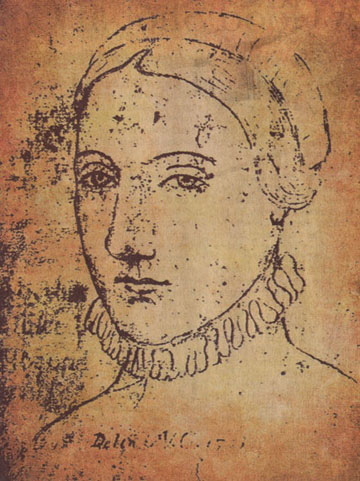
AND it’s also the day Anne Hathaway died. Shakespeare’s wife, to whom he left his “second-best” bed.

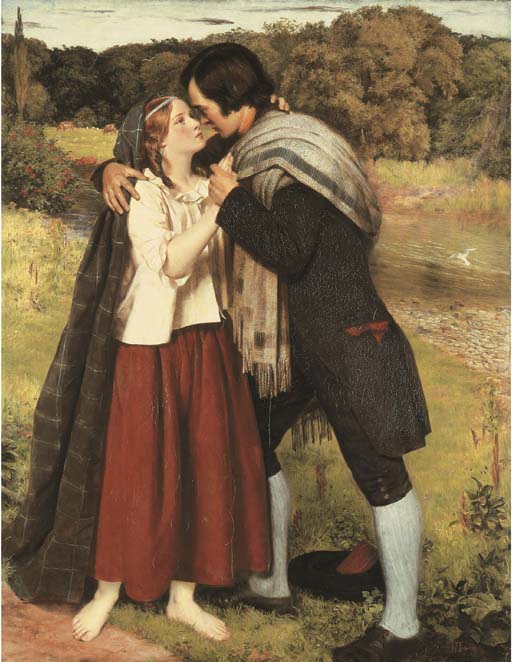
AND it’s the day that Robert Burns was roundly and publicly chastised in church for having knocked up a chick to whom he was not yet married–with fraternal twins.

While perhaps having also gotten another chick pregnant (that would be the OTHER chick, pictured above, whom he called his “Highland Mary.”) And even though he THEN got published and all of a sudden chick numero uno’s parents welcomed him with open arms as a son-in-law and stuff, and they went on to have a boatload more children–and he had a separate boatload along the way with a bunch of OTHER chicks, apparently. Which state of affairs (ahem) was accepted with grace by his wife, the former Jean Armour:

She bore his philandering with patience and apparent good cheer, just as she continued to bear him children — the ninth was born on the day of Robert Burns’ funeral in 1796. “Our Robbie should have had twa [two] wives,” she is said to have exclaimed upon taking in one of his illegitimate daughters to raise.


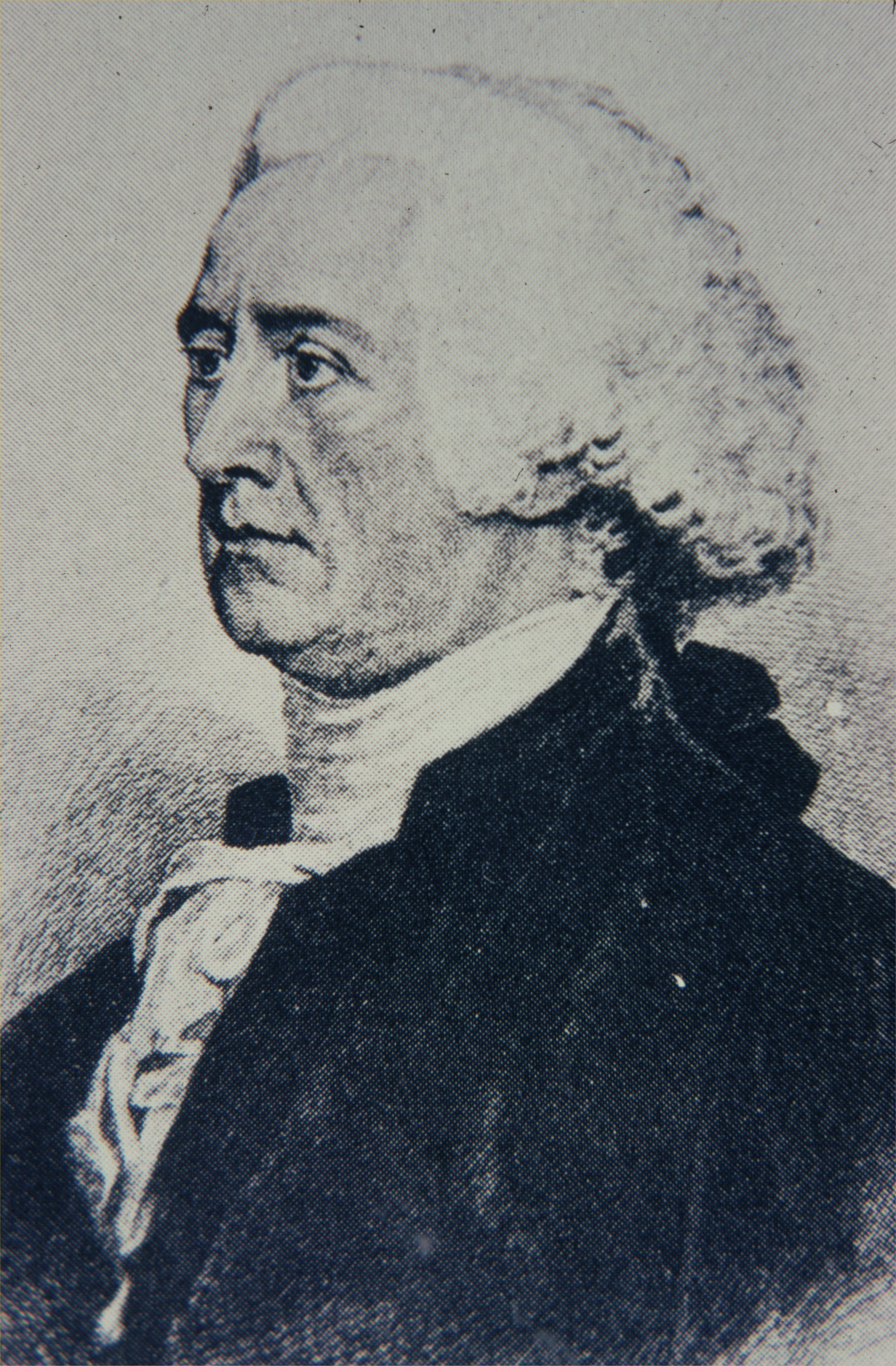
Oh, AND today South Carolina delegate John Rutledge “presented a first draft of the United States Constitution to the Constitutional Convention, in 1781,”

while it’s also the day that Jane Austen finished writing Persuasion.

So all of that seems pretty damn auspicious, to me, but I think my favorite bit from today’s Almanac is the following, in that the innovation has been quite literally and profoundly life-altering for me (and probably you, too, if you’re reading this, which we must presume you are):

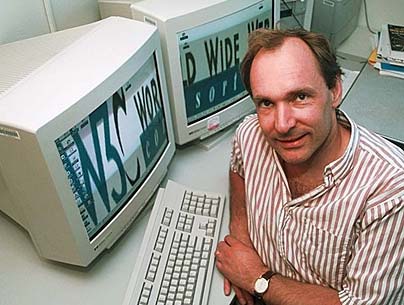
It was 20 years ago today that British physicist Tim Berners-Lee posted a description of a project he called the “World Wide Web” to an online newsgroup, effectively revolutionizing modern life. 

Working for CERN, the European Organization for Nuclear Research, Berners-Lee invented his service to allow scientists to easily share and access information via the Internet. Although the infrastructure of the “Net” had been growing for years, it was until then a highly technical system known mostly to academics and scientists like Berners-Lee. The World Wide Web, as Berners-Lee conceived it, would use the Net to connect documents with clickable links — or hypertext — and make them searchable.

Under the encouraging headline “Try it,” Berners-Lee’s post included information on accessing the first Web server and a Web browser prototype, and gave the address — or “coordinates,” as he called it then — of an example website he’d created. This Web page — the world’s very first — further explained the project he’d nicknamed “W3,” explaining how to search the Web and how to build your own page. Academia began using the service first, then industry. In early 1993, Mosaic was released, the first Web-browsing software for PCs and Apple Macintosh computers. Anyone with an Internet connection could now surf — and help create — the Web.

Berners-Lee had written in that first post: “The project started with the philosophy that much academic information should be freely available to anyone.” Today the word “much” seems quite an understatement, and “academic” almost laughable. But it is astonishing to be reminded that so much of what’s on the Web is “freely available” because Berners-Lee created the Web for free. For his donation, he was named by Timemagazine as one of the top 20 thinkers of the 20th century, and was awarded a knighthood in 2004.

Berners-Lee said: “The dream behind the Web is of a common information space in which we communicate by sharing information. Its universality is essential: the fact that a hypertext link can point to anything, be it personal, local or global, be it draft or highly polished.” 

I mean, DUDE–THE FUCKING INTERNET, right? Or the worldwideweb or whatever. I get kind of confused. But still… I mean, here are ten things that happened to me because of the internet (in reverse temporal order):


  1. I signed up for The Book Passage Mystery Writers Conference, and ended up meeting Lee Child and a whole slew of other groovers, including many of the people who’ve written for this blog.
  2. I found my mystery-writing group in Berkeley on craigslist, and got published five years later with the help of all those good folk.
  3. I (earlier, slightly) found epinions.com, which landed me smack-dab in the middle of a bunch of burgeoning writers who were AWESOME and funny and talented and wonderful, right when my life had totally turned to shit. They gave me my chops back, as a writer and as a human being. Seriously.
  4. Part of the reason my life had turned to shit is that I found out my husband had been fucking the secretary at his office in Boulder, shortly after I learned how to do email. Because I found their emails. (Okay, this one SUCKED, but still–life altering.) We were in Cambridge by that point, but still…
  5. I got to meet a really groovy writer named Dick Pollak (because of an autism chat group on Compuserve) who wrote a deeply amazing book about Bruno Bettelheim, who was such a giant shitheel I would still like to dig him up from his grave and hit him over the head with a shovel. Even though he was cremated. (Bettelheim, not Dick. Dick is excellent.)
  6. Well, I can’t even begin to enumerate all the amazing shit that the world wide web has wrought in my life… because it’s just totally stunning and mind-boggling and FUCKING AMAZING. So I will stop at six. 


But I am hugely, hugely grateful to Tim Berners-Lee. DUDE–YOU ROCK!!! THANK YOU!!!!

What’s the best thing that’s happened in your life because of the web, o dearest ‘Ratis? What’s the shittiest? What would you be doing right now instead of reading Murderati, if this whole shebang hadn’t been invented?

10,000 words in one day? No way…WAY!

By PD Martin

I know there are some freaks of nature whose normal output is 6,000-10,000 words a day, but for most writers it’s anywhere between 1K-4K words per day. And so, it sounds impossible when you first hear or think about writing 10,000 words in one day. But it IS possible…I’ve done it (many times). In fact, on my debut 10K day I wrote 12,000 words!

I first heard about the 10K day at a writers’ meeting in Melbourne. I was well and truly intrigued — and excited. I tend to write between 2,000 and 3,000 words a day (and I’ve been told that’s quite a high output) but the thought of quadrupling that was mind-boggling. So I Googled 10K day to find out what it was all about. The basic rules are:

  • You write for four two-hour blocks (NO interruptions whatsoever).
  • You take a 10-15-minute break between stints. 
  • You stock up on food and drink in between each block so you don’t have to leave your seat during each session. 
  • You clear your schedule COMPLETELY for that day. 
  • You unplug the phone and internet (I know it’s hard, but you can do it). 
  • You don’t edit or review anything you’ve written – just keep writing (perhaps the hardest one to follow). 
  • You turn off your word processor’s spelling and grammar check so you’re not distracted by red or green lines. 
  • You complete any necessary research and/or plot outlining work before the 10K day (or you fill in the research later). 

It also helps to have a writing buddy. This commits you to the full day, and serves as further motivation when you phone each other or chat online (yes, you can turn the internet back on for the short breaks). It’s not only support, but I guess a bit of healthy competition too.

My 10K days generally look like this:
9am-11am – First writing block
11-11.15am – Contact writing buddy for a few minutes, then stretch and stock up on food/drink
11.15-1.15 – Second writing block
1.15-1.30 – Second break (as above)
1.30-3.30 – Third writing block
3.30-3.45 – Third break (as above)
3.45-5.45 – Final writing block
5.45 – Chat to writing buddy
5.50 – Collapse into a chair, almost catatonic (like this woman)

Coffee and chocolate can also come in handy. My preference is for quality coffee and chocolate (I love the Aussie brand, Haighs). Anyway…


What’s the output like?

The first question I get when talking about 10K days tends to be focused on the quality of the writing. Most people’s initial response is that the words on the page must be crap. Not so, I say.

First off, by not reading what you’ve just written, you’re cutting off the inner critic. So instead of thinking: “That sounds crap, how else can I put it?” or “Oh no, that’s all wrong!” you keep writing and eventually the critical voice realises you’re not listening to them today and gives up. And let me tell you, it’s incredibly liberating to silence that sucker!

Secondly, by not re-reading your work and virtually not stopping, you’re effectively following a ‘stream of consciousness’ writing style. Many times when I’ve read what I’ve written in my 10K day I don’t even remember writing it. And I’m almost always pleasantly surprised.

Admittedly the 10K day works really well for me because I don’t plan/plot, which means I can do a 10K day whenever I can clear one full day. I don’t have to plan for it by plotting out what’s going to happen in the next few chapters. I do, however, do a lot of research. But that’s easy to overcome in a 10K day. Your sentence might look something like this: She rested her hand on her gun, relishing the cold feel of the (gun make and model here) under her fingertips. Or maybe your character turns up at a crime scene that needs some detailed description. Simple: She pulled in behind the black and white. (Description of street/house here)

The point is, you don’t stop. You don’t stop for editing, for the inner critic, for research or for plot decisions. You just keep writing.

So by the end of the day, you’ve got 10,000 words, and rather than deleting those words you usually end up adding to them. You add in research details, you add in dialogue tags and you add in descriptions. Of course, you also edit to refine your writing, tweaking word choice and sentence structure as you go.

10K days are particularly amazing for dialogue (like I said, you can add the tags in later) and for moving the plot forward. In contrast, I can see they probably wouldn’t work well for literary writers.

Of course, you can’t use the 10K day to write a first draft in 8-10 days. At least I don’t think you could! I find the 10K day too much of a brain-drain for a daily or even weekly part of my schedule, but once a month seems perfect for me. And, let’s face it, a 10K day is a great way to get a large chunk of work done while also getting a more direct sub-conscious-to-page experience happening.

Try it out for yourself! You may not get the full 10,000 words, but I reckon you’ll approximately quadruple your normal output. A fellow writer friend who was my 10K buddy one day only wrote 5,000 words, but when her normal output is 1,000 she was overjoyed with 5K. And in some of my more recent 10K days I’ve only made it to 8,000 words or so. But who’s complaining? Not me! I juggle my writing with a pre-schooler and this year I’ve also been taking on corporate work so 8,000 words is massive for me.

So, what do you think of the 10K day concept?

PS I’ll be overseas when this goes live (in Ireland for my sister-in-law’s wedding) and I’m not sure if I’ll have internet access on 4 August. But I will check back in and reply to all the comments, so hit the notify check-box when you post.

PPS My daughter Grace is the flowergirl…so exciting!!!!

Muckabout, Outcast, Hero

David Corbett

Alexandra and Allison this past week blogged about heroes, and I mentioned in a comment that my favorite heroes are seldom the kind so many others seem to find so compelling. I realize this may seem like apostasy, but as much as I enjoyed Reacher and Harry Bosch and Dave Robicheaux (my favorite series hero), I felt no great need to revisit them. One bite of the apple and I was pretty much sated.

I know. Shoot me.

What can I say—I prefer the muckabout or lost soul, the guy down on his luck and wildly imperfect but not contemptible or contemptuous, the despised or disregarded outcast who comes through in a selfless act of courage.

Not only does this sort of hero feel more real and thus convincing to me, his arc is more gratifying because it travels a more difficult and unlikely trajectory. I can’t buy in to a final victory if it’s foretold all along by the hero’s too-conspicuous strengths and virtues.

And the hero I’m talking about can’t just possess a flaw, or a haunted past, or a lack of foresight. The flaw has to undermine his abilities or his will in such a way the climactic confrontation is realistically in doubt until the very end. That’s what creates suspense for me—not plot twists or overwhelming odds. The sheer complicated noble blind perversity of the human heart.

This type of hero appears in more permutations that one might think at first blush—everyone from Gal Dove in Sexy Beast:

To Kid Collins in After Dark, My Sweet:

To Freddy Heflin in Copland:

To Mickey Ward in The Fighter

To, yes, Seabiscuit (the horse everyone gave up on):


I think heroes reflect a kind of love affair. We don’t choose who we’re attracted to, who we fall in love with. That’s done for us by forces in our hearts and minds—and bodies—far beyond the radar’s sweep. And what can I say, the heroes so many others love often leave me cold. They remind me too much of the star quarterback, whereas I’ve always admired the guys in the trenches, the big uglies with muck and blood on their faces and hands, who fight and claw with little recognition, out of honor or pride or just cussed meanness. The Grunt, not the Officer & Gentleman. Sergeant Rock, not Captain America.

Now, it may well be that this love affair I’m describing is self-love. The kinds of heroes I like best are an almost embarrassingly obvious reflection of myself. They strike a chord because I see You Know Who in them.

But they also remind me of my father, whom I loved deeply and admired, whom I watched every morning dress for work like a warrior putting on his armor—this man my mother savaged with ridicule throughout their marriage, and left to die alone in a nursing home thousands of miles away. I wanted to rescue this proud man from his lovelessness, to redeem both him and me.

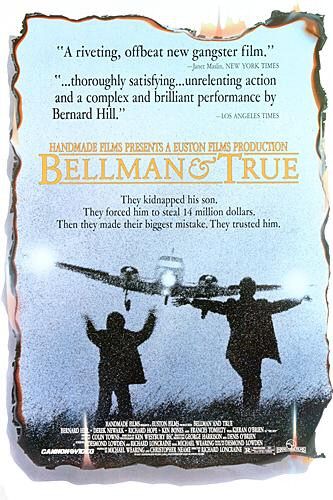
But I’m not sure pursuing this from an overly personal perspective gets us anywhere, so I’d like to discuss it in terms of one particular book and film, a relatively little known crime story from George Harrison’s HandMade Films titled Bellman & True (1987), and the novel by Desmond Lowden on which it’s based.

Here’s a trailer for the film, and the similarity to Sexy Beast should be obvious


They’re both British crime capers with a bank heist at their cores, with similar themes of the hero being drawn in against his will. But Bellman & True‘s Hiller lacks Gal Dove’s fallen-angel sex appeal — something that, in the end, strangely works to Hiller’s advantage.

The title comes from an old Cumberland song titled “D’ye Ken John Peel,” specifically the lyric:

            Yes, I ken John Peel and Ruby too.

            Ranter and Ringwood, Bellman and True.

            From a find to a check, from a check to a view,

            From a view to a death in the morning.

But there’s a pun in the term “bellman.” It also refers to a criminal who specializes in getting past bank alarms.

As good as the movie is—and it’s not just one of my favorite crime films, but one of my favorite films, period—I recently spent a sunny Sunday reading the book on which it’s based. I’ve now ordered everything else I can find that Desmond Lowden’s written—most of which, sadly, is long out of print and can be had for a song.

Don’t confuse obscurity with lack of talent—in writers or heroes.

This book provided me with one of the most gratifying reading experiences I’ve had lately. As I said, I read it in a day—it’s a mere 183 pages—almost in one sitting. (I’ve only done that with two other books: Double Indemnity and Kim Addonizio’s brilliant poetry collection, Tell Me.)

The book is briskly paced, deftly executed, with brilliant dialog and a well-researched and richly detailed high-tech heist at its core. But what makes it truly unforgettable is the writing, especially the characters.

Consider the following sketches, which are deceptively simple:

Of Hiller, the hapless hero: He was middle-aged, with thinning hair, but there was something of the schoolboy about him. It was the tweed suit, ready-made, from a High Street tailor’s. The sort of suit you bought on leaving school for your first job. The man had kept to the same style ever since, though heavier now in the stomach and seat. And he’d looked after them well, as he walked he kept the suitcases carefully away from his trouser creases.

Of Hiller’s stepson, known only as the boy: He was small, the back of his head was soft and rounded. But his face was pale, sharply pointed with the effort of being eleven years old.

Of Anna, a former high-priced call girl (“on the game, what you’d call the big game, South Africa and the Bahamas”): She wore no make-up, she was strangely neutral, like a fashion model walking from one job to another, her face and hair in her handbag, and no expression for the journey in between.

Of a minor character, a shop clerk: The man was grey-haired. He had bacon and a suburban train-ride on his breath, and he caught the smell of whiskey on Hiller’s.

Even the setting descriptions enhance character, in this case Hiller’s again:

The room, when they reached it, was small. There was an old striped carpet, and a basin in the corner held up by its plumbing. Hiller went straight to the window. He stood close to the glass and smelled the sourness of other people’s breath. Across the street he saw the four houses in a row that were empty, their insides gutted and piled at the kerb, their insides dark. And Hiller felt safe. No-one could see he was here.

But the book rewards most poignantly in the interactions between Hiller and the boy, specifically the stories Hiller tells him to keep him entertained—stories about Lulu Land, where they only had Wagner on the jukebox, and about the Princess, who only smoked French cigarettes and was beautiful when she wasn’t looking. 

In one particularly revealing bit of storytelling early in the narrative, accomplished with sly indirection, using subtext beneath the dialog, we observe Hiller’s struggle with drink and his tender if troubled relationship with the boy; we see flickers of mawkish anger beneath his wit, especially anger at vapid bourgeois pretension—and resentment of the financial success that has eluded him, or which he himself has sabotaged; we learn of the Princess, who is the boy’s mother, and the infatuation they share for her, despite her cruel desertion of them both; and we feel that desertion bitterly, even though (or perhaps because) its extremes are merely hinted at. 

The other great joy of the book is watching Hiller’s character solidify—and his love for the boy deepen. It’s easy to assume that Hiller is doomed, because of the feckless oblivion that’s led to his involvement with men far more ruthless than he realizes. But it’s not as simple as that, and Hiller is not that simple a man. His fondness and concern for the boy crystallize with a mutual realization that they only have each other, and it’s never been otherwise.

Hiller engages me in ways more conventional mystery/thriller heroes just don’t (which no doubt explains a great deal about my career). He’s not just the clichéd “tarnished hero,” nor can he be tidily tucked into the anti-hero drawer. He’s a recognizable man with a complex past and an insidious, almost overwhelming problem in the present, caused by his own thoughtless flirtation with darkness, his ongoing accommodation with despair.

And by the end he isn’t the same just more so, like so many heroes one comes across, especially in the genre. Without giving too much away, he achieves a distinct nobility, that of a man who gets up off his knees—if only to prove he can.

Note: The film was remade (and butchered) for American audiences by the same director (Richard Loncraine) with Harrison Ford in the lead. Curiously, this version, titled FIREWALL, includes no mention of Lowden in the credits. When I mentioned this to Don Winslow, he conjectured that Lowden got paid and “told to fuck off,” an all-too-frequent arrangement in the film world. Oh, and the American version is godawful. Harrison Ford has never sleepwalked through a performance more shamelessly. He looks like he’s expecting every scene to climax in an enema.

So, Murderati: Are you drawn to heroes with a crucial flaw, one that renders the likelihood of their prevailing always in doubt? Or do you prefer knights of a conspicuously whiter and more reassuring shade? In either case — why?

And ever notice how easy it is to mistype herpes for heroes?

Last–yes, I recognize the parallel between Hiller and the boy and my father and me—though I didn’t until Monday, when I wrote this piece. Talk about oblivious. Sheesh…

* * * * *

Jukebox Hero of the Week: In keeping with my theme, here’s a video of Bettye Lavette, who for almost 40 years wandered the desert of R&B obscurity, until she gave the following performance of The Who’s “Love Reign O’er Me” at the Lincoln Center, and revealed not just that the woman has a soulful voice, but a cagey, fierce, indomitable spirit:


Story and Song

by Alafair Burke

While I was listening to Adele’s “Rolling in the Deep” for the gamillionth time yesterday, I realized I had a video clip playing in my head, and it wasn’t footage of Adele performing her hit song.  It was of Chuck and Blair from the season finale of Gossip Girl, clasping hands from their hoisted chairs at a crashed wedding, one final romantic night in their tragic union before Blair is to be married off to a prince.

Yes, I watch Gossip Girl.   Go ahead.  Laugh.  I’ll wait.  But the fact that I have the same taste in TV as your fourteen year old daughter is not the point of this post.  My point is about a good soundtrack.  Sometimes the connection between a song and the story it helps narrate becomes so indelibly etched into the brain that the two can never be separated.

If you don’t believe me, check out the love between these two doomed, slo-mo youngsters.  “We could have had it all.”  I’ll love this song forever, and it will forever remind me of Chuck and Blair.

Adele and Gossip Girl aren’t the only song/story combination linked together in my mind.  My playlist seems to be filled with songs from soundtracks.  Here are some of my favorite uses of song to accompany story.

Queen and David Bowie’s “Under Pressure” in Grosse Point Blank

You can feel John Cusack seeing the life he hasn’t lived in that adorable baby’s eyes.  “Cause love’s such an old fashioned word, And love dares you to care for the people on the edge of the night, And love dares you to change our way of caring about ourselves.  This is our last dance.  Under Pressure.”

Peter Gabriel’s “In Your Eyes” from Say Anything

And speaking of John Cusack, I see the life I could have lived with him everytime I hear “In Your Eyes” by Peter Gabriel.  “I see the doorway to a thousand churches in your eyes, the resolution of all the fruitless searches.”

Dear Husband, at some point before I die, I need to be serenaded with a boom box beneath my window. Oh, I want to be that complete.

Journey’s “Wheel in the Sky” in the Sopranos

David Chase used music brilliantly through this series.  When it comes to Journey, most people will remember “Don’t Stop Believing” in that final, controversial scene, but I always remember “Wheel in the Sky” playing at the end of the episode Bust Out in season 2.  Tony has just ended a particularly bad-behaving day, having ruined a friend’s sporting goods business and beaten a murder rap.  He takes the helm of his new boat, leaving a trail of destruction in his wake.  “The wheel in the sky keeps on turning, Don’t know where I’ll be tomorrow.”  It’s Tony Soprano’s anthem.

Thompson Twins’ “If You Were Here” from Sixteen Candles

If you were a straight girl in the 80s, Admit it: A part of you is still in love with Jake Ryan.  Dear Husband, I also need you to wait for me outside my sister’s wedding in a red Porsche, then sit crosslegged on a table with me and a birthday cake.  “If you were here, I could deceive you.  And if you were here, you would believe.”

Jackson Browne’s “Somebody’s Baby” in Fast Times at Ridgemont High

Every time I see Jennifer Jason Leigh, I hear this song, and vice versa.  Poor girl, losing her virginity to that scum bag in the high school dugout.  “She’s gonna be somebody’s baby tonight.”

Cat Stevens’ “The Wind” in Almost Famous

Another Cameron Crowe movie, no surprise.  Most people will remember that epic bus tour scene with the Elton John’s Tiny Dancer singalong, but I also love this scene with Penny Lane dancing to Cat Stevens.  These kinds of moments in this film are the reason I still haven’t given up on Kate Hudson.  “Where I’ll end up, well I think only God really knows.”

Cat Stevens’ “Don’t Be Shy” from Harold and Maude

And speaking of Cat Stevens, his song “Don’t Be Shy” always makes me think of the moment we met Harold as he was about to hang himself.  “Don’t wear fear or nobody will know you’re there.”

Elliot Smith’s “Needle in the Hay” in Royal Tenenbaums

And speaking of songs to kill yourself by, I love the use of this song in this scene.  “I’m going to kill myself tomorrow.”

Kate Bush’s “This Woman’s Work” in, Um, Everything

I just learned from Wikipedia that this Kate Bush song, one of my favorites, has been used in a slew of stuff I don’t watch, like CSI, Ghost Whisperer, Alias, Without a Trace, and It’s Always Sunny in Philadelphia.  But since the 80s (also known as the best era ever), the song always makes me cry thanks to this scene in She’s Having a Baby.  “Give me these moments back, give them back to me.”

More recently, I also really enjoyed Ricky Gervais’ use of the song in the series finale of the Extras to show his friend Maggie’s plight.

I know that some writers find inspiration in music.  Our own Jonathan Hayes even created a playlist to accompany A Hard Death (love his warning that it’s “not for kids, unless they’re bad kids”).  I’m not one of those people, but did last year decide while listening to Lady Gaga’s Bad Romance that it was the perfect song to narrate 212.  Here’s the resulting book trailer, complete with ads that pop up when you use copyrighted music on You Tube.


So, how about it?  What are the songs and stories that are forever married in your minds?