Author Archives: Murderati Members


OMG OMG OMG, Mea culpa culpa culpa…

Hi everyone,

Hugest apologies for posting so late in the day. We have screwed up the schedule over at Lipstick Chronicles, so I’m now supposed to blog at both places on the same day, only I thought it wouldn’t start until NEXT Saturday, and have been on a cruise ship with seventy-five-cents-a-minute internet for the past ten days, and am currently en route from Anchorage to Newark.

So, not only am I late, but I’m going to double post the same thing I have up at LC.

Hope everyone is having a great summer so far, partied on the solstice, and will forgive me… My first plane is boarding right now, and I’ll try to catch up with comments in Seattle if I can get wireless access during the stopover.

xx Cornelia


Vintage_cruise_ship_bon_voyage_party_poster-p228691583697907754tdcp_400


By Cornelia Read

So I just finished my first-ever voyage on a boat (not counting ferries or dinghies or floatingish thingies that are inflatable and/or require what the sailor types in my lineage always refer to as “a nice breeze” to locomote). Which was pretty damn cool, I have to tell you.

6a00d83451c29169e200e551a478388834-800wi

The trip was an enormo-prezzie to the fam from my mother, in honor of three of her grandkids having graduated from various and sundry schools this month.

IMG_1840_2

Mummie (hey, if you are a parent of the female persuasion and gift your offspring with splendiferous adventures of this magnitude, you deserve the classically haute-Mitfordian pronoun, right?) treated me, my sister, my sister’s husband, my eldest girl, my niece, my nephew, and two school pals of niece and nephew to the proceedings, which was damn fine and gobsmackingly generous of her.

FLASHIP4

Mom does tons of awesome stuff for us all, and I don’t know how she comes up with the buckage for it. I think she subsists on cardboard soup and government-cheese fumes in between these stunning bouts of maternal largesse or something. Really.

4390716359_ba6942b2c2

I have learned many things during my time at sea. Here are some of them: 


1. If you are a woman who has two sons in the Navy, DO NOT let them take you drinking in Pearl Harbor, because you might wake up with a two-foot-tall tattoo of angel wings from your shoulder blades to your waist, even though the last thing you remember is being led into a room with all these weird pictures on the walls and one of your kids saying, “you can do Mom in the other room, me and my brother will stay together.” And then waking up with your nightgown stuck to your back, totally hospital-cornered into the guest bed so tightly you can’t move.


On the bright side, this woman’s sons did this to her because they think she IS a wonderful angel, and she already had a number of tattoos. And it’s really pretty (she showed us by pulling down her tanktop straps on the Denali Lodge shuttle bus, and also I saw her getting her formal portrait photo done on the ship). But still.

And hey, could be worse:

YourMom

Although I think this one might be suitable revenge on the guy who did the angel wings tattoo at one’s children’s behest, if one were to, say, kidnap him and take him to a rival tattoo parlor, after nuking him with one of those Marlin Perkins Mutual of Omaha Wild Kingdom tranquilizer darts.

MarlinPerkinspostcardpressr

2. Go to the fire drill on the first day. Because you’ll want to know what to do if bad stuff happens. Which it so totally probably won’t, but still. Sometimes it does. And I say this because this is the ship my Grandmother Smith christened in the ‘30s.

Smoking-hulk-of-the-MORRO-CASTLE---Asbury-Park,-eve-of-Sept.-8,-1934,...-painting-artwork-print

3. Bring stretchy pants. Because you will eat the entire side of a house at every meal. With ice cream on it. Probably flambé.

IMG_1608

And then a couple of bowls of gravy and some chocolate mousse. And twice your pre-cruise weight in smoked salmon.

IMG_1489

4. If you are bringing your own luggage to the departure dock, make sure that the guy you give your stuff to attaches THE TAGS FOR THE ACTUAL CRUISE LINE YOU ARE GOING ON to each of your bags (e.g., if you are going on a Princess Lines cruise, having the guy apply Holland America tags is a really, really bummer idea.

51cunardcruiselines

As you may have surmised, I speak here from personal experience.)


5. If you forget suggestion number four, be on a ship that has nice people working on it. Because you will need awesome, awesome people who will make it nice for you even though you are wearing the same clothes for three days (and totally feel like Immigration is going to send you back to fin-de-siecle wherever from Ellis Island–with “Scarlet Fever” chalked on the back of your itchy homespun-tweed shmatte where you can’t even see it–well before the Holland America boat decides to take its sweet time lolling into Juneau.)

The people on our ship made Gavin McLeod and Lauren Tewes

C5EFCB19B35D173C2C6059_Large

look like rank amateurs. Even though they only played captain and cruise director on TV and stuff (okay, I do admit I kept expecting to find Isaac mixing frothy/frosty day-glo libations in a blender behind the Lido deck bar,

The-love-boat-1


and to run into various bejeweled Gabors in the elevators.

669386-the-gabor-sisters

Or at least Paul Lynde or something.)


6. A lot of people end up crashing in Alaska from elsewhere. And their stories are pretty great.

Hitchhiking

But here is a caveat from a tourbus person about the whole “there are five single men to every single woman here on The Last Frontier” thing:

“Sure, the odds are good. But the goods are odd.”

$(KGrHqR,!lwE1F6W4IkKBNfkzM2W2!~~_35


7. IMPORTANT SAFETY TIP: Do not let your fine-looking teenage daughter go party with the dudes who run the zipline for the rest of the day until the ship embarks after they send her whizzing along cables above the tree canopy for an hour and a half unless you want her to hang out with some guy named “Steve the ‘Stache” and discover an entire galaxy of body-piercings neither of you had ever envisioned in your wildest nightmares. Even though she is rock-solid on assuring me that she is not interested in any of them, but she got great pictures of them sent to her by Steve the ‘Stache over the last several days. Isn’t texting fun?

Ruler_0_10

So even though I worry she might change her mind, which she insists she totally won’t, I did love hearing about the slightly exaggerated ruler (with witty disclaimer caption) the aforementioned Steve has reportedly had tattooed on his inner thigh–which had me doing spit-takes of mirth throughout dinner that night, every time I thought of it. Which almost makes up for the whole piercing-galaxy thing.

And, hey, she just got another text from Steve the ‘Stache. Who is a mere eleven years older than she is.

Yea.

8. Deleted.

9. The legal smoking age in Alaska is nineteen, which becomes an important thing to know if you have recently decided on a whim to buy each of the three kids in your traveling party who just graduated from high school his or her very own sixteen-dollar Arturo Fuentes Hemingway Classic from the ship’s cigar bar.

Af_hemingway_classic

Like, especially if you have just told the bar-server chick who’s kinda-sorta in charge of the place for the evening that your young companions are all eighteen. Whether or not they are actually, uh, seventeen. Allegedly.

Ahem.

Not least if the bar-server-chick-k/s-in-charge-of-the-place-for-the-evening only remembers that the smoking age in Alaska is nineteen after you’ve helped your young companions set fire to said trio of sixteen-dollar cigars.

Though it is rather fine to finish smoking your respective Hemingway Classics on the fantail of the Promenade deck at midnight when it’s the longest day of the year, still totally light out, and you happen to be sailing through a really groovy-looking fjord in Alaska. Just saying.

IMG_1665_2


Especially when you and your three young smoking companions can sing all of the verses of Lonely Island’s “I’m on a Boat” from memory, afterwards.


 k


Complete with lyric-appropriate arm motions.


[DISCLAIMER: My young traveling companions are all really nineteen. I have intimated that they were underage merely for humor purposes. They were slow learners and all held back for a year in grammar school. Cross my heart and pinkie swear. And I didn’t let any of them sample my rocks glass of Scotch, either. Because, let’s face it, a fine single malt is, like youth, wasted on the young.]


10. Pack your sleeping pills, your toothbrush, your deodorant, and a change of undies in your carry-on bag.

Img-thing

Even if you didn’t sleep at all the night before you flew to Vancouver because your writing group is on California time and you are Skyping in from the Upper West Side of Manhattan to hear what they thought of your second draft–which means 8 p.m. for them is 11 p.m. for you, and doesn’t leave you a whole lot of sleeping time by the end of the session before you have to get back up again.

Because despite that stuff, all-nighters are no excuse for stupid. Or crappy packing.


11. The long-term parking lots for the Newark Airport are actually located in Western Pennsylvania. So you’ll want to get up at 3:30 and not 4:00. Even if you didn’t sign off with your writing group until 1 a.m. And this is especially true if Air Canada’s ground crews are on strike. But I’m pro-labor so it was worth it to leave earlier.

Sw_aboveparkinglot


12. Douglas Adams was absolutely correct when he posited that “no one has uttered the phrase ‘as beautiful as an airport.’” Especially when it’s in New Jersey and you’ve been awake for circa forty-eight hours.

(I will spare you an illustration.)

Although he might have reconsidered if he’d been admiring the interior design of the Vancouver Airport for two hours from a bench next to the baggage claim. It’s pretty great.

(But, you know, still an airport. Not, like, a splendid afternoon in the Bois de Boulogne or the view across Florence from Fiesole at dawn or whatever.)


13. Denali (AKA Mount McKinley) is REALLY FUCKING BIG. And I say that having trekked to the base camp on Annapurna.

Denali_National_Park

Trust me, the Himalayas are totally pussified by comparison.

Kind of like Vancouver’s hockey team.

Vancouver_Canucks_Jersey

Heh.


14. I make a habit of dancing once a decade. I recommend doing this on a cruise ship. I just did. It was totally great. Especially when me and my niece’s pal dragged my mother out onto the dancefloor for “We Are Family.” 

And now I will not dance again until 2021. Phew.


 15. I found out my new $49 iPhone takes video. My old $200 iPhone did not, but it was four years old or something.

Unfortunately, I have not yet figured out how I’m going to post them. So here’s a nice lady on a ship waving goodbye, instead:


ShipFlapper

Tell me about a trip that you loved… And please forgive me if I don’t check in very often the day this is posted–ten-hour flight back to the East Coast, and spotty internet…


Cult research – part 1

By PD Martin

Welcome to the second blog in my research series (and to my first Thursday blog!). In case you missed it, I recently joined the Murderati gang and started off on Sundays for a few posts before moving to my new permanent spot of Thursday. And at the moment, every second post of mine will be looking at some of the weird and wonderful research crime writers do in the name of good books! And yes, coincidentally that’s back-to-back research posts from Murderati…I put it down to the collective unconscious. Hope you’re lapping up the research stuff. 

Today, I want to focus on some of the fascinating research I’ve conducted into cults (mostly for my fifth novel, Kiss of Death, although I’m also currently ghost writing a non-fiction book called Death in a Cult). In fact, I’ve got so much to say on this subject that I’ve broken the post into two parts! This first post will be a bit of an introduction and look at some of the psychology behind cult members. Then, next post I’ll focus on gurus. And I guess in some ways, this is the stuff that I would have loved to incorporate into Kiss of Death, but of course I could only use much smaller parts of it to avoid the dreaded research dump Allison brought up yesterday. I still think it’s a fascinating subject!

The word cult immediately rings alarm bells for most people – we think of Charles Manson and his murderous followers, of Jim Jones and the estimated nine hundred and seventeen members who died with him at Jonestown, of David Koresh and Waco and of the Tokyo subway poisoning by Aum. In fact the word “cult” has got so many negative connotations that cults themselves want to disown the term. And who wouldn’t when it paints a modern-day group with the same brush as Charles Manson, Jonestown and Waco?

So what is a cult? The Random House dictionary has several definitions – from the more neutral ‘a particular system of religious worship’ to the negative ‘a religion or sect considered to be false, unorthodox, or extremist, with members often living outside of conventional society under the direction of a charismatic leader’.

By these definitions, cults have been around for thousands of years. For example, some hunter-gatherer tribes had a cult-like belief system and structure with the shaman as guru; the Assyrians around 880BC have been described as a tree-worshiping cult; and let’s not forget the recently revived Knights Templar and Opus Dei, which can easily be described as cults.

In the past few decades our understanding and tolerance of cults has increased, largely due to the many studies in this area. Scholars such as sociologists and psychologists have studied cults, cult members and their leaders. These scholars generally use the more politically correct term of new religious movements or NRMs for short.

It should also be noted that the bad wrap cults have is largely due to destructive cults. And while it’s these cults we tend to hear about in the media, there are thousands and thousands of other cults that simply go about their business.

NRM members

People outside cults/NRMs often wonder what sort of person is attracted to a cult. In fact, many people believe that cult members are somehow mentally unstable, depressive or simply weak. Psychologists have studied members, cults and their leaders (gurus) looking for patterns and commonalities. And some of the recent studies have revealed some distinctive personality traits in members and ex-members of NRMs. For example, a 2008 Belgium study looked at ex-members of NRMs and compared them to the general population and to current members of NRMs on certain self-reported personality traits. The study, conducted by Coralie Buxant and Vassilis Saroglou, identified four main areas of vulnerability: insecure attachment to parental figures during childhood; limited social relationships; negative life events; and a higher need for order. The negative life events were traumas such as the death of a loved one, marriage break up, major life-threatening illness, bankruptcy, etc.

Other research has found that people who join new religious movements often share characteristics such as: a sense of not belonging during childhood and adulthood; identity confusion or crisis; alienation from family; feelings of powerlessness; a recent psychological stressor; low self-esteem; and social anxiety. Notice the cross-overs from the list above.

Are cults dangerous?

History has shown us that cults certainly can be dangerous – but many cults are harmless.

Deciding whether a cult is dangerous – and how to deal with it – generally falls into the hands of law enforcement. In a 2000 article for the FBI Law Enforcement Bulletin, experts identify risk factors, neutral factors and positive or protective factors within NRMs.

Risk factors include:


  • a history of violent episodes or clashes;
  • the leader’s past or present state of mind and condition (e.g. violence, drug or alcohol abuse, etc.);
  • an abrupt reversal of direction (positive or negative);
  • recent attempts to obtain the knowledge to carry out a violent act;
  • recent purchases of weapons or other arms; 
  • training in the use of weapons;
  • instances of violence within the NRM;
  • setting an exact date for the imminent transformation of life on earth;
  • moving the date of that transformation; 
  • phrasing prophesies or predictions in a detailed and specific manner (otherwise they tend to be vaguer so the leader can’t be proved wrong);
  • envisioning an active role for the NRM in the coming transformation; and
  • having the knowledge, means and ability to carry out a plan.


And while some of these risk factors are obvious — it’s common sense that any group stockpiling weapons (or purchasing a tank like the one above!) is potentially dangerous — other factors are not as readily identified by the general public. However, it makes sense that if a guru is very specific, for example claiming the world will come to an end on a certain date, that they may plan a mass suicide of their followers before or on that date in ‘preparation’ for the coming Armageddon. 

The FBI article is also quick to point out that just because an NRM has one or more of these risk factors, it doesn’t mean the group’s about to implode (suicide) or explode (committing violence against the public or law enforcement).

The authors also stress that a dynamic or situation that we may think is strange or dangerous, isn’t necessarily so. The neutral factors identified are: members offer absolute and unquestioning adherence to their leader and the belief system; the group physically segregates itself from others; and members adopt unfamiliar customs or rituals (i.e. diet, dress, language, etc.). In fact, these three factors are often present in all NRMs.

The law-enforcement experts also talk about “protective” factors – factors that will make a cult less likely to be violent. These factors are: members taking practical steps to plan for the future; and the group adopting routines and administrative processes (e.g. transcribing teachings and disseminating information about their group to others).

So, that’s it for cults and me today. I hope you were glued to the page/computer just like I was when I was reading these research materials!

Field Trip!

By Allison Brennan

You’re probably here expecting David Corbett to challenge your mind with a smart and thoughtful essay, but we switched days because it’s his birthday and he’s out being happy. You can read his post from last Sunday here.

So you’re stuck with me today.

David is a recent addition to Murderati and after reading his first post, I emailed JT and said:

“Where’d you dig up the smart guy? Sheesh, I feel so inadequate. I think I’m going to have permanent blog-writer’s block :/”

Seriously.

So I’m not David, no great insights from me today! But I want to talk about one of my favorite subjects: research.

I’m giddy about my next research trip. Tomorrow I’m participating in another FBI SWAT training session, this time as a hostage. I can’t tell you how exciting these things are for me. First, I lead a boring life. It’s all writing and kids. That’s it. So when I get to research in the field, I feel like I’ve been released from prison. But most important, there’s nothing like hands on research.

90% of my research comes from books and talking with experts—cops, feds, doctors, lawyers, private investigators, coroners, rape counselors, pilots, business owners, mechanics, you name it. For my upcoming book IF I SHOULD DIE (11.22.11) I contacted the press guy for Argus Thermal Imaging Products about air surveillance; my regular contact at the FBI for information about working with Canadian law enforcement; a trauma surgeon I met through one of the hands on training programs about triage in the field; and even my daughter’s boyfriend who rides dirt bikes to get his input about ATVs. I poured over brochures and online maps related to the Adirondacks, learned the make-up of St. Lawrence County, New York, and researched mining history in upstate New York. I even pulled out my criminal psychology books to make sure I understood the psychology behind not only my primary villain, but because there are a lot of people involved in keeping this criminal organization running, I wanted a better understanding of group psychology.

But in the end, research shouldn’t be visible in the story. I absorb what I read and hear, but I can’t put any of it on the page. Research works only in context to the story. My readers aren’t going to be impressed that I now know how to dress a wound in the field—they don’t need me describing it in detail. What they want to know is what my main character Lucy is thinking and feeling while she’s assessing how seriously Sean is hurt after falling down an abandoned mine shaft. Because she is trained in first aid, she’s not going to be thinking about step A, B, C … she’s just going to do it.

The other 10% of my research is field trips. Touring Quantico and Folsom State Prison. Being a victim in an active shooter situation. Playing hostage. Viewing an autopsy and asking questions. But my questions are different than others. I can look up the procedures of an autopsy, but I want to know what the pathologists are thinking. Do they talk about what they’re doing? Do they chit-chat? Are they formal? Do they joke? What do they do to unwind after a difficult case? Do they tease the newbies? What’s their background? What are the strange cases? What do they like best about their job? Least? Pet peeves? 

Or consider how different characters view the same scene. A pathologist is going to look at a corpse much differently than a jogger who stumbles across a body in a park, so I try to view every situation from a different perspective. What does the first responder think/feel? The untrained observer? The killer? The victim’s family? What do they notice that someone else might not?

This is where the field trips really help me. I’m lucky in that I can put myself in other people’s shoes, so-to-speak. I try to understand the world from different perspectives. When I play hostage tomorrow, it’ll be running the same scenario multiple times. I can “be” the hostage and imagine that it’s real (and they way they run these drills, it feels real—I’m hyper-alert.) I can also “be” the bad guy and watch and listen and imagine why is he doing thing? What made him snap? Is it emotional or calculating? Because he’s stressed or because he wants something? And one of the my favorite parts of these drills is when, after the fact, the trainer comes through with the team and analyzes the operation. I get to listen to why decisions were made, what they were thinking, all the information they have to process immediately. If I can understand a scene from all three viewpoints—cop, suspect, hostage—I can write it.

Don’t be surprised if a hostage situation shows up in one of my upcoming stories. 🙂

Too many beginning authors spend a lot of time researching, then dump their newfound knowledge in the middle of a scene. BORING! Okay, okay, there are some people who like all the technical detail, and there are some authors who have made a name for themselves with involved, elaborate, and accurate descriptions of technology or science or forensic investigation. And sometimes, a bit more detail is necessary for the story—but as Elmore Leonard advises, try to leave out the boring parts.

I confess, I’ve been guilty of research dumps, usually because I learned something really cool and I want to share. Fortunately, my editor usually stops me from going overboard. And I never forget the advice of a good friend of mine, Karin Tabke, who’s married to a retired cop. It’s the details that’ll hang you, especially when you’re not an expert, so only share what’s necessary for the immediate story and move on. (But then I remember two emails I received a week apart on my book THE HUNT—one cop wrote that I got everything wrong, another cop wrote that I must have worked in law enforcement because I got it all right. Go figure.)

In the end, research needs to serve the story, not the other way around. Raise the stakes, tighten the prose, maintain the proper pacing, and be true to each character. Incorporating research is just the window dressing.

Next week I’m off for a two week trip! Not a book tour or anything fancy like that (being a mass market original author, touring isn’t an option.) But I will be at RWA and Thrillerfest, both of which are in NYC back-to-back this year. Toni McGee Causey and I are rooming together and hopefully will have time to do tourist stuff between conferences. After six (seven?) trips to NY, I have yet to walk across the Brooklyn Bridge, so that’s up this time. Any must-see Broadway shows? Go-to restaurants or shops? One of those “you have to do this before you die” experiences? Are you going to one of the conferences? Bouchercon? Maybe next year?

I printed up a promotional copy of my digital novella, Love is Murder, to give away at the conferences. Comment or say ‘hi’ and I’ll randomly send five people a copy (which also includes an excerpt of my upcoming book.)


So About That Pre-Order Gift…

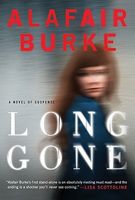
by Alafair Burke

You may recall that a few months ago, I solicited your advice about a pre-order campaign for my first standalone thriller, LONG GONE, which comes out … OMG, tomorrow!  After giving pre-orderers (that’s a word, right?) a keychain last year for my novel 212, I wanted to know what readers might appreciate this time around.  Another trinket I could send to every person?  Or a smaller chance at being one lucky winner of something big, like an iPad?

Well, in more than fifty comments, y’all made three preferences very clear: 1) It’s more about the gesture than the monetary value; 2) Better to give something to every reader than to just one lucky winner; and 3) The more personal to the reader-writer relationship, the better.

Thanks to your input, I made a decision I never could have reached on my own.  In fact, I got so excited that I disclosed the decision in parts.  Because we all love mysteries, I decided to make the LONG GONE pre-order gift a surprise.

Like all good mysteries, this one came with clues.

1.  It consists of thirteen parts that can be assembled in less than three seconds.

2.  You put its parts together with your fingers, but you will not want to hold it.

3.  What force and strength cannot get through, this, with little effort, can do.

4.  It is not a car or an iPad. It is something little old me can actually give everyone who buys a book.

Got it?

Did you figure it out?

Try one more time?

It’s a thirteen-letter password!  And in that case, it’s a password to a private book club.  It’s private in every sense of the word. It requires a password, available only to early supporters of Long Gone.

It is also private because it provides a behind the scenes look at the writing of Long Gone: thoughts about various scenes and characters, information about the real locations depicted in the book, and other content that I hope will enhance the reading experience. 

Y’all told me readers wanted something personal and connected to the books.  I couldn’t think of anything more personal and Long-Gone related than exclusive content from the gal who wrote the novel.  Although the password to this club was intended to be a pre-order “gift” to readers and a small token of my gratitude, it has turned out to be a gift to me as well. 

LongGone_HiRes FINAL SNAPSHOT 3-21-11

In the past, I constantly had to admonish readers on Facebook and the web not to post comments with SPOILERS!  The private book club is a place where we can all start on page 1 together (tomorrow!) and read together for 10 days.  Every post begins with a page number, so anyone who falls behind can skip that post and come back later.  Faster readers can wait for the rest of us to catch up, then jump into the conversation.  I am really looking forward to talking to readers about LONG GONE in real time as they read.  Then on July 5, at 9 PM EST, we’ll wrap up our club with a live webchat.

Since all of you here helped me come up with this experiment, I thought you might want the details.  And because some of you may even want to join the club, I’m extending membership applications through the week. 

How do you get the password to the club?  Just purchase a copy of LONG GONE by June 25 (earlier is better, though, because we start reading tomorrow!).  It can be an e-copy or a paper book.  Either forward your proof of purchase to offer@alafairburke.com, OR fill out this handy, dandy pre-order offer form, whichever is easier.  Then I’ll send you the club location and password.  How simple is that?

The book club might be a completely transformative way to read a book with a community, or it could be a total trainwreck.  Either way, I’m looking forward to the experiment, and appreciate the willingness of others to follow me on the journey.

Learn more about LONG GONE, read an excerpt, and watch the video trailer here.  You can find many of your favorite booksellers here and here.  For signed copies, contact stores listed here.

And since I’m totally pimping myself out today, I’ll go all in with the advance praise:

“I loved this book.” —Michael Connelly

“Long Gone is a tremendous novel, and Alafair Burke is one of the finest young crime writers working today.” —Dennis Lehane

“Alafair Burke’s first standalone is an absolutely riveting must read—and the ending is a shocker you’ll never see coming.” —Lisa Scottoline

“A red-hot firecracker of a thriller. If you already love Alafair Burke’s novels, buckle up for her best book ever.” —Lisa Unger

“Highly addictive. The ending will leave you breathless.” —Karin Slaughter

“Very smart. The dialogue crackles, the plot is intriguing, and the pacing is perfect.” —Nelson DeMille

Seriously, everyone: Thanks a lot for your input about this in March.  I’m very happy with the little “gift” we came up with, and hope some of you here will enjoy it as well.

Comment time: What was the last book (other than LONG GONE, natch) that you purchased? And was it hardback, paper, or e?

 P.S. I’ll be the featured guest blogger this week for Powells Books, posting everyday this week.  Stop by and say hi!

Women Make the Best Detectives

David Corbett

Due to conflicting family obligations, Allison and I have exchanged posting days this week. I’m appearing today, and Allison will appear this Wednesday.

In my fifteen-plus years as a private investigator, I had the opportunity to work with numerous detectives, men and women both, but in retrospect I find myself particularly impressed with the latter.

Perhaps that’s because the qualities they brought to the profession weren’t the ones usually associated with it: toughness, intimidation, bravura. Their talents lay elsewhere, and turned out to be perfectly suited to the business.

Three women specifically stick out in my memory.

The most famous, and the materfamilias for the others, is Sandra Sutherland, who was my boss, along with her husband Jack Palladino. Together they lent their names to arguably the best investigation firm west of the Mississippi at the time: Palladino & Sutherland.

Jack was a Bostonian, raised by a shipyard worker, street-smart and book-smart too (brilliant, really, an encyclopedic mind), flamboyant and ambitious, a bully to some but that’s a compliment to others, especially in that field. He’s Sicilian, I’m Irish, and we spent the first year-and-a-half testing each other’s tempers, then settled down into a solid working rapport.

But this about Sandra and she was something else—a diffident Australian, former journalist, single mom (until she married Jack), arch-lefty to the bone, anti-authoritarian and literary and gentle by nature but fiercely proud, savagely loyal—crossing her was madness—and voraciously hungry for the story beneath the story. She was perhaps best renowned for spearheading the firm’s efforts in the Michael Jackson Case.

Some of the things that made her brilliant could not be taught, though in observing them I did lift a few pointers for the old trick bag. She relied on her intuition about witnesses with uncanny insight, knowing what to say, when to say it, and most importantly when to stop.

I once read a government transcript of a secret taping by an informant in a drug case in which Sandra, appearing at his door as background for a grand jury defense, tried to engage him in admissions about events he was concealing from his handlers. She played the dithering blond thing to perfection, priming the pump with harmless anecdotes about this suspect or that (most of them our clients), offering sly little openings for the snitch to fall into, which he did. Liars can’t help but brag. Sandra knew that, knew it in her core.

She taught me that my most essential tool was my own personality, my instincts, my ability to put people at ease. The rest was the easy stuff. Without the gift of being able to get people to open up, though, you were useless.

The second woman who astonished me was Melody Ermachild, another P&S investigator until she launched off to start her own firm with Barry Simon (yes, back then women needed a man in the frame to legitimize their “toughness”).

Melody shared Sandra’s essentially gentle spirit — a perhaps counter-intuitive quality for a detective of either sex — which is what made them both such sly interrogators: People trusted them. And she shared Sandra’s core moral sympathy for the underdog. But that sympathy felt more grounded in Melody—perhaps because of her longtime Buddhist practice—and that was the impression she gave you: This woman is fundamentally decent but also centered, strong, smart.

I worked with Melody on the second People’s Temple Trial. She’d been one of the key investigators in the first go-round, which ended in a hung jury. She’d  gone off to form her own firm by the time the second trial commenced, and so we divvied up witnesses for the reconnection necessary to make sure, in the event courtroom appearances were necessary, the Temple survivors were up for it.

This was no small matter. These people were devastated. They had been betrayed by one of the most monstrous religious con men in the history of America, seen their personal histories of abuse and their thirst for social justice turned hideously against them, watched themselves and their families manipulated and brainwashed into unspeakable privations and ultimately death, only to become pariahs to anyone who learned they’d once been associated with the temple. They needed to be coaxed gently into the light. Many refused. I met with witnesses in ghetto coffee shops, condemned buildings, prison—and the Berkeley fourplex where, unknown to me at the time, my wife-to-be also lived in an upstairs apartment.

None of my successes would have been imaginable, frankly, without Melody. She’d paved the way, meeting with many of them in the first round of interviews, building a bridge of trust with these brutalized people that I relied upon each and every time. She was meticulous, thorough, determined, resourceful—but her greatest asset was her simple humanity. She inspired me not just professionally. I think I became a better person, a better man, because of working on that case, working with her.

Melody is also the author of two wonderful books: Altars in the Streets: A Courageous Memoir of Community and Spiritual Awakening, and Meena: Heroine of Afghanistan.

The last of the three women I want to discuss was also an operative at P&S, but she never went on to glory in the field, never formed her own firm. She in fact left the business shortly after I came on board, moved to New Hampshire (if I recall correctly) and opened a boutique. Her name was Bonnie Ferro, and she was a tiny redhead with paprika freckles and an infectious laugh. I remember her precisely because she wasn’t an investigator by nature—no dogged insistence on the truth, no fierce sense of justice, no uncompromising allegiance to the underdog. She was just brave.

I can’t even recall the name of the case now, but it involved the murder of a Cow Hollow woman whose remains were so water-logged by the time they were found, wrapped in a sleeping bag in the bay, that the brightness of her recently manicured nails stood out as the one recognizably human feature on her corpse.

We were hired by the defense team for her husband, a mousy accountant, who was charged with her murder. The investigation led us to a seedy hotel on Market Street, where there resided a trio of young men with suspiciously precise knowledge of the murder. Bonnie went in undercover to befriend them, get them to open up to her, living in this fleabag SRO for three weeks until she thought she’d go mad. But she didn’t go mad. She got the goods.

And yet that success did not induce a hunger for more. She recognized that, unlike Sandra and Melody, she had no core longing for the work. But she didn’t pack it in until after she’d done the job asked of her, as disturbing and dangerous as it was.

These three were by no means the only women investigators at P&S who also worked hard and well and inspiringly: Stephanie Voss, Jacqui Tully, Dee Modglin, I remember them as well. And though Nancy Pemberton, another San Francisco PI, never worked for P&S, I know Nancy well, know her work—her professionalism, her integrity, her determination and profound sense of morality—and if I were in trouble I’d want her on my team.

As for fictional private investigators? Sadly, there I prefer a man: His name is Jackson Brodie, and he’s the most imaginatively, convincingly and profoundly fleshed-out investigator I’ve ever come across in the pages of a novel. Some consolation: his creator is, indeed, a woman: Kate Atkinson, a literary novelist who turned her hand to writing a detective and struck gold. I’m sure some wag would say her books “transcend the genre,” but that’s a phrase only used by pedants and lit-crit fetishists who wouldn’t know “the genre” and if it came up and bit off their . . .

But I digress.

* * * * *

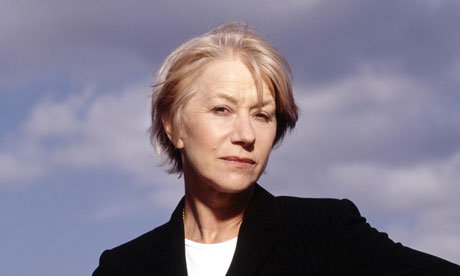
So, chime in on your favorite women detectives, flesh-and-blood or fictional. I don’t mean women cops, like Jane Tennison pictured above, but private investigators. 

Do the fictional women PIs you love possess the same traits I found in my real-life avatars — specifically, gentleness of spirit, simple humanity, integrity — or are they obliged to bring more traditionally masculine traits to the game? 

* * * * *

Jukebox Hero of the Week: The late great Solomon Burke, joining Italian rock legend Zucchero in a rocking stomping bit of bilingual Gospel-soul called Diavolo in Me (I Got the Devil in Me) — and I do.

Please abide about the first 40 seconds or so — the track is live, with introductions, etc. — then get ready to boogie with your bibles and jump up for Jesus — CRANK IT UP!:


Looking Back, Looking Forward

by Alexandra Sokoloff

Zoë did a brilliant thing in her post last week – a looking back and looking forward at her career as a writer, and JT said something about all of us maybe doing it.  Which is just like JT, who is so good about one-year plans and five-year plans and that kind of grownup thing.

Well, maybe Steve’s post yesterday scared me into acting a little more like an adult, because I decided to do the career review thing for myself today, and the rest of you can do what you want.

A career is always evolving, I guess, it’s not just a writer’s career that does. And it’s interesting to look back over my career and see how certain patterns emerge. Today I’ll be looking at the fairly positive ones, not the horrific soul-crushing mistakes that take years to recover from. That’s another post.

So a first really clear pattern is that every 5 to 10 years I have moved from one medium to another, always incorporating what I’ve learned from each previous incarnation.

I started off not as a writer but in theater, at eight or nine, first acting (a lot of it) and dancing, then directing and choreographing. I didn’t start writing until college.  But in theater,  without meaning to,  I was learning all the jobs required to write: acting, directing, set design, lighting design, choreography, musical direction, props….  I also did a stint in video production in there somewhere.

I graduated from college and worked for a couple of years in an improvisational theater ensemble, which was more great training, and a totally fabulous time. But I started getting these– feelings. Whispers, you might say. They weren’t all that coherent really, but I was picking up on a message that sounded suspiciously like: “No one’s ever going to pay you to do political theater in Berkeley.”  It’s a coals to Newcastle kind of thing.

So since I’d already been to New York, and I knew I didn’t want to write for Broadway (or Off-), I decided – not all at once, but in a sort of gradual tipping point from “maybe” to “okay, let’s just do it” – that I’d move down to LA and become a screenwriter. Yes, just like that. You really have to love California; from birth we are completely inundated with T-shirt and bumper sticker messages like “Follow your bliss!” “Do what you love and the money will follow!” “Feel the fear and do it anyway!” 

Even more amusing- we actually believe all that.

So I moved down to LA and became a screenwriter.  Pretty much just like that.  Well, I worked in development for about a year and a half while I was writing my first script, and of course I was working my ass off learning the craft and the town and everything it takes to actually accomplish it all, but it really did happen pretty much like that. 

This is another example of a pattern that established itself early in my life. I’d be subliminally pushed to do something and then I’d power down, one might say obsessively, and make it happen. I directed my first full-length play at 16 by pretty much the same process; I landed an unheard-of gig (for a 17-year old!) in college directing a full-scale musical every year with an actual budget and in fantastic theater venues.  The Universe is very supportive of inspiration, I find.

I won’t go into my Hollywood years, it’s too convoluted a story for one blog and I still have the PTSD issues. I’ll just say I made a good and sometimes great living as a screenwriter for a long time until I started getting those feelings again– this time more like something was going terribly wrong in the industry. A lot of this was coming from being on the Board of Directors of the WGA, the screenwriters’ union, and getting an insider look at changes happening in the film business. I started getting whispers again– something like: This is insane. Save yourself.  Get out.  Or at least, diversify, as they say in the financial business.  And so I wrote a book. At night. Screenwriting became my day job as I sweated over the novel, one page at a time.  Sometimes one paragraph or one sentence at a time.  But that’s how a book gets written.

And that book sold and was nominated for a couple of awards and suddenly I was in another career. Just at the right time, I have to say, given what’s happened in the film business since I wrote that first book.

So now for the last five years I’ve been making my living at books. I have five published novels out, with numerous foreign editions, and a non-fiction workbook of my Screenwriting Tricks workshops. I have contracts for four more books, and every day I am incredibly grateful to be making a living at what I love (or some days, love to hate) in the middle of this terrible recession.

But –  I’m getting that feeling, again.  That – “Time to change” feeling.  “Diversify,” the voice whispers. Sometimes it’s not much of a whisper; sometimes it’s a bolt straight upright in bed with a voice in my head screaming DO IT!!!!  kind of thing. I mean, I have contracts for now, but what’s the business going to look like in a year?

Yes, I am talking about indie publishing.

We’ve been having these backstage discussions at Murderati about where we want the blog to go from here, and my own very strong feeling is that we need to be talking even more about e books and indie publishing. So I am putting my blogging where my mouth is and am going to do a series of posts on how the changes in the publishing business are affecting me and how I personally am dealing with it all.

I already have a toe in the e book business. Screenwriting Tricks For Authors is up on Amazon for Kindle, and I’ve been loving getting that direct deposit to my bank account every month; it really helped back there around Christmas when my advance check was taking about forever to show up. And a few weeks ago I finally buckled down and figured out how to get the book up on Smashwords, in all those formats that Smashwords does, and on B&N for Nook. And once I did, I felt like a complete idiot for not having done it before.  It is instant money that I could have been getting all along.

Back to the portfolio analogy for a moment:  it’s an income stream. As a professional author, I have many income streams. I get advances for my new books, I have a backlist that generates royalties, I have royalties from foreign publishers, and now I have e book income, soon to have much more, if things go as I’m planning – all in concert with my agent, of course.

The thing writers don’t talk about enough, I think, is how we actually manage to make that combine into a real living.  Well, I can tell you for myself, and for most of my friends who have NOT broken into the huge advance category but are still making a full-time living at writing books: how it’s done is by constant, grueling work to get more product out there to create more income streams – on top of writing the best book you can write every single time. It’s not very pleasant, truthfully – it means firing on all four burners 24/7.  But that’s nothing new – it seems to be the job description. Everyone I know does it.

Now, e books are a freaking ton of work that I’ve just added to an already overflowing plate. I am now responsible for lining up all kinds of support people that my publisher has always provided: proofreaders, editors, cover designers, formatters, technical services – and there’s a lot of new technical stuff I’ve had to learn myself, which I must say is not my forte. It’s overwhelming, which is why I haven’t fully done it before now. But I think it’s going to be crucial to have some eggs in that basket, so I’m biting the bullet, for real.  To mix all kinds of metaphors, as you all know I love to do.

And honestly, the control and flexibility you get with indie publishing is exhilarating. One thing I’ve discovered is that you can create your own formats. For Screenwriting Tricks, I have been working on and off for most of the past year on an extensive revision of the first book, incorporating all the things I’ve been learning in my own workshops. And then I realized – Why revise the first one?  At a $2.99 selling price I can put out another book that has a different focus, and people can choose which book is best suited to their needs, or get both – two whole workbooks for the price of one paperback novel! That’s an incredible thing. And I can price it that way and still make money because the royalties are so high.

So, in the next couple of weeks I am going to be releasing two new e books, the second Screenwriting Tricks book and a spooky new original e book novel: The Space Between – plus the Thriller Award-winning short story that I based that novel on: The Edge of Seventeen. And I’m going to write some posts documenting the process I’ve been going through and the resources I’ve discovered that helped me do it all.

It’s a whole new world, but it’s an exciting one, and I hope I can convey it in a way that might open some doors for other people thinking of taking the plunge.

So, a couple of questions.  Do any of you do periodic reviews of your careers to see how far you’ve come and where you want to go from now?  Do you find patterns?

And what about this e book thing?  Have you done it?  Are you thinking of doing it?  It’s coming up on Solstice, time for some serious manifestation.   Follow your bliss!!!

–  Alex

FOURTEEN

by Stephen Jay Schwartz

 I just celebrated another birthday and I realize I’m fourteen years old.

I was fourteen last year, too. And the year before that. In fact, I’ve been fourteen years old since I was fourteen.

Not that fourteen is the perfect age. Fourteen is a pretty rotten age. It’s in-between everything. You want to be big, you want to be a man, but you’re still a punk. When I was fourteen (as I am now) I was a freshman in high school. Ninth grade. Bottom of the food chain. Thirteen was better—I was in eighth grade and the oldest kid in middle school.

When you’re fourteen you think you’re gonna live forever. You think you might be a doctor or movie director or the president of the United States. You think you’re going to make a huge amount of money so you don’t really need to save. You live for the moment.

I realize I’ve never left this mindset. I know I’m going to make a huge amount of money, one of these days. Probably when I’m twenty-five. I know I’m going to direct a feature film, too. I intend to do that before I’m forty, because I hear Hollywood’s a pretty young town.

There are drawbacks to living fourteen. Like, you might buy a house without any money, using something the grown-ups call a zero-downpayment loan. But they have this great feature called a negative amortization payment and that’ll help, for a while. And then they got this even greater thing called a short sale. I guess there’s always something to look forward to.

Other things come up that are tough, you know, when you’re fourteen. Like, those things they put on bananas in the sex education class? You might want to wear one. Otherwise, well, all these crazy things happen that are just a bit too much for a fourteen year old deal with. I didn’t wear one and now I’ve got kids and a wife and I had to get a job for, like, a really long time, and I had to do what people said without talking back and the times I did talk back they said I was fired and when I went back the next day they said what are you doing here we fired you and I said oh.

Now I’ve got two kids. One is eleven and one is thirteen. The eleven year old is thirty-two. The thirteen year old is fourteen. We say the eleven year old is the wise one. He tells the rest of us to save money. We don’t know what he’s talking about.

My wife is fourteen, too. So, that’s cool. I think my thirteen year old will be fourteen for a long time as well, but then I think he’s going to get older and end up around twenty-one. And I’m hoping that our eleven year old becomes fourteen someday, maybe after his fiftieth birthday.

It’s not for everyone. I’m not even sure if it’s really that healthy, you know, in a psychological sense. I read in a book in my freshman something class that it’s called “arrested development.” You get stuck in the year where you had some kind of trauma. When I think back on it I remember that fourteen is how old I was when my dad left my mom. I remember waking up one morning to find my mother in the kitchen crying over a bowl of cereal. She’d been up all night. I asked her what was wrong and she said, “Your father left us.” I told her not to joke around. “Your father left us and he’s not coming back,” she yelled. Later that day my dad picked me up at soccer practice and cried, telling me he was leaving my mother to marry the woman he’d been seeing for six years.

Fourteen was the year the world came crashing down. It was the year I was expected to grow up, to take it like a man. I did all the things they told me to do. Things got really hard after that. I tried and tried and tried and tried.

What’s great, though, is that you have this awesome imagination when you’re fourteen, so you can fall back on your dreams and ideas and stories and the little movies you keep in your head. I think that’s how I got through it all. It’s a good thing I wasn’t the age they said I was or I don’t think I would’ve made it.

So, now I’m fourteen again and I have no idea how the rest of my life is going to play out. I know I’m going to direct a feature film someday and I know I’m going to make a lot of money so I won’t have to worry about how to pay the bills they keep sending me for all the things I like to do, like watch TV and go to movies and eat at restaurants (that’s really cool, I LOVE eating at restaurants!) and taking road trips with my fourteen year old wife and our kids. I know I’m always going to live near the ocean because I’ve wanted to live near the ocean since before I was fourteen and it’s one of the things that everyone told me I couldn’t do until I had enough money and I always thought hell why not. Come to think of it, that’s what I’ve thought about pretty much everything everyone told me I’m not supposed to do. I guess that’s why some people call me Peter Pan. That’s okay, he always was my favorite.

But a couple years ago I found this really cool group of other fourteen year olds. They all write books and together we call ourselves “authors.” I always thought I was strange and out-of-place and doing things the wrong way and then I met these other people and they’re just like me. It’s like camp for fourteen year olds forever. Thank God most of us have children to take care of us when we get into trouble. Because we can get into some real messes.

Anyway, it’s really good to finally have this figured out. Now when my accountant yells at me for spending money on things that don’t make sense I say, “Why would anyone trust a fourteen year old with that kind of money?” Or when my lawyer says disagreements should be handled in the courtroom I say, “Why do you think God gave me fists?” I’m starting to talk this way to all the grown-ups in my life. It’s really fun but I find their responses disturbing. I like hanging out with the authors the best.

Anyway, I feel a lot better now that I know the reason I do the things I do is because of my age. It doesn’t make things easier, I still get in a lot of trouble, but it explains a lot.

It’s funny how you gotta wait until these later birthdays to figure out the really obvious things in your life. I guess that’s why they say that youth is wasted on the young.

Death By … Euphonium?

Zoë Sharp

As you may have realised, I shouldn’t be here this week, but with the sad retirement of Brett Battles from these pages, it was suddenly realised there was a breach, and I’ve stepped into it!)

I am a very unimaginative serial killer, I’ve decided. Over the course of my writing career, I’ve managed to dispatch quite a number of people, with means from a hit-and-run that forced the victim off the edge of a cliff on his motorcycle, to throat cutting, disembowelment, having their neck broken in a bathtub, and being buried alive.

I’ve had my heroine, Charlie Fox, kill with her bare hands (or feet) on several occasions – one nasal bone smashed up into the frontal lobe of the brain, and one crushed larynx are the ones that spring to mind immediately.

Mostly, though, I tend to shoot people. Death is nasty and final enough without lovingly lingering over it like some kind of sado porn. And it’s usually the quiet deaths, the ones where people slip quietly away when you least expect it, that are the ones I remember.

The reason for this melancholy reflection is that this week is National Crime Writing Week in the UK. Organised by the Crime Writers’ Association, the event celebrates Bloodthirsty Britain in all its gory glory, and I quote:

A survey carried out to mark the start of National Crime Writing Week, which runs between June 13 and 19, has cast light on some of the original ways that crime writers murder their victims.

The Bloodthirsty Britain research was carried out by the CWA,which is organising the week. Members across the UK took part.

The CWA asked how many people they had killed off over the past year (2010). The average body count was 8.38 and the most people killed by one author was 150.

The most inventive means of killing included:

Taxidermied alive

Sliced to death in an olive machine

Poisoned with soluble aspirin and ribena

Rigged a euphonium to land on victim’s head

Super glue in mouth & nostrils to suffocate.

Bees in a wicket-keeper’s inner glove leading to anaphylactic shock

Decapitation by glider cable

Trapped inside Damien Hurst style art installation

Dragged behind horse

Tied up and drowned by rising tide

Stabbed through the heart with a spangly stiletto

Drinking blood

Gored on the horns of a goat

Answers to why people like crime so much included:

“People like to crack puzzles. They also love strong but deeply fallible or troubled main characters they can empathise with, and crime writers dish this up in spades.”

“Crime Writing is a fantastic genre to examine big moral questions about society, the State of Man as much as any so-called “literary” novel.”

“Crime stories can illuminate and celebrate the human condition, not just tell grim stories.”

“Creates suspense and allows you to explore the wicked/bad side of your own character that you don’t actually want to act upon in real life…allows you a window into that world without you having to participate.”

More than 30% of those surveyed read crime fiction or watched crime drama every day of the year, and more than 50% read it weekly or several times a week.

CWA Chair, the best-selling author Peter James, said: “This survey has thrown up some fascinating findings and underlines why readers so love crime writing.

“One of the big campaigns undertaken by the CWA at the moment is to support libraries and we know that crime forms the most popular genre when it comes to borrowings. This research emphasises the reason why it remains so popular.”

I took part in an event at Kendal Library in Cumbria last night (Wednesday, June 15th) together with fellow Cumbria crime writers Anna Dean, Diane Janes, and Matt Hilton. Strangely, nobody asked us what bizarre methods of murder we’d come up with in the past, but it got me thinking.

So, fellow ‘Rati, what’s the strangest method of murder you’ve ever either come across in a novel, or devised for your own victims – erm, all in print, of course …

This week’s hasty Word of the Week is outspan. Not just a brand of orange (in the UK at least) but a South African verb meaning to unyoke oxen or unharness a horse. Also a noun, meaning a stopping-place.

And on a final note, I had the honour to be interviewed by the delightful J Sydney Jones for his Scene of the Crime blog this week. Please stop by and say hello!


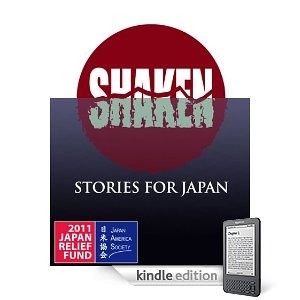
Thank you to Lil Gluckstern (below) for bringing up the topic of Brett’s contribution to SHAKEN, which I am delighted to mention here:

One hundred percent of the royalties from this new collection of original stories will go directly to the 2011 JAPAN RELIEF FUND administered by the Japan America Society of Southern California. The 2011 Japan Relief Fund was created on March 11, 2011 to aid victims of the Great East Japan Earthquake and resulting tsunami waves. With the funds that have been raised so far, $750,000 has been committed to nonprofit organizations that are on the front lines of relief and recovery work in northeastern Japan.

This collection was born out of the writers’ concern for the people in the disaster zone. SHAKEN: STORIES FOR JAPAN is an attempt by writers to pool their talents to help people in need, as musicians and actors so often do.

The book contains original stories by Brett Battles, Cara Black, Vicki Doudera, Dianne Emley, Dale Furutani, Timothy Hallinan, Stefan Hammond, Rosemary Harris, Naomi Hirahara, Wendy Hornsby, Ken Kuhlken, Debbi Mack, Adrian McKinty, I.J. Parker, Gary Phillips, Hank Phillippi Ryan, Jeffrey Siger, Kelli Stanley, C.J. West, and Jeri Westerson. As a group, these authors have won every mystery award there is and sold hundreds of thousand of copies. They’re all working at the top of their games in this volume. SHAKEN; STORIES FROM JAPAN is art for heart’s sake, and the purchase price will help those who are struggling to repair, or at least soothe, these terrible losses.

Not all the stories are mysteries; the consensus was simply that all writers should submit something that touches on Japan. Linking the stories are haiku by the 17th-century master Basho, translated by Jane Reichhold, and Issa, translated by David Lanoue. Both translators donated their work, as did the cover designer, writer Gar Anthony Haywood, and the e-book producer, Kimberly Hitchens.

To Our Health We Drank a Thousand Times, It’s Time to Ramble On

by J.D. Rhoades

There’s no easy way to say this, so I’ll just say it. This is my last regular post here on Murderati.

It hasn’t been an casual  decision, and it took a while to make. There are a lot of factors that have gone into it, but far and away the most important one is: I need that Tuesday evening back.

 As I’ve mentioned here several times, I still have a day job practicing law. That takes up most of my days. I’ve never been much of a morning person. I’ve tried getting up at 5 AM  to write, and it never seems to work for me. That leaves the evenings as my only realistic time to write fiction.

Every other Wednesday, I have a Murderati post due, so there goes that Tuesday. I also, as I’ve mentioned before, write a weekly political humor column for the local paper. That’s due on Thursdays, so I spend my Wednesday writing time on that.

So on my “Murderati weeks,”  I lose two evenings of fiction writing in a row. That’s made it very hard to get back to the work in progress on Thursdays. In fact, trying to pick the thread back up after two days is so bloody difficult that I confess, I sometimes give in to the temptation to just chuck it all and go watch Community (promising myself I’ll just write more on the weekend). Fridays are hit and miss because of family stuff, so….you can see the dilemma. I’m fighting  to  get my career back, which means every opportunity to write becomes precious, and let’s face it, I ain’t getting any younger and certainly not any prettier.

So some commitments have to go. The newspaper column may be next, but they actually pay me for that. Not a huge amount, but  as precious as time is, every dollar is almost as precious these days, what with one kind in college and another headed there.

All that said, this wasn’t an easy decision. I’ve had a blast here, and I will always be grateful to Pari and JT for inviting me. I’ll always be grateful as well for all the encouragement, knowledge, laughs, and even the tears  each and every one of you, both posters and commenters, has shared with  me.

I look over at the right sidebar, and I see all the folks who have come and gone: Simon. Michael. Elaine. Naomi. And of course, Ken. When Toni, Brett and Rob bowed out (for many of the same reasons I am), I realized that change is part of what keeps a blog fresh,  so it’s time for me to move along as well. 

The good news is that my replacement is going to be Jonathan Hayes. I’ve hung out with Jonathan some, and I can tell you he is  is one fascinating guy. He’s a forensic pathologist, a food writer, a music fan with tastes almost as eclectic as my own, a raconteur, and he writes one hell of a thriller. I know I’m leaving you in good hands.

I’ve let the folks know I may be able to pinch hit as a guest blogger from time to time, and I have a feeling that my inability to keep any opinion to myself means I’ll still be around in the comments. But for now…play me off, Jimmy!


Bloody Words Conference

by Tess Gerritsen


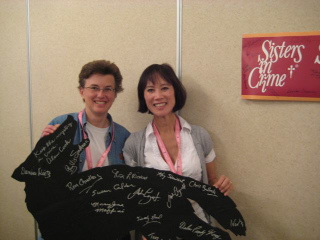
Sometimes, you just want to share travel photos.  And that’s what I’m going to do here, but I also want to say a few words about what brought me to Victoria, BC in the first place, and that’s the Bloody Words Conference. I was invited there as the “International Guest of Honor”, which was an honor indeed as it involved one of the most delightful few days I’ve ever spent at a writers event.  First, because it was a very low stress conference where I only had to sit on panels.  In my last blog post, I talked about how anxiety-producing it can be to solo- teach a workshop.  But panels are more like a conversation, a chance to share your honest, off-the-cuff thoughts, without the labor of composing prepared remarks. (If you want to keep writers relaxed and happy, make it a panel program!)

The other reason I had such a fine time was the fact we were in Canada and there’s something about Canadians that’s so darn, well… nice.  They’re not just helpful, they seem happy to be helpful. It started at the Victoria airport, where we discovered that my husband’s suitcase didn’t make the three-transfer flight from Maine.  He was standing there at the carousel, looking bereft because he hadn’t packed a toothbrush or even a change of underwear in his carry-on.  Suddenly an airport employee came swooping in from nowhere to ask if we’d lost a bag, and said: “Let’s just see what we can do!” After the necessary paperwork was filed, he handed my husband a sack with a shaving kit, toothbrush, shampoo, and detergent.  In all the years I’ve flown in the U.S. and lost bags (and it’s happened half a dozen times) I’ve never met anyone so anxious to help a beleaguered traveler.  

Why are Canadians so nice?  I posed this question while I was there, and one fellow offered brightly: “It’s because we’re so happy not to be Americans!”  He was quickly shushed up by his countrymen because “that’s not a nice thing to say.”  From taxi drivers to bellmen, rental car clerks to waitresses, there was something so different about the way they treated us there.  Instead of the bored and disinterested “I’ll have to check with management about this” that you hear so often in the US, what we heard in Victoria was “of course we can do this for you!”

At one point, my husband turned to me and said, “Tell me again why we live in the US?”

The conference itself was, as you’d expect, a friendly and collegial affair.  I was curious about the state of genre publishing in Canada, and was not surprised to hear about the same woes I heard in South Africa.  With a population that’s only a tenth of the US, Canadian writers simply don’t have a large enough readership for them to make a living, unless they sell internationally.  The US is considered the “elephant to the south,” the market that’s too huge to be ignored, and the market that everyone wants to penetrate.  In crime fiction, Americans are certainly familiar with Louise Penny, Rick Mofina, Linwood Barclay and Peter Robinson, but too many other Canadian crime writers simply aren’t distributed in the US.  

But now that there are e-books, it should be an international market, right?  Why don’t Canadian authors simply sell to Americans via Kindle? I discovered it isn’t as easy as just emailing a file to Amazon.  To self publish an e-book for sale to American Kindles, you must have an American bank account and mailing address.  That, at least, was what one Canadian told me.  Which makes it a bureaucratic hassle to sell your own books south of the border. 

Another complaint I heard was the lack of publisher support in Canada for genre fiction.  Publishing is partially subsidized by the government, and literary novels get all the financial support and review attention while genre fiction is left to fend for itself in the marketplace.  It’s not surprising that genre writers, who actually make a profit for their publishers, are a bit resentful. 

One of the best things about international conferences is the chance to meet authors I wouldn’t otherwise meet at US conferences.

 Michael Slade, the Canadian Guest of Honor, comes to crime writing with a lifetime’s worth of expertise under his belt.  He’s a criminal defense attorney, and some of his real-life stories will make your jaw drop.  (Like the time a satisfied client offered to kill any person of Michael’s choosing as a token of his appreciation.)  Michael originated “Shock Theater”, a staged reading of radio plays at various mystery conferences, and I was allowed in on the fun when we read “Chicken Heart.”  It’s a truly stupid play, but loads of fun to scream over.  Michael’s legion of fans are called “Sladists”, and they’re so devoted to Michael that one of them peeled down her pants to show off the “Sladist” permanent tattoo just over her rear end.  Now that is true fan devotion.

Grant McKenzie is a Scottish-born Canadian journalist whose crime novels have been translated into German, Chinese, and Russian.  He interviewed me for an afternoon session, and it was a truly delightful conversation.  He’s a terrific novelist who’s published internationally —  just not yet in the U.S.  I hope American publishers are taking note!

William Deverell, the local Guest of Honor, is another Canadian crime writer who brings a rich lifetime of experience to his novels.  He’s the Dashiel Hammett-award winning author of fifteen novels, including the Arthur Beauchamp series.  He’s also an attorney who’s been involved in more than a thousand criminal cases, serving both in prosecution and defense.  Bill and I had a lovely private lunch together where we talked about writing, the future of publishing, and some of the fascinating criminal cases that he’s litigated.  

Booksellers were at the conference as well, and here’s Frances Thorsen of Victoria’s “Chronicles of Crime” mystery bookshop, along with the author-autographed coyote placard that will hang in her shop.  Frances sat on a panel called “What’s hot, what’s not”, about trends in crime fiction.  If you want to know that answer, just ask a bookseller!

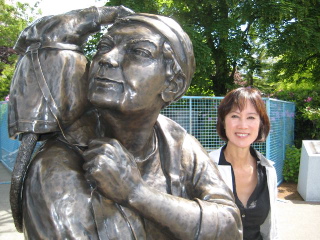
Here’s a photo of me with another writer.  It’s a statue of local Victoria heroine Emily Carr, with her pet monkey perched on her shoulder.  Hats off to any town that chooses to honor its authors.


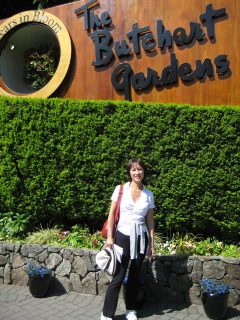
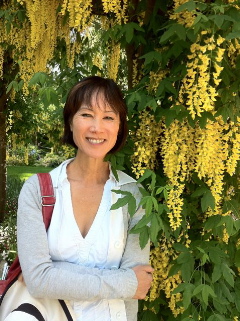
After the conference, it was off to see world-famous Butchart Gardens, where I ogled gorgeous vines of golden laburnum.  It’s a poisonous plant, by the way, which was used as a murder weapon (fictionally) in the TV mystery series “Mother Love.”

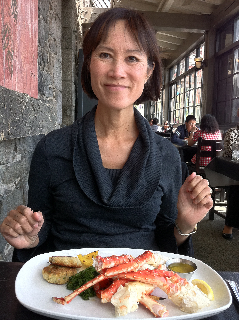
Finally, no set of travel photos is complete without at least one shot of food:

Crab legs, anyone?