Author Archives: Murderati Members


HERE COMES MR. TROUBLE

by Brett Battles

After reading Tess’s and JD’s posts from the previous 2 days, I thought about changing what I was going to share with you today. I mean, after all, it’s definitely BSP, and after the important topics we’ve been discussing here, I wasn’t sure if it was the right thing to do.

Two things stopped me. First, one of the secondary themes of the book I wanted to tell you about is bullying, and second, this is my penultimate post as a Murderati regular, so what better time to discuss it? In view of all this, I hope you’ll forgive the BSP… 
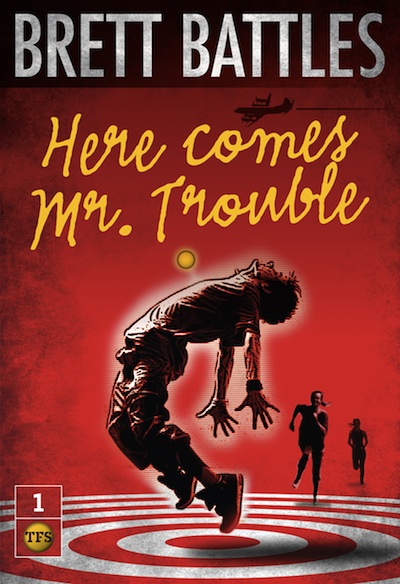
Unlike the other two books I’ve mentioned lately, the book I just released is a little different. HERE COMES MR. TROUBLE is my first foray into the world of younger readers. Technically I think it would be considered a cross between middle school and tween genres, but in reality can be enjoyed by anyone 10 and up.

It’s a mix of reality and my own brand of mythology, with humor, suspense, and more than a couple scary moments thrown in. Oh yeah, and thrills, too. I can’t get away from that.

I can’t tell you how much fun this was to write. I’ve wanted to work in the middle school/YA market for a while. Part of it is because I read and love the genre books, but probably the biggest reason is that my kids are in that reading group. I think some of the most innovative and interesting work is being done for readers 20 and under.

To say MR. TROUBLE holds a very special place in my heart, would be an understatement. Here’s a bit about the book:

ARE YOU LOSING THINGS?

ARE PEOPLE YOU KNOW ACTING STRANGE?

IS SOMEONE CLOSE TO YOU MISSING???

DO YOU FEEL LIKE THINGS ARE BEYOND YOUR CONTROL?

ARE YOU IN…TROUBLE?

When Eric Morrison sees the advertisement, he doesn’t know which is more surprising—the ad’s sudden appearance or the fact that his answer to every question is YES!

Not only can’t he find things, but the bullies at school are suddenly picking on him for no reason, and, worse yet, his mother has disappeared but he seems to be the only one who’s noticed. Even his best friend Maggie thinks he’s only run into a little bad luck.

But if Eric thinks his life is upside down now, it’s nothing compared to what’s about to happen when Mr. Trouble and the Trouble family arrive to assist him in solving his problems.

One thing’s for sure—Eric will never see the world in the same way again.


If that caught your interest, I guarantee what you’ll find is a wild ride that you’ll enjoy no matter how old you are. Currently it’s available as an ebook, priced at $2.99 from all the normal outlets (links below). By the end of the month a trade paperback version will also be available through Amazon.com.

If I could ask your help…MR. TROUBLE may not necessarily be for you, but you may know someone who might enjoy it. I grateful request is that if you could, please pass the information about the book on to them.

It’s a great story with wonderful characters, and, yes, I know I’m biased. But I truly believe this.

Here are those promised links:

HERE COMES MR. TROUBLE in the Amazon Kindle Store

HERE COMES MR. TROUBLE in the Barnes & Noble Nook Store

HERE COMES MR. TROUBLE at Smashwords.com

HERE COMES MR. TROUBLE in the Amazon UK Kindle Store

And if you’d like to read more, here’s the first chapter:


1

It started with a guuuuuuurgly suuuuuuuck.

Eric Morrison twisted around, trying to see what had caused the noise.

“Are you going to just sit there all afternoon?”

He would have sworn the sound had come from the other side of the classroom, but he didn’t see anything over there that could have caused it.

Please tell me I’m not hearing things, too.

As he started to turn back around, someone punched him in his arm. “Hey, are you ignoring me?”

He glanced over his shoulder. Maggie Ortega was standing right next to his desk. He’d been concentrating so hard on the gurgly suck he hadn’t heard her walk up.

“Why’d you do that?” he asked, rubbing the spot where she’d hit him.

She stared at him over the top of her glasses as if he’d lost his mind. “The bell? It went off like two minutes ago. You’re usually the first one out the door.”

Eric glanced at the clock hanging at the back of the classroom. Two fifty-two p.m. School was out. How had he missed that?

“Thanks,” he said. He gathered his books and started shoving them in his backpack. “I guess I wasn’t paying attention.”

She looked down at him for a few seconds, then said, “What’s wrong with you?”

What’s not? “What do you mean?”

“You’ve been acting all weird for days now. Stop it. I don’t like it.”

“No, I haven’t,” he said.

She rolled her eyes. “Yes, you have,” she said, heading for the door.

She was right and Eric knew it. He had been acting weird, but given what was going on, how else was he supposed to act?

“Everything all right back there?” Mrs. Bernhardi asked from her desk at the front of the room. She was their sixth-period English teacher.

“Yeah. Fine,” he said as he stood up.

“Eric, I expect you to have your essay in on time next Monday. It’s not like you to fall behind.”

“Yes, ma’am.”

Like he needed that reminder. Still, just like Maggie a few seconds earlier, Mrs. Bernhardi was also right. It wasn’t like him.

He was a good student who always got his work in on time in the past. But for the last two weeks, even though he was sure he’d put his finished assignments in his backpack, when it came time to turn them in, they weren’t there. Math, history, English—it didn’t matter.

It almost felt like he was going crazy.

Actually, maybe not almost, he thought. If I am going crazy, that would explain everything.

“Hurry up!” Maggie called from the doorway.

“Have a nice afternoon,” Mrs. Bernhardi said.

“You, too,” Eric replied quickly, then headed for the door.

The main corridor of Valley View Middle School was nearly deserted as they headed toward the front exit.

“Come on, come on,” Maggie said.

“If you’re in a hurry, don’t let me hold you back,” Eric said. “I’ll just see you tomorrow.”

She whirled around, stopping right in front of him. “Tomorrow? What do you mean tomorrow?”

“I’m just saying, if you need to be somewhere, I don’t want to be the one who makes you late. I know you hate that.”

She did hate it, but that wasn’t the real reason Eric was urging her to go on without him. Unlike the rush she seemed to be in, he definitely was not in a hurry. Chances were there’d be another one of the Neanderthals waiting to mess with him on his walk home. It had been happening almost every day lately, since about the same time he’d started forgetting his homework.

Plus there was another reason he wasn’t anxious to get going. Eric really didn’t want to be at his house at all, not if it meant opening his front door again and finding out his mother was still gone. It would be the fourth day in a row.

His dad had told him she’d gone on a business trip, like it was a normal event, and had been completely unconcerned about the fact she hadn’t said goodbye to either of them before she left. But it wasn’t normal. Not even close. And skipping goodbyes? No way.

Eric’s mom worked at a small beauty salon in town. She didn’t go on vacations, let alone business trips. “Time away means time we’re losing money. And we can’t afford that.” How many times had he heard her say that?

“Have you forgotten what we’re supposed to do today?” Maggie asked.

Guuuuuuuuuurrrrrgly suuuuuuuuuuuuuuuck.

Eric turned his head, trying once more to pinpoint where the odd noise was coming from. “Did you hear that?” he asked. It sounded both distant and right around the corner.

“Hear what?”

“That sound.”

“What sound? I didn’t hear anything.” She crossed her arms and narrowed her eyes. “You’re just trying to distract me, aren’t you? Well, that’s not going to happen. We agreed to go to the library this afternoon to work on our China report, remember? Now, come on.”

The China report. Right.

She took off down the hallway at a pace that was more a run than a walk. After a deep breath, Eric started after her.

• • •

The Tobin City Library was a single-story building about three times larger than Eric’s house. It was only six blocks from the school so the walk didn’t take them long. But because they had gotten a late start—Eric’s fault, as Maggie pointed out several times on the way over—the only open table when they got there was the one nearest the librarian counter.

“Great,” Maggie said as she dropped her bag on top.

Mrs. Kim, the head librarian, looked over, one eyebrow arched high into her forehead. “Shhhh!”

Mrs. Kim was the reason no one wanted that particular table. She could hear everything you said. The second you started goofing around she would “Shhhh” you and remind you that if you weren’t there to study, you were welcome to leave.

“Sorry, Mrs. Kim,” Maggie said, glaring at Eric.

As soon as they sat down, Maggie pulled a thick folder of loose papers out of her bag and slid it across the table to him.

“You’re responsible for the part about the Great Wall,” she said.

Eric picked up the folder. “What is this?”

“Research I printed out from the Internet last night.”

He looked at a couple of the pages. “You printed all this out last night?”

She sat back. “Well, given the way you’ve been acting lately, I knew you weren’t going to do it.”

He ignored that and asked, “Why am I responsible for the Great Wall? Aren’t we supposed to decide who does what together?”

She stared at him, her face blank.

After a moment, he said, “Fine. I’ll take the Great Wall.” He thought about asking what she was going to work on but was afraid she might snap at him again, so he said nothing and glanced through the pages instead.

“You’re going to have to read them,” Maggie said.

“I know. I’m just trying to get an idea of what’s here.”

She scowled, pulled out another equally thick folder and started going through it.

After twenty minutes, Eric leaned back and rubbed his eyes. He’d only made it about a third of the way through the folder but he was seriously thinking about skipping the rest. He was sure he already had more than enough information. The only problem was Maggie. Since she’d taken the time to print everything out, she probably expected him to read it all.

He gave his eyes one more rub, then opened them. As annoying as it was, he was probably going to have to—

He suddenly became aware that there was someone sitting in the chair next to him. He turned his head just enough so he could see who it was and immediately wished he hadn’t.

Filling the chair beside him was the six-foot-two, two-hundred-and-who-knew-how-many-pound solid body of terror known as Peter Garr. That was his legal name, anyway. To most of the kids at school he was known as King of the Jerks.

In the two weeks since Eric had become the victim of choice for after-school intimidation, the one guy who hadn’t bothered with him yet was Peter Garr. Apparently, that was about to change.

With his oily blond hair hanging partially over his face, Peter sneered long and hard at Eric, then opened a car magazine that was sitting on the table and started looking through it.

I didn’t even hear him sit down.

With a shudder, he returned to Maggie’s printouts. But the words refused to cooperate and he soon found himself reading the same sentence over and over and over.

Focus!

Just as Eric was starting to relax enough to understand what was on the page, Peter set a meaty hand on the table. He flexed his fingers then curled them into a fist as he turned his head just enough so that he could look Eric in the eye.

Eric wanted to turn away but Peter’s stare held him in place.

The corner of Peter’s mouth inched upward and he began a laugh so low that Eric almost didn’t hear it. It was nearly half a minute before he turned back to his magazine.

“What are you doing?” Maggie asked. “You can’t be done yet.”

Had she not seen what just happened?

“Nothing. I was just…never mind.” He returned his attention to the folder, but just as he started to read a new page he heard the noise again.

Guuuuu–

His head snapped around, scanning the area behind him. It was close. So very close.

–uuuuuuuuuuuu–

But there was nothing there.

–uuuuuuurrr–

He looked back at Maggie. “Tell me you hear it now,” he said, his voice raised so he could be heard over the sound.

–rrrgly suuuuuu

“Quiet,” Maggie whispered, her eyes wide.

“You hear it, right?”

uuuuuuuuuck.

“Why are you talking so loud?”

“Shhh,” Mrs. Kim said from behind the counter.

“Yeah. Shut up,” Peter said beside him in an oddly monotone voice.

Eric turned and looked back again. It had to be there somewhere. But all he could see were bookcases.

Must be in one of the aisles.

He pushed himself out of his chair.

“Where are you going?” Maggie asked.

Peter looked at him as if he was interested in the answer, too.

“The sound,” Eric said.

“What sound?” she asked.

Guuuuuuuuuurrrrrgly suuuuuuuuuuuuuuuck.

 “That sound.”

Peter, who had been obviously listening to their conversation, narrowed his eyes as if he didn’t quite understand what Eric was talking about but thought he should.

Maggie shrugged. “The only thing making any noise is you.”

“Shhhhhh,” Mrs. Kim commanded.

Eric shook his head. “Never mind.”

If he was right, the sound was coming from just the other side of the nearest bookcase.

Guuuuuuuuuurrrrrgly suuuuuuuuuuuuuuuck.

He walked around it and stopped at the end of the aisle.

Guuuuuuuuuurrrrrgly suuuuuuuuuuuuuuuck.

No question about it. The gurgly suck was coming from somewhere down there and it seemed to be speeding up. But he couldn’t see anything that could be causing it.

Cautiously, he entered the aisle.

Guuuuuuuuuurrrrrgly suuuuuuuuuuuuuuuck.

When he’d gone halfway down the row, the sound grew so loud he had to put his hands over his ears just to think straight. He looked back the way he’d come, expecting to see a crowd of people gathered there wondering what was making all the racket, but there was no one.

Was he really the only person who could hear it?

He peered through the bookcase back at the table where he’d been sitting. Maggie was writing something in her notebook and Peter appeared engrossed in his magazine. Behind them, Mrs. Kim sat quietly at her desk using the scanner to check in books. If anyone should have heard the noise, it would have been her. Her hearing was scary good.

But she showed no reaction at all. None of them did.

It’s just like everything else that’s been going on. I’m the only one it’s happening to.

The thought that he was going crazy crossed his mind again.

Guuuuuuuuuurrrrrgly suuuuuuuuuuuuuuuck. Guuuuuuuuuurrrrrgly suuuuuuuuuuuuuuuck. Guuuuuuuuuurrrrrgly suuuuuuuuuuuuuuuck.

Eric whipped around in surprise, the noise right behind him. But as he turned, his foot caught on the carpet and sent him banging into the bookcase.

“Shhhh!” Mrs. Kim said. “If you can’t be quiet, then you’ll have to leave.”

Guuuuuuuuuurrrrrgly suuuuuuuuuuuuuuuck.

It was so close Eric felt he could almost reach out and touch it.

Gurgly. Gurgly. Gurgly. Suck. Suck. Suck. Suuuuuuuuuuuuuuuuuuck.

Then, though he knew it was impossible, the air moved.

Not like a breeze you could feel. He could actually see it. It was like an inflating balloon expanding toward him.

As the last of the sucking sound faded, the air jiggled then collapsed back to normal.

Eric reached out and put his hand through the area where it had been. There was nothing there.

Had he been seeing things? Had he–

Gurgly. Gurgly. Gurgly. Suck. Suck. Suck. Suuuuuuuuuuuuuuuuuuck.

The air bubble shot out again, coming straight at him. He fell backwards onto the floor but it stopped just inches from where he’d been standing and hovered there. As he scrambled back to his feet, he could see it wasn’t round like he’d initially thought. It was more like a box—a foot long, maybe a little less than that wide, and about two inches thick—but definitely a box.

Once more it snapped back and disappeared.

Eric reached out again, this time halting just short of where the box had been.

Gurgly. Gurgly. Gurgly. Suck. Suck. Suck. Suuuuuuuuuuuuuuuuuuck.

The air rushed out so quickly it knocked into his fingers before he could pull them away. What he saw had to have been an illusion. There was something solid inside, something definitely not, well, air-like.

Gurgly. Gurgly. Gurgly. Gurgly. Gurgly. Gurgly.

The box pushed out further.

Suck. Suck. Suck. Suck. Suck. Suck.

It was sticking out at least three feet from where it had started, warping the air around it. Then the box began to vibrate up and down, up and down, up and down. Faster and faster and faster.

Gurgly. Suuuuuuuuuuuuuuuuuuuuuuuuuuu–

SNAP!

The air split open and the whole building began to shake.

As Eric grabbed the bookcase so he wouldn’t fall down, he could hear yelps of surprise from the other side.

Then, when the shaking reached its height, a book shot out from the rip in the air.

The moment it landed on the ground at Eric’s feet, the gurgly suck stopped.

• • • • 

Things only get wilder from there! Thanks for giving me a little bit of your time. 

Treat the Youths Right

by J.D. Rhoades

Like a lot of you probably did, I found the above video very moving. despite the fact that there’s a nagging cynical voice in the back of my head that says it’s just Google trying to cash in on the “It Gets Better” meme. Still, it’s an important message, given the number of high-profile suicides of young gay, lesbian, bisexual,  transgendered, etc. people. 

It got me thinking, though. While LGBT folks are particularly at risk, they’re not the only ones. There are a lot of people bullied every day for no other reason than they’re different. You know, your geeks, freaks, and weirdos. Your  nerds, spazzes, dorks, and dweebs. Kids get bullied because of their ethnicity, their religion, their weight. Some get bullied because they’d rather read than play or watch sports. I’m not sure at what age kids start being cruel to anyone who doesn’t fit seamlessly into the pack, but I know it gets particularly mean starting in junior high and can escalate to downright brutality in high school. 

I was moderately  lucky.  I was reading from the age of four, and I had my nose in a book at every opportunity. I read stuff that was above my age group, and I talked about it. And don’t believe people didn’t notice. I got called names. I got pushed around. But I got bigger. I learned to throw a punch. More importantly,  I eventually discovered that being funny could get me out of having to throw punches, especially if I was funny at the expense of teachers and other authority figures. So by high school, most of it had tapered off But there were still people I felt nervous around because I saw too many examples of what coud happen to someone who was merely perceived as different. For exampe, a friend of  mine made the wrong joke to a carload of cruising rednecks and got his face slashed open with a box-cutter for it. 

But you know what? It did get better. I got out of town, went to college, found some like-minded friends in an enviroment where being a “reader” wasn’t suspect (video NSFW):


…and the bullies (mostly)  grew up.

But some kids don’t make it. Kids like Phoebe Prince, who killed herself at 15 after being mercilessly harassed by schoolmates. Or Ryan Halligan. who was hounded to death by people who pretended to befriend him, then mocked him publicly for things he’d told them in confidence. The list goes on and on. These were kids who weren’t gay, they were just different, and the pack turned on them for it. They saw no way out. They didn’t know that it gets better.

So, if you were a little different, a little weird, a little out of the mainstream, tell us: did it get better? And if it did, do you know some young person in a similar situation that might need to hear it?

Non-white heroes: the kiss of death in the marketplace?

by Tess Gerritsen

Memory #1: I am ten years old, sitting in the back seat of a parked car with my best school chum as we wait for her mother to come out of the grocery store.  My friend is white.  We are chattering, giggling, making noisy girl noises. A woman walks back to her car, which is parked beside ours.  Maybe it’s the fact we’re laughing so loudly.  Maybe she thinks we’re laughing at her.  She glares at us.  

What she sees: a white girl and an Asian girl sitting in the parked car.

What she says is: “Damn noisy chink.” 

Memory #2: I am twelve years old, and my parents have taken us out to a nice new restaurant. We arrive at around seven thirty and are seated.  No one gives us a menu.  As wait staff whisk past our table, as other diners are seated, eat, and depart, we sit ignored.  Several times my father beckons to the waitresses and asks if we might be served.  They shrug and move on.  Two hours later all the diners have left except for us, and the wait staff is now cleaning up.  The manager comes out, tells us he’s sorry but the restaurant is now closed for the night and we’ll have to leave.

My father doesn’t say a word.  We all get up and quietly walk out.

These kinds of experiences leave a mark on a child.  Like so many other Asian Americans, I reacted by ducking my head and focusing on my schoolwork. Exhorted by our Tiger Mothers to prove ourselves worthy and make our families proud, too many of us become silent and conflict-averse, terrified of drawing attention to ourselves or pursuing any career that doesn’t lead to guaranteed security.  

That, apparently, is the definition of a model minority.

Although I became a writer, it wasn’t until after I’d first fulfilled my cultural imperative and earned a medical degree.  Now I’m doing exactly what I’d always dreamed of doing:  telling stories and getting paid for it.  You would think that I’d want to explore some of those painful themes from my childhood.  Other writers do it.  There are bestselling novels with protagonists who are  Jewish or Irish or Italian or autistic or southern women bonding with their household help.  And there are lots and lots of novels about middle-aged white men having affairs and mid-life crises.  But rarely do you see a novel, much less a bestselling novel, that explores the Asian American experience.

So why have I never written one?  My three-word answer: fear of failure.    

That’s not just my own lack of confidence speaking; it’s something that a very canny (and honest) publishing executive told me two decades ago.  It was back while I was writing romance novels for Harlequin Intrigue, and I had a chat with one of Harlequin’s top brass.  She loved my writing and she wanted to discuss my upcoming book projects.  I asked her if she’d be interested in a romance featuring an Asian American heroine.

She wasn’t afraid to tell me the truth, and I will always be grateful for her honesty.  Harlequin had done extensive market research, she said.  They knew which titles were hits and which were flops.  And whenever they published a book with an Asian hero or heroine, no one bought those books.  They might be the best stories in the line, but they invariably failed in the marketplace.  

“I want your books to be bestsellers,” she said.  “And this will hurt your sales.”

I took that advice, so generously given, and all my novels have featured white heroes and heroines.  I’ve slipped in Asian Americans as secondary characters: Maura’s morgue assistant Yoshima, for example, or Vivian Chao, the fearless surgeon in HARVEST.  But in none of my books have I featured an Asian or touched on those painful memories from my childhood — until now.

In THE SILENT GIRL, I’ve finally written the story I’ve been burning to tell, a story with bits and pieces of my own Chinese-American childhood. Not the painful memories, but the quirky bits, imbued with my mother’s lore about ghosts and monsters.  One of her stories in particular has always stayed with me, the much-beloved Chinese legend of the Monkey King, a wild and unpredictable creature who was born from a stone and becomes a warrior.  When Jane Rizzoli finds monkey hairs on the body of a butchered woman in Boston’s Chinatown, the legend of the Monkey King becomes key to understanding the crime.  Monkeys both fascinate and frighten me, and I get chills thinking of such a creature roaming Chinatown’s dark alleys.

For the first time, I introduce not just one, but two major Asian American characters.  The first is Detective Johnny Tam, who joins Jane and Maura in the investigation.  The second is a female martial arts master.  Her character was inspired by a real woman: Bow-Sim Mark, an internationally revered wushu master who teaches in Boston.   

Twenty three years have passed since my chat with that Harlequin executive.  I’m now got a best-selling crime series on which a hit television show is based.  I want to believe that readers in this country have matured and broadened their tastes.  They’re avidly reading about boy wizards and teen vampires and Swedish sleuths; surely they’re now open to more.  

Or are they?


( I am, once again, traveling and unable to respond to comments.  But I do hope this will start a conversation about minorities in fiction.  How far have we come?  Is there a strong enough market for it?  Or should authors continue to “write white” to ensure sales?) 


Owning our creativity for life

by Pari

Last Friday, JT, wrote an eloquent post about owning her past creativity. She marveled at downplaying the stunning poem she wrote at age 10 and how, now, she negated or belittled so much of what she’d produced in her early years as a writer.

Her post stayed with me because I’ve been thinking about the role of creativity in my own life. This self examination began intensely in January when a tectonic rift in my marriage opened too wide. The resulting disaster area will soon translate into an informal, but very real, separation. After the initial shock and despair – much of which remains with me, albeit in more muted tones – I’ve found myself exploring this singularly important conflict in our years together.

In a nutshell, my fiction hasn’t lived up to the promise of making a solid income. From my husband’s perspective, my taking the time and space to write has been selfish, self-focused and a waste of time and resources.

Though I’ve also spent those years raising two beautiful children so that they radiate self-confidence and kindness, I’ve slowly bought into the myth that I’m a failure in many areas of my life. And, yes, writing tops the list. Sure, three of my books have been published traditionally and two have garnered national nominations. Still . . . I can’t get past the sensation that there should be more to show for my work. And that that more is, no matter how crass it might seem, money.

What, then, is creativity? Does the outcome matter more than the process?

Is its true worth measured by projects finished rather than the journey of creation?

If something doesn’t sell, is it somehow less valid than something that does?

I’ve been looking hard at these questions during this incredibly transformative time in my life and have come to a few conclusions . . . for me. First of all, the journey is tremendously important. The process of discovering my characters’ stories, of bringing them to life and crafting them is very satisfying. And though money and fame may not be the end goals anymore by which I choose to judge myself vis a vis my fiction, finishing my stories and getting them to readers in some form are.

And I’ve decided that if nurturing my creativity is selfish, then that’s fine. In the coming weeks, months and years when I’m alone – when my children are staying with their father or have grown beyond needing either one of us – I intend encourage this impulse even more in my life.

And what that means is that I commit, without fear of failure, to keep this part of my nature healthy and alive too . . .

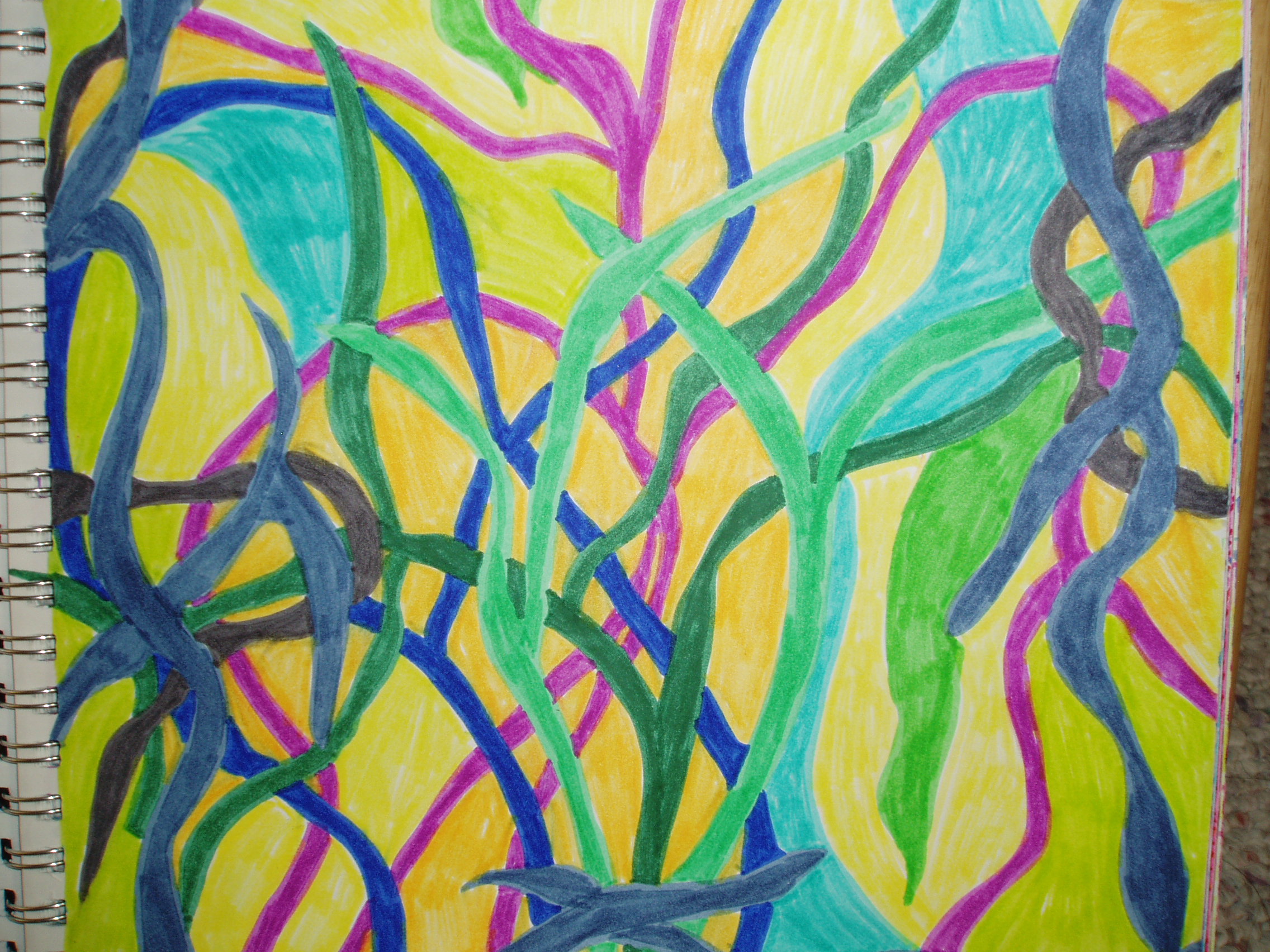
One of the interesting byproducts of all of this thinking and turmoil is that I’ve begun to “doodle.” A few months ago, I started feeling an overwhelming need for color in my life. Rather than suppress the compulsion, I went with it and bought a big pad of sketch paper and a bunch of magic markers.

And I started to draw this . . . .

Since then, I’ve created dozens of the things – each different and each very important to me. The process has become a nightly practice, a meditation of sorts though I might have music or the television on in the background while I work. Some are quite complicated  . . .

. . . while others are more soothing to the eye.

I have two rules with this healing work. I must finish what I start (I have the same rule with my fiction) – and for the moment, I’m still requiring myself to fill the page rather than leaving white space.

Now that I have so many, I’m considering turning some of them into cards or writing about them on my private blog — if I figure out how to photograph/reproduce them well. Even though I didn’t start creating them to make money, they might provide a little necessary income. But the difference with these – and with my writing from here on out – is that it doesn’t matter.

I’m creating.

And that’s enough.


What about you?

Have you explored similar questions?
Do you think creativity is inherently selfish? Is that bad?

Is there a validity correlation between creativity and monetary outcome?

Switching teams

By P.D. Martin

When you talk to agents or publishers about switching genres it’s usually met with jaws dropping, heads shaking and anything from mild disapproval to screams of “No!”

So why is it that switching genres can produce such a strong reaction? You’d think you were announcing to your family that you were switching teams. (If you’re a Seinfeld fan you’ll be following my analogy, but if you’re a little lost, here’s the missing piece of the puzzle: the characters in Seinfeld used to talk about people “batting for the other team”, which meant they were gay rather than heterosexual. And, as you’ve probably guessed, switching teams means changing sexual orientation.) So….

Why does something as seemingly small and insignificant as switching genres produce a jaw-dropping reaction? I mean, it’s just a genre, right? A story is a story. Right? Well, it’s actually more complex than that.

At this point, I should come clean. I’m a chronic genre switcher. (Although you wouldn’t know it by looking at my published novels – on the surface I appear to be a mystery novelist firmly entrenched in the police procedural/forensic thriller zone.) However, I DO believe a story is a story and I often get story ideas for a range of genres. For example, before getting published I wrote two children’s fantasy novels (which remain unpublished). Then for my third book I was deciding between three different ideas, all in different genres! I had one crime fiction, one action/espionage thriller and one mainstream women’s fiction. In the end, as you may have guessed, I chose the crime fiction story and wrote what became my first published novel, Body Count.


But the other novels and ideas have stayed with me, as well as new ideas. Another example…I’m a bit of a closet vampire fiction fan (I know, big confession) and after I’d written three Sophie books I wanted to write a vampire fiction book. But my agent convinced me to stay focused on crime, and Sophie. Why upset the apple cart?

What about my first two children’s books? People often assume it would be easy to get them published now that I’m a published author. To a certain extent the first books an author writes tend to be learning experiences, a way for them to refine their craft. Having said that, I still believe in one of my children’s books; I believe the writing is good enough. Problem is, it’s a different genre. Publishers and agents think of an author’s name as a brand. Promote the brand and keep the brand ‘strong’ by ensuring the author’s name is synonymous with a certain type of book. ‘P.D. Martin’ is crime fiction/mysteries/thrillers. And obviously I wouldn’t want to bring out a children’s novel under the same name anyway because I definitely wouldn’t want 8-12 year olds who enjoyed my fantasy novels to pick up one of my crime books!

So why not publish under a different name? It’s all about time and focus. After all, if you go and write a romance novel or a children’s fantasy series, that’s going to take time away from the mysteries, right? Basically, your agent and publisher(s) try to convince you to focus on writing in your current genre and at least one book a year. It seems that’s the magical formula in publishing. Of course, genre hopping can be more easily done if you can write two books a year – then you’d still be bringing out one book a year in each series.

I’ve scrapped the children’s fantasy novels, at least for now. But I still want/wanted to do something different. After five Sophie novels and one ebook novella, I went back to my action thriller idea and I’ve just finished writing that book.  While it is very different to my Sophie Anderson series, crime fiction and action thrillers aren’t SO different that my new one couldn’t be a ‘P.D. Martin book’. At least, I think it’s okay.

Of course, there are authors who have successfully crossed the divide. One that comes to mind is Nora Roberts. She started off with straight romance novels and then moved on to romantic suspense, writing as J.D. Robb. Although, interestingly, the books bear both of her names, with the byline “Nora Roberts writing as J.D. Robb”. I also noticed from Wikipedia that she’d always wanted to write romantic suspense but was persuaded by her agent to stay focused on romance until she built a following. In fact, it was over 10 years before she finally got her wish to write romantic suspense and it was partly in response to her prolific output.

Scottish author Val McDermid also has a series she writes under V.L. McDermid. However, the rationale is not genre-based because all her books are mysteries. Rather, her V.L. books feature a lesbian protagonist (batting for the other team), while her Val books are considered more ‘mainstream’.

Murderati’s own Tess Gerritsen is another example of an author who successfully switched genres. She started with romantic thrillers and then moved to medical thrillers, then crime thrillers. Interestingly, she HAS written all her novels using the same name and said when she changed from romantic thrillers to medical thrillers she considered releasing them under a different name but ultimately decided against it. Tess sees advantages and disadvantages. When she switched genres, she felt that she’d built up an audience and didn’t want to lose them. However, she says the romance novels continue to annoy her purist thriller readers. “But in the long run, I think it’s been good for sales,” Tess said.

Another author who’s shifted genres but all within the same ‘brand’/same name is Philippa Gregory. Probably most well known for historical fiction she’s also written thrillers and her Amazon bio describes her as the pioneer of “fictional biography”. The Other Boleyn Girl is a well-known example.

I guess these genre-switchers are good news for me…especially given the book I’ve just started working on is best described as a “mainstream women’s fiction”. I know, something different again! (Please don’t shake your head at me.)

Unfortunately my agent passed away late last year and I’m currently on the hunt for a new agent. This means I don’t have anyone to berate me for switching genres or to warn me against it. A new found freedom? But will querying with an action thriller and a work in progress of a women’s fiction make it harder for me to find a new agent? Only time will tell. And maybe I should be on the lookout for an agent who’s also open to children’s fantasy – just to really get their jaws dropping and heads shaking. Come on, people…I’m switching genres, not teams

So do you like your authors to keep their genres straight up? And the writers out there…are you closet genre-switchers like me?

Behold and See, As You Pass By

By Cornelia Read

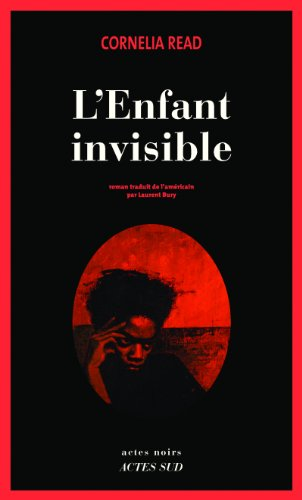
Last Night I went to the Grassroots Preservation Awards ceremony at Plymouth Church in Brooklyn Heights, to celebrate my cousin Cate Ludlam’s work at Prospect Cemetery in Jamaica, Queens. Cate is most excellent, and her involvement with the cemetery is the basis of my third novel, Invisible Boy. Which just came out in French, if you happen to know of any Francophones.

It was amazing to be at the church which was known as “The Grand Central Station of the Underground Railroad.” Henry Ward Beecher was the priest there, and used to hold mock slave auctions to buy the freedom of specific slaves. Also, they have a chunk of Plymouth Rock. And the Brooklyn Boys Choir performed. So the whole thing was lovely. As is Cate.

And today… well, it’s fucking Friday the 13th, to begin with. Which is rather fitting. It’s also the first anniversary of my father’s suicide. It’s been a trippy week, as you might imagine. Lots to think about.

And tomorrow is my 30th boarding school reunion. I missed the 25th because I was on tour for my first novel, which is pretty damn luxury reason to miss something I otherwise would have loved to attend. Especially because I got to do several gigs with the very gracious and lovely Lee Child. It was at one of those that I saw Dad for the first time in nearly twelve years, actually. And we kind of re-bonded after a long hiatus. Which was a nice thing to have happened, considering how it all turned out.

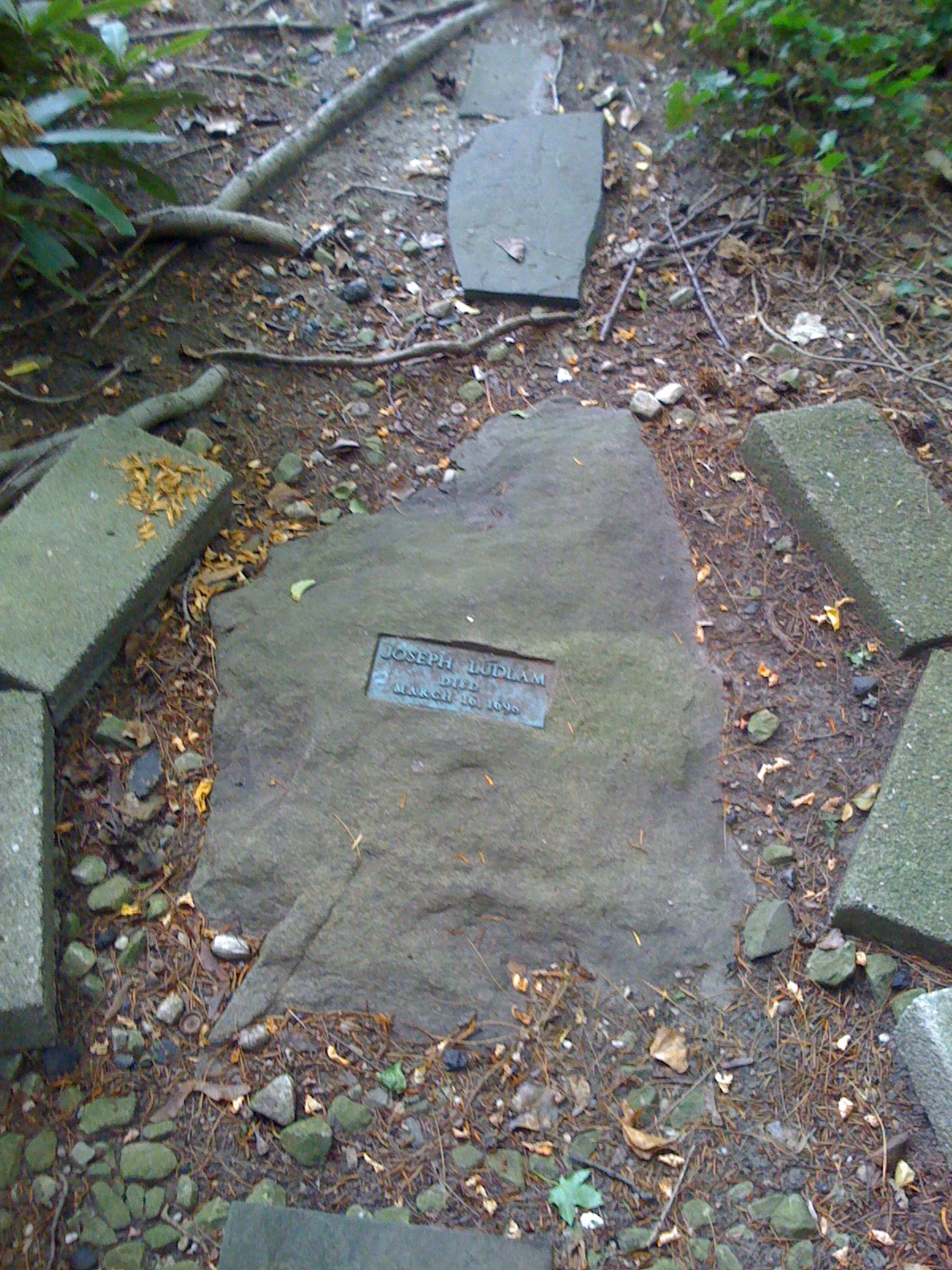
So, sad old times, happy old times. Fuck me, it’s a lot, you know? So I spent a chunk of today at the family cemetery on Centre Island, which is in Oyster Bay, New York. Ludlams and Smiths–my mother’s people. The gravestones go back to the late 17th century. Which is pretty mind-boggling. Wrong family, but I felt like communing with those who’ve gone on to whatever’s next.

And I stopped, as I always do, in front of my favorite headstone, the one with the inscription:

Behold and see, as you pass by

As you are now, so once was I.

As I am now, you soon must be.

Prepare for death, to follow me.

Yeah, baby… memento mori.

So that’s all swirling around in my head today. And I hope I don’t cry tomorrow, because it’s going to be a happy goddamn day and they’re going to dance the Maypole and the dogwood flowers are going to be out.

So fuck death, and sadness, and misery, and all the bad shit. It’s spring, it’s May, it’s gorgeous out. I wish everyone a day of perfect peace and happiness, and only good memories.

Who do you miss, my ‘Ratis? Who would you like to spend the day with today, if you had them back for just a little while. Tell me something good.


No Answers, Just Questions

Zoë Sharp

I have no words of wisdom for you this week. In fact, I was rather hoping you might have a few for me.

You see, I’ve finally decided I need to get my head round the concept of e-publishing. I know this may seem incredibly behind the times to some of you, but on this side of the Atlantic e-publishing has yet to reach the heights of popularity it has done in the States and, frankly, it’s such a huge subject that I don’t quite know where to begin.

Enter any kind of query about it into a search engine and you get a gazillion hits. I begin losing the will to live after the first twenty or so pages. (Coupled to this is the fact we’re on a cripplingly slow internet connection, and I am possibly the most non-internet-savvy person I know. Just ask any of my fellow ‘Rati authors who get regular panicked emails from me when my post is due and I hit a technical snag!)

The more I find out about e-publishing, the more I realise I don’t know, so I thought the best idea was to ask my ‘Rati friends what they knew.

And that’s where you come in – I hope!

I know I’m being cheeky to ask, but who else has the breadth and depth of knowledge that you do? You obviously enjoy reading in digital format, or you wouldn’t be here, so I hope you’ll forgive me for asking what may seem like a set of dumb questions:

If you’re a writer, do you have direct experience of e-publishing? By that, I mean, have you self-published one of your own titles and, if so, what was the biggest hurdle to overcome?

How did you go about the process itself of getting the book out there?

Is it a brand new work, or a book that was previously print-published?

If it’s new, who handled the editing and proofreading?

What platforms did you choose, and how did you make that decision?

Who handled the formatting?

Who designed the cover, and have you changed the cover or the title since the e-book went on sale? If so, why?

Is piracy a problem or do you feel the need for some kind of password-protection to prevent your book being shared?

Of course, just writing the book and navigating the technicalities of putting it on sale are only half the battle. People have to know about it in order to want to read it. I was a reader long before I was a writer, and I continue to devour all kinds of books. Therefore, I’m just as anxious to know the best places for discussion and recommendations. So:

Where do you go to get good recommendations on new e-books?

What annoys you most about authors’ behaviour on discussion forums or social networking sites?

How important are social networking sites like Twitter, Linkedin, Facebook, etc, to finding new authors or keeping up with a favourite author’s work?

Of course, I’m also thinking that maybe – just maybe – I should get an e-reader of my own. That throws up a different set of questions:

Do you have an e-reader and if so, what kind, and how much do you use it?

Or, equally, if you’d NEVER consider an e-reader, why not?

How much of your reading has gone over to an e-device of some description, and have you found any drawbacks? (This is other than the plane problem of not being able to use any electronic device until you get to 10,000 feet.)

Have I asked too many questions?

Should I stop now?

Erm, OK.

This week’s Word of the Week is osteoPORNosis – a degenerate disease …

Characterization: Controlled Hallucination or Craft?

David Corbett 

Inspired by Alexandra’s postings on craft, I’ve decided to chime in with a bit of scribbler wonkery of my own.

Rather than address story, however–which Alexandra, to my mind, discusses as insightfully as anyone I’ve read–I’d like to talk about character.

What follows is the introduction to a book I’m writing on the subject, and I’ll follow up in following weeks with portions from successive chapters. (This being a mere introduction, it’s general and thematic, not practical; the wonkery will follow.)

The book began as lectures for an online course I taught through UCLA’s Writers’ Program, one of the best resources for classes geared to both aspiring and working writers I’ve ever been around: http://www2.uclaextension.edu/writers/

I’m very much interested in what the Murderati crowd thinks on this subject, and what insights and suggestions each of you might have. 

During a 2010 interview in San Francisco, the British novelist Kate Atkinson confided that her characters—who are some of the most unique and engaging in current literature—appear to her imagination fully formed, like dream figures.

Queried on the subject of teaching characterization—specifically, asked what strategy or technique she might suggest to students for bringing a character so vividly before the mind’s eye—she conceded puzzlement, remarking candidly, “I really can’t imagine what that might be.”

Consider this book a humble attempt to inform her disbelief. A writer of Atkinson’s gifts arguably has no need of what appears within these pages, but there are perfectly competent writers who do, or might benefit from it, and they need malign neither their imaginations nor their talent for that.

Of course, it’s not as though Atkinson is off the mark. What every writer hopes for—one might even say requires—is a full embodiment of his characters within his imagination, as though they possess a life of their own.

I realize this makes writing sound like a quasi-functional neurosis, or at least a kind of controlled hallucination—or professional daydreaming. But writers almost universally admit that when things are going well, it’s because the characters seem to act at will, of their own accord.

And yet fluidity of conceptualization guarantees neither richness nor elegance of portrayal. A great many characters who have leapt fully formed within their creator’s imagination have done so precisely because they were facile, predictable, clichéd. Whatever else can be said of characterization, it is absolutely true that if a portrayal falls flat, it is not the character’s fault.

For all but a lucky few, writing requires more than taking dictation from imaginary beings. One must be ready not just to bear witness but to engage the imagination—to ask penetrating, even embarrassing questions of one’s characters, to mold them, remold them, defy them, even destroy and resurrect them, while still maintaining that curious capability to step back, allow them once again to escape their creator’s grasp—dust themselves off, as it were—and reassert their enigmatic independence.

This dialog between deliberate and spontaneous, intentional and unknowable, conscious and unconscious lies at the heart not just of characterization but of all creativity. It is the pulse, the inhalation and exhalation, of the artistic endeavor.

Even at its most realistic, art remains an approach to the mysterious, and working with the depiction of human life can often seem particularly tricky—like fingering smoke. But at their most unique and unforgettable, characters strangely feel no less real to us than human beings themselves—seemingly infinite in their complexity, fathomless in their depth, tangible and yet ineluctable.

That does not mean, however, that the craft of characterization can’t be analyzed, or is resistant to technique. If that were the case, Atkinson would win the match and this book would be pointless.

And yet I make no claim that what you will read on these pages alone can instill an unerring gift for creating memorable characters. Since their appearance in the mind remains a mysterious business, the craft of rendering characters well is by its nature incomplete. Magic once explained ceases to be magic. But the act of conjuring should not be mistaken for what is conjured.

What can be learned in this book are ways to help you bring forth a concrete, compelling and dynamic image in your mind, and further shape what appears. This is no small accomplishment. Without it, storytelling withers into convention, hackwork, formula—worse, propaganda. The lifeblood of any story resides in characters that are, at one and the same time, vivid, unpredictable, and convincing. And the art of creating, shaping, depicting such characters is an exhilarating, at times maddening business.

But at some point in your life you have felt that curious, ineffable stirring in your imagination—the nameless, shapeless volition that seems to both arise from within and yet come from elsewhere, that manageable madness, that quickening pulse of urgent light we somewhat crudely refer to as the creative impulse. It is why you are reading these words. You may even believe it is why you are alive. You craft stories. Whether characters are demons or angels, apparitions or simply mental stuff, they are your inescapable companions. Hopefully this book will help you engage them with greater confidence and deeper insight.  

So, fellow Murderateros–intrigued, confused, inspired, bored? Chime in, pipe up, fire away. Please.

* * * * *

Jukebox Heroes of the Week: You have not lived until you’ve heard the gypsy wedding band Fanfare Ciocarlia play the James Bond Theme:


Get up and rhumba!!

For more on Fanfare Ciocarlia, go here: http://www.asphalt-tango.de/fanfare/artist.html 

Ending the Phrases “I Don’t Read” and “I Don’t Read Women,” One T-Shirt At A Time

by Alafair Burke

Admit it. At some point in your life, you’ve said it, or at least heard someone say it. “I don’t read books by women,” or more harshly, “I don’t like women authors.”

Typically when I hear the sentiment, there’s a slight (and I suppose flattering?) modification: “I don’t usually like women authors, but I love your books.”

Huh??

Appreciative yet perplexed, I started asking readers why they thought they didn’t like women authors. Usually they said it was because the books weren’t hard-boiled enough. Or they said there was too much romance and not enough action.T hey believed that women writers were writing for women and not men.

On the conference circuit, I’ve talked a little bit about the stereotyping of authors, and we’ve had great discussions about male/female differences (or the lack thereof) here on Murderati.  I do believe that publishers and editors are more likely to steer female crime writers toward romantic suspense.  They might also encourage them to write more about female experiences and characters. 

But to say “I don’t read women” is very different than preferring certain types of books over other types of books.  Some of the most inventive, brilliant, and, yes, bad-ass crime fiction being written today comes from women.  Using gender as a proxy for subgenre is a darn lazy way to choose books when your local independent bookseller will happily hand-select books tailored to your individual preferences, and when Amazon tells you if you like Michael Connelly, you might also like Tess Gerritsen, and if you like Harlan Coben, you might also like Lisa Gardner, and when thousands of high-quality reader-reviews are a computer away via GoodReads

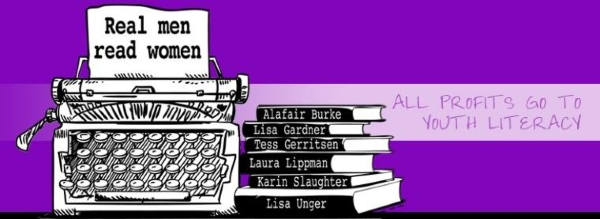
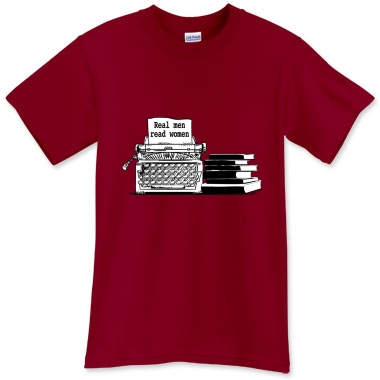
I was talking about the “I don’t read women” phenomenon over on my Facebook wall a few months ago, and I quipped, “I want a t-shirt that says Real Men Read Women.”  Before I knew it, a bunch of my friends said they wanted to buy that t-shirt.  Well, when it comes to my readers, I say, “Ask and you shall receive.” 

But if I was going to get into the tee-shirt vending business, the money needed to go to a good cause.  And as the daughter of a writer and a librarian, I see no worthier cause than youth literacy.  As much as I hate to hear someone say, “I don’t read women,” it’s far worse to hear, “I don’t read.”  And it’s even sadder to hear those words from a child.

Did you know that the majority of low-income families do not have a single book for their children at home?  Teachers have students bringing in phone books when asked to bring a book from home, because it was the only book they had. 

I’m proud to report that bestselling (and super cool) authors Lisa Gardner, Tess Gerritsen, Laura Lippman, Karin Slaughter, and Lisa Unger have lent their names to an odd little effort to end the phrases “I don’t read” and “I don’t read women,” one t-shirt at a time.  Thanks to them, “Real Men Read Women” gear is now available online

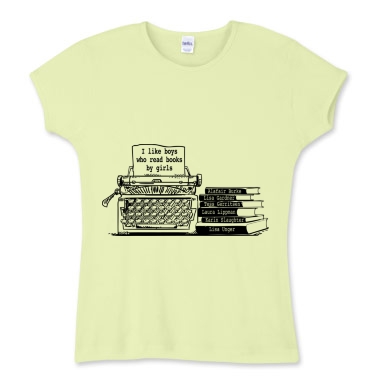
We’ve also got “I Like Boys Who Read Books by Girls” gear.

And though we thought that the use of our names would help bring the crime fiction community to the effort, we also have gear that does not list any individual authors, so you can collect the gear even if you prefer Harper Lee and Dorothy Parker.

All profits will go to First Book, a non-profit organization that provides new books to low-income children.  Order your stuff here.  And if you’re not into t-shirts, mousepads, and water bottles (who ISN’T into that stuff?), please consider donating directly to First Book here.

Thanks in advance for your support and for help spreading the word!

I’ll be raffling off a t-shirt to one lucky commenter.  Just post a comment that relates either to your favorite female authors or your experiences reading as a child.

P.S./B.S.P.  Early reviews for my new book, LONG GONE, are rolling in.  Library Journal, in a starred review, says “Burke’s first stand-alone novel is a fast-paced, plot-driven nail-biter.”  And from Booklist: “Burke delivers a tightly plotted, suspenseful account  . . . It’s very much in the Lisa Gardner vein—strong female protagonist, shadowy villains, intricate and suspenseful story.” (And they didn’t even know Lisa and I are on t-shirts together!)  Still waiting for PW and Kirkus.

You can watch the LONG GONE book trailer here:

THE KILLING

By Allison Brennan


It’s not a secret that I love television.


I gave it up for three years when I first started seriously writing. At the time, I had three kids and a full-time job—the only time in the day to write was after the kids went to bed. The only time I watched television was what the kids were watching. Rugrats, Spongebob, Lizzie McGuire, and whatever was on the now-defunct TV Land. (My two oldest, now 15 and 17, were probably the only kids in their generation who’ve seen most episodes of Little House on the Prairie, the Brady Bunch, and Bewitched.)


When I started watching tv again, I was highly selective. First, I couldn’t stand to sit through commercials. Other than during the Super Bowl, I don’t think I’ve watched a commercial – unless it was something on a kids show. I started buying DVD sets, then got an Apple TV when I moved and love it.


TV has gotten so much better over the last few years. I recently blogged about the BBC program LUTHER which I loved. Edgy, different, with fantastic characters. They only had six episodes, but each was riveting. They’re producing two two-hour episodes for the fall.


It’s no secret that I love JUSTIFIED, another amazing show with a cast full of talented actors who bring these flawed characters to life. The season finale? Wow. Just … Wow. I am so frustrated that I have to wait nine months for Season Three . . . but I’m thrilled to get a third season, especially since LIFE (another favorite show) was cancelled after only two.


I can’t remember where I heard the recommendation, but I decided to buy season one of THE KILLING.


I don’t know whether I love it or hate it.


With LUTHER, I had a complex, character-driven police procedural in an unfamiliar world (the UK) that tackled the issues of justice vs vengeance. John Luther himself is an intriguing character who bends (and breaks) the law for justice. Lots of shades of gray.


With JUSTIFIED, I had an over-the-top adventure with a hero you love and criminals you both love and hate. Boyd Crowder is one of the greatest characters created, a villain who was redeemed in so many ways that we begin to root for him, so when he starts down the dangerous road, we’re still on his side.


LUTHER made me think; JUSTIFIED kept me on the edge of my seat.


THE KILLING made me cry.


My crying in movies isn’t new—FINDING NEMO at both the beginning where the mother clown fish and all her eggs are eaten by a shark, except for Nemo who Marlin protects to the extreme until Nemo rebels and Marlin’s worst fears are realized. And again at the end when Marlin finds Nemo again and thinks he’s dying. I cried in TOY STORY 3 at the beginning when the mom sees Andy’s empty room and tears up because he’s going to college … and again at the end when he gives his toys to another child as he’s leaving for college. But I never, if ever, cry in television shows. They don’t seem to have that power over me . . . until THE KILLING.


It’s a crime show like the others. It had complex and very real characters. More real than the others in so many ways. It’s edgy. It has a political component I spent 13 years working in the California State Legislature, and the nuances of the political subplot are so true-to-life I suspect one of the writers has worked in politics as well. I’ve only watched the first two episodes (so far six have aired) but I couldn’t turn away. Even when I wanted to.


It’s not graphic or violent like JUSTIFIED. It’s not even that fast-paced. In fact, it’s quite methodical. I’m not saying it’s slow, because it’s not, but it doesn’t rely on the “high stakes” speed that other crime shows incorporate.


What captured me—and repelled me—is the emotion. There is so much emotion in each scene that I can’t turn away. But the emotion that hits me isn’t a feeling I want to have.


Fear. Grief. Heartache.


The victim is a 17 year old girl, Rosie Larsen. She goes missing on a Friday night. Her parents are on a camping trip, she’s a good kid and they trust her. They thought she was staying with a friend. No one realizes she’s missing until after school starts on Monday.


The parents begin to expect something when the detective, Sarah Linden, finds the father’s credit card near the victim’s bloody sweater. She doesn’t yet know the identity or fate of the victim, but pretty quickly realizes that it’s Rosie, and she’s likely not alive.


Starting with the parents absolutely believable reaction—worry and anger—followed by the father seeking answers, starting with Rosie’s ex-boyfriend and going to his house to drag Rosie home, only to learn the woman in the ex’s bed isn’t his daughter. I could see me playing out the same reactions, inwardly scared to death that something happened but holding onto the hope and anger. 


But what really did it to me emotionally was when Stan the dad turns up at the location where Rosie’s body is found (through his own, increasingly frantic search) and while talking on the phone with his wife when a car is pulled out of the lake he demands answers. He’s nearly arrested until Sarah comes over and she doesn’t have to tell him the person in the car is Rosie. She turns and walks back and he breaks down sobbing in rage and pain while his wife is on the phone hearing it.


The opening to episode two has the parents identifying the body and that scene also had me in tears even though there was no rage or tantrums, just a quiet truth and grief. The parents, played by Michelle Forbes and Brent Sexton (from JUSTIFIED) made me believe that was their daughter in the morgue. That was followed by separate interviews where they are in shock, particularly the mother, speaking in monotones, knowing the truth but still not believing it.


Worry. Anger. Pain. Grief. Guilt. Sorry. None of these are violent, but they are all powerful emotions.


THE KILLING is one of the best shows on television today because it taps into the deepest fears a parent can have. And it probably affected me more than the average viewer because I have a seventeen year old daughter.


And because it explores these raw fears so truthfully, I almost hate the show. Almost. I can’t stop watching, but I can’t watch one episode after another. I need a break to recover. Maybe watch an episode of JUSTIFIED. Just as riveting, without the emotional pain.


Has a television show, movie or book ever affected you so deeply that you were emotionally wrung out after the experience?