Author Archives: Murderati Members


It’s Justified

By Allison Brennan 

Our dear friend Rob is buried in deep deadlines, and allowed me to take over his blog today to talk about one of my favorite television shows.

I’ve been pleased with the quality of the new crime shows on television these past two years. I’ve long grown tired of the CSI franchise, irritated with Criminal Minds practically since the beginning, and while I still enjoy Law & Order SVU, it doesn’t have the same energy. And the idiot power that be cancelled one of my favorite series after two seasons, LIFE. The “classic” crime shows don’t have the edge, or they’re sorely outdated.

DARK BLUE and DETROIT 187 – both of which I downloaded because of comments on this blog – are fantastic. I edge to DETROIT because some of DARK BLUE feels unreal (and I don’t like the FBI Agent Alex Rice from Season Two-I still have three episodes to watch, so no spoilers-but I’m kind of hoping she gets killed off, or we find out she betrayed the team-which I think she planned to do all along. I just don’t trust her.) But both shows have terrific characters, and that is ultimately why I watch television.
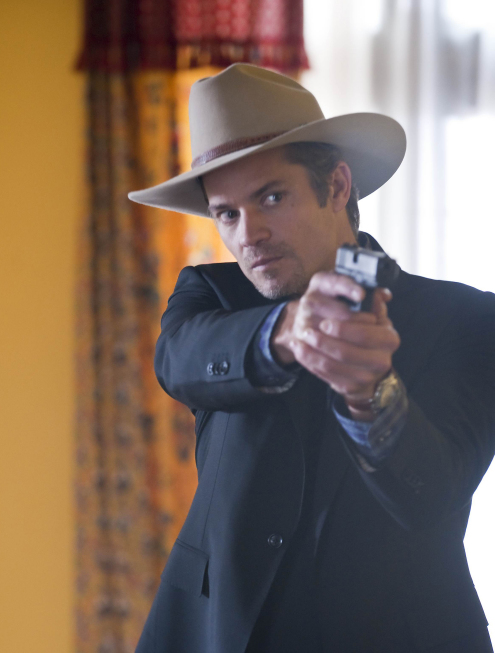
Last year, I was surfing through iTunes and found a new show called JUSTIFIED, an F/X original program. It starred Timothy Olyphant (who I loved in DEADWOOD), and at the time there was only a couple episode that had aired. I was surprised I hadn’t heard of it, but I bought it for two reasons: it was based on a short story by Elmore Leonard, a consultant on the show, and starred Timothy Olyphant. (Whoops, I already said that.)

(As an aside, Timothy Olyphant is welcome to play nearly any of the heroes in my books, but I’m partial to him as Gallatin County Sheriff Nick Thomas who, in SPEAK NO EVIL, is a fish out of water in San Diego as he sets out to prove his brother is innocent of murder. Or Sheriff Tyler McBride, also in Montana, from TEMPTING EVIL. Or FBI Agent Mitch Bianchi from PLAYING DEAD. Or . . . well, he’d fit many of them. Just saying.)

I remember watching the pilot, not really knowing what to expect, only to be floored by the best five-minute opener of any television series I’ve seen. I was more than hooked; I became an evangelist for the series. I remember emailing our Toni and telling her she had to watch it. She’d turned me onto LIFE; I had to return the favor.

JUSTIFIED is based on Leonard’s character US Marshal Raylan Givens and the short story Fire in the Hole which is currently a free read on the HarperCollins website. (A bit of trivia-well, maybe everyone here knows this, but I didn’t until this afternoon, but Leonard-who writes all his stories with pen and paper-wrote Fire in the Hole for the e-book market in 2001.)
Leonard is pretty amazing-over three dozen books, a Grand Master of Mystery Writers of America, and now consulting on JUSTIFIED. His advice to writers is legendary: “Leave out the parts everyone skips.” But my favorite is, “If it sounds like writing, I rewrite.” Which reminds me of another quote-though I don’t remember who said it-“It’s not easy to write a book that’s easy to read.”

The show has the same sharp, story-driving dialogue that Leonard is known for. The timing is perfect, the actors amazingly well cast, and the setting is itself a character. Nothing is wasted, a good lesson for writers.

The pilot episode follows the short story fairly closely, except for the end. In the story, Boyd Crowder dies. In the television show, he’s redeemed.

Or is he?
Raylan Givens (Olyphant) is the star, but first I’m compelled to talk about Boyd Crowder (played by Walton Groggins). When Crowder is introduced, he’s the villain. A racist who blew up a black church-or is he? Why he hit the church with a rocket launcher isn’t as clear-cut as it seems in the beginning. Crowder is definitely bad news. He has a mail-order ordination and quotes (and misquotes) the Bible to justify his white supremacy. His father Bo controls the drug trade in the area, and is working with a nasty cartel. But as the season goes on, Boyd has (possibly) a complete change of focus.

What is so fascinating about Boyd is that the writers on the show redeemed a despicable character in an amazing and plausible way. We, the viewers-and Raylan Givens, who worked with Boyd in the mines-are skeptical of his change of heart. Even now, I’m not certain, but I want him to be redeemed.
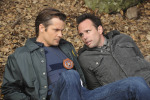
I’d read last year that Groggins wasn’t supposed to become a continuing character, but after the pilot the chemistry between Olyphant and Groggins was so amazing, that they kept him on.

Raylan Givens. His ex-wife (and I hope she stays his ex-wife because I do NOT like Winona) told him in the first episode that he was the angriest man she’d ever met. And his anger simmers under his skin, giving him a perpetual brooding appearance. Where Boyd Crowder is a complex character, Raylan Givens is not. I wouldn’t call him simple, either. There is also a strong cast of supporting characters from Nick Searcy as Chief Art Mullen to the other two US Marshals in the office (Jacob Pitts and Erica Tazel) to the other Crowders, and even Winona (though I don’t like her character, the actress, Natalie Zea, is good.)

In the first season, Raylan spends his time split between protecting Ava Crowder (Joelle Carter) from the rest of the Crowder family, and handling his cases. (I read somewhere that Ava was “self-widowed” which I got a kick out of -she killed her husband, Boyd’s younger brother Bowman, while he sat at his dining table. Some might call Ava a battered woman-and she certainly was when Bowman was alive-but I call her a survivor. I didn’t like her at the beginning of the show, but she grew on me for two reasons: first, she doesn’t pretend to be someone she’s not. She’s not stupid, but she’s uneducated, and while she would be safer leaving Harlan, it’s the only place she knows. And second, she will stand up for herself–at least now she does. She’s scared, but she won’t be chased from her home. She doesn’t always make the right decisions, but she’s not conniving or playing some game. What you see is what you get. Which, ironically, is a lot like Raylan.)
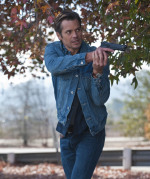
Raylan isn’t perfect. He doesn’t always make the right choices. Sleeping with Ava Crowder when she’s the only witness in his shooting of Boyd Crowder wasn’t a smart move, and set up a lot of the conflict in the first season. The second season starts where the first season left off-but new viewers can hop right in. You’ll get a sense of the first season, but the opener introduces a whole new-level of home-grown bad guys. The last person on the planet I’d want to piss off is Mags Bennett (played by Margo Martindale.) She makes Bo Crowder look like a kitten.

I could talk on and on about the tight plotting, the fantastic choreography, the setting, the action-but I can’t do it justice. You’ll just have to see it for yourself. If it sounds like I’m doing the hard sell, maybe I am. All my favorite shows tend to get cancelled after a season or two, and I’m doing my level best to ensure that JUSTIFIED has a third season.

When it comes to fighting the bad guys, there is no one you’d want on your side more than Raylan. While I wouldn’t call him simple, he’s straightforward. We know how Raylan will react. We know what he’ll do. And we know that it’ll be justified.

Some memorable quotes

Raylan: Alright, I tried to be reasonable. You give me your word in ten seconds or I shoot you in the head.

Reyes: My God, she needs a doctor.
Raylan: She’s needed one for a while, but I don’t think these next two minutes are going to kill her.

Raylan (to sex offender): Normally, I would’ve just shot you myself the second you pulled, but I am doing my level-best to avoid the paper work and the self-recrimination that comes with it, though Lord knows you’re the kind that makes it worth it more.

Raylan (to his father, Arlo, a criminal): Sometimes we have to make deals with lowlifes because we have our sights set on life forms even somehow lower on the ladder of lowlife than they.

Ava: Didn’t the district attorney order you to stay away from Boyd?
Raylan: It was more of a suggestion.

Raylan: I wasn’t in a shootout, I was just near one.

Raylan: I shot people I like more for less.

Winona: You’re a little old to be fighting, aren’t you?
Raylan: Certainly too old to be losing.

Bo Crowder: Howdy Marshall, I sure am glad you could join us
Raylan: Oh, no, no, no. I’m not joining you. You were just leaving.

Hanselman: Next time you’re in Cincinnati, come by the gallery, I’ll show you my collection. I think you’ll be quite surprised.
Raylan: Honestly, I’d rather stick my dick in a blender.
Chief Mullen: Well, that would solve a few problems.

US Marshal: How’s Winona?
Raylan: Oh, she’s still happily married to someone else, thanks for asking.

Raylan: If you’re going to talk, I’ll put you in the trunk and drive myself.
Dewey: I can’t drive handcuffed to the damned steering wheel!
Raylan: You’ll get the hang of it.
I’m in a really good mood after watching a bunch of clips from JUSTIFIED in preparation for this blog (grueling work, I know, watching Timothy Olyphant all night. As an aside, I saw on Elmore Leonard’s blog that two-thirds of JUSTIFIED viewers are men, and I’m like, WTF? I think every romance writer on the planet watches the show, if the status bars on Facebook are any indication.) If you haven’t seen the show, watch it. Download it to your computer or buy the DVD ($22.99 on iTunes; $19.99 on Amazon.) I’m giving away a DVD set of Season One-just comment below. If you haven’t seen the show, tell me if you want to see it-and what is your favorite show so far this year. And if you have seen it, do you have a favorite episode or quote?

In case you missed it, here’s the Superbowl commercial promoting the series–it’s pitch perfect.

And here is the Season 2 teaser

Love and Music

by Alafair Burke

Happy Valentine’s Day, y’all.  Even though this is a pretty stupid holiday — originally linked to romance through a tale of birds hooking up, now propogated to sell greeting cards — I still sort of like it.  Remember those little paper cards we used to exchange in grade school?

Those adorable but culinarily-suspect heartshaped Necco candies?

Those overpriced dinners at overbooked restaurants?  Oh, wait, that’s another entry on the con side of the ledger.

Anyway, I have enough fondness for Valentine’s Day that I wanted my blog to have some connection to the concept of overwhelming swooniness that we’re all supposed to feel this day.  The only problem is that talking about love sort of makes me want to hurl.  Don’t get me wrong.  I feel love.  I still get that little hiccup in my chest when I look at my husband when he doesn’t know I’m watching him.  But somehow I suspect most of you don’t want to read an entire blog post filled with sentences like that last one.  Ick, that’s sweeter than those Necco wafers.

A writer’s cynicism of the words we typically use to explain love might strike some as odd, but I think it stems from too many greeting cards, bad romance scenes, and sappy lyrics.  Love pulls you up weightless into the fluffy white clouds, turns you inside out, and then throws you on your ass, but in a good way.  Love is also so subjective that the previous sentence might not mean anything to anyone besides me.

I was trying to identify any other experience that feels like being in love.  The closest I came was that feeling you (or at least, I) get when in the presence of a truly magical musical moment.  I don’t simply mean ones reaction to a sappy love song (though this one happens to be a fave).

Every once in a while, I am so pulled in by musical talent, I can’t move.  I don’t want to breath, just in case the air moving into my lungs interferes with the magesty of that moment.  I want to stop time to linger in the perfection.  I want to be able to experience it again and again.

Have you ever had that feeling? I hope for your sake the answer is yes.

I suppose it would be impressive to say these moments came during O Patria Mia from the Verdi’s Aida.  But that’s not how I roll.  (In fact, I don’t know what O Patria Mia is.  I just found it on Google.)

My most recent love and music moment came last week when I saw Prince in concert at Madison Square Garden.  His incredible talent, the memories of listening to that music in high school, and my happiness about seeing him in New York with a good friend all culminated in one of those all-out weepy, goose-bumpy moments.  (Even though bootleg video won’t do the performance justice, I went hunting for a clip, which will probably be pulled by his copyright lawyers by the time you read this.)


Another performance that had me swooning was Fantasia’s tribute to Patti LaBelle.  I know.  It sounds as bad as a puppy on a unicorn, but, damn, that woman can sing.  And somehow through all those notes, she manages to convey the utter respect and love she has for Miss Patti.  Check them out and then try to tell me you don’t feel it.  (Make sure to hold out for the mutual lovefest starting at 2:04 and Patti’s awesome move at 3:39.)

And don’t forget Mary J Blige’s emotional performance of No More Drama at the 2002 Grammy Awards, which brought both the singer and members of the audience to tears. 

Maybe I’m totally out there, but the feeling I get watching a singer put every part of himself or herself into a single experience makes me feel … love(ish). 

So, here are my questions for the day:

1) Your verdict on Valentine’s Day: yay or nay?

2) Any musical performances that induce tears, chills, or paralysis?

The Creative Process

By Allison Brennan


Tess’s blog on Tuesday reminded me of a blog I posted last year on Murder She Writes about how manuscripts change. I had blogged about one scene from rough draft to final draft. I’d picked a scene that had stayed in the book, not one I had cut. Most of the scenes I cut either on my own or during the revision process I wouldn’t want to share because they lead the reader down the wrong story path. The exercised showed that the first, lean draft (for me) can have the same rhythm and content and voice . . . but be so much stronger with layers and depth and editing.

Revisions usually make an “okay” scene stronger. I love revisions—not just my own edits before I turn the manuscript into my editor, but editorial revisions and even line edits which, for me, tighten and strengthen the story.

Every writer has a different process, and most of us are stifled when our process is forced to change. Our process is as much part of writing as the writing itself. Meaning, some of us plot extensively, some of us plot loosely, and some of us don’t plot at all. When I say don’t plot I mean it literally—I start with a premise or situation, a “What If” scenario, and at least one character I kind of know (or think I do) and start from there. This is why my beginnings (the first act) take me twice as long to write as the second and third acts combined. I write and rewrite until something clicks, then I finish the rough draft, usually with only light editing until my editor sees it. I usually revise once with her notes (sometimes extensively, and sometimes not), then another clean-up edit to tighten, fix errors, add more layers to a scene if necessary, ultimately making sure each scene is as strong as it can be.

Some writers—published and unpublished—love to tell people that their process is the best way, or the “right” way, or some other such nonsense. I’m telling you right now: my process is mine. It’s not better or worse than anyone else’s (though I sometimes wish it were easier . . .) The process works if you put words on paper (or screen) and write the best story you can. Process isn’t talent, it’s not voice, it’s not anything except how you create.

When I get the page proofs back, I don’t make major changes (though I have been known to add or cut a scene or three and I probably make a mark on nearly every page.) I read the proofs out loud because it helps me make sure the rhythm of the book works. (See Alex’s fabulous post yesterday on voice—the rhythm of the book is part of the author’s voice.)

I’m not looking for how the book sounds as much as how it feels when I read it. I’ll catch the obvious typos and repetition, but more important, I’m making sure the dialogue is natural, that the characters aren’t just talking heads but there is action even in the most sedate scenes. That when I’m in deep POV, I feel like I am that character. If I need to add an internal thought here or there to deepen the POV and make it more immediate, I will.

Another thing I do is take a visual assessment. This isn’t conscious on my part, but when I see a lot of text on a page, I’m looking for obvious breaks that I have missed. This is where I’ll break apart paragraphs—sometimes I’ll add a single sentence paragraph between two larger graphs if I missed it before. This might be weird, I don’t know, but see my comments regarding process. It’s mine, it doesn’t have to be yours. I don’t like big blocks of text.

My “clean” rough draft, which is usually what I send to my editor knowing I’ll be working on revisions, is usually short. It’s mostly the meat of the story with no dressing. My descriptions are vague, if there at all, and my ending is usually rushed (because I’m excited to figure out crime!) Case in point: my first draft of LOVE ME TO DEATH was 78K words. My revised draft was 117K, and the final draft 120K. My first draft of KISS ME, KILL ME was 86K, my final draft 96K.

And what is my point? That writing is rewriting. That very few writers, if any, write a perfect first draft. Writing is practice. I believe in writing every day, because for me if I don’t write for a day or two, it always takes me a day or two to get back into my rhythm. If I write every day, I can keep up the momentum for a longer time, and my final product is always better.

As I was writing LOVE ME TO DEATH, I knew it was about a vigilante group killing sex offenders. Originally, I had the group using Lucy to draw them into a trap ala Dateline’s TO CATCH A PREDATOR, but instead of exposing them on film, the suspected sex offenders were killed. But I had a bit of a moral dilemma with the set up (innocent until proven guilty.) Lucy was having some issues with it as well, and no matter how I wrote it, she was either too cold and criminal, or stupid because she didn’t catch on.

I was wrestling with that problem when I toured Folsom State Prison with my FBI Citizens Academy group (fellow thriller writer James Rollins was also there.) During the tour, the warden told us that with the tight budget cuts, parolees were rarely, if ever, sent back to prison because of parole violations. They usually had to be convicted for a new crime before they went back (while waiting trial, most accused are in jail—funded by counties—rather than prison, which is funded by states. Though I’m sure all states have different processes, I only know mine.)

That tidbit of information solved my problems. Lucy would have no problem targeting paroled sex offenders. Sex offenders, particularly those who prey on children, have a high recidivism rate. She happily set them up to go back to prison . . . and when she found out some of them were being killed, she could have a moment’s pause. That maybe it wasn’t such a bad thing.

Of course, vigilantism breeds anarchy and it’s a slippery slope to complete lawlessness.

My story took off, and also gave me a strong sub-plot that had theretofore been weakly connected to the main story.

What did that revelation ultimately mean? You got it—a near complete rewrite of the first 100 pages of LOVE ME TO DEATH, before it ever went to my editor. But the story ended up so much stronger, it was worth it.

Don’t be afraid to make mistakes. Practice is part of everything we do. Musicians practice daily. Artists draw daily. Athletes exercise daily. And often, what they all do when they’re not practicing or playing, contributes in some way to their talents. I wasn’t writing when I took the Folsom Prison tour, but it was instrumental to my creative process.

Next month, I’m going on another fun FBI excursion, this time back to the former McClellan AFB to participate in SWAT training exercises. I was a “victim” last time . . . I might ask to be a bad guy this time. It might just fuel my muse.

That elusive voice

by Alexandra Sokoloff

I accidentally agreed to read some first chapter submissions for an upcoming conference (or the conference organizer figured out I’m a Pisces and just pretended I agreed to it so I’d have to do it, which actually would work like a charm.  Hmm… and that would be just like him, too.)

This is not something I ordinarily do because I’m so much more comfortable teaching plotting and structure – and rewriting! – than I am teaching more basic writing writing, which I tend to believe can only be self-taught.  I know how to write because I spent however many dozens of years journaling, starting at age four (my mother was a teacher and insisted that my siblings and I write every day.  First a sentence, then a paragraph, then a page.   Let me tell you – it worked.).  That’s not something you can recreate in a workshop, any more than you can teach someone to play the piano in a workshop or teach someone to dance or paint in a workshop.  The authors I know ARE writers; they may just have gotten around to writing a first book, but inevitably, in whatever way, they have been writers for dozens of years.

So I am reading these first chapters, and realizing that I am absolutely right – I cannot teach these people to write.   Some of them can write already, and some of them can’t.   I can make suggestions to all of them to improve what they have handed in to me.   And actually the suggestions would pretty much be along the same lines to all of them.  But the ones who can write will take my suggestions and end up with better first chapters – or they’ll ignore me completely and their chapters will still be good, possibly better than they would be if they tried to rewrite them.

And the ones who can’t write can take those suggestions and incorporate them until the cows come home and – I’m afraid – they are still never going to have chapters that would be of any interest to any editor.

These are not terrible writers I’m talking about, either.  The writing is not uneducated, or laughable.  That’s sort of what makes this kind of thing so painful to see.

And it occurs to me that this is mainly what editors are talking about when they talk about VOICE.  I think there’s some confusion on this issue because a lot of times when people talk about voice they’re talking about how a character narrates a story – especially those first-person narrations.   If they’re clever and witty and self-deprecating or use a lot of hip words, then a lot of people call that “voice”.    I also hear “voice” used to describe an author’s unique storytelling –I mean the author’s character, or persona, as it comes through the story.

But there’s a more important voice that makes a book – and I mean literally MAKES a book.  And that is the way an author puts a bunch of images, actions, thoughts, emotions and sensations into an order, in words, that puts a reader into the action and makes a reader have the exact experience that the characters are having – just like being inside a dream or a movie.

That is the real and completely elusive magic of storytelling – that an author can make all those disparate elements play as an engaging, unbroken whole – that literally becomes more important to the reader than their own consciousness.   Because it’s true, isn’t it?  When we read, we give up our own consciousness, our ego awareness, to the book, to the story.

I don’t know if this makes any sense at all, but voice is like the unspoken narrative that makes a dream seem to make sense at the time that you dream it.  It gives the action cohesion.

Okay, here’s another analogy.  I was a theater director, mostly musical theater, and I’ve sat through many an audition.  This is always an excruciatingly tense thing in the first couple of seconds of a song, because you do not know if the person in front of you is actually going to be able to sing or not.  You are bracing yourself – physically bracing yourself, for the very real possibility that this person will not be able to pull off a song at all, which is actually very sad and painful.

Most of us now get to have this special experience with televised American Idol tryouts, right?

And when that person starts the song, and they really can sing, there is first a relief, and then a relaxation, a giving over into that person’s hands, because you know they’re not going to drop you. You can commit to that song, that performance, because of the singer’s confidence.  They’re going to do the work and make it not seem like work, and carry you along.

Same with writing.  The first page, the first chapter, has to convey that confidence in storytelling that will make the reader relax and give themself over to you.  They are putting themselves in your hands. But the thing that makes them have that trust is VOICE.

I would not exactly say that ALL published authors have this skill, or gift… not as far as I’m concerned. But they obviously have that gift enough to make other people (agents, editors, readers) give their consciousness up to their stories.   And most of the time, annoying as I find these authors, I would have to reluctantly concede that they have at least that much skill – compared to unpublished authors.

I’ve taught enough now to know that some things about writing CAN be taught successfully, so I find this question of voice very interesting, and, like most unknowns – scary.  

Is there a way to teach it, I wonder?   Or is it like perfect pitch – you can fine-tune it, but if you don’t have it, you don’t?

Now, there are obvious, easily definable problems with some of these first chapters I’m reading.   I think a first chapter carries the whole weight of the book with it.  It has to convey mood, tone, genre, foreshadowing, stakes, urgency  main character need and desire, setting, theme (especially, especially, ESPECIALLY theme) – and a dozen other things I’m not awake enough to list – and the absolute sense that this is a journey that we want to take. (Note I didn’t mention “a great first line”.  I am not one of the cult of the first line). 

And a first chapter doesn’t have to be explosive or perfect to convey those things, either.  If an author has written a book worth reading, the first chapter will communicate that (partly because if it hasn’t, the author will have rewritten the chapter or started over with a new chapter that introduces the book convincingly.)

So I can tell these writers that they need to be conveying mood, tone, genre, foreshadowing, stakes, urgency, main character need and desire, setting, THEME, etc.,  in their first chapters.   And I can make very concrete suggestions about how to bring those things out.   And I think I’ll make that my next blog post, as a matter of fact.

The problem is, I don’t think that’s going to do a thing to improve the voice of a book.

And – I’m not sure if I’ve ranted about this before, here, but I think contests put far, far, far too much emphasis on endlessly rewriting the first three chapters when there’s no book there to begin with.

Maybe the only advice to give people who haven’t discovered voice is – keep writing.  Write whole books.  And find a critique group that will let you read your work aloud, where it becomes immediately evident if voice is there or not.

Except that even in that situation,  if a writer doesn’t have voice, it doesn’t seem evident to them at all.

Sigh.

So here’s the question and discussion for the day.   Authors, can you actually tell us how you learned voice?   Have you ever encountered a teacher who was able to teach voice (or even adequately explain it)?    How do you define voice?    Readers, do you read for voice, and how would you define or explain it?

And Rati, if you have posts on voice that I can link to here, I think it would be great to have a compilation on the subject.    I was able to find Allison’s here:

Discovering Voice

Alex

(Oh, and remember we have Captcha enabled now because of recent deluges of spam… sorry about that, but you have to enter the letters to post comments.) 

LIVING IN THE MANIC

By Stephen Jay Schwartz

“Mania: excitement manifested by mental and physical hyperactivity, elevation of mood; excessive or unreasonable enthusiasm.”

Yep. Yeah, that’s where I’m at. I’m fuckin’ manic.

I never thought of myself as a “manic-depressive” person, but these past couple years have put my moods to the test. I saw huge “highs” with the publications of my first and second novels and all the goodies that came with that. This includes the friendships I’ve made with hundreds of authors and readers. But the “lows” were pretty tough. I struggled with foreclosure and ultimately lost the home my wife and I built together. I pounded my head against the wall in a day job that left me unfulfilled five days a week. Each day at the office brought a depression that dragged into my evenings and weekends, my only time to write or hang with the family. The only way I could finish my second novel, BEAT, was to give my employer a doctor’s note saying I had to take an immediate, two-week medical leave of absence in order to rest my heart. I spent those fourteen days writing twelve-hours a day in an effort to finish the book. When it was over I handed the book to my editor and went back to the day job, nursing my wrists for the first carpal tunnel I’d ever encountered. I think my boss was surprised that I didn’t look like a guy who spent two weeks on mandatory bed-rest.

2011 initiated the Big Change. With the short-sale of our home finalized, my family and I were able to set ourselves up in a stable little apartment in a beautiful area not far from the beach. One major stressor was removed from my life.

And just before that, near the end of 2010, I started interviewing for a screenwriting assignment for a big, 3D zombie movie. I read different drafts of the project and delivered notes on how I would approach a rewrite. The notes reverberated with the producers and director and I got the gig.

There was no way I’d be able to write a screenplay and a novel and keep a full-time day job. I had to evaluate what that job gave me—security and health insurance on the one hand, depression and heart palpitations on the other. It was time to give it up.

It was a strangely exhilarating feeling, walking into the same office I’d gone to every day for ten years and walking out a free man. It was very much like that moment in “Jerry Macguire,” when Tom Cruise was listening to Tom Petty and the Heartbreakers’ singing “Free Falling” on his car stereo. “I’m freeeeeeee….free falling!”

Stressor number two was removed from the list.

I didn’t think it was possible to live a manic-depressive life without the depressive. But now that I’ve closed the file on the house and the day job…well, I’m feeling pretty good.

What I’ve learned is that I rather enjoy living in the manic. Okay, maybe we’re supposed to have a calm, balanced life. Someday I’ll move to Tibet and meditate my way to Nirvana. But, for the present, I reside in friggin’ Los Angeles and I’m living the dream. I’ll take that adrenaline hit and ride it on out.

I’m a long way from completing my third novel, however. My goal is to write two novels and a screenplay this year, and by God, I’ll…really try to make that happen. I’ve done some significant research for the book, but not enough. I’ve written the first fifty pages a couple times and thrown them out. It’s a process, but, thankfully, now I’ve got time.

It’s only been one month and I’ve already forgotten what the date is–I’m barely aware of the days of the week anymore. And, since my favorite writing cafe is open 24/7, I don’t even need to know what time it is. My world has become magnificently malleable. If I wake up at 2:00 in the morning with an idea, I can get up and follow that trail to its end, crashing out on the sofa again at 10:00 after putting in an eight-hour work day. The last time I had that kind of flexibility was when I wrote my first screenplay at age twenty.

But I’m not twenty anymore and I’ve yet to wake up at 2:00 am to tackle the Muse. My day begins when I drag myself out of bed, about an hour after the alarm clock sounds. I’m gonna have to work on that. Then I toodle around on the computer, take the dog for a walk, take a long shower, and before you know it I’ve arrived at my cafe for the day, at 11:00 am. Again, not good. Gotta get there by 9:00 am sharp. Fortunately, I can work until 10:00 pm, which gives me an eleven-hour work day if I start by 11:00. Or, if I get a later start, I can go to the 24-hour cafe and pull an all-nighter. But I’m not going to the gym, so I have no stamina, which means that I end up falling asleep at the cafe, my mouth open, spittle drooling from the corners of my mouth. If I’m going to write like this I’m going to have to get back in shape.

I’ll figure it out. Give me another week or two and I’ll have it down. The biggest challenge I’ve got is juggling the novel with the screenwriting assignment. The script is definitely one thing I don’t want to fuck up.

Having been a development executive in the film business, I recognize just how good this screenwriting opportunity is. Most of the time screenwriters find themselves writing and rewriting for producers or studio executives who hope to attract a director or actor to their project. When these “elements” come on board they usually have their own ideas for the script, and they often have a screenwriter in mind to do additional rewrites. In this way, screenplays can go through years of development before landing in production, and the vast majority never get that far. But I’ve stepped into a project that’s slated to go into production this summer, with a talented director attached and the financing in place. And I love the producing team—they’re all incredibly bright and inventive. In all the years I did development work I rarely saw such a positive environment for creative collaboration.

Another fun perk is that I get to bring my kids to the studio and show them the 3D technology that will be used in the film. I’ve already seen it, and it’s amazing. I was never a big 3D fan until I saw “Avatar,” and then I thought, “I don’t ever want to see a movie that doesn’t look like this again.” Instead of leaping into my lap, like most 3D films, “Avatar” invited me to join its world, to walk among the foliage and see the butterflies and other creatures up close. The producers making this film are doing the 3D conversions for films like “The Matrix” and “Titanic.” And if James Cameron signs off on their work, you know they’re good. I saw the 3D conversion they did for a Jane Austen-type period film and it made me feel like I’d just walked through a cathedral in 19th Century England. When I told the producers I was surprised to see a 3D period film they said, “3D is the way we see the world. 2D is the anomaly.” It’s very cool to be joining a technological revolution in its infancy.

So, come on, now. I’m spending my days reading and writing at beach cafes, taking meetings in Hollywood, hanging with my wife and kids. And since an apartment is easier to clean than a house, we can now make the place presentable for babysitters. My wife and I just had our first “date night” in two years!

Kick me if I sound like I’m gloating. I’m really not. I’m just truly happy for the first time in years. Like a nut-case I’m bumping into walls and tripping over my feet. It looks a lot like “excessive and unreasonable enthusiasm.” If the psychologists want to call that “mania”…so be it. I wouldn’t want it any other way.

Read Me A River

by Brett Battles

I just finished the draft of my latest WIP, and am feeling a little tired. Make that a LOT tired. Since November 18th, I’ve actually written two books (one all the way through several rewrites, the current one with no rewrites at all yet), and did a thorough rewrite pass on a YA novel I wrote last summer. Yeah, I write fast. The thing is, we all write a different speeds, and have different amounts of time we can dedicate to the process. So it’s not a “wow,” or a “how do you do that.” It’s just an “is.” That’s all. To achieve this though, I keep this insane schedule (not my words, I’ve been told by many people.) The result is that I basically wipe myself out, day after day. Not great for the old social life, but works well on the writing front.

Anyway, this is a long way around for me to say I’m going to go with an easy one today. Something fun.

It thought we could talk about recent reads. I’ve read a string of winners since the holidays, which is not always the case. I’m on number six in a row, and have at least three more lined up that I have high hopes for! This makes me very, very happy.

First up: THE HUNGER GAMES/CATCHING FIRE/MOCKINGJAY by Suzanne Collins

Several years ago, I read the book BATTLE ROYALE by Koushun Takami (translated by Yuji Oniki) about a group of school age kids that get picked against their will by a fictional oppressive government in the future to partake in a game of sorts where they have to kill or be killed and the winner is the last one standing. I absolutely loved it. Have read it twice. Well, over the holidays, I finally read THE HUNGER GAMES, about a group of school aged kids that get picked against their will by a fictional oppressive government in the future to partake in a game of sorts where they have to kill or be killed and the winner is the last one standing. Yep. There’s no denying that the plots are…eh…similar, down to the fact that two of the last players standing are in love (or appear to be in one of the two books.) But even so I loved this book, too! And the plot similarity didn’t bother me. I think both books rock. (One of the big differences is that in THE HUNGER GAMES most of the deaths occur off screen. Not the case in BATTLE ROYALE.) Anyway, I loved Collins so much, I rushed out and bought both of the sequels (CATCHING FIRE and MOCKINGJAY) and devoured them, too. The first was the best of the series, but the others were good, too. Big recommend from me. (If I find out BATTLE ROYALE has a translated sequel – and yes, I know there was a sequel movie, I’m talking book – I’d read it in a heartbeat.)

Next: THE REVERSAL by Michael Connelly

How can you not enjoy anything Connelly writes? I loved the combo of Haller and Bosch in this one. Well worth the read.  

And then: THE SENTRY by Robert Crais.

Yep, I went from one L.A. based series to another. That was actually kind of fun. In fact there were scenes in both books set in areas that I frequent a lot. I always love that. As far as THE SENTRY goes, I just have to say I would never want to have Joe Pike on my ass. You might as well purchase your grave marker right away. Not surprisingly, this was another page turner.

And, finally: THE WANDERING GHOST by Martin Limon

This might be my favorite of the bunch. It’s from Limon’s Sueño & Bascom mystery series about two Criminal Investigation Sergeants in 1970s era Korea. They try to do the right thing, but are also great at getting themselves into trouble. WANDERING GHOST is no exception. I love this series, and Limon is such a good writer that I can’t wait to pick up another one of his. Couldn’t recommend this series more.

There’s six recommendations (seven if you count BATTLE ROYALE) from me to you. So whatca’ got for me? 

Great Expectations, or, Let Me Take You To the Movies II

by J.D. Rhoades

This past weekend, I finally got around to seeing THE KILLER INSIDE ME, in which Casey Affleck starred as Jim Thompson’s sociopathic sheriff Lou Ford. Not only that, I got to see it on the brand spanking new Blu-Ray player I’d gotten for my birthday (thanks, hon!).

Seeing the movie  reminded me that I’d written about it back in June as one of the films I’d been looking forward to seeing over the summer. Well, you know how it is. Best laid plans an all that. But I did end up seeing it, as well as most of the other ones on the list. I went back and looked at that June 2 post, just  to see…how did my expecatations hold up?

THE KILLER INSIDE ME

What I said at the time: I didn’t think Affleck could pull off Patrick Kenzie in GONE BABY GONE, but damned if he didn’t do it, and I do love me some Jim Thompson. And it’s got Jessica Alba, apparently getting nekkid. So this one’s on my list.

    Yes, Jessica does get nekkid, as does Kate Hudson, and they both get way kinky with Casey Affleck. It was a pretty faithful adaptation of Thompson’s book, which means it was dark, twisted, nasty, and one should not expect anything even close to a happy ending. Some of the violence was difficult to watch, but then, it was supposed to be. The people who decried the movie for its portrayal of violence against women were, I think, missing the point. Yes, it was ugly. Ford is an ugly character who does ugly things.

So how did I like it? Well, I reacted to it the way I do to Thompson on the page: I was horrified, but couldn’t look away. My only complaint was Affleck’s high, grating Texas twang, which came close to sounding whiny.

WINTER’S BONE:

What I said at the time: Oh boy oh boy oh boy. I cannot wait for this movie. I don’t know anything about the director or any of the near-unknowns starring in it, but  Daniel Woodrell’s book was as dark and brutal a slice of redneck noir as you’ll find anywhere. I definitely wouldn’t recommend it as a light and frothy date movie.

       This movie was freakin’ awesome, from the Oscar-worthy performances of Jennifer Lawrence and John Hawkes, to the absolutely note-perfect re-creation of the lives of the desperate and dirt-poor in the rural South. No, definitely not a light and frothy date movie, but the distilled essence of redenck noir. Riveting. 

PREDATORS

What I said at the time:  Why? Why does this this movie exist? What was wrong with the original (the only movie to star two future state governors) that someone felt it needed to be remade? Is there any way Adrian Brody can pull off deathless lines like “If eet bleeds, ve can kill eet” and “GET TO DA CHOPPAAAH!” with the same panache as the Governator? We think not.

Okay, Adrian Brody’s no Ahnuld, and no one in the band of killers dropped onto the Predator Planet to provide sport for the dreadlocked aliens possesses  the sheer badassery of Jesse Ventura or even Bill Duke (although the always wonderful Danny Trejo comes close, he’s out of the move far too soon). No fall-on-the-floor funny lines like the ones in the original, although there are some sly references to other movies sprinkled throughout. Still, all in all, a decent action flick, and better than I expected.

GET HIM TO THE GREEK

What I said at the time: Looks an awful lot like a rip-off of the 1982 film MY FAVORITE YEAR, another movie about a hapless underling trying to keep a wacked out, substance-abusing  star together long enough to make the big show. Russell Brand plays the Peter O’Toole role in the update, and while Brand’s no O’Toole, he’s still pretty damn funny, as is Jonah Hill. A definite maybe.

I laughed. Sometimes I laughed hard. The leads did not disappoint, and some of the send-ups of rock-star excess were a scream, like Brand’s disastrous “African Child” video, which one magazine called “the worst thing to happen to Africa since apartheid.” And who  the hell knew that Sean Combs/Puff Daddy/P. Diddy/whatever could be so funny? I walked around for days singing “stroke the furry wall…”

THE EXPENDABLES

What I said at the time: How could this possibly go wrong? Well, plenty of ways actually.  It could be a mess. It could also be the most brain-meltingly awesome movie ever. I have got to be there to find out.

Not a disaster, but not brain-meltingly awesome, either. Mostly Stallone, with a little Statham, while the other action stars weren’t’ really given enough chance to shine, especially Jet li, who was just wasted here. Competent, but disappointing considering its potential.

So what have you read/seen/listened to in the past few months that either exceeded or disappointed your expectations? 

What happened to the book I planned to write?

by Tess Gerritsen

A few days ago, I finally finished the fifth draft of THE SILENT GIRL,  typed “The End” and emailed the manuscript to my agent and editor.  Then, as is my custom, I attacked the detritus that’s accumulated on my desk over the past 12 months during the writing of that book.  Into the rubbish basket went notes and stray scraps of papers, photocopied articles, etc.  Underneath it all, I came across my long-lost yellow legal pad on which I had jotted the original plot outline for THE SILENT GIRL. These were my personal notes to myself, notes that no one else has seen, with a sequence of proposed events in the story.  They might as well have been written by a Martian, because I didn’t recognize any of it.  That’s how different the finished story turned out from anything on that yellow pad.  

Before I turned in the manuscript, my husband read it and he asked, “How did you come up with all the complications of this story?  At what point did you know about the final two twists?  When did you know who the bad guy was?”  I couldn’t answer the questions because I couldn’t remember.  Writing is such a disorganized process for me that sometimes the most surprising twists occur on the fly, right as I get to that point in the story.  And the bad guy doesn’t become obvious to me until he suddenly unmasks himself.  I can’t tell you how these things reveal themselves.  I can’t tell you how character A morphed into character B, only that it happened somewhere between draft 1 and draft 2.  Which is why holding onto all those drafts becomes important to future scholars who might want to dissect an author’s writing process.  Because I’ve promised my papers to the University of New England, I’ve saved and stored all the drafts of my manuscripts since THE SINNER.  Whether anyone will be able to decipher my process is a big question; even I don’t know how I did it.

But here’s an example of how I first approached  writing my novel THE KEEPSAKE, about an “Egyptian” mummy found in a Boston museum.  When they discover she has a bullet in her leg, they realize she’s not Egyptian at all, but a modern murder victim.  That’s all I knew about the story.  I didn’t know who did it.  I didn’t know why the killer did it.  I didn’t know who the suspects might be.

So I jotted down notes, which I happened to save.  I don’t remember writing them, so all I can do is tell you what was on the page.

At the top, I’d written five possible motives for the killer:  JEALOUSY.  GREED.  DESIRE.  FEAR OF DISCOVERY.  REVENGE.  Nothing too original.

Then come notes that seem to be off the top of my head:

— A crazy grad student who got ignored by all the girls — now getting back at the famed archaeologist for stealing his girlfriends?

— Archaeologist’s third young wife is gorgeous and now being stalked?

— Archaeologist believes he accidentally killed someone years ago in Egypt — turns out his victim is still alive and out for vengeance?

— Archaeologist’s son killed someone and father is covering for him?  He’s an evil boy who hasn’t spoken to his dad in years?

— Group of young archaeologists in desert witnessed the death of a local child and archaeologist paid them to be silent.  Years later, these witnesses are being killed one by one, each victim killed by his or her own area of expertise?  (Mummies, shrunken heads, bog bodies)

The list of possible victims/killers/suspects goes on and on for three pages.  After I wrote these possible premises, I gave up on trying to settle on one, and just started writing.  I opened the book with Maura observing the CT scan of a mummy, and the discovery of the bullet.  I had no idea where the book was going.

 Those of you who’ve read THE KEEPSAKE (KEEPING THE DEAD in the UK) will know that the final book ended up completely different from anything on the list I’d jotted down.  Because as I wrote the book, better ideas kept popping into my head as I wrote the book.  Ideas that didn’t occur to me despite days of brainstorming at my desk.  Ideas that only showed up after I’d laid the groundwork of the first few chapters.  

I’ve tried and tried to be more organized about my writing.  I’ve spoken to authors who plot every chapter on notecards and don’t start writing the book until those notecards are in order.  I’ve spoken to authors who work off 50-page outlines, with every plot point logically thought out.  I envy them.  

Instead, I have five drafts of a book that kept changing on me, and an initial set of notes that appear to have been written by someone else.   And the end result is a plot that I don’t remember devising.


Meet Joshua Graham

by Pari

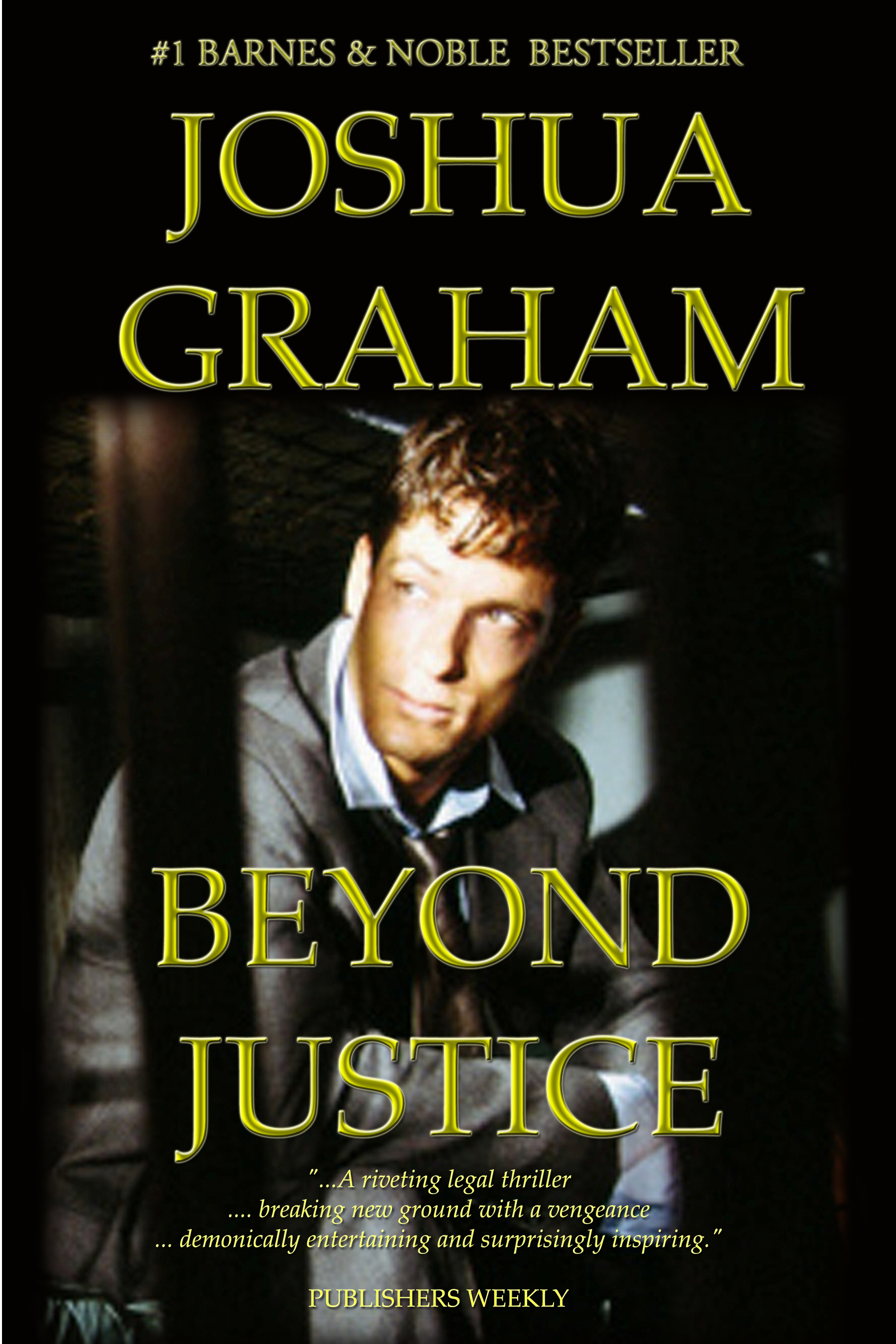
I met Joshua Graham a little more than a year ago at the life-changing master class in Oregon. I was incredibly impressed with his discipline, creativity, ability to come up with the big ideas, and just how nice he was. The fact that he’d worked as a professional musician also gave him insights into the realities of what it takes to make it as an artist. In the months since then, I’ve only become more of a fan. Please join me in welcoming this up-and-coming writer who has embraced electronic publishing and is really using it to succeed in his writing career.

Tell us a little about your education and experience as a musician.
I hold a Bachelors and Masters Degree from Julliard and my Doctorate from Johns Hopkins University in music.  As a professor of music I’ve taught at Western Maryland College, Columbia Union College and Shepherd College. 

I performed as a soloist and principal cellist with orchestras throughout the United States, South Africa, Egypt, Jordan and Israel. Domestically, I’ve performed on the stages of Carnegie Hall, Avery Fischer Hall.

Being a musician is different from being a writer, but being a professional is the same no matter what the profession.  Give your best work, on time, treat people with respect, and always remember what a small world it is. You never know whose help you will need in the future, so treat people the way you like being treated today.

Like other creatives, have you also held bread-and-butter jobs?
Believe it or not I’ve worn many different hats.  I worked over a decade in the IT field, but before that I worked as a sales representative for Honda, and I’ve owned and operated a small local computer repair store in Brooklyn, NY.

How long have you been writing?
Literally since the 1st grade. Writing has always been a great love of mine, whether it’s stories, plays, or scripts. I made my first sale in 2005 to Pocket Books, and that’s when I first considered myself a professional writer.

You’ve embraced electronic publishing — why?
Ah yes!  Ebooks are great.  I still love the feel, smell, and look of opening a beautiful new hardback, but ebooks are convenient in that you can carry an entire library on one device. Another advantage is instant gratification. You can download an ebook and start enjoying it in seconds. Whereas with paperback/hardcover books, you have to either go to the bookstore, library or order them online and wait for delivery.  Ebooks are also good for the environment. I’m not known for standing on this soapbox, but it’s true.

There are many advantages for writers too. One of the biggest is the turnaround time from final draft to going on sale. Instead of months, it could literally take hours to two days. And if you are an independent author, your royalties are significantly higher than what you’d earn from a traditional print publisher.

How many works do you have up right now and where are they?
I have 10 titles available right now. They are available at Barnes & Noble and at Amazon.com

My best known book, BEYOND JUSTICE, is available in both trade paperback and ebook (Amazon) and for Barnes & Noble nook/nook color and in formats for iPad, SONY Reader, and Kobo as well.

Do you work with an editor? A critique group?
Yes, I work with editors and a fantastic writing group that meets a couple of times a month.  It’s been a lifesaver to work with professionals who know the craft and business of writing.

Are you still interested in traditional publishing?
Of course! Traditional publishers have many resources independents don’t, such as sales and marketing and art departments. But most of all, publication by one of the big 6 helps with a certain degree of credibility. That said, I don’t think it the best plan for professional writers to limit themselves with only one or the other. One need not wait to be traditionally published before developing a following and a platform, which you can do as an independent author. If you are traditionally published, your readers will follow you and read your independently published works as well.

Tell us a little about some of the things you’ve written . . . what interests you as a writer?
I have written in several genres.  Actually, I started off in Science Fiction, but have written mostly suspense thrillers and fantasy.  The bottom line is that I am interested in great characters and their stories.  What interests me is a story where characters develop and go through a journey of irrevocable change.  I also want to challenge my readers to think about various issues from new perspectives.

My novel BEYOND JUSTICE was a semifinalist in the first Amazon Breakout Novel Award Competition, and was awarded Suspense Magazine’s BEST OF 2010.  It has been on mutliple Amazon bestseller lists and even hit #1 the on Barnes & Noble bestseller list for legal thrillers just weeks after its release. 

As gratifying as those acheivements have been, the greatest reward has been receiving emails and letters from fans who tell me how my book has changed their lives.

What advice do you have for people just getting into electronic publishing?
Don’t be intimidated.  There are plenty of resources out there to help you get into it. Just about any technical question  — and answer — can be found online or through Google. There are many independent contractors who have years of experience in the publishing field who can help you with editing, cover art, ebook formatting., etc.

But the most important thing, first and foremost, is to write a great book, because no amount of knowledge in the technology will keep readers reading.  It’s all about the book.

What advice do you have for writers in general?
The hardest thing is getting started. Push past self-doubt, dare to write something that might not be “good enough.” You can always improve a flawed manuscript. You cannot improve a blank page by any other way than writing something.

Crystal ball time: Where do you think publishing is going to be in 5-10 years?
I wish I knew. Such knowledge could be really helpful. I definitely think we are going to see ebooks take on a huge market share, but traditional books aren’t going away.  I think savvy writers/publishers are going to find a way to leverage both mediums (and future ones as well) and make the most of them. I’d keep on top of all the trends to make sound decisions in the future.

Wonderful interview, Joshua. Do you have anything else you’d like to add?
Thanks so much for having me as a guest. It’s an honor to participate. In closing, I’d like to say that I really love interacting with my fans
and readers over the internet.  I hope to get to know more of them through:

Facebook: http://www.facebook.com/J0shuaGraham
my website:  www.joshua-graham.com
twitter: @J0shuaGraham

Joshua Graham’s bestselling novel. 


Going Out of Your Way, Not Getting Out of The Way

Zoë Sharp

There used to be a guy who ran our local municipal tip – that’s garbage dump in American – where we’d go if we wanted to dispose of items too large to fit into the standard-issue blue bin bag and put out for collection every week. Now, landfill is a universal problem, but the council are enlightened enough to have separate skips – OK, dumpsters – for garden waste, wood, metal, electrical appliances, as well as the usual recycling bins for glass, tin foil, paper, plastic, batteries and glass.

Nevertheless, there’s an awful lot of stuff that gets thrown away for no good reason other than its owners don’t want it any more. Working stuff. Stuff that, if they could be arsed, could be given away with a postcard in the local newsagents’ window, or put on a swap site like FreeCycle, or taken to a car boot sale at the weekend. One man’s rubbish, after all, is another’s treasure.

The guy who used to run the local tip understood this. He also understood that people often don’t have a lot of spare cash, and children eat up a goodly proportion of it. So, if someone came in with an outgrown child’s bicycle in good order, he wouldn’t just sling it into a skip, he’d put it to one side against the fence, and let that person choose a slightly larger bicycle from the stock already there to take away with them.

That’s my kind of recycling.

He made going to the tip an adventure. He would come bouncing out of his little hut and beckon you over to show you the latest treasure he’d unearthed. One time, he showed us a beautifully made wooden rack with loops cut out of it and marbles secured into the loops with wire. We couldn’t guess what it was for. An old-fashioned printer’s drying rack, he told us. The marbles slid up and gripped the paper gently enough for the ink to dry without smudging.

Of course, such free-thinking is not part of today’s bureaucratic make-up. The council soon knocked that on the head, no doubt citing some Health and Safety/insurance/liability issue as the reason. The guys who run the tip now are friendly enough, but the fun’s gone out of it.

They are not really people people.

Some people find fun in everything they do, no matter how mundane it might seem to the rest of us. They make a trip through the supermarket checkout a real giggle, or something as tiresome as a late-night short-hop plane ride an experience to remember.

When we were touring in the States back in 2007, we took a LOT of Southwest flights. They were cheap, yes, but cheerful, too. I still recall getting on one flight in Phoenix. It was late, the plane was full, everyone was tired and grouchy, and when the standard safety briefing began, nobody was paying much attention to the cabin crew.

“We’re not anticipating any problems with our flight tonight,” said the woman on the address system, briskly, “otherwise I would have called in sick …”

Heads started to come up all the way along the rows of seats ahead of us.

“… but in the event of a loss of cabin pressure, an oxygen mask will drop down from the overhead compartment in front of you. Place the mask over your nose and mouth and tighten the straps around your head. Always adjust your own mask before helping others. If you’re travelling with children – we’re sorry. Pick the one you like best. If you don’t like either of them, pick the one with the most potential. If neither of them have potential, nyah.”

By the time she finished, she got a round of applause from everyone on the aircraft. 

A people person.

Of course, some people cultivate this, like the yeoman warders at the Tower of London. I confess that I don’t often watch video clips sent to me – mainly because our internet speed is horribly, horribly slow, but this particular guy is absolutely fantastic at his job. He imparts history with humour. If only I’d had a history teacher who’d made ingesting historical facts this much fun, I might even have continued going to school past my twelfth birthday.

What about you, ‘Rati? Any nice examples of people you’ve come across who turn an everyday task into an event? Equally, anybody who springs to mind who takes what should have been a fun experience and made it deathly dull?

This week’s Word of the Week is sophomore, which means a second-year student. I’m sure most of you have come across the word, although it’s used far more in the States and in the UK, but did you know it comes from sophos, meaning wise, and moros meaning foolish?