Travelling these days is not a simple business. Airline regulations and heightened security have made sure of that. Ever-restricted luggage allowances have compounded things. Gone are the days when I could travel with my Swiss Army knife and a full bottle of water. But there are still things—beyond the obvious like passport and credit cards—I never leave home without.
The first of these is eyedrops. Something about air conditioning on planes and in hotels makes my eyes resemble a pair of fried tomatoes. As a teetotaller, looking like I’ve had a very heavy night on the beer is not the best thing for me, so I always travel with a (tiny, of course) bottle of Visine.
A square scarf. Not what you might immediately think of, but it has so many uses. Not only does it keep my neck warm when the plane ventilation system seems uncannily accurate at squirting icy air down the back of it, but it’s also useful for keeping the sun off slightly scorched shoulders, and would even double as a sling. Should that occasion ever arise, I realise things will have already gone Horribly Wrong. But you have to bear it in mind.
A rubber doorstop. I know, you were expecting me to say lip gloss and moisturiser, but you should know me better by now. Some hotels have locks on the doors that are disengaged by a housekeeping master key, without an independent bolt arrangement as well. Not that I’m casting aspersions on any housekeeping personnel, of course, but on anyone with nefarious intent who happens to get their sticky mitts on that master key. A doorstop, kicked firmly under your side of the door will keep just about anyone out unless they’re prepared to make a hell of a lot of noise in the process.
A flashlight. I used to carry one of those little Maglites, but since I swapped to a new smartphone, one of the features is a three-brightness flashlight app. I’ve been in hotels where the power’s gone out, and also in a ladies’ restroom when some joker thought it would be fun to turn off the lights on the way out, despite knowing there was somebody else inside. I stayed in a hotel on the outskirts of Tokyo where there was a flashlight clipped to the wall in case of earthquake.
An empty metal water bottle. Again, this sounds like a weird one, but since they stopped you being able to carry a bottle of water through airport security—and also since people keep telling me that plastic water bottles are really not good for you—I’ve carried an empty container when I travel. Get through security and fill it from a water fountain and you’re done. It also clips to a belt or slides into a bag and I know it’s not going to leak.
Breath mints. Travelling seems to do something to your mouth, and talking a lot does a whole lot more. As conventions are all about travelling and talking while standing close to people, I usually take a pack of Extra Strong mints with me. Just sayin’…
And the final item—the key on the chain? Well I’m not going to tell you what that’s for, on the grounds that I may incriminate myself!
So, ‘Rati, what do you never leave home without?
As I write this I’m in Cleveland Ohio for the Bouchercon World Mystery Convention, and I have all of these items with me, as you can see. The only one not pictured is the flashlight app, because that smartphone also means I don’t need to carry a pocket camera. (Don’t you just love technology?) If you’re attending Bouchercon, please come and say “Hi!”
This week’s Word of the Week is a total blank, so help me out here, would you? What’s your favourite word of the moment?
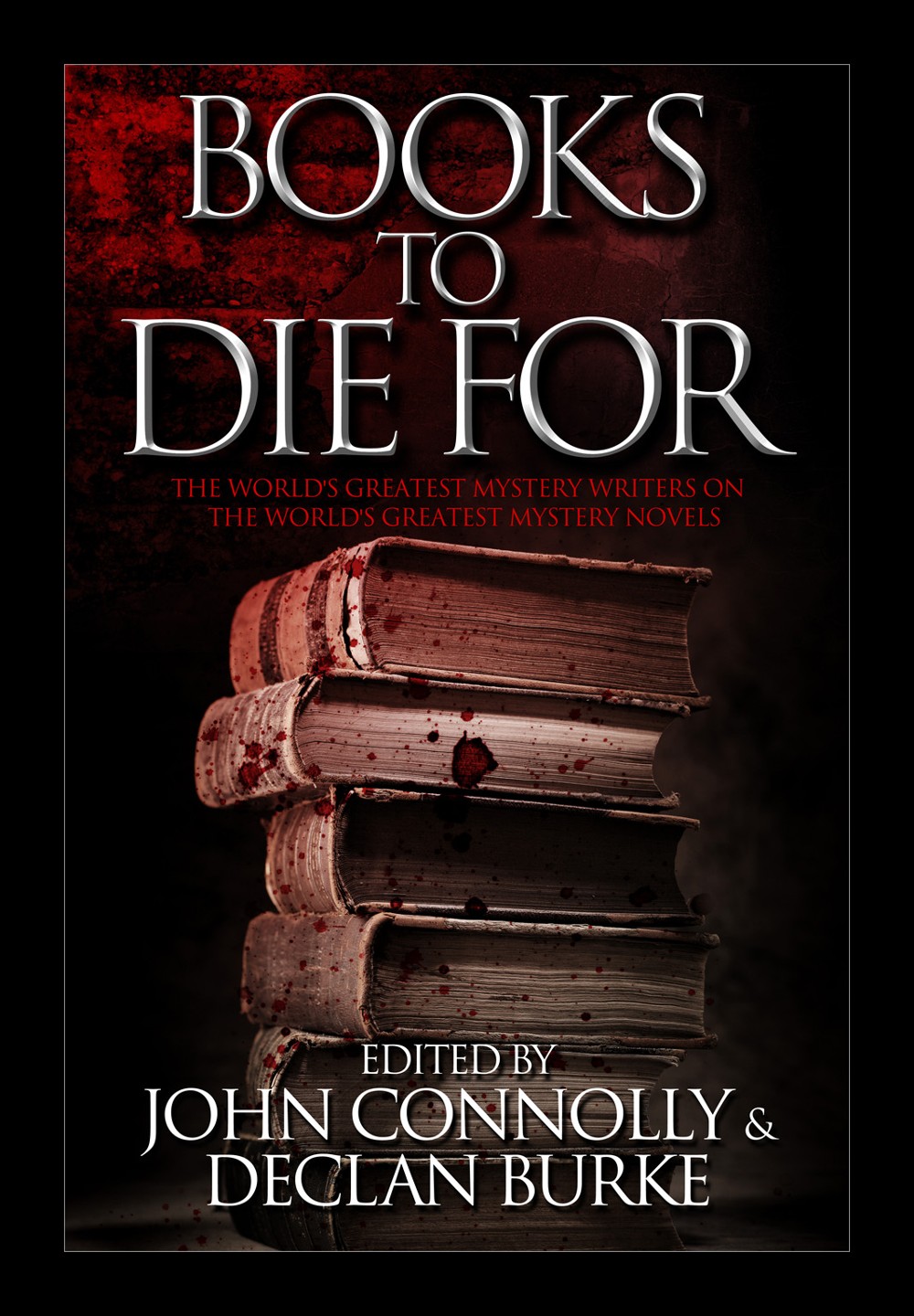
Due to numerous ungodly demands, I’m unable to do justice to a new post this week, but in celebration of the award nominations — including the Edgar and the Agatha to date — being extended to Books to Die For, the compendium edited by John Connelly and Declan Burke, I thought I’d offer it again. For those of you who haven’t yet picked up this book, it really is an indispensable guide to crime fiction by the women and men who love it so much they write it.
Last year, John Connolly asked if I wanted to take part in an anthology he and Declan Burke were planning, with the invaluable aid of Assistant Editor (and esteemed Answer Girl) Ellen Clair Lamb.
The premise: Ask some of the best crime writers in the world today what book within the genre—whether a classic, a modern masterpiece, an overlooked gem, or a long-forgotten pulp—most influenced them, inspired them, or otherwise led them to want to shove a copy into the hands of every unsuspecting reader they came across.
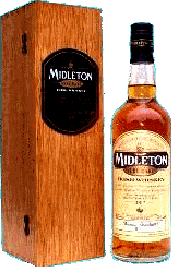
Compensation: A pittance, or a bottle of whiskey—Midleton Very Rare Blended Irish Whiskey, to be exact.
Guess what my answer was—both as to whether I wished to join the scrum and what form of compensation I preferred.
Turns out, I was in excellent company.
The result: Books to Die For, a compendium (love that word) of almost 120 pieces from writers around the world that hit bookstores in the U.S. yesterday. (It came out in the U.K. last month.)
It’s truly a must-read for the crime aficionado on your Christmas list—or, as John and Dec put it perfectly in a word of appreciation sent out to the contributors:
Quite frankly, we don’t think there has ever been a line-up quite so starry in any previously published anthology, and the quality of the contributions was exceptionally high. In the end, the book functions not only as a reading guide, but as an overview of the genre.
That’s an understatement. Treated to my own copy, I’ve been reading the entries and marveling at the books chosen, the insights and historical perspective provided (the books are arranged chronologically), as well as the personal statements of awe and fascination and devotion—even envy.
To give you some idea of who some of the contributors are, just check out this list of those attending the promotional event at Bouchercon (Friday afternoon at 4:00 in Grand Ballroom A of the Cleveland Marriott Renaissance):
Linwood Barclay, Mark Billingham, Cara Black, Lee Child, Reed Farrel Coleman, Max Allan Collins, Michael Connelly, Thomas H. Cook, Deborah Crombie, Joseph Finder, Meg Gardiner, Alison Gaylin, Charlaine Harris, Erin Hart, Peter James, Laurie R. King, Michael Koryta, Bill Loehfelm, Val McDermid, John McFetridge, Stuart Neville, Sara Paretsky, Michael Robotham, S.J. Rozan, Yrsa Sigurdardottir, Julia Spencer-Fleming, Kelli Stanley, Martyn Waites, and F. Paul Wilson.
And that list neglects Elmore Leonard and Joseph Wambaugh and Marcia Muller and Rita Mae Brown and George Pelecanos and Dennis Lehane and Karin Slaughter and Laura Lippman and Jeffery Deaver and Bill Pronzini and Tana French and Louise Penny and Ian Rankin and Jo Nesbo and Megan Abbott and Sara Gran and John Harvey and Ken Bruen and Minette Walters and Kathy Reichs and Scott Phillips and Joe Lansdale and Chuck Hogan and Lisa Lutz and Patricia Cornwell and Eddie Muller and Meg Gardiner and Adrian McKinty and Margaret Maron and James Sallis and …
For a complete list of contributors and the books they chose, as well as Bonus Materials from some of us who had other books we wanted to champion but space would not permit—the book already clocks in at an impressive 730 pages—check out the Books2Die4 website.
Some of the entries are gems of critical appreciation. Some read like fan letters. Every single one I’ve read so far has taught me something I didn’t know.
Karin Slaughter selected Metta Fuller Victor’s The Dead Letter and makes an airtight case that the overlooked Victor—a woman writing voluminously in the mid-to-late nineteenth century—was far more influential to the subsequent development of the genre than Edgar Allan Poe:
Victor’s novels were not driven to immediate climax, but filled with reversals, twists, and misdirections that both prolonged the denouement and arguably made the climax that much more rewarding. Victor didn’t just set out the facts of the crime: she explored social mores, distinguishing between the upper and middle classes with a subtle reference to clothing or manner. She described atmosphere and scenery in careful detail, giving her stories an air of grounded reality. The characters in Victor’s books were not cynical about crime. They felt loss and tragedy to their very core. For these reasons and more, it seems that the Victor formula, not Poe’s, is the convention to which modern crime fiction more closely hews.
Megan Abbott makes a similar argument for Dorothy B. Hughes’s In A Lonely Place—“the most influential novel you’ve never read”—a serial killer tale from the murderer’s point of view that preceded Jim Thompson’s The Killer Inside Me by five years.
Hughes hoists her killer on the autopsy table, still breathing, and shows us everything he doesn’t want to see about himself: the twin arteries of masculine neurosis and sexual panic that drive his crimes. It turns out that Hughes is up to much more than telling a killer’s tale. Through her dissection, In A Lonely Place says more about gender trouble and sexual paranoia in post-World War II America than perhaps any other American novel.
Two of my favorite entries were written by my fellow Murderateros Martyn Waites and Gar Anthony Haywood.
Martyn selected Always Outnumbered, Always Outgunned, a book he routinely recommended to the inmates he tutored at one of Her Majesty’s prisons. It’s the first Socrates Fortlow novel from Walter Mosley, a series often overshadowed by the Easy Rawlins monolith. When my late wife read this book, she forced it on me with the same enthusiasm Martyn does, saying, “This isn’t like a crime novel. It’s like a myth.” Here’s how Martyn puts it:
It’s no accident that this lead character has been given the name of Socrates, the father of Western philosophy. Written in the aftermath of the L.A. riots and the Rodney King beating, this hulking ex-con becomes a contemporary inquisitor, asking difficult moral questions of a society that has retained a dogmatic grip on the letter of the law but has lost purchase of its fair and compassionate spirit.
Gar selected Richard Price’s Clockers, a book I often go back and re-read. Gar’s entry brings in his father, and I always enjoy reading Gar discuss his dad. It turns out that Gar lent his father a number of top-tier crime novels, but only one “blew him completely away.”
“This guy’s the real deal,” he told me when I asked him what he thought. And coming from my father—a man of few words if ever there was one—this was high praise, indeed…. Reading it from a writer’s perspective, you’re immediately struck by the vast array of skills Price has on display: plotting that moves at optimum speed, characters that live and breathe, dialogue devoid of a single false note. And this last is no exaggeration: every word of every line Price’s people speak in Clockers rings true. Every one.
My own pick was James Crumley’s The Wrong Case, and it pairs with Dennis Lehane’s appreciation of The Last Good Kiss. Of Crumley’s ability to make even the absurd seem not just believable but necessary, I wrote:
He set a tone that kept you off-balance, a tone that blended a kind of sly irony with heartsick desperation, an understanding that the battle for the good is fought by ingeniously flawed men doing the ridiculous in the service of some angry, inscrutable truth.
The anthology is full of gems, each only a few pages long, so it’s easy to wrap one up in a brief sitting and move on to the next, or wait to savor it later.
Speaking of savoring it later: I haven’t tried the whiskey yet, saving it for some special occasion over the holidays. But it’s from County Cork, where William Augustus Corbett and his bride, Katie, spent their lives before sailing to America in 1882. That alone bears promise.
So, Murderateros: If asked to name just one book in the genre that had an overwhelming impact on you, which one would you choose—more importantly, why? (Feel free to add your remarks to those of others on the book’s website.)
Final Note: John will be touring to promote the book, and a select group of booksellers will have copies signed by various contributors. For where to find John or one of those copies, go here.
* * * * *
Jukebox Hero of the Week: In one of my very first author appearances (with Laurie King and Michael Connelly), I was asked a question similar to the one asked of me by John and Dec for Books to Die For. But I didn’t name a book or a writer. I admitted that I was probably far more influenced by this man than anyone I’d ever read, specifically this song:
was talking to a writer friend recently, a famous, bestselling writer friend, and the question of confidence came up. ‘I love it when a reader tells me how much they’ve enjoyed my book,’ my friend said, ‘because until I hear that I think they’re all rubbish.’
I know I shouldn’t have been surprised at this but I was. It reminded me of another conversation I’d had with a writer friend – again famous and bestselling – who said after handing their new book in, ‘This is the one. This is the one where I’m going to be found out.’ It wasn’t. The book was another bestseller.
I don’t know why I was surprised by what they said, really. Because I don’t think it matters what level you’re operating at, sales-wise, as a writer, you’re always prey to the same doubts and fears. Last week was the publication of J K Rowling’s first novel since her Harry Potter series. Some of you may be aware of this, it didn’t happen without notice. I would say its had mixed reviews but I don’t think that’s the right word. Polarised would be a more accurate one. Some people loved it, some hated it. The ones who hated it did so mainly because Rowling had written the novel she wanted to write and not the one they had expected her to. Fair enough. There was a fantastically angry review by Jan Moir in the Daily Mail – which I’m not going to link to as I don’t believe in giving that rag any more publicity – which slated the novel as a socialist tract and left wing propaganda. Considering the Daily Mail is the British newspaper to have supported Hitler and old habits die hard, I would think Rowling would be massively pleased by that. I would be. Some reviews on Amazon complained because characters, just like people in real life, swore.
But other more fair and balanced reviews appeared in other papers. By and large, her book would be judged a success. Despite all the numpties and their negative reviews, others were more positive and sales were, of course, huge. Well done her.
We were talking about Rowling the other night at home. We’ve been doing that quite a lot recently since she now has the same publisher as the Tania books (In fact the release date for Choked was moved so as not to coincide with hers). Linda is firmly of the opinion that she doesn’t know why Rowling has bothered. ‘If I’d been that successful and made that much money,’ she said, ‘why would I want to open myself up to that kind of scrutiny? Why would I put my head above the parapet just to have people take a pot shot at me?’ She’s got a good point. But my response was, ‘What else is she going to do? She’s a writer. Why write and not be published?’ Both valid viewpoints but over the last few days I’ve been thinking more about what Linda said. And this reminded me of the two conversations at the start of this piece.
The three of us were all together recently, talking about the same thing. Confidence in our work. I confessed that I was still waiting for the tap on the shoulder and someone to say, ‘Come on son, you’ve had your fun. But now it’s time to let the real writers in. There’s the door.’ My friends said they felt exactly the same. One of my friends even admitted that they thought they had a double whose place they had taken and who should have been getting all the acclaim. And yet, we still keep doing it.
It’s hard enough to write in the first place. To put your work out there, fearing – and often expecting – the worst, work that you could well have spent at least a year of your life working on, work that’s become precious to you. To let it go and have people hurl whatever they want at it. I’m always amazed when I get a good review. Or rather relieved. I always think about what my friend said earlier: They haven’t found me out yet. Phew. I’ve dodged a bullet this time. But next time . . .
I know, when you examine it, it’s a stupid way to think, behave and conduct a career. But I honestly believe that writers have to do it. You’re driven to write. Compelled to do it. And when you have written you want to be read. You need to be read. Because without a reader a book is just a lump of paper. So you have to do it. And to tell you the truth, if I know any writers who think differently to what I’ve outlined above I doubt I would want to read their books. Feeling that your work is terrible is, I think, a necessary part of the process. It’s what drives you on, keeps you going. Makes you strive to improve, to stretch yourself. To go deeper into that character, further with that situation, make that dialogue better, that description more succinct. You have to. And that’s why I think J K Rowling is no different, despite the slight disparity in earnings with the rest of us. She’s a writer with a writer’s heart and a writer’s drive. And a writer’s willingness to put her work out there and be judged by it when she doesn’t need to. And I love her for that.
So how do we keep the balance? Well, there’s something I always tell creative writing students. It refers to an old interview with Martin Amis when his (some would say last good) novel The Information was about to be published. The book concerns two writers, one who is successful, one who isn’t. The interviewer asked which one he was. ‘Both,’ he said. ‘Usually at the same time.’ When I read that I thought, ‘What a load of pretentious bollocks.’ But the more I thought about that, the more I thought he was right. As a writer when you’re working you have to be both. At the same time. It’s a balancing act, a seesaw, with the brilliantly successful writer at one end and the abject failure at the other. You have to be able to write stuff that you think is absolutely sparkling deathless prose yet at the same time the worst piece of dross ever written and you’ve got to strive to improve on that. It’s an odd way to think but it works. For me, at least. It’s a confidence trick. It keeps me in check while simultaneously making me work harder.
It stops the book I’m currently working on being the one where I’m found out.
Baby Boomers, as a group, are becoming the passing generation. We’re not quite ancient yet but, other than ED and osteoporosis ads (and all those cut-ten-years-off-of-your-face/neck commercials), marketers have turned much of their attention to the next population waves.
I feel obsolescence tapping my shoulder. For now, I’m giving it a swift backward kick in the groin . . . but its presence still shadows me.
The first few decades of my life, only humans filled the roles of Confessor, Therapist and Persuader. The means for standing on soapboxes and pushing political agendas — for most of us — rested in letters to the editor, op-eds and the tiny number of talk radio programs that existed at the time. A single, regular guy’s reach back then — if he had PR in his toolkit — spanned at most a few thousand.
For better or worse, the ubiquitous nature of 24-7 television (plus cable, Youtube, etc), the internet and other easy-access electronic means of communication have changed all that. A message written in a private email can be resent endlessly. Tweets are retweeted, videos/blogs reposted. People of my era bemoan the demise of privacy even as we flush our own down the drain in a million small ways each day.
There just isn’t a useful instruction manual for us Techno-tweeners to help us navigate this new age of communication. The scary thing for me right now is: With the advent of no-taking-anything-back, caution must be top-of-mind even as someone experiences powerful life-changes.
So I sit wondering how much to share and how much to withhold . . .
And here’s why I’ve been thinking about all of this: It’s been just a few days since my husband got a lawyer. After more than a year, he is finally ready to move on. As a matter of fact, he’s hot to trot on ending this marriage once and for all. Me? I’m shaky. My discomfort, grief and fear, my hope for a happy end to a difficult process, all are bound to squirt out in the coming months as I move through this next phase. Do I disclose and risk an eternal artifact of this time in my life? Do I keep my blogs and other electronic communications purely professional and risk living a half-truth at best?
I haven’t figured any of this out yet . . . but I’m sure struggling with trying to be wise.
How about you?
Have you faced similar dilemmas? Do you share important parts of your life with potential millions of unknown readers/viewers? Do you feel compelled to keep much more “close to your chest?” How the hell do you manage it?
Okay, someone just had to scrape Lee Lofland off the ceiling. NO. You DO NOT smell cordite after gunfire. Not since WWII, anyway. I know that now because last weekend I attended Lee’s Writers Police Academy.
Lee Lofland, a former police detective and author of the Writers Digest bestselling book Police Procedure and Investigation (a must-have!) is not only a law enforcement professional who knows the job inside and out, but a writer who understands what other writers need to learn from law enforcement professionals in order to do OUR best work. And knowing that, he’s assembled a cast of characters any one of whom could easily be the star of their own series. Because it’s not about the facts, it’s about the people. And wow, the people. (Photos by Lee Lofland).
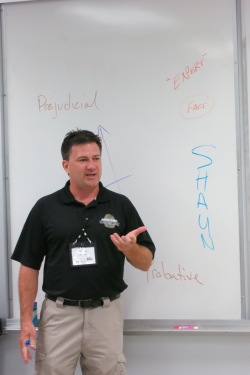
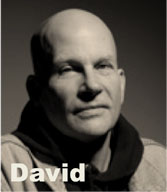
So I walked into my first forensics investigation workshop and the incarnation of my agent from Huntress Moon turned from the whiteboard. I thought I was hallucinating, or having one of those dreams where… well, never mind that. Dave Pauly, forensics professor at Methodist University in NC, has a resume that’s half Indiana Jones, half Jack Reacher. He team-taught with Robert Skiff – two of these for the price of one! (When I first arrived at the conference I wondered why 90 percent of the attendees were women. That got cleared up for me in the first hour. Testosterone was rolling down those corridors in waves…)
Skiff is more of a scientist, the training manager at Sirchie, a leading manufacturer of fingerprinting and forensics supplies. I may not know every single detail I need to know about blood spatter, print impressions, cold cases, and alternative light sources to finish my sequel – but let me tell you, after a day of forensics classes and demos with these two instructors, I am a lot closer than I was a week ago.
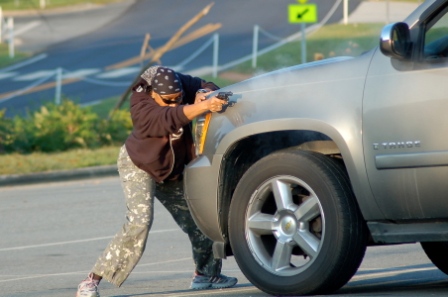
Then there was Corporal Dee Jackson, of the Guilford County Sheriff’s Department. A former Marine, one of the very first women to go into combat in the Gulf War, and if anyone ever thought a woman isn’t capable of the most intensive combat duty? Look no further than Dee, here playing a bad guy in a simulated shootout.
She is hilarious, profound, such a great comic and physical actor it floors me she hasn’t been scooped up by Hollywood, and committed to her mission in a way that literally halts your breath. The whole room – male, female, animal, vegetable, mineral – just stops when she walks in.
Katherine Ramsland. My first time meeting this powerhouse after reading a half-dozen of her forensics psychology books (and her brilliant biography of Anne Rice, Prism of the Night). This woman has LIVED with death in a way most of us will never comprehend, and she is deep, funny, philosophical and mesmerizing.
And talk about powerhouse women…. I lived in L.A. during the Simpson trials and meeting Marcia Clark was like meeting a movie star. Her lecture on putting a case together for the prosecution was stellar, and she is a warm, witty, encompassingly charismatic human being. Thrilled to know her!
Andy Russell, one of the main organizers of the conference, was one of our Firearms Training Simulator (FATS) instructors. Somehow he managed not to break into hysterical laughter at my first attempts to heft a handgun, and in fact gave me some useful tips (“Try not to drop the magazine”) with a straight face.
On a later panel he kicked off a series of stories that made me understand that people go into law enforcement mainly because every other call or traffic stop turns out to involve a naked perp.
Marco Conelli, a retired NYC undercover cop (now YA mystery author) is such a doll I was in total fear for him just listening to his buy and bust stories (narrated in a voice just like Woody Allen’s). You could see him slipping back into his junkie persona as he described the scenes. Fascinating.
This was my schedule:
Thursday night: Jail Tour (a post in itself)
Friday: Impressions Evidence, Cold Case Investigation, Building Searches, Blood Spatter Analysis, Forensic Anthropology.
Saturday: Anatomy of an Undercover Detective, FATS Training, Arrest and Handcuffing Techniques, Personal Survival Training for Women, Building a Case for the Prosecution.
The only frustration was not being able to take absolutely every workshop on offer.
Probably halfway into the second day, a lovely and radiant EMS technician, one that I can tell you for sure you would want there with you if you were, you know, dying, turned to me in the elevator between classes and said, “How can you possibly describe any of this?”
And I really wanted to answer her, and it’s a hard answer. What I said was something like – “You have to put across enough of the science for a reader to kind of understand but it’s not ABOUT the science. It’s about making the science real enough that readers will give themselves over to the EXPERIENCE you’re trying to create for them, which is about the searing passion of wanting to help people and the live wire adrenaline rush of fear and danger and commitment, and the intimacy of doing this job with people who are as skilled and committed as you are and who understand good and evil and pure life force the way you do and the way that no one who hasn’t done the job will ever know. It’s not about the science practically at all, it’s about the way you guys move, and the way ninhydrin crystals look in the light, and the things you say to each other and your twisted sense of humor and your absolute radiant love for all of it.”
I said some of that, not enough of it, because you can’t possibly say enough.
Some of these courses redefine the concept of adrenaline rush. Lt. Randy Shepherd (aka Honeybuns, and yes, the moniker is accurate) put a squad of fifteen of us through our paces during Building Searches. We’ve all seen this on a million TV shows, but now I have some grasp of the choreography and the constantly changing, split-second decision/dynamics of a bust like this – I have the flow of it in my BODY, and because it’s my own particular job as a writer to do so, I know I can put the experience of it onto the page for someone else to live through. I have been menaced and I have been shot at and I know the exact weight of the shield and the vest and the gun and I know the paralyzing fear of having to grasp ALL possible dangers behind ALL doors and windows and fireplace screens (even when there was no real danger there for me) and I know for damn sure that I am hopelessly inadequate and yet that I may still somehow survive… somehow… if I can manage not to kill anyone on MY OWN SIDE.
That is a hell of a lot to learn in a two-hour class. And that’s just two hours of a non-stop marathon of police academy training.
There’s a saying in Hollywood that “Nobody knows anything.” Well, I’ll tell you what you don’t know. You don’t know how you or anyone you know is going to react in life-threatening situations, even simulations of them, until you’re right there.
My five-foot tall (and that’s on a good hair day) roommate earned the title of “Killer” from the Firearms Training Simulator instructors when she put down every bad guy in the training DVD without even breathing hard.
While I seem incapable of shooting at anyone under twenty years old (although I also managed never to get killed or to kill a fellow officer). But – I was the only person in the Handcuffs Techniques workshop flexible enough to slip my body through my handcuffs back to front, putting me in a prime position to choke my arresting officer to death before she realized I was relatively loose (all right, so I’m more experienced with handcuffs than guns…)
And in Women’s Personal Survival Training, it was pretty clear how many women in the room had never actually let themselves think about what would happen to them if they LET a stranger force them into a car, or van, and why it is essential to make the choice to fight BEFORE anyone ever gets you into the car. Or at least understand the consequences of not fighting. Not many people in that class slept that night, I’d wager.
In fact, it’s five days later and I’m still not sleeping all the way through the night. The adrenaline is that powerful.
You cannot research those things by READING about them, or interviewing people who have lived it.
I’m not saying it’s at all the same to go through simulations, compared to the actual experience. But compared to reading about it? No contest.
Do we want to be better mystery and thriller writers? Or what?
If you do, you owe it to yourself, your books and your readers to make the WPA a MUST DO event in your year.
I’ve written more about it here, and plan to do more posts as I’m processing everything I learned for myself, but here’s a better taste of the weekend on Lee’s blog.
My deepest thanks to Lee, all our superb instructors (ALL of whom volunteered their time) and to Sisters in Crime, who generously underwrote a large portion of the event to keep the tuition at rock-bottom.
And the question of the day is about research. Authors, how do you do the research that you need to do to write your books? Tell us some stories! And readers, how detailed do you like your police procedure? Who do you really think gets it right, in fiction?
In my last post I talked about adopting our son from Korea and it seems fitting that this post should focus on the current chaos in my life!
As any new mum/mom will tell you, it’s a HUGE change and no matter how prepared you feel, you’re NEVER prepared. And, let’s face it, some elements of the typical writer personality don’t blend well with motherhood (e.g. vagueness).
Writer + Mum = Scary combination
I know I’m a great mum in terms of being loving and affectionate, making sure they’re eating well, instilling a good sense of self, etc., but I’m a hopeless role model when it comes to getting out the door and general calmness about said departure.
So, this WAS my typical day four weeks ago:
5.55am – alarm goes off (3-4 mornings a week)
6.15am gym class (3-4 mornings a week)
7.15am – home (morning routine starts)
8.45 – Drop Grace to school at 8.45am,
9.15am – At desk writing
3.15pm – Leave to pick up Grace from school
Plus I had two longer writing days (my husband works four days a week and one day my mum picked up Grace).
And even though I started the morning routine at 7.15am, I still struggled to get out the door by 8.35am! And I ALWAYS felt a little chaotic and disorganised. And that was with one child. Sometimes I’d have to duck back up to the school with Grace’s library bag (often forgot that one every Wednesday) or her glasses.
As you can imagine, the morning chaos (and general chaos) has gone to a whole new level. It’s the night time chaos that is probably the worst. I’m happy to report that our new little boy is a great eater. But at about 5pm when I go into the kitchen to start making dinner he comes up to the child gate and starts screaming and rattling the child gate with all his might. Sometimes he’ll start throwing things at me (toys). It’s kind of like this primal voice going: “Come on, woman. Get my dinner on the table.”
Actually, he’s an incredibly well-behaved little man (food obsession aside), and incredibly happy. It’s amazing how well he has adjusted. He loves everything. Just amazing to see him settle in despite not understanding a word we’re saying, changing seasons (Northern Hemisphere to Southern Hemisphere), not to mention the biggest upheaval of them all —leaving his foster family and moving in with ‘strangers’.
Except for the chaos, things are going very smoothly. I’ve even managed to get to my 6.15am gym class two mornings a week (hopefully I’ll work my way back up to 3-4 mornings a week soon).
Pre-children we went to a friend’s house for dinner and his wife said that when he got home from work she’d hand the two kids over to him for bath, bed, etc. On the way back home that night, I said: “I can’t believe he works all day and then has to come home and get the kids bathed and into bed.” I think I even said “I’d never do that.” How ignorant was I?! Two days ago I sent my husband a text: Just curious…how far away are you? Of course, he read and knew the subtext. Ahhh….chaos! Help!
Life has certainly changed. I’m loving motherhood but still settling into my new routine (not to mention lack of writing time). But the chaos makes me feel a little out of control. So, got any funny stories of complete chaos so I don’t feel like such a loser mum!?? They can be parenthood or non-parenthood related. Please…indulge me 🙂
As you may have noticed, some of us Murderati authors of late have been having a heck of a time getting brand new posts up on schedule for your entertainment. It’s not that we’ve been shirking our duties, it’s just that life intrudes. So rather than fresh content, for better or worse, you’ve been treated to a lot of Oldies but Goodies over the last few days.
Well, as it happens, I’m in a bind trying to put my own post together today. The family and I are moving into a new home this weekend and to say I’ve been swamped getting ready would be the equivalent of saying Noah worked liked the devil preparing for the flood. I’m dead on my feet.
Still, all excuses to do so aside, I’m not in the mood to fall back on an old post of mine on this Wednesday, no matter how brilliant it would have been. So what I’m going to do instead is lightly touch on a subject that’s been on my mind quite a bit lately.
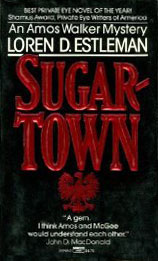
Take a look at this book cover:
I bought this Fawcett paperback back in 1986 or so. This photo’s rather lousy, so just to be clear, the cover text reads as follows:
BEST PRIVATE EYE NOVEL OF THE YEAR
Shamus Award, Private Eye Writers of America
An Amos Walker Mystery
LOREN D. ESTLEMAN
SUGAR-TOWN
“A gem. I think Amos and McGee would understand each other.” John D. MacDonald
Now, here’s my question: Can you guess what element of the overall cover ultimately convinced me to buy the book?
a) the art
b) the John D. MacDonald blurb
c) the title
d) the reference to the Shamus award
e) the name of Estleman’s character, Amos Walker
If you guessed b, you’d be close. I’ve never been big on cover blurbs, but a kind word from John D. MacDonald would have been nothing to sneeze at.
The art? It’s fine, but it didn’t particular impress me.
I liked the title, I didn’t love it.
And while Amos Walker is a great name for a series character, I wouldn’t have risked $1.95 on that alone.
Which leave us with d, the reference to the Shamus award. That’s the correct answer. I’d never heard of the Shamus award at the time and knew nothing about the Private Eye Writers of America, but I figured if a group of Estleman’s peers had seen fit to proclaim this book “the best private eye novel of the year,” it had to be pretty damn good.
It was.
I’m a little more jaded where awards are concerned now, of course. But not by much. I still believe in them, and value them, and yes, goddamnit, as an author, I covet them. How readers in general feel about them is a mixed bag. Some find awards important and some don’t. And publishers?
Publishers don’t give a flying f-word about awards.
You want proof? How’s this:
I’m a judge on the Best Paperback Original committee for one of the major book awards this year and I can count on two hands the number of submissions I’ve received directly from publishers over the last five weeks. Authors have sent their own books in, publicity professionals have sent the books of clients in — but only three submissions have come from the house that published them. The list of major publishers yet to be heard from, regardless of who did the actual submitting, would be longer than your arm.
Conclusion? Publishers don’t think the promotional payoff of one of their books winning a literary award (short of the Booker Prize) is greater than the cost of mailing one physical copy each out to four or five award judges.
Seriously?
I think this is pretty sad and incredibly shortsighted, but maybe publishers are right. Maybe awards really don’t matter.
From time to time, the authors here at Murderati would like to reacquaint you with some of our favorite old posts, posts we think represent some of the best writing we’ve ever done here. Each post has been hand-selected by the author him-/herself. So kickback and enjoy these blasts from the past, and feel free, if you read them the first time, to comment here (not at the original post) all over again.
So I’m sitting on the can reading BE COOL by Elmore Leonard and come across this quote: “You just put down what you want to say, then you get somebody to add the commas and shit, fix up the spelling if it needs it. The way this one’s going I think it’ll write itself.”
Chili Palmer and his buddy Elaine are discussing writing screenplays, but the whole enchilada gets me thinking about punctuation (after I scoff at the idea that anything writes itself. Yeah, right.).
Many posts on Murderati have to do with the art of creating crime fiction — and our blog’s readers enjoy these insights — but commas, well, they affect us all. It doesn’t matter if you’re writing the Great American Novel or a thank-you to Grandma Rose, you put a comma in the wrong place and your meaning gets shot to smithereens.
Don’t get me started on misplaced periods. And colons? Forgettaboutit. (MORE)
Memorial Day is a good time to reflect on what heroism means. That hit home with particular force this year as, last Thursday, one of the kindest, smartest, funniest, most generous, caring and beautiful women I’ve ever known passed away after a valiant battle with breast cancer.
Her name was Kathi Kamen Goldmark, and she didn’t just crank out the courage in fighting her illness. She had that particular kind of courage that too often gets overlooked: The courage to be happy. And she had a particular gift for welcoming others into that happiness.
Or as David Phillips, the pedal steel player for Kathi’s band, Los Train Wreck, put it:
“Kathi’s job was to make sure everybody sang.”
Briefly, a bio: Kathi was not just the lead singer, rhythm guitarist (with her trademark leopard-skin Stratocaster), and heart and soul of Los Train Wreck, she was also a novelist—the marvelous And My Shoes Keep Walking Back to You— plus a contributor and co-writer for a number of anthologies and other books, a founder and the lead Remainderette for the all-writer rock band The Rock Bottom Reminders—which included Amy Tan, Dave Barry, Scott Turow, Stephen King and Ridley Pearson among others—as well as the most deeply appreciated literary escort in the San Francisco Bay Area (perhaps the known world). So Kathi knew a host of writers who loved her deeply and miss her bitterly. (MORE)
Look, I did my raves already. And I’ll fight anyone to the death who even dares to hint that Ruth and Jon and Judy didn’t just put on the greatest show on earth. But let’s get honest, now. There’s something missing, endemically, intrinsically, about the whole Bouchercon experience.
There’s no dancing.
Yeah, yeah, I can feel the skeptics of you out there going skeptical on me already, but trust me, this is leading somewhere you might just want to go.
Because of my confused genre identity, and because romance readers love them some ghost stories, I end up at a lot of romance conferences. And there is dancing there, oh, is there. No hangovers ever at an Romantic Times or RWA conference, because you just dance it right out. Great exercise, too – no one needs to bother with the gym at these things. And it’s great bonding. But there’s a major problem there, too.
As anyone who reads this must be aware, the new Tania Carver novel, CHOKED, was published in the UK this week.
We’re very happy with it. The sales are good, the reviews enthusiastic and the reader reaction very positive. Or at least the readers who have taken the time to contact us and tell us. But that’s not all that’s happened.
Simon Harwood lost his job.
Who? I’m sure many people in the States haven’t a clue who he is but his name should be familiar to UK readers. He was the police officer who attacked unarmed newspaper seller Ian Tomlinson during the G20 protests in London a couple of years ago. If you’re not familiar with the story, here it is. During the G20 protests Ian Tomlinson was found dead. The police officially claimed that he had been attacked by demonstrators and police were unable to aid him because they were under attack by an unruly mob who pelted them with bottles and missiles when they attempted to administer first aid.
The truth was somewhat different. Video footage presented to the Guardian newspaper showed a masked police officer attack Tomlinson with a baton. Tomlinson was unarmed, not part of the demonstration and walking in the opposite direction, going home after work. Protesters rushed to his aid but he died. The police, initially issued threats of legal action against the Guardian for making the footage public but, when public opinion was against them, ordered a post mortem. The pathologist the police chose came to the conclusion that Tomlinson’s death was natural causes. This pathologist has since been struck off and a sizeable number of his post mortems found to be unsafe. Two subsequent post mortems revealed that the cause of death was internal bleeding from hitting the pavement following the attack.
Harwood was eventually identified. An inquest last year ruled that Harwood had unlawfully killed Tomlinson and he was put on trail for manslaughter. Incredibly, he was acquitted. However, the jury at the manslaughter trial was not told details of Harwood’s past record, notably a disciplinary hearing in which he illegally tried to arrest a driver in a road rage incident in 2001, retrospectively altering his notes to justify his actions. He left the force on health grounds before the hearing could take place, joining the Surrey force and returning to the Met in 2005 where he faced subsequent allegations of punching, throttling, kneeing and threatening other suspects while in uniform in other incidents.
This week’s hearing was initially set up to reconcile those two contradictory verdicts. However, Harwood’s lawyers intervened and Commander Julian Bennett who chaired the panel stated that Harwood had discredited the police service and undermined public confidence in it and had allowed him to resign. But also allowed him to keep his full pension. Ian Tomlinson’s family was, understandably, furious. The man who unlawfully killed him was allowed to walk free. They are now taking their case to the civil court.
Some could still argue that after reading all that Simon Harwood was just that clichéd bad apple. If so, why did the police, as an official body, try so hard and for so long to cover for him? To protect one of their own even after he was shown to be the worst kind of violent thug?
This is not an isolated incident. Take the case of Stephen Laurence. You might have heard about this. There’s a much fuller account of it here, but I’ll recap. Stephen was a teenager living in South London. In 1993 he and his friend were attacked by a gang of white youths chanting racist slogans. Stephen was killed. Five suspects were arrested but not convicted. The investigation against them was so flawed a public enquiry chaired by Sir William MacPherson was initiated. The subsequent report concluded that the Metropolitan Police force were ‘institutionally racist’ and that was why Stephen’s killers had not been convicted. Subsequent reports indicated something else. Detective Sergeant John Davidson, one of the murder inquiry’s detectives, had taken money from Clifford Norris, a known drug smuggler and the father of one of the chief suspects, David Norris, to obstruct the case and protect the suspects. Two unnamed police officers were arrested as a result of these allegations but no further action was taken. Dr Richard Stone who had sat on the panel of the MacPherson Inquiry said that the panel had felt that there was “a large amount of information that the police were either not processing or were suppressing” and “a strong smell of corruption”.
David Norris along with Gary Dobson were eventually tried and, on January 3 2012, nearly a decade since Stephen’s death, were found guilty of his murder.
Just two cases. I could have chosen many more. Both could have the bad apple cliché applied to them, both could have that cliché blown apart. The force – the institution – allowed these corrupt police officers not only to get away with it but to flourish as a result of it.
So what has all this got to do with CHOKED? Well, sometimes it’s hard to write a police procedural when this is going on in the real world. It’s difficult to write about damaged but basically decent coppers trying to catch criminals, keep the public safe and generally doing the job they are paid to do. Coppers like our Phil Brennan who, in the same way Philip Marlowe or Lew Archer wouldn’t be a private eye in real life, probably wouldn’t be a police officer. Sometimes Linda and I feel like we’re just writing police propaganda, books that say, ‘Don’t look too closely at what we’re doing in the real world, just read about someone who punishes the bad guys and rewards the good ones’. Maybe that’s just too simplistic and I’d like to think that our books are more complex than that but when you read stuff like the cases detailed above it’s hard not to feel that way.
I know all cops aren’t like that. I’ve met some that are wonderful individuals. Who care deeply about the work they do and the public they try to serve and protect. I’ve also met ex-officers who had to leave because their voice, one of integrity and decency, was being drowned out.
So what do we do about it? CHOKED isn’t really a police procedural. It focuses on Marina Esposito, a psychologist hunting for her missing child. The police are sidelined for once. And I have to say, it felt cathartic to do it. I hope it works.
Having said all that, the next one, THE DOLL’S HOUSE, currently being written, is procedural once more. It has to be for the kind of case it involves. And it’s started me thinking again. Maybe by presenting police officers as complex individuals instead of black and white cyphers. I like to think we’ve put in characters to the Tania novels that don’t fit the stereotype. We’ve had corrupt coppers, amoral, ambitious coppers. We’ve had corrupt but redeemed cops. We’ve had cops who are computer nerds, marathon runners and amateur dramatic performers. We’ve had decent, if flawed, cops. We’ve had characters. We’ve had people.
But, a dissenting voice could say, it all turns out alright in the end. The good guys get rewarded, the bad guys get punished. Well . . . not always. Generally, yes, but not always. I like to mix it up a bit. The body count in the books is quite high, as is the turnover of leading characters. This, I think, is a real reflection of the job. If the cases in the books were real, there would be quite a high attrition rate. The characters are put in dangerous situations. They could lose their lives.
And that’s why we keep writing them. Because writing about people in extreme situations is what crime fiction is all about. Or at least a large part of it. And police officers are a godsend for that. So I don’t want to be seen to bang a drum for a non-existent police force. The books aren’t propaganda. If the police force want that, they can do it themselves. We just want to write the best crime novels we can.
And as for Simon Harwood . . . I’d love to put him – or someone very similar to him for legal reasons, of course – in a book. After what he’s managed to get away with, (with the blessing and complicity of the force) after the people he has hurt or killed, he deserves it. And I think we could be excused if in this one instance we could guarantee his ending would not be a happy one.
If the only justice Ian Tomlinson’s family can get in this world is poetic, then so be it.
Dudes, I am sooo sorry, but I’m going to have to re-post an old favorite of mine. I’m in VEGAS with the family and there’s just no damn way I’m going to spend all night trying to write something wholly unique and insightful. Not after three margaritas, I’m not.
So, here’s one I’ve always loved….
MAGICAL OPTIMISM
My eleven year old boy opens his eyes and sees the world he wants to see and magically it is there. I remember I was once like that, when I was a boy younger than his years. The magical optimism slowly faded as I encountered adults who knew better, men and women who’d correct me when I was wrong. As the years advanced I grew up to become an optimistic realist, but a realist none-the-less. Although it is easy to slip into the slough of the cynic, I’ve generally fought to keep a “glass half-full” attitude.
My son re-booted my operating system recently when two things occurred.
Thing One: Noah’s favorite flower is the bright yellow sunflower. My other son, Ben, saved a couple seeds from destruction and planted them and they sprouted. Their little green stems grew and dangled and needed help and I convinced Noah, who had taken over the project, that we should tie their little vines to a tongue depressor with a fuzzy little pipe-cleaner from his arts and crafts supply kit. He trusted me (I’d taken a class called Greenhouse Management when I was in high school, which was really the slacker’s way out of taking Biology II) and I tied one of the nascent plants to the wooden stick and just about broke it in two.
The plant was a goner. I’d broken it in such a way that just a sliver of green connected the top to the bottom. It was only a matter of time before it would turn brown and shrivel up like a sun-stroked earthworm. I put a little Scotch tape around the break and prepared my son for the worst.
“It’s not going to make it, I just want you to know.”
“Maybe it will,” he said.
“I’ve lived a lot longer than you, kid, and I’ve seen things. Experience tells me that plant is going to die.”
“I’ll just keep watering it,” he said.
And sure enough, somehow, that plant sprang a sliver of green glucose cells and built an elbow to tie the two halves together. Now this little plant has grown thick and strong and healthy. It continues reaching for the sky today. In all my year of Greenhouse Management I never saw such a miracle.
At approximately the same time, Thing Two occurred.
Thing Two: While cleaning our fish bowl I accidentally let the fish (a beta) fall into the sink among the dirty dishes and general scum. I tossed the dishes to the floor, yelling, “Shit! Shit! Shit!” until I’d found the flopping creature and, after several tries, grabbed and tossed it back into the fish bowl.
Experience told me this story wasn’t going to end well for the kids.
Sure enough, a couple weeks later the fish developed a brown scab on the left side of his body. A couple days after that the scab appeared on the right side as well. It took another day for one side to eat into the other, creating a gaping hole.
There was a hole in our fish.
Experience told me this was not a good sign. The hole grew larger in the coming days and soon the fish stopped eating.
“I’m sorry, Noah, but this doesn’t look good. I think you should say your goodbyes.”
“Don’t give up,” he told me. “We can save his life.”
“I don’t know, I’ve lived a long time and I’ve seen things. My gut tells me it’s time to pull the plug.”
Taking a stab in the dark I suggested that maybe the local pet store had something to “fix the hole.” Sure enough, my son came back with a bottle of what I considered to be voodoo googlygock with instructions to add ten drops to the bowl, twice daily. We began treatment immediately.
The substance seemed only to blacken the water, creating a charcoal haze in which our fish would spend his final days. And the hole remained. I mean, I could see the toaster oven through the fish. I was surprised the thing had lasted this long.
And then the fish began to eat.
Days later Noah said that the hole was growing smaller. Ah, life through the eyes of a child, I thought as I peered down to study the beta. But he was right, the hole was smaller.
It’s been a month since this thing began and the hole is nearly gone. The fish, which was old to begin with, is older still, yet appears as healthy and playful as a young fishling. Maybe the playful part is my imagination talking, but he sure looks fit.
The point, if I may return to the purpose of writing this blog, is that my “realism” was really cynicism in disguise. If I had gone with my instincts, i.e. my experience, I would have seen that sunflower sapling strangle our fish in a whirlpool of toilet water as they made their way to the city sewer. I would have euthanized them to save myself the trouble of watching them die slowly, over time.
I didn’t know there were any other options. An eleven year old boy told me there was.
I think these two occurrences illustrate the fact that we occasionally need a paradigm shift. In my case, I needed to adjust my concept of what is and isn’t real. The way I lived my life had been tainted by negative experiences I accepted as truth. Noah did not have those experiences and he was strong enough to resist them when I suggested they were universal truths.
Maybe optimism is just a way of seeing life as it should be, and then participating in its positive outcome. Maybe a person’s good fortune is anchored by his positive attitude.
My boys will encounter great struggles in their lives. It’s unavoidable. They’ve already experienced the loss of their home. The negative effect this has had on their personalities has thus far been minimal — they veered toward the positive. Life in an apartment isn’t tough, it hasn’t stopped them from doing the things they love, like hanging out at the beach and enjoying their music and art classes. If anything, it’s removed some stress from my life, which removes stress from theirs.
I hope their optimism continues to flourish. I hope the people they encounter, the ones who thrive on gossip and negativity, won’t have an impact on their development. And I’m glad as hell my boy was there, like a young bodhisattva, to teach me the ways of the world.
* * *
Also, I wanted to plug a wonderful new ebook compilation edited by Edgar-nominated author Timothy Hallinan called MAKING STORY: Twenty-One Writers on How They Plot, in which I’m one of the featured authors. You’ll read a bunch of wonderful authors writing about how they begin the process of establishing STORY. It’s a really great resource and, at $3.99 on Kindle, a great price.

 Travelling these days is not a simple business. Airline regulations and heightened security have made sure of that. Ever-restricted luggage allowances have compounded things. Gone are the days when I could travel with my Swiss Army knife and a full bottle of water. But there are still things—beyond the obvious like passport and credit cards—I never leave home without.