Author Archives: Murderati Members


The end of an era

Zoë Sharp

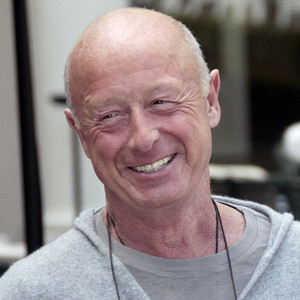
On Sunday, the British movie director Tony Scott jumped to his death from the Vincent Thomas Bridge across Los Angeles harbor. He was sixty-eight years old.

Scott was, by all accounts, a human dynamo of a man, often juggling multiple projects, radiating energy and enthusiasm. His movie career really took off (pun intended) with the highly successful Top Gun of 1986. He’s been making money and movies ever since.

And yet, on Sunday, he took his own life.

Jumping off a suspension bridge 185 feet into the water is a dramatic way to go. It is not a cry for help. It offers no second chances, no last-minute reprieve. It is the act of a man who has come to a decision from which there is no turning back.

This is not a eulogy to Mr Scott, nor is it supposed to be. I was not intending to incite a discussion on the subject of his passing. Indeed, I did not know him beyond having seen a fair amount of his work and I claim no association beyond that. To express anything other than the natural sympathy of one human being for the plight of another would be hypocritical and insincere on my part.

I heard the news in passing. It gave me momentary pause and a twinge of incomprehension. Why would a man who apparently had it all ― loving wife, children, career, acclaim ― decide to cut short his life? Many people endure daily lives of enormous suffering with great fortitude. What could have been so dreadfully wrong that this seemed like the only logical solution?

By Monday, stories were emerging that Scott had inoperable brain cancer. It seemed to offer a rational answer.

Today, however, I wake to news reports from the LA County Coroners that no trace of the disease was found during the autopsy. His wife claimed he had no health problems that she was aware of, so was he sick or not?

Some would say he must have been ill in some way, mentally or physically, to be driven to such an extreme act. But what actually made him jump? And what passed through his mind as he climbed that safety fence?

Pictures taken only a couple of days before Scott’s death show a man who seems, to all intents and purposes, to be full of the joys of life and living.

We may never know the full story behind this, and that in itself is a kind of tragedy.

Suicide is a deeply selfish act, but at least one could say that in making his such a public event there would be no doubts over it. He was clearly shown on CCTV footage as being alone and unaided. There was little delay in the discovery of his body, and his close family were not the ones to do so. That onlookers reached for their cameras rather than going to his aid is a sad comment on society today. That these people are now trying to flog their macabre video clips to the news agencies is shameful but comes as no surprise.

Perhaps, on reflection, it is the rest of us who are sick.

But the motivations of people under duress, whether physical or psychological, are fascinating in a somewhat horrifying way. When faced with desperate situations—even if they are not immediately apparent to outsiders—what governs the choices people make?

When I write I am always trying to provoke my characters into doing something extraordinary, good or bad. But I am aware that at the end of the book you close the cover and they lie down again to await the next reading. Their journey is a circular one, but like the arc of the sun we only see part of it before it drops beyond the far horizon out of view. What happened to those people before the opening page, and—of those who make it to the final chapter—what happens to them afterwards?

This week’s Word of the Week is procerity, which simply means tallness.

And here’s a beautiful piece of classical guitar from Vasco Martin, which I heard on radio yesterday. I include it for no other reason than it moved me.

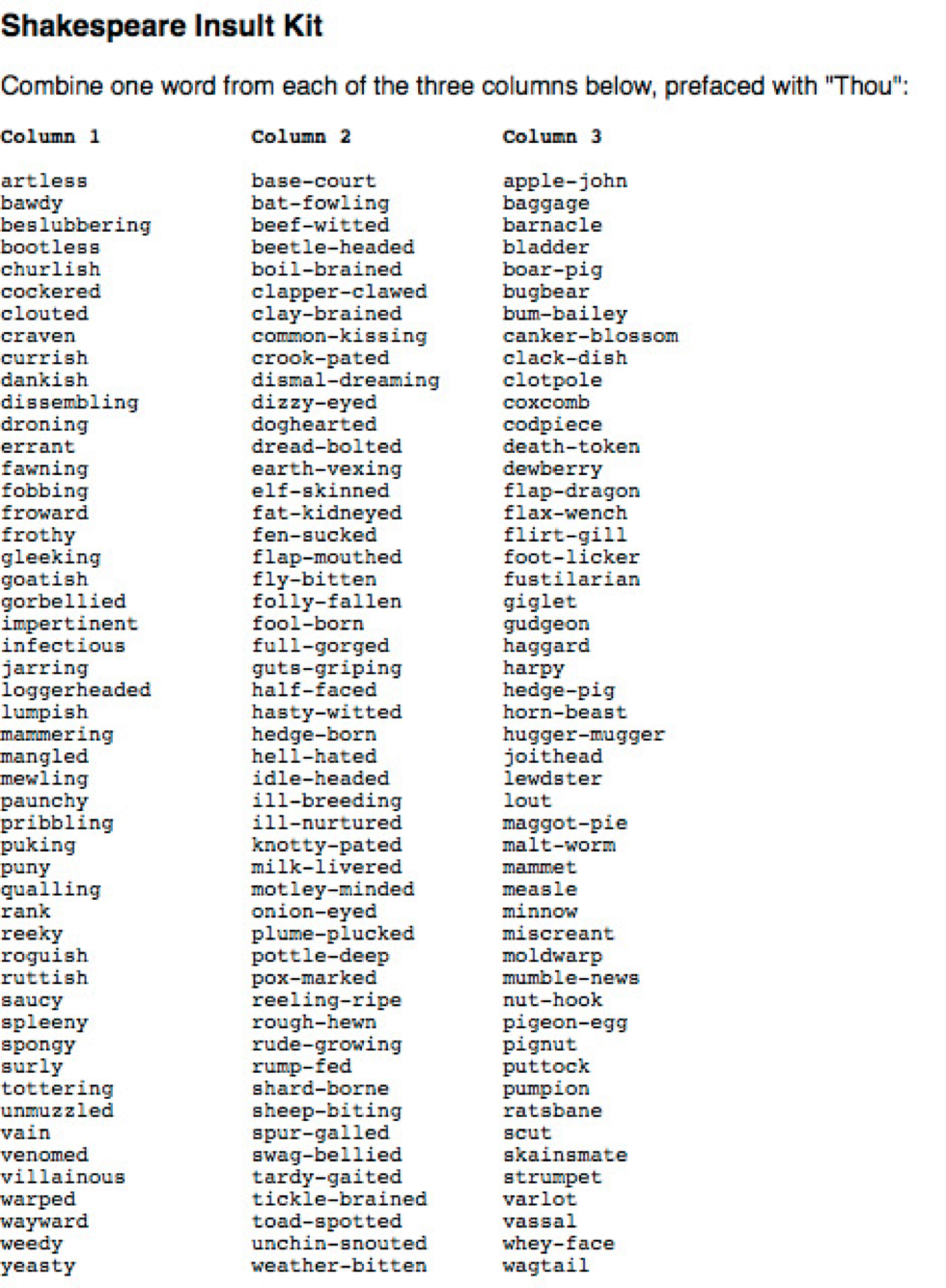
Make Your Own Shakespearean Insults (Thou gleeking, crook-pated flap-dragon)!

By David Corbett 

I have it on excellent authority that I’ve been way too serious lately.

So my guardian angel, Mortie, told me to lighten up. Have some fun for once. Slip into some giggles.

No sooner did he say this than I saw this little item on the amazing interweb:

Shakespearean Insults

I saw, I read, I chortled.

WARNING: This is a great way to waste time. Seriously.

Check out the chart below. Pick one word from each column, and precede what you get with “Thou.”

As in:

Thou unmuzzled, rump-fed puttock!

(Feels good to get it out, doesn’t it?)


Don’t you wish you trash-talked like this? Don’t you wish everybody did?

Now, after you’ve limbered up a bit, gotten a few combinations under your belt, gotten so they glide effortlessly off your velvet/acid tongue, you may want to try something bold—like come up with insults for the Murderati member you love (read: despise) most!

Post it in the Comment thread and we’ll all try to guess who you mean!

Or, if you’re lazy (and who isn’t, really?), or just overwhelmed by your go-getter/jetsetter/bedwetter lifestyle, you may prefer to let the help do it for you!

Just match the Murderatero of your choice to one of these pre-selected barbs, chosen judiciously by our trained, conscientious, and dedicated staff.

It’s fun! It’s easy! It’s insulting! 

Match One From This List                                        With One From This List

Thou fawning, fen-sucked barnacle!                         Pari Noskin Taichert

Thou beslubbering, beef-witted clotpole!                   Tania Carver

Thou reeky, onion-eyed scut!                                   David Corbett

Thou fobbing, tickle-brained measle!                         Gar Anthony Haywood

Thou gorbellied, hedge-born wagtail!                         P.D. Martin

Thou yeasty, milk-livered jolthead!                           Zoë Sharp

Thou ruttish, pottle-deep moldwarp!                         Stephen Jay Schwartz

Thou pribbling, sheep-biting mammet!                      Alexandra Sokoloff

BONUS POINTS if you actually know what any of these words mean!

* * * * *

Jukebox Hero of the Week: Continuing on with the light-hearted meme, here’s a spoof on Inglourious Basterds for the grammar sticklers among you (I know you’re out there …): 


IT’S THE LITTLE THINGS

by Gar Anthony Haywood

My writer Facebook friend Jeff Cohen recently posted a lament regarding a great pet peeve, one to which all but the most successful published authors among us can relate.  He’d recently gone to a party and had some thoughtless dumb-ass ask him The Question.  You know the one I’m talking about, because you’ve almost certainly heard it yourself:

“So, are you still writing?”

Naturally, Jeff was somewhat irked, as we all are when our choice of career is similarly treated with such disrespect and disdain.  But if we were to give the party guest who’d accosted Jeff the benefit of the doubt, and tried to understand why he (or she) would ask such an asinine question, we might be less ready to condemn.  Because this, in my opinion, is what The Question really breaks down to whenever it’s asked, in terms of what the person asking it is actually trying to find out:

“Since your writing hasn’t yet made you rich or famous, and you pour so much of your heart and soul and time into doing it, why are you still bothering?”

Granted, that’s still a rather insensitive inquiry, but I can see how people might wonder.  Why do we authors keep writing when the ultimate rewards we seek — fame and, if not fortune, a decent living independent of a day job, continue to evade us?  What in the hell keeps us going in the face of all the discouragement and rejection we regularly endure?

The little things, that’s what.

Those small, golden moments in which we are made to feel, however fleetingly, like a winner.  Unexpected notes of recognition from surprising corners of the universe that serve to prove we are not, in fact, writing in a vacuum.
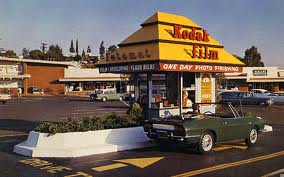
Example: Not two weeks after my first novel, FEAR OF THE DARK, was published by St. Martin’s Press way back in 1988, the family and I went to pick up some photos we’d dropped off at the local Fotomat.  (Remember them?  Those little drive-thru booths in strip malls just big enough for a cashier and about 100 rolls of film to fit in?  How about film?  Do you remember film?  Nevermind.)  Anyway, I’d paid the old guy behind the window for our developed photos and was about to walk off (yeah, we’d walked up, rather than driven through) when he said, “You aren’t Gar Anthony Haywood the novelist, are you?”

Huh?

Turns out he’d found my book in the library, read it, and liked it.  A lot.

I floated on air the rest of the day.

That’s a “Little Thing.”  And we all experience them, sooner or later.  And this being Wildcard Tuesday, I thought I’d ask some of my other writer friends to share their favorite Little Things with you.

Enjoy.


Tess Gerritsen, author of LAST TO DIE

The incident that stands out for me was while flying aboard a British Airways flight from Boston to London. A short time into the flight, the male flight attendant quietly approached and said the crew were all wondering if I was the famous author. I never had such attentive service!
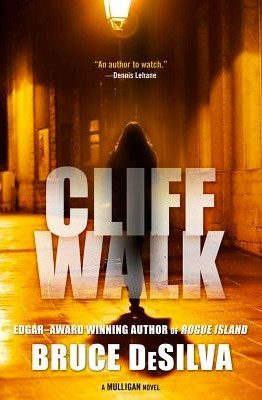
 

Bruce DeSilva, author of CLIFF WALK

Howard Frank Mosher (“Waiting for Teddy Williams”) is my favorite living novelist, the closest thing we have today to Mark Twain. So I was stunned to receive an unsolicited email from him shortly after my first crime novel, “Rogue Island,” was published. He raved about it, calling the book “a highly serious work of fiction combining a fascinating evocation of a twenty-first American city with a lyrical tribute to the dying newspaper business.” When my second novel, “Cliff Walk,” was published in June, he got in touch again, saying my protagonist, Liam Mulligan, is “the most human, unpredictable, and anti-authoritarian fictional character I’ve met since Ranger Gus McCrae of “Lonesome Dove.” But that’s not even the best part. My hero and I are email buddies now.
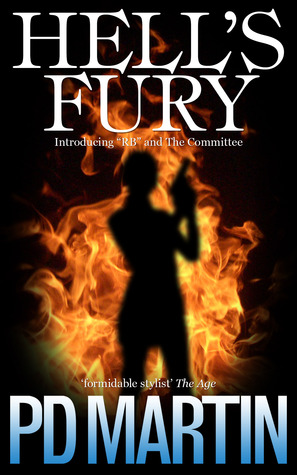
 

P.D. Martin, author of HELL’S FURY

I remember when my first novel got published and my ‘publicist’ rang me to introduce herself and chat. The whole idea of a publicist sounded pretty special and made me feel very much like a celebrity! And then I went to my first event with her, and she was like: “Can I get you a drink? Coffee, wine?” Might be the closest I come to having ‘people’!


Aaron Philip Clark, author of A HEALTHY FEAR OF MAN

I don’t have too many stories about folks recognizing me or any of those cool happenings. However, I did receive an email from a reader who thanked me for “writing a character with a soul” and said she typically didn’t read mysteries unless it was something Mosley had written. It put a smile on my face.


J.T. Ellison, author of A DEEPER DARKNESS

So many wonderful experiences: Winning the thriller award in New York last summer. It was an insane night – I was dreadfully ill, had laryngitis, a wicked case of nerves, and two of my literary heroes were in the room: John Sandford and Diana Gabaldon. To win a prestigious award in the presence of two of the writers who shaped me was incredible and gratifying. The very first Thrillerfest in Phoenix, 112 degrees and all the people I’ve only ever heard of there in the flesh; meeting Lee Child and having him react with, “Oh yes, I’ve heard your name.” I was floored. What? How? OMG!!! Allison Brennan talking to me like I was a real writer. The moment my agent called to tell me I had my very first deal – and not just for one book, but three. The day my agent called to tell me he wanted to be my agent. The first time I finished a book – Christmas Day, 2003, at my parents’ house in Florida, and the exhausted realization I’d finally done something special. But the very best was the very first sentence I ever wrote with intention to follow it with another, and another. I finished that paragraph and began to cry. There’s true magic in intention.


David Corbett, author of KILLING YOURSELF TO SURVIVE

Do They Know I’m Running? produced some of the most generous and heartfelt communications from readers I ever received in my career. I was deeply touched by many of the comments people shared, this one in particular:

“My father-in-law was finishing your book when I got home tonight. When I mentioned I met you, he right away asked, ‘Is he a cholo with a white boy’s name?’

I said nope, a white boy.

He got quiet for a second, then said, ‘He is a poet of my people.'”


Pari Noskin Taichert, author of THE BELEN HITCH

I was at a party the other night. It had nothing to do with my writing or writing at all, just a social gathering mostly of people I didn’t know. I introduced myself.  A woman in the group recognized my name, squealed loudly and said, “I can’t believe this! I’ve been waiting and waiting and waiting for you to get me another book! When are you going to write one?” Then she gushed about my books to me and to the group.  It was a small moment and an utter surprise. And it made my evening.


Brad Parks, author of THE GIRL NEXT DOOR

I was at a doctor’s office, doing some routine intake stuff with my wife, who has a different last name than me (and who, of course, carries our insurance, because her husband is a ne’er-do-well writer). Anyhow, the doctor got through asking my wife all the questions she needed to ask, then turned to me. “And what’s your name?” she asked. “Brad Parks,” I said. The doctor gasped and blurted, “The author?!?” She then launched on a 90-second rave about the great pleasure of reading my books and the tremendous admiration she had for me as a writer. I loved it and try to visit that doctor whenever possible. Strangely, my wife doesn’t use her anymore.


Zoë Sharp, author of FIFTH VICTIM

I’m constantly both humbled and honoured when I hear from readers who have enjoyed the Charlie Fox books. I try not to read reviews, so when people make a point of getting in touch directly it really means something special. It’s hard to pick out individual occasions, but three relatively recent ones spring to mind.

I have a fan in New Zealand, Karen, who is a huge champion of Charlie on Goodreads. She is always making sure the book covers and the details are correct, and she is an absolute wonder.

The second is reviewer and blogger Judith Baxter, who has done some wonderful posts about the books, and even about her surprise that I would get in touch to thank her for her kind words.

And thirdly is US singer/songwriter Beth Rudetsky, who wrote an amazing song for FIFTH VICTIM: Charlie Fox book nine called ‘The Victim Won’t Be Me’. I am just so moved by this.


Alexandra Sokoloff, author of HUNTRESS MOON

I was thrilled that Shelfari’s mystery and suspense group picked Huntress Moon as their August read, and the incredible discussion questions they’re coming up with are making all the work worthwhile.


Brett Battles, author of THE DESTROYED

When my first book (THE CLEANER) came out, I was still working at E! Entertainment Television. Every summer we would have this big party with a top named musical artist…can’t remember for sure, but think LL Cool J might have been that year. I had given a copy of my book to Ted Harbert, President of the network and he read and loved it. I had heard that he might say something when he was up on stage talking to everyone. He did…unfortunately I was in the bathroom at the time and never heard it. But I did have several folks later come up and congratulate me.


Robert Gregory Browne, author of TRIAL JUNKIES

I remember a young aspiring writer approached me at a conference and was so nervous he could barely stop shaking. I assured him that there was nothing to be nervous about—I mean, for godsakes, I’m NOBODY—but to think that someone was as nervous around me as I would be around, say, Stephen King or Donald Westlake, certainly got me to reflect for a moment on how I see myself. I rarely take time to realize that I’m doing what others only dream of and I’m a very lucky man, indeed.
 

Bill Crider, author of MURDER OF A BEAUTY SHOP QUEEN

In 1980 I attended Bouchercon for the first time.  It was a very small convention in those days, and I hadn’t published a novel yet.  (My first one, a book in the Nick Carter series, came out in January 1981.)  I was, however, writing reviews and articles for a number of fanzines like Paperback Quarterly, The Mystery FANcier, The Poisoned Pen, and The Armchair Detective.  I was looking at paperbacks at a dealer’s table and found one I wanted: The Case of the Phantom Fingerprints by Kendall Foster Crossen.  I can’t remember the price, but it was more than I wanted to pay.  I asked the dealer if he’d take less, and he looked at my name tag.  “Bill Crider,” he said.  “Are you THE Bill Crider?”  I told him I was the only one at the convention as far as I knew, and he told me how much he’d enjoyed reading my articles in Paperback Quarterly.  Then he said, “I’ve enjoyed them so much, I want to give you the book.”  This was particularly gratifying because the publishers PQ were standing there beside me, amazed.  I thought that as soon as my Nick Carter novel was published, things like that would happen all the time, but of course nothing like that’s ever happened to me again.


Gary Phillips, author of VIOLENT SPRING

One of my biggest thrills early on was being on a panel with Ross Thomas at the downtown main library.  We both talked about having worked for the same national union — AFSCME- and among his books he signed for me was the Seersucker Whipsaw, his novel about, among other things, union shenanigans.


Timothy Hallinan, author of THE FEAR ARTIST

Aside from the thrill of getting on a plane a few times and seeing someone reading one of my books (rocked my world) my biggest thrills come from fan mail.  My hero, Poke Rafferty, and his Thai wife, Rose, have adopted a little street child, Miaow, as their daughter.  Once or twice a year I get email from people who have become cross-cultural adoptive parents who want to say how accurately my books describe the joys and pitfalls of bringing someone into your family who has different beliefs, experiences, and expectations.  The emails practically paralyze me with pleasure–not only because the books mean something to these people but also because I blithely wrote the relationships in Poke’s little family without giving a thought to the possibility that I’d get it all wrong.  The best of these letters arrive with photos of the children.  The VERY best of them came from a 15-year-old Korean-American adoptee whose father wrote me in 2006 and now, six years later, she was old enough to read the book (A Nail Through the Heart) that had prompted his letter.  She wrote to say that I’d told aspects of her story so accurately that parts of the book had almost seemed to be about her.


Stephen Jay Schwartz, author of BEAT

The very best “shout-out” I got was when I stood in the back of a Michael Connelly signing at Mysterious Galaxy – a room packed with almost 200 people – and a woman in front of me asked Michael what authors he liked to read.  He answered that he didn’t always read in the genre in which he writes, but occasionally someone will send him the work of a new author.  “Like the author behind you,” he said, “Stephen Jay Schwartz’s work is exceptional.”  At that point every one of his fans turned around to look at me and my face went completely white.  I nodded to him, thanking him for his kindness.  That was an amazing thing for him to do, at his own signing.  I really love him for that.


Questions for the Class: Writers: What Little Things motivate you to keep writing?  And readers, have you ever done a Little Thing that may have inspired a favorite author to keep on writing?

How do you write?

by Pari

In addition to having wonderful writers at Murderati, we also have several who are superb writing teachers.

I am not one of them.
This isn’t false humility; it’s a simple fact. I have never spent much time analyzing my writing process. As a matter of fact, I have a really difficult time even trying to. I read our Murderati members’ —  and others’ — fabulous posts on building climaxes, structures, big concepts and, each time, I think I’m finally ready to jump in and learn how to write! Over the years, I’ve enthusiastically signed up for several classes and  . . . after about the second or third one, I’m back where I started: utterly befuddled.

I just don’t approach my writing in an analytical way though I admire the hell out of people who do.

But last week one of the psychiatrists at work approached me about collaborating on an article about creativity and storytelling from the therapist’s and the writer’s perspective.  And for some reason, I actually liked the possibility of looking at my own process.

Right now, I don’t have much of a framework upon which to hang any concepts. However, I do know:

  1. I start most of my stories with a broad theme (or a name) that intrigues me:
  • ·         The chile pepper industry in NM and the conflicts between big ag and small farmers
  • ·         A first-hand experience of divorce based on a book I read about “Rebuilding”
  • ·         An overweight Midwestern farmer’s wife who uses small magic without realizing it
  • ·         A woman named Guadalupe Nakamura

No questions. No conflicts to drive the story forward or give it much shape. Just interesting ideas to explore.

  1. Voice is the most important thing to me.  So I spend a lot of time getting to know my character(s). I go in as deeply as I can and write. I often talk aloud to hear the character’s cadence and close my eyes to see that person’s world, to smell it and taste it and hear it. I sit at the computer and feel the emotions that tighten my character’s stomach, the ones that make her heart beat faster or her skin tingle.  I let myself experience that full reality as much as possible.

If I’m true to this second step, the authenticity of the character shines through in my writing. However, if I think about audience at this point or whether my new creation will “sell,” both the character and I are in big trouble.

So those are the first two steps in my process . . . I think.  

How about you?
Do you know how you write? Have you thought about it?

The Art of Reinvention

by Alexandra Sokoloff

(I’m in Australia, teaching an all-day Screenwriting Tricks for Authors workshop today, or maybe that’s tomorrow, so I’ll try to comment tomorrow, or yesterday, or whatever! — Alex, jetlagged…)


A couple of weeks ago I was driving home from a “Noir at the Bar” reading here in L.A., and my favorite radio station was playing a live recording of a Sting concert at the Hollywood Bowl I’d actually been in the audience for, years ago. I always love that multidimensional feeling; it was like being in a time machine taking me back to a night I remember very well, because I’d just sold my first screenplay that month, a huge kick-start to what turned into an eleven-year screenwriting career. Now, when you’re outside the film business, a break like that feels like shattering some enormous, impenetrable glass dome atop the mythical business they call “the movies”, a dome that you’ve been circling for years, trying to figure out the entry point.  A familiar feeling for any of us who have ever experienced circling the glass dome of publishing, I imagine!

And it was a great synchronicity, being transported back to that time and that feeling… because I’ve just now broken into e publishing with the launch of my new direct-to-e thriller Huntress Moon and am feeling the same kind of exhilaration of shattering a barrier to a whole new and exciting level of my career.  It reminded me how life is a spiral like that. You come back to the exact same points of life, but hopefully you’re constantly moving UP the spiral, taking all your knowledge of that pivotal threshold with you and ascending to a both a higher and a deeper level.

It also reminded me that as writers, we are constantly reinventing ourselves. I would say “having to reinvent ourselves” but that sounds scary and ominous. Oh well, okay, let’s be real. We are constantly HAVING to reinvent ourselves.

I started out as a theater person, from the time I was a kid, really, but after college I quickly switched my ambitions and focus to screenwriting, because I was aware of the practical need to, you know, eat.  Knowing nothing about the film business, I moved to L.A. just figuring I would figure it out. And the fact is, I did pretty much just that – I got the classic entry level job into movies, a script reader for various production companies, learned the business and the craft of film writing by reading and reporting on hundreds of scripts in a very short amount of time, wrote my own script with a writing partner, got an agent by using what I’d learned as a script reader, and sold the script to Fox in a bidding war.

Now, the trouble with being a screenwriter, and with Hollywood in general, is that you get caught up in the fact that you’ve MADE IT in a profession that all the naysayers (you know the ones I mean) always told you you would never MAKE IT in, and you’re making great money for doing what you love and the people you’re working with are wildly talented and interesting, and it’s all so exciting and non-stop that it becomes very hard to see when things are not quite working out the way you envisioned.  Screenwriters have very little power over their work; the potential movies you work on are very very seldom made, and most of them don’t look like any movie you would want your name on anyway once the script has been through the process very aptly named “development hell.” Cut to ten years later and I had become so creatively miserable, without really knowing it, that it was affecting every other area of my life. And when a movie I’d written that I was truly passionate about fell through when we lost our director to another movie, I snapped. I just wasn’t going to go through that whole thing again.

And that’s how I wrote my first novel, The Harrowing.  And all the naysayers started up again, a lot of them inside my own head. “You’ll never make a living in publishing. At least in screenwriting you’re writing AND getting paid…”  (insert any profession, you know the drill….) But I knew I had to do something else, so I did, and the book got written, and it got sold, and suddenly a whole other glass dome had been shattered and I was on the rollercoaster of a whole new career, to mix a couple of metaphors. And I was lucky to make the shift when I did, because changes in the film industry have made a screenwriting career exponentially more difficult and creatively frustrating than it was when I started in the business.

But now I had to learn a whole different business and figure out a whole different way of making a living at writing. (NOT making a living was not an option – I’ve been writing professionally for so long I have no other marketable job skills). And publishing is a different way of making a living.

When you start out as an author – well, when I started out as an author, in 2006, people advised that we put our entire first book advance back into promotion. Because that’s how important the lift-off factor is in traditional publishing. I was a total newbie, and got completely obsessed with trying everything there was to try in marketing, all the things I imagine all the authors here have been doing or preparing to do with varying degrees of terror: website, Facebook, Twitter, Google+, Pinterest, blog, grog, blog tours, book tours – oh right, and writing that second book. (If you want a bloodcurdling glimpse into how it was, I’ve blogged about it here: Marketing =Madness).

Well, I made a good launch with The Harrowing – nominations for Stoker and Anthony Awards, significant recognition as a new and interesting female horror writer… but nothing like the brass ring, bestseller status. But I wrote more good books and got more recognition and also figured out how to create multiple income streams in my writing life –like teaching my Screenwriting Tricks for Authors workshop, that I started on my blog and developed into an e workbook (doing the workshops for free at conferences until I was in demand, and then starting to pick and choose my venues and going only where people would pay me, which also turned into self-perpetuating and well-paying promotion, as well as a personally rewarding avocation).

I’m a big believer in diversifying your writing career in the same way that you diversify a financial portfolio; the money is erratic in a writing career, often cyclical, and it’s a huge mistake to think you’ll earn the same income every year – I’ve seen way too many talented screenwriters and authors crash and burn by making that assumption. Invest wisely when you have the money and always keep a cushion for the lean years, because believe me, there are going to be lean years.

But still, I wasn’t published for long before I started getting that uncomfortable feeling again.  This time it didn’t take as long for me to figure out that I had to try something different – again. (Watching the publishing industry starting to crumble before my eyes with the rise of e readers and self-publishing was a pretty good clue…)

I truly believe we are in the midst of the biggest revolution since the invention of the printing press. E books, ereaders – it is ALL good news for us as writers, because we have so many more choices now. Look, I know it’s hard enough to just get through the day doing the writing you have to do and the promotion you have to do on top of that. You may be just learning the ropes of traditional publishing and here I am suggesting that you add learning the ropes of e publishing, to boot. Don’t panic! Do what you need to do at whatever step you are on in your career. But if you do find you’re not getting picked up by an agent when you know –  and enough credible people have told you – that you’ve got a great book… or you’re not making enough of a living with your traditionally published book(s)… or you are getting a nagging feeling that your publisher is not getting enough of your books out there to be bought and read in the first place… or Barnes & Noble goes bankrupt or something – there is a whole other miraculous option for you now.

In a time of diminishing publisher advances and massive bookstore closures, I and many of my traditionally published author friends who started out in publishing at the same time as I did have recently had the surreal experience of making more money in the first few weeks of an e publishing book launch as we ever got for a traditional advance. We can put a book out as soon as we finish it, rather than waiting a year and a half to two years for the publishing process to grind through its cycle. 

Given the choice between a traditional publishing deal for Huntress Moon and the tens of thousands of new readers that I was able to reach in just three days of a free Amazon promotion, plus having the force of the Amazon marketing machine behind the book (which is now an Amazon bestseller that is outselling a staggering number of high-profile traditionally published books that have a Big Six publisher behind them)…

Well, it’s a no-brainer to me.

I guess what I’m trying to say to you is: Be aware. Be aware if a small voice in your head or your gut or wherever those small voices come from tells you that you need to do something different. Be aware of the incredible sea changes taking place in publishing because of the e publishing revolution, and the incredible opportunities that are there for you.  Be aware that you can always, always reinvent yourself.

We’re writers. We make things up. 

Including ourselves.

Alex

Aloha

By PD Martin

Yes, I AM blogging from Hawaii today 🙂

I’m currently on a girls’ trip with my daughter, mother and sister. But I want to devote this blog not to the trip per se, but to motherhood.

In some ways, it took becoming a mother for me to really appreciate my mother. She sacrificed lots of things for us girls, and was a single-parent for most of our lives, following a divorce when I was eight years old. She worked incredibly hard and saved hard to give us the basics early on, then later on a few splurges.

This trip would definitely count as a HUGE splurge. She brought my sister to Hawaii for her 40th birthday in 2008, and then a couple of years later my daughter and me, but this time for my 40th birthday. Then last year Mum really wanted to go again, but I knew it wasn’t going to be financially possible for me; so I said Grace and I couldn’t come. A few weeks later, she offered to pay for airfares and accommodation if we could come up with the spending money. Pretty good offer, huh?

Then, around April/May this year the same thing happened. Mum wanted to go to Hawaii again, but we couldn’t afford it. So she decided to dip into her retirement savings – again!

We have all been completely spoiled with these trips to Hawaii, and can’t believe how lucky we are. 

Like I said, being a mum yourself makes you realise how much work goes into motherhood, and how much love. Not to mention the worry! But that’s a whole other blog.

When I was thinking about this blog, there was one other occasion that came to mind. When I was 22, I’d fairly recently split up with my boyfriend and he’d started seeing someone new. We’d managed to stay pretty much out of each other’s paths despite living around the corner, but then there was a birthday party coming up of the mutual friend we met through.

I was feeling insecure and second best – a feeling many people experience after a separation, particularly when another person comes on the scene.

Anyway, my Mum took me shopping and bought me a fancy leather jacket. I walked into that party feeling strong, way cool, confident and like a million bucks…thanks to my mum.

Don’t mums rock? What’s your best mum story?  I hope you’ve been lucky enough to have a great mother in your life.

NO PAIN, NO GAIN

by Gar Anthony Haywood

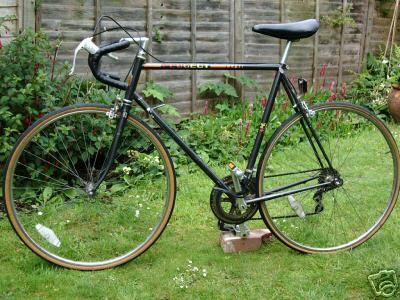
I rode my bike yesterday.  It’s a thirty-plus-year-old Peugeot 12-speed roadie like this one . . .

. . . that, by modern standards, is heavy and insufficiently geared, but it gets the job done for a twice-a-week, amateur cyclist like me.  I usually ride down to the Arroyo Seco and, sometimes, around the Rose Bowl beyond once or twice, but today I really pushed myself for no good reason I can think of.  I rode round-trip from the home the family and I are renting in Alhambra up to La Canada Flintridge, a total of roughly 20 miles, and I did it in the 90-degree heat much of L.A. has been baking in for the last two weeks or so.

Crazy, right?  Especially for an old goat like me?

But I made it, and it was fun.  It was a challenge that required me to push beyond the point of exhaustion — or the point at which the will to go on was seriously on the wane — a number of times.

I do this sort of thing regularly at the gym.  I predetermine what weight training exercises I’m going to do, how many sets of how many reps each, and then I do it, come hell or high water.  I force myself to work harder than it’s often comfortable to work.  I don’t quit, I don’t whine.  (And I don’t grunt like a dwarf trying to heave a submarine out of dry dock, either, as some muscleheads are wont to do.)  All I do is get it done.

Usually, what I’m thinking about as I shove, pull or push that weight stack this way or that, is writing.  Specifically, what I’m thinking is that this same dynamic, working hard as hell to achieve a given goal even when the going is damn tough — when everything inside you is screaming, “Stop, please, no more!  We don’t need this crap!” — should work for me, the writer, as well as it does for me, the physical fitness freak.

But it generally doesn’t.

Bust your ass in the gym and invariably, you see results.  Muscle growth, fat loss, an increase in strength and stamina.  It’s simple math: Do this, get that.  But bust your ass with that same level of commitment and determination behind your desk and, well . . .  Maybe something good will happen, and maybe it won’t.

It doesn’t seem fair.

The natural reaction to this inequity is to work harder still at your craft.  Write more, write better, write smarter.  Put even more effort into marketing your work.  Sleep six hours a night instead of eight.  That should do the trick, right?

Not necessarily.

Just as genetics ultimately limits what gains all your blood, sweat and tears in the weight room can earn you physically, so do things like talent, and timing, and luck have a similar effect on what you are able to accomplish as a professional author.  Working harder than all your peers guarantees you nothing.

This all makes for a great argument to do something else with one’s life.  Something less fickle and more likely to pay off.  Something your poor parents, or husband or wife, would be relieved to see you finally do.

Except that we don’t find something else to do.  We just keep on pushing, fighting, scratching to get the words out.  To write something people in great numbers will want to read.  Because the sports analogy that really fits the writer’s life is not one about weight training, but — to bring this post full circle — cycling.  Cycling is primarily a test of endurance, not strength.  How far can you go without giving up?  How many back-breaking hills can you climb before hitting the brakes and turning back for home?

And your reward for the ride?  Forward progress.  Each mile gets you one step closer to the next.  You ride for the certain knowledge, the unassailable fact that — despite any evidence there may be to the contrary — you’re not as far away from your destination in this minute as you were the minute before.  You’re not standing still or, worse, regressing.  You’re on the move, headed toward that place you want to be.

Will you ever actually get there?  The answer to that question may lie just over the next big, imposing, twenty-percent grade on the horizon.

And you’ll never top that grade if you quit pedaling.

Questions for the class: How do you use physical exercise to motivate you in a chosen endeavor?

Alison Gaylin

By Tania Carver

It’s Wildcard Tuesday again and here’s another interview by Martyn, the male half of Tania. Edgar-nominated crime novelist Alison Gaylin has long been a favourite writer of mine. Entertainment journalist by day and crime writer by night, she’s writing some of the best PI novels around. We first met at Bouchercon in Baltimore in 2008 when we shared a panel and immediately hit it off. In San Francisco Bouchercon in 2010 we both took the title roles in a reading of Declan Hughes’ play about Dashiell Hammett and Lillian Hellman, ‘I Can’t Get Started’. She was great. If you’ve already read her you’ll know how good she is. If you haven’t, (and why not?) here she is . . .

And She Was, the first in the Brenna Spector series, came out in February. It’s a fantastic book, I loved it and it’s been a thoroughly deserved bestseller too. Can you fill us in on the background to it?

Firstly, thank you Martyn! That means a lot, seeing as I’m a huge fan of both you and your darkly seductive alter ego, Tania Carver. The book’s success has been really satisfying for me, especially since it was such a long time coming. I signed a three-book deal back in 2008 based, not on a manuscript, but an idea for one. The book itself didn’t come out til February of this year. I’m always a big rewriter (is this a word? My spell check says no. Anyway….) I rewrite a lot. But I think I worked harder and did more revising on this book — both in proposal form and the manuscript — than any of my others.

Brenna Spector herself must be one of the most interesting and engaging characters in contemporary crime fiction. She’s also got a very memorable affliction (geddit?). Where did she come from – and what came first, the character or the affliction? Or were both things the same?

The affliction came first. Back in 2007, I saw a magazine article about someone with hyperthymestic syndrome — perfect autobiographical memory. So, as opposed to someone with photographic memory (ie The 39 Steps) this is a person who remembers every day of their entire life in perfect visceral detail, with all five senses. After reading the article, I thought, “Man that sounds awful!” And then, as I often think when I read about something particularly horrifying, “Hmmm… Maybe I can write about it.” The thing that fascinates me the most about this disorder, which is very rare, is not so much the ability to remember — but the inability to forget. What a tragic burden, to carry every mistake you’ve ever made, forever in your mind…

In creating Brenna, I thought about how that disorder would affect not just a detective’s career, but her interpersonal relationships, and I sort of took it from there.


Your background is in journalism, particularly in the entertainment industry. How did you go from that to writing crime novels? And what made you want to write crime novels in particular?

I have my masters in journalism and my undergraduate degree in theater, so writing for entertainment magazines was a career I naturally fell into. But my interest in crime came first. I’ve always loved reading crime books — both true crime and crime fiction. It goes back to what I was saying about liking to write about things I find distasteful. In a way, it’s an opposite form of escape. Instead of going into an idealized world (as you might with a romance novel or a fantasy) you take a trip to the darker side, and then you come back to reality thinking, “Hey, this isn’t so bad.” I love writing crime because you can take very basic human emotions — envy, guilt, the desire for vengeance etc. — and magnify them until they’re terrifying. And hey…. that’s kind of true of writing for celebrity magazines too when I think about it.

And in one of your previous novels, Trashed, the heroine is working for a Hollywood celeb tabloid, using underhand means to get stories and going dumpster diving. Is this autobiographical in any way? (And could you explain what dumpster diving is to those of us who’ve never had to do it for a living?)

Ha! Yes. Outside of the murder stuff, and the fact it’s set in present day, TRASHED is pretty autobiographical I’m embarrassed to say…  One of my first jobs out of college was as a reporter for The Star. This was before its current glossy incarnation, when it was a down-and-dirty tabloid whose competition was the National Enquirer. Publicists refused to talk to us, celebs spit on us and slammed doors in our faces. So we had to resort to getting our information in other ways…. Posing as extras on the set of movies or cater waiters at weddings, crashing parties, hanging around the waiting rooms of plastic surgery wards, chatting up bouncers and yes, Dumpster diving… which means sifting through celebrity garbage cans in search of… I have no idea. A story? This was many years ago, Martyn. Anyway, a lot of that real-life experience found its way into TRASHED.

And have you any salacious Hollywood gossip you can pass along? Just between ourselves, obviously.

Hmmm…Oh, I know! What best-selling, darkly seductive female author is really a 6’2″ dude and his wife?

You missed out handsome. Now Lee Child gave what I think is the best description of your work: ‘A perfect blend of ice-cold suspense and warmhearted good humour. I’m not sure how she does it but believe me she does it.’ You seem to be able to combine dark, noirish plots with such a deft light touch without compromising on either. How do you manage it?

Oh thank you so much! I think it’s just the way I look at the world in general. Most of the time, I try to see the goodness in people and the humor in dark situations. It’s a survival tool more than anything else.  As for fiction, I think pure darkness loses its impact when it’s portrayed as such. You want to distance yourself, and I’m not big on writing that distances me. If I’m going to be involved and scared and everything else, I have to care. 

Is it true you have terrible taste in music?

 Absolutely, positively NOT. I have the best taste in music I know. And no, you cannot see my iPod… 

I’m not surprised. And finally, what next? More Brenna hopefully.

Yes! I’m finishing up revisions on INTO THE DARK — the sequel to AND SHE WAS, which will be out next February. I also just sold my first YA mystery, REALITY ENDS HERE — about a 14-year-old girl who’s on TV’s longest running reality show along with her six-year-old, sextuplet half-siblings, and whose life takes a dark turn when receives a gift, on camera, from her presumed dead dad. It was sold to PocketStar/ Simon and Schuster and it’s got lots of celebrity stuff and humor and murder in it.

And here’s an action shot of that play reading in San Francisco. I’m the tall one, obviously. Seated: Mark Billingham, Christa Faust, Brett Battles, Megan Abbott and Declan himself.

Thanks Alison, it’s been a blast, as always.

And here’s a link to Alison’s Amazon page. Here.

Better Never Stops

By Tania Carver

As I’m sure you’re aware – unless you’ve been living in a cave or recently crashed down on Mars – the Olympics have been on. And not just any old Olympics, the LONDON Olympics. Now, I realise this is a blog about crime writing and not sport but bear with me because I want to write about the Olympics. (And not just because watching them has taken the place of crime writing for the last fortnight. Honest. I’ve been working. Really.)

Now I’m not normally a fan of athletics, or much sport really, with the exception of football (or soccer as it’s incorrectly known in the colonies) and have a lifelong, if somewhat misplaced, passion for my hometown team Newcastle United. But I now live in (or rather near) London and this was something else. This was going to be a huge event in my adoptive hometown. Having said that, as it drew nearer I found myself getting less and less excited about the games. It seemed like it was going to be one huge corporate free for all, all branding and tax-avoidance, with the actual spirit of it ignored and forgotten. Plus construction costs were spiralling. The games bankrupted Greece and it looked like it was going to do the same for us. Then I decided I wanted to be on holiday when the games were on. Or at least just get out of London and stay out. I’d gone from being enthusiastic to indifferent to adversarial.   

And then I saw the opening ceremony.

Danny Boyle, a film director who I’m sure you don’t need me to tell you about, was in charge, along with writer Frank Cottrell Boyce. And they managed to do something that was both a spectacular and awesome spectacle and a personal, heart-warming and life-affirming performance piece. And it made me feel something else. Something I have never, ever felt. Proud of being British.

As I said, I’m from Newcastle. It’s a city on the border of England and Scotland and often feels like it belongs to neither one country nor the other. The major roads stop a hundred miles south and don’t start up again until they’re over the border. Growing up there in the seventies as I did made you feel very isolated and disenfranchised from the rest of the country which is totally London-centric. And that’s why the popular concept of being English or being British never seemed to reach Newcastle.

I should add that all of this was, in hindsight, great for the formation of a writer. The perpetual outsider, the observer, the non-participant. Brilliant. But not at the time. Not when you have to grow up and experience that.

But now I live just outside London (interestingly, with that observer perspective again – near it but not of it) and that’s where the Olympics were being held. And that opening ceremony – which I watched under duress, expecting a huge, embarrassing car crash of an event – was wonderful. Cynicism just dropped away – and that is a hell of an admission for me, steeped in the stuff, to make – and I loved it. Because as I said, it made me proud to be British.

So why – and how – did it do that? I’ve been thinking a lot about this. And I’ve reached the conclusion that the ceremony represented the kind of Britain I believe in. That I recognised and want to be – and hope I am – part of. It spoke of the things that our country should be most proud of – children’s literature and literature in general, the fantastic popular culture we have, especially the musical diversity, our multicultural make up.  The trades unions who fought for the rights of working people. The sufferagettes. And our NHS, the best free health service in the world. It was an unashamedly liberal, left wing ceremony and it was fantastic.

There were dissenting voices, all from the right. The Daily Mail, a far-right tabloid (in fact the only British paper to have supported Hitler) wrote a hideously racist piece denouncing one section of the ceremony showing a white woman married to a black man and their mixed race children as unbelievable, saying no intelligent, middle aged white woman would do that. The fact that Jessica Ennis, a British athlete of mixed race parentage won gold in the heptathlon flung their remarks right back in their faces. It was described as ‘multicultural crap’ by one Conservative MP. When Mo Farah, a Somalian asylum seeker who settled in our country and is now a UK citizen won two golds and spoke of his pride at being British the Conservative MP retreated.

So yes. Proud at being British. Or at least proud to identify myself as standing for the same things that the ceremony portrayed. And, judging by the hugely positive response and the viewing figures, I wasn’t alone in thinking that. I took to Twitter straight after the ceremony to see what others thought. And everyone – with the exception of those previously mentioned dissenters – were as positive and uncynical as me. The interesting thing was the response from my friends in America. Nobody, even friends that I thought I was so similar to, got it. And that made me, perversely, even more proud and even a bit unique.

I tried to find the opening ceremony online but could only find this. If you haven’t seen it, watch it. And yes, it really is her:

And then the games started. As I said earlier, I’m not that interested in sports that don’t involve a football. But I got drawn in, watching the cycling, then the running then . . . everything. Even things I didn’t understand like dressage, which seems to involve making a horse dance mincingly to music, or tae kwon do which largely consists of one person trying to kick another one in the face. On Saturday night, I sat with family and friends cheering at the TV as Mo Farar (my new hero) won gold for Britain in the 5,000 metres. Yes, cheering.

And after all the events I would watch the interviews with both the winners and losers. And, being a writer, I was trying to find some kind of similarity or common ground with the process of competing with the process of writing. At first I didn’t think there was any. Or at least nothing I could find. But that didn’t stop me looking. And gradually some similarities began to emerge.

As writers, we sit in a room and write. Yes, I know, most of that time is spent staring at the wall, or making coffee, or on Twitter, but essentially we are writing. Athletes are training to compete against others and against themselves. To be the best they can. Writers should be doing the same in their own way. We have to better our last effort. We have to be constantly moving forward. We should never be happy with what we have achieved (or at least not for very long) and we should always be striving to do better.

Another comparable thing I found was that the camaraderie among athletes seems to be very similar to that among crime writers. One of us does well, it reflects well on all of us. One of us wins something, the rest respond by trying to raise their game. They seem to genuinely like each other and whatever rivalry exists, even between citizens of different countries, is a healthy one.

The one glaring difference is with the idea of competition. Athletes are there to win. And they do that by finishing first. Writing is very different in that respect. To quote from Trevor Griffiths in his play ‘Comedians’ (one of my favourite plays of all time), ‘We work through applause, not for it.’ And also, ‘There’s nothing wrong with being famous. But be good first. Because you can never be good later.’ Those lines are like my mission statement as a writer.

Last year at this time, London was being torn apart by riots. Whether you believed the rioters had a point or not, we saw, in the carnage, destruction, assault and even murder humanity at its worse and most base. We saw kids disenfranchised and disillusioned hitting out with undirected rage and anger. For the last two weeks we have seen kids, a lot of them from the same backgrounds as the rioters of a year ago, being given an outlet, a focus. A goal. And a chance to be the best they can be.

So by the time you read this, the Olympics will be over. What the legacy will be, I don’t know. Whether it has bankrupted the country I couldn’t say either. Will we all be fitter, more positive people as a result? Or will we go back to the same cynical state we were in before? I don’t know. But for two weeks in August 2012, there was a palpable, but rare, sense of hope. Of belief. Let’s hope we haven’t seen the last of it.

If you want to read more, Tim Adams in The Guardian says it a lot more eloquently than me. 

THE THINGS WE DO WE NEVER THOUGHT WE’D DO

by Stephen Jay Schwartz


Jimmy Hendrix, Janis Joplin, Marilyn Monroe, Amy Winehouse, James Dean, Stevie Ray Vaughn, Heath Ledger, Notorious B.I.G., Tupak Shakur, Kurt Cobain, Sid Vicious, Jim Morrison, River Phoenix, Buddy Holly, Aaliyah, John Lennon, Reggie Lewis, Ritchie Valens, Bob Marley, Jim Croce, Bruce Lee, Charlie Parker, John Belushi, Martin Luther King, Rudolph Valentino, Eva Peron, Alexander the Great, King Tut and Jesus Christ.

They all died too young. They died in the prime of their lives. They became icons and heros for the things they did during their short stay on planet Earth.

But if any of them had been allowed to live deep into old age, would they have retained that sheen of heroism? Would Sid Vicious be doing late night infomercials selling CD sets of classic rock, like Roger Daltry? Did Roger see that one coming? Makes me wonder about that lyric of his, “Hope I die before I get old…”

Remember how pissed off Jim Morrison got when his band members sold “Light My Fire” to Muzak for a car commercial? This was long before Eric Clapton did those fucking beer commercials. We called that “selling out,” back in the day. Now it’s called “a diversified portfolio.”

If Jim Morrison hadn’t died young, would he have lived long enough to embarrass his younger self? Even though he died drunk and fat, he still died a rock star. He didn’t go out selling used cars.

I bet David Lee Roth thought he’d be a rock star forever, and then he became DJ “Diamond” Dave doing Top Forty Faves.

Sometimes it’s best to die young, if you really care about leaving a legacy behind.

Of course, you have to have a huge impact doing something first or else dying young is just really pathetically sad. So, to become an icon, one must first capture the attention of the world, and then suddenly, tragically, die. Young.

If one continues to live, one must constantly reinvent oneself in order to recapture the attention of the world. Like Madonna. She’s fighting it all the way to the grave. If she dies suddenly her obit will still say that she died in her prime.

And there’s nothing worse than watching our great icons not-die, instead drifting into oblivion, or drug-addiction (sans overdose), or hoarding or, finally, reality TV.

I find it terribly difficult to watch Howard Stern and Steve Tyler clown-up for what is essentially a new wave of The Gong Show remakes. We know they’re only doing it for the almighty dollar, which makes it seem like our heros can be bought and sold. I think Jimi Hendrix thanks God every day for taking his life before American Idol came knocking. Would he have resisted? We’ll never know.

It all just makes me think about the things we do that we never thought we’d do when we were young. And they’re not bad things, necessarily, just different things. Sometimes they actually prove our growth as human beings.

Like, I never thought I’d be a fan of Mariachi music. I mean, really. I grew up on rock and then had a healthy education of classical and jazz. When my younger son, Noah, began violin lessons I was excited about someday hearing him play in a string quartet. But, no, his music teacher put him into a Mariachi band (really?) and he’s hooked. So, now I hang out at the local church or crash the Quinceanera in hopes of catching a blast of trumpets and strumming guitarrons.

I also never thought I’d fall out of shape. That’s another way of dying young, I suppose. Elvis didn’t die quite young enough, so he bloated up. Like Orson Welles. Their bodies were saying, “Give up already! You’ve gone on ten years longer than you should have. Don’t you want to be an icon?”

I think it’s interesting that we remember Elvis young and thin, while our image of Orson Welles is quite the opposite (“We will sell no wine before its time”).

Since I haven’t done anything iconic yet I can afford to fall out of shape and work my way back into shape again before I make an impact on American society. I still have the opportunity to die young (well, relatively) and/or bloat up for ten years before bursting a liver.

Or maybe I’ll age gracefully after having a solid career in the arts. Like Jimmy Stewart or Bob Hope or Elmore Leonard or Michael Connelly. That’s classy, but not quite as dramatic as hearing the sirens approach Chateau Marmont after John Belushi’s demise.

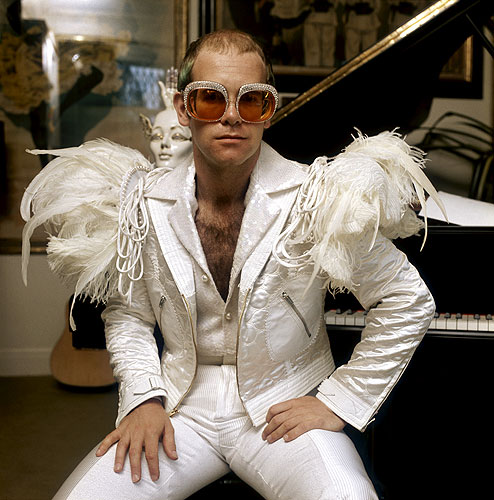
And don’t you think it’s kind of weird that Elton John and David Bowie are still around, all mellow and out-of-touch, after the fuss they made when they were young? They could have been truly iconic, but they missed their chance. I mean, geez, Elton’s got a high-end retail clothing store in Caesar’s Palace. And he’s been knighted, for godsakes.  By the Queen of England.  Did he see that coming? He could have been the Pinball Wizard forever, if only he’d died young.

I just hope I live long enough to get my own page on Wikipedia. Then I’ll know I’ve made a difference.

Or maybe I should just forget all this nonsense and finish my book.

Sounds like a good idea to me.