Author Archives: Murderati Members


Ignoring the H8Rs.

by Tess Gerritsen

Recently I came across the premise for a new reality TV show called “H8R,” which, for those of us who are text-message neophytes, translates as: “Hater.”  Here’s the description:

On this reality show, celebrities go head-to-head with regular people who don’t like them. They try to win their adversaries over and, in the process, reveal person behind the famous name. Mario Lopez hosts the program which includes two celebrities in each episode.

The haters are not told about the show’s actual premise when they’re recruited. Producers tell them a different type of documentary or show is being shot but extensive background checks are done to ensure the haters are not also stalkers. In some cases, the celebrities nominate their haters, who they know from the Internet or Twitter.

For people who aren’t celebrities, it may come as a surprise that celebrities can, in fact, feel personally wounded by cruel remarks made by complete strangers. When Gwyneth Paltrow started amassing hordes of such haters, I wondered how she felt about it.  I also wondered why anyone would bother hating a woman just because she’s a blonde, beautiful, talented gal who likes to share lifestyle tips.  It’s the same thing I wondered about people who hate Martha Stewart with such gusto, investing a great deal of emotional energy attacking a woman they don’t personally know. When I thumb through her LIVING magazine to gawk at her impossibly elaborate craft projects, I don’t feel jealousy or disdain. What I feel is resignation, because I know I’d probably end up hot-glueing my own head to the ceiling fan. I’ll never be as capable as Martha Stewart, but that’s okay with me. 

You don’t have to read the National Enquirer to know that the most-envied celebrities are often the public’s favorite targets of vilification.  It’s the people we want to be or look like, the people who have what we want to have, that catch the brunt of public hatred.  Celebrities aren’t really human, so how could they possibly have human feelings?  They’re rich, they’re beautiful, they’re successful, so why should they care if complete strangers spew hateful things about them?

Some people think it’s fun and amusing and harmless to hate the Marthas and Gwyneths and Brangelinas, and to express that hatred online so the world can share our bile.  But celebrity is only a matter of degree.  Just about anyone can be considered a public person these days.  Restaurant chefs. Athletes. Policemen.  

And writers.

A few weeks ago, novelist JA Konrath posted a blog entry called “Not Caring,” about how important it is for writers to develop thick skins.  

One of the greatest skills you can acquire as an author is a thick skin.

 Once you unleash a story onto the world, it no longer belongs to you. When it was in your head, and on your computer during the writing/rewriting process, it was a personal, private thing. But the moment your words go out into the world, they are subject to the opinion of strangers. What was once personal is now public.

 Do yourself a huge favor, and don’t listen to the public.

 This goes for more than your literary endeavors. If you blog, or speak in public, or tweet on Twitter, you are a Public Figure.

 That means some people aren’t going to like you.

 And you shouldn’t care.

 You hear this very wise advice from non-writers as well.  That we writers shouldn’t give a damn about reviews.  That writers should stop whining and pull on their “big-girl panties.” That being published means you have no right to be sensitive to whatever anyone, anywhere, says about you.  But that advice isn’t always easy to take, and I know many authors who are still personally wounded by a bad review or snarky comments on Amazon. One very talented debut novelist, a man who’s hitting bestseller lists around the world, told me that the hardest thing about being published was learning to take the blows.  He knew he was thin-skinned, and he tried to prepare himself for public criticism, yet he was taken aback by how much it hurt.

“Crybaby!” I can hear the public sneering.  “Why don’t you man up and grow a pair?” 

On a readers’ forum, I came across comments by two teachers who smugly observed that, unlike crybaby writers, when teachers get performance reviews, they’re mature enough to deal with the negative ones. They said that writers are a privileged and lucky group (whose average income, by the way, is less than $10,000) so no one should sympathize with them. Writers should stop whining and be as tough as everyone else whose work gets reviewed by superiors. For crying out loud, writers should learn to be as tough as teachers.

Then, a few months later, a tragic thing happened.  In a new policy introduced by the Los Angeles Times, L.A. public school teachers’ performance ratings were published in the newspaper.   A highly dedicated teacher, despondent over his merely average rating, committed suicide.  

I’m wondering if it suddenly became clear to those teachers that public criticism, public exposure, feels like a different thing entirely than does a private performance review.  When your boss tells you you need to shape up, that can sting.  But when that performance review is online and in the newspapers for your neighbors and colleagues to see and talk about, that’s a level of embarrassment that not everyone can deal with.

Not surprisingly, many teachers were upset about the dead teacher’s public shaming and suicide.  Just as they’re upset when they’re called lousy teachers by students on Facebook.   

Yet that’s what writers routinely put up with.  It comes with the job — a job that pays the average writer about as much as a part-time dishwasher — and we have to learn to deal with it.

But it’s not easy.


Does adversity make creativity stronger?

by Pari

Ever since I heard the concept in elementary school, I’ve subscribed to the idea that adversity makes a person stronger. At the very least, it adds a certain meaning to those times in life when it feels like the entire universe is conspiring against one’s happiness, health, financial success, good relationships with others . . . .

I’m still inclined to accept the idea on a meta-level, though I’ve seen troubles take dear friends and family down hard. Some of them have never recovered. Some decided their pain was too much to bear and they killed themselves. So I’m not quite as ideal as I once was.

However, the other day in conversation with a tremendously accomplished man, Chris Schueler, a different take on the concept came up: Chris believes that adversity makes creativity stronger.

Hmmmm. I don’t know how I feel about this one.  The thought encourages me; I really want to hang my hat on it. How comforting to think that the emotional struggles I’m going through right now will make me a better writer.

I want to believe; I’m just not seeing any obvious evidence of its veracity yet.

It is true that I’m creating more in general. While my fiction may not be as large in word count as it was while I was home full time, I’m sticking to a schedule and have only forgotten to write one day in the last 412. So I’m far more consistent. I’m also painting, “doodling,” dancing and singing more than I’ve done in years. So, again, the sheer quantity of my creativity is increasing.

But is any of it “stronger?”

I can’t say because I don’t know what that means.

There’s a bit of “One must suffer for one’s art,” underlying my interpretation of Chris’s observations. I know that’s not what he meant. He was talking about his own work and how he was able to pour much of his emotional turmoil into incredibly moving television productions such as Cody — a video about Cody Unser (of Unser racing family fame) and her journey with paralysis.

I don’t feel like I’m pouring anything into anything. Instead I feel like I’m a dancing drop of water on a hot frying pan.

Right now my days have an automatic quality to them rather than the vigor of creativity. Yeah, yeah, it’s early days in my own journey and I’m maintaining well. Yes. I know all of that. And maybe it’s too much to expect that I can even judge if I’m becoming stronger creatively – or if my creative output is stronger.

Again, I don’t know, but I think it’s a really interesting idea.

Would you like to explore it with me?

1. Do you buy it? Does adversity make creativity stronger?

2. Can you give examples in your own life or from artists/writers /other creatives that have found this to be true?

CONFESSIONS OF A CLOSETED ROMANTIC

by Gar Anthony Haywood

Despite all the evidence to the contrary, I am a hopeless romantic.  This isn’t something I make a habit of admitting because hardboiled crime writers aren’t supposed to have a heart, and if word gets out I’ve got one, it could ruin me forever (if I’m not in fact ruined already).

All but a few of my favorite books and movies are really just love stories in disguise.  They wear the trappings of crime fiction, but at their very core they are Romeo and Juliet, with the emphasis placed on the former.  Most involve a man, brave and strong and ostensibly indestructible, in love with one woman so deeply that his world has no meaning without her.  Her loss renders his surface masculinity — the perception others have of him as impenetrable and without weakness — a sham.

Take this scene from CASABLANCA, for instance:

Damn.  That was Humphrey Friggin’ Bogart bawling like that.  Over a woman.  (Granted, the woman is Ingrid Bergman, but still . . .)

Is this what love is supposed to feel like?  Like someone’s tearing your guts out with a baling hook?

Yes.  I think it is.  And I’ve come to this opinion, in no small part, by way of such cultural influences as the classic movie mentioned above.  I’ve always been a pie-in-the-sky idealist, and knew from a very early age that, whatever love was, there had to be more to it than what I was seeing at home.  My parents were loving, don’t get me wrong — when my mother wasn’t throwing Dad’s clothes out on the front lawn, anyway.  But there was nothing overt or effusive about their affection for each other, and I couldn’t imagine myself ever being happy in that kind of muted relationship.  The brand of love I wanted for myself was big and bold and irrepressible, and in my search for it, I looked to contemporary art — literature, film, music — to paint its description for me, so that I might know it when I found it.

Needless to say, this is an approach fraught with danger.  Depending on taste, in trusting the people who make movies and write pop songs to shape his view of romance, a man could wind up taking his cues from such world-renowned experts on affairs of the heart as Jon Landis and Barry Manilow.

While I didn’t make that grave mistake, what I did do was fall hard for material that celebrates love not as a prelude to a fairy tale, but as a double-edged sword that cuts like a goddamn Ginsu knife when it goes wrong.  In the films, books and ballads I gravitated to most, love isn’t about pain, but pain is most definitely part of the bargain, and anything calling itself “love” that does not involve the risk of emotional evisceration is a mere imitation.

I know.  Sounds wonderful, doesn’t it?

Oh, I can appreciate the occasional ode to love that has nothing but wonderful things to say about it, sure, but my obsession is with those that tell the sad tale of love found and then tragically, often stupidly, lost.  Because such tales are never told from the perspective of some giddy, delirious soul who merely thinks he’s in love, but rather someone who knows he is and has the open wounds to prove it.  For me, it’s a simple matter of credibility.

Curiously, I’m not of the school that believes “true” love only comes around once.  That’s too pessimistic a take for me.  I believe you can replicate true love with various partners, though in each case, it will look and feel somewhat different.

How this somewhat backwards view of love has informed my writing is not easily explained, for I barely understand it myself.  What I can say with any degree of certainty is that I treat romantic love with deathly seriousness, and I’ve never created a protagonist who was immune to it or, more importantly, lived in denial of it.  The truth I think I’m always trying to get at in my writing is that we are all at our most human when we are willing to accept both our need for love and our moral obligation to share it with others.  How near or how far a character is to finding that acceptance is what separates good men from bad in my fictional universe.

So now you know my deep, dark secret: I’m a closeted romantic, just like these two guys:

But before you threaten to take my Man Card away, remember that my idea of a great love story involves all the stuff hardboiled noirs are generally made of: pain, regret and lots of insufferable longing.  As evidence, I present the following, some of my favorite melancholy ruminations on the subject of love lost, found, and on its way out the door.   They’re all sad, to be sure, until you stop to realize that, before a man can hurt this bad, a woman (or a man, as the case may be) has to first make him feel better than he has ever felt in his life.


YOU ARE EVERYTHING – The Stylistics

This song kills me every time I hear it.  The title says it all.  Everywhere this poor bastard looks, he sees the woman he loves — and she’s gone.  She’s walked out and she’s not coming back, leaving him to pine for a past he can never, ever recapture.

Damn.


WARNING SIGN – Coldplay

Yeah, I know.  Coldplay isn’t for everybody.  In fact, there are as many people who think their stuff is lightweight crap as there are those who find it incredibly moving.  Right or wrong, I fall into the latter camp, and this song is Exhibit A in my defense.  This time, the poor bastard in question has lost the love of his life because he foolishly let her walk, and he’s only now figured out what a tragic mistake that was.  But maybe there’s hope for the big dope yet; he’s offering her a sincere mea culpa and inviting himself into her open arms, and if she’s willing to give him another chance. . .

(You can write the ending any way you like.  I choose to believe she forgives the fool and they make a spectacular go of it the second time around.)


BROKEBACK MOUNTAIN – Something to Remember Jack By

If I were a) a raging homophobe; b) a misguided Christian fundamentalist; or c) a block of stone, I probably wouldn’t give a damn for BROKEBACK MOUNTAIN.  But as I’m none of these things, I consider Ang Lee’s movie to be one of the greatest romances ever filmed, and this scene tears my heart out.  So sue me.


INCEPTION – Letting Mal Go

All right, let’s get this out of the way right now: I’ve drunk from the INCEPTION Kool-Aid vat and I’m not ashamed to admit it.  I love this film, and I think Leo D did a yeoman’s job in the lead role.  While most of the discussion about INCEPTION has generally centered around its complex sci-fi plot and groundbreaking CGI, it’s the love story between Leo’s Cobb and Cobb’s late wife Mal (a breathtakingly beautiful Marion Cotillard) that makes this film work for me.   Cobb wants to get back to their children, yes, but what drives him more than anything is the desperate need to preserve Mal’s  memory, to cheat death by holding onto and reliving every second of his time with her, over and over again.

SPOILER ALERT!

Whether Cobb really reclaims his children at the end or not is almost immaterial.  That he finds a way to reconcile with Mal, to earn the right to go on loving her without guilt, is all the closure any viewer should require.  (Sorry, the video can’t be embedded — you’ve gotta click on the link to view it.)

http://youtu.be/f_o70GrwaaU 


HE STOPPED LOVING HER TODAY – George Jones

Corny?  Sure.  Dated?  No doubt.  Heartbreaking?  Damn straight.


VERTIGO – Madeleine Reborn

Just like Coldplay, Hitchcock isn’t for everybody.  As evidenced here, one man’s cinematic masterpiece is another’s sacred cow in desperate need of a good goring.  But I grew up on Hitchcock, and VERTIGO served as one of my earliest lessons in love as maddening, debilitating obsession.  When the only way a man can think to survive a woman’s death is to RECREATE her — man, that’s one brokenhearted sonofabitch.  What Jimmy Stewart does here at around the 3:05 mark, when his Scotty thinks his beloved Madeleine has all but risen from the grave to return to him, is sheer genius.  And if you can’t feel all the emotions he’s going through, you might know a thing or two about love, but you don’t know jack about LOVE.


500 DAYS OF SUMMER – The Final Day

I suppose there’s an outside chance that, were it possible to watch this movie and NOT fall madly in love with Zooey Deschanel, it wouldn’t pack the emotional punch it does.  But me, I’ve got it bad for Zooey, so this ending hurt me to the bone.  In part because I’ve been there, done that, and don’t ever want to go there again.  Unrequited love is the coldest bitch of all, ain’t it?


DIARY – Bread

Ladies, let this song serve as a warning to you: If you must fall in love with someone other than your present partner, and feel compelled to write all about it in your diary, PLEASE don’t leave the goddamn thing where your husband/boyfriend can find it.  And fellas: If you spot your woman’s unlocked diary lying carelessly around the crib, under a tree or anywhere else — walk away.  Just walk away.  Because believe me, you don’t want to know what the lady’s thinking.  Ever.


SOMEWHERE IN TIME – Mourning Elise

Picture this: You’ve finally found the one woman in the world you could ever really love, and discover she’s dead, having been born at the turn of the twentieth century.  But that’s not the bad news.  The bad news is, you’ve figured out how to travel back in time to be with this woman, only to have fate snatch you back to the present, where she’s out of your reach forever.  Cold blooded, right?  Now imagine the woman in question looks like Jane Seymour.

You’d want to just lie down and die, wouldn’t you?  Well, that’s more or less what poor Richard Collier (Christopher Reeve) does here.


Okay, enough is enough.  I think I’ve embarrassed myself as much as I’m going to today.  If I expose one more inch of my hard-shell exterior’s soft, pink underbelly, I’ll run the risk of saying something kind about Bette Midler’s “Wind Beneath My Wings,” and whatever respect you have left for me will be gone for sure.

Luckily, it’s Sunday, so for a much-needed infusion of testosterone, I’m going to go watch some football, drink a beer and read some Mickey Spillane.  While I’m busy doing that, please consider the following. . .

Questions for the Class:  What’s your personal concept of romantic love, and how is it manifested in your work?  What songs or films would you list as representative of romance as you perceive it?

Making ends meet or selling my soul?

By PD Martin

Like many writers (especially these days) unfortunately I’ve had to take on extra work to supplement my income 🙁 The reality is, getting money fast means putting creative projects on the back-burner.

For about three years I was lucky enough to only write (well, write and look after my baby and then toddler!). But I only had two balls in the air — writing crime fiction and motherhood. This was quite an achievement, especially in Australia where the average author makes $10,000 a year.

Around book 3 in the Sophie Anderson series, I was interested in trying something different. I wrote the first three chapters of two completely different books and pitched them to my agent. But Sophie was doing well and I was convinced to focus on Sophie. The big break was just around the corner.

And then everything went to **** (insert preferred expletive). Sales of book 4 weren’t quite as good as the first three books. My US agent and both my US and Aussie publishers were a little perplexed. The reviews were excellent and my editors loved Sophie, so why weren’t the sales on the up and up? When book 5 was a similar story it was official…my sales had “levelled off”. No one seemed to know why Sophie hadn’t taken off like they’d expected, but she hadn’t. We started thinking of other options. I talked to my agent about a new series and the two manuscripts I’d started a couple of years earlier came out of the draw.

Around this time I got an offer of a corporate writing gig one-day a week. It was fairly short term (six months) and the hourly rate was incredibly good. In fact, my husband asked me what I estimated my hourly rate would be on one of my books – and trust me, that’s not something you want to think about! So I took the job and decided to take six months off my own writing.

Once the six months were up, I decided to work on the action thriller I’d started years earlier. I made revisions to the proposal and first three chapters before sending it through to my agent. I waited, with that terrible mix of fear and excitement that all authors feel when someone is reading their work.

Three weeks went by and I hadn’t heard back. I thought it was strange but was about to go on a 10-day holiday and decided I’d follow up when I got back. But while I was away I got an email to say that my agent had passed away. I had only met her a couple of times but she seemed like an incredibly strong woman. I thought she’d been in her fifties, but she was in her sixties.

For a while there was uncertainty over what the agency would do and I certainly wasn’t going to hound her husband (who’d taken over the agency even while grieving) or the one assistant. But eventually I had to make the phone call. The agency was still in flux and after chatting to the assistant I decided, given I was starting a new series anyway, it would be a good time to move to another agency.

That was November last year. I queried a few agents and got interest but no offers of representation. One agent suggested that in the current economic climate I might have to finish the book rather than getting an agent and deal on the first three chapters alone. My past sales track record was good, but not great.

I took her advice and wrote like a demon (is that an expression in the US??). By the end of March this year I had completed my action thriller. I started the submission process again, only targeting ‘top-tier’ agencies. Again, I got interest and compliments on my writing but no offer of representation. It seemed action thrillers were mid-list books unless the author was already established – or perhaps if it was such a phenomenally new take on the genre that it was mind-blowing. But mine was/is a well-written (so I’ve been told), darker-styled classic action thriller.

In the meantime, finances were getting very tight and I had to take freelance writing gigs to make ends meet. At times I felt/feel like I’m selling my soul when I’m writing corporate pieces, but at other times I feel like I’m just doing what needs to be done to make ends meet. And let’s face it, I’m extremely lucky. I’ve been doing freelance work (from home, around my daughter’s pre-school classes and activities) and some of the content has been extremely interesting. I haven’t had to put my little girl in day care and go in for a 9-5 (more like 8-6) job. And I’ve actually been writing – just not my stuff. Remember this golden oldie? Don’t know what the Disney version is about…

So, what have I been doing?

For the first half of this year I taught a writing class at Victorian Writers Centre. It was fun and also interesting to revisit some of the basics of character, plot, etc. I re-acquainted myself with my writing books (my favourite is Self-editing for Fiction Writers Renni Browne and Dave King) and discovered some new books too (like Donald Maas’s Writing a Breakout Novel).

I started a new project of my own – something completely different again. If this book gets picked up it will take me into an entirely new genre…I might even get kicked off Murderati! My only problem is I haven’t worked on the book for nearly three months now because I’ve been too busy with the corporate work. Catch 22. Need the money to write, but when I get the jobs I don’t have the time to write!

Anyway, back to my eclectic mix…I’ve got two ghost writing jobs on the go. One book is called Death in a Cult and it looks at a young boy whose death was ruled suicide but there are still questions. I’ve been commissioned by the boy’s grandmother to write the story and she’ll self-publish if the book doesn’t get picked up by a publisher. The other ghost writing job is for a book that looks at the different ways women process information and behave when it comes to finances. Some interesting psychological stuff in there! The proposal and first four chapters are currently with a couple of agents. So, that’s two balls in the air.

In the past two weeks I’ve written a website for financial services companies and a couple of brochures. Couple more balls in the air, and why not add a couple more… I’ve also been commissioned to write four presentations in the next couple of months.

I hope to finish Death in a Cult in the next four weeks and then move back on to my drama book (in between the presentations, the women’s finance book if that gets picked up and any other jobs that come my way!). Will I ever be able to get back to my writing?

 I can’t get an advance until I get a publishing deal. I can’t get a publishing deal until I have an agent. And I can’t get an agent until I finish the book. Maybe I just need to sleep less.

So, how do you juggle your various roles? Have you got too many balls in the air like me?

Now I’m off to check my lottery ticket. If I don’t respond to comments it’s because I’ve won and I’m out celebrating.

Bouchercon Bound

David Corbett

It’s Wednesday, which means I’m packing my writerly clothinganything that looks okay wrinkled (jeans, a denim shirt, a Hawaiian shirt–what I wouldn’t give for a decent bowling shirt), a pair of suitably retro spectators, the blue guayabera from Mexicoand getting ready to rise tomorrow morning at 4:00 AM to join my fellow crime-writing heathens as we descend en masse on poor, unsuspecting St. Louis to attend the year’s grand event for crime writers: Bouchercon

As Captain William Lewis gaily quipped when happening upon the same territory after Thomas Jefferson’s unconstitutional Louisiana Purchase:

“These are the vilest miscreants of the savage race, and must ever remain the pirates of the Missouri, until such measures are pursued, by our government, as will make them feel a dependence on it…”

Prescient bastard. But I digress.

Sadly, only a handful of the Murderati Mob will be there: Alafair, Alexandra, JT, Zoë, and Jonathan. But a great many other first-rate writers and fans and assorted publishing wonks and weasels and wonderful joes are migrating in, and I’m on two great panels with a number of folks I admire, as well as a few writers who are new to me and whom I’m incredibly jazzed to meet.

The first panel (Friday, 1:00 PM) is titled SHADOWS RISING—Movies for the crime fiction fan, and we will try to come up with a canon of must-see films for the crime buff. It will include a stellar group: Megan Abbott, Russel McLean, Todd Ritter, Wallace Stroby, with Crimespree’s Jeremy Lynch moderating.

Trust me: This panel is going to be an unqualified kick in the pants.

We’ve divvied up the history of crime film into five time periods:

Classics (Pre-1945)

Cold War Crime (1946-1965)

Revolution (1965-1980)

Reaction: Reagan, Glasnost and the Tech Boom (1980s & 1990s)

The Reign of Terror (2000 to present)

And added a final category titled:

        Sacred Cow We Would Love to Gore

Each of us gets to propose three films from each time period and one sacred cow, and we’ll slug it out as to who has the savviest take on cinematic crime. It’s not as easy as it sounds. I’ve suffered over my choices, and agonized over the ones that didn’t make the cut.

I don’t want to give anything by away blurting out here the films I’ve chosen but let’s just say I intend to be the panel’s contrarian. Unless Stroby beats me to it.

But here’s a sampling of the films that made my final cut:

Classics (Pre-1945) 

Double Indemnity  Fury M

La Bete Humaine Scarlet Street Woman in the Window

Laura Phantom Lady

Cold War Crime (1946-1965)

Rififi Le Samourai Try and Get Me!

Asphalt Jungle Out of the Past Force of Evil

Il Bidone Night and the City Sweet Smell of Success

Pickup on South Street Nightmare Alley Odds Against Tomorrow

Revolution (1965-1980) 

Chinatown Mickey One The Killing of a Chinese Bookie

The Godfather Bonnie & Clyde Taxi Driver

The Clockmaker Coup de Torchon Mean Streets

King of Marvin Gardens Dog Day Afternoon

The Friends of Eddie Coyle  

Reaction: Reagan, Glasnost and the Tech Boom (1980s & 1990s) 

Donnie Brasco The Grifters After Dark, My Sweet

Mona Lisa Bellman & True The Long Good Friday

Glengarry Glen Ross Garde à Vue Following

Lisboa LA Confidential Reservoir Dogs

Pulp Fiction True Romance Jackie Brown

Out of Sight The Limey Drugstore Cowboy

The Color of Money Prizzi’s Honor

The Reign of Terror (2000 to present) 

Mesrine, Parts 1 & 2 Red Riding Trilogy Memento

El Aura Amores Perros The Secret in their Eyes

Sexy Beast Animal Kingdom The Town

Dirty Pretty Things Training Day London to Brighton

The Prophet Traffic In Bruges

Oldboy Infernal Affairs Zift

Sacred Cow I Would Most Like to Gore:

        Inception Rear Window Maltese Falcon North by Northwest

Whew! See what I mean? Hard work. NowI need a nap and a bowl of Wheaties.

The second panel (Saturday, 1:00 PM) is titled WITNESS TO AN INCIDENT—The Human Element, and will focus on the role of human witnesses—not forensics or other techy whoop-de-doo—in both the real world and crime fiction. And the panel features some of the most impressive bios it’s ever been my privilege to be humbled by, belonging to: Deborah Crombie, Clea Koff, Taylor Stevens and Amanda Kyle Williams, with Meg Gardiner serving as moderator.

The keen observer will have noticed that all of the panelists are women, with the sole exception of you know who. Fear not, brave brothers: I fully intend to hold my own. (Wait—not quite sure I worded that as well as I might have…)

I know Deborah, having met her at the Book Passage Mystery Conference a few years back, where we became fast friends. She’s not just a brilliant, best selling writer with an international audience, she’s one of the most charming, generous, sweet-natured human beings you will ever meet. (If only all Texans were the same.)

Clea Koff likes to pretend she’s nervous to be the “newbie” on this panel—afterall, the only thing she’s accomplished in life is getting chosen by the UN International Criminal Tribunal to join a crack team of scientists to go to Rwanda to unearth physical evidence of crimes against humanity. Oh, and she was twenty-three at the time. Her book, The Bone Woman, recounts her experience in Rwanda and also additional work she did in the Balkans on behalf of the UN. (I know. What a lightweight.)

Taylor Stephens is another slacker whose bio is an utter yawn. She grew up in an apocalyptic cult, begging on city streets from Zurich to Tokyo, culminating in four years spent in East and West-Central Africa—the primary setting for her critically acclaimed first novel The Informationist.

Important note: The woman who will be appearing on the panel is Taylor Stevens, the author:


  Not Taylor Stephens, the porn star:

If this news comes as a disappointment, my guess is you’re not much of a reader.

Amanda Kyle Williams also likes to play the neophyte debutante, claiming she’s just happy to be on a panel with such experienced old hands—despite having written for the Atlanta Journal-Constitution, and working as both a private investigator and a court-appointed process server.

Oh, and who gets to corral this herd of cats? Meg Gardiner, another underachiever—Stanford Law grad, Edgar winner, author of nine novels.

What a pack of wannabes. 

Seriously: I can only imagine what the visual experience will be for the audience, looking up at four smart, witty, accomplished and attractive women—and wondering who invited Uncle Fester.

If you’re coming to Bouchercon, make sure to come up and introduce yourself. If not, stay tuned. I’m sure one or more of the Murderati Poohbahs will be letting you know right here how it all panned out.

So, Murderateros: What films would you pick as the best in each of the time periods I and my fellow Shadow panelists have designated? What sacred cow crime film would you most like to gore?

What would you like to ask my world-wise partners-in-crime on the Witness to an Incident panel? (I’ll try to sneak them in, if Meg will let me.)

*****

Jukebox Heroes of the Week: Well, Bouchercon is one big unabashed bash, more or less, so why not have a party anthem—say the theme from Psycho Beach Party, by the one and only Los Straightjackets:

 PARTAY!


Rewriting v. Editing

by Alafair Burke

I just finished a book.

I’ve been in a position to use that glorious sentence eight times.  The first seven times, I spoke the sentence immediately after typing the final period on the final page.  I even typed THE END to mark the moment. 

Did that mean I was completely done with my work on the book?  Of course not.  My agent and editor needed to read it.  I would listen to their good feedback.  I would make changes, some of them big.  The book would be better for it.  And then we’d do another pass.  And then copyediting.  But that’s all editing.  The book was “finished,” as I use that word. 

Book eight?  I typed an ending a month ago, but, for the first time, I didn’t type THE END.  I didn’t say, “I just finished a book.” Instead, I paused a moment to celebrate having a beginning, middle, and an end.  I may even have had a drink or two.

One of each, please!

Then I opened a new, blank document on my computer and started again from the beginning. 

Yep, I rewrote my book. 

Now, a month later, I’m willing to say I finished.  I even typed THE END.  The celebratory drinks made those first ones look like amateur hour.

Having to reach an ending twice before typing THE END got me to thinking about what made this time different. 

1.  Why wasn’t the first ending the finish line? 

At a spotlight interview during last year’s Bouchercon, Gregg Hurwitz asked Michael Connelly if he had any publishing regrets.  After initially saying no, Michael backed up and said he wished he had submitted his first novel earlier.  It was done, but he kept tinkering and refining on his own for nearly three years.

Little did he know as an unpublished writer that the book would get even better with an editor.  By Michael’s calculation, if he’d sent the book out earlier, he would have benefitted from an editor’s feedback sooner, and he could have started his second book instead of working on his own for all that time.  The world might have an additional Connelly novel or two as a result.

His observation made me think about my own process.  I don’t generally tinker and refine on my own.  I type THE END and send it away.  But I’ve been able to do that because I force myself to get it right — or at least my own best version of right — the very first time.  I nitpick at myself constantly during the first (and only) draft.

For this book, I decided to let all that go.  I made myself write, even when I knew a certain scene or a certain plot twist wasn’t exactly right.  It’s not a process I would have been comfortable with seven books ago, but I’ve learned by now that that finishing sooner is better than finishing later.  I’ve seen for myself — seven previous times — how much better a book can be once you finish that first pass of editing.  Plus I heard Michael Connelly say it, so it must be true!

But changing my objective from finishing my very best draft to simply finishing a draft necessarily changed how I felt about “finishing.”  All I could say was that I had a beginning, middle, and an end.  I couldn’t really say I had finished the book.  I couldn’t type THE END. 

2.  Why I Called it a Re-Write

In my previous seven edits, I made some pretty big changes.  But I made those changes directly to the document.  I cut and pasted if I switched the order of two scenes.  I added chapters.  I deleted entire pages. Overall, however, the narrative arc of the plot and characters remained intact.

This time, I decided that an “edit” — even a big edit — would not suffice.  I wanted to start with a blank document.  I wanted to revisit every decision I had made the first time around.  I would reimagine the book with more information than I had all those months ago.  I’d pull over scenes, character, words, sentences, paragraphs, and entire chapters only as helpful.  I’d skip the rest.  I’d write new scenes and characters as I went.

Two characters completely left the page.  One arrived a hundred and fifty pages earlier.  An affair that happened suddenly didn’t.

When I reached the ending of this new book, I knew it was better.  I knew I was proud of it.  And I knew I was actually done.  

I’m not certain I’d recommend this process to anyone else.  The messiness of it has me wishing once again that I could outline a book chapter by chapter, scene for scene, prior to writing.  But at least I’m able to say that I have finished my eighth book and am very happy with it.  

THE END

To my fellow writers: Do you rewrite or merely edit?  To the readers: Do you enjoy hearing how the sausage is made, or should writers make it look easier than it sometimes is?

How Many Times Can I Not Give the Same Speech?

By Allison Brennan 

I’m in Colorado for the Rocky Mountain Fiction Writers “Colorado Gold” conference. This is new experience for me. I’ve spoken to thriller/mystery writers and romance writers, but never a multi-genre “fiction” writers group.

I presented my “No Plotters Allowed” workshop, which I always like to give. As I tell the audience at the beginning, they really only need to take one thing from the workshop: There is no one right way to write, but there is a right way for you. I created the workshop years ago (before my first book came out) because I was tired of well-meaning people telling me I had to do this or that (write an outline, create a GMC chart, use the snowflake method, know my theme, identify the black moment–what the hell is the black moment? Yes, that’s a rhetorical question. Sort of.) So I devised the workshop originally with my pal Patti Berg to give people permission to write the way they want that moves them forward. It’s the right way if you’re making progress; it’s the wrong way if you aren’t. Simple.

And then I go off on a hundred tangents and hope people have lots of questions. I love questions 🙂

I haven’t attended any other workshops because I have a book due in three weeks and need to write every day, so have been putting in 4 hours a day writing, netting 6500 words in two days. I tend to write more when I’m NOT at home–which is why I go to Starbucks when I’m stuck or when I’m close to deadline and need to increase my writing pace. Fewer distractions.

Now, it’s Saturday night (because I never get my blog done early) and I’m in my hotel room after listening to an AMAZING keynote speech by Bernard Cornwell, who writes historical fiction. Maybe because he has a British accent, or maybe because he’s just a great speaker and hilarious to boot, I’m a bit panicked. I’m speaking tomorrow at the luncheon. I can not compete with his performance or wit, and I have no accent to hide behind.

I’d planned on giving the speech I haven’t given to three different conferences. I wrote it for the New Jersey Romance Writers in 2009, and got derailed after three pages. I then attempted it at the Moonlight & Magnolia’s conference in 2010–but I had cut it down and (nearly) got through the whole thing before I went off on a story. So I attempted it again at the Dreaming in Dallas conference earlier this year … and don’t think I got through more than the opening.

This would have been my fourth attempt. 

But I’m thinking maybe the speech just isn’t worth telling. So now, instead of going down and drinking in the hospitality suite, I’m taking the speech apart and trying to find the good parts and write something around them. Maybe it’s just because I’ve read it so many times that I’m finding it boring. Or maybe because I just listened to a funny and poignant speech that was both inspiring even as he told everyone not to become a writer.

And then I wonder, why do I agree to do these things?

Truth is, I enjoy conferences and presenting workshops. The speeches, not so much, but I get through it. And I’ll do it this time. Even if I end up not giving the speech I write.

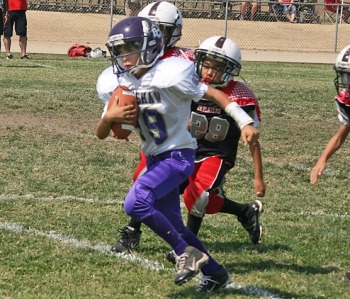
This weekend has been a busy weekend in the Brennan house. I’ve had this Colorado conference on the calendar for nearly a year. Then after school starts, I learn that my oldest has a volleyball tournament in San Diego (and yes, she arrived on Thursday in the midst of the power outage!); my #2 daughter has a cross country retreat in Lake Tahoe; my sons have an away football game; and my youngest daughter has her first soccer game. Fortunately, my mom was able to take care of the soccer game (yeah, grandma!) so my husband could take the boys to the football game. Soccer game: Victory! 7-1. Mighty Mites (6-8 year olds) football game: Victory! Come from behind to win 13-12. Jr. Pee Wees (8-10 yrs): They lost BUT my son, #49, caught his first pass in a game. A 20 yard throw, and he ran an additional five yards before being tackled. I’m sorry I missed the catch (but not sorry I missed him being tackled!)


And finally, we all know what day it is today. I didn’t want to write a blog summarizing what we all know happened ten years ago, or reliving where we were or what we were doing–but I do want to recognize the amazing men and women who sacrificed so much. Those who died. Those who cleaned up. Those who rebuilt. America is an amazing country, and we truly have amazing people. And even though I may complain about this or that on occasion, there’s no place I would rather live.

I apologize in advance for not being around much of today, what with the speech I’ll be giving and then pre-speech panic attack. But I hope you’ll share a good book you’ve read recently, or a movie that you were surprised you liked. I saw SUPER-8 earlier this summer. I expected it to be ok; I ended up really enjoying it.

It’s Fall – do you know what your next book is?

by Alexandra Sokoloff

 Fall is my favorite season. Maybe it’s that Halloween thing, maybe it’s the “back to school” energy, maybe it’s the Santa Ana winds that were so much a part of my life growing up in Southern California that I made them a character in The Space Between, maybe it’s just that you get a jolt of ambition because it gets cooler and your brain returns to some functional temperature.  

Because it’s sort of ingrained in us (whether we like it or not), that fall is the beginning of a new school year, I think fall is a good time for making resolutions.  Like, about that new book you’re going to be writing for the next year or so. 

Myself, I have so many books to finish right now that I can’t let myself think about any new ones until I get at least ONE more done.  I’ve taken the idea of multitasking to a near-suicidal extreme.  But I’m not complaining – not only do I have a job, I have my dream job. 

However, given what I blog and teach about, I am aware that this is a perfect time for OTHER people to be thinking about THEIR new books.  Because, you know, it’s September, but November will be here before you know it.

I’m sure many if not most here are aware that November is Nanowrimo – National Novel Writing Month.  As explained at the official site here, and here and here, the goal of Nanowrimo is to bash through 50,000 words of a novel in a  single month.  

I could not be more supportive of this idea – it gives focus and a nice juicy competitive edge to an endeavor that can seem completely overwhelming when you’re facing it all on your own.   Through peer pressure and the truly national focus on the event, Nanowrimo forces people to commit.    It’s easy to get caught up in and carried along by the writing frenzy of tens of thousands – or maybe by now hundreds of thousands – of  “Wrimos”.  And I’ve met and heard of lots of novelists, like Carrie Ryan (The Forest of Hands and Teeth) Sara Gruen (Water For Elephants), and Lisa Daily (The Dreamgirl Academy) who started novels during Nanowrimo that went on to sell, sometimes sell big.

Nanowrimo works.  

But as everyone who reads this blog knows, I’m not a big fan of sitting down and typing Chapter One at the top of a blank screen and seeing what comes out from there.   It may be fine – but it may be a disaster, or something even worse than a disaster – an unfinished book.  And it doesn’t have to be.

I’m always asked to do Nanowrimo “pep talks”.   These are always in the month of November. 

That makes no sense to me.

I mean, I’m happy to do it, but mid-November is way too late for that kind of thing. What people should be asking me, and other authors that they ask to do Nano support, is Nano PREP talks.

If you’re going to put a month aside to write 50,000 words, doesn’t it make a little more sense to have worked out the outline, or at least an overall roadmap, before November 1?   I am pretty positive that in most cases far more writing, and far more professional writing, would get done in November if Wrimos took the month of October – at LEAST –  to really think out some things about their story and characters, and where the whole book is going.   It wouldn’t have to be the full-tilt-every-day frenzy that November will be, but even a half hour per day in October, even fifteen minutes a day, thinking about what you really want to be writing would do your potential novel worlds of good.

But you know what?   Even if you never look at that prep work again, your brilliant subconscious mind will have been working on it for you for a whole month.   (Cause let’s face it – we don’t do this mystical thing called writing all by ourselves, now, do we?).

So here’s my topic for the day, and possibly for my next blog as well:

How do you choose the next book you write?

I know, I know, it chooses you.   That’s a good answer, and sometimes it IS the answer, but it’s not the only answer.  And let’s face it – just like with, well, men, sometimes the one who chooses you is NOT the one YOU should be choosing.  What makes anyone think it’s any different with books? 

It’s a huge commitment, to decide on a book to write. That’s a minimum of six months of your life just getting it written, not even factoring in revisions and promotion. You live in that world for a long, long time.  Not only that, but if you’re a professional writer, you’re pretty much always going to be having to work on more than one book at a time.  You’re writing a minimum of one book while you’re editing another and always doing promotion for a third.  

So the book you choose to write is not just going to have to hold your attention for six to twelve months with its world and characters, but it’s going to have to hold your attention while you’re working just as hard on another or two or three other completely different projects at the same time.   You’re going to have to want to come back to that book after being on the road touring a completely different book and doing something that is both exhausting and  almost antithetical to writing (promotion).

That’s a lot to ask of a story.

So how does that decision process happen? 

When on panels or at events, I have been asked, “How do you decide what book you should write?” I have not so facetiously answered: “I write the book that someone writes me a check for.”

That’s maybe a screenwriter thing to say, and I don’t mean that in a good way, but it’s true, isn’t it?

Anything that you aren’t getting a check for you’re going to have to scramble to write, steal time for – it’s just harder. That doesn’t mean it’s not worth doing, or that it doesn’t produce great work, but it’s harder. 

As a professional writer, you’re also constricted to a certain degree by your genre, and even more so by your brand. I’m not allowed to turn in a chick lit story, or a flat-out gruesome horrorfest, or probably a spy story, either. Once you’ve published you are a certain commodity.  

If you are writing a series, you’re even more restricted.  You have a certain amount of freedom about your situation and plot but – you’re going to have to write the same characters, and if your characters live in a certain place, you’re also constricted by place.  Now that I’m doing a couple of paranormal series, I am learning that every decision is easier in a way, because so many elements are already defined, but it’s also way more limiting than my standalones and I could see how it would get frustrating.

Input from your agent is key, of course – you are a team and you are shaping your career together. Your agent will steer you away from projects that are in a genre that is glutted, saving you years of work over the years, and s/he will help you make all kinds of big-pitcure decisions.

But what I’m really interested in today is not the restrictions but the limitless possibilities. 

How DO you decide what to write?

And even more importantly – How do you decide what to READ?  

Because I have a theory that it’s actually the same answer, but we’ll see.

Happy Fall, everyone!

Alex

Keeping The Plates Spinning

Zoë Sharp

There’s always talk among writers about the pros and cons of writing a series versus standalone novels and I can see both sides of the argument. There’s a lot of freedom to writing standalones. Any character traits that engage your interest can form the protagonist of your next work.

No baggage, no preconceptions. You can narrate in first person, third person, close third, multiple viewpoints – second person if you feel the urge. Present tense, past tense, a mix of both. Contemporary, historical, futuristic. There seems to be no limits beyond what your publisher will accept and your readers will enjoy. (And reader expectation is a whole different subject . . .)

Of course, there has always been a liking for ‘the same . . . but different’. I was a big fan of the early Dick Francis books, and not just for their horse-orientated content. Although they were mainly standalones with only a few repeated characters, there were definite similarities between the heroes of the Francis books, regardless of whether they were jockeys or bankers, airline pilots or movie stars.

As a reader, you knew what you were getting. And if you liked one, the chances were pretty good that you were going to like them all.

Few of the Francis protags were professionally involved with crime, but he successfully side-stepped the issue of Cabot Cove Syndrome, as it’s known. Anybody familiar with the long-running Jessica Fletcher ‘Murder She Wrote’ TV series will understand this. Every time that woman turned around, she tripped over a body. I mean, nobody in their right minds should ever have accepted an invitation to dine with Ms Fletcher, because you could be certain there’d be one less guest for dessert than for the appetiser. She was a jinx.

So, if you want an amateur sleuth to discover the bloodied corpse book after book, at least with a standalone character you aren’t forced to invent yet another reason why someone with an apparently harmless occupation should become such a magnet for murder.

Even professional law enforcement characters may stumble into the credibility issue, though. Just how many serial killers or fiendishly cunning murderers can a small-town police chief chase down in his career? Reminds me of the Bruce Willis line in ‘Die Hard 2’ as he’s battling the bad guys in a stricken airport in the snow: “How can the same sh*t happen to the same guy twice?”

Of course, the standalone writers might argue that the series writers have it easy. Once you’ve hit upon an intriguing main character, you’re halfway there. If people are hooked on your recurring protag, they’re likely to pre-order the next in the series without knowing more than the title.

And this is the reason that publishers, it seems, also rather like series. I wonder how many debut authors have stopped work on a non-related second novel because of hints that another book featuring the same characters as the first would be smiled on rather more favourably.

Then you have the additional question with a series – how inter-related do you make the books? If someone picks up book five, for example, how much are they missing – and how frustrating will they find it – if they haven’t already read books one through four?

Do you keep your main character stuck in a time warp, where they never age, never change, never carry lasting memories of old cases, old love affairs, old enemies? Or do you allow your protag to evolve and develop as the series goes on, taking them on a personal journey through each book that’s as important to returning readers as the individual story arc?

I set out to write Charlie Fox as a series character from the beginning, and I had a reasonable idea of where I was going to take her, from ex-army self-defence instructor, through training and into the world of close protection. Maybe I should have just chucked her straight in at the deep end, and made every client she had to protect a new job without reference to anything that went before.

But I couldn’t do that.

It seemed important to me that the character learn from her past experiences, that they affected her as much as she affected them. People tell me they like Charlie’s ongoing internal battles, her complicated relationship with her former army training instructor, lover, and now boss, Sean Meyer, and her constant struggle to come to terms with her own cold-blooded side.

And this is where I discovered another difficulty with writing a long-running series.

Keeping the plates spinning.

People who are coming to a series cold like to start at the very beginning. My first US publisher picked up the series at book four, FIRST DROP, and then leapfrogged the next one to go straight to book six. Books one, two, three and five were overlooked, causing endless confusion, not to mention frustration.

My original UK publisher was sold out to a larger house and one by one, the early UK books went out of print. All five of them. The only editions still obtainable – apart from Large Print and audiobooks – were snapped up by the collectors, and I have been amazed and even a little horrified (if, I admit, somewhat flattered) by some of the prices being achieved. But this has meant that getting hold of a half-decent reading copy became an exercise out of the reach of most people’s pocket. Mine included.

Not any more.

(And here you must picture me shuffling my feet awkwardly, being British and finding BSP a difficult exercise. Please forgive my excitement, though. Normal service will be resumed next time, I promise.)

For the first time in years, all the early Charlie Fox backlist books are available again – in e-format. It’s taken some blood, sweat and tears – not necessarily in that order – but they’re all out and damn if I’m not proud to have them back on sale. The later books, of course, are available from Allison & Busby in the UK and St Martin’s/Pegasus in the States, with e-versions either out currently or on the way, in the case of FIFTH VICTIM.

(And even those of you who don’t have a Kindle reader device itself, you can download Kindle Reader for PC or Mac absolutely free.)

Until now, it’s felt like one of those TV game shows where hapless volunteers from the audience have to try to keep a load of plates spinning on the end of poles. Just you thought you’d got them all going, the one at the beginning begins to topple.

At last, all my plates are spinning at once.

I know I mentioned the new Charlie Fox e-thology, FOX FIVE last time, and the new edition of the very first book, KILLER INSTINCT, but now these have been joined by RIOT ACT, HARD KNOCKS, FIRST DROP and ROAD KILL. (Although as I write this I’m still waiting for a couple of them to go live on Amazon US, UK, and DE. This brand newness explains part of my ‘kid with new toy’ feeling today – sorry!)

Here are the covers for the series, designed by Jane Hudson at NuDesign. I’m over the moon with the eye-catching look of the series, but see what you think:


As with KILLER INSTINCT, each book has some added extras, like Author’s notes, an introduction to Charlie Fox, an excerpt from the next book in the series, and a guest excerpt.

For these I’ve been lucky enough to hook up with some of my favourite writers. Former ‘Rati Brett Battles allowed me to put an excerpt from his Jonathan Quinn novella, BECOMING QUINN in the first book, and others are: in RIOT ACT, Timothy Hallinan’s second Junior Bender novel, LITTLE ELVISES; in HARD KNOCKS, Libby Fischer Hellmann’s PI Georgia Davis/Ellie Foreman novel, DOUBLEBACK; in FIRST DROP, Blake Crouch’s ‘what if’ thriller, RUN; and finally in ROAD KILL, Lee Goldberg’s new standalone, KING CITY.

I can’t tell you how thrilled I am to have been able to join forces with these very talented writers, who are also including excerpts from the Charlie Fox books in their latest work. Let’s hope this cross-pollination opens up our novels to a wider audience.

And finally, I was invited to join a new outfit called The Hardboiled Collective, by Jochem Vandersteen of the Sons of Spade blogsite. This is just a group of – well, the clue is in the name, and I hope you’ll check out some of the great writers who are members. We even have a terrific group logo, courtesy of Jane Hudson again:

OK, that’s it, I’m going to stop going ‘me, me, ME’ now. I promise to calm down and stop stuffing myself with Sunny Delight and blue Smarties and go lie down in a darkened room for a bit.

My questions this week, though, are do you feel that you HAVE to start reading a series right from the start, or are you happy to dive in wherever the fancy takes you? And if you used to read a series but have stopped, what made you do so?

Next weekend I shall be attending Bouchercon 2011 in St Louis MO, and am hugely looking forward to going – more so as I’ve missed out on the last couple. Please say “Hi” if you’re going. On the way, I’m doing an event at Lisle Library in Chicago IL. Can’t wait!

Finally, this week’s Word of the Week is paedometer, a device that can be strapped to the arm while out exercising to show you how many perverts are in the immediate vicinity . . .