Author Archives: Murderati Members


Holiday Repeats

By Tania Carver

Morming all. And happy holidays. Because the deadline is looming and the festive season is upon us, here’s a repeat post from last summer. It might remind you of sunny, warm days as well.

Happy new year! 

And so begins one of the busiest weeks of the year.  Yes, Harrogate is upon us.  And Tania Carver will be there.  Or one of us will be – and it’s me.  As I’ve said before, Linda doesn’t like getting up on stage and mouthing off, she’s happy to leave that to me.  And since I have been the Festival’s Reader in Residence for the last few years it makes sense for me to be the one there.

This year, I’m appearing (as Tania) on a panel on women and violence.  It should be fun.  And no, before you ask, I won’t be getting dressed up.  I’m also doing a couple of events as Martyn too so that balances things out.

But I didn’t want to talk about women and violence.  That’s for next weekend.  Instead my eye was caught by another panel in the programme, namely ‘A Donkey In The Grand National’.  That phrase was used by John Sutherland, who as a former chair of the Man Booker judges was asked what the chances were of a crime novel winning the prize.  About the same, he said.  Now the whole genre/literary debate has been about played to death.  For an excellent piece about it, have a look at what Ray Banks has to say here.  (There’s even a comment by me on there).  I’m not going to address that directly.  What I do want to talk about is something that may seem, at first glance, to be tangential to it but is actually – I think – at the heart of the debate.  Class.

Now I know that in the States you have trouble working out the class system we have over here.  So let me have a stab at explaining how it works.  We have the Royal family, you have the Kennedys.  We have the aristocracy, you have the Kardashians.  (When I first heard the name I thought they were aliens from Star Trek.  Honestly.  Having seen them I feel I was absolutely right in that judgement.)  We’re supposed to be deferential to our lords and ladies, you’re supposed to take seriously what comes out of Angelina Jolie’s mouth.  You see the parallels.  You see how both are essentially ludicrous.

I was out with Mark Billingham the other night and we started talking about this.  He wondered what the critical response had been to Agatha Christie during the so-called Golden Age of crime fiction.  Was she feted as the mistress of the puzzle novel?  Sneers at for the same thing?  Patronised as a genre writer (before the term had even been fully embraced)?  I don’t know.  I haven’t been able to find out.  But if anyone does, please let me know – seriously, I’d love to know.  We do know that her sales were huge, her following enormous with movie adaptations, stage plays (The Mousetrap is still the longest running play in London’s West End) and a level of interest in her personal life that most contemporary authors (JK Rowling excepted) would be hard pushed to match.  But how seriously was she taken as a writer?  From what I can tell, she was praised for being what she was.  A good mechanic, someone who reproduced puzzles in the form of novels.  She was no great prose stylist, her characters were stock, her action perfunctory.  My theory is she’s remembered because she bridged the gap between childhood and adult reading.  Her books, involving murders and puzzles, gave a young reader eager to develop beyond Enid Blyton the veneer of sophistication but they were written in such simplistic a manner as to be linguistically unchallenging.  And Christie knew her milieu.  The country house, the vicarage.  A train travelling in an exotic, far-off country.  The characters were all upper middle class (or just upper class), vicars and military officers and Lords and Ladies.  Christie knew these people.  She was in the same class as them.  Interestingly, whenever a member of the lower classes appeared they were always thick coppers that her brilliant detective would show up as idiots or servants.  They were also often the murderers and being sent to the gallows at the end of the novel was seen as a just punishment for getting ideas above their station.  She was also horribly reactionary.  I can’t speak for her contemporaries such as Margery Allingham, Dorothy L Sayers, Josephine Tey and the like because I’ve never read them.  Nor have I ever been tempted to read them and maybe that’s my loss.  I’ve read Christie and she’s not what I look for in a writer.  I strongly suspect they wouldn’t be either.  However, Christie and her coven cast a long shadow over British crime fiction.  And at its heart, I believe, is class.

It goes back even further.  It’s the Victorian idea that reading books is somehow improving and difficult.  If the reader doesn’t come away from experiencing great literature with their life enriched and challenged then they’ve been reading it wrong.  Forget entertainment, that was for the lower classes.  Education and enrichment was what it was all about, the two are mutually exclusive and if you wanted entertainment too there was something inherently wrong with your intellect.  And that prevailing attitude, I believe, still hangs over the literary world today.

I’ve mentioned this before but make no apologies for bringing it up again.  I hope I never have to see another article by some broadsheet’s literary editor about how he’s been reading (fill in the name of the latest Scandanavian crime import in translation) and is loving it.  It has everything you would want from a novel, the literary editor drivels on – beautiful prose, compelling characters, structure, poetry, strong narrative and above all a sense of social engagement with the contemporary world in which its set.  They then always conclude with a variation on the same whinge: Why oh why can’t the crime writers in this country do the same?

And my answer to that is very simple.  We do.  Or at least a lot of us do, or at least strive to do just that.  Because crime fiction – contemporary crime fiction, being written now – is doing just that.  That’s what it is.  I can come up with numerous examples and I’m sure you can too.  In fact I just did but took them all out because this piece would have doubled in length.

I’d always been a fan of crime fiction.  I came to it through comics and pulp – as a kid I would devour anything by the holy trinity: Stan Lee, Jack Kirby and Steve Ditko.  I’ve still got those comics on my shelf.  I’m proud of that.  I still read them.  I think Kirby’s work for DC in the early Seventies is some of the greatest art of the Twentieth Century and I don’t care who disagrees with that opinion.  I love it so much I could write a PhD on it.  From comics I went on to pulp fiction.  I was a bookish, geekish kid who spent summer holidays sitting reading Doc Savage, the Shadow and my favourite, the Spider.  From there I graduated to crime fiction.  I read Farewell My Lovely at a very impressionable age and that was it.  It was like someone had just flung open the doors and windows.  Here was a book that didn’t apologise for anything.  It was unashamedly a crime novel yet it was unashamedly literature – both at the same time.  How did he do that?

And in the late Eighties/early Nineties I discovered a bunch of writers who would become my literary godfathers and mothers.  James Ellroy.  James Lee Burke.  James Crumley. And the ones who weren’t called James: Andrew Vachss.  Sara Paretsky.  Walter Mosley.  There were, but again we’d be here all night if I listed them.  They wrote with a sense of engagement with the world around them that was completely absent in British crime fiction at the time.  They were like the literary equivalent of CNN: reportage as literature.  Their work was both comment on and product of the societies that shaped and formed them as writers and people.  I loved what they were doing.  I wanted to take that ethos and make it work in Britain.  I did, but I wasn’t alone.  A lot of other writers had the same idea at the same time.  We all, whether consciously or unconsciously, rejected Christie’s rigid, reactionary, class-based structure and created crime fiction about the country we lived in.  You want to now what Britain was like in the Nineties?  Read John Harvey’s Resnick series.  You want an insight into contemporary British gender politics?  Read Val McDermid.  And on and on. 

So yes.  The broadsheet literary editors bemoaning the lack of British crime writing as literature just haven’t been reading it.  Britain has crime writers the equal to any in the world.  But – and this, I believe, is one of the big things – we’re not in translation.  We write in English and therefore there’s no cache when it comes to discussing us at dinner parties. And because most literary editors are of the same class Christie was from, they still think that’s what crime fiction is in this country.  We’re not seen as difficult or improving or challenging.  In their eyes, we’re providers of entertainment for the lower orders.

Now in an abstract sense, as any serious reader will tell you, the argument is spurious.  There are only good books and bad ones.  That’s all that counts.  Great ones that could be considered genre, awful ones that are seen as literary.  And vice versa.  And a discerning reader knows that.  But for me, personally, I don’t care.  I don’t think their argument applies to me.  Because I’m the guy that thinks Jack Kirby is as big a genius as Jackson Pollack.  I’m proud to write crime fiction.  It’s a genre I love and if I want to make any penetrating insights into the human condition I can do so in a crime novel.  Just as long as I remember to put a plot in it because someone has paid money to be entertained. 

Here’s a last example of what I mean.  I’ve just finished reading a biography of Frankie Howerd.  He was a British comedian who died in 1992.  He had huge mainstream success and was best remembered for his stand up, sit coms and catch phrases.  He was, in short, a light entertainment mainstay.  Yet he had also performed Shakespeare, won acclaim as a satirist (he followed Lenny Bruce as resident comedian at Peter Cook’s Establishment Club in the Sixties), revived Roman comedies and had one critic calling him ‘the most Brechtian actor in Britain’.  Not bad for a working class bloke from Eltham, London.  Yeah, he had all those penetrating insights about the human condition but he made them while he was making his audience laugh.  While he was entertaining them.  He was the best at what he did and he did it so well it became something more than that.

That’s what the best crime writers always do.

And they’re a class act because of it.



I AM RESOLVED

By Stephen Jay Schwartz


As 2012 rolls to an end I find myself contemplating plans for surviving 2013. That might not be the best way to look at it – surviving, as opposed to conquering the new year, or simply relaxing and enjoying it – but experience has taught me that survival comes first.


That’s dramatic, of course. I’m really doing much better than surviving, especially when compared to about 98% of the world’s population. Living basically middle class in Southern California, despite the small apartment and a mountain of debt, is a huge life achievement.


Things were a bit scary around this time last year. I had left my day job to write the-movie-that-seems-never-to-be-made and tackle my third novel, the-book-that-seems-never-to-be-finished. The screenplay money didn’t last, and soon my savings ran out, and the panic set in.


With a family of four to house and feed, I went into survival mode. It was a tough time and help came from friends both near and far. One woman in particular jumped in to make sure my rent and utilities were paid while I searched for the job that would keep me afloat. Paying her back remains on my “resolutions” list to this day.


2012 was also a year of health challenges, as one of my sons required medical treatment in another state and was required to leave our home for two months. While it was difficult to see him go, the moment revealed itself as the resolution to a problem that had been growing for years. His departure and treatment marked the beginning of what has become the best thing that ever happened to the Schwartz Family. We are reunited and healthy, and close, and thankful.


So I’ve been in this day job for almost eight months and it feels good to be paying my way, to be standing on my own two feet again. The only great challenge ahead is to find a way to manage the demanding day job, the precious family time (which I refuse to sacrifice), and still be a productive author, screenwriter, and poet.


And while it’s been great being a judge for two major writing competitions this year, I’ve learned that a commitment like this means something has to give, and unfortunately what gave was my writing. In the future I’ll have to be more protective of my time, because, as writers, time is our greatest resource.


As I look towards 2013, I make the following resolutions:


  • Learn to say no. Protect my three major objectives: work, family and writing. Don’t commit to anything if it derails any of the three.

  • Write the next Hayden Glass novel. Commit to it. Finish it.

  • Finish the standalone project. No excuses.

  • Save a little money every month. Build a safety net.

  • Similarly, put some money into paying down the debts I’ve accrued. Don’t be a dependent, don’t be a flake.

  • Look around. Keep looking for a way to support myself as a creative individual, 24/7. I shouldn’t have to live two separate lives.

  • Don’t live beyond my means.

  • Plan for a future as a working writer. Write spec TV episodes in an effort to get staffed on a show.

  • Work out at the gym with Ryen and the boys. Get the body I had when I was nineteen.

  • Stay connected to my wife. We’re taking this journey together.

  • Don’t dwell in the darkness. Remember that things are good. Stay positive and appreciate what I’ve got.

  • Read more Bukowski. Read more Updike. See more movies. Return to my roots.

  • And, if there’s time, pick up that saxophone and wail.

That’s about all I can think to write. What are your resolutions for the new year? Care to share?

The mental lightbulb

Zoë Sharp

Well, the disruption of Christmas is just about all over. I say that without any edge to the words. But for the past three days I’ve had the house filled with strangers—strangers I just happen to know well.

Please don’t misunderstand me. I love my family, but I’ve been living away from them now for far longer than I ever lived with them. As an individual I have grown to fill the expanded corners of my own existence in such a way that we somehow no longer quite fit together as the close family unit we once were. I daresay they feel much the same way about me.

And yet, this Christmas, I have appreciated my family more than ever.

But I know that Thursday—the day after St Stephen’s Day, or Boxing Day—marks a return to normality. And that brings with it more questions than answers.

Because I’m not sure I know what classifies as normality any longer.

It was only when I flicked through a favourite book before loaning it to a friend that I realised what probably lay behind this recent feeling of malaise.

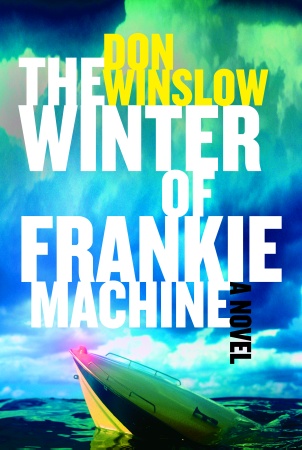
The book is THE WINTER OF FRANKIE MACHINE by Don Winslow, one of the writers I admire most and a master of present-tense narrative. The passage in question comes at the start of chapter four:

All Frank’s days are busy, what with four businesses, and ex-wife and a girlfriend to manage. The key to pulling it off is to stick to a routine, or at least try to.

He has tried—without conspicuous success—to explain this simple management technique to the kid Abe. “If you have a routine,” he has lectured, “you can always deviate from it if something comes up. But if you don’t have a routine, then everything is stuff that comes up. Get it?”

“Got it.”

But he doesn’t get it, Frank knows, because he doesn’t do it.

And I realised—doh—that I don’t actually have a proper routine.

For years I wrote fiction in the cracks of the day-job, but my day-job also did not involve any kind of set routine. As an example, few years ago I did two particular photoshoots on consecutive days. The first took place on a bitterly cold disused airforce base just outside Warrington in the northwest of the UK where the temperature was minus ten degrees. The next was on the sands of Daytona Beach in Florida in baking hundred-degrees-plus heat.

The unexpected nature of the job was one of the things I loved most about it. Through my photography work I met millionaires and criminals, the titled, the notorious, the hilarious, and the downright insane. But I never quite knew, from one day to the next, what it would bring. I suspect that was one of the reasons I clung to the day-job long after I could probably have let it go.

Now I am free to put all my effort into writing. And it’s tougher than I thought it would be.

Which brings me back to having a routine.

I need to create some more defined structure to my day. After all, I love writing. It’s all I’ve wanted to do for as long as I can remember. I have more ideas and plots and stories than I know what to do with, but if I don’t develop some organised method of working I’m going to burn myself to a frazzle inside a year.

Not only that, but I suspect I would soon start to resent the demands of the very job I always dreamed of.

So, taking the advice of Don Winslow’s retired hitman, Frank ‘Machine’ Machianno, I need to get myself a workable routine. One that fits in all the essential daily elements, including some time for simple domestic tasks—like doing laundry, keeping my accounts updated, and going to the supermarket—with all the other Stuff that’s an inevitable part of a modern writer’s life, like social media and marketing.

Oh, and a bit of time for writing, too.

And quite honestly, ‘Rati, I’m open to suggestions.

Do you have a daily routine or is it more loosely based than that? What are essentials for you—what do you try to do every day without fail, even if all other good intentions fall apart?

A couple of other points I’d like to mention today. The first is an appeal by Mary Andrea Clarke who is in charge of the CWA Debut Dagger competition. If you’ve never heard of the Debut Dagger and you are an as-yet unpublished author, it’s a brilliant way to get the start of your crime in front of top editors and agents. Past winners and shortlisted authors have gone on to great success.

Mary has asked for writers to provide for the next bulletin, one writing tip, and one criminal thought for the Holiday season. Suggestions welcome!

As well, I hope you don’t mind me mentioning that both the trade paperback edition and the US hardcover edition of DIE EASY: Charlie Fox book ten are now available to order. Thank you to everyone who’s said such wonderful things about this latest outing for Charlie—fighting it out with the bad guys in New Orleans.

This is my last Murderati post of 2012, so I wish you all health, luck and happiness for the coming New Year, and I’ll be back on Jan 1st with a Wildcard round-up.

John Updike Saves the Universe (sorta)

David Corbett

I’m writing this on Christmas Day, after reading Stephen’s incredible interview with Sean Black. Nothing quite so bracing today, I’m afraid. More grateful and reflective.

I want to thank all our readers for visiting so faithfully over the preceding year. It’s so easy to fear that one is bellowing into a vacuum. Every day, you spare us that by logging on, and at times chiming in. I can’t tell you how much all of us appreciate it. I hope we continue to see you here in 2013.

On the reflective front: I’ll keep it brief, because I know everyone’s busy.

In trying to think of something that resonated with what it is we’re trying to celebrate this time of year — the wonder of warmth and light at a time of cold and darkness, the comfort of family and friends, the hope of love against the certainty of death, the promise of meaning in the face of an at times far more convincing void — I thought back to an article from earlier this year, upon publication of Jim Holt’s Why Does the World Exist? 

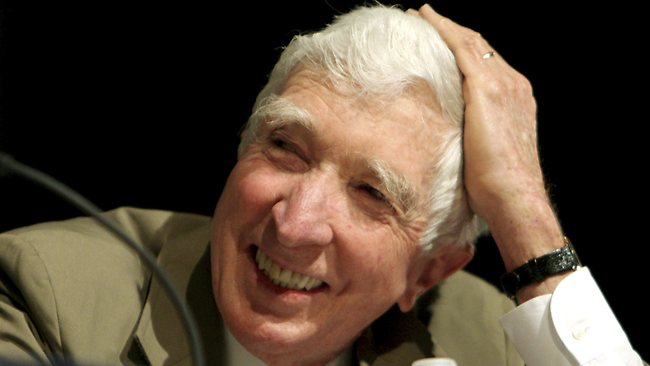
The article was adapted from an interview Holt conducted for the book with the author John Updike the year before he died. It’s a marvelously positive and loving testament to our humble existence, and I found myself reading it hungrily this morning. I thought you might enjoy reading it as well. 

You can find it online here. Or read the text below.

Merry Christmas one and all. And best wishes for a 2013

filled with warmth and light and love and promise.

Jukebox Hero of the Week: I was tempted to share Franz Biebl’s Ave Maria, my favorite piece of Christmas music, sung by one of my favorite vocal groups, Chanticleer. But instead, in keeping with the theme of wonder, I’m going to share Martin Lauridsen’s O magnum mysterium, a work of modern polyphony that is simply stunningly beautiful, and which I’ve been listening to all morning:

 * * * * *

Late winter in Manhattan. Afternoon. A siren in the distance. (There is always a siren in the distance.) The phone rings. It’s John Updike.

I had been expecting the call. Earlier that month, I had sent a letter to Updike describing my interest in the mystery of existence. I had guessed, I said, that he shared this interest, and I wondered whether he would be willing to talk about the matter. I included my phone number in case he did.

A week later, I received a plain postcard with Updike’s return address on the front and a long type-written paragraph crowded onto the back. The occasional typo had been corrected in pen with a proofreader’s “delete” or “transpose” sign. At the bottom, in blue ink, it was signed “J.U.”

“I’d be happy to talk to you about something rather than nothing,” Updike had typed, “with the warning that I have no thoughts.” He then, in a trio of brisk sentences, mentioned the dimensionality of reality, the possibility of positive and negative being, and the anthropic principle—the last of which, he cryptically added, “to some extent works for somethingness.” Then, as a comment on the mysteriousness of it all, came the kicker:

“Beats me, actually; but who doesn’t love the universe?”

That Updike loved the universe had long been obvious to me. His novels and stories are suffused with the sheer sweetness of being. We “skate upon an intense radiance we do not see because we see nothing else,” he wrote in a memoir of his youth. “And in fact there is a color, a quiet but tireless goodness that things at rest, like a brick wall or a small stone, seem to affirm.”

In this respect, Updike was the anti-Woody Allen, who once described human existence as “a brutal, meaningless experience” (in an interview he gave to a Catholic priest, curiously enough).

But, in another respect, he was at one with Woody Allen. He shared the same horror of eternal nothingness—and the conviction that sex offered a psychological hedge against it. Indeed, he found that his phobia of nonbeing was inversely proportional to his carnal flourishing—a point he put in succinct mathematical form in his 1969 credo poem, “Midpoint”:

ASS = 1 / ANGST

But it was not only eros that fortified Updike against the terrors of nothingness. He also claimed to draw consolation from religion—specifically, from a leap-of-faith version of Christianity—and the hope it offered of all-encompassing grace and personal salvation. Here his heroes were Pascal and Kierkegaard and, especially, Karl Barth. “Barth’s theology, at one point in my life, seemed alone to be supporting it (my life),” Updike once observed. He professed to share Barth’s belief that God is totaliter aliter—wholly other—and that the divine mysteries could not be approached by rational thought. He was also drawn to Barth’s somewhat mystical equation of nothingness with evil. In an early collection of writings, Picked-up Pieces, Updike darkly dilates on the idea of “Satanic nothingness”—and then, as if in search of metaphysical relief, transitions directly to an essay on golf.

Updike’s obsession with sex and death, with the goodness of being and the evil of nonbeing, is perhaps not unusual in the literary profession. But only with Updike do you find the mystery of existence figuring directly and explicitly in his fiction. His 1986 novel, Roger’s Version, a merry roundelay of theology, science, and sex, culminates in a virtuoso passage that explains, over the course of nearly 10 pages, “how things popped up out of nothing”: a detailed scientific account of the Big Bang. The explanation is delivered in the course of a cocktail party, and no doubt Updike didn’t mean for us to take it too seriously. It is being mouthed, after all, by a character in a novel, and a somewhat ridiculous character to boot. Still, Updike had clearly pondered the mystery of being from the scientific as well as the theological angle. And that was reason enough to seek out his thoughts.

Updike was calling from his longtime home in the town of Ipswich, on the Massachusetts shore an hour north of Boston. In the background I could hear his visiting grandchildren at play. As he spoke, in his characteristically soft and richly modulated voice, I could see him in my mind’s eye: the thick thatch of gray hair, the curved beak of a nose, the mottled, psoriatic complexion, the eyes and mouth forming his habitual expression, that of a man, as Martin Amis once put it, “beset by an embarrassment of delicious drolleries.”

I began by asking Updike whether the theology of Karl Barth had really sustained him through a difficult time in his life.

“I’ve certainly said that and it did seem to be true,” he said. “I fell upon Barth having exhausted Kierkegaard as a consoler, and having previously resorted to Chesterton. I discovered Barth through a series of addresses and lectures called The Word of God and the Word of Man. He didn’t attempt to play anybody’s game as far as looking at the Gospels as historic documents or anything. He just said, essentially, that this is a faith—take it or leave it. So yes, I did find Barth comforting, and a couple of my early novels—not so early, actually—are sort of Barthian. Rabbit Run certainly presents a Barthian point of view, from the standpoint of a Lutheran minister. And in Roger’s Version, Barthianism is about the only refuge for Roger from all the besieging elements that would deprive one of one’s faith—both science, which Dale tries to use on behalf of the theist point of view, and the watering down of theology with liberal values.”

Was that 10-page scientific account of the origin of the universe from nothingness meant to be convincing?

“Not entirely, and that’s an embarrassment for science. Science aspires, like theology used to, to explain absolutely everything. But how can you cross this enormous gulf between nothing and something? And not just something, a whole universe. So much … I mean the universe is very big. Ugh! I mean, it’s big beyond imagining squared!”

Updike’s voice rose a register in genuine wonderment.

“It’s interesting,” I said, “that some philosophers are so astonished and awed that anything at all should exist—like Wittgenstein, who said in the Tractatus that it’s not how the world is that is mystical, but that it is. And Heidegger, of course, made heavy weather of this too. He claimed that even people who never thought about why there is something rather than nothing were still ‘grazed’ by the question whether they realized it or not—say, in moments of boredom, when they’d just as soon that nothing at all existed, or in states of joy when everything is transfigured and they see the world anew, as if for the first time. Yet I’ve run into philosophers who don’t see anything very astonishing about existence. And in some moods I agree with them. The question Why is there something rather than nothing? sometimes seems vacuous to me. But in other moods it seems very very profound. How does it strike you? Have you ever spent much time brooding over it?”

“Well, to call it ‘brooding’ would be to dignify it,” Updike said. “But I am of the party that thinks that the existence of the world is a kind of miracle. It’s the last resort, really, of naturalistic theology. So many other props have been knocked out from under naturalistic theology—the first principle argument that Aristotle set forth, Aquinas’s prime mover … they’re all gone, but the riddle does remain: why is there something instead of nothing?”

I told Updike that I admired the way he had a character in Roger’s Version explain how the universe might have arisen from nothingness via a quantum-mechanical fluctuation. In the decades since he wrote the book, I added, physicists had come up with some very neat scenarios that would allow something to emerge spontaneously out of nothing in accordance with quantum laws. But then, of course, you’re faced with the mystery: Where are these laws written? And what gives them the power to command the void?

“Also, the laws amount to a funny way of saying, ‘Nothing equals something,’ ” Updike said, bursting into laughter. “QED! One opinion I’ve encountered is that, since getting from nothing to something involves time, and time didn’t exist before there was something, the whole question is a meaningless one that we should stop asking ourselves. It’s beyond our intellectual limits as a species. Put yourself into the position of a dog. A dog is responsive, shows intuition, looks at us with eyes behind which there is intelligence of a sort, and yet a dog must not understand most of the things it sees people doing. It must have no idea how they invented, say, the internal-combustion engine. So maybe what we need to do is imagine that we’re dogs and that there are realms that go beyond our understanding. I’m not sure I buy that view, but it is a way of saying that the mystery of being is a permanent mystery, at least given the present state of the human brain. I have trouble even believing—and this will offend you—the standard scientific explanation of how the universe rapidly grew from nearly nothing. Just think of it. The notion that this planet and all the stars we see, and many thousands of times more than those we see—that all this was once bounded in a point with the size of, what, a period or a grape? How, I ask myself, could that possibly be? And, that said, I sort of move on.”

Updike chuckled softly. His mood appeared to lighten.

 “When you think about it,” he continued, “we rationalists—and we’re all, to an extent, rationalist—we accept propositions about the early universe which boggle the mind more than any of the biblical miracles do. Your mind can intuitively grasp the notion of a dead man coming back again to life, as people in deep comas do, and as we do when we wake up every morning out of a sound sleep. But to believe that the universe, immeasurably vast as it appears to be, was once compressed into a tiny space—into a tiny point—is in truth very hard to believe. I’m not saying I can disprove the equations that back it up. I’m just saying that it’s as much a matter of faith to accept that.”

Here I was moved to demur. The theories that imply this picture of the early universe—general relativity, the standard model of particle physics, and so forth—work beautifully at predicting our present-day observations. Even the theory of cosmic inflation, which admittedly is a bit conjectural, has been confirmed by the shape of the cosmic background radiation, as measured by the Hubble space telescope. If these theories are so good at accounting for the evidence we see at present, why shouldn’t we trust them as we extrapolate backward in time toward the beginning of the universe?

“I’m just saying I can’t trust them,” Updike replied. “My reptile brain won’t let me. It’s impossible to imagine that even the Earth was once compressed to the size of a pea, let alone the whole universe.”

Some things that are impossible to imagine, I pointed out, are quite easy to describe mathematically.

“Still,” Updike said, warming to the argument, “there have been other intricate systems in the history of mankind. The scholastics in the Middle Ages had a lot of intricacy in their intellectual constructions, and even the Ptolemaic epicycles or whatever were … Well, all of this showed a lot of intelligence, and theoretical consistency even, but in the end they collapsed. But, as you say, the evidence piles up. It’s been decades and decades since the standard model of physics was proposed, and it checks out to the twelfth decimal point. But this whole string theory business … There’s never any evidence, just mathematical formulas, right? There are men spending their whole careers working on a theory of something that might not even exist.”

Even so, I said, they’re doing some beautiful pure mathematics in the process.

“Beautiful in a vacuum!” Updike exclaimed. “What’s beauty if it’s not, in the end, true? Beauty is truth, and truth is beauty.”

I asked Updike if his own attitude toward natural theology was as contemptuous as Barth’s was. Some people think there’s a God because they have a religious experience. Some think there’s a God because they believe the priest. But others want evidence, evidence that will appeal to reason. And those are the people that natural theology, by showing how observations of the world around us might support the conclusion that there is a God, has the power to reach. Is Updike really willing to leave those people out in the cold just because he doesn’t like the idea of a God who lets himself be “intellectually trapped”?

Updike paused for a moment or two, then said, “I was once asked to be on a radio program called This I Believe. As a fiction writer, I really don’t like to formulate what I believe because, like a quantum phenomenon, it varies from day to day, and anyway there’s a sort of bad luck attached to expressing yourself too clearly. On this radio program I conceded that ruling out natural theology does leave too much of humanity and human experience behind. I suppose even a hardened Barthian might cling to at least one piece of natural theology, Christ’s saying, ‘By their fruits shall ye know them’—that so much of what we construe as virtue and heroism seems to come from faith. But to make faith into an abstract scientific proposition is to please no one, least of all the believers. There’s no intellectual exertion in accepting it. Faith is like being in love. As Barth put it, God is reached by the shortest ladder, not by the longest ladder. Barth’s constant point was that it is God’s movement that bridges the distance, not human effort.”

And why should God make that movement? Why should he have created a universe at all? I remembered Updike saying somewhere that God may have brought the world into being out of spiritual fatigue—that reality was a product of “divine acedia.” What, I asked him, could this possibly mean?

“Did I say that? God created the world out of boredom? Well, Aquinas said that God made the world ‘in play.’ In play. In a playful spirit he made the world. That, to me, seems closer to the truth.”

He was silent again for a moment, then continued. “Some scientists who are believers, like Freeman Dyson, have actually tackled the ultimate end of the universe. They’ve tried to describe a universe where entropy is almost total and individual particles are separated by distances that are greater than the dimensions of the present observable universe … an unthinkably dreary and pointless vacuum. I admire their scientific imagination, but I just can’t make myself go there. And a space like that is the space in which God existed and nothing else. Could God then have suffered boredom to the point that he made the universe? That makes reality seem almost a piece of light verse.”

What a lovely conceit! Reality is not a “blot on nothingness,” as Updike’s character Henry Bech had once, in a bilious moment, decided. It is a piece of light verse.

I told Updike how much I had enjoyed the chat. He said he had been almost out of breath at the beginning because he had just come in from playing kickball with his grandchildren. “I find when I play kickball, which I did with ease most of my life, that at seventy-five it’s a definite strain,” he said, laughing. “You listen to your heart beating and hear your own rasping lungs. It’s a good way to keep in touch with what stage of life you’re at.”

A few months later, Updike was diagnosed with lung cancer. Within a year he was dead.

Adapted from Why Does the World Exist?: An Existential Detective Story by Jim Holt. Copyright © 2012 by Jim Holt. With the permission of the Liveright Publishing Corporation, a division of W.W. Norton & Company Inc. 

AN INTERVIEW WITH AUTHOR SEAN BLACK

By Stephen Jay Schwartz


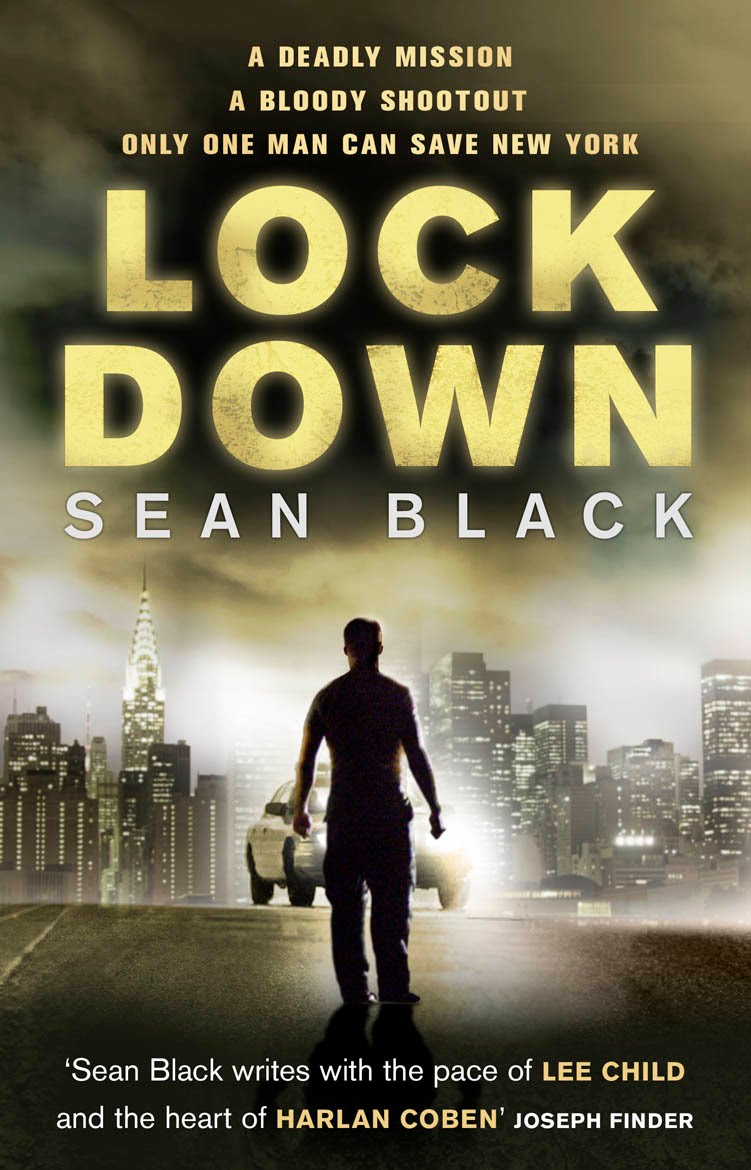
Despite the fiercely intense gaze and the eyebrows slightly arched, as if to say, “I’ve got a shiv in my hand that could sever your carotid in the time it takes you to avert your eyes,” Author Sean Black is the sweetest guy I’ve ever met. His author photo delivers the kind-of tough-guy persona you’d expect to find behind his popular LOCKDOWN series, featuring bodyguard-turned-avenger Ryan Lock.

To research the series, Sean trained as a bodyguard with former members of the Royal Military Police’s specialist close protection unit, spent time inside America’s most dangerous maximum security prison, Pelican Bay Supermax in California, and underwent desert survival training in Arizona.

He was born and raised in Scotland and attended college at Oxford, where he graduated with a degree in Philosophy, Politics and Economics. After college, he spent a summer teaching in a housing project in New Orleans before following former Grand Wizard of the Ku Klux Klan David Duke’s campaign for US Senate. Having whet his taste for America’s diverse culture, Sean won a place at Columbia University in New York to study for his Master of Fine Arts in Film. He lived in New York for three and a half years, before moving to Los Angeles, where he met his wife.

After a short stint living as a screenwriter in Hollywood, Sean returned to England to teach college before landing his first television-writing gig. Between 1999 and 2008, Sean wrote over seventy episodes of some of Britain’s best-known television dramas.

In 2006, as part of the research for a television series he was developing, he enrolled on an intensive 24-day bodyguarding course. The TV series wasn’t picked up, but it gave him the idea for a series of thrillers about an ex-military bodyguard who finds himself working in high-end private security. In November of 2007, he started writing the first book in the series, Lockdown.


In September of 2008, after a heated auction, Lockdown sold to Bantam/Transworld in what Publishers Weekly categorised as ‘a major deal’.

I met Sean a few years ago at the Mystery Bookstore in Westwood, California, the night before the L.A. Times Festival of Books. He was absolutely charming; a humble guy from across the pond who hadn’t let his success in television go to his head. We kept in touch over the years — I think he’s read every Murderati blog I’ve ever written — and recently we brought our families together in Hermosa Beach for a brunch he wouldn’t let me pay for. His family is adorable, and his daughter is the type of precocious young woman who will surely break the hearts of all the young men she meets, including my two boys. She has the kind of clever that inspires strong female characters, and I am sure we will see her influence in the pages of Sean Black novels yet to come.

Today, Sean and his family live just outside of Dublin, Ireland.

With that, I bring you Sean Black…

Stephen: Sean, you’re pretty much my hero when it comes to taking life by the horns. I love the way you throw yourself into research in an effort to bring a sense of reality to your writing. How the hell did you get into Pelican Bay, and what did you do while you were there?

Sean: Thanks, Steve! It was not easy getting into PB because we went through the official channels and they are seemingly not that keen on people from outside coming into Pelican Bay. I still didn’t have a yes when I flew out but I’m a believer in getting off your ass to make things happen. Finally, a few days before I had my flight booked to come home, I got the go ahead. I was inside for the day. They did offer me a place to stay overnight but I politely declined. They had just had a minor riot so it was relatively chilled when I got there. Days before they had a young white inmate who was a Crip (a predominantly African-American organization as many readers will know). He decided that despite words of warning, he would hang with the Crips on the yard – a Pelican Bay no-no. He was attacked as he walked back into his unit and it turned into a fairly serious incident with live rounds fired from the tower, but thankfully no-one killed. The white and black inmates were on lockdown when I visited so the other inmates were pretty damn happy as they didn’t have to watch their backs for a few days. Mixing with someone of another race is a no-no for the prison gangs. The most nerve-wracking part was going inside the SHU or secure housing unit. They give you a protective vest. I was puzzled because I thought, “Wait, they’re in their cells.” “Oh, yeah,” I was told, ” but sometimes they try and spear us.” They make little darts in their cells, dip them in, well use your imagination, and fire them through the holes in the cell door with the elastic from their shorts. If you have someone with Hepatitis or HIV and it breaks your skin, well, it ain’t nothing good.

Stephen: What other cool research experiences stand out in your mind?

Sean: What got me started was doing a three and a half week close protection operative (bodyguard) course in the UK and Eastern Europe. It was right around the time when companies like Blackwater took off and there were hundreds of guys signing up to go to Afghanistan and Iraq and work as private contractors. I stumbled across this world and was fascinated. I thought it would make a great TV show but I couldn’t get the pilot episode away (still open to offers on that one) so I wrote Lockdown instead. The best thing about it was meeting the two former British Royal Military Police close protection unit guys, Andy and Cliff. In a world full of bullshitters, they were the real deal, and they gave me this amazing insight into a world very few people see. I also got to smash up cars on a dis-used airfield, did firearms training in Prague, and generally live out every twelve-year-old (thirty-seven-year-old?) boy’s fantasy for almost a month. When I got home I spent a month praying someone would break in so I could kick the shit out of them. Thankfully for all concerned, no one did.

Stephen: Your history really reminds me of another talented author we know here at Murderati – Gregg Hurwitz. Did you run into Gregg at Oxford?

Sean: No, bizarrely I met Gregg at my mother-in-law’s house. She and her husband had been on a USC alumni cruise and Gregg had been there helping his Dad who, if memory serves, had broken his arm. I was writing TV at the time so she wanted us to meet. And, well, if you’ve met Gregg he is one of the most talented, coolest people you will ever meet. I read his Rackley series and loved them and I loved his whole approach to research, which just comes off the page. One of the great things over the past year or two has been seeing him hit it big in the UK, having spent several years banging on to everyone I met, especially in London publishing, about how good he is. No one deserves it more than he does. I just wish he wasn’t quite as good looking. It’s really not fair to be that talented and have that face as well.

Stephen: How does a kid from Scotland end up following David Duke during his campaign for senate? How does that process even get started?

Sean: During summer vacation, I went to New Orleans to volunteer for an anti-death penalty group. The death penalty is something I still oppose. Not because I don’t feel that need for punishment but because, let’s be honest, in the southern US, there are dozens of black men on Death Row who are, and have been proven to be, innocent. DNA is no safeguard either, incidentally. Anyway, while I was there, Duke was running for Senate so I went to interview him. Of course he talked in code for most of the time. So he would talk about welfare mothers, which was code for black women with kids. He was an utterly bizarre, quite seductive individual. And, he came within a few percentage points of unseating one of the strongest Democratic incumbents in the US Senate. He did not like me one little bit, which I took to be a great compliment.

Stephen: You must have been your parents’ dream, coming out of Oxford with a degree in Politics and Economics. What sort of psychotic break did you experience that made you decide to study film at Columbia?

Sean: Ha ha ha ha. That’s how it feels some days. Most writers have that “What the hell have I done with my life” moment, don’t they? A lot of my friends went to work for the UN, or into the City of London, or to work as management consultants. I had already started writing journalism and fiction and it was that dumb ass romantic notion of wanting to be a writer. Anyway, one day I picked up this career magazine and it was about film schools. I thought “aha, screenwriting, you can write and make a living.” Cue hollow laughter. I went, had a great time, and then spent the next seven years trying to break in. It was great though. I got to live in New York in my early twenties and Columbia is a great school.

Stephen: What was your “Hollywood” experience like? Was it anything like you expected?

Sean: My original experience was straight out of film school and didn’t work out, which I am very grateful for now. One of the people I have got to know over the past few years is David Seidler who wrote The King’s Speech. He told me that part of the reason for the longevity of his career was that he came to Hollywood when he was forty. Hollywood is all about the new thing, and the flavor of the month. Lots of people break through, they have ten years if they’re lucky, and then they are done. A very few like David reconnect with their passion, stick at it and they get a second shot. I was so happy watching him pick up that Oscar knowing what he had been through. Also, last time we were out to dinner, I got back to the parking garage in Santa Monica after it closed (because I am an idiot) and he gave me a toothbrush and let me sleep on his couch so, great guy. So, yeah, Hollywood. I think as long as you don’t take it too seriously it’s hugely enjoyable. It is full of very talented people who I enjoy meeting immensely but don’t get sucked in by the mirage and you’ll be fine. I mean who doesn’t like being told how great they are? Just remember though that behind door numbers two through ten are a bunch of other people who are going to get the same speech. It’s that old saying, isn’t it? Hollywood is the only town where you can die of encouragement. I have a Scotsman’s cynicism so that’s helped me.

Stephen: Do you feel there are more opportunities to write for television or film in England than the U.S.? How are the industries different in the two countries?

Sean: TV in England is producer led, which in terms of drama doesn’t work that well. I know lots of very talented TV writers in the UK but it’s like a big sausage machine so it’s hard to discern just how good some of them are. Americans see the best of British TV, and vice versa, so we both have a skewed view of how good each other’s television is.

Stephen: How did you segue from writing television to writing novels? Were you able to bring fans of your TV series to your books?

Sean: With a few exceptions, I don’t think anyone who watches TV has a clue who wrote it, or cares, so not really. It gave me some amazing things, the best of which was a lack of attachment to my words,and an ability to know a good note from a bad note. Most of all though I wrote a LOT, and saw hours upon hours upon hours of my work on screen, so you get to see what works. You learn fast in that environment or you don’t work. It’s brutal in that regard. It was a wonderful training ground where I met some very talented people.

Stephen: Do you feel more satisfied writing novels than television? If so, how?

Sean: Novels are infinitely more satisfying although I do miss the contact with other writers and all the people who make a TV show possible. One of the big differences is that if you want to blow up a building in a novel, you write it. Good luck trying to get that scene past a producer. So you have that freedom to go anywhere and do anything and immerse people in a world in a book. On the other side, if someone thinks you suck, well you can’t exactly blame the director. It’s all on you, but overall, novels by a long way. As a side note, when someone told me it was harder to sell a debut novel than get a TV show commissioned, I can remember laughing. A debut costs what at the low end? Well, nothing now, but with a big publisher? Say fifty to eighty grand? That’s going to cover the catering on a TV show – if you’re lucky.

Stephen: Currently you’re living with your wife and beautiful little daughter in my favorite country in the world – Ireland. Why did you make the move? Does Ireland offer advantages to authors that are not available in the U.S or U.K.?

Sean: The best thing about being here for us are the people and the education system. The economy is in the toilet but the people (if we can talk about them as a monolithic entity) are just great. There is still that sense of community here. I would argue we all need that sense more than ever these days. I wish the weather was better, I guess. Oh, and our politicians are for the most part, to use an Irish expression, a bunch of ‘cute hoors,’ but that goes for most politicians these days. Apart from that though, I love it.

Stephen: Tell us a bit about your Lockdown novels. The series became very popular from the start – what is it about your books that draws the readers in?

Sean: I still feel like I’m on the nursery slopes in terms of readership, with a very long way to go, but yes the reaction has been great. I’m not sure that I’m that beloved of the cognosceti because the books are very stripped down in terms of prose. I think people tend to enjoy the pace of the books, and the interplay between the two main characters, Lock and Ty. Lock is more of your buttoned up good guy and Ty is a self-styled bad boy, ladies man. Interestingly, female readers seem to really love Ty. I make no comment. I hope that above all, the books are fun. Whether they are thrilling fun or scary fun or funny fun, it doesn’t matter to me. I want to engage people and I will go anywhere and do anything and screw up my back sitting at my desk for hours to make sure that happens.

Stephen: Is there a TV series or film version of your books in the making?

Sean: We’ve had interest but nothing firm on the horizon. I’m in no rush. The books are there for people. Plus, I know how hard it is to get a movie or TV show made these days so even if you get an option, well, that takes you to the first base camp with the rest of the mountain still to climb. If the right people come along, great. If not then I’m not going to cry myself to sleep.

Stephen: What’s next in the series – do you have a book coming out now?


Sean: Over the summer the fourth book in the series was published, The Devil’s Bounty. Lock and Ty are recruited as bounty hunters to go after a very wealthy serial rapist who has fled across the border into Mexico and is being protected by a very violent drugs cartel. I also just published a novelette, if that’s the term, called Lock & Load. It’s a pretty simple story about a young Hollywood actress whose movie star ex-boyfriend won’t leave her alone. Lock and Ty deal with him in a slightly atypical fashion. It’s a bit lighter than The Devil’s Bounty, not that it would be difficult.

Stephen: What’s in store for Sean Black? Will you continue to write novels, branching out into new series characters? Do you anticipate a return to writing for TV, or possibly film?


Sean: Lock and Load was a way of keeping the series ticking over while I work on two different novels. One is finished. One is halfway done. I can’t say anything much about either of them just yet, although one is a big thriller, and the other is also big canvas but a completely different genre and something I just wrote for myself. Once they are done, I will come back to Lock and Ty for a fifth novel that I already have planned out in my head. Thrillers are hard to write because there is so much reverse engineering but I love those characters and I have readers who will hunt me down and kill me if I don’t give them more books. And readers after all are the people who make me get up in the morning when it comes to the work. They are the start and the end. In terms of TV, as big Sean Connery said, Never Say Never Again. If the right project came along, or I came up with an idea that seemed like TV or a movie, then who knows. It’s not something I am actively seeking out.

Stephen: Well, I’m real proud of you and happy for your success, Sean. It’s great to see smart, talented authors being rewarded for their efforts. It’s even better when they’re truly wonderful people, like yourself. Thanks for stopping by on Christmas Day.

Sean: Thanks so much, Steve!


Almost

by Pari

My holiday present to the kids this year was a trip to Sitting Bull Falls in southern NM. We hopped into the car on Friday and drove more than 360 miles — through Socorro, San Antonio, Carrizozo, Roswell, Artesia — all the way to Carlsbad, but it was too late to try to get to the falls. We stayed in Artesia and headed to the falls nice and early on Saturday. And, guess what? They were closed. Yep. Even though the local guide book said they’d be open.

We would’ve had to wait for almost 2 hours and we just didn’t feel like we could afford the time. We also didn’t feel like we wanted to pay a $1500 fine if we got caught going in and there was a ranger nearby (which there probably would be).  However, the drive had been gorgeous.

We got to see what I assume to be was Sitting Bull rock.

A lot of other rocks.

And some pretty funky flora.

Yesterday, we drove from Artesia, through Mayhill, Cloudcroft, Alamogordo, Tularosa to Socorro. This morning we were going to head out and take the very long way home via Datil, Pie Town, Quemado and Grants . . . but I had a flat tire and though I got it repaired (and that was a really nice story, but I’ll save it for another time), I just didn’t want to be 200 miles from the nearest phone transmitter.

The reason for this travelogue is that in driving more than 800 miles during the last few days, we had a lot of potential disappointments. But they didn’t end up being bummers because we were having such fun on the trip.

A few years ago I would’ve been so upset at not getting into Sitting Bull Falls. I would’ve felt like it was my fault. In so many ways, that also sums up my writing career. I aimed for a particular direction and for years was devastated that I didn’t achieve that goal. But you know what? I’m in a much better place in life than I was a few years ago. I’m going to start writing again during this break and I don’t care if a million people read or buy my work. I want to write because in long run, it does bring me joy.

It’s all about the journey, baby.

May yours this holiday season and into the New Year be sweet, healthy and filled with unanticipated pleasure.

Apocalypse Not

by Alexandra Sokoloff

Yay!  I get the Apocalypse post! 

I know, I shouldn’t joke, the day is young… but apparently they all survived in New Zealand and Australia, so I’m optimistic.

Actually this end of the world is turning out to be a lot less viral than the one with the crazy – or Really Media-Savvy – preacher last year. Maybe we just had too much lead time on the aptly named Mayan Long Count – sort of the way I feel about hurricanes as opposed to earthquakes, actually. There’s so much anticipation to a hurricane that by the time it hits, no matter how much of a disaster it really is you’re already emotionally burned out on it. Earthquakes, you get all your adrenaline rush at once.

More likely, though, we’re all too numb from our two most recent real-life end of the world tragedies, Superstorm Sandy, and the Sandy Hook massacre that Gar and PD have so eloquently posted about this week, to be able to make light of any theoretical apocalypse. It feels like we’ve had it. 

And then there’s just the ordinary anxiety of the holidays. The first day of January is really just one day after the last day of December, so why do we put all this pressure on the END of one year and the BEGINNING of another?

A better way to look at it would be that we get to let all of the baggage of the old year go and start over fresh. Maybe some people do do that and I’m just late to that party.

I think a lot of my Christmas anxiety is because my tendency is ALWAYS to think I’m not doing enough, and the end of the year brings that out (What did you DO all year, anyway?). So today I’m going to go back over my year to remind myself I got a hell of a lot done, and even enjoyed myself doing it. (Sort of like Facebook is encouraging us all to do now with some app about our 2012 Year in Review highlights.  If someone could tell me how Facebook knows what the highlights of my year were, I’d be grateful.)

But these were my own highlights, in relative order.

E books have been good to me. I got my backlist up; every one of my books is now available for the infinitely reasonable prices of $2.99 or $3.99, and I’m thrilled to have more control over my writing schedule, release schedule, and book pricing, not to mention a regular, understandable, and perfectly livable income.

I launched a new series, my first direct-to-e thriller, Huntress Moon, which instantly became an Amazon bestseller in mysteries and police procedurals, and I’m thrilled to report that it made Suspense Magazine’s list of Best Books of 2012.

Writing the series is giving me a chance to get reacquainted with all my favorite places in California, where I’m living again, though I’m still unsure if I’m going to settle in the Bay Area or the Los Angeles area. I love them both! I’m loving the research, though, and Book Two in the series, Blood Moon, will be out in late January or early February. 

My dear friends Heather Graham, Harley Jane Kozak and I had a blast co-writing the next installments in our paranormal mystery series The Keepers; this time we took the series to L.A., and the new books come out in January, March and May.  

I’ve also been teaching a film class in L.A. – basically I screen my favorite movies and talk all the way through them, raving about all the visual excellence and story structure brilliance. And they call this working! Such a scam!

This summer I was the keynote speaker at the Romance Writers of Australia National Conference on the Gold Coast, and had a wonderful time teaching my Screenwriting Tricks for Authors workshop and doing panels on e books and writing paranormal suspense with all those crazy Aussies.  Then my friend Elle Lothlorien and I did a wild road trip down to Sydney, driving on the wrong side of the road and leveling – I mean visiting – every beach city along the way.  Love the country, love the people, want to go back as soon as possible.


Then I came back and put my house on the market (meaning two months of the worst kind of emotionally fraught prep), and it’s currently “under contract”, so a lot of the beginning of my 2013 is going to be house-hunting. If I can ever narrow the prospective location down from just “somewhere in the world, possibly California.”


Throughout the year I did my usual insane conference traveling, with appearances at Left Coast Crime, Romance Writers of America National Conference, Romance Writers of Australia National Conference, the ever –inspiring Bouchercon – and I just returned from paneling, performing, and dancing the night away at Heather Graham’s Writers for New Orleans, my favorite conference in my favorite city, which is just as fabulous at Christmas as it is every other time of year. (French Quarter photo with Chantelle Osman and Elle Lothlorien)


Somewhere in there I did an entire website overhaul: designed by the fabulous Madeira James of Xuni.com. 

– I’ve also embraced Facebook as the virtual cocktail party it really can be. This might not sound like an accomplishment, but promotion and networking is a fact of life for authors, and to find a way to do that that feels a little like taking a break to hang out at the conference bar with witty and like-minded friends – without ever leaving my chair – is pretty damn cool, if you ask me.  

Not only that, but – even though I didn’t quite get Blood Moon finished (finished in my definition of the word) for a December release – I’ve put together a boxed set of three of my spooky thrillers called Haunted. Anyone who doesn’t already have these books can now get them all for just $5.99, and give themselves or special friends nightmares for days! 

 Buy now on Amazon.


And to bring this back to the end of the world: I have a brand new anthology out this weekend: Apocalypse: Year Zero, with four end-of-the-world novellas by me and my award-winning dark fantasy friends Sarah Langan, Sarah Pinborough, and Rhodi Hawk. We cover 9/11, tsunamis, Hurricane Katrina, and The Big One, as well as, in no particular order, Hollywood, sex, rage, and the Four Horsemen, who turn out to be not men at all.  (Nook link to come shortly…)

On Amazon

So if tomorrow you wake up, are still here, and feel cheated out of your Apocalypse, no worries – we’ve got you covered.

Okay, I bet you know the question of the day!  What were the highlights of your 2012?

Or if that’s too personal, let’s talk Apocalypse.  What are some of your favorite Apocalypse stories, in any media?  Yes, I am already missing The Walking Dead… and since I just got back from Australia, I’m thinking The Last Wave…

And don’t forget – today is not just the end of the world, it’s also the winter solstice, a very powerful day for manifestation. Make a wish.

Alex

Gun laws in Australia

By PD Martin

For any regular visitors to Murderati, it’s difficult if not impossible to follow up from Gar’s post yesterday. I had been contemplating two subjects for my blog today — both very different from one another (one was ‘failure’ and what it means and the other was my complete inability to get Christmas cards out on time…actually maybe they are related). However, I didn’t feel that either of those subjects was a fitting ‘follow-on’ from Gar’s amazing post.

So, I’m sticking with the theme by talking about Australian gun laws. I guess as a way of saying ‘this is what it would look like’ if America ever did change its (wicked) ways. Plus Gar’s post inspired me to explore things a little more.

The first thing I discovered was that Aussie gun laws have gone through a massive change — and it was in response to a spree killing. Specifically, in 1996 gun laws were reviewed following the Port Arthur Massacre. I should say, that gun control wasn’t really on the radar in Australia before that, because we’ve always had a relatively low violent crime rate plus we have a long history of low firearm use and gun legislation (off and on, and different for the different states). However the state laws were aligned via the 1996 National Agreement on Firearms. But the fact that gun laws haven’t been a constant source of debate does make us very different to America.

Here’s what it’s like in Australia. I’ll start with a personal experience.

I grew up in Melbourne (population 4.1 million, Australia’s second largest city) and had never seen or held a gun until I went to a firing range as research for my Sophie novels. So I was thirty-five years old the first time I saw a gun. Could this be said for many Americans?   

According to Wikipedia, 5.2% of Australians currently own a gun. Under the current legislation, you must get a license to purchase a gun, and there’s a mandatory 28-day delay before the first permit is issued. You also must have a “genuine reason” to own a gun and it must be related to pest control, target shooting, hunting, etc. Self defense is NOT considered a genuine reason.

According to Wikipedia, 25% of Americans currently own a gun and about half of the entire population has lived in a household with a gun. This is something I can barely comprehend. So how many thirty-five year olds in America would never have even seen a gun? Not many, I guess. If any.

And in terms of firearms related deaths? Again from Wikipedia, in the US there were 3.7 homicides and 6.1 suicides using firearms per 100,000 people (2009) and in Australia it was 0.09 homicides and 0.79 suicides per 100,000 people (2008).

For most Australians, guns just aren’t part of our lives. We don’t own them, don’t see them, don’t want them. And I guess that’s why it’s hard for us to understand the debate in the US.

You might also be interested to know what happened in 1996 when Australia’s gun laws changed. I haven’t been monitoring how far the discussions are going in the US, but I assume people are talking about how, if gun laws were changed, you could get all the guns out of circulation. Well, this is how it worked in Australia.  It was simple: gun owners had a certain amount of time to hand in their weapons and they got money in exchange. This from Wikipedia: “Because the Australian Constitution prevents the taking of property without just compensation the federal government introduced the Medicare Levy Amendment Act 1996 to raise the predicted cost of A$500 million through a one-off increase in the Medicare levy. The gun buy-back scheme started on 1 October 1996 and concluded on 30 September 1997.[23] The buyback purchased and destroyed more than 631,000 firearms, mostly semi-auto .22 rimfires, semi-automatic shotguns and pump-action shotguns.” (By the way, Medicare is our national healthcare system, and it was increased from 1.5% of your wage to 1.7% for the 1996 tax year.)

I guess it would be rude and probably naïve of me to say: ‘See America, that’s how it’s done.’ Not to mention inflammatory. We are very different countries with different histories. But from the outside looking in, it’s hard not to feel disbelief at America’s gun laws and attitudes. I’m not saying Australia is perfect — it’s not. And it’s with great shame personally and as a nation that we have to claim one of the world’s worst spree killings – Port Arthur. However, I do think we’re at least pointing in the right direction.

I’m proud that I’d never seen a gun until I was thirty-five. Proud that I don’t know anyone who owns a gun. And as a mother, I’d prefer my children to have similar experiences. I think it would be great if they only see a gun if they become a crime fiction author and need to do some research. What about you?

DECEMBER 14, 2012

by Gar Anthony Haywood

There’s an elephant in the room, and its name is “Newtown.”

Sure, I could pretend it isn’t there.  Post something today similar to all my other posts in the past, an essay on writing or the writer’s life that would amuse or inform but say nothing whatsoever about the nightmare we’ve all been living since last Friday.  But I’m not going to do that.  This seat I have at the Murderati round table is an opportunity to contribute to the discussion we as citizens of this great nation must have, and have now, regarding responsible gun ownership, if we are to avoid such horrific events in the future, and hell if I’m not going to take advantage of it.

We authors here at Muderati, as the blog’s very name implies, write about murder every day.  To varying degrees, death is our stock in trade.  Whether we write about single-victim crimes of passion or serial killers who claim multiple lives, we are all deliberately counting on the perverse thrill readers find in the act of one person murdering another to sell books, so being silent on the subject of the Newtown massacre, as if we are wholly unqualified to discuss such matters, would seem somewhat cowardly to me.  None of us have all the answers — we barely know all the questions — but I’m certain each of us has some idea why those 26 people — 20 of them small children — died in Newtown, Connecticut, last week, and what we can do — what we must do — to try and make it the last tragedy of its kind on American soil.

I’ve decided to couch my statement, such as it is, in the form of a point-by-point response to what I believe is the general attitude most intelligent, reasonable gun rights advocates have toward this crisis, based upon the online comments I’ve seen some make on Facebook and elsewhere.  That attitude goes something like this:

  1. First and foremost, our thoughts and prayers go out to the families who lost children in the Sandy Hill Elementary School shooting.  No one grieves for those kids or their parents more than we do.
  2. However, what happened in Newtown, Connecticut last Friday was not about guns.  It was about mental illness.
  3. No gun control law could have prevented this tragedy.
  4. Further, no gun control law can ever guarantee that such terrible events will not occur in the future.
  5. Gun control laws only serve to inhibit the ability of law-abiding citizens to secure weapons of self-defense.  Properly motivated, criminals and the mentally disturbed will always find ways to arm themselves.
  6. Any attempt by the government to limit the kind of weapons a U.S. citizen can legally acquire is an infringement upon our Constitutional right to bear arms, and should be viewed as the first step down the slippery slope that inevitably leads to tyranny.
  7. We can’t allow the emotions of the moment to spur us into taking legislative actions we may regret later.
  8. As tragic and heartbreaking as the deaths of 20 innocent children are, this is a relatively small price to pay for the freedoms our Founding Fathers granted us.

To which I would reply:

  1. I’m quite sure this is true.
  2. Actually, it was about mental illness combined with a Bushmaster AR-15 rifle and two handguns: a Glock 10 mm and a Sig Sauer 9 mm.  All legally purchased by the shooter’s mother, who needed such an arsenal for self-defense like Donald Trump needs a home equity loan.
  3. Prevented?  Perhaps not.  But a ban on the AR-15 — such as that which was in effect until 2004, when Congress repealed it — would have gone a long way toward making this tragedy infinitely less deadly.
  4. Can we please stop talking about gun control as if it has to eliminate every gun-related homicide for all time in order to serve any purpose?  Traffic laws don’t prevent all speed-related accidents, but surely we can agree that our streets are a hell of a lot safer with such laws in effect.  Merriam-Webster defines “control,” in part, as “to reduce the incidence or severity of especially to innocuous levels.”  Get it?  Gun control is about the reduction of gun-related crime, not the eradication of it.  Opposing any form of gun control on the grounds it can’t accomplish the impossible is both foolish and indefensible.
  5. Again, sensible gun control laws aren’t designed to keep guns out of the hands of every bad person who wants one — they’re simply designed to make the task of acquiring a gun as difficult as possible for criminals and the mentally unstable.  Sure, a highly motivated nutcase could probably find someone somewhere to sell him an illegal handgun, but not with the ease of going down to his local gun show and picking one off the shelf, no questions asked.  Gun control laws create layers of complexity in the process of acquiring a firearm that not every criminal or would-be murderer is up to dealing with.  Dissuading those who would use a gun to harm others from seeking one out is the logical first step in preventing gun-related homicides, and it shouldn’t be dismissed as ineffectual simply because its reach is not absolute.
  6. I don’t want to say this is paranoid bullshit, but it’s paranoid bullshit.  Every law ever enacted could potentially lead to a slippery slope; slippery slopes are everywhere if one cares to look for them.  Our government is imperfect, and it deserves something far less than our unquestioning trust, but staying up at night worrying about it becoming an authoritarian gulag any time soon is the rational equivalent of wearing a colander on your head to keep the Martians from reading your thoughts.  While you fret over being ever-vigilant for the first signs of democracy’s decay, kindergartners are being sacrificed at the altar of your ignorance.  Wake up and take fresh stock of your priorities.
  7. On the contrary, no moment in our history has called out for us to change our way of thinking about guns with greater urgency than this one.  If we don’t do it now, we never will.
  8. I vehemently disagree, and suspect every parent who lost a child in Newtown, Connecticut, would as well.

I’m a father of four children.  Up to now, I’ve been happy to watch the gun control debate from afar.  Who needs my opinion?  I write about crimes that are merely fictional, why should anyone care what I think?

But silence isn’t going to work for me any more.  Whether twenty children dead is sufficient cause for others to demand change or not, it is more than enough for me.

To those of you still unmoved, clinging yet to the idea that we dare not let what happened in Newtown inspire us to question the sanctity of our Second Amendment rights, I will leave you with a comment I made to a similarly recalcitrant gun-rights advocate on Facebook earlier this week:

“We can’t keep giving these people EASY access to WEAPONS DESIGNED FOR WARFARE. The caps here are significant, because they’re meant to make it clear that I am not advocating a ban on weapons reasonable people could own and use for self-defense, nor am I suggesting that there’s anything we could do to keep ALL assault weapons out of the hands of crazy people. The time has come for us to MAKE IT SIGNIFICANTLY MORE DIFFICULT for average citizens to buy any kind of weapon that can kill dozens of people in a matter of seconds. Nobody, and I mean NOBODY, can make an intelligent argument for allowing people like you and me, let alone sick bastards like the Newtown shooter, to buy a fucking assault rifle that does not boil down to ‘because it would be fun to play with, and the Constitution says I should have the right.’ And don’t give me any of that ‘well-armed militia’ crap, either, because that’s just a crux people use to justify the war games they like to play in their backyard. If the death of 20 kids in the span of a half-hour isn’t enough to convince you people that something about the way we worship the Almighty 2nd Amendment in this country has to change, how many dead kids WILL it take? 40? 100? What’s the number that’ll finally move you to surrender your right to legally buy a goddamn AR-15?”

I’m still waiting for his answer.

An Interview with the Inimitable Tony Broadbent

By David Corbett

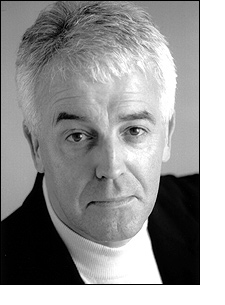
I first met Tony Broadbent at the Book Passage Mystery Writers Conference in Corte Madera, California. I wondered who this handsome, smart, dapper, witty, self-effacing, charming, utterly intimidating Brit could be.

I wanted to hate him—how could he be so goddamn brilliant—effortlessly so—at absolutely everything? But as I quickly learned, hating Tony Broadbent is just not an option. Fortunately, befriending him proved much easier than I’d imagined.

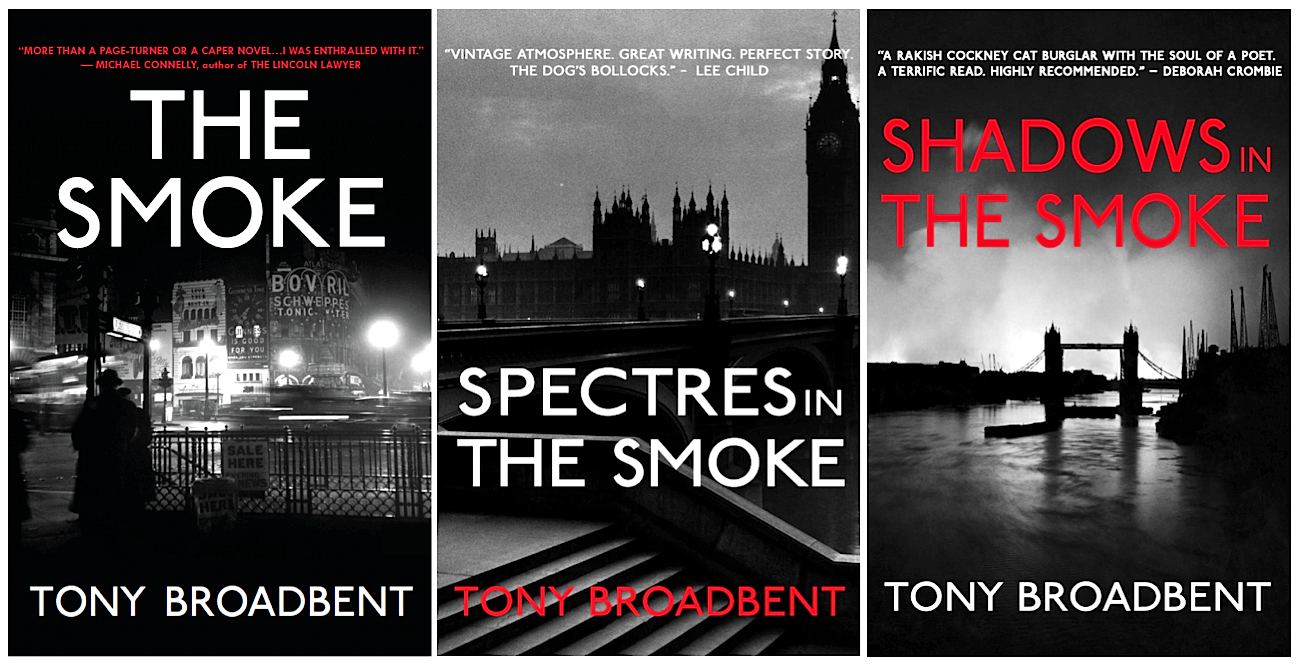
Tony’s the author of three of the most intriguing, suspenseful, and beautifully written thrillers I’ve ever read, all of which take place in post-war London:

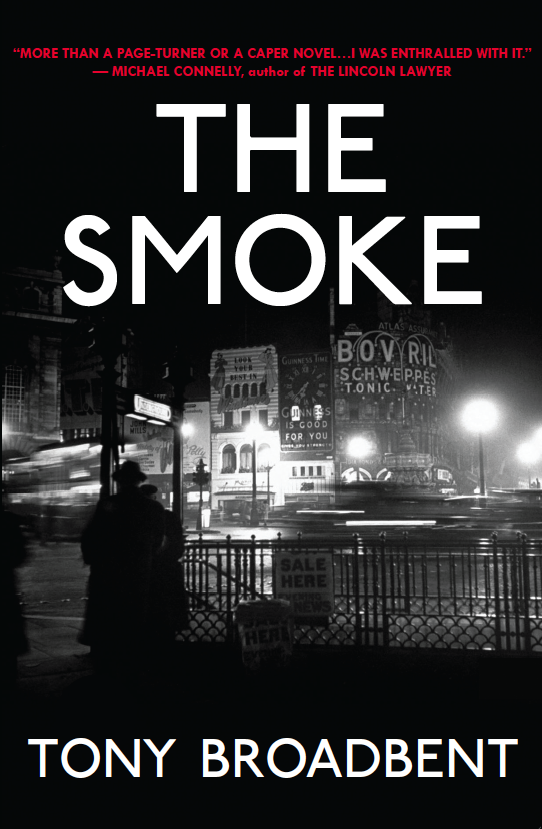
The Smoke (named by Booklist as both one of the best first novels and one of the two best historical novels of 2002)

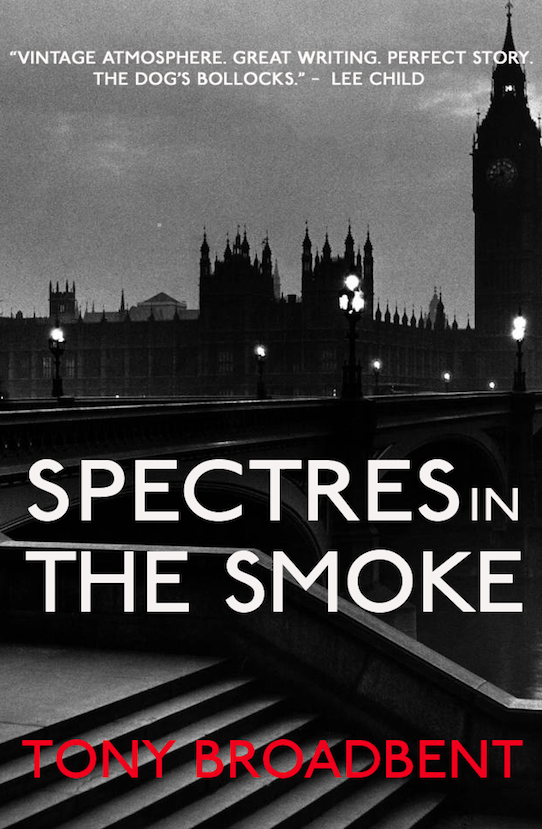
Spectres in the Smoke (Winner of the Bruce Alexander History Mystery Award, named by Booklist as one of the best spy novels of 2006, and named an IMBA “Killer Book” for November 2005)

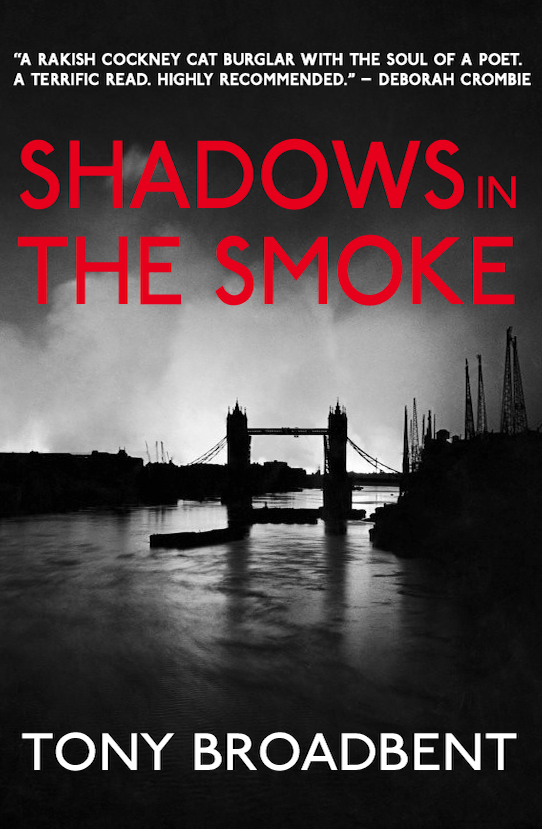
Shadows in the Smoke (just published—distinctions pending)

(Note: As those of you acquainted with Tony’s work well know, “The Smoke” is a nickname for London.)

Not surprisingly, Tony’s work has garnered exceptional praise. For a full sampling, visit his website. But to give you a modest taste:

The Smoke takes its time concentrating on its main suspense story; after all, there are so many dark alleys and byways in London to explore (the great crumbling theaters, fry shops like The Victory Cafe, where customers can still get “a good nosh”) that the novel is easily diverted from its spy-vs.-spy machinations. Not a problem. Jethro’s illicit adventures are entertaining, but this is one of those mysteries whose distinctive sense of place lingers long after plot details have faded. —The Washington Post

Broadbent honors—with understated admiration and moments of high-quality local humor—the spirit of London’s (postwar) inhabitants. Cary Grant could have played Jethro perfectly. —Chicago Tribune

Tony studied art in London—for a taste of his artwork, check out his covers (below), all of which he designed—then he worked as copywriter and creative director at some of the best advertising agencies in London, New York, and San Francisco, before opening his own agency. He’s now a consulting brand strategist, planner, and ideator (whatever the hell that is) for clients in the U.S. and Europe.

So—let the Q&A commence:

David: Every time I hear you discuss your books, I’m impressed by the personal connection you have with the material, especially the setting: Post WW2 London. Victory seldom looked so harsh and hollow. And yet you bring the time and place to life in a way that testifies to an incredible vigor of spirit—and earthy wit. Could you speak for just a moment on why you chose this particular time in English history, why it affects you so deeply, and why it’s so important to you to convey it to readers with the richness of atmosphere and detail that you do?

Tony: Firstly—thanks very much—David—for the opportunity to hang out—as they say—with the Murderati.

The Jesuit credo: ‘Give me a boy till he’s seven and I’ll make you the man’ holds true for the country and times we’re born into. And if I can misquote Graham Greene—‘England very much made me.’ I was born mid-century—not long after the end of World War Two—an event that radically changed the political map of the world and its peoples and led to the Cold War. Those events of sixty plus years ago still directly influence events today.

The Second World War—and its aftermath—was very much a time of heroes; ordinary people caught up in extraordinary times. It’s been hailed as “the Greatest Generation”—and quite rightly so in my opinion—and we continue to owe them a huge debt. They’d won the War, but then had to survive the peace.

In England, the government was forced to introduce severe austerity measures that went on well into the Fifties. Bread was rationed—and it hadn’t once been on ration during the war—as too were almost all consumables—foodstuffs, beer, clothing, furniture, motorcars, and petrol (gas). Meat was on ration until 1956. Sweets (chocolate and candy) came off ration in 1953 as ‘gift’ to the nation’s children to mark the coronation of Queen Elizabeth II—after which they put it back on ration for another three years. (Probably the reason why so many of my generation still have sweet-tooth cravings.) All of which led to a British mind-set that harked back more to the ‘Thirties’ than the future. And which—in many ways—gave rise to the ‘angry young men’ movement of late-Fifties British theatre and literature and film and—in all probability—the teenage yearning for and addiction to rock ‘n’ roll and ultimately the explosion of the ‘Swinging Sixties’. 

And as with everyone else in postwar Britain, I was steeped from birth in the mythology of the times. So writing The Smoke novels not only gave me the opportunity to go back and explore the country—and the city—that made and formed me—it’s allowed me to appreciate it all the more.

As for that ‘postwar’ London of bombed-out broken buildings and bombsites—it was all still there—well into the Sixties. And when I was nipper—a very young kid—my father would take me up to London—for the fun of it. (He loved the city.) So I actually visited many of the areas I write about—Church Street and Petticoat Lane (street markets) in particular—and actually saw Jack Spot—‘Spottsy’—one of the Lords of The Underworld—on Church Street. And I suppose our ‘body memories’—the sights, sounds, and smells of time and place—never really leave us—not if we’ve truly loved them in the first place.


David: Each of the books explores a distinct aspect of post-war austerity, adversity, and survival. You’ve tackled the threat of Communism, the surprising rise of post-war fascism (and the ties between British Royals and the Nazis), the rise of organized crime amid the bombsites and ashes. Is there a historical arc intended in the books? Or are there at least certain historical or societal events or changes you find particularly compelling, and use for your stories?

Tony: The arc of The Smoke novels—publishers willing—stretches from the late Forties through to end of the Fifties. Postwar Britain seemed immeasurably grey and forever frozen in black and white—and not only because of newsreels and newspaper photographs of the period. The actor Terence Stamp—who grew up in postwar London’s East End—once said that it was only when The Beatles burst onto the scene in 1962 that the whole of England—London particularly—seemed to erupt into Technicolor.

So the stories—all of them based in ‘The Smoke’ (Cockney slang for London Town)—and most all of them steeped in London’s criminal underworld—take the reader from the wartime government directive of ’make do and mend’ all the way to the emergence of the consumer society. And along the way—as background—I touch upon various key UK events; everything from the surprising and very alarming resurgence of Fascism (in response to Clement Attlee’s 1945 Labour Government), the 1948 London Olympics, and the 1951 Festival of Britain, to Cold War espionage, the Deadly Fog of 1952, the Queen’s Coronation in 1953, and the Suez crisis of 1956.

David: You’re not just a master of setting and milieu. The other brilliant creation in the series is its hero, the cockney cat-burglar (or “creeper”) commandeered by MI-5, Jethro—Last Name Unknown. In him you’ve given us a completely British creation who nonetheless adheres to the Chandlerian diktat: He walks the mean streets but is not himself mean. Where in the smithy of your soul did you find him?

Tony: There’s that old saw, to ‘always write what you know about.’ So I peopled The Smoke with people, places, and events I knew of or had heard of or read about. Jethro—the Cockney cat burglar and jewel thief—is based on the father of an old friend of mine­­­—who I never ever met—but who was an honest to goodness London cat burglar. And as my ‘old china’ (Cockney rhyming slang: old china = old china plate = mate) had a career in the London theatre, I put the two together—added a dash of one or two of my favorite British actors and—‘voila’—I came up with our Jethro.

I also cast my own dad as a character—cast a wonderful old teacher of mine as another—and based another key recurring character on a friend from my days at art college. Later, when I found out the father of a writer friend of mine had served in the OSS and then CIA during and after the War—I had him as one of the main characters in Spectres In The Smoke. The reason? They’re all heroes in my book—which is why I also have Ian Fleming and David Niven—two other particular heroes of mine—in major walk-on parts. Then I have them all meet up—back in London—back when they were all in their prime.

So all the characters—Jethro especially—are amalgams of characters witnessed—real or imagined. I’m a child of my times and thus I’m very much a child of mass media—books, comic-books, pop-songs, radio, television, films. And so Jethro is a reflection of those times—and if not exactly a working class kitchen-sink hero—even though one reviewer likened him to a proto-Bond—he’s not a ‘clubland’ hero, either. I hope he’s someone you’d like to have a drink with—spend some time with —in a pub or on a long walk.

David: You’re justly praised for your command of cockney slang—and feel free to riff on that if you’d like—but I think your style in general is simply marvelous. I always sink in to your books because you draw me in so completely with the world you create through language. Your voice is unique and yet natural. You trained in the visual arts and in music—Little Known Fact: You design your own covers—where did you develop such an engaging prose style?

Tony: Thanks David—that’s very kind of you to say so. Language—voice—is very much a part of time and place and so as much as I can I try to follow the rhythms and patterns of London itself—very much a character in the stories—but I also then try to make it all very accessible—rather than merely a dry historical tract—by adding copious dashes of humor and—dare I say it—humanity.

I write in first person—and refer to the stories as it were told by Jethro as ‘Creeping Narratives—(in this case ‘creeping’ referring to the Cockney slang for burglary)—even so, the pacing is measured in that I only ever reveal what Jethro would actually know at any one time. So fast food it isn’t.

When I write—I always hear Jethro in the voice of Michael Caine—born and bred in London—and one of Britain’s finest film actors—and very much a man who oozes humanity and humor. Though the younger Murderati out there will perhaps know him best as Alfred the butler in the ‘Dark Knight Rises’ film trilogy starring Christian Bale as the caped crusader (Again—our heroes are ever important—regardless of how they might kit themselves out)—Caine has made some truly wonderful films over the years. All I have to do is read some lines of narrative in Caine’s (younger, Cockney) voice and I’m away and running, so to speak.

Cockney or Rhyming Slang evolved in the East End of London over hundreds of years—its natural habitat, the docks, the markets, the streets, the theatres, the taverns and pubs. It’s thought to have originated from the soldiers and seamen—and thieves—who frequented London’s vast docklands and the waves of immigrants—Russian, Jewish, French-Huguenots, Irish and Chinese amongst others—all of whom at one time or another have called the East End of the city, home.

Slang—usually defined as colloquial alternatives to standard language—is probably as old as human speech—and on the surface it might appear as being little more than linguistic playfulness—but Cockney Rhyming Slang and its sub-set, ‘back-slang’— “rouf”; “neves”; “yob”—was originally a ‘secret’ language that intentionally excluded the uninitiated and was as exclusive a London club as any to be found in Pall Mall or St James’s. Much the same could also be said for polari—the secret language of London’s gay community when homosexuality was strictly forbidden by law and subject to swingeing prison sentences.

David: What comes next for Jethro—and you?

Tony: The next book in the series is called Skylon In The Smoke—and follows hard on from events in Shadows In The Smoke. It sees the start of a major power shift in London’s Underworld—witnesses the Festival of Britain—and touches upon MI5 and the emerging dark and murky world of the postwar atomic spies. And all before Jethro even has a chance to put on his turtles (a little more Cockney rhyming slang: turtles = turtledoves = gloves) to go do a bit of burglary.


David: One last question. I mentioned music in a preceding question. You had something of a career in music as a youth in London, and you’ve written a book with a unique look into the Beatles. Could you share a little about either of these endeavors—or, happily, both?

Tony: Again it was more a function of the times—than true musical ambition or design. The Beatles opened up the door for many a lad in Britain in the Sixties. I just jumped through the opening with a guitar in my hand, along with almost everyone else I knew. And was lucky enough to witness—up close—the early days of some now legendary bands. Also, being in a rock’n’roll band and playing rhythm and blues was a great way to meet girls or ‘birds’ as they were called back then. All wonderfully captured in the words of the great Bob Dylan—“The times they are a’changing.”

We had no idea—of course—of the true extent of any changes and absolutely no way of knowing the long term effects we might have on society or even on ourselves—but to be a teenager—back then—and share in the music—somehow made you feel you were connected to every other teenager in the world—language or culture didn’t seem to matter at all. It was the attitude—the hope—that ‘a way’ was opening for something really new—something that would be better for everyone. It truly seemed to be a magical time.

As I mentioned before—it’s all to do with the teenage yearning for meaning that for me—in my youth—was all part of the ‘pop’ culture explosion—in popular music, the arts, fashion—even sexuality—of the ‘Swinging Sixties’. A little of which I’ve tried to explore in the mystery novel I’ve just completed that revolves (at thirty-three-and-a-third) around the early days of The Beatles—and others—in the Liverpool, Hamburg and London of yesterday.

* * * * *

So, Murderateros—any questions for the Inimitable Mr. Broadbent–Art? Music? History? Cockney Slang?

* * * * *

Jukebox Hero of the Week: I asked Tony to name the hero for this post but he graciously declined, deferring to my judgment. And following along in that spirit of generoisty, I’ve chosen an hour-long concert by Elbow, a British act that whose lyrical genius and melodic inventiveness calls to mind that former UK vanguard Tony remembers so fondly above.

(Note: I owe my introduction to Elbow to frequent Murderati contributor Gordon Harries, who also introduced me to Richard Hawley, who makes a featured appearance on the following video, joing Elbow for “The Fix is In”):