Author Archives: Murderati Members


The End

Zoë Sharp

One day I’m going to be able to type ‘THE END’ on a work-in-progress and think, ‘Wow, what a masterpiece – and such a breeze to write. Next?’
The reality is that I finish each book feeling like I’ve come through a battle, battered, bloodied, exhausted, and filled with a dreadful wake-in-the-night-sweating kind of fear that what I’ve written is absolute nonsensical rubbish that will be laughed at by anybody who picks it up.

For writers, however, this is normal.

OK, for most writers, this is almost normal.

I’m beginning to think I definitely fall into the category of writers who enjoy having written rather than the process of actually writing. Having said that, the first two thirds of the book were less troublesome than the last third. I tend to self-edit as I go along, so stopping to unravel and re-ravel bits of the story always slows me down, but I just can’t move forwards knowing something isn’t quite right with the bit I’ve already done.

I keep thinking there must be an easier way.

There never is. <sigh>

I’ve been over the typescript so many times I can’t tell if it’s good bad or indifferent. I’ve tried to make sure the emotional tension is as high as the other dangers. I’ve checked my action scenes are physically possible and make sense, and looked at the positioning of chapter breaks.

Of course, my long-suffering Other Half, Andy, has read every bit of the book at the just-written stage, but that means he’s as close to the story as I am. Now I need people who haven’t lived through every twist and turn and aren’t bored silly by it quite yet.

So, now DIE EASY is out with test-readers and having celebrated by doing the ironing (gosh, I know how to live) I have already started to look at my outline notes for the next project.

Basically, this is a coping mechanism so I’m not thinking about their verdict. It didn’t help that one of my test-readers rang up the day after receiving the typescript with that awful question: “Erm, has this gone out to everybody else yet …?”

“ARGH! NOOOOOOO! What terrible mistake have I missed that you’ve spotted it already?”

“Oh, just a few literals and typos …”

We do have a designated First Responder in the valley who has charge of the defibrillator, and I very nearly had to call them out at this point.

I have a small group of test-readers, mainly avid readers but a couple of writer/readers as well. I try not to bother my writer friends too much, as I know how time-consuming it is to go through a t/s thoroughly, and how distracting it can be when you have your own stuff to work on.

My test-readers are not necessarily fans of the character, but chosen both for their insight and their gentle brutality. If there’s something not right I need to know, but in my fragile post-book state I don’t want to be beaten round the head with it.

I suppose first of all I need to know does it keep you turning the pages. I want to have written something that you find hard to put down, that keeps you reading – just one more chapter – late into the night.

I need to know if the pace feels right, with enough light and shade between action and introspection to create the natural rhythms of the story. Is it too slow in the first half and then too compressed towards the end?

Does the behaviour of the characters feel logical and cohesive? Do they feel like real people or puppets to the plot? Do you care what happens to them?

It’s only really in the last instance that I want to know about minor plot-holes. Yes, it’s useful to know if a character stands up twice in a scene without sitting down again in between, or if I’ve managed to include a nine-day week, but that’s the kind of thing that the wonderful copy-editors usually catch, bless ‘em. And besides, I’ll be making yet another pass through the t/s once I have my test-reader comments in. Hopefully there will be a week or so’s distance by then, and I might even spot such stoopid mistakes myself …

And then my editor gets hold of it and I go through the whole painful process again.

We’re just gluttons for punishment, aren’t we?

So, how analytical are you when you’re reading a book? Do you try to work out what made you enjoy it and instantly look for the next by the same author? And to the writers among you, who do you use for test-reading your work? Do you use anyone other than your editor? And finally, any suggestions from people as to mindless (but repeatable in polite company) activities I might be able to engage in to take my mind off the waiting?

This week’s Word of the Week is epyllion, which is a poem with some resemblance to an epic, but shorter, from the Greek epos, meaning word.

Alex has just reminded me that in the interview she so kindly did with me on Jan 19th, we promised a giveaway of one of the first five books to a randomly chosen commenter. Alex told me to pick a number and she informs me that it lines up with Reine. So, drop me an email, Reine, and I’ll send you an e-book!

Are you a Cumberbitch?

by Alexandra Sokoloff

If you know what I’m talking about, you know what I’m talking about.   If you don’t, you’ve somehow been missing out on the biggest thing since Jesus.  I mean, you know, since the Beatles.

So I’d like to talk today about the new Sherlock Holmes.  (Hey, it’s crime fiction, isn’t it?)  Those of you who know can just scream and faint in the background, there, while I fill the others in.  And for the hopelessly straight men of Murderati, well,  you’re just going to have to endure a little erotomania.  It is, after all, coming on Valentine’s Day.

Once in a while there is in film or television or music what has become known in technology as a Black Swan.  Something that defies all expectations at the same time meeting all the expectations you never actually knew you had.  And that’s a good enough definition for the Masterpiece Mystery! TV series, Sherlock.


The series is brilliant – a redefining of Sherlock Holmes exactly as he would present himself in modern London, complete with e mailing, texting, GPS—and blogging by his faithful Boswell, John Watson, a veteran doctor who was wounded in Afghanistan, just as the original Watson was (I mean, when something is right, it’s right, right?).  And Sherlock is as he is depicted, an unfettered and unrepentant autistic-slash-high-functioning sociopath.

And a rock god.

An unfettered and unrepentant autistic-slash-high-functioning sociopath of a rock god.

The tagline for the show is “Smart is the new sexy.” And that pretty much sums it up.  This is not just a modern imagining of one of the – or is it THE? -world’s most popular and enduring detectives.  It’s a sexual fantasy for smart people.  And may I say it’s about bloody time we got one?

This is the unlikely catnip at the heart of this show:


A truly incredibly actor with the unlikely name of Benedict Cumberbatch (who is now banking upwards of hundreds of thousands of dollars, or at least tens of thousands, for every time he was ever called Cumberbitch as a kid. It’s revenge of the geeks in spades.).

You really need to see the real-time reactions of women, girls, men, boys, dogs, horses to this actor to understand the physiological phenomenon going on here.  There are fan groups that call themselves Cumberbitches.  There are cat fights over him on Facebook (think Dionysus, Maenads…) Mention his name or the word Sherlock to a girl (or boy) of fifteen or a woman (or man) of fify and you will get the same helpless, delirious giggling.  That’s actually part of the appeal, the group experience, the knowing that you are not the only one dissolving into goo over this man and this show. And if you are not a fan, you might as well move to Antarctica, because you are going to be seeing Cumberbatch in every movie that Hollywood can cram him into for the next fifty years (fortunately, I think he’s beyond smart enough to choose his roles and limit his exposure.)

I admit that I become flushed and breathless when he launches into one of his twenty-pages-in-a-minute and-a-half-monologues about who ate what pastry at which Tube stop after whichever assignation with whatever coworker that is a trademark of the show.  But my actual fantasies about Cumberbatch are not exactly sexual; they’re more about going back to school in lighting design just to be able to properly light the man’s face.  These are the cheekbones that launched a thousand ships. He is literally golden-eyed.  And I say “man”, but one of the guilty pleasures of the show is that this is a thirty-five-year-old man who looks and acts like the world’s most precocious fourteen-year-old; you feel as if you’re committing a felony just watching it.

One of the delicious ironies of the show is that all of this extreme sexual response from TV fans all over the world is occurring over a character who is not only massively socially incompetent but patently asexual.   The character is explicitly referred to as a virgin, although the gay subtext is – not subtextual at all. This is a love story. But still, clearly unconsummated. (Or is it? It’s your fantasy, after all…)

All this sexual confusion I think is one of the delights of the show.  It is polymorphous perversity in the flesh. Well, in the flesh on screen. The creators even make Doyle’s Irene Adler character a dominatrix (not the world’s most convincing one, in my opinion, but anything further I could say on the subject will only get me in trouble so I’ll refrain) who is just as fritzed out by Sherlock the virgin as he is by her.

But there’s more to it than the sex, I swear. This is a truly perfect melding of an actor and a role.  Cumberbatch is a star, period – I loved him as Stephen Hawking in Hawking, he conveyed not just brilliance but a heartbreaking sweetness and innocence as the young Hawking. But Sherlock is a career-defining role. It reminds me a bit of Cary Grant, before and after Hitchcock got hold of him. Grant was clearly one fine hunk of actor even in the fluffy romantic roles he did early in his career, but it was the darkness and edge and ambiguity that Hitchcock saw and encouraged (or should I say demanded?) in him that made him an iconic, archetypal movie star. (Take a look at Cumberbatch in Masterpiece’s pre-Sherlock miniseries The Last Enemy. There are hints of Sherlock, there, in the irritated monologue the character finally explodes into on national television, the kind of monologue that makes you say THERE.  Do THAT. Much more of THAT.  Please forget the love plot and just let this guy talk, and visibly think, on screen.)

Clearly creator/writers (of Dr. Who fame) Steven Moffat and Mark Gatiss (who also wonderfully portrays Sherlock’s fussy and hovering older brother Mycroft), have that masterful Hitchcockian understanding of the material and their star. They saw it, and they gave him what he needed.  It’s filmmaking collaboration in its most perfected state, the stuff that dreams (and smart people’s sexual fantasies) are made on.

The writing is stellar, wicked and joyous and – I’ll say it again, unrepentant; I’ve had whole years of my life that haven’t given me as much pleasure as the scene in which Sherlock compulsively corrects a convict’s grammar.  (Well, I may be exaggerating JUST a bit, but that’s how it felt in the moment…)

And yes, there is a Team Watson (we have a representative among us, actually, if she wants to speak up), and I don’t at all mean to give Martin Freeman short shrift; he is the perfect, earthy, touchingly maternal counterpart to Sherlock (talk about catnip, I so LOVE that adenoidal British voice), and I’m also thrilled to have Rupert Graves as Detective Inspector Lestrade.  (Graves is a former punk rocker I’ve loved since he made his sizzling acting debut as little brother Freddy in Merchant/Ivory/Jhabvala’s swoony Room with a View).  I wasn’t quite as thrilled with Andrew Scott as little-boy-psychopath Moriarty in the first season, but he grew on me in season two; there was just a certain way he bared his teeth that was endearing enough to make me stop hating him for the two seconds required to commit to an arch villain.

You’ll notice I’m not expounding on the plot lines (I’m too busy designing lights over here….).  I confess, it’s been a long time since I’ve read anything in the Sherlock canon, although it seems to me the second season is more true to the plot lines of the Sherlock stories I remember from my childhood than the first season. The episodes are not adaptations, but there are plenty of clever-to-brilliant references and homages for those in the know. The plots work just fine, and there are always wonderful setpieces (the Chinese circus setting in Episode 2(?) is truly dazzling), but it’s the character interaction, chemistry, and the dialogue that provide most of the breathtaking suspense. And to be perfectly honest, I’d have to watch every episode again to be able to focus on the plots because I simply DON’T CARE; I am way too busy being dazzled by – other things (and remember, I TEACH structure,  I’m telling you, this is how bad it is!).

As for social and cultural relevance, Sherlock makes Asperger’s both normal and attractive, which in an age driven by minds like Steve Jobs and Bill Gates and Mark Zuckerberg makes the whole show not just topical but inevitable. There is something uncannily true about the series.  We KNOW this Sherlock; he is the natural, timeless, entirely present-tense incarnation of an immortal character.

He is US.

So— those of you who don’t know Sherlock like I know Sherlock, go treat yourself to a little Holmes crack, available on Netflix and Amazon and iTunes.   I dare you not to get hooked.

And for all you Cumberbitches, pull up a chair, grab the riding crop, slap on a couple of nicotine patches and let’s dish.  What is it about this show?  What does it do for you?

And yes, let’s hear about other perfect portrayals of classic characters, too.

Alex

 —————————————–

Huntress Moon, an Amazon bestseller!

Amazon US

Amazon UK

SORRY, OUR MISTAKE, WON’T EVER HAPPEN AGAIN

by Gar Anthony Haywood

By now, unless you only yesterday emerged from a coma that was at least 5 days in length, you’ve heard about the Susan G. Komen/Planned Parenthood fiasco.  Last Wednesday, the Komen Foundation, the nation’s largest breast cancer non-profit, informed Planned Parenthood that it would be discontinuing its funding of the organization, and pretty much all hell broke loose.  Womens’ health advocates went nuts, accusing Komen of de-funding Planned Parenthood strictly for political reasons, and in an instant, the public outcry had Komen executives backpedaling faster than a man who’s just found himself face-to-face with a black bear.  The charity issued one conflicting rationale after another for its decision, then finally offered Planned Parenthood and its supporters an apology and a promise to consider funding the non-profit in the future.

Setting aside all the politics involved — and we’re all going to do that, people, here and in the comments, because this isn’t the place for that kind of discussion — what amazed me most about the controversy was how surprised the Komen execs seemed to be by the firestorm of criticism their decision received.  They all behaved as if no one at Komen could have possibly predicted how thousands of women would react to one womens’ health organization yanking the rug out from under another.

Breast cancer research charity pulls $600,000 in contributions from non-profit supplying women with reproductive health services; many women get upset.

Gee, you think?

This particular brand of cluelessness, however, is not a new phenomenon. 

Remember when Coke tried to pass “New Coke” off on its faithful customer base and had to pull that crap-in-a-can off the shelves and replace it with the original almost before the delivery trucks had pulled out of the dock?  Result: Humiliating mea culpa and reversal.

Or how about the Gap’s recent attempt to “upgrade” its iconic logo from this . . .

. . . to this?

Result: Humiliating mea culpa and reversal.

Mark Zuckerberg suffered a similar case of brain-lock back in 2009, when his Facebook’s privacy policy was changed to essentially ensure that there was nothing at all “private” about user data — Facebook owned it all.  “Uh, no.  Hell, no,” users — and the FTC — said.  Result: Humiliating mea culpa and reversal.

As near as I can tell, nothing along these lines has ever happened in the publishing business.  But surely it’s just a matter of time, and this being Wildcard Tuesday and all, I thought I’d look into my crystal ball and see if I can’t imagine what could lie ahead . . .


Online retail giant Amazon.com today announced it is scrapping plans to have a virtual employee “greet” customers on the home page of their website.  Modeled after the flesh-and-blood front door greeters at Walmart’s brick-and-mortar stores, Amazon’s computer-generated greeter would have met users with a cheerful hello and directed them to Amazon’s “World Domination Specials” of the day, but the program’s debut has now been put on hold indefinitely.  “We studied the matter carefully,” Amazon CEO Jeff Bezos said, “and we decided to go in a different direction, primarily because customers told us they’d rather chew glass than have some character out of a bad Pixar movie tell them where to mouse-click to get the best deal in the known universe on ball-peen hammers.”


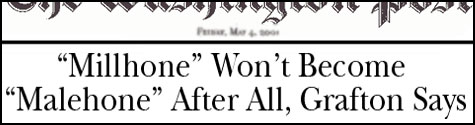
After weathering weeks of irate blowback from her faithful fans, bestselling mystery author Sue Grafton has decided her popular series character, private investigator Kinsey Millhone, will remain a woman in all future books.  Word of Grafton’s intent to change Millhone’s gender from female to male — to alleviate a bad case of “alphabet-induced boredom,” she said — went viral after a pirated copy of her outline for the next book in the series, “T is for Transsexual,” appeared all over the Internet, and reader outrage was as deafening as it was immediate.  “Sue labored long and hard to develop a heretofore secret backstory for Kinsey in which she’d always wanted to be a man,” Grafton’s agent said.  “But we both underestimated how many readers adore her specifically because she’s a woman, and how poorly they’d take to her first name being changed to ‘Klyde.'”


Search giant Google’s controversial effort to single-handedly retire the word “book” and replace it with a word of the company’s own invention has come to an abrupt end.  Public outcry and widespread ridicule — no Jay Leno Tonight Show monologue has been complete lately without at least one reference to the gaffe — ultimately did the ill-conceived scheme in.  As a press release issued by the company today explained, in part:

“While we are still of the opinion that electronic publishing has rendered the word people have always used for a piece of long-form reading material — ‘book’ — outdated and useless, Google must concede that our timing in suggesting the word is dead and needs replacement was, at the very least, poor.  Therefore, effective immediately, Google will be returning to the practice of using the word ‘book’ in all its on-site content, and will no longer be using the word ‘zot‘ — the copyright to which the company fully intends to maintain — instead.”


It sounded like a bad idea when the company first announced it two weeks ago, and now New York publisher Random House has been forced to agree: Asking book buyers to pay extra to find out how a book ends is no way to grow revenue.  Withering under an avalanche of criticism from retailers and readers alike, company executives took to the stage at a press conference today to officially end the publisher’s plans to sell all its titles minus their last five pages, which readers would have had to pay an additional $5 to receive.  Suggesting most readers don’t read to the end of every book they buy anyway, Random House had tried to sell the program — called “Five for Five” — as a value added service, but readers weren’t buying, hence the company’s hasty retreat.  Questions posed to Random House spokesperson Dervin Elbert regarding a rumored plan to try charging extra for punctuation next went unanswered.


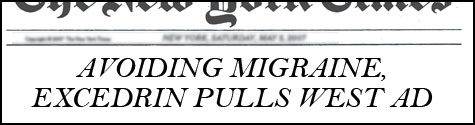
Novartis thought it had the perfect pitch man to star in its Excedrin Superbowl commercial scheduled to run this February: hip-hop superstar Kanye West.  But literacy advocates forced the company to shelf the spot sight-unseen when its script became public and its tagline became the butt of jokes everywhere.  In the commercial, West — who created a stir back in 2009 by issuing a number of searing anti-literacy proclamations, including, “I am a proud non-reader of books.  I would never want a book’s autograph” — sits in a drawing room beside a roaring fire, peering intently at an open copy of Dr. Seuss’s classic book for pre-schoolers, FOX IN SOCKS, before looking directly into the camera and exclaiming, “Reading makes my damn head hurt!”  He then reaches for a nearby bottle of Excedrin and downs two tablets.

In its public apology, issued today by the company’s attorneys on the steps of the New York Public Library, Novartis said, “We realize in retrospect that the commercial would have sent an entirely inappropriate message regarding the importance of books and reading to people of all ages, and hope our lapse in judgment hasn’t caused anyone too much pain.  Get it?  Pain?


Author and self-publishing guru J.A. Konrath said today he will not attempt to serve as his own anesthesiologist during the gall bladder surgery he is scheduled to undergo next Thursday.  Claiming licensed anesthesiologists are unnecessary middle-men between surgeons and their patients, Konrath had declared last month that he would not be paying one to assist in his surgery and would instead anesthetize himself in accordance to his surgeon’s directions.  The author changed his mind, however, after an attempt to self-administer Novocain during a recent root canal procedure went terribly awry.

“As much as it burns my ass to pay someone to do something I could easily do myself, given the proper time and training, I owe it to my fans not to take such unnecessary risks with my health,” Konrath told Publisher’s Weekly, speaking only out of the left side of his mouth, as his experiment at the dentist still has him waiting for any feeling to return to the right.


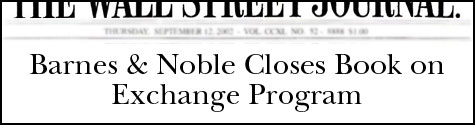
Only six days in, book retailer Barnes & Noble is ending its heralded e-book exchange program for the Nook.  The program, which would have allowed customers to upload four old e-book titles from their Nook e-readers back to B & N in exchange for one new one, quickly proved a disaster, as readers by the score took it as an opportunity to rid themselves of books they completely regretted buying in the first place.  “From Barnes and Noble’s perspective, good books were going out with only bad books coming in,” industry observer Angie Linchbach wrote in a column for Inkwatch.com Monday.  “They were getting twenty James Pattersons for every James Lee Burke they downloaded.”

It was reported that three Barnes & Noble data center servers crashed under the stress of uploaded Stephanie Meyer titles alone.  B & N says it hopes to have the machines back online in time for Christmas.

The Books I’m Not Reading

David Corbett

Due to a scheduling snafu, I had to swap days, and Alexandra graciously obliged. I’m taking her spot today, and she’ll be taking mine next Wednesday. So, if you’re disappointed Alex isn’t here—and how could you not be?—take heart, she’ll be here at the controls this coming Wednesday, February 8th.

John Updike once remarked that he realized early on he couldn’t be both a reader and a writer and he had to choose one or the other. As my career has progressed I’ve increasingly realized the truth of that insight, unpleasantly so.

Writers are readers first and foremost. But recently the onslaught of work has been so overwhelming my reading has come to a virtual standstill. The time it takes to write, pitch, research, keep up with the business of writing (with more research required), prepare for my classes, teach, network, do my volunteer work in the community—I feel like I’m skating across my days like a madman on black ice. More and more often I wake up with a jolt of apprehension clenched in my gut. I know I’m behind, I know I can’t keep up, I know the stakes.

Read? For pleasure? It is to laugh.

One sneaky outlet I always had was the High Crimes book group I lead at my local indie bookstore. I knew that I’d get to read at least one book I wanted to each month. But even that has fallen apart on me. During December I was supposed to be reading Don Carpenter’s Hard Rain Falling. I loved the book, and was really enjoying it, but I got only halfway through by the time the group met to discuss it.

I promised to do better this month with Ann Patchett’s Bel Canto, a book I again was loving, but I barely got past page 20. I’m not exaggerating.

This isn’t just irritating, it’s irresponsible. I’m letting my group down. Worse, I feel like I’m letting myself down.

I’m not one of those writers who can’t read fiction when he’s writing. I actually get inspired reading fiction I admire and relish when I’m working on my own book. I take care of the voice-infection problem, the possibility that what I’m reading will seep into my own voice, by going back over what I’ve written the day before as I begin working and tidying it up before moving on to new pages. But now that inspirational fertilization of my imagination, that spur to my creativity, is absent. And I feel it.

I know we all have TBR piles that seem overwhelming. My TBR pile became a box, then several boxes, then a closet, and now pretty much consumes a whole second office. In no particular order (who has time to prioritize what you’ll never get to do?):

The Financial Lives of the Poets by Jess Walter

Lucifer at the Starlight by Kim Addonizio

The City The City by China Miéville

The Confessions of Max Tivoli by Andrew Sean Greer

Absurdistan by Gary Shteyngart

Spooner by Pete Dexter

The Outlaw Album by Daniel Woodrell

Nothing to be Frightened Of by Julian Barnes

The Given Day by Dennis Lehane

Dreamland by Newton Thornburg

Murder City by Charles Bowden

2666 by Roberto Bolaño

The Dawn Patrol by Don Winslow

The Hidden Assassins by Robert Wilson

The Dead Yard by Adrian McKinty

Body of Lies by David Ignatius

Ash & Bone by John Harvey

The Spies of Warsaw by Alan Furst

He Kills Coppers by Jake Arnott

Total Chaos by Jean-Claude Izzo

I’m just listing the ones in easy reach. There are so many more—including books written by my friends and my fellow Murderateros. And I have to reread James Crumley’s The Wrong Case for an article I’ve been asked to do, and I should probably reread The Last Good Kiss while I’m at it, and I’m reading a number of writing guides as I conduct my courses and write my own book on character, and and and…

It’s not just that I feel like a slaggard. I feel like I’m letting the most important thing, one of my life’s greatest pleasures, slip away. And in no small way, it’s killing me.

Warren Zevon wrote an anthem to life at full throttle: “I’ll Sleep When I’m Dead.” I’m beginning to think that’s when I’ll get some reading in.

So, Murderateros—what book or books have you been aching to get to but just can’t? What is it that’s swallowing up your days? Is the pace of modern life really accelerating or are we just becoming increasingly scattered and unfocused? And if we don’t read, who will?

* * * * *

Jukebox Hero of the Week: Take a wild guess.

Golf…what the?

by PD Martin


Okay, I’m still in holiday mode here (this is the view from my towel most mornings, although this picture does NOT do it justice!). In my last blog I talked about what I’ve been up to on my extended holiday break and today I’m going to continue with the holiday theme. We’re still down in the Mornington Peninsula (until Saturday), and then on Monday my daughter starts school (scary!). Anyway…holidays…  


My mum is an avid golfer. She’s now retired and plays golf two to three times a week. She loves it. So, when she came down to the coast for a few days it was natural for her to persuade us all to go for nine holes of golf. I did try to suggest I could stay at home and write, but the look (you know the one that only a mother can give you) told me that it was NOT a good idea for me to bail on the golf. So off I went.

I’ve played golf a few times and keep thinking I’ll “get it”…but it hasn’t happened yet. After the first hole I was completely perplexed. What do people see in this game?? Why do they play it? Now the cynics reading this might think it had something to do with the fact that on the first hole (a par 4) it took me around 12 shots to get the stupid ball into the stupid hole. It may have even been 14 shots…let’s face it, by around six you lose count. My mum also tells me you have to count the shots when you completely miss the ball (air golf) but I think that’s a bit rough for a beginner.

The second hole wasn’t much better, but by the third I was down to about 8 or so shots (not counting the air-golf shots). Then one hole, I think it was the fifth hole, I took four shots for a par 3 and it did feel kind of good. But let’s face it, it was a complete fluke.

In the next hole there was a pond between me and the fairway. My daughter (who’s only 5) was in hysterics: “No, Mummy. It will go in the water. No!”  She was also quite worried about the ducks in the lake. But I thought I’d give it a go (maybe artificially buoyed by my four-shot hole). And what were the chances my ball would actually hit some poor innocent duck? Nil, surely. First ball went straight into the lake (of course), as did the second one. Thankfully, the ducks remained intact. Grace was most concerned about losing another ball (and I don’t think my mum wanted to give me another one either) so I walked around and dropped the ball on the fairway. And it still took me like a million shots to get it in the hole.

I think it was around this point that I said to my mum: “How many more holes have we got to go?” I guess it’s a variation on “Are we there yet?”

Interestingly, my daughter enjoys golf! My mum sometimes takes her to the driving range where they have 50 balls and then do some putting. On our 9 holes, Grace teed off about six times, often striking the ball further than me. Then we’d pick up her ball and give her a shot at the other end – putting. She seems pretty good for a 5yro, but then what do I know about golf?

As I walked around (for nearly three hours) I couldn’t help but think about what a complete waste of time golf was – and how I’d MUCH rather be at home writing. Time is very tight for me (the juggling act of motherhood, freelance corporate work and fiction writing) and I felt like I’d completely wasted three hours of my precious time. But I’m trying to be more ‘the glass if half full’ so I tried to think about the up-side.

  1. I did walk around eight kilometers so at least I got a bit of exercise.
  2. Cape Schanck is a stunning golf course, and on many holes you catch glimpses of the ocean in the background.
  3. I was with my daughter, mum and mother-in-law.  Family time!

The only other thing that worried me on the course was that this particular course has lots of houses on it. I kept saying to my mum, “I’d be worried a ball was going to come sailing through my window.” She assured me they were designed so it rarely/never happened. But they hadn’t seen me play golf! Or maybe the designers had taken into account people like me because I miraculously avoided both ducks and houses. Yay, me!

So, any golfers out there? What am I missing?  Or do you think this game is as absurd as I do? Or maybe there’s some other sport or hobby that you just don’t get. 

BUILDING THE (TOO-) PERFECT PROTAGONIST

by Gar Anthony Haywood

One of the questions we writers get all the time is:

“Is your protagonist you?

I’ve heard a lot of different answers to this question, some long and some short, but I don’t think I’ve ever heard anyone just come out and say what we all know to be true:

Of course he is!”

Because really, is there ever any doubt?  Why create a heroic character — especially one who triumphs in the end — if you can’t live vicariously through him?  And how can you live vicariously through a character who’s totally removed from yourself?

Has any card-carrying ‘Rati ever read a Charlie Fox thriller and not seen Zoë Sharp herself doing all that ass-kicking?

I didn’t think so.

Sure, we take pains to disguise ourselves, giving our protagonists attributes we don’t actually share, but we’re in there, all right.  Fiction is a game of pretend, and part of the fun of writing it comes from putting yourself at the center of the action, in the guise of a bigger and better you, facing enemies and dangers larger than you could reliably handle in the real world.  With ourselves as the underlying framework, we build a protagonist built for heroism, endowing him with strengths and powers we either lack altogether, or do not possess in sufficient quantity to tackle the task at hand.

But there’s a limit to this process.  Unless you’re writing pulp, or some kind of retro-crime fiction that harkens back to the days when “realism” was a dirty word, you never want to follow such fantasies to their extreme.  You know what your perfect protagonist looks like, but he’s not anybody you could actually use in a story supposedly grounded in a non-fictional universe.

God bless Ian Fleming.  He got to have his cake and eat it, too, creating the ultimate male protagonist in James Bond, agent 007, at a time when scores of readers were still willing to forgive such laughable affronts to realism, common sense, and the sensibilities of women.  Try writing a series about such an ingenious, indefatigable, sexually flawless protagonist as Bond now and see how many rejection letters you collect.

Still, whether you can use him or her in your fiction or not, it’s always fun to imagine what kind of protagonist you could build were the sky the limit.  Unencumbered by any restrictions suspension-of-disbelief might demand, what would he look like?  What would his powers be?

Or should I say, what would your powers be?  Because your protagonist is really you, remember?

When I created Aaron Gunner, the Los Angeles private investigator I’ve now put at the center of six novels, I drew the line at giving him only one thing my “perfect” protagonist would possess that I, sadly, do not: a red Ford Shelby Cobra, my favorite sports car of all time.

But I could have been much more generous to Gunner than that.

If I were building him according to my own personal wants and needs today, independent of what I thought readers would be willing to buy, this would be his basic profile:

  1. Height/Weight: 6′-2″/220 lbs.

    Just big enough to give someone thinking about throwing down on him reason to think twice.

  2. Physical attractiveness: 7.5

    This is on a scale of 1 – 10, 1 being Homer Simpson and 10 being Denzel Washington.

  3. Sexual prowess: 8

    Again, this is on a scale of 1 to 10, where 10 basically means any song featuring the words “all night long” in its lyrics could have been written about him on a typical Tuesday in March.

    (Sorry, ladies, I know you think this stuff is silly, but we guys really do fantasize like this, especially those of us with serious performance anxieties.  You dream about chocolate and warm baths, we dream about making Gisele Bündchen forget she ever even met Tom Brady.  What can I tell you?)

  4. Annual income: $95,000

    Enough to live comfortably without losing sight of his humble origins.

  5. Place of residence: 3 bedroom home in Ladera Heights (Los Angeles, CA)

    Because every man should have an expansive view of his city, and a spare bedroom to put all his toys in.

  6. Could be a Jeopardy champion in the category of: World history
  7. Aptitude in the kitchen: 7

    Where Bobby Flay would be a 10.  Not good enough to win any cooking contests, but capable of making any first date memorable for the food and drink alone.

  8. Languages spoken fluently: 3

    English, Spanish and Japanese

  9. Musical instruments played: 2

    Piano and guitar.  Self-taught.  No pro by a longshot, but he could join the band at any concert and not embarrass himself.  And every once in a blue moon, can rip off a jam like this:

  10. Hidden talent: Expert magician.

    And I don’t mean card tricks.  I mean “How the hell did he do that??” stuff.

And so on and so forth.  You get the idea.  A ridiculous character, to be sure, but someone it might be fun to be for a day or so, just to see how it would feel.

So what about you, my fellow ‘Ratis?  Using the 10 categories above as a jumping off point, what would the profile of your “perfect protagonist” look like, if suspension-of-disbelief was not a consideration?

Acrostics

by Pari

Any parent with a kid in elementary school has had to read at least a dozen acrostics. If you haven’t been so blessed, let me explain. These are the “poems” in which the first letter of each line spells out something that, one hopes, refers back to the meaning of said poem.

For example

Mona could be found
Underneath, definitely not above,
Rachel’s  rosewood
Desk  . . . strangely
Emitting smells most
Repugnant.  

Or . . .

Kneeling quietly, hand
Nearing the throat
In and out
Forward and side
Enter eternity.

Okay, I must be in an Edward Gorey kind of mood. I’m just writing the first things that come to mind.

Pretty little eyes of newt
O
diferous fungi from the inner forest
I
mmerse in alcohol for a week
S
it it in the sun until dry
Open a packet of arsenic for insurance
N
o, not in the pudding! Add it to the stew.

So does anyone else want to play? I’d say anything goes. But if you want to keep it to a mystery theme, that might be fun. Repeated words are fine by me.


Let’s see just how wild we can make this Wildcard Tuesday!

Exuberant writing

by Pari

Lately I’ve been streaming a lot of Bollywood movies. I’ve always liked the dancing and music in these films and, of course, the happy endings. But the other night when I’d stayed up late to watch one with a really stupid plot — that had it been from Hollywood I would’ve turned off hours before — I realized that it’s not the music or dancing that keep me coming back for more . . . it’s the exuberance.  The joy, man, I’m into the joy.

That’s what I want in every aspect of my life right now. I know being blissed out on a constant basis would be boring, but I want moments of that unabashed vitality and enthusiasm for life every single day.

I want it. I want it now!

In the Bollywood films, the camera pans around love-struck couples and then rises high above groups of dancers swirling in saris of hot pink, royal blue, new leaf green. I jump up from my couch and dance with them on my worn carpet in the privacy of my living room and I can almost feel the Indian sun warming my arms and shoulders, shining off my graying hair.

And do you know what? I want that same feel, that rush of delight, sometimes when I read. I want a laughing literary experience that doesn’t so much astound me with its wit or cleverness, the perfectly placed word or phrase  — but that takes me on such a wonderful rapid ride I can hardly catch my breath.

Who am I kidding?

I want literary rides that take me so fast I don’t even think about catching my breath!

So much of what we write about here at Murderati has to do with control and thought and the wonderful mastery of creating excellent work.

But right now, I want to read books just for fun,  for the giddy experience I inhale when I’m engrossed in my Bollywood movies.

So, please, today help me:

Where can I find exuberant writing?

(Oh, and if you’ve got Netflix and want to recommend some b-wood movies, that’d be fine too. Or if you know of some posted vids online . . . I’d enjoy those too!!)

RESEARCH, HUH?


by Stephen Jay Schwartz

Yes, I’m still writing blogs about research. But this one serves a greater purpose.

I’ve got essays in two books out currently.

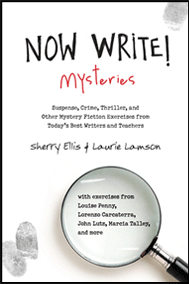
The first book is the new edition of the NOW WRITE! series, called Now Write! Mysteries. The book features essays from loads of outstanding mystery authors and each author includes a set of exercises designed to give the reader the opportunity to learn the skills discussed in the author’s essay.

I’ve attached a link to my contribution, so you can get a sense of how the book works. I haven’t really given anything away that cannot be found by clicking on the “Look Inside!” button on the book’s Amazon page.

Some of the many talented authors in the collection include Aileen G. Baron, James Scott Bell, Rhys Bowen, Rachel Brady, Robert Browne, Rebecca Cantrell, Reed Farrel Coleman, Deborah Coonts, Bill Crider, Meg Gardiner, Gar Anthony Haywood, Harley Jane Kozak, William Kent Krueger, Robert S. Levinson, Sophie Littlefield, Tim Maleeny, Christopher Moore, Kelli Stanley, John Lutz, Louise Penny, Lorenzo Carcaterra and many, many more. I apologize for not including every contributor; the names themselves would fill a book.

The NOW WRITE! series includes other notable publications, such as Now Write! Fiction, Now Write! Nonfiction, and Now Write! Screenwriting.

The books are edited by Sherry Ellis and her niece Laurie Lamson. Laurie took over finishing the new book after Sherry passed away unexpectedly last year. It was a terrible loss to our community. And I’m honored to have been part of her last creative effort on this planet.


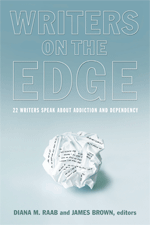
The other book I’m in is called WRITERS ON THE EDGE: 22 Writers Speak About Addiction and Dependency.

My essay here finally answers the big question I get when I’m on panels at conferences. The question: “How the hell did you do your research for Boulevard and Beat?”

When I don’t want to get into the specifics, I go with the answer I have in the Now Write! series. I discuss the passion I have for boots-on-the-ground research, how I love to meet and interview people and learn the details of their lives.

When I get down-and-dirty, I talk about the struggles I had with my own sex-addiction, how I went to twelve-step meetings and marriage counseling and therapy and took a potentially life-threatening problem and turned it into something life-affirming and creative. My essay in this book is open and honest and, ultimately, uplifting. I discuss the things I did, how the addiction began, how it affected my psychology, my relationships, my marriage. It’s the most personal discussion I’ve had on the subject. I was actually reluctant to write the piece, but the editors, Diana M. Raab and James Brown, convinced me that my experiences should be shared with others who might be struggling with their own addictive behavior. After all, it’s Twelfth Step stuff – helping others along the path to their own sobriety.

All the essays in the book are fabulous. The authors speak from their hearts and I admire them for the vulnerability they exhibit.

The book also features a forward by Jerry Stahl, author of PERMANENT MIDNIGHT.

For those of you in the Los Angeles area, we will be launching the book from Book Soup on Saturday, February 25, at 4:00 pm.

That’s it for now, folks.

Personal security on the move

Charlie Fox

Last year I ran the first in what I promised would be an occasional series of ‘guest’ blogs by my protagonist, Charlotte ‘Charlie’ Fox on the subject of personal safety. Charlie had a short-lived career in the Women’s Royal Army Corps, passing selection for Special Forces training, but being dishonourably discharged following a court martial. (Don’t ask.) She then taught self-defence for women in a small northern UK city, and eventually moved into a career as a bodyguard – initially for a London-based outfit run by her partner, Sean Meyer. When Sean was offered a partnership in Parker Armstrong’s prestigious close-protection agency in New York City, Charlie moved with Sean to Manhattan. She has been based there ever since.

Let me tell you, car drivers have it easy – sometimes too easy. There you are sitting in a cushioned little tin box on wheels, largely oblivious to what’s going on around you, but cocooned in your own little bubble of false security.

You think you’re safe in there, but you’re not.

Can’t you tell I’ve spent most of my motoring life on two wheels instead? Especially since moving to New York City. Like any city, getting around by car can be slower than walking and daily parking fees would just about feed a family of four for a month. Riding a motorcycle is the best way to cut through traffic, although since my Buell got trashed (another ‘don’t ask’ moment – ZS) I’m seriously thinking about sticking to travelling either by the subway or by up-armoured Lincoln Navigator.

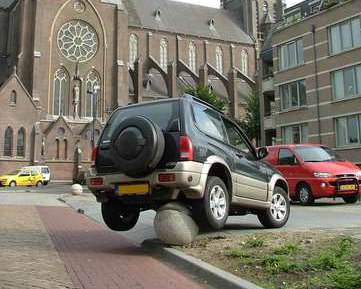
Personal security on the move begins before you ever leave home. Well before. Never does any harm to walk around your car on a regular basis and check none of your tyres have gone soft, or are wearing unevenly. Tyre failure is the biggest cause of motorway accidents in the UK. And looking at the way some people abuse their wheels every time they park, I’m not surprised.

If I’m taking out a principal in their own car, I do a walk-round check every time. I also look for anything underneath or attached to it, often disguised as litter. Doesn’t need to be explosives – on one local sink estate the kiddies thought it was a great laugh to wedge nails against the tyres of cars parked outside the local late-night convenience store, just to watch the tyres go pop as they were driven away. Changing one flat tyre is a nuisance. Changing two involves calling your breakdown recovery service.

Speaking of which, it might just be worth checking that the spare wheel is inflated and has enough tread on it to get you home, and that the jack and wheelbrace are where they should be. Oh, and if your car has locking wheelnuts, make sure you have the key – better to find it now than have to search in the dark, in the rain, at three a.m. on a scary piece of lonely road.

Carry a map. Sounds obvious, but in these days of handheld GPS units a lot of people don’t bother any more. Bad weather like snow will block the GPS antenna from picking up a signal from the satellite and you’ll be doubly lost unless you can still do it the old-fashioned way.

Knowing where you’re going is a fundamental piece of safety advice. GPS is good, but not that good, and not all the time. If you’re going somewhere new for the first time, double-check the address and if necessary instruct the GPS to take you to a precise point on a map rather than the postcode or zip code, which could be anywhere within several miles of your actual destination.

If you’re travelling outside your home country, you have to decide if you’re going to rent a car and drive yourself or rely on local drivers or taxis. If you decide to rent, make sure there’s nothing about the vehicle that obviously marks you out as a foreigner. And learn which local rules of the road you can break to blend in.

In a hot climate air conditioning is not a luxury, it’s a necessity because it enables you to drive without all the windows open. Same goes for central locking. If it isn’t automatic, activate it before you set off rather than waiting until you’re in a dangerous situation – the sound of the locks operating may act as provocation.

In some countries, using taxis can be safer, unless they’re scoping out tourists as potential kidnap victims. Ask your hotel to recommend drivers they’ve used before without incident. Get an idea of the fare before you set out, and don’t flash too much cash when you’re settling up. And always make sure people know where you’re going and when you’re likely to return.

Of course, I’m generally happier in something with armour – it goes with the job. And if the vehicle is fitted with a direction-of-fire indicator so you don’t debus into incoming sniper fire, so much the better. But I’ve been known to stuff Kevlar body armour inside door panels or lay them on seats for instant protection.

OK, I realise that for most people this advice seems like overkill. But certain habits when you’re in your car are good practice, no matter who or where you are.

If you live in a city where you’re often caught in slow-moving traffic and car-jacking is a possibility, get anti-smash window film fitted to the side glass. Put your bag or laptop on the floor rather than on the passenger seat.

Women drivers should avoid having a private registration with an obviously female first name on it. And never mind valuables, don’t leave any personal items on show when you park. Particularly anything that makes your gender obvious. If you drive a girlie car, though, there’s not much you can do to disguise that.

When you leave the car, bear in mind what time it will be when you come back to it. It may not seem important to park under a light during the day, but after dark you’ll be glad you did. In a multi-storey parking garage, reverse park so you can drive out forwards quickly and easily.

Make sure you have your keys in your hand long before you reach your car, so you’re not standing there fumbling in your bag or pockets. If your alarm has the feature, keep your thumb on the panic button as you approach, just in case. Most alarms or remote central locking systems automatically put the interior lights on when the locks disengage. And I know it’s an urban myth, but check the back seat anyway before you get in.

I always do.

So, ‘Rati, any tips to add to these from Charlie? Any near misses you’ve experienced or heard about while you’ve been on the road?

This week’s Words of the Week are flotsam and jetsam. Jetsam are goods jettisoned from a ship in time of danger, but also goods from a wreck that remain under water. The word is a contraction of jettison, from the Latin jacere, to throw. Flotsam, on the other hand, are goods lost overboard as the ship sinks and found floating on the sea.