Author Archives: Murderati Members


BECAUSE EVERYONE LOVES A CHALLENGE


by Stephen Jay Schwartz

I thought we’d do something a little different, a little fun.

I’ve listed thirty-six first sentences from classic novels and mystery-thrillers. See how many you can identify by the first sentence alone. Give the title of the book and the author.

And it’s not fair to Google them. No fair, no way. We’ll do this on the Honor System.

I’ll give all the answers at the end of the day. Whoever gets the most right wins a signed, hardcopy of my novel BEAT.

If there’s a tie, I’ll pick the winner from a hat.

Have fun!

                                                            * * *

1.  The village of Holcomb stands on the high wheat plains of western Kansas, a lonesome area that other Kansans call “out there.”

2.  I’d finished my pie and was having a second cup of coffee when I saw him.

3.  Call me Ishmael.

4.  I saw the best minds of my generation destroyed by madness…

5.  When he was nearly thirteen, my brother Jem got his arm badly broken at the elbow.

6.  I can feel the heat closing in, feel them out there making their moves, setting up their devil doll stool pigeons, crooning over my spoon and dropper…

7.  riverrun, past Eve and Adam’s, from swerve of shore to bend of bay, brings us by a commodius vicus of recirculation back to Howth Castle and Environs.

8.  Fuck you.

9.  I first met Dean not long after my wife and I split up.

10.  I sent one boy to the gaschamber at Huntsville.

11.  To the red country and part of the gray country of Oklahoma, the last rains came gently, and they did not cut the scarred earth.

12.  The year 1866 was marked by a strange occurrence, an unexplained and inexplicable phenomenon that surely no one has forgotten.

13.  One sultry evening early in July a young man emerged from the small furnished room he occupied in a large five-storied house in Sennoy Lane, and turned slowly, with an air of indecision, towards the Kalininksy bridge.

14.  You will rejoice to hear that no disaster has accompanied the commencement of an enterprise which you have regarded with such evil forebodings.

15.  The first time I laid eyes on Terry Lennox he was drunk in a Rolls-Royce Silver Wraith outside the terrace of The Dancers.

16.  Howard Roark laughed.

17.  I’d been hearing about the Tennis Club for years, but I’d never been inside of it.

18.  It was good standing there on the promontory overlooking the evening sea, the fog lifting itself like gauzy veils to touch his face.

19.  It was a pleasure to burn.

20.  He lay flat on the brown, pine-needled floor of the forest, his chin on his folded arms, and high overhead the wind blew in the tops of the pine trees.

21.  Mr. Jones, of the Manor Farm, had locked the hen-houses for the night, but was too drunk to remember to shut the popholes.

22.  The hall ahead is dark, a tunnel of black.

23.  Foley had never seen a prison where you could walk right up to the fence without getting shot.

24.  Coming back from the dead isn’t as easy as they make it seem in the movies.

25.  When she was home from her boarding school I used to see her almost every day sometimes, because their house was right opposite the Town Halle Annexe.

26.  They threw me off the hay truck about noon.

27.  Late in the afternoon of a chilly day in February, two gentlemen were sitting alone over their wine, in a well-furnished dining parlor, in the town of P—, in Kentucky.

28.  It was daybreak and the rancher, standing at his kitchen window, watched two silhouettes stagger forward through the desert scrub.

29.  Samuel Spade’s jaw was long and bony, his chin a jutting v under the more flexible v of his mouth.

30.  In the corner of a first-class smoking carriage, Mr. Justice Wargrave, lately retired from the bench, puffed at a cigar and ran an interested eye through the political news in The Times.

31.  Everybody lies.

32.  Her stomach clutched at the sight of the water tower hovering above the still, bare trees, a spaceship come to earth.

33.  Behavioral Science, the FBI section that deals with serial murder, is on the bottom floor of the Academy building at Quantico, half-buried in the earth.

34.  “That’s torn it!” said Lord Peter Wimsey.

35.  “I am inclined to think–” said I.

36.   “Tush, never tell me; I take it much unkindly, that you, Iago, who has had my purse, as if the strings were thine, shouldst know of this.”

From a different POV

by Pari

One of my favorite movies is Akira Kurosawa’s Rashomon. If you haven’t seen it, please do. I don’t want to ruin this piece of art for any of you . . . So I’ll just say, that without any disrespect meant to the great Japanese director, I’d posit that the main gist of the tale is a he-said she-said situation: a horrible event happens and we see it through four POVs. Some tellers of the story are deeply invested in their version of the events, others less so. But each iteration of the story is believable and therein resides one of the beauties of this cinematic study  . . . .

I think I enjoyed Rashomon more than many of my college classmates when I first saw it because I’d already learned that messing with POVs could be fun. When I was in high school, I had a class where I wrote an impassioned paper about why arranged marriage was a stupid idea. I finished the assignment early and the teacher offered me extra credit to write an entirely new paper from the opposite POV. I did. And I loved throwing myself wholeheartedly into the different argument, finding its nuances and defending them as strongly as I’d done the first time round.

It was a good lesson in seeing the world from someone else’s perspective . . .

We all know Dorothy’s Midwestern school-girl take on Oz and we’ve gotten a different perspective in Wicked. But dow did the munchkins perceive this witch-killing giant with the flying house and motley crew of associates?

What would the story have been like if we’d known the true motivation behind the wolf’s attack in the Three Pigs? Maybe his long-time lover had left him and he had a death wish? Maybe those three pigs weren’t the angels we’re lead to believe . . . perhaps they were hoodlums, graffiti artists that had destroyed a bucolic mural the wolf had created the day before the unveiling.

What would Mrs. Rochester have to say about her life with Rochester in the West Indies? About his betrayal with Jane Eyre? About having to spend her life cooped up in a joyless room with the  surly, coarse and frightening Grace Pool? Apparently, Jean Rhys has done it!

What was Helen’s perspective on the Trojan War and why it was really fought?

What would Mrs. Hudson’s story be about her upstairs tenant and his constant companion? Would she speculate about Sherlock Holmes’ sexuality? Would she kvetch about his messiness?

You get the idea.

Today, rather than a question, I’d like to loosen up our collective creativity, get it flowing for the new week. Are you up for it?
Task: Take a favorite story/narrative and give us another character’s POV. Let’s have fun with this!

Best Holiday Movies

by Alexandra Sokoloff

Everyone’s shopping, right? 

Okay, I’m a little behind on the post.  There are reasons, but also, I admit to some holiday blues here.   

The fact is that I am JUST NOT a homebody, so any holiday that revolves around decorating, baking, shopping, and obligatory writing of greeting cards is bound to give me the hives.  My friends know I love them.  I hope.  They know I love them enough not to cook for them, anyway.  

I also hate the feeling of HAVING to participate in all this commercialism.   It’s become so forced and desperate.    I heard Donovan’s “I Don’t Like Christmas Anymore (cause they push it on the TV and they push it in the stores…)”  on the radio the other day (because of course, the Christmas music started the day after Halloween) and felt a savage pleasure in it.   

And surely there’s more unnamed angst, deeply buried, requiring years of expensive therapy to unearth.

Truthfully, I grew up with not much religion.  At all.   My parents, both of the scientific mind (despite some pretty typical religious training for their generation) are two of the most agnostic people you are ever likely to meet.   My siblings and I were not forced to any particular church as children; instead, our parents encouraged religious promiscuity – meaning, whatever friend’s house was the slumber party for the weekend, we’d end up at that friend’s house of worship in the morning, whatever that was.   Or – not.

Little did our parents know how broadly we would apply that theory…

Well, never mind that.

I was really a lot better about the holidays when I had singing to do.  When I was in middle school, through college and those undefined and fucked up but kinda great years after college, the holidays were all about choir rehearsals and holiday performances, the obligatory but ecstatic gang-bang Messiah, and all that endless caroling, including impromptu a cappella breakouts into song on San Francisco cable cars, magical!!! I didn’t have to THINK about Christmas – I just FELT it, in the music.

Nowadays, I don’t have any formal singing to do, I don’t have any children to create holiday myths for, and there’s just too damn much chocolate around, leering and beckoning.  (“Everyone’s wearing sweaters this time of year anyway… no one’s going to notice…”  Oh yeah, right.)

Luckily, the antidote is clear.  The best thing about the holidays besides champagne: HOLIDAY movies.  TCM is already pulling out the stops.  So let’s compare.  Here are mine:

HOLIDAY INN

The ultimate escapist fantasy.    Yes, let me make a living doing 12 live shows a year, simultaneously keeping two men at my beck and call, one who sings, one who dances.   Where do I sign?    Best line:   “But I do love you, Jim.  I love everybody.”   Best song:   “Be Careful, It’s My Heart”.   Best dance – Fred and the firecrackers.   Best cat-fight moment: Marjorie Reynolds trying to look contented with Bing Crosby while Fred is dancing up a storm with Virginia Dale.

IT’S A WONDERFUL LIFE

A non-escapist fantasy that puts you through the emotional wringer only to emerge the feel-good – that’s, feel GOOD – film of all time.

Used to show it to my gang kids in prison school – it remains one of the all-time highlights of my life to see those kids start out whining that I was showing them a black and white film and then watch them fall under this movie’s spell.   Oh man, did they GET it.

HOLIDAY

George Cukor directing a Donald Ogden Stewart & Sidney Buchman adaptation of a Philip Barry play starring Cary Grant and Katherine Hepburn.   Anything else you need to know?

PHILADELPHIA STORY

See above, plus Jimmy Stewart, and the brilliant and under-known Ruth Hussey  (“Oh, I just photograph well.”) and Virginia Weidler as the weirdest little sister on the planet (“I did it.  I did it ALL.”)   Not a holiday movie, per se, but if you’re looking for cheer…

RUDOLPH THE RED-NOSED REINDEER

Best Christmas musical soundtrack there is – one great song after another – only the whole thing makes me cry so hard I generally end up avoiding it.

FAWLTY TOWERS

BBC series written by and starring John Cleese and Connie Booth, with Cleese as the most incompetent innkeeper in the history of innkeeping.  The entire series is genius, every single episode – not exactly holiday themed, either, but guaranteed healer of depression and all other ills.   Be prepared to laugh until you’re sick.

ABSOLUTELY FABULOUS

My brother turned the fam onto AB FAB and now it just wouldn’t be a holiday without Patsy and Eddy and Saffy.   Sin is in, sweetie.

GODSPELL and JESUS CHRIST SUPERSTAR

Okay, so I’m not technically a Christian or anything, but I can see God in those two shows.

Hah!  I’m feeling better already!

So give.   What movies mean the holidays to YOU?

 – Alex


Too good to be true?

By PD Martin

Before I get into today’s post, I wanted to say Happy Thanksgiving to all our North American readers. I know you may be expecting a Thanksgiving-themed post but guess who got Thanksgiving…the Aussie! So I’ve gone with a regular post 🙂 Now, on to ‘Too good to be true’…

While I’ve never been one of those writers who paces for hours to come up with one sentence or spends six months planning out every detail of a book before I start writing, I’ve still always thought of writing as hard work. It is hard work.  

Sure, there’s the fun stuff…writing in your pyjamas, the long commute from bedroom to study, tax-deductible trips to various destinations for research and/or promotion (although you have to be able to afford the flights in the first place), not to mention sitting in a café and writing. And sometimes cake does need to be involved! I don’t think anyone can argue that the above perks of the job are cool…way cool.  But it’s still bum on chair, thinking, creating and writing. And while it’s tempting to get up and procrastinate every time the flow stops, it’s not something I do.

In a post some time ago, I mentioned that I was working on a new book that’s not crime fiction. It’s not even a thriller or remotely related to my past work. I’m still getting my head around what I’d call it, but I think ‘mainstream fiction/drama’ is pretty accurate. The book is about relationships and how people deal with different traumas. I’m also entering another new world, using multiple viewpoints. And some of my subject matter is tense and issues-based…controversial, I guess.

I started writing this book at the beginning of the year, and then it was on hold for months as I took corporate gigs to pay the bills. I started on the project again in October and soon found myself zooming through it. My writing week is often very fragmented as I fit it in around being a full-time mother (to a pre-schooler) and freelance writing gigs. But I’d find I’d have an hour to write…and write 1,000 words. And every Saturday I have four hours to write while my daughter is in classes. The last two Saturdays, I’ve written 5,000 words during each of those four-hour blocks. Two productive sessions, to say the least. 

So, a couple of weeks ago I found myself asking the inevitable question. Is this too good to be true? Can writing really be this ‘easy’? Am I writing dribble that I won’t be able to edit into shape? I’m a write first, edit later kind of girl, so that’s fine. But will my bare bones be barer than usual? Or is it because the subject matter is close to my heart? One of the characters is experiencing something that I went through about eight years ago and I’m finding it easy to tap into that character and the others too for that matter.

I know Gar wrote a post two weeks ago with pretty much the polar opposite sentiment of this one, and I think that highlights the different working processes of writers. But then I’m still left with the question: Too good to be true?

This feeling is compounded by the fact that I came to this project after six months off my own writing altogether, then writing a thriller that I found incredibly hard-going. The writing didn’t seem to come naturally to me and I wasn’t sure if it was the idea/characters or the fact I’d had six months off fiction writing. This new project certainly provides a stark contrast to writing the thriller.

 So now I’m torn between two polar opposites.

  1. I’m writing what I’m “meant” to write. (Although this sounds a little cliché or dramatic…or something.) The flow and ‘ease’ is just an indication of that.
  2. It’s too good to be true.

Obviously the proof will be in the pudding. I’m now 70,000 words into the first draft, so the end is nigh and soon the major, major editing will start. Then I’ll have a better idea of how bare the bare bones are.

In the meantime, I wanted to throw this out to the Rati. Does good writing HAVE to be a hard slog? And if it flows incredibly easy, is that too good to be true?  

THE THINGS WE DON’T PUT IN

by Gar Anthony Haywood

Several weeks ago, I wrote a post here describing how reluctant I’ve always been to write about my own real life experiences.  The reasons I gave were, a) I don’t think those experiences are all that fascinating; and b) I don’t think they’re anybody’s business but my own.  That’s a rather selfish attitude, I admit, but then, I’ve never been a subscriber to the idea that nothing great ever comes of art that doesn’t require one to open up a vein.

This isn’t to say I don’t believe a writer’s best work has to involve some measure of self-reflection.  I do.  I just don’t think a reader needs to know the intimate details of a writer’s life in order to fully connect with his work.  If a writer’s done his job right, a reader should get the benefit of his life experiences without the writer having to spell those experiences out.  Whether I choose to write about specific events in my life or not, the world view those events have left me with can be found in everything I write, and I wouldn’t have it any other way.  Narcissistic exhibitionism is the point of all this writing-for-publication business, after all.

And yet, for all our desire to share our unique world perspective with perfect strangers, to reveal our true selves by way of literary expression, there is a limit to what most of us will lay bare.  We set these limits for all kinds of reasons, both personal and commercial:

This is humiliating.

This won’t sell in Middle America.

My agent will want me to cut this.

My (brother/father/cousin Bill) will know this is about him and will never forgive me for writing about it.

Whatever our reasons for the omission, we all withhold something from the reader, and sometimes this is to the benefit of our writing and sometimes it’s to the detriment of it.  I think what determines which of the two it is is how central what we choose to omit is to the person we really are.  Trying to write around ideas and principles we hold dear is like trying to paint around the proverbial elephant in the room; it can create an artificiality the reader can’t help but sense.

I don’t know if I’ve been guilty of such artificiality myself, but I have come to realize over the last several weeks that there’s a part of me I’ve never allowed to color my writing in any substantial way, and not simply because the opportunity to do so hasn’t presented itself.  No, this is something I’ve deliberately shied away from, something I’ve convinced myself has no proper place in the kinds of stories I write.  In my personal life, I make no bones about it, but in my professional one, I’ve treated it like a small physical defect best turned away from the light.

Here it is:  I’m an unrepentant Catholic.

Whoa.  Where’d everybody go?

Well, anyway, for the benefit of those still here, the word “unrepentant” in the confession above can best be defined as follows: “Content to remain a card-carrying member while reserving the right to be guided by conscience and not the Vatican.”

Whether that makes me a good Catholic or no Catholic at all is a discussion for another day — and another blog.  My personal belief system is only germane to this post as an example of something that defines me as an individual, yet has never been given much of a voice in my writing.  Religion is such a divisive subject, I’ve made it a non-issue in my work so as to avoid turning anybody off.

But what kind of bullshit is that?  I’ve gone on record many times decrying self-censorship where profanity is concerned; I think writers who try to pass “friggin'” off as a perfectly acceptable synonym for “motherfucker,” just to keep all those book-buying cozy readers from fleeing the room screaming, are calculating, disingenuous weenies.  And yet, here I’ve been, dodging matters of faith with equal intent, and with the same commercial considerations in mind.

Well, not anymore.

Writers are always trying to find their “truth,” the specific story or stories they alone were put on this earth to tell.  And it’s finally occurred to me that, if I ever intend to find my truth, I’m going to have to empty the larder and throw everything I’ve got into the pot.  Writing with restraint is no longer going to cut it.

Anybody expecting me to suddenly become the Tim Tebow of noir is going to be sorely disappointed, however.  I have no interest in writing Sunday sermons disguised as crime fiction, nor in saving anybody’s soul.  I don’t like to read religious screeds, no matter how subliminal, and I sure as hell don’t want to write them.  But neither do I intend to go on treating my core beliefs like a dirty secret, while writing to be loved by everyone and despised by no one.  The time has come for me to find out what kind of work I can produce when I’m no longer worrying about revealing too much of the man behind the curtain.

They say the truth will set you free.

We’ll see.

Questions for the Class: Does your writing reflect everything and every one you are?  Or are there things about yourself you choose to keep separate from your work?  Readers, what writers, if any, have you read who handle matters of faith with the right balance of heft and subtlety?


Expect the Unexpected … questions

Zoë Sharp

Today is my turn to take the wheel for Expect the Unexpected Tuesday here at Murderati. So, I thought I’d share a few of the strange questions we’ve all been asked as writers when we go to do signings or events. I emailed round my fellow ‘Ratis and asked for their oddest Q&A, and also another oddball question.

So, in no particular order, here are their anwers:
Zoë Sharp (I thought I’d kick off, just to make things fair)

My oddest question has to be from someone at a library event. “If you were asked, would you write the autobiography of Tony Blair (then Prime Minister of the UK).”

My answer? “If it’s his autobiography, he can write it himself.”

What’s something my main protagonist would NEVER say?

“What a pretty motorcycle. Do they have them in pink?” Charlie Fox.

And finally, what’s in my fridge? Fresh coriander, the last of the Jamaican Blue Mountain coffee, half a melon, grapes, spinach leaves, chillis, live yoghurt (might not have been live when it went in there) three different types of olives, feta cheese, chorizo, Marmite chocolate, cherry tomatoes, 1% milk, and something growing fur that growls when I open the door.
 

Alex Sokoloff

Well, my most-asked question is a completely expected one, given what I write, but I’d say an unusual one in general: “Have you ever had a paranormal experience?” And my answer varies, but very early on in life I noticed what seemed to be a correlation between mental/emotional illness and paranormal events. Emotionally disturbed people seem to have a high level of psychic awareness, and they attract synchronicities and even weirder occurrences, and I’ve been around for some of those weirdnesses. That’s a theme in a lot of my writing.

I can safely say that none of my main characters would ever say: “I’m voting for Newt Gingrich.”
 

Jonathan Hayes

What’s in my fridge? I live in New York City, and am pretty busy, so I tend to order for delivery most days. I have the fridge of a supermodel, nothing but condiments and wine. I have to do regular purges to dislodge various hangers-on – sandwich ends, the rotting husks of formerly fine French cheeses etc. On the plus side, it’s usually spotless, thanks to a combination of under use and my excellent housekeeper.
Stephen Jay Schwartz

My question? “How did you do the research for all the sex-addiction stuff in BOULEVARD and BEAT?”

My answer? “Uh … next question?”

What’s something my protagonist would never say?  “I’d rather you not wear the fuck-me pumps tonight.”

What’s in my fridge?  Tofu, non-fat milk, the last of the crusty old cake we made for Halloween, yogurt, Manchego cheese, ketchup and mustard.
 

Gar Anthony Haywood

Oddest question? Somebody (don’t remember who or where) asked me recently how I manage to get all my manuscripts to conform to what he perceived was my publisher’s general page count, as if I plan for them all to end at page 435 on the button.  Wish I could say I had a snappy comeback for that, but I was too stunned to say much more than, “My manuscripts end where they will, I don’t have any page-length expectations whatsoever.”

What’s in my fridge? Asparagus I will never touch.  (It belongs to the wife, who loves the stuff.  Me, I can’t stand it.)
Rob Gregory Browne

Questions I’ve been asked? The only thing I can think of is:  When my first book came out, I did a signing for Book Soup at the LA Festival of Books. I had a stack of hardbacks in front of me and guy comes up and asks me when Michael Connelly would be signing. I told him I didn’t know, but the schedule is posted, and gestured to the wall behind me. He looked at me and said, “You’re a poor excuse for an employee. You want me to report you to your supervisor?” 

I wish I could tell you I had a witty retort, but I was too dumbfounded to respond before he walked away in disgust.

Got nothing on the character front.  Half the time I don’t know what they’re going to say, so it’s hard to predict.  As for my fridge, I’d say that at any given time there are usually about two weeks’ worth or leftovers that nobody has the courage to look at, let alone eat.
Brett Battles

So, would you mind giving me a quote of something you’ve been asked? And your answer to it?

The question: Are “you” in any of the characters you write?

My answer: Definitely. Most obvious would be in my main protagonist, but with this caveat: pretty much any of their faults are mine, but, as much as I wish it weren’t true, few of their strengths.

What’s in my fridge? Seven hardboiled eggs, 21 cans of Diet Dr. Pepper, 2 bottles of Champagne, various condiments, 3 bottles of Pilsner, 3/4s of a bar of Toblerone Chocolate, 2 tomatoes, 1/2 bag of marshmallows, and a partially used 6 pack of 5-Hour Energy Drinks. (Wow, what happens at five hours and five minutes, Brett? Do your energy levels suddenly just crash? ZS)
 

JT Ellison

Fridge: Apple cider, wine, milk, caffeine-free Diet Dr. Pepper, 7Up, water, four different types of cheese, spinach, Dulce de Leche pudding, hummus, pizza crust, pepperonis, mushrooms, eggs. BORING.

Funny question: “So why don’t you write children’s books?”

(answer unrepeatable) Because sometimes I get huffy about it. My honest answer is usually because I don’t have kids. Then they logically reply but you were a kid once. Sisyphus.
 

Tess Gerritsen

It’s not a question  but a comment, meant to be complimentary, that startles me whenever i hear it: “Your English is so good!” (Said because they can’t quite fathom that even with an Asian face, one really can be American.)

What’s in my fridge?  Always a bottle of white wine!
 

JD Rhoades

I couldn’t begin to repeat to you the strangest question I’ve ever been asked. It was at a bookstore event, and during the Q & A, an older lady who my very well have been off her medications stood up and launched into this long, rambling, and nearly incoherent…well, the only way to describe it was “word salad.” After a couple of minutes, everyone was sort of looking at each other uncomfortably. When she finally wound down, I couldn’t resist; I said “can you repeat the question?” I felt kind of bad when everyone laughed and the poor mad woman just looked confused. Fortunately the host stepped in at that point and called on someone else.


My other favorite comment (not necessarily a question) was at one of those “moveable feast’ events where there’s a luncheon and the authors move from table to table to talk about their books with people who’ve bought tickets. I’d been getting a polite reception from the various tables, but it was clear they hadn’t read and probably hadn’t heard of any of my books. Finally I sat down at a table of attractive young women, one of whom immediately announced “we’ve decided we all want to sleep with Jack Keller.” Made the whole trip worth it for me.

 What’s something one of my characters would never say?

“Dang it, I’m fresh out of high explosives.” -Sgt. Thomas Calhoun, GALLOWS POLE

“Screw it, they’re not my kids, I’m not going to get involved.” -Tony Wolf, BREAKING COVER.
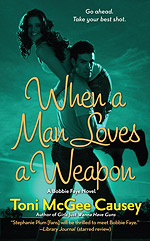
 

 Toni McGee Causey

The question that I still shake my head over is the lengthy one someone asked at a romance conference where we were talking about sex scenes and how to write them. First question out of the box from a woman in the back of the room was: “How would you go about writing a sex scene where the heroine, who is over fifty, is having sex for the very first time and is… excited… and [the questioner added] let me assure you this can happen–she was well… lubricated… so how would you describe that to the audience?”

The answer? “Very carefully.”

The rest of the answer? We don’t need a play-by-play of these details unless they are somehow extremely relevant to the development of the character and story. Most of the time, less really is more.

What’s something your main protag or one of your characters would NEVER say?

Bobbie Faye would never say, “Oh, dear, I shall just sit here on the porch and let the strong menfolk handle everything.”

What’s in your fridge? Sadly, very little, as I’ve just gotten back from a long trip and there is a desperate need for a grocery shopping in my near future.
 

PD Martin

This is hard, Zoë! Most of the questions I get asked are just ‘regular’. You know, how long does it take you to write a book, how long did it take you to get published, how do you do the research … One I get a lot is do I think crime fiction contributes to the crime rate. Has anyone done that one? Want me to give my official answer?


Something my protagonist would never say. I must be having a completely non-creative moment so I’m going with the fridge.


My fridge is full of boring healthy stuff at the moment because the Aussie summer is less than two weeks away and I don’t fit into any of my summer clothes! Ahh!!! So, celery, carrot, low-fat yogurt, eggs. There are also some gorgeous chicken pies hubby made (but I’m not letting myself have any). And beer, Chang (Thai) – man, I’d love one of those right about now 🙂
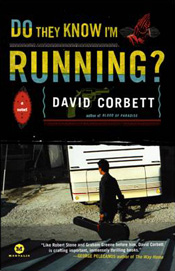
 

David Corbett

So, would you mind giving me a quote of something you’ve been asked? And your answer to it?

During my first book tour, when my PI background was still a prominent part of my bio, I did a reading in Davis, CA at the Avid Reader, and only two people showed up — one man, one woman, neither with any interest in my book. Rather, both had cases they wanted to discuss with me, cases that involved vast conspiracies so insidious “no one would touch them.” I can’t recall the specifics of either now, but I was asked to take up the call and expose the faceless monsters behind the curtain. The fact I had two such characters at a single reading — and on one else — seemed odd for a campus town, and just a little discouraging. I humored both of them by agreeing the cases sounded dire indeed, but I was out of the business and sadly couldn’t help. For the most part they seemed mollified just to talk. Thankfully. Would have been nice if just one of them had ponied up and bought a book, but I suppose that’s asking too much.

 What’s in your fridge?

The severed head of the last person who asked me this question.


So, ‘Rati. What’s the strangest question you’ve heard asked of an author. Or that you’ve asked an author? Or been asked yourself?

What’s something your character would never say? Or something your favourite character would never say?

And what’s in your fridge?


The good stuff on the side…

By Cornelia Read


Okay, when it comes to food for Thanksgiving, I think the turkey is the lame part of the meal. What’s good is the stuff on the side–stuffing especially.

I’m at the age (and have been for a while) when this holiday is usually a gathering of a bunch of people and all of us cook, which is way nicer than the days when I was responsible for the whole shebang myself, but also nicer than the days when I was little and had to eat whatever the fuck was put in front of me no matter what.

It’s great fun to just get to concentrate on doing a few side dishes and doing them well. Riffs on the traditional stuff, as it were.

If you’re in the same position for coming up with a couple of things for this meal, here are some groovy things to try your hand at in the coming week.

This was just in the New York Times food section a couple of weeks ago, and I made it for dinner a few days ago:

Roasted Cauliflower and Raisins with Anchovy Vinaigrette

Time: 45 minutes

1 large cauliflower, cored, trimmed and separated into florets 
½ cup extra virgin olive oil
Salt and freshly ground black pepper
2 tablespoons sherry or balsamic vinegar, or to taste
4 minced anchovy fillets, with a little of their oil, or to taste
½ cup raisins, preferably golden
½ cup chopped fresh parsley leaves.

1. Preheat oven to 400 degrees. Put cauliflower in roasting pan, drizzle with 3 tablespoons oil and some salt and pepper; toss. Roast, turning once or twice, for 15 minutes or so, until cauliflower just starts to soften.

2. Meanwhile, make vinaigrette by combining remaining oil with vinegar, anchovies and a little salt and pepper; taste and adjust seasoning. Remove pan, drizzle cauliflower with 2 tablespoons of vinaigrette, and toss. Roast, turning once, until a thin-bladed knife pierces a piece with little resistance, for 15 minutes. (Recipe may be cooled at this point, covered tightly and refrigerated for 2 days.)

2. At last minute, put cauliflower in salad bowl and add raisins, parsley and remaining vinaigrette and toss. Taste and sprinkle with salt, if needed, and lots of pepper, then serve.

Yield: 8 servings.


Here’s some thing newish to do with sweet potatoes, if you’re sick of the whole marshmallow thing: mash them with one chipotle pepper from a can of chipotles in adobo sauce, with a nice big spoonful of the adobo mixed in. A little orange juice, maybe, with zest of the orange. Top with some crumbled bacon. Gives them a nice smoky-sweet savor that rounds the whole thing out.

And if you’re sick of same-old same-old turnips, there’s a beautiful recipe for turnips mashed with some rice and cream in Julia Child’s Mastering the Art of French Cooking:


1. Bring the milk to a simmer. Add rice, butter, and garlic

2. Simmer, stirring occasionally, for ten minutes.

3. Stir in turnips. Add more milk if needed to submerge the vegetables.

4. Cover and simmer for 15 minutes, stirring occasionally, until turnips are tender.

5. When the liquid is almost absorbed, puree in a food mill or food processor.

6. Reheat before seasoning. Stir in butter or cream and adjust seasonings.

7. Garnish with fresh parsley.


This is a deeply gorgeous way to serve turnips–they come out sweet and creamy and with a beautifully silky texture. They do look an AWFUL lot like mashed potatoes, though, so you might want to stir in some turmeric just to give them a little visual difference.

Also, I’ve become a huge convert to Brussels sprouts over the last couple of years. Because basically when you have anemia, they taste better than cheesecake.

Take some sprouts, cut the ends off, and toss them in a baking pan with a bunch of cloves of garlic, a generous dollop of olive oil, and the juice and zest of at least one lemon. Roast them in a 400-degree oven for about half and hour, tossing around occasionally. They’re good to go when they’re starting to brown on the outer leaves and aren’t too crunchy any more if you stick a fork in them.

Okay, ‘ratis, what’s your favorite thing to cook for Thanksgiving?

THE BIRTH OF AN INDEPENDENT


by Stephen Jay Schwartz

This is a success story. It’s the story of two individuals who rolled the dice.


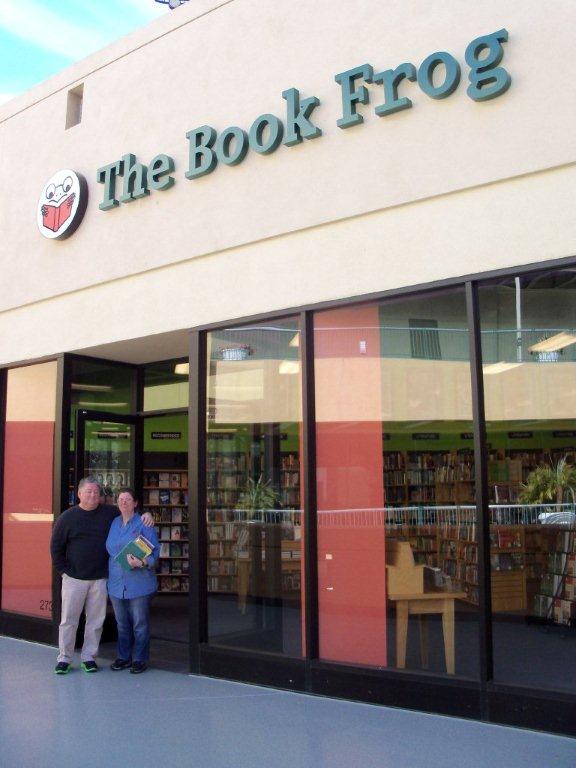
(Owners Pete Ledesma and Rebecca Glenn at The Book Frog)

They opened an independent bookstore. Three weeks ago.

I encountered Becky and Pete at roughly the same time. Becky’s name popped up on a Google Alert when she reviewed my first novel, Boulevard. I read the review and then I read many others she had written on this brilliant little website called The Book Frog. The site links to Murderati and to Tim Hallinan’s Blog Cabin and numerous other sites. Becky’s reviews are full of insight and wisdom and her library on LibraryThing.com speaks volumes about her commitment to the written word.

Becky was the manager of the Borders Books in El Segundo, California.

Pete was the manager of Borders Books in Rolling Hills Estates, California. Pete was the one who passed my book to Becky, his girlfriend, after one of his booksellers told him it was written by a local author. In fact, the very first place I saw Boulevard on the shelves was Pete’s Borders. Pete became incredibly supportive of both Boulevard and Beat, instructing his employees to hand-sell my books to every customer who said they liked reading The Girl with the Dragon Tattoo. Gotta love Pete.

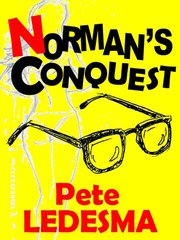
I soon discovered that Pete had also written an unpublished novel and I asked to take a look at it. I read the book, Norman’s Conquest, and was frankly blown away. It’s a charming mystery romp with such rich character description that I came away envious of his talent. He took a stab at getting it published a few years back, but met with some resistance, as most of us do. I told him to get it out there again, or to self-publish it, because the work is good and it needs to be seen.

Becky and Pete, long-time soul-mates, were also long-time Borders cheerleaders. They lived and breathed the business. And then the ax came.

Their jobs were gone. It was liquidation time. Pete had built a loyal community of customers at his branch and no one wanted to see him go. People started asking him if he would open a bookstore of his own.

A bookstore of his own. Right. In this economic climate?

But the chorus grew loud and he and Becky started asking themselves crazy questions, like, “Should we open an independent bookstore of our own?”

They had a tiny bit of savings. They had a little bit of credit. They did not have jobs. They went to the banks and discovered that the banks were capable of great fits of laughter.

They’ve come a long way, Pete and Becky, and still they’ve just begun. They’ve got one of the largest fiction sections in the South Bay, and, in addition to their growing mystery section, they have a special spot for California Crime Fiction and a section for out-of-print, used books by the likes of Ross MacDonald, John D. Macdonald, and many others. They hope to make The Book Frog a place for book signings, book launches and author panels.

I wanted to ask them a bit about their journey into the great unknown. I wanted to celebrate their entrepreneurial spirit, their sense of adventure, their commitment to making their dreams a reality…


Stephen: Tell me a bit about your experiences as booksellers. What are your backgrounds?

B & P: Becky became a bookseller way back in the Clinton era. She started at Borders in Mesa, AZ in March of ’94. Back then Borders was awesomely cool, staffed from the top down by people who loved and lived books. It was like coming home. In the years to follow that home would become more and more dysfunctional, but hey–at least she got to work around books all the time. Pete started at the Brea Borders in 1996. After 11 years in Aerospace, he loved being surrounded by books instead of rum-soaked engineers.

Stephen:  What was it like when you heard that Borders would be going out of business?

B & P:  It was like receiving the diagnostic confirmation that someone you once loved and still care about is dying.

Stephen:  How did The Book Frog evolve from there?

B & P: When Pete’s store went into liquidation early this year his customers and the other merchants in the mall immediately began asking whether he would be opening a new bookstore. At first it seemed like a crazy idea, but it soon came to be the only idea. Since booksellers don’t make very much money at the best of times, and since Borders hadn’t been in a position to give any kind of raise for half a decade, and since we had made the probably ill-advised decision to purchase a home before the real estate market had hit rock bottom, the fact that we decided to pursue this crazy idea often seemed, well, crazy. But, we threw caution to the wind, made a number of fiscal leaps of faith, and six months later…Let’s just say that our decision to open a bookstore was driven almost as much by desperation as it was by our love of books.

Stephen: What was it like trying to find loans and investors to support a new, independent book store?

B & P: Awful! Nobody wants to give you money if you don’t have a proven track record, and if you don’t know how to find private investors, well, where do you find them? We were turned down for SBA loans by three different banks. An SBA counselor working out of a local Chamber of Commerce office told us our idea was bound to fail and that nobody would give us money. Luckily, on the very last day Pete’s store was open to the public an angel came into the store and offered an ungodly amount of money to get this thing off the ground. It wasn’t enough, but it was more than we’d hoped for.

Stephen: How did everything finally come together?

B & P: Lots of bickering, some crying, a fair amount of wheeling and dealing. We snagged fixtures for next to nothing from our respective closing stores, we had wonderful counsel pro bono to help us through the lease process, we got in at the end of the liquidations of the last two stores in the South Bay as buyers and were able to buy almost an entire store’s inventory at a fraction of what it would have cost even at wholesale. It was very much like being someone in desperate need of an organ transplant and when your best friend dies…

Stephen: What makes Book Frog different from Borders? What makes it different from other independent bookstores?

B & P: The Book Frog is different from the Borders of the last decade or so in that it has heart and soul, and we care deeply about books and about getting books into people’s hands. We know that selling a book is in no way the same as selling a blouse or a can of green beans. When we started with Borders it was a wonderful company. It was a chain with an independent bookseller way of doing things. We learned a sad and serious lesson from the downward spiral of our once dear employer, as we watched the company expand too rapidly and aggressively, adding product that had no business being in a bookstore. How are we different from other independent booksellers? Well, by definition each independent bookstore is different from the other. Each has its own vibe, its own feel. We’re working on ours, but we hope it will be warm and inviting and maybe even kind of exciting.

Stephen: What about Book Frog makes you most proud?

B & P: We did it! We had a vision, we chased that vision, and it’s almost come together.

Stephen: What are your plans for the future? How do you think the business will grow and change?

B & P: We are working on getting our webstore up and running (it will be www.thebookfrog.com when it finally happens, sometime within the next couple of weeks). We are going to be implementing a delivery service. We’re already starting to build our inventory based on our customers’ buying habits.

(The Book Frog, 550 Deep Valley Drive #273, Rolling Hills Estates, CA 90274.  310-265-2665)

Becky and Pete are good people. They’re book people, and they’re in the business because it’s in their blood. Let’s encourage them, and welcome them, and wish them all the success in the world. And when you’re planning your next book tour in the Los Angeles area, call Becky and Pete so they can set up a signing for you. Let’s make this a trend.

Becky and Pete will be checking in throughout the day, so be sure to say hello!

Just for the fun of it

Zoë Sharp

I hope you’ll forgive me this week if I repeat a blog I did over at Sirens of Suspense a couple of weeks ago. We’ve been rushing around like eejits for the past week or more, and although we expected to be home a couple of days ago … we’re not. Long story that involves builders letting people down and the prospect of houses not being finished for Christmas means our DIY skills have been called into service. And, weirdly enough, we rather enjoy it.

Part of the rushing around involved seeing our friend, fellow crime author Anne Zouroudi, doing two events for Kirklees libraries with Penny Grubb and Lesley Horton, plus a crime writing workshop also with Lesley, and interviewing the delightful Martina Cole at the 4th Reading Festival of Crime Writing last Friday. So, if you’ve been wondering why I’ve been very quiet on these pages, that’s my excuse …


When was the last time you did something just for the fun of it? Or took a moment to really observe rather than just see your way through a familiar journey?

As a race, humans are becoming hardened to beauty, disconnected from the simple pleasures in life, and I find that very sad. As a writer, part of my job is to dig deep into the kind of emotions that drive us on a primal level. To do that, I need to be in touch with those kinds of feelings.

And maintaining a sense of wonder definitely falls into that category.

Andy (my Other Half) is as daft as I am about this. We rush to the office window to see a steam train passing on the other side of the valley, a low-flying Hercules transport plane lumbering overhead, or a particularly beautiful strake of sunlight on the hills behind our house.

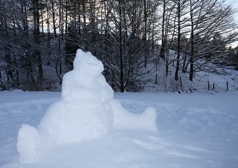
I still build snowmen – and snow-bears, and snow-Easter-Island heads, and I was in the middle of a full-size horse last year, but the snow turned powdery and its head fell off, dammit. I know – what an excuse – the wrong kind of snow …

I still ride the shopping cart back to the stack after we’ve loaded up the car at the supermarket, still laugh like a drain at dirty jokes and whoopee cushions. But frost on leaves or winter mist or sunlight through a cloud leaves me breathtaken.

Because how can you hope to write something that will instil any sense of wonder if you don’t have it yourself?

We are not simply hardened to beauty in the modern world, but isolated from it. A fabulous cliff view will now have a safety railing to save you from yourself. Everything, we are told, would be better with our lives if we just had the latest gadget, a larger TV, a newer car, a bigger house. And it takes something drastic to make us realise that those things are not important.

Don’t worry, I’m not going to come out with some worn platitude about the best things in life being free. Whoever said that has never had to pay for meds, make the rent, or put food on the table. Those things cost money, and you better have it when the red bill arrives, or life is going to turn pretty ugly pretty fast.      


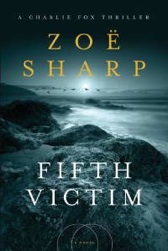
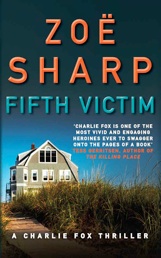
At the moment I’m caught between rich and poor in my writing, and it’s making me re-evaluate a lot of things. By definition, my bodyguard heroine Charlie Fox works for those wealthy enough to afford her services. In the latest book, FIFTH VICTIM: Charlie Fox book nine, she’s babysitting the rich and powerful of New York’s Long Island playground. She sees what too much of everything has done to these people, and it makes her reconsider what’s important in her life – love, health, happiness.

And just as FIFTH VICTIM is gearing up for its January 2012 publication in the States (sorry, but it’s been out in the UK since March this year) I’m also hard at work on the next in the series – DIE EASY: Charlie Fox book ten. For this book I wanted to set the ‘haves’ much more firmly alongside the ‘have-nots’. Where else was better to do that – where was the contrast more stark – than New Orleans, post Katrina.

OK, so the centre of NOLA looks very much as it always did, but some of the outlying areas are derelict ghost towns. It’s a fascinating setting for a book, and one that grabbed me from our first visit last year. As for the huge recycling plant – Southern Scrap – a crime thriller writer couldn’t ask for a better location for a confrontation, or a show-down.

But driving round the place it was hard not to be saddened and sobered by the destruction still on view. I came away grateful for what I have, and even more determined that as I pass the good things in life, I don’t want to miss them because I have my eyes in a text message and my ears in an iPod.

So, ‘Rati – what did you see today? And what will you notice tomorrow?

This week’s Word of the Week is innuendo. An Italian suppository …

My Favorite Woman Writer: Martha Gellhorn

David Corbett

Last Thursday, Phillipa released the results of her poll on preferences for male and female authors and protagonists. In my comment, I sheepishly admitted that I’d not really recognized my favoritism toward male authors until obliged to fess up.

And yet I knew there were women writers I not only enjoyed but admired and read greedily. So in a fit of atonement (I’m so Catholic), I felt obliged to discuss one of them here. A woman who has me awestruck, frankly: Martha Gellhorn.

I came upon her by accident—that is, while doing research.

John Updike once remarked that he realized early in his career that he could either be a reader or a writer but not both. Hearing that, I felt welcomed, as it were, to one of the severest regrets of many a professional writer—the lack of time one has to pursue reading for pleasure. Deadlines, the demands of research—not to mention the fear of a sort of stylistic or tonal contamination many novelists experience when they read fiction while at work on a manuscript—bars many of us from reading as widely as we would like.

And so much research requires plodding through impenetrable tracts of dense lifeless data, culling for that one crackling detail that might bring a passage to life. The joy is compound, then, when a source not only provides the information sought, but does so with a fresh, commanding style.

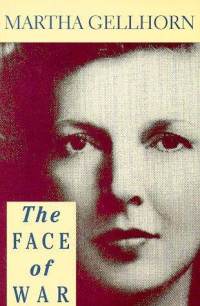
That’s how it was when I encountered the work of Martha Gellhorn, war correspondent for nearly fifty years (as well as a novelist and short story writer), too often known merely for her brief marriage to Ernest Hemingway.


Her collection, The Face of War, drawn from her work covering combat zones from the Spanish Civil War in the 1930s to Central America in the 1980s, provided one of those rare frissons every reader craves—the discovery of a fresh voice that is so unique, so penetrating, so sure-handed and clear, that every page seems to shimmer or haunt.

Opening the book at random, I came across her descriptions of the Nuremburg defendants, and was spellbound:

Goering’s “terrible mouth . . . a smile that was not a smile, but only a habit his lips had taken.”

Sauckel with his “puzzled stupid butcher-boy face.”

Hess, with “dark dents for eyes,” who “jerked his foreshortened head on his long neck, weird, inquisitive and birdlike.”

Frank with his “small cheap face, pink-cheeked, with a little sharp nose and black sleek hair. He looked patient and composed, like a waiter when the restaurant is not busy.”

Streicher compulsively chewing gum, his face blank: “the face of an idiot, this one.”

The “dreadful, weak” face of Schirach, who from the side sometimes resembled a hypochondriacal woman, who all her life “blackened her family’s existence with complaints.”

But the principal reason I was drawn to her was because, late in her professional life, she ventured to El Salvador, where much of my most recent two novels, Blood of Paradise and Do They Know I’m Running?, take place. She notes that she went there “in stupefying ignorance,” but it was her motive for going that I found inspiring:

As citizens, I think we all have an exhaustive duty to know what our governments are up to, and it is cowardice or laziness to ask: what can I do about it anyway? Every squeak counts, if only in self-respect. Gloomily, because otherwise I would be ashamed of myself, I made the small effort of a detour to El Salvador.

Gellhorn helped me with my own ignorance, just as she corrected her own. She spoke of a young American journalist who checked into the San Salvador Sheraton, left the hotel and then was never seen again until his body was returned to his family a year and a half later. The reason for his murder? No one could tell. Suggesting it might have been a case of mistaken identity, Gellhorn reflects acidly, “When killing is so easy, general and never punished, there must often be casual errors.”

Despite having been in war-ravaged cities such as Madrid, London, Helsinki and Saigon, she found San Salvador to be the most frightening of all. The violence didn’t come loudly from outside, but stealthily from within. The police hunted day and night, and she feared for the people who spoke to her. “Those who should have hated me as an American were friendly and trusting. But I knew what they risked and was awed by their courage.”

She came to admire the country’s poor: “Learning to read is the peasants’ rebellion. Their primer is the Bible. They were called the People of the Word, and that made them subversives. Subversives are prey.”

She was also outraged by the state of the refugee camps, the worst she’d seen since Vietnam. “Without the Church, courageous in El Salvador, the refugees would starve.” And her conversations with the wealthy women of the capital revealed a mind-numbing oblivion to the true state of affairs in their country: Only a few agitators were causing the trouble; talk of murdered civilians was propaganda; if there were any refugees, they were fleeing the Communists.

Such bromides were echoed by President Reagan, for whom Gellhorn harbored a particularly fierce revulsion, describing him as “boyish,” with an “ultra sincere chocolate voice.” When he equated the Nicaraguan Contras with the Founding Fathers, she could barely contain her rage: “This is truly astonishing, since the Founding Fathers were not known to gouge out the eyes and mutilate the bodies of their enemies, or to commit other such unseemly acts.”

Gellhorn found many parallels between El Salvador and Vietnam, which she also covered as a journalist, and she remarked that it was not easy being a citizen of a superpower, nor was it getting easier. She would feel isolated in her shame, she said, if she didn’t belong to a perennial minority of Americans, the “obstinate bleeding hearts who will never agree that might makes right, and know that if the end justifies the means, the end is worthless.” She recalls with both fury and shame how Johnson and Nixon lied about their plans to escalate the conflict in Southeast Asia, cheating America of the leaders its citizens thought they had elected, only to blunder into atrocity:

Power corrupts, an old truism, but why does it also make the powerful so stupid? Their power schemes become unstuck in time, at cruel cost to others; then the powerful put their stupid important heads together and invent the next similar schemes.

Like I said, sometimes research isn’t a chore, it’s a joy, an inspiration. A call to arms. Reading Gellhorn reminded me that the battle against naked power never ends, and life is a daily choosing of sides—if only for self-respect.

* * * * *

Murderateros—who sits on the throne in your temple of revered writers, male or female?

Do you have a favorite war correspondent, or journalist, whose work anchors you once again in the world and reminds you of the stakes of being human, of being alive together at this time, in this place, on this planet?

What inspirational nudge, insight, or life lesson has your favorite writer bestowed?

* * * * *

Jukebox Hero of the Week: Boy, this one’s hard, because the post is so damn serious. But I’m going with Arlene Auger, one of my favorite sopranos, who died far too young (age 53) of a brain tumor in 1993. She was a late bloomer, so her career was sadly far too short, but her voice was the essence of simplicity and clarity.

This clip shows her singing “Morgen” (Morning) by Richard Strauss. I chose this piece because Strauss, though exonerated of being a Nazi sympathizer, was nonetheless one of the composers sanctioned by Hitler as fitting for the Third Reich, and Thomas Mann condemned him after the war for being “a Nazi composer.” Despite the messy background, the song is stunning, and reminds me that man is complicated, stitched together from light and dark, and even the wise and gifted routinely fall far short of their ideals (ask Joe Paterno):