Author Archives: Murderati Members


Bloody Noses, Broken Hearts

 By David Corbett

Zoë Sharp recently posted an excellent piece on the question of why we—meaning you, me, and the shy, skulking, blinky stranger in the threadbare overcoat crouching over there in the corner with the thumb-worn paperback—why we, dear friends, read crime fiction.

Given a natural, almost irrepressible inclination to let my mind wander and generally, hopelessly digress, I soon found myself mentally drifting into the conjectural weeds, wondering about a related question:

Why do we write crime fiction?

I’m hoping all my fellow Murderateros chime in on this, because I have a nagging little notion that the answers will prove not just revealing but jaw-dropping.

I mean, why does a conscientious, civil, well-educated, upstanding, socially responsible, personally hygienic, cheerful, brave, clean and reverent soul and lifelong swell gal like Pari Noskin Taichert or Phillipa Martin—to take but two blushing examples—come to share the blue-skied expanse of their otherwise benign imaginations with schemy lowlifes, bumbling thugs, skin-curdling perverts, gun-toting birdbrains, shuffling miscreants, jolly sadists, penny-ante lawmen, bogus medicine men and anarchist shoplifters?

I hope the dozens-to-hundreds of the rest you toiling away in the crime fiction boiler room—whether famous or obscure, published or soon-to-be-published or dreaming-of-being-published or willing-to-kill-to-get-published—will also pipe up and be heard. Why oh why do you do it?

I can only speak for myself, of course, and what purpose would generalizations serve? So here is my sad and sordid tale, my ars poetica.

Let me take you back to the tranquil midwestern burg known as Columbus, Ohio—a great place to raise a family, it was often said. Or brew up a first-rate neurosis. Everything of any import, I was convinced, happened elsewhere. In particular, it happened in books.

I was a brainy, tubby, near-sighted kid who read voraciously, tirelessly, endlessly, so much so my less print-bedazed brother considered me an excellent target for mockery, torment and contempt. To little avail. I devoured the Hardy Boys and Danny Dunn and the We Were There novels—We Were There at the Battle of the Bulge, We Were There on the Chisolm Trail, We Were There at the Oklahoma Land Rush—and the Random House American history set that taught me about everything from Buffalo Bill’s Wild West Show to the U.S. Marine assault at Belleau Wood. I had the kind of knowledge that would serve me well later as a PI—a thousand miles wide and two inches deep. All of it from books.

Meanwhile, there was a gas station in my neighborhood run by the Moro brothers who always bought the change from my paper route, and once that transaction was complete I normally bought a soda from the machine and a candy bar and hung out for a while. Though not exactly Tom and Ray Magliozzi—NPR’s infamous Click and Clack from Car Talk—Jimmy and Johnny Moro weren’t far off, and they mesmerized me. They were earthy, funny, fouled with grease and full of fun. They laughed loud and seemed to possess that rarest of gifts I so wanted to share: They lived.

I wondered if it wasn’t an Italian thing, for I saw much the same kind of gioia di vivere at my buddy Vince Milletello’s house, even though he was even pudgier than me. His mom and aunts were gorgeous, their husbands charismatic, the food incredible—I didn’t know why everybody didn’t hang out at that house. (Mrs. Milletello was constantly trying to get me to go home, to the point, on occasion, of shaking her shoe.)

These people just lived larger than my family did. In my home, anything remotely emotional remained studiously in check—until unleashed by alcohol, or uncorked by rage.

This resulted in the all too familiar fate of the bookworm: self-loathing. I was convinced an essential piece to the puzzle of life was by its very nature nowhere to be found—by me. And it was the piece that had to do with the dirty business known as Life As It Is, not Life As It Appears In Books.

My egg-headedness began paying dividends, though, at least in attention from teachers—I still got the usual ragging crap from classmates—and I embraced my IQ as the quintessential essence of my life. Or at least the most direct way out of puberty. I was the guy who got straight A’s, but with a bit of a mouth, the class clown attitude, a rough edge here and there. I was never top of my class but always close. And in the pit of my black little soul, I sensed that any hope I had of getting a girl, it would probably be because I was so doggone smart.

What an idiot.

But I was also musical, played guitar in the campus coffeehouses, and then took a year off from THE Ohio State University to join a bar band, touring Midwestern backwaters like Beckley, West Virginia; Lima, Ohio; Kokomo, Indiana; Midland, Michigan.

It was a formative time. I met many cocktail waitresses.

(If you want an idea of what one of our signature tunes was, go here.)

But the siren call of campus life drew me back. There’s only so many times you can play “Color My World” to a roomful of horny, polyester-clad divorcees drenched in Old Spice—or sweet Midwestern fogheads nodding on quaaludes—before you begin having unhealthy imaginings, replete with knives and curdled in bile.

I returned to college and somehow bumbled my way into a math major. I was the department freak—a hippy entranced with diophantine equations and Fermat’s Last Theorem. I continued playing in coffeehouses, dabbled in writing, won a poetry prize (figure that one out), hung out with dancers—I mean, who wouldn’t?—and was basically on a collision course with full-blown academe.

But I had no clue what to do as a graduate student. I threw a dart, hit linguistics—a perfect marriage of my fascination with language and my scientific soul—and won a full scholarship to U.C. Berkeley.

Within a matter of weeks, I was drowning in doubt and my own lack of talent, not to mention a serious deficiency of oomph. I saw the life my professors were living—marrying young, the girl across the table in the library, then divorcing at 40, lustily chasing their students—and I ran screaming. On some deep level I knew I had to climb down out of the ivory tower and wander the world. Get my heart broken, my nose bloodied.

But I still had that artistic itch, so after leaving school I studied acting and began writing short stories. Ironically, it was two of my friends from acting school who turned me on to the PI firm where I would spend the next thirteen years of my life. One friend worked as a receptionist, the other as a stringer (serving subpoenas, spending hours in his car conducting surveillance), and they both made it clear—if I wanted to write, I couldn’t beat this job for material.

I bugged the owners of the firm, Jack Palladino and Sandra Sutherland, for nine months, and was finally hired because I wore them down (they graciously referred to me as the most persistent applicant they’d ever had—persistence, incidentally, being of far more use to a PI than anything else). As for my writing, I told myself: These will be my years at sea. What I saw and did would provide not just the subject matter but the texture and worldview that would inform everything I wrote for the rest of my life.

The job rooted me to the real world like nothing had before. I was now working for men and women whose freedom, life-savings, even their very lives were at risk. Half measures wouldn’t do. The stakes were high and the lights were on. I loved it, like no other job I’d ever had. I felt like I could finally go back home, walk into the Moro brothers’ gas station and not feel like a phony. I was no longer waiting for my life. I’d found it.

Up to this point, no joke, I hadn’t picked up a crime novel since the Hardy Boys. I associated crime fiction with B movies, fun but campy, and preferred Kafka and Borges and Robbe-Grillet, Pinter and Stoppard. Now that I was actually working in the world of crime, I figured: Oh, what the hell. I picked up Chandler’s The Long Goodbye. Shortly thereafter I devoured Cain’s Double Indemnity, and then the clincher, James Crumley’s The Wrong Case.

No, I wasn’t hooked. But I got it. And the point hit home in a way it hadn’t before. I saw the world I knew, the world of the justice system—witnesses, criminals, victims and cops, snitches and lawyers—transplanted to a literary landscape, a smart one (of course, I couldn’t give up that), and my artistic sensibility and my real-world existence had finally meshed in a way they never had before.

Here was the literary representation of the authenticity I’d been craving since my boyhood, the world where people didn’t think about life, they lived it. Yeah, sure, they existed in books, so sue me. Or shoot me. The characters in those books suffered the terror of their smallness before the crushing wheel of power, they fought and even killed for just a little more, they needed, they craved, they believed, they despaired. Justice might be small but it was everything. And even the most cynical had an inner fire.

Due to the heritage of American realism, there was a convincing lack of prettiness, a sharpness, a directness and hard-edged simplicity that rang true for me. I didn’t completely forego lyricism but the mode was now decidedly minor. And though I didn’t give up on literary fiction I needed the edge I found in crime, that same lack of sentiment, that commitment to a life faced squarely and lived fully, damn the bloody noses and broken hearts.

Please chime in: Why do you write crime? And if you don’t write, what do you expect from the crime writers you read that you don’t expect from others?

* * * * *

Jukebox Hero of the Week: My own music career was behind me when Steve Earle came out with “Copperhead Road,” but on one of my very first author panels—which I got to share with both Laurie King and Michael Connelly—I admitted that this song probably had as much influence on me as writer as anything I’d ever read. Still does:


Thinkiness

by Pari

When does thinking get in the way of writing? It’s not a trick question. I often wonder about the intrusion or benefit of analysis at each step of literary creation — from the initial idea to writing, editing, revision, all the way to publication.

I ask because I’ve seen applied brain power work and, sometimes, destroy writing careers during the years I’ve paid attention to such things. Of the dozens of writers whose creative trajectories I have watched with interest, not all have been published or have earned a living in their chosen field. The publishing industry is much too capricious to judge their success in those terms. What intrigues me is the end product in relation to those writers’ personal satisfaction AND ability to translate their ideas into pieces that evoke the intended responses in readers.

In the creative phase
I know writers who approach every word and scene with a director’s clarity of vision before even typing the first letter of the first “The.” Other writers agonize over every sentence to the point of utter creative constipation. In these cases, their analyses are debilitating. Some acquaintances write with ease and speed, never stopping to question their impulses. Some are satisfied with their disjointed — and often sloppy — results. Some don’t need to edit. Some can see the flaws in their works, without self-flagellation, and know how to fix them.

In the editing process
I know writers who, like great brain surgeons, work with a skill and attention to detail that slices away every errant adverb and cauterizes every poignant scene at the perfect moment. I also know writers who bleed criticism on their pages with such abandon  — and lack of self-confidence — I fear they’ll hemorrhage each time they take to analyzing the effectiveness of their creations.

So what’s right?
Hell if I know.

My own process has gone through many changes. I used to be delighted with everything I wrote and didn’t think I needed any editing at all. Then came the self-doubt. Then came the obsessive editing. Then came the creative constipation. Then came the fury at the lack of joy in the writing and the total rejection of editing while in the creative process. And now? Well, I’m still stuck in that last phase, but am starting to feel the urge to publish again. BUT I haven’t any idea what my editing approach will be.

I do, however, remain curious about others . . .

My questions today are

For readers:  Are there any books/stories you’ve read where you’re aware of the writer’s thinkiness? Of his or her plans, editing etc? Can thinkiness intrude?

For writers: Is there such a thing as overthinking, overediting? Or . . . have your processes changed since you started writing?

Zoë Sharp’s FIFTH VICTIM

by Alexandra Sokoloff

Today I have the great pleasure of interviewing my blog sister, Zoë Sharp, on her new book, the ninth in the Charlie Fox series: FIFTH VICTIM.


To introduce the interview, I started thinking back to the first few times I met Our Zoë.  And I realized when I first met her, I was intimidated. Now, that’s not something you’ll hear me saying often, about anyone. And as I thought about it, it occurred to me that I was intimidated because I knew I couldn’t fool her. Writers are perceptive people as a species, but even so I think most people tend to buy my public persona.  Which is not NOT me, it’s just not ALL of me.  With Zoë – I knew that wouldn’t work, not for two seconds. There was going to be no hiding anything from this woman.  I didn’t know how I felt about that, so I hung back until I knew her better.  (It was worth the wait!)

Zoë’s heroine Charlie Fox is that way. You cannot get anything by her; she sees to the core of people and also to the core of situations. She has a wry sense of humor and she can take the piss out of anyone (how’s that for British?) without even trying. But she also has this aura that is pure, white-hot power. You do NOT want to mess with this woman.  You especially want to be careful when she gets still. And if you were in trouble, this is the first person you would want to have watching your back.

Just exactly what you would want in a bodyguard.

We sat down over our computers, transatlantically, to talk about the book.


FIFTH VICTIM  

On Long Island, the playground of New York’s wealthy and privileged, Charlie Fox is tasked with protecting the wayward daughter of rich businesswoman Caroline Willner. It seems that an alarming number of the girl’s circle of friends have been through kidnap ordeals, and Charlie quickly discovers that the girl herself, Dina, is fascinated by the clique formed by these former victims.

Charlie worries that Dina’s thrill-seeking tendencies will put both of them in real danger. But just as her worst fears are realized, Charlie receives devastating personal news. The man who put her partner Sean Meyer in his coma is on the loose.

She is faced with the choice between her loyalties to her client and avenging Sean, but the two goals are soon inextricably linked. The decisions Charlie makes now, and the path she chooses to follow, will have far-reaching consequences.


Alex: So how do you research the habits and habitats of the wealthy and privileged?  Enquiring minds want to know. 

Zoë: My day job used to involve a lot of writing about classic cars – often very expensive and rare vehicles that were, by their definition, owned by people with a lot of disposable income. Spending any time of time around these people tells you that the rich are another country – they do things differently there. For the families I describe in FIFTH VICTIM, I guess I just built on that experience and took the next instinctive leap forwards.

Alex: Well, I love how completely unfazed Charlie is by all of it – her dry nonchalance is a riot. Also I noticed Charlie’s pretty comfortable around horses and slings that terminology around like a pro. Did you grow up riding?  Do you still?

Zoë: I confess that I did grow up with horses. In fact, my only professional qualification is as a British Horse Society riding instructor. It struck me when I started planning FIFTH VICTIM that I’d  never used this knowledge in any of the books, and yet I’d made mention  of Charlie having horses in her background, so I thought I’d like it to  play a larger role. Besides anything else, it fitted into the story so nicely, in a way that tennis lessons, say, simply would not have done.

Alex: Wow, I didn’t know that about you, although you do have the aura. I thought it was clever how Charlie uses the horse in that one fight scene. So obvious, and yet I’ve never seen it before.

Okay, since we’re kind of on the subject, when I blog and teach I’m always reminding my readers/students that people read books and watch movies for a vicarious experience. In FIFTH VICTIM you take us into the rarefied world of the Hamptons, the horse culture, the yacht culture.  As an author, do you consciously use settings like this to provide a fantasy experience for your readers? 

Zoë: Not especially, although for people to require close protection, often by definition they have the most to lose. The higher the stakes, the greater the conflict, and I like to put Charlie in situations of conflict.

Alex: Speaking of conflict, you’ve got a great love triangle going on in FIFTH VICTIM (I’m Team Parker, if you’re wondering).

Zoë: Are you? Hmm, interesting. I thought you’d be more of a fan of Sean’s bad-boy image.

Alex: Maybe I hit my limit in real life. But what I was wondering was – did that complication surprise you, or have you been plotting the triangle for years, now?

Zoë: I’d love to be able to say it was all planned from the start, but the truth is that the awkward relationship between Charlie and Sean and her boss, Parker Armstrong, was one of those things that developed more as the series went along. When I came to write this book and I was looking back, though, I was surprised to realise that there had been little signs previously that Parker looked on her as more than a simple employee. So it must have been fermenting away at a subconscious level somewhere. 

Alex: I love it when that happens, actually!

All right, now I have to ask about Torquil. He’s one of those wonderful love-to-hate-him characters. Just that name! You can refuse to answer on the grounds that it might incriminate you, but is he anyone you know?

Zoë: Actually, Torquil is nobody I know – honest. OK, so there might be one or two traits I’ve observed in various people who shall definitely remain nameless, but nobody specific. I think that all through this book I was working on a theme of people appreciating what they have – or failing to appreciate it until it’s too late and they don’t have it any more by which time it’s too late to go back. I wanted to embody some of that feeling in one character in particular, and Torquil was it. 

Alex: That is the way it played out – I never expected to feel sympathy for him, but I did. 

A completely different question, but fascinating to a non-series writer: I like the way your number titles are always actually significant to the story!  Does your series name concept influence your plots at all, or do you have the plots first and then figure out how to integrate the proper number in as a clue or significant phrase?  Is it a hassle or does it actually inspire you?

Zoë: It’s both inspiring and a hassle – and totally confusing, as FIFTH VICTIM is actually the ninth book, not the fifth. See what I mean?

Alex: Oh, yike. That is confusing.

Zoë: I wrote the first three books (KILLER INSTINCT, RIOT ACT, HARD KNOCKS) before the title FIRST DROP arrived from the rollercoaster reference. I  had absolutely no idea that my first US publisher would jump on that  and want the next book they took (actually book six, as ROAD KILL came  after FIRST DROP) to be called SECOND Something. I’m dropping the numerical sequence for the next one, a New Orleans-set tale called DIE EASY.

Alex: And you know I can’t wait for that one! Tell us a little about your research in my favorite city. 

Zoë: There’s a feel and a texture to New Orleans that really interested me. Plus the events surrounding Hurricane Katrina and the ongoing aftermath give the city a stark edge. People there spent a long time looking into the abyss and you can’t go through something like that and not emerge unchanged.  I was in New Orleans in mid 2010 – five years after Katrina – and some parts of it still look as though people evacuated and never went back. 

And although you look at the tourist areas and it’s all business as usual, there felt to be something defiant about it, something ever so slightly forced. I found that contrast fascinating. As an outsider I also felt there was a great sense of betrayal. Coming four years after 9/11 I think there was an expectation that if something really bad happened – whether a natural or man-made disaster, the government would be ready for it. Katrina proved they were not. 

Alex: Not ready or not willing. But you don’t even want to get me started on the betrayal surrounding Katrina!

So what’s next for Charlie—besides that complicated love life? 

Zoë: That’s a good question. I’m planning to take a little break from her next so I can write something new. In 2011 I had a pretty full-on  Charlie Fox year, what with organising getting the backlist to e-book  format, plus I did the short story e-thology for which I wrote a brand  new 12,000-word long short, Truth And Lies, and then did another  Charlie short in December, Across The Broken Line, plus DIE EASY. So, I’d really like a breather, just to take stock with the character and the direction she’s moving in. Having said that, of course, an idea for the next book in the series has already been forming vaguely in the back of my mind. I shall try to keep it in check!  I’ll keep writing about Charlie for as long as people want to keep reading about her. As long as I continue to have avenues of her character that I feel I can explore – as long as she has something to say to me – then the interest is there for me as a writer. I keep putting her under pressure, whether it’s physical, emotional, or psychological, and I see what happens. So far she’s always come out fighting. 

Alex:  Was your first Charlie Fox book your first novel, or did you have a few practice novels before that? 

Zoë: I did write a novel when I was fifteen, which I wrote long-hand and  my father, bless him, typed up for me. It did go out to publishers and  received “rave rejections”. I believe it may still be in a box in the  attic. My father keeps threatening to dig it out and put it on eBay. I  just threaten him at this point … Charlie was, therefore, my first real novel, and although I rewrote KILLER INSTINCT several times the basic  core of the book stayed true to the original idea.

Alex: And you’ve now got all the first Charlie Fox books up as e-books.  Can we get a list, in order? 

Zoë: To try to diffuse the confusion I’ve added the book order into the titles. It just seemed the best way to do it.

The full list is:

KILLER INSTINCT: Charlie Fox book one

RIOT ACT: Charlie Fox book two

HARD KNOCKS: Charlie Fox book three

FIRST DROP: Charlie Fox book four

ROAD KILL: Charlie Fox book five

SECOND SHOT: Charlie Fox book six

THIRD STRIKE: Charlie Fox book seven

FOURTH DAY: Charlie Fox book eight

FIFTH VICTIM: Charlie Fox book nine

DIE EASY: Charlie Fox book ten – coming 2012!

And today we’re giving away an e book to a randomly chosen commenter – any one of the first five Charlie books, winner’s choice.

Thanks so much, Zoë!


Summer Down Under

by PD Martin

I know the Murderati readers are scattered around the globe (we’re such an eclectic bunch) but many of you are in the Northern Hemisphere and in the throes of winter. So, I thought you might like to hear about my summer holidays!

Currently my daughter is on holidays, about to transition from pre-school to her first school year, which starts Monday 6 February  (yes, our school year coincides more with the calendar). After Christmas, we headed down to the beach, specifically Mornington Peninsula. It’s a lovely spot down there, and my family has a small house in a suburban area, but it’s only a ten-minute walk to the beach. There’s a great beach-side track for walking/jogging/cycling, the beach (of course) and we spend lots of time on the deck having BBQs and drinking good wine. Aussie wine, of course!

Our days have been varied, partly because we’ve been experiencing some classic crazy Melbourne weather (Melbourne is known for its unpredictable weather, and it’s often said you can experience all four seasons in one day – and you can). Anyway, so the first week down at the beach was damn hot (30-38 Celsius or 86 to 103 for those of you who prefer Fahrenheit). Then the next week temperatures plummeted to 16-18 Celsius (60-64 Fahrenheit) and we had rain. Now we’ve had another hot few days so we’ve been lying on top of the bed clothes with a cold facewasher on hand. I know it’s weird…for a country that experiences such extreme hot weather many of our houses don’t have air conditioning. In fact, my family’s beach house doesn’t have air-con, neither does our two-bedroom unit in Melbourne (which was built in 1972). So some nights it gets hot, hot, hot! But who knows, tomorrow it might plummet again.

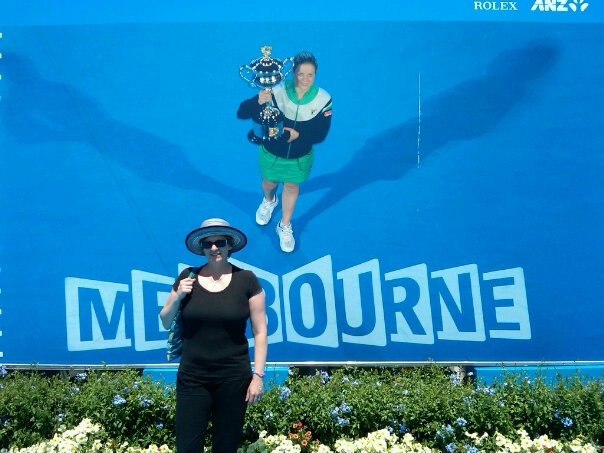
Another key part of our Aussie summer each year is the Australian Open. Today we headed in for a ‘day pass’, another fun day in the sun, watching the tennis heavyweights hit it out. Hopefully we applied enough sunscreen and got enough water into us to cope! So far so good. The picture on the left is a partial view of the Melbourne skyline from the Margaret Court Arena. 

This summer has also been made extra special with two overseas visitors. Firstly, my  best friend (who I’ve known since I was 4yro). She’s actually an Aussie but moved to Rhode Island nearly six years ago with her American husband.  It’s been great to have her in town, visiting some of our old haunts and finding some new (more mature) haunts. We’ve also got my husband’s mother in town from Ireland. She’s here for three weeks, spurred on by wanting to be around for Grace’s first day of school.

We’ll be hitting a few more tourist destinations with her, but mostly relaxing down at the beach house.

Writing?
Writing you say? What’s that? No, I have been doing a little bit of writing/editing here and there, but really only one day a week plus a couple of nights. My output is down, but I managed to finish the first draft of my new ‘mainstream fiction’ book just before Christmas and I have managed my first editorial pass. I expect my output will suddenly and significantly increase on 6 February. 


So, what does your typical summer involve? And if you’re in the middle of winter, can you even imagine the hot sun on your face and diving into the ocean to cool off?

THIS CAN’T POSSIBLY END WELL . . . (OR CAN IT?)

by Gar Anthony Haywood

The other night, the wife and I caught the last forty minutes or so of the classic film THELMA & LOUISE on television.  The story of two BFFs on the run from the law after a weekend getaway from the troublesome men in their lives turns deadly, it’s a movie I greatly enjoyed when it was first released in 1991.  The late Callie Khouri’s script is fantastic and the two leads, Geena Davis as Thelma and Susan Sarandon as Louise, are simply brilliant (not to mention gorgeous).

Iron-willed feminist that she is, I expected my wife Tessa would be a fan, but just before fade-out, she surprised me by demanding we turn the movie off.

Turns out she can’t stand how it ends.

If you’ve seen the film yourself (or have just watched the clip above), you know that its big payoff is a flashy suicide: With the law fast closing in, and facing an almost certain future behind bars, the girls decide to show all the men who’ve ever wronged them one final, giant-sized “Fuck you!” by taking a flying leap (actually, it’s a driving leap) into the Grand Canyon.  Better to die in a blaze of glory than go on living as a second-class citizen under the oppressive, sexist thumb of the Man.

Those who have found this ending to be extremely satisfying — and there are many — would probably describe it as a happy one.  After all, aren’t Thelma and Louise breathlessly fist-pumping as the curtain falls, having left Harvey Keitel and a small army of lawmen holding nothing but dust in their wake?  Haven’t they escaped the injustice of going to prison for a crime they committed only in self-defense?  In driving off that cliff, rather than surrender and submit for the ten-thousandth time in their lives, aren’t they realizing the ultimate dream of oppressed people everywhere: self-determination?

Well, yes . . .

Except that they fucking die!

That’s your happy ending?  Victory in death?  Really?

Oh, hell, no.  There’s nothing “happy” about that ending at all.  Suicide under any circumstances is an act of desperation; it’s a capitulation to forces making life too unbearable to hold on to.  And yet, this is not to say the ending to THELMA & LOUISE is not a perfectly fitting one.  In fact, one might argue it’s the only ending to the film Callie Khouri could have written that would have been true to all that came before it.

But was it?

Were there other, equally authentic but far less tragic ways to bring the saga of Thelma and Louise to a close Khouri could have devised instead, had she been motivated to try?  Or was this a story that simply demanded the downer ending it was given?

I don’t know.

For all the love I have for Roman Polanski’s CHINATOWN (actually, I prefer to think of it as Robert Towne’s CHINATOWN), the ending to that film has always left me asking the same question: Was that really the best Towne could do?  Was there really no other way to bring Jake Gitte’s conflict with Noah Cross to a satisfactory conclusion other than to have Cross — as evil and twisted a villain as has ever darkened the silver screen — win?


Again, I don’t know.  The only thing I do know is that, had Towne not chosen to take the path he did, he might never have written one of the greatest last lines in movie history: “Forget it, Jake.  It’s Chinatown.”  And that would have been a tragedy.

Personally, I think both Robert Towne and Callie Khouri nailed the endings to their respective films, whether viable, more upbeat alternatives were available to them or not.  But I don’t believe the same can be said for every screenwriter (or novelist) whose film (novel) ends on a similar, fatalistic note.  Sometimes, a writer runs his ladies off a cliff, or has his private eye taste the bitter taste of defeat, simply because finding another way out of the jam he’s placed them in is too terrible a thought to contemplate.

Readers call authors to task all the time for slapping happy endings on books that don’t logically point to one, and with good reason.  But affixing sad endings to stories that don’t necessarily require them is just as egregious in my opinion.

Like the old saying goes: “Tragedy is easy.  It’s comedy that’s hard.”

Questions for the Class: Can you think of a book or film that ended badly more out of obvious convenience than necessity?

OPTIONING YOUR BOOK

AN INTERVIEW WITH FILM & TV MANAGER DAVID BAIRD OF KINETIC MANAGEMENT

By Stephen Jay Schwartz


I’ve known David Baird for over fifteen years. In a way, we grew up together as D-Boys in the entertainment industry. We met when I was a development executive for Wolfgang Petersen and David was a development executive for Marc Shmuger at Sony Studios. We hit it off right away and, in time, ended up traveling to different screenwriting and book conferences talking about the process of developing films for Hollywood.

When we left the development world, I went off to pursue a career as a writer and he launched his own management company. Last year, when my literary and film agents started talking about a TV option for my novels BOULEVARD and BEAT, I found David’s knowledge of the Hollywood landscape indispensable. I chose to bring him on as my manager and he chose to accept me as one of his clients. David is the person who put me in the meeting with the producers of GRINDER, the film I wrote last year, and the rest is history.

I’m very happy he could join us today to give us a little perspective on how books are optioned for TV and film.

First of all, what exactly is it that you do? What does your typical day or week look like? Is there a “seasonal” nature to your work? When are you busiest, and why?

I spend a pretty big portion of my time any given week talking with clients about their current or next project. That might mean anything from discussing ideas for TV “specs” (sample scripts of existing TV shows) to discussing feedback on drafts of current projects. I spend the remaining portion of my time meeting executives, doing recon on what buyers are looking for, following up with executives on client sample submissions, and reading client material and material from potential new clients. I have a number of TV clients, and so TV “staffing season” (the period where new fall shows on the broadcast networks do the majority of their writer hiring — .i.e. March to June –is the busiest time of year for me.

What does a manager do that isn’t typically done by an agent or entertainment lawyer?

Every manager/agent/lawyer relationship is a bit different of course, but the traditional breakdown of responsibilities is that the agent focuses on identifying job opportunities, and then along with the lawyer handles negotiations and contracts. Managers are often part of those processes, but also typically spend time helping out on a week to week basis with the selection and generation of new sample material, giving feedback on spec projects or projects the client is working on for a buyer, and strategizing with a client about short and long term — anything from planning for an upcoming meeting to helping map out priorities and a schedule when a writer is involved with more than one project at once.

What do you look for in a novel?

The business is motivated very, very strongly by the need to be able to effectively market new projects. Studios tend to have confidence that an adaptation will be marketable if it is either a bestseller (Girl with the Dragon Tattoo), or it has at its heart a very big idea—a provocative and unique central idea which can be conveyed effectively in a blurb, or billboard, or 30 second spot. (Fight Club)

Books tend to be closed-ended stories, and therefore a slightly better match for film adaptation, since film by its nature tends to be about closed-ended stories as well. TV by contrast tends to be an episodic medium, or an open-ended serialized medium, so often the same characteristics that make a character viable for a book series will make that same book series viable as a TV series. Often that means really unique characters whose jobs bring them repeatedly and regularly into unusually dramatic situations.

When I look at material that hasn’t been out in the marketplace already, I think about possible film adaptations in terms of whether the central idea is unique, provocative, and conveyable, and about possible TV adaptations in terms how unique the central character is, and whether she inhabits a world which is intrinsically dramatic, such that stories beyond the one in the novel are relatively easy to generate.

What do you look for in an author?

Most managers, myself included, spend a lot of time with their clients, either on the phone or in person. So in addition to wanting to work with writers who are great storytellers and strong declarative writers, I like to work with folks I feel compatible with; to me that almost always means writers who are confident in their vision, but also welcoming of feedback.

Take us through the process: How does an author get his novel optioned and what are the steps that lead from the option to a successful TV series or film?

It’s the old cliché: There are just as many ways of getting there as there are writers and authors. What most adaptations will have in common is a piece of material with a big idea or a big character at the center; and an agent and/manager who is excited and able to get the material into the hands of a lot of potential producers or buyers. A good book agent will often have a strong sense about whether a piece is a good candidate for film or TV, and will also often have relationships with agents or managers in LA who handle book-to-film or book-to-TV sales. A writer can occasionally navigate those waters herself, but I think it’s extraordinarily difficult. I always encourage authors to spend their time trying to find representation, rather than trying to find a buyer themselves.

What are the obstacles that keep an optioned novel from making it as a series or a feature film?

In TV, success tends to revolve around the quality of the pilot script. If a good pilot script is generated, a network will usually opt to “go to pilot”; if the pilot shoot then goes well — i.e. the production values and performances are good, the cast has good chemistry, the shoot stays more or less within budget – then getting a “series order” (i.e. having your show put on the air) often comes down to whether the network needs your particular type of show for its schedule in the upcoming year, and how much competition there is from other new pilots the network has shot. The TV process is nice in the sense that it is fairly quick; with some exceptions, optioned material doesn’t tend to languish for years and years. It either gets moved forward relatively quickly from one step to the next, or it tends to be dropped. Film is very different; a film project likewise has to start with a great script, but a film studio is often more than willing to go through many iterations over many years to get that script right. Once a good script exists, the factors that really tend to push a film adaptation forward quickly are the attachment of a director and the attachment of an actor or actress who the financier considers “big” enough to justify the budget of the film. A strong film script might sit for years before the right combination of director and star come aboard and the studio decides to greenlight the film.

What are the pitfalls in the option process, and how do you protect the author’s interests?

With an option, my goals for the writer include getting a reasonable amount of money up front (and “reasonable” can vary widely, depending on the book’s sales, the number of other buyers who are interested in optioning, etc); ensuring that the producer who options the books stays motivated to put the project together (which in practice means limiting the time period of the initial option to 12 or 18 months, and building in additional payments to the author for option periods beyond that if the producer wants to keep a property under option); and most importantly perhaps, constructing a deal so that the author is fairly compensated in any number of possible eventual scenarios. No one ever really knows in advance how a particular adaptation will perform commercially, so particularly in film, there should be some mechanism by which the author’s compensation rises in some direct proportion to a film’s success. (On a TV series, success is measured in number of episodes produced; the author will be entitled to a certain fee or fees on a per-episode basis in most book-to-TV adaptations, so that the author will automatically make a larger total fee on a successful TV series than on a series which is cancelled after a few episodes.)

If an author has a choice, should he go with a feature film option or a TV option? Why?

It’s rare in my experience that an author gets a practical choice, where she is approached by one producer interested in film, and a second interested in TV. Should that happen, I think the choice comes down to which medium the author and her reps feel is a better match for the content, and which producer the author and her reps have the most confidence in. Most of the time, a given producer will have film or TV in mind when he approaches an author, but will nonetheless offer an option which allows him the right to eventually develop the project for either film OR TV.

What should an author do to maximize his chances of getting a film or TV option?

If we consider that issue of marketability again, it’s really out of any author’s hands whether her book becomes a bestseller. What she can control to some degree, if it’s an important consideration to her, is whether the content of the novel will make for a good film or TV adaptation — in other words, back to our old question about whether the idea of the book is provocative, unique, and concisely conveyed, or whether the book has a big unique character at the center whose life is intrinsically dramatic. The challenge on this front is that the more specific answer to the question “What works in film and TV?” is constantly evolving. A surly, outspoken, and brilliant research doctor may seem like a great idea for a TV series by the standard I’ve described here… until one considers that HOUSE has already effectively cornered that market. So, unless an author is following the TV and film markets very carefully, or getting some feedback from someone who is, engineering appropriate content can be a very tough.

What I tend to emphasize to my clients as a result is that they will find the most success if they consider a variety of ideas that they could write enthusiastically, and then secondarily home in on a final choice based on a sense of which of those ideas the market might tend to embrace. In other words, I’ll look at the market, but only as a secondary consideration, and only with a healthy respect for the limitations of that approach. It’s a fool’s errand to write something one doesn’t have sustained passion for just because it seems commercial.

Once an author has a finished piece of material in hand which she thinks may make for a good film or TV adaptation, the big key for me, again, is getting a representative on board who knows the waters, has a good reputation, and can get the material into the hands of producers and buyers.

What is the current state of the film and TV industries and what opportunities do you see for authors in the future?

It’s good news in many ways for novelists that the studio film business has become very marketing-oriented. Studios like to pursue stories that have had a successful test run in some other medium already. So books, magazine articles, graphic comics — sometimes even game properties like Battleship and Monopoly — appeal to studios insofar as they are “pre-marketed.” This makes the film business a really interesting place for authors with “filmic” novels, and I think that trend will continue for some time.

What do you recommend for authors who want to write for film or television? How does one make the transition? What challenges should the author expect to encounter while making this transition?

On one level, a storyteller is a storyteller. That said, film, and particularly TV, are to novels like haiku is to free verse; there are real structural constraints inherent in both, and understanding those unique structural demands is critical. If an author is interested in film, I think the best chance she has of breaking in is to write sample screenplays, which she may then either sell outright, or which, more often, she may use to demonstrate to a producer that she knows the medium and ought to get first crack at adapting her own material when it is optioned.

This is far less likely to happen in TV, however. When a network buys a pilot pitch or an underlying property like a novel to be adapted into a pilot, they will almost always demand to have a very seasoned TV writer write the pilot. That said, once a TV series is put on the air, the show then hires a staff of writers to work together and share the burden of developing and writing the individual episodes over a given season. Most of these writers will have had some previous TV writing experience, but some of the “junior” jobs on these staffs will go to aspiring writers who have not yet broken into TV, but who have written strong TV samples (either samples of existing shows, original pilot scripts, or both) that suggest to a studio and network that they are worth giving a try. So while a novelist with no TV experience will rarely if ever get a shot at writing a TV pilot based on her novel, she does have a chance at getting on the writing staff itself by demonstrating, with strong TV samples, that she is sufficiently versed in the medium.

Thank you, David, for spending time with us at Murderati!

David began his career working as an assistant to the producers of the Ace Award winning television series “The Hidden Room” on Lifetime, and subsequently worked as an executive for literary manager/producer David Rotman, as well as for feature producers Marc Shmuger at Sony and Lynwood Spinks at Universal.

In 2003 David started literary management company Kinetic Management, where he works with both film and television writers.

He graduated with a B.A. in Political Science from Amherst College.

David will be checking in throughout the day to answer any questions you have. 

Meaning

by Pari

So here’s a little question for a day off of work:

If you could do anything to bring more meaning to your life, what would it be?

I know, I know, that’s pretty heavy for a Monday. But it is a national holiday and we are honoring Dr. Martin Luther King who certainly did many meaningful things in his life.

Last week at work, we hosted William S. Breitbart, MD, from Memorial Sloan-Kettering Cancer Center in NY. Dr. Breitbart — who is board certified in internal medicine, psychiatry and psychosomatic medicine  — has spent much of his career working to ease the emotional  fallout facing terminally ill cancer patients and their families . During his decades of research and clinical experience, he has developed short-term meaning-centered psychotherapies based on Viktor Frankl’s theories first outlined in Man’s Search for Meaning.

It’s no wonder I spent a lot of last week thinking about my life, its meaning, and how I could live more fully. Because, as Dr. Breitbart pointed out many times, though we may not want to face it and may not know when and how we’ll die  . . . we will indeed die.

Dr. Breitbart describes facing death as facing a wall. We can’t stare at that wall all the time. So we turn around and see where we’ve been. Unless we’ve got a terminal diagnosis, most of us don’t spend a lot of time sitting with that introspection because we’re so darn busy looking to where we’re going — to work, to dinner, to the store . . .

But when we do stop to look, meaning can be found in many places: relationships, the natural world, spirituality/faith . . . art.

As I writer, I know I find meaning in telling stories that are important to me, in figuring out how to express thoughts and ideas that matter in my world. I’ve kept the fiction to myself during the last couple of years, but the nonfiction also matters a great deal. I delight in your responses here at the ‘Rati. I also hear from others about the articles — even the press releases — that I write and how they matter.

I like that as much as I like the process of writing for myself.

In addition to the pleasure of meeting people who’ve enjoyed my writing, I’ve also known the incredible honor of hearing that my books brought laughter to at least two people in their last days of life. I can’t begin to express how profoundly that truth has affected me, how much I cherish knowing that something I’ve done delivered those moments to others as they faced the Wall.

I’m not sure where this post is going . . . it’s probably just the beginning of a process of examining what I want to do with my writing now, how I want to delight in its meaning for myself and to experience more of the ineffable pleasure of knowing it has meaning for others.

Today, on this holiday, I have no conclusions about any of this . . . just a desire to bring up the subject and discuss it with anyone who wants to participate.

Look at that question at the beginning of this post and, if you’re willing, let me know what ideas it sparks for you.


XENOPHOBIA

By Stephen Jay Schwartz


I tried, I tried, I tried, but I just couldn’t get a fresh new blog out this week due to the fact that I’m on an eleventh-hour rewrite for GRINDER, the film I’ve been writing.  So I’m reposting a favorite blog of mine, one that definitely speaks to me.  I’m still around to respond to comments and I’m looking forward to a lively dialogue.  Thanks for understanding!


Xenophobia: a dislike and/or fear of that which is unknown or different from oneself. It comes from the Greek words ξένος (xenos), meaning “stranger,” “foreigner” and φόβος (phobos), meaning “fear.” The term is typically used to describe a fear or dislike of foreigners or of people significantly different from oneself, usually in the context of visibly differentiated minorities.

I don’t know why this was on my mind this week. Maybe it’s because I’m aware of the unique opportunity we as writers have to combat xenophobic thinking. It brings up the writings of Jim Thompson, a classic crime writer from the 1950s. His protagonists always encountered xenophobic characters, yet even before the days of the Civil Rights Movement, Thompson managed to reveal the absurdity of racism and discrimination through character confrontation.

Thinking about this, I considered my own role in this process. I wondered if I had truly examined my perspective on race and culture. It brought out the moments in my life where I first observed xenophobic thinking:

Memory Flash #1: I’m in high school, with one of my very best friends. She and I weren’t romantic, but we were so close that, at times, it seemed like we were meant to be together. I knew she was a very religious Christian and, since I’m Jewish, I recognized that this was one major point of difference between us. I remember one day at lunch I saw her crying and I asked her what was wrong. She told me she was sad because someday we would pass on from this world, and she would be in Heaven, and I wouldn’t be there.

Memory Flash #2: I’m in college, at North Texas State University, in Denton, Texas. A friend of mine is waiting for the dorm-mate who had been assigned to her. It’s a week into the semester and the girl hasn’t arrived. Then one day she appears and tells my friend, “This is the imaginary line in the center of our room. I’ll stay on my side and you stay on yours, whitey.”

Memory Flash #3: I’m in college again, playing in a sixteen-piece swing band called Big Al’s Swing Dance Orchestra. I’m playing alto and I’m working through a section with the tenor player. He’s being a real jerk to me, as he always is. Suddenly he apologizes, saying that he’s just never been around a Jew before and didn’t know how to deal with someone whose people were responsible for killing Jesus Christ.

Memory Flash #4: A girl hangs out with us at the dorms. She’s mulatto, but her features are mostly African American. She’s a musician, like the rest of us. The guys she hangs out with at the Black Student Union tell her she has to make a choice – is she black or white? ‘Cause she’s acting like an “Oreo”. She is torn.

Memory Flash #5: I’m driving in a heavy rainstorm in Northern Arizona, doing research in the Navajo Reservation. My car breaks down. I’ve got the hood up and a Navajo man in his twenties stops and asks if I need help. I’m freaked out, scared, having heard stories of people being held up on the road in the Res. “No, I’m fine!” I say and I instantly regret it. I see the look on his face, he shakes his head. I can tell I’ve hurt something inside him, hurt him bad. He goes back to his truck. He was only trying to help, after all.

These are experiences I’ve had and I can surely use them in my own writing, in an effort to unmask xenophobia, the way Jim Thompson did. But I wonder if these experiences are enough.

Part of my job as a writer is to walk in the shoes of the characters I depict. But I wonder if I truly understand the racially and religiously diverse characters I write. Am I writing real people or stereotypes? Is there a subtle xenophobia working behind the scenes, keeping me from capturing the nuance of characters too different from myself?

I wrote an African American detective named Wallace into my novel, BOULEVARD. Does he read authentic? Does he need to read different than any other American detective I write? I first wrote the character as white, and then, mid-stream, I changed his ethnic background. Should I have reached back further, created a new character analysis to redefine his perspective on life, based on the different forces that have influenced his life as a black man in America? I did some of this on the fly, but was it enough? I wonder if I have a responsibility to do more.

When I was in college I wrote a screenplay about a nineteen-year old Navajo boy who took a trip through the Res, encountering other Navajo characters on his way to California. I did a huge amount of research for this story and, in the end, I think I captured the characters realistically. But maybe the work was overly sentimental. Maybe it was a white, Jewish, college kid’s idealized version of the world of the Navajo.

What does it take to see the world through the eyes of another? Does our best work come when we rely on our own experiences for authenticity? We’ve all heard that we should write what we know. So many great writers have written from their own childhood experiences and their work stands out because of it. But I’ve always thought that good research would fill the gap. If I research it, I experience it, and therefore I know it. And then if I write this “researched experience,” I’ll be writing what I know.

But is that enough? Can I possibly write from the perspective of a Navajo or African American or East Indian if all I’ve done is the research? Is there a part of me that’s afraid of the differences between them and me? And, if so, will I truly be able to represent their stories on the page? It makes me wonder if I’m capable of exposing our xenophobic world through my fiction, when my own point of view might be influenced by the xenophobia that surrounds me.

It makes me admire Jim Thompson all the more.

Why do we read crime?

Zoë Sharp

It might seem an odd question either for a crime writer to ask, but why do we read crime? Of course, people have always enjoyed a good story, with a premise that grabs or intrigues us from the outset and characters that keep us along for the duration of the ride. Storytelling goes back to the cave and the campfire.

But why is the crime story in particular so popular?

Maybe it’s because of some human desire for vicarious thrills. We want to be drawn to the edge of our seats by the suspense, then given a satisfying resolution.

That’s not to say crime novels necessarily finish with a neat bow and a happy ever after. If you read a series you know that unless things are going to cross over from crime into a paranormal ghost story, the chances are that your main protagonist will survive at least to the next book. That doesn’t mean to say they won’t be changed or damaged by events – perhaps irrevocably. Ken Bruen is a master of this with his Jack Taylor series. Just when you think Taylor has reached rock bottom and can’t possibly go any lower, Ken takes it to another heartbreaking downward level.

But if you read a standalone, you know that all bets are off. Nobody has to survive past the final page. The good guys do not necessarily have to triumph. Anybody who’s read Duane Swierczynski’s THE WHEELMAN will know that the ending can be as shocking as the author cares to make it.

Do you read crime to be shocked?

Certainly in recent years there has been a rise of crime novels that are more violent – and which show a more twisted inventiveness to that violence – than previously. One publishing editor told me last year that they were only being allowed to buy ‘slasher-gore’ books of the type which the marketing people reckoned would sell well in supermarkets. It’s popular, but why? Perhaps there is something titillating in reading this from behind the safety glass of fictional perspective, of knowing that while someone can imagine such a thing, it hasn’t actually happened.

Do you read crime for the twisted violence?

Crime fiction also provides a sometimes painfully perceptive insight into social situations. The most uncomfortable subjects can be touched on within the confines of a novel, without resorting to outright violence on the page. Sometimes hinted-at nastiness lurking in the shadows is infinitely worse than anything we are forced to confront head on. It slips past our guard and makes us think.

Do you read crime to be painlessly informed?

Or is entertainment our primary goal, and anything else that slips along for the ride to be treated as a bonus? Perhaps life is painful enough without needing to absorb a worthy message from our leisure pursuits, other than some snippets of inside information that makes us feel as if we are getting a behind-the-scenes look. The late Arthur Hailey specialised in this with his series of thrillers published in the sixties and seventies, when he meticulously researched his subject – the hotel industry, airports, banks, or pharmaceuticals – before setting a novel in that world.

Do you read crime purely to be briefly diverted and entertained?

Some people, I know, read crime purely for the brain-teasing element of the plot. I’m not one of them, which is why the convoluted whodunits of Agatha Christie never really appealed to me as a reader, although for some reason I was fascinated by the character of Sherlock Holmes. I do not try to guess the outcome of a novel unless it is obvious from the beginning, and then I tend to hope that I’m being misled. Possibly this is why I can quite happily read books more than once – maybe I just have a very short memory.

Do you read crime for the puzzle?

Or do you want to feel satisfied by the experience in another way? There is a fine tradition of crime-fighter whose identity is either unknown, or whose position in society is more nebulous than official. At one end of the scale are the police, with the private detectives as the next stage removed from officialdom. And then there are the lone wolves, like Lee Child’s Jack Reacher. Reacher follows the classic archetype of the mysterious stranger who rides into town to right wrongs before disappearing into the sunset. And that is part of his appeal. A Reacher who lived in a nice little house in the suburbs with a wife, two-point-five children and a dog would not be the same character.

Do you read crime for the satisfaction of right winning out over wrong?

This could be said to be at the heart of things for many people. They read about dreadful things being done by horrible people in the hopes of some return to normality, to balance, at the end. However gruesome the story, there is still some comfort to be taken from it. The feeling that there is a chance for justice – at least in a fictional world – when there is so little justice to be found in the real one.

So, fellow ‘Rati, why do YOU read crime?

This week’s Word of the Week is meretricious, meaning of the nature of or relating to prostitution; flashy or gaudy. Its root is from the Latin merere to earn, from which we also get the word meritorious, but this means possessing merit; deserving of reward, honour or praise. Why the difference? Sadly, the answer is purely down to gender. The Romans indicated somebody was feminine by adding trix onto the end of the word, from which we get aviatrix or even dominatrix. Sadly, there weren’t many opportunities for women to enter professions in ancient Rome apart from the oldest profession, that is. So, when a woman earned a living she was a meretrix and the dubious associations still linger.

And finally, just to let you know that the latest Charlie Fox book – FIFTH VICTIM: Charlie Fox book nine – is out today in the States in hardcover from Pegasus, along with the trade paperback edition of FOURTH DAY: Charlie Fox book eight.

 Plus, of course, available from A&B in the UK, and as an e-book, in large print, and unabridged audio.

Voice Lessons

By David Corbett

First, a couple workshop notices:

Starting January 23rd, I’m teaching an eight-week course on crime-writing both in-person at San Francisco’s The Grotto and online for Chuck Pahalniuk’s LitReactor. If you or someone you know is interested, act fast, because classroom slots are disappearing pretty quickly.

Also, I’m teaching one of my favorite classes at Book Passage the weekend of February 4th-5th. This one’s titled Integrating Arcs & Acts, and I do scene-by-scene breakdowns of five iconic films—Vertigo, The Godfather, Chinatown, Silence of the Lambs and Michael Clayton—and analyze them in terms of character arc, proof of premise, theme, subplot development and suspense, then use what we learn to discuss student work. Seriously, it’s the most fun you’ll have in a classroom ever, promise.

* * * * *

Most of you know by now I often play the contrarian—call me Captain Cranky—hoping to ignite a fire or at least stir things up a bit, keep the discussion lively.

It’s something I tell my students about their stories: When in doubt, pick a fight. Terrible advice for a marriage, I realize, but that’s a discussion for another day.

An example of my all-too-typical cranky contrarian method was my most recent post, where I staked out a somewhat extreme perimeter on the future of narrative, hoping to flag the flames of debate concerning where storytelling is headed.

I suggested that the eBook revolution may well introduce not just the possibility but a necessity to embed audio and video perks, making narrative a more fully multimedia mindmeld—perhaps, in the case of sophisticated role-playing games, even an interactive dance or duel—all of which most likely means a more communal, demanding and costly enterprise for writers.

A lot of the response this verbal shot across the bow engendered was to the effect that storytelling will never die—the delivery system may evolve, but the fundamental human craving for story will remain.

I don’t dispute this. (I may be cranky, but I’m not an idiot.) But I don’t think that’s why the book cum book will survive.

What is it about the book specifically that makes it both unique and indispensable? Here’s my potentially contentious, contrarian, cranky stand of the day, except it isn’t an extreme position; it’s what I truly believe.

We don’t read books for story. We read books for voice.

Or, put less contentiously: What books and especially novels provide that no other form can is voice, not story.

The book is a deeply personal meeting of minds, writer and reader, and its access to inner life offers a particular type of intimacy unlike any other. It provides access to a whispering or wisecracking confidant in a world of bellowing shills, feverish opinionators, thundering dullards. And the way the singular intimacy between writer and reader takes form is in the unique way the writer’s fictive universe takes form in words.

Voice is more than style, i.e., diction and rhythm, structural boldness, innovative conceit. It incorporates worldview and attitude, the embers of passion, the cool surfaces of reason. It’s the embodiment of the writer’s creative spirit in language. It’s the writer’s presence in words as we engage with her story in our own imaginations—and the written word does require engagement.

There is always an element of passivity to hearing a story, but the degree of that passivity is less in reading than in more visual media. Writers who understand this tend to rein in the special effects, but that doesn’t mean squelching every speck of individuality whatsoever—assuming such a thing is even possible.

The basic power of less-is-more resides in its respect for the reader, its understanding of not just the willingness but the need of the reader to share in the shaping of the story, not just sit there and get pampered with prose. This often leads to a belief that the best writing is always that in which the author disappears, and lets his characters and story command the stage.

And yet I wonder—is this really true? Does that describe the books we really admire and crave and return to? Or is there something subtler going on—enough individual distinctness to remind us we’re not alone with the words, not so much we wish the writer would just buzz off.

Even the sparest prose—Hemingway, Hammett, Simenon—conveys far more than just what the eye and ear take in. A uniquely rendered world takes form, but not just that. We feel what matters in that world, feel the ghosts in the shadows and hear the murmuring beyond the door. Strangely, so much is revealed in what’s missing, because somehow we sense what was chosen and why, and wonder at the omissions. That too is voice, for we know someone did the choosing, the leaving out, and can feel it in both the cut of the words and the gaping silences.

But whether the prose is spare or Proustian, we want not just Once upon a time, we want the smell of our grandfather’s cigarettes and after-shave and the freshly cut grass, we want the whispery hum of the dragonflies hovering near the rose blossoms just beyond the screen and the creak of the old man’s rocker on the porch as, after much shameless begging on our part, he tells us what happened to him all those years ago, when he was a wild young man back in Stillwater … or Acapulco … or Inchon.

From a writer, we want that presence in words on the page:


            You could not tell if you were a bird descending (and there was a bird descending, a vulture) if the naked man was dead or alive. The man didn’t know himself and the bird was tentative when he reached the ground and made a croaking sideward approach, askance and looking off down the chaparral in the arroyo as if expecting company from the coyotes. Carrion was shared not by the sharer’s design but by a pattern set before anyone knew there were patterns.

—Jim Harrison, “Revenge”

            From the beginning, we were sisters more than mother and daughter. Joanna Shaw rescued me in her way, and I tried to return the favor. I do not say this boastfully, but ironies are the way of the world, and now that I am an old woman I tell you with certainty that those who presume to lift another are most often in need of being raised themselves.

—Aimee Liu, Flash House


             The girls look like ghosts.

            Coming out of the early-morning mist, their silver forms emerge from a thin line of trees and the girls pad through the wet grass that edges the field. The dampness muffles their footsteps, so they approach silently, and the mist that wraps around their legs makes them look as if they’re floating.

            Like spirits who died as children.

—Don Winslow, The Dawn Patrol


            Three Indians were standing out in front of the post office that hot summer morning when the motorcycle blazed down Walnut Street and caused Mel Weatherwax to back his pickup truck over the cowboy who was loading sacks of lime. The man and woman on the motorcycle probably didn’t even see the accident they had caused, they went by so fast. Both of them were wearing heavy-rimmed goggles, and all Mel saw was the red motorcycle, the goggles, and two heads of hair, black for him and blond for her. But everybody forgot about them; the cowboy was badly hurt, lying there in the reddish dirt cursing, his face gone white from pain. The Indians stayed up on the board sidewalk and watched while Mel Weatherwax and one of his hands carried the cowboy into the shade of the alley beside the store.

—Don Carpenter, Hard Rain Falling


            She ached. As if her spine were a zipper and someone had come up behind her and unzipped it and pushed his hands into her organs and squeezed, as if they were butter or dough, or grapes to be smashed for wine. At other times it was something sharp like diamonds or shards of glass engraving her bones. Teresa explained these sensations to the doctor—the zipper, the grapes, the diamonds, and the glass—while he sat on his little stool and wrote in a notebook. He continued to write after she’d stopped speaking, his head cocked and still like a dog listening to a sound that was distinct, but far off. It was late afternoon, the end of a long day of tests, and he was the final doctor, the real doctor, the one who would tell her at last what was wrong.

—Cheryl Strayed, Torch


            Ree Dolly stood at break of day on her cold front steps and smelled coming flurries and saw meat. Meat hung from trees across the creek. The carcasses hung pale of flesh with a fatty gleam from low limbs of saplings in the side yards. Three halt haggard houses formed a kneeling rank on the far creekside and each had two or more skinned torsos dangling by rope from sagged limbs, venison left to the weather for two nights and three days so the early blossoming of decay might round the flavor, sweeten that meat to the bone.

—Daniel Woodrell, Winter’s Bone


In each of these excerpts, we get not just the beginning of the story but the entrance of the storyteller. This can be done badly, of course, and fan dancing won’t do. But neither will the timidity of those who use story like a crutch. It’s not flash we’re after but the sense of someone real speaking to us directly and honestly, and for that a certain confidence is not just called for but expected and deeply wanted. In some cases, even a fire-eyed bravado. Or just the intimate whisper of someone with a secret we feel almost certain we dare not believe, but will.

The writer who too obsessively vanishes leaves us at the altar alone. This is the ceremony of fiction on the page, the thing film and TV and games can’t do (or at least not so well), the thrill of it, the thing that makes the written word crackle and sing, that makes it sumptuous and sensual and gives us gooseflesh, the kind we get when someone important, someone we want to know better, perhaps even someone we want to love, is suddenly standing very near, and with a brief glance first one direction then the other leans close, very close, to tell us something.

So Murderateros—which writers do you read for voice? Which writers do you read for story alone, despite a lack of any distinctive individual voice? Are there any writers you admire whose voice is so subtle—Patricia Highsmith, is my example—it almost seems at first like no voice at all, until the tale gathers momentum and you hear it unmistakably in your mind?

* * * * *

Jukebox Hero of the Week: Long ago in a universe far away, aka the 1970s in the Midwest, I did the solo coffeehouse bit, and I know how naked it can feel up there with just a guitar and a song. No one did it better than Townes Van Zandt, truly one of my heroes, and someone who can teach us all a bit about presence and voice and a slice of life rendered full in words.

(This particular song has a very special meaning for me, which I won’t get into, but should the one who knows what I’m talking about read these words and listen to this clip, know I’m grateful. For everything. Even when I’m cranky.):